Aliso: A Journal of Systematic and Evolutionary Botany
Aliso: A Journal of Systematic and Evolutionary Botany
Volume 13 Issue 1 Article 9
1991
Germination Patterns in Dicotyledons
Germination Patterns in Dicotyledons
H. T. Clifford
University of Queensland
Follow this and additional works at: https://scholarship.claremont.edu/aliso
Part of the Botany Commons
Recommended Citation Recommended Citation
Clifford, H. T. (1991) "Germination Patterns in Dicotyledons," Aliso: A Journal of Systematic and Evolutionary Botany: Vol. 13: Iss. 1, Article 9.
ALISO
•f quinolizidine
~a! Congress in teps toward the
ALISO 13(1), 1991, pp. 207-213
GERMINATION PATTERNS IN DICOTYLEDONS1
H. T. CLIFFORD
Botany Department University of Queensland St. Lucia, Australia 4067
ABSTRACT
Seedlings of about 3500 species of dicotyledons were classified as exhibiting either phanerocotylar or cryptocotylar germination. The percentages of cryptocotylar species in the orders as circumscribed by Dahlgren (J. Linn. Soc., Bot. 80:91-124, 1980) were calculated and grouped into five classes whose distributions were plotted onto a bubble-diagram. The resulting pattern revealed a concentration of cryptocotyly in primitive families thereby supporting the view that within the dicotyledons, crypto-cotyly is the primitive germination pattern.
Key words: cryptocotyly, germination.
INTRODUCTION
Although dycotyledon seedlings may be classified into several groups on the basis ofthe relationships between the cotyledons and testa (de Vogel1980), most species have seedlings that may be described as phanerocotylar or cryptocotylar (Duke 1965). In the former, the cotyledons ultimately escape from the testa whereas in the latter they remain enclosed indefinitely.
Whereas phanerocotylar species generally exhibit epigeal germination and cryp-tocotylar species hypogeal germination, there are exceptions. For example, the
seedlings of Lobelia are phanerocotylar with cotyledons which expand under the
soil (Fraser 1931) and the seedlings of Myristica have cotyledons that are included
permanently within the testa, which is carried up above the soil (Miiller 1887). The phylogenetic significance of germination patterns is uncertain and both phanerocotyly and cryptocotyly have been proposed as primitive (Clifford 1984). In an attempt to resolve between these two viewpoints the taxonomic distribution of germination pattern throughout the dicotyledons was investigated using the classification system of Dahlgren (1980). That scheme is avowedly phylogenetic, and recognizes a large number of orders and superorders whose relationships are expressed in a figure that lends itself readily to displaying the distributions of characters. Only in a few respects does the scheme differ from that subsequently published but without a diagram (Dahlgren 1983).
DATA
From personal observation and reference to the literature, seedlings of about 3500 species were classified as to being either phanerocotylar or cryptocotylar. Where the record was unillustrated, epigeal germination was taken to mean pha-nerocotylar and hypogeal to mean cryptocotylar. Whilst this procedure will have introduced some error into the results, it is regarded as minor and as not influ-encing the overall pattern.
i
I
~
~
~
~
:5:
~
~
~
r;:
.~
~
R
.~
~
;:;.
"!=;',
el
..,
....
11\
H
PERCENTAGE
CAYPTOCOTYLY
0
o-10
·
..
·
·
10-20
I'·'
•
•
'
'
•:i
20•30 >
30
rre~~""lc:rs-~~
R~RP.-.i!l~
?."
qs
ALISO VOLUME 13, NUMBER l 209
grouped into five grades of cryptocotyly whose distribution is shown in Figure I. Of the seven small orders for which no frequencies are given, the Balanophorales have no cotyledons (Cronquist 1981 ).
DISCUSSION
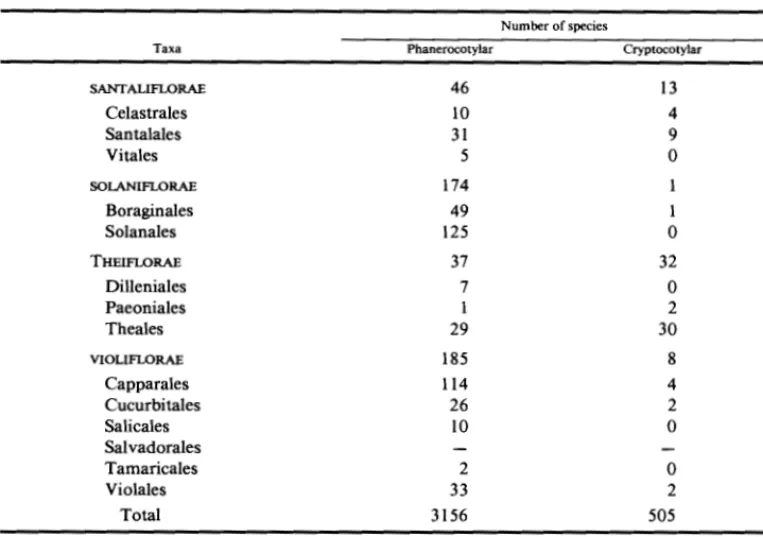
From both Table 1 and Figure 1 it is evident that cryptocotylar species are not randomly distributed throughout the taxonomic system. Whereas cryptocotylar species do not occur amongst the Asterfiorae or Caryophyllifiorae they are abun-dant throughout the Theifiorae, most orders of the Rutifiorae, and the two large orders of Magnoliifiorae. The general pattern is one of increasing frequency of cryptocotyly towards the center of the bubble diagram with only small specialized orders showing high frequencies elsewhere in the system.
The reasons for this are not clear, for although most orders exhibiting cryp-tocotyly are rich in woody species with large seeds there are notable exceptions. In particular the Paeoniales and Droserales are both largely herbaceous, and the latter have minute seeds. In Figure 1 the Paeoniales are placed in the Malvifiorae, but in his later classification Dahlgren (1983) transferred them to an emended Theifiorae from which the Droserales had been removed to Rosifiorae. Two orders of the Rosifiorae, the Fagales and Juglandales, are rich in cryptocotylar species. Knowledge of the germination patterns did not promote these transfers, which none-the-less do not alter the general pattern of cryptocotyly within the dicoty-ledons.
Given there are two basic germination patterns in the dicotyledons it is of interest to speculate on which is the more primitive. Unfortunately, the fossil record is inadequate and so evidence must be sought elsewhere.
One approach is to consider the behavior of seedlings in presumed primitive angiosperm groups such as the Magnoliifiorae, but this is of little help for both phanerocotylar and cryptocotylar species occur in the superorder. Alternatively, the seedling type in the sister-group to the Magnoliophyta could be taken as the primitive condition if the group could be identified.
Whilst there is no unanimity as to the sister-group of the angiosperms, the cycads are strongly implicated in three recent cladistic analyses of the relationships of the major groups of seed plants by Bremer (1985) and Doyle and Donoghue (1986a, b). In the most recent of these analyses (Doyle and Donoghue 1986b) the
cycads plus Peltaspermum form a sister-group to a clade comprising
Glossopter-idales, Caytonia, angiosperms, Bennetitales, Pentoxylales, Ephedra, Gnetum, and Welwitschia. Of those taxa in the later clade whose seedlings are known, all except
the angiosperms are exclusively phanerocotylar. Inasmuch as the angiosperms in this analysis are the sister-group to a subclade containing Ephedra, Gentum, and Welwitschia phanerocotyly may be regarded as derived in the angiosperms.
Fur-ther support for this view is afforded by the universal occurrence of cryptocotyly amongst the cycads and the sister-group to the major clade that includes the angiosperms. That phanerocotyly is derived in the angiosperms has also been proposed by Grushvitskyi (1963), de Vogel (1980), and Clifford (1984).
210 ALISO
Table l. The frequencies of species with phanerocotylar and cryptocotylar germination grouped in the orders and superorders of Dahlgren (1983) (n.a. =not applicable;-= no records available).
Number of species
Taxa Phanerocotylar Cryptocotylar
ARALIIFLORAE 107 0
Araliales 95 0
Pittosporales 12 0
ASTERIFLORAE 178 0
Asterales 156 0
Campanulales 22 0
BALANOPHORIFLORAE n.a. n.a.
Balanophorales n.a. n.a.
CARYOPHYLLIFLORAE 168 0
Caryophyllales 168 0
CORNIFLORAE 233 2
Cornales 45 2
Dipsacales 1 0
Ericales 181 0
Eucommiales 1 0
Fouquieriales 4 0
Sarraceniales 0
FABIFLORAE 427 109
Fa bales 427 109
GENTIANIFLORAE 117 7
Gentianales 102 6
Goodeniales 3 0
Oleales 12
LAMIIFLORAE 262 10
Hippuridales 0
Hydrostachyales 0
Lamiales 107 6
Scrophulariales 153 4
LOASIFLORAE 5 0
Loasales 5 0
MAGNOLIIFLORAE 36 39
Annonales 22 16
Aristolochiales 4 1
Chloranthales
Illiciales 0
Lactoridales
Laurales 3 21
Magnoliales 6 0
Nelumbonales 0
Raffiesiales
MAL VIFLORAE 276 61
Elaeagnales 3 0
Euphorbiales 103 5
Mal vales 108 40
Rhamnales 13 2
Thymeleales 5 3
ALISO VOLUME 13, NUMBER 1 211
ination grouped Table 1. Continued.
rds available).
Number of species
Taxa Phanerocotylar Cryptocotylar
tocotylar
MYRTIFLORAE 241 37
0 Chrysobalanales
0 Haloragales 2 0
0 Myrtales 236 27
0 Rhizophorales 3 10
0 NYMPHAEIFLORAE 5 4
0 Nymphaeales 4
Piperales 4 0
n.a.
n.a. PLUMBAGINIFLORAE 5 0
0 Plumbaginales 5 0
0 PODOSTEMIFLORAE 2 0
2 Podostemales 2 0
2 POLYGONIFLORAE 36
0 Polygonales 36 I
0
74
0 PRIMULIFLORAE 8
0 Ebenales 49 5
0 Primulales 30
109 PROTEIFLORAE 95 5
109 Proteales 95 5
7 RANUNCULIFLORAE 80 6
6 Papaverales 24 2
0 Ranunculales 56 4
ROSIFLORAE IJ7 50
10 Balanophales
0 Buxales 1 0
0 Casuarinales 8 0
6 Cercidiphyllales 2 0
4 Cunoniales 7
Droserales 9 11
0 Fagales 18 10
0 Geissolomomatales
39 Gunnerales 2 0
16 Hamamelidales 5 0
Juglandales 4 8
Myricales 2 0
0 Rosales 90 20
Saxifragales 26 0
21 Trochondendrales 0
0 RUTIFLORAE 190 114
Balsaminales 3 0
Geraniales 44 0
61 Polygalales 8 4
0 Rutales 79 46
5 Sapindales 55 61
40 Tropaeolales 1 3
212 ALISO
Table 1. Continued.
Number of species
Taxa Phanerocotylar Cryptocotylar
SANT ALIFLORAE 46 13
Celastrales 10 4
Santalales 31 9
Vi tales 5 0
SOLANIFLORAE 174
Boraginales 49 1
Solanales 125 0
THEIFLORAE 37 32
Dilleniales 7 0
Paeoniales 1 2
Theales 29 30
VIOLIFLORAE 185 8
Capparales 114 4
Cucurbitales 26 2
Salicales 10 0
Salvadorales
Tamaricales 2 0
Violales 33 2
Total 3156 505
On the basis of comparative morphology, Grushvitskyi (1963) proposed that seedlings with fleshy enclosed cotyledons be regarded as primitive. Amongst the examples he cited were seedlings that resembled those of Horsfieldia from which de Vogel (1980) was able to derive all others within the dicotyledons, thereby making the cryptocotylar condition primitive. In addition, he noted that seedlings of Horsfie/dia resembled those of cycads. Furthermore, Horsfie/dia belongs to the Magnoliiflorae, which is rich in primitive species and which Clifford (1984) showed to be rich in cryptocotyly.
Accordingly, the widely held opinion that cryptocotyly is advanced in the di-cotyledons (Eames 1961) should be treated with caution.
ACKNOWLEDGMENTS
The assistance of Albert Steginga in compiling the basic data reported upon and the comments of Dr. E. de Vogel on an early draft of the manuscript are gratefully acknowledged.
LITERATURE CITED
Bremer, K. 1985. Summary of green plant phylogeny and classification. Cladistics 1:369-385. Clifford, H. T. 1984. Cryptocotyly in Australian dicotyledons. Fl. Males. Bull. 37:49-53.
Cronquist, A. 1981. An integrated system of classification of flowering plants. Columbia Univ. Press, New York. 1262 p.
Dahlgren, R. T. M. 1980. A revised system of classification ofthe angiosperms. J. Linn. Soc., Bot. 80:91-124.
- - . 1983. General aspects of angiosperm evolution and macrosystematics. Nord. J. Bot. 3:119-149.
VO
de
Do
DIL
EaJ
Fra
ALISO
IOOtylar
'l3 4 :9 10
I 0
32 0
I 2
30
8 4 2 0
1
-0
I 2
ro5
that the
1:369-385.
Soc., Bot.
J. Bot.
3:119-VOLUME 13, NUMBER I 213
de Vogel, E. F. 1980. Morphological types in dicot seedlings, with reference to their origin. Bull. Soc. Bot. France, 126 Actual. Bot., no. 3:17 3-182.
Doyle, J. A., and M. J. Donoghue. 1986a. Relationships of angiosperms and Gnetales: a numerical cladistic analysis, pp. 177-198. In B. A. Thomas and R. A. Spicer [eds.], Systematic and taxonomic approaches in paleobotany. Syst. Assoc. Spec. Vol. 31. Oxford Univ. Press, Oxford. - - - , and - - - . 1986b. Seed plant phylogeny and the origin of angiosperms: an experimental
cladistic approach. Bot. Rev. 52:321-431.
Duke, J. A. 1965. Keys for the identification of seedlings of some prominent woody species in forest types of Puerto Rico. Ann. Missouri Bot. Gard. 52:315-350.
Eames, A. J. 1961. Morphology of the angiosperms. McGraw-Hill, New York. 518 p.
Fraser, L. 1931. An investigation of Lobelia gibbosa and Lobelia dentata I. Mycorrhiza, latex system and general biology. Proc. Linn. Soc. New South Wales 56:497-525.
Grushvitskyi, I. V. 1963. Subterranean germination and the function of the cotyledons. Bot. Zurn. (Moscow & Leningrad) 48:906-915 (in Russian).
Milller, F. 1887. Keimung der Bicuiba. Ber. Deutsch. Bot. Ges. 5:468-472.
FOOTNOTE