urn:nbn:de:hebis:34-2015011347180 ISSN: 2363-6033 (online); 1612-9830 (print) – website: www.jarts.info
E
ff
ects of Tithonia diversifolia, farmyard manure and urea,
and phosphate fertiliser application methods on maize yields
in western Kenya
Peter Asbon Opala
a,∗, Peter Oloo Kisinyo
b, Robert Orangi Nyambati
caDepartment of Soil Science, Maseno University, Kenya bRongo University College, Rongo, Kenya
cKenya Forestry Research Institute, Maseno Regional Centre, Kisumu, Kenya
Abstract
Maize production in western Kenya is often limited by deficiencies of nitrogen and phosphorus. We assessed the effectiveness of Tithonia diversifolia green manure (tithonia), farmyard manure (FYM) and urea as sources of nitrogen (N) for maize when inorganic phosphorus (P) fertiliser was either broadcast (BR) or spot-placed in the planting hole (SP) for two consecutive seasons; October to December of 1998 and April to August of 1999 at two sites; Nyabeda and Khwisero in western Kenya. A randomised complete block design with four replications was used. Maize yields were higher at Nyabeda and responded to P application better than at Khwisero. At the same N rate, tithonia and FYM were as effective as urea in increasing maize yields at both sites. There were no significant differences in maize yields when phosphate fertiliser was either BR or SP regardless of the N source used in the first season. However, in the second season, the residual yields for the BR treatments were consistently higher than those of the SP. Our results suggest that tithonia and FYM can substitute for urea as N sources and that fertiliser P should be broadcast and incorporated together with the organic materials at the time of planting to save on labour costs.
Keywords: integrated soil fertility management, organic materials, phosphorus availability, on-farm research
1
Introduction
Western Kenya is one of the most densely populated areas in Africa where population densities of over 1000 persons per square kilometer are not unusual (Jama
et al., 2008). Agriculture in the western Kenya
dis-tricts of Kakamega and Siaya is dominated by subsis-tence farming with maize as the preferred staple and main crop. Simultaneous deficiencies of nitrogen (N) and phosphorus (P) are widespread in the region but farming is characterised by low nutrient inputs (Woomer
∗Corresponding author
Department of Soil Science, Maseno University, P.O. Box, Private Bag Maseno, Kenya Email: [email protected]
et al., 1997). Therefore, although most parts of western
Kenya receive favorable rainfall, crop productivity is se-riously constrained, with yields of maize rarely exceed-ing 1 ton ha−1 on smallholder farms against a potential of 6 ton ha−1 if the soils were well managed by replen-ishing the essential nutrients (Ojiem et al., 2004). Con-sequently, food insecurity and poverty are rampant in the region. An essential ingredient for increasing crop yields in this region, therefore, is to concurrently in-crease the supply of plant-available soil phosphorus and nitrogen. This can be done by addition of organic nu-trient inputs or inorganic fertiliser. Many smallholder farmers however cannot afford to use fertiliser because they are costly while the organic materials (OMs) avail-able on smallholder farms such as farmyard manure
(FYM) are limited and are often of poor quality (Rufino
et al., 2006). A paradigm shift towards the integrated
soil fertility management strategy (ISFM), where or-ganic and inoror-ganic nutrient sources are used in com-bination, has therefore been proposed on smallholder farms in western Kenya (Vanlauwe, 2004). In addition, to increase the range of OMs that smallholder farmers can use, some non-traditional sources of nutrients such as agroforestry shrubs have previously been tested in the area with Tithonia diversifolia (Hemsley) A. Gray as green manure (tithonia) showing great promise. Re-search in the 1990s in western Kenya generated aware-ness of tithonia biomass as a source of nutrients for crops (Gachengo et al., 1999).
It is now known that tithonia has a high N content but is too low in P to meet the crop P demand (Palm
et al., 2001). A proposed strategy therefore is to supply
all the N needs of the crops using cheap locally avail-able OMs such as tithonia and supplement them with inorganic P fertilisers. Soluble P fertilisers are, how-ever, amenable to P-fixation when applied to P-fixing soils which reduce their availability to plants and hence their effectiveness in increasing crop yields. The method of P application can significantly influence availability of the added P fertiliser. Previous attempts at obtain-ing the optimal method of P fertiliser application have usually compared localized application methods such as banding or spot-placement (SP) at planting with broad-cast applied fertiliser and incorporated by surface tillage (BR). Although BR is less laborious compared to SP, it enhances P-fixation by bringing the fertiliser in close contact with soil (Sánchez & Salinas, 1981). Therefore SP which minimizes contact between fertiliser and soil has been recommended for smallholder farmers in west-ern Kenya.
In integrated soil fertility management, OMs such as tithonia are usually broadcast and incorporated at planting time. Such OMs can reduce P-fixation and in-crease P availability (Nziguheba et al., 1998, 2000). We therefore hypothesized that in such cases, BR and SP will be equally effective in increasing crop yields. To save on labour, which has been cited as the main factor hindering adoption of ISFM technologies (Sanginga & Woomer, 2009), P fertiliser could therefore be broadcast and incorporated together with the OMs instead of spot applying it after incorporating the OMs as is the prac-tice by most farmers. The objective of this study was therefore to assess the effectiveness of tithonia, FYM and urea as sources of N for maize when inorganic P fertiliser is either BR or SP on two P deficient soils in western Kenya.
2
Materials and methods
2.1 Site description
The study was conducted on two farmers’ fields at Khwisero in Kakamega district and Nyabeda in Siaya district in the highlands of western Kenya for two con-secutive seasons; October to December of 1998 and April to August of 1999. The sites were chosen based on contrasting soil characteristics (Table 1) with Nyabeda having a higher P sorption capacity than Khwisero but lower exchangeable acidity and available P. Khwisero is at an altitude of 1400 m above sea level, 0°30’N lat-itude and 34°30’E longlat-itude while Nyabeda is situated at 1330 m above sea level, 0°08’N latitude and 34°22’E longitude. The average annual rainfall at both sites is 1800 mm with a reliability of 60 % which accommo-dates two growing seasons per year, the long rainy sea-son from March to August and short rainy seasea-son from September to December (Jaetzold & Schmidt, 1982).
2.2 Experimental layout and management
A randomised complete block design with four repli-cations and 13 treatments (Table 2) was used.
FYM was obtained from a small-scale farmer within the study area while tithonia was collected from the hedges bordering the experimental sites. A sub sam-ple of each of the OMs was then oven-dried at 70°C and ground to pass through a 0.5 mm sieve. The total N, P and K was determined by the methods described by An-derson & Ingram (1993).
Tithonia had the following characteristics on average: 3.3 % N, 0.31 % P and 5.0 % K. It was therefore ap-plied at a rate of 1.82 t dry matter ha−1 to provide 60 kg N ha−1. The FYM contained 1 % N, 1.2 % K and 0.23 % P and was therefore applied at a rate of 6.0 t dry matter ha−1so as to provide 60 kg N ha−1.
The treatments were selected to allow the following comparisons:
(1) Treatments 3 and 4, 5 and 6, 10 and 11 compared the effects of P fertiliser application method when tithonia (3 and 4), urea (5 and 6) or FYM (10 and 11) were used as sources of N at equal N (60 kg ha−1) and P (20 kg P ha−1) levels.
(3) Treatment 2 was compared with treatment 7 or 8 to determine the agronomic effectiveness of titho-nia alone when compared to inorganic fertilisers at the same N and P (6 kg ha−1) levels. A similar com-parison for FYM was provided by treatments 9 vs 12 or 13 (60 kg N ha−1and 14 kg P ha−1).
Plot sizes of 5 m×3 m were used. Nutrient inputs were applied in the first season only. In the SP, triple su-perphosphate (TSP) was put in the planting holes and mixed with the soil while in the BR method, TSP was broadcast evenly within each experimental plot, fol-lowed by mixing with top soil (0–15 cm depth) using
Table 1: Some initial properties of top soil (0–15 cm) at Nyabeda and Khwisero
Soil property Nyabeda Khwisero
pH (H2O) (1:2.5) 5.4 5.2
Exchangeable acidity (cmolckg−1) 0.3 1.0
Ca (cmolckg−1) 4.7 3.5
K (cmolckg−1) 0.1 0.1
Mg (cmolckg−1) 1.9 1.3
bicarbonate extractable P (mg kg−1) 0.9 1.2
P sorbed at 0.2 mg L−1 355 328
Organic C (g kg−1soil) 1.59 1.75
Clay (%) 54.8 34.5
Silt (%) 19.7 20.2
Sand (%) 25.5 45.3
Textural class clay clay loam
Soil classification Ferralsol Ferralsol
Table 2: Experimental treatments and nitrogen and phosphorus rates applied from tithonia, FYM and inorganic fertilisers
Treatment
N and P rates (kg ha−1)
From organics From inorganics
Total P added Total N
N P N P
1. Control 0 0 0 0 0 0
2. Tithonia 60 6 0 0 6 60
3. Tithonia+TSP BR 60 6 0 14 20 60
4. Tithonia+TSP SP 60 6 0 14 20 60
5. Urea+TSP BR 0 0 60 20 20 60
6. Urea+TSP SP 0 0 60 20 20 60
7. Urea+TSP BR 0 0 60 6 6 60
8. Urea+TSP SP 0 0 60 6 6 60
9. FYM 60 14 0 0 14 60
10. FYM+TSP BR 60 14 0 6 20 60
11. FYM+TSP SP 60 14 0 6 20 60
12. Urea+TSP BR 0 0 60 14 14 60
13. Urea+TSP SP 0 0 60 14 14 60
a hoe. The OMs (tithonia and FYM) were evenly spread within the appropriate experimental plots and incorpo-rated to a depth of 15 cm. The same was done with urea except that it was applied at only one third of the full rate. The rest was applied in the fifth week after plant-ing by bandplant-ing the urea fertiliser at about 5 cm from the maize rows. Potassic fertiliser in the form of muri-ate of potash was uniformly broadcasted and incorpo-rated at an equivalent rate of 100 kg K ha−1to all plots at the time of planting. Maize was planted at a spac-ing of 75 cm by 25 cm to achieve a density of 53,000 plants ha−1. The crop was managed using the appropri-ate agronomic practices for the area.
Soils were sampled, in the first season only, from treatments 1, 2, 3, 5, 7, 9, 10 and 12 (Table 2) at the 3, 9 and 16 weeks after planting (WAP). Each sample was a composite of soil collected from nine locations per plot. Sampling for the treatments where fertiliser P was ap-plied using SP was not done to avoid possible damage to the maize roots. The soils were air-dried, ground to pass through a 2 mm screen and analyzed for available P using the Olsen method as described by (Okalebo et al., 2002).
Plant heights were measured at 4 and 8 WAP (first season only) as a non-destructive measure of early plant growth by measuring the distance from the ground to the longest leaf of the plant when held vertically. This was done for 6 plants randomly selected in each row and for only the central 3 rows per plot. Maize was harvested at maturity where the grain and stover yields were deter-mined. All data were subjected to Analysis of variance (ANOVA) using the Genstat statistical package (Gen-stat, 2005). The standard error of difference of means (s.e.d) was used to compare treatment means at p<0.05.
3
Results
3.1 The effect of organic and inorganic sources of nu-trients on available soil P
The effect of organic and inorganic sources of nutri-ents on available soil P The results of available soil P are presented in Table 3. In general, the available P in soils increased with increasing P application rates. When applied at the same P rate of 20 kg ha−1 using the BR method, Urea+TSP yielded significantly higher amounts of extractable soil P than FYM+TSP, but not tithonia+TSP, at 3 WAP at both sites. The differences, in available soil P as influenced by the N sources at same P rate were however not significant at 9 and 16 WAP at both sites. Tithonia when applied alone yielded available soil P that was not different from the con-trol with no P input at both sites at all sampling times. Similar results were obtained with FYM applied alone at Nyabeda. However, at Khwisero FYM alone gave significantly higher amounts of extractable soil P than the control at 9 WAP. There was a general decline in the available P in the soil between 3 and 16 WAP at Nyabeda with the largest decline (39 %) being recorded when P was applied at a rate of 20 kg ha−1using the BR method with urea as the N source. There was however no discernable pattern at Khwisero.
3.2 Maize growth
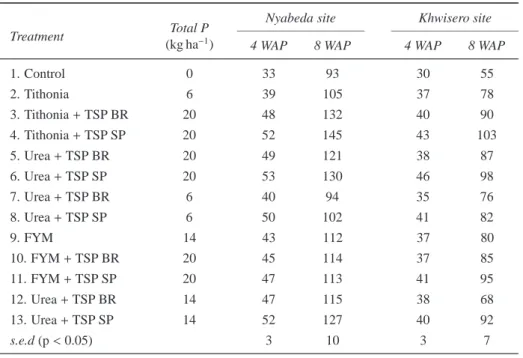
Maize plant heights in the first season at Khwisero were generally shorter than those at Nyabeda (Table 4) at both 4 and 8 WAP. The greatest increase in height (60 % at Nyabeda and 53 % at Khwisero) when com-pared to the control was obtained with urea+TSP SP. At 8 WAP the control treatment again had the shortest
Table 3: Effect of organic and inorganic sources of nutrients on available soil P (mg kg-1) at 3, 9 and 16 weeks after planting of the first season crop.
Treatment Total P added
(kg ha−1)
3 WAP 9 WAP 16 WAP
Nyabeda Khwisero Nyabeda Khwisero Nyabeda Khwisero
Control 0 3.25 5.97 3.18 5.80 2.72 5.53
Tithonia 6 3.53 6.00 3.46 8.55 3.06 7.71
Urea+TSP BR 6 3.60 6.17 3.63 9.21 3.64 8.22
Tithonia+TSP BR 20 6.15 11.35 6.21 11.70 5.41 10.26
Urea+TSP BR 20 7.03 13.41 7.25 12.21 4.32 11.34
FYM+TSP BR 20 5.18 10.42 5.23 11.35 4.21 10.10
FYM 14 4.17 7.32 4.22 9.45 3.08 8.25
Urea+TSP BR 14 5.43 8.45 5.40 10. 90 3.34 8.65
s.e.d. (p<0.05) 0.60 1.45 0.58 1.50 0.50 1.42
Table 4: The effect of nitrogen sources and phosphorus application methods on maize plant heights (cm) at 4 and 8 weeks after planting of the first season crop.
Treatment Total P
(kg ha−1)
Nyabeda site Khwisero site
4 WAP 8 WAP 4 WAP 8 WAP
1. Control 0 33 93 30 55
2. Tithonia 6 39 105 37 78
3. Tithonia+TSP BR 20 48 132 40 90
4. Tithonia+TSP SP 20 52 145 43 103
5. Urea+TSP BR 20 49 121 38 87
6. Urea+TSP SP 20 53 130 46 98
7. Urea+TSP BR 6 40 94 35 76
8. Urea+TSP SP 6 50 102 41 82
9. FYM 14 43 112 37 80
10. FYM+TSP BR 20 45 114 37 85
11. FYM+TSP SP 20 47 113 41 95
12. Urea+TSP BR 14 47 115 38 68
13. Urea+TSP SP 14 52 127 40 92
s.e.d (p<0.05) 3 10 3 7
WAP: Weeks after planting; s.e.d: The standard error of difference of means; BR: broadcast; SP: spot-placed; TSP: Triple superphosphate
Table 5: The effect of N sources and P fertiliser application methods on maize grain and stover yields (t ha−1) at Nyabeda and Khwisero in western Kenya.
Treatment Total P added
(kg ha−1)
Nyabeda Khwisero
Grain yield Stover Grain yield Stover
Season
1 2 1 2 1 2 1 2
1. Control 0 0.8 1.5 2.5 4.1 0.1 1.1 0.3 2.4
2. Tithonia 6 0.8 1.6 3.4 4.9 0.1 1.5 1.2 3.4
3. Tithonia+TSP BR 20 1.8 2.4 5.4 5.9 0.9 1.7 4.1 3.6
4. Tithonia+TSP SP 20 1.8 2.2 6.1 5.6 0.6 1.8 3.3 3.5
5. Urea+TSP BR 20 1.8 2.7 4.9 6.6 0.6 1.8 2.8 3.7
6. Urea+TSP SP 20 1.0 1.9 3.6 4.7 0.3 1.6 2.6 3.5
7. Urea+TSP BR 6 0.6 1.4 3.0 4.0 0.2 1.4 1.8 2.7
8. Urea+TSP SP 6 0.5 1.3 2.7 3.9 0.2 1.5 1.9 2.8
9. FYM 14 1.3 1.9 4.1 4.5 0.4 2.0 2.0 3.5
10. FYM+TSP BR 20 1.5 2.8 4.1 6.2 0.6 2.4 2.3 4.3
11. FYM+TSP SP 20 1.4 2.0 4.0 5.1 0.9 2.4 3.8 4.8
12. Urea+TSP BR 14 1.4 2.2 4.2 5.4 0.2 1.7 1.2 2.3
13. Urea+TSP SP 14 1.2 1.9 4.4 4.9 0.3 1.5 2.1 3.4
s.e.d. (P<0.05) 0.40 0.36 1.0 0.64 0.21 0.35 0.49 0.86
C.V. (%) 35 25 32 19 32 29 30 33
maize plants at both sites. Tithonia+TSP SP had the tallest plants at 8 WAP with a mean increase in height over the control of 87 % and 56 % at Khwisero and Nyabeda respectively. No significant differences were observed in maize heights at 4 WAP between the two P application methods regardless of whether tithonia, urea, or FYM was used as the N source at the P rate of 20 kg ha−1. Nevertheless, the SP treatments tended to have taller plants than the BR treatments. There were also no significant differences in maize heights among the three N sources (at the same P rate and P placement method) at Khwisero at both 4 and 8 WAP. This was un-like the Nyabeda site where FYM was inferior to urea and tithonia when P was spot-placed at 4 WAP. How-ever, when P was BR at this site, the three N sources had similar effects on maize heights at 4 WAP. At 8 WAP, maize plants were generally taller in the tithonia treat-ments when compared to FYM or urea at equivalent P rates and P application methods at both sites with most of the SP treatments maintaining a slight but statistically insignificant advantage over BR.
3.3 Maize yields
The maize grain yields were lower in Khwisero than Nyabeda in both seasons while the yields of the sec-ond season were higher than those of the first season at both sites (Table 5). In the first season, maize grain yields ranged from 0.5 to 1.8 t ha−1at Nyabeda and 0.1 to 0.9 t ha−1at Khwisero. In the second season, the grain yields ranged from 1.1 to 2.4 t ha−1at Khwisero and 1.3 to 2.8 t ha−1at Nyabeda. Application of Urea combined with 6 kg P ha−1 gave lower grain yields than the con-trol at Nyabeda in both seasons but this was more pro-nounced in the first season where it lowered yields by 25 % when P was BR and by 38 % when SP. No sig-nificant differences in grain yield among the three N sources, at same P rate of 20 kg ha−1, was observed in the first season at both sites irrespective of the P appli-cation method (Table 5). Notwithstanding the lack of statistically significant differences, the treatments with tithonia as N source at Nyabeda generally had higher grain yields than urea and FYM at the same P rate. For instance, averaged over the two P placement methods at a P application rate of 20 kg ha−1, maize grain yield with tithonia exceeded that of both urea and FYM by 29 %. At Khwisero, however, mean maize grain yield with tithonia and FYM as N sources were similar but higher than those of urea by 50 %. At the P rate of 20 kg ha−1 applied using the broadcast method, the titho-nia treatments gave significantly higher stover yields at Khwisero than FYM and urea in the first season (Table 5). No significant differences in stover yield were,
how-ever, observed among the N sources at Nyabeda in the first season.
In the second season, no significant differences were noticed at Nyabeda in both the grain and the stover yields irrespective of whether urea, tithonia or FYM was used as the N sources at the same P rate and placement method. At Khwisero, however, FYM gave significantly higher grain yields than tithonia when P was BR at a rate of 20 kg ha−1. The total grain yield for the two seasons (averaged over the two P placement methods for each of the N sources at the P rate of 20 kg ha−1) at Nyabeda fol-lowed the trend: tithonia>FYM>urea while at Khwis-ero the trend was FYM>tithonia>urea. The grain and total stover yield of the treatments where P was BR were in most cases higher than those of the SP treatments at the same P rate and N source at both sites in the second season although statistical significance was not always attained.
4
Discussions
Our results suggest that the P from the OMs was uti-lized as effectively as that from TSP by the maize crop. This implies that the OMs were able to supply P in sim-ilar amounts as TSP. This is supported by the available P data that showed that at equal P rates, available soil P in soils treated with OMs alone was similar to that of inorganic fertilisers applied without OMs. These find-ings confirm observations that OMs such as tithonia and FYM can provide plant-available P at least as effectively as an equivalent amount of P from soluble fertiliser and can therefore replace P fertilisers on smallholder farms (Buresh & Niang, 1997; Kwabiah et al., 2003). The gen-eral increase in grain and stover yields at both sites with increasing P rate confirms the fact that P was strongly limiting in these soils. The initial P content of both soils was below the 10 mg kg−1 recommended for optimum maize growth in the tropics (Okalebo et al., 2002). The lack of correlation between extractable P at the ninth week with maize yields at Khwisero (r2=0.29) and a high positive correlation at Nyabeda (r2=0.86) suggests that maize yield at Khwisero was likely limited by some other nutrient deficiencies besides P or chemical con-straint such as Al toxicity which was not a problem at Nyabeda.
The pattern of growth exhibited in this study whereby the SP treatments had a slightly better early maize growth in the first season than the BR treatments is con-sistent with observations of Warren (1992) and Okalebo
et al. (1990). They reported that SP or banding of
to BR but the advantage diminished with time as plant growth continued. This resulted in yields that were not significantly different between the two P fertiliser appli-cation methods. Casanova (1982) attributed the better early growth in SP to the fact that the fertiliser P was put in close proximity to the seeds. Therefore, as the roots of seedlings emerged, they were able to come into contact with relatively high concentrations of P in soil solution. This is not the case with the BR treatments where the fertiliser is mixed with a large volume of soil, resulting in a much lower concentration of P and hence a lower absorption per unit root surface during this early plant phase. In soils with high P fixing capacity and very low levels of P, however, subsequent root develop-ment may be limited to regions where P was spot-placed (Yost et al., 1979; Sánchez & Uehara, 1980). The plants may, therefore, not spread their roots far from the sites of P fertilization. But plants in the treatments where P was broadcast-applied may not have the problem of root localization because the P fertiliser is evenly distributed within the soil. Therefore, the plants where P was ap-plied using the broadcast method, caught up with those where P was spot-applied later in the growing season as their roots spread further and utilized the broadcast P in a better manner.
The OMs (tithonia and FYM) gave maize yields that were similar to and in some cases higher than urea at the same P application rate in the first season implying that they can be as effective as, or even better than urea in providing N to the maize crop. However, the choice of which of the three N sources i.e. Tithonia, FYM and urea, to use, should be based on economic considera-tions and not just the maize yield. The net financial ben-efits accruing from the use of tithonia were found to be similar to those of urea at the same study sites (Jama & Kiwia, 2009). However, the labour costs associated with the use of tithonia are very high and this, together with the extra land for plantation of the shrubs, may act as a disincentive for adoption of tithonia as a green manure by farmers in western Kenya (Opala et al., 2010).
Although OMs have to mineralize to release their nu-trients, which may lead to poor response in the season of application, tithonia is classified as a high quality OM (Jama et al., 2000) hence it decomposes very fast and is able to release N at rates that match the crop demand. FYM on the other hand was well decomposed and is likely to have had some of the N already in the plant available mineral form at the time of application which was able to support maize growth in the first season. Or-ganic materials may also increase the efficiency of inor-ganic fertilisers by providing micronutrients not present in inorganic fertilisers or by alleviating other constraints
to crop production such as Al toxicity through their lim-ing effect (Palm et al., 1997). In addition, OMs such as tithonia have been found to reduce P-fixation there-fore increasing P availability in soils (Nziguheba et al., 1998, 2000). This could partially explain the apparent superiority, on average, of the OMs as N sources when compared to urea. The better performance of FYM as an N source in the second season compared to urea and tithonia may be attributed to the good residual effect usually associated with FYM (Ikombo, 1984). Yield re-sponses to FYM have been observed in crops for several years after application when manure is supplied in suf-ficiently large amounts (Murgwira & Murwira, 1997). It has also been suggested that much of the N released from organic inputs that is not utilized by the crops is incorporated into active pools of soil organic matter and saved as N capital that can be utilized by subsequent crops (Sánchez et al., 1997). This may in part explain the stronger residual responses observed for the FYM treatments. On the other hand, most of the fertiliser N not used by the crop is subject to leaching, denitrifica-tion and other losses and hence residual responses due to such N fertiliser are not usually expected. The resid-ual benefits observed in the urea treatments are therefore likely to be due to residual P and not N. Such residual benefits due to phosphorus have been reported in other studies in western Kenya (Kifuko et al., 2007; Kamiri
et al., 2011; Kisinyo et al., 2014, e.g.).
The lower maize grain yields obtained when urea was applied together with 6 kg P ha−1, compared to the con-trol treatment with no fertiliser application at Nyabeda, is likely due to the acidifying nature of urea. When urea is applied to soil, it is converted to ammonium and then undergoes nitrification which is an acidifying process. Hence in soils with a high P-fixing capacity such as those at Nyabeda, available P will be fixed as Fe and Al phosphate thus exacerbating the problem of P defi-ciency unless enough P fertiliser is applied along with Urea. At Khwisero, where the soil had a lower P fixa-tion capacity, this problem was not observed. The higher maize yields obtained in the second season compared to the first season are attributed mainly to the higher and well distributed rainfall in the second season compared to the first season. For instance, at Khwisero, the to-tal amount of rainfall in the second season was 950 mm which was recorded in 59 days compared to the first sea-son where 395 mm was obtained in 43 days. A similar trend was observed at Nyabeda where 600 mm of rain was recorded in the second season in 53 days while in the first season only 350 mm was recorded in 39 days.
be attributed to the poor distribution of the SP fertiliser over the land after tillage. It is also likely that the plant-ing holes in the second season did not coincide with lo-cations where P was SP in the first season. Some maize plants in the SP treatments may, therefore, have grown in spots where there was very little or no residual P in the second season. This situation is less likely to have occurred in the BR treatments where fertiliser P was uni-formly BR in the soil in the first season and the unifor-mity is likely to have persisted into the second season. Most of the plants growing in the BR treatments were, therefore, more likely to encounter the residual P than those in the SP treatments. Therefore, there may be lit-tle or no merit in spot-placing P fertilisers in western Kenya, especially when integrated with organic materi-als such as tithonia or FYM as N sources for crops. The findings of this study suggest that fertiliser P should be BR together with the OMs at planting time to save on time and labour, instead of broadcasting and incorporat-ing the OMs only and then later applyincorporat-ing fertiliser P in the planting hole as is currently the practice in the study area.
We can conclude that both tithonia and FYM have po-tential to replace urea as N sources for maize in western Kenya. However, the choice of which of the N sources to be used should be based on economic considerations. There is need therefore to conduct rigorous economic analyses in future studies at different sites in western Kenya in order to derive site specific recommendations that can easily be adopted by farmers.
Acknowledgements
We thank the field technicians at the Maseno Kenya Forestry Research Institute (KEFRI) station for manag-ing the field experiments and technicians at the KEFRI Maseno laboratories for assisting in the analysis of the soil and plant samples.
References
Anderson, J. M. & Ingram, J. S. I. (1993). Tropical soil
Biology and Fertility: A handbook of methods. CAB
International, Wallingford, UK.
Buresh, R. & Niang, A. (1997). Tithonia diversifolia as a green manure: Awareness, expectations and reali-ties. Agroforestry forum, 8, 29–31.
Casanova, E. (1982). Nutrient uptake and corn yields as influenced by fertiliser placement in Venezuela. In A. Scaife (Ed.), Plant nutrition 1982. Proceedings of
the 9thInternational Plant Nutrition Colloquium.
Vol-ume I (pp. 89–94). Commonwealth Agricultural
Bu-reaux, Slough, U.K.
Gachengo, C. N., Palm, C. A., Jama, B. & Othieno, C. (1999). Tithonia and senna green manures and inor-ganic fertilisers as phosphorus sources for maize in western Kenya. Agroforestry systems, 44, 21–36.
Genstat (2005). Genstat Release 8.1 for windows.
Lawes Agricultural Trust, Rothamstead Experimental Station, UK.
Ikombo, B. M. (1984). Effects of farmyard manure and fertilizers on maize in semi-arid areas of East-ern Kenya. East African Agricultural and Forestry
Journal, 44, 266–274.
Jaetzold, R. & Schmidt, H. (1982). Farm manage-ment handbook of Kenya Vol. 2. Natural conditions and Farm management information. Part A: Western Kenya. Ministry of Agriculture, Nairobi, Kenya.
Jama, B. & Kiwia, A. (2009). Agronomic and financial benefits of phosphorus and nitrogen sources in west-ern Kenya. Experimental Agriculture, 45, 241–260.
Jama, B., Palm, C. A., Buresh, R. J., Niang, A. I., Gachengo, C., Nziguheba, G. & Amadalo, B. (2000).
Tithonia diversifolia as a green manure for soil
fer-tility improvement in western Kenya. Agroforestry
Systems, 49, 201–221.
Jama, B. A., Mutegi, J. K. & Njui, A. N. (2008). Po-tential of improved fallows to increase household and regional fuelwood supply: evidence from western Kenya. Agroforestry Systems, 73, 155–166.
Kamiri, W. M. H., Pypers, P. & Vanlauwe, B. (2011). Residual Effects of Applied Phosphorus Fertilizer on Maize Grain Yield and Phosphorus Recovery from a Long-Term Trial in Western Kenya. In A. Bationo, B. Waswa, J. M. Okeyo, F. Maina, & J. Kihara (Eds.),
Innovations as Key to the Green Revolution in Africa
(pp. 717–727). Springer, Netherlands.
Kifuko, M. N., Othieno, C. O., Okalebo, J. R., Kimenye, L. N., Ndungu, K. W. & Kipkoech, A. K. (2007). Effect of combining organic residues with minjingu phosphate rock on sorption and availability of phos-phorus and maize production in acid soils of western Kenya. Experimental Agriculture, 43, 51–66.
Kisinyo, P. O., Othieno, C. O., Gudu, S. O., Okalebo, J. R., Opala, P. A., Ng’etich, W. K., Nyambati, R. O., Ouma, E. O., Agalo, J. J., Kebeney, S. J., Too, E. J., Kisinyo, J. A. & Opile, W. R. (2014). Immediate and residual effects of lime and phosphorus fertilizer on soil acidity and maize production in western Kenya.
Kwabiah, A. B., Stoskopf, N. C., Palm, C. A. & Voroney, R. P. (2003). Soil P availability as affected by the chemical composition of plant materials: Im-plications for P-limiting agriculture in tropical Africa.
Agriculture, Ecosysems and Environment, 100, 53–
61.
Murgwira, L. M. & Murwira, H. K. (1997). Use of
cat-tle manure to improve soil fertility in Zimbabwe: Past and current research and future research needs.
CIM-MYT, Harare, Zimbabwe.
Nziguheba, G., Merckx, R., Palm, C. A. & Rao, M. R. (2000). Organic residues affect phosphorus availbilty and maize yields in a Nitisol of western Kenya.
Biol-ogy and Fertility of Soils, 32 (4), 328–339.
Nziguheba, G., Palm, C. A., Buresh, R. J. & Smithson, P. C. (1998). Soil P fractions and adsorption as af-fected by organic and inorganic sources. Plant and
Soil, 198, 159–168.
Ojiem, J. O., Palm, C. A., Okwosa, E. A. & Mudeheri, M. A. (2004). Effect of combining organic and inor-ganic P sources on maize grain yield in a humic niti-sol in Western Kenya. In A. Bationo (Ed.), Managing
nutrient cycles to sustain soil fertility in sub-Saharan Africa (pp. 346–356). Academy Sciences Publishers,
Nairobi, Kenya.
Okalebo, J. R., Gathua, K. W. & Woomer, P. L. (2002).
Laboratory methods in soil and plant analysis: A working manual. Second edition. TSBF-CIAT and
SACRED Africa, Nairobi, Kenya.
Okalebo, J. R., Njuho, P. M. & Gathua, K. W. (1990). Effects of form and method of phosphate fertilizer application on maize, sorghum and millet growth in semi-arid environment of Kenya. East African
Agri-cultural and Forestry Journal, 55 (4), 227–238.
Opala, P. A., Othieno, C. O., Okalebo, J. R. & Kisinyo, P. O. (2010). Effects of combining organic materials with inorganic phosphorus sources on maize yields and financial benefits in western Kenya.
Experimen-tal Agriculture, 46, 23–34.
Palm, C. A., Gachengo, C. N., Delve, R., Cadisch, G. & Giller, K. E. (2001). Organic inputs for soil fertility management in tropical agroecosystems: Application of the organic resource database. Agriculture,
Ecosys-tems and Environment, 83, 27–42.
Palm, C. A., Robert, J. K. & Nandwa, S. M. (1997). Combined use of organic and inorganic nutrients sources for soil fertility maintenance and
replenish-ment. In R. J. Buresh, P. A. Sanchez, & F. Cal-houn (Eds.), Replenishing soil fertility in Africa. SSSA
Spec. Publ. 51. (pp. 193–217). SSSA, Madison, WI.
Rufino, M. C., Rowe, E. C., Delve, R. & Giller, K. (2006). Nitrogen cycling efficiencies through resource-poor African crop-livestock Systems.
Agri-culture, Ecosystems and Environment, 112, 261–282.
Sánchez, P. A. & Salinas, J. G. (1981). Low-input tech-nologies for managing Oxisols and Ultisols in Trop-ical America. (pp. 279–406). Academic Press vol-ume 34 of Advances in Agronomy.
Sánchez, P. A., Shepherd, J. D., Soule, M. J., Place, F. M., Buresh, R. J., Isaac, A. M. V., Mukwonye, A. U., Kwesiga, F. R., Ndiritu, C. G. & Woomer, P. L. (1997). Soil fertility replenishment in Africa: An in-vestment in natural resource capital. In R. J. Buresh, P. A. Sánchez, & F. Calhoun (Eds.), Replenishing soil
fertility in Africa (pp. 1–46). SSSA, Madison, WI.
Sánchez, P. A. & Uehara, G. (1980). Management con-siderations for acid soils with high phosphorus fix-ation capacity. In F. E. Khasawneh, C. R. Dinauer, E. C. Sample, & E. J. Kamprath (Eds.), The role of
phosphorus in agriculture (pp. 471–514). Amer. Soc.
Agron, Madison, Wisconsin.
Sanginga, N. & Woomer, P. L. (2009). Integrated Soil
Fertility Management in Africa: Principles, Practices and Development Process. Tropical Soil Biology and
Fertility Institute of the International Centre for Trop-ical Agriculture, Nairobi. 263 pp.
Vanlauwe, B. (2004). Integrated soil fertility manage-ment research at TSBF: The framework, the princi-ples and their application. In A. Bationo (Ed.),
Man-aging nutrient cycles to sustain soil fertility in sub-Saharan Africa (pp. 25–42). Academy Sciences
Pub-lishers, Nairobi, Kenya.
Warren, G. P. (1992). Phophorus sorption and residual value in tropical African soils. NRI bulletin No. 37. Chatham, U.K.
Woomer, P., Okalebo, J. R. & Sánchez, P. A. (1997). Phosphorus replenishment in western Kenya: From field experimentation to operational strategy. African
Crop Science Conference Proceedings, 3 (1), 559–
570.
Yost, R. S., Kamprath, E. J., Lobato, E. & Naderman, G. (1979). Phosphorus response of corn on an Oxisol as influenced by rates and placement. Soil Science