Lucrări ştiinŃifice Zootehnie şi Biotehnologii, vol. 41 (1) (2008), Timişoara
THE INFLUENCE OF XYLANASE ON THE QUALITY OF
BREAD
INFLUEN
ł
A XILANAZEI ASUPRA CALIT
Ăł
II PÂINII
CHEREJI RODICA*, CRETESCU IULIANA**, CĂPRIłĂ RODICA** * Sanitary Veterinary and Food Safety Department Bihor, Oradea, Romania
**Faculty of Animal Sciences and Biotechnologies, Timisoara, Romania
This paper determined the quality of the bread obtained form the control flour (M) and the quality of the bread obtained from the flour with an addition of 3 different concentrations of xylanase (P1-8100 U.FXU/ 100 kg flour, P2-16200 U.FXU/ 100 kg flour, P3-24300 U.FXU/ 100 kg flour). Xylanase was used in these concentrations to establish which one is more suitable to be added in flour to obtain superior quality characteristics of the bread: higher volume, fine texture of the core, prolonging the freshness of the bread, improving the color and flavor of the bread, improving the cutting proprieties of the bread.
Key words: bread, xylanase, quality parameters.
Introduction
Statistics show, that the world population is almost constantly interested in bread as a basic aliment, for covering the necessary of sugars and proteins, contained in bread and pastry products.
Aiming to diversify the pastry products, there appeared new products on the Romanian market, which, although not traditional, have imposed themselves through nutritional quality and high digestibility. Among these is the bread with a xylanase supplement.
In this paper, we determined the quality of the bread (volume, porosity, elasticity), after baking. We determined the quality of the bread obtained from the control flour (M) and the quality of the bread obtained from the flour with an addition of 3 different concentrations of xylanase (P1-8100 U.FXU/ 100 kg flour, P2-16200 U.FXU/ 100kg flour, P3-24300 U.FXU/ 100kg flour ;) [2, 3, 4].
Materials and Methods
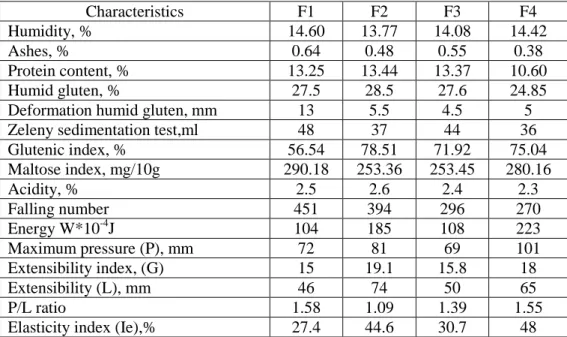
Table 1 Flour characteristics
Characteristics F1 F2 F3 F4
Humidity, % 14.60 13.77 14.08 14.42
Ashes, % 0.64 0.48 0.55 0.38
Protein content, % 13.25 13.44 13.37 10.60
Humid gluten, % 27.5 28.5 27.6 24.85
Deformation humid gluten, mm 13 5.5 4.5 5
Zeleny sedimentation test,ml 48 37 44 36
Glutenic index, % 56.54 78.51 71.92 75.04
Maltose index, mg/10g 290.18 253.36 253.45 280.16
Acidity, % 2.5 2.6 2.4 2.3
Falling number 451 394 296 270
Energy W*10-4J 104 185 108 223
Maximum pressure (P), mm 72 81 69 101
Extensibility index, (G) 15 19.1 15.8 18
Extensibility (L), mm 46 74 50 65
P/L ratio 1.58 1.09 1.39 1.55
Elasticity index (Ie),% 27.4 44.6 30.7 48
Yeast – Pakmaya (commerce), Salt – extrafine salt (commerce), Water – tap water, Enzyme: Belpan XILA L– a fungal standardized xilanase of microbial origin, obtained from immersed fermentation of Aspergillus strains. The enzyme contains pentosans, endo- and exo-xylanases, hemicellulases which favor the hydrolyze reactions of pentosans, transforming the insoluble pentosans into soluble ones, thus enhancing the elasticity module of the dough, with an enzymatic activity of 2700 FXU/g. FXU-unities of fungal xylanase.
Then we dosed the enzyme thus: for 99 g flour we added 1g enzyme, and mixed it 20 minutes. Weighing the enzyme was made on the electronic scale Sartorius. The limits of usage for each enzyme was determined through several tries, we used just the intervals which had effects, choosing just the optimum dosage.
Dosing the enzyme was necessary because the quantity of enzyme used in the determinations was very small.
We prepared 4 samples, including a control one, without the enzyme and 3 with following levels of xylanase: (P1-8100 U.FXU/ 100 kg flour, P2-16200 U.FXU/ 100kg flour, P3-24300 U.FXU/ 100kg flour;). We took turns in using F1, F2, F3 and F4 flour and the enzyme preparation Belpan XILA L .
was dissolved in 50 ml water, and the enzyme was added in different proportions, according to the flour quantity from the prescription.
Operational program: slowly mixing 12 minutes in laboratory mixer; fast mixing 4 minutes; fermentation 20 minutes; 25-30oC, another mixing 20 s; manual division - 1000 g; manual rotunding; pre-yeasting – 20 minutes (rest); shaping – in long form; final fermentation 60 minutes, 33°C in automatic yeaster, relative humidity 80%; baking 35 minutes, 250°C in cyclothermic furnace; cooling to a temperature of 20°C.
In order to estimate the bread quality we determined the following parameters: organoleptic appreciation, volume, porosity, elasticity.
Results and Discussions
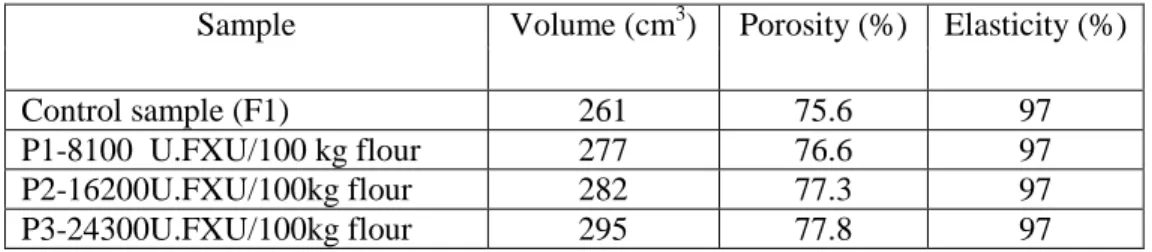
The influence of xylanase on the quality of bread prepared from flour F1 is presented in Table 2.
Table 2 The influence of xylanase on the quality of bread prepared from flour F1
The dough samples containing the enzyme didn’t present damping or stickiness, in comparison with the control sample, using one xylanase preparation, without alpha amylasic activity. Also, the dough containing xylanase, had a better tolerance to fermentation and the time of fermentation could be shortened in comparison to the control sample [1].
The influence of xylanase on the quality of the bread prepared from flour F2 is presented in Table 3.
Table 3 The influence of xylanase on the quality of the bread prepared from flour
F2
Sample Volume (cm3) Porosity (%) Elasticity (%)
Control sample (F1) 261 75.6 97
P1-8100 U.FXU/100 kg flour 277 76.6 97
P2-16200U.FXU/100kg flour 282 77.3 97
P3-24300U.FXU/100kg flour 295 77.8 97
Sample Volume (cm3) Porosity (%) Elasticity (%)
Control sample Flour F2 (F2) 235 71.7 96
P1-8100 U.FXU/100 kg flour 267 75.6 98
We can observe, that the samples which contain enzymes have a bigger volume than the control one, but when the enzyme level increases, the dough starts to become sticky and hard to work with, therefore at sample P2 and P3 the dough is ineligible for mechanical processing. We also observe an increase of the hydrating capacity of the flour, directly proportional with the quantity of the enzyme [5].
The influence of xylanase on the quality of the bread prepared from flour F3 is presented in Table 4.
Table 4 The influence of xylanase on the quality of the bread prepared from flour F3
We noticed that the volume of the bread increases with the level of the enzyme. The dough from P2 and P3 began to become sticky.
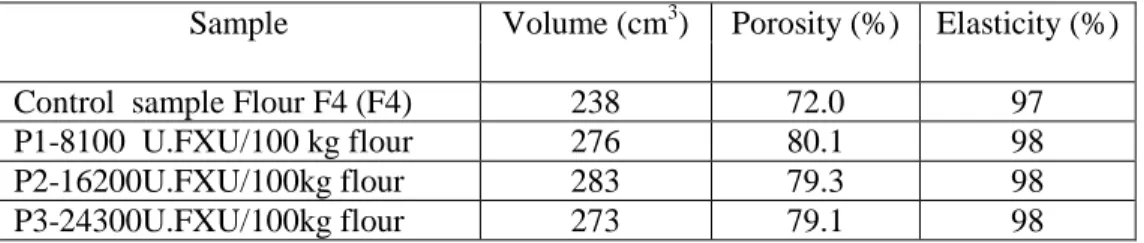
The influence of xylanase on the quality of the bread prepared from flour F4 is presented in Table 5.
Table 5 The influence of xylanase on the quality of the bread prepared from flour F4
We observed that the volume of the bread increases with the enzyme level until a point, from which it drops. This can be explained through the high level of hydrating of the flour, and one part of this water is later freed. The dough, and finally the products are more flattened.
Conclusions
Adding xylanase improved the volume, the porosity and the elasticity of the bread, increasing with the enzyme level and flour quality, which positively Sample Volume (cm3) Porosity (%) Elasticity (%)
Control sample Flour F3 (F3) 269 76.6 98
P1-8100 U.FXU/100 kg flour 283 77.3 98
P2-16200U.FXU/100kg flour 288 78.4 98
P3-24300U.FXU/100kg flour 296 78.6 98
Sample Volume (cm3) Porosity (%) Elasticity (%)
Control sample Flour F4 (F4) 238 72.0 97
P1-8100 U.FXU/100 kg flour 276 80.1 98
P2-16200U.FXU/100kg flour 283 79.3 98
influenced the gas retainment. However, at larger dosage than 16200U.FXU/100 kg flour, the texture of bread was sticky and tasted sweet, hard to process.
The maximum dosage for xylanase is 24300U.FXU/100 kg flour. The effect of these enzyme increases with the quality of the flours gluten.
Bibliography
1. Bordei, D., (2004) - Bread technology, Agir Bucharest. 383.
2. Ismail Hakki Boyaci, Phil C. Williams, Hamit Koksel (2004) - A rapid method for the estimation of damaged starch in wheat flours, Journal of Cereal Science, no.39, p.139-145.
3. SR ISO 5530-1, (1999)- Wheat flour. Physical caracteristics of dough. Part 1: Analysis water absorption and rheological properties using pharinograpfe, ASRO, Bucuharest.
4. SR ISO 5530-4, (2002)- Wheat flour. Physical caracteristics of dough. Part 4:Analysis rheological properties using alveographe and consistographe, ASRO, Bucharest.