����������������������
�������������
����� ����������������������
����� ������������������������
�������������
���������������������
����������������������������������
����
�����������������
������������������
Copyright © 2005
by the United Nations Development Program All rights reserved
ISBN: 1-84407-219-3 paperback
For a full list of publications please contact: Earthscan
8–12 Camden High Street London, NW1 0JH, UK Tel: +44 (0)20 7387 8558 Fax: +44 (0)20 7387 8998 Email: [email protected] Web: www.earthscan.co.uk
22883 Quicksilver Drive, Sterling, VA 20166-2012, USA
Earthscan is an imprint of James and James (Science Publishers) Ltd and publishes in association with the International Institute for Environment and Development
A catalogue record for this book is available from the British Library Library of Congress Cataloging-in-Publication Data
A catalog record has been requested
This publication should be cited as: UN Millennium Project 2005. Health, Dignity, and Development: What Will it Take? Task Force on Water and Sanitation.
Photos: Front cover Franck Charton/UNICEF; back cover, top to bottom, Christopher Dowswell, Pedro Cote/ UNDP, Giacomo Pirozzi/Panos Pictures, Liba Taylor/Panos Pictures, Jørgen Schytte/UNDP, UN Photo Library, Giacomo Pirozzi/UNICEF, Curt Carnemark/World Bank, Pedro Cote/UNDP, Franck Charton/UNICEF, Paul Chesley/Getty Images, Ray Witlin/World Bank, Pete Turner/Getty Images.
This book was edited, designed, and produced by Communications Development Inc., Washington, D.C., and its UK design partner, Grundy & Northedge.
The Millennium Project was commissioned by the UN Secretary-General and sponsored by the United Nations Development Programme on behalf of the UN Development Group. The report is an independent publication that reflects the views of the members of the Task Force on Water and Sanitation, who contributed in their personal capac-ity. This publication does not necessarily reflect the views of the United Nations, the United Nations Development Programme, or their Member States.
The world has an unprecedented opportunity to improve the lives of billions of people by adopting practical approaches to meeting the Millennium Devel-opment Goals. At the request of UN Secretary-General Kofi Annan, the UN Millennium Project has identified practical strategies to eradicate poverty by scaling up investments in infrastructure and human capital while promoting gender equality and environmental sustainability. These strategies are described in the UN Millennium Project’s report Investing in Development: A Practical Plan to Achieve the Millennium Development Goals, which was coauthored by the coordinators of the UN Millennium Project task forces.
The task forces have identified the interventions and policy measures needed to achieve each of the Goals. In Health, Dignity, and Development: What Will It Take? the UN Millennium Project Task Force on Water and Sani-tation emphasizes that achieving the water and saniSani-tation target and investing in water infrastructure and management are crucial to the achievement of all the Millennium Development Goals—a key point that is echoed in Investing in Development.
Consider, for example, the sanitation crisis. Four in ten of our fellow women, men, and children have no choice but to defecate in buckets, in plas-tic bags, in open fields, and alongside footpaths, streets, and railroad tracks, not occasionally but every single day. This persistent yet largely unrecognized humanitarian crisis must end if we are to reduce disease, hunger, and gen-der inequality; improve the lives of slum dwellers; and achieve environmental sustainability. Conversely, progress toward these and other Millennium Devel-opment Goals—particularly the reduction of poverty and gender inequality— is vital to achieving the water and sanitation target and to improving the use of Earth’s water resources.
Health, Dignity, and Development has been prepared by a group of leading experts who contributed in their personal capacity and volunteered their time to this important task. I am very grateful for their thorough and skilled efforts, and I am sure that the practical options for action in this report will make an important contribution to achieving the Millennium Development Goals. I strongly recommend it to anyone who is interested in how countries can make the dream of safe drinking water and basic sanitation a reality for their poorest citizens.
Jeffrey D. Sachs New York January 17, 2005
Foreword iii
Task force members x Preface xii
Acknowledgments xv
Millennium Development Goals xviii Executive summary 1
Chapter 1 Water is life 3 The historical context 4 The institutional context 7 The focus of this report 10
Part 1 The Millennium Development target for domstic water supply and sanitation 13
Chapter 2 Why focus on water supply and sanitation? 15 Human values and human rights 15
Contribution to the Millennium Development Goals 17 Chapter 3 Target 10 and the global monitoring system 28 Target 10 on water and sanitation 31
The current system for monitoring and evaluation 33 Chapter 4 Where are the needs greatest? 38
Access to domestic water supply and sanitation services 39
Current levels of access and the rate of progress toward the goal 41 Low access to services and high incidence of water-related disease 42
Identifying greatest needs globally 44
Pinpointing greatest needs within countries 45 Chapter 5 What’s holding us back? 62 Political constraints 62
Institutional constraints 64 Financial constraints 69 Technical challenges 74 Conclusion 77
Chapter 6 The special challenge of meeting the sanitation target 79 A collective or an individual service? 80
The nature of demand for improved sanitation 81
Reorienting public institutions for sanitation service delivery 83 Changing roles for government 85
New technologies or better use of existing technologies? 87 Alternative planning approaches for urban sanitation 88 Alternative planning approaches for rural sanitation 90 Galvanizing support for sanitation and hygiene 91 Chapter 7 Technology and infrastructure 93 Available technological options 93
Cost-reduction strategies 98 The need for innovation 100
Chapter 8 What would it cost? 102 Global estimates 102
National estimates: a method to assess needs 103
Chapter 9 Grappling with financing for the poorest 113 Principal target group: poor people in the poorest countries 114 Financial constraints in low-income countries 115
Affordability, sustainability, and water conservation 122 What about middle-income countries? 123
Part 2 Water resources for all the Millennium Development Goals 125
Chapter 10 Why does water resources development and management matter? 127 Poverty and hunger 128
Environmental sustainability 133 Health 136
Gender equality 137
Exploiting potential synergies through combined approaches 138 Chapter 11 What actions are needed? 142
Investing in water resources development and management 146 Adopting integrated water resources management 147
Examples of context-specific actions 148
Chapter 12 Monitoring and support systems 151 Monitoring water resources 151
Global institutional support structures 156
Recommendations for the international community 157 Part 3 Achieving the Millennium Development Goals 161 Chapter 13 How to make the Goals a reality 163
A call to action 163 Ten critical actions 165
Chapter 14 An operational plan 174 Appendix 1 Insights from case studies 180 Notes 194
References 200 Boxes
1.1 Millennium Development target 10 4
1.2 Lessons from the International Drinking Water Supply and Sanitation Decade 9
2.1 Lack of sustainable access to basic sanitation—a polite way to say “open defecation” 16
2.2 Economic benefits from improving water supply and sanitation services 19
2.3 Maximizing the health benefits from water supply, sanitation, and hygiene interventions 20
2.4 Where does hygiene fit in? 24
2.5 Household water treatment and safe storage 24 2.6 How long are we going to live this way? 25 2.7 Modest dreams 26
3.1 What is sanitation? 30 5.1 Water is a political issue 63
5.2 Overcoming constraints and increasing access: the South African experience 77
6.1 Unheard voices of women 82
8.1 Assumptions used in arriving at the estimates in table 8.1 103 10.1 Water-related disasters: facts from the World Health
Organization 127
10.2 Improving water management to spur economic development 128
10.3 Main water-related recommendations of the Millennium Project for meeting the poverty and hunger Goals 130
10.4 Main water-related recommendations of the Millennium Project Task Force on Environmental Sustainability 133
10.5 Living with urban environmental problems 134
10.6 Main water-related recommendations of the Millennium Project Task Force on Improving the Lives of Slum Dwellers 135
10.7 Malaria: facts from the World Health Organization 136
10.8 Main water-related recommendations of the Millennium Project Task Force on Education and Gender Equality 137
12.1 The evolution of interagency coordination in water resources and sanitation 157
Figures
3.1 Millennium Development Goals for water and sanitation reach the neediest in urban and rural areas 33
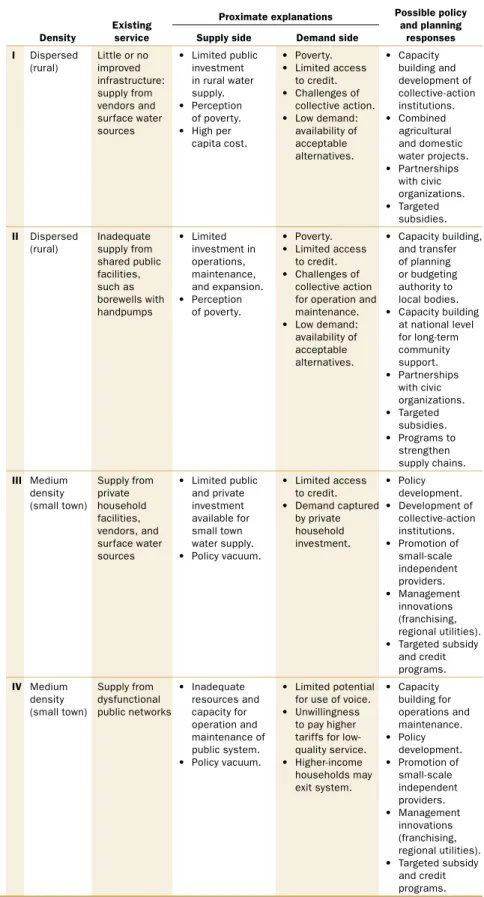
4.1 A typology of communities with low water supply and sanitation coverage 45
5.1 Access to water supply rises as national income rises 69
5.2 The richest are twice as likely to use drinking water from an improved source as the poorest 70
5.3 The richest are four times more likely to use improved sanitation than the poorest 70
5.4 Private investment in infrastructure has fallen off in recent years 72
6.1 Urban water and sanitation services are much more expensive than simpler rural services 89
Maps
4.1 Regional groupings for the Joint Monitoring Programme 39 4.2 Prevalence of diarrhea and improved water supplies, 2000 43 4.3 Prevalence of diarrhea and improved sanitation, 2000 44 11.1 Water stress in major river basins 145
Tables
2.1 Contribution of access to domestic water supply and sanitation to the Millennium Development Goals 18
3.1 Improved and unimproved water and sanitation facilities 29 4.1 Access to improved drinking water sources by region, 2002 40 4.2 Access to improved sanitation by region, 2002 40
4.3 Number of people to whom access must be extended by 2015 to meet target 10 41
4.4 High-need countries identified by various criteria 46 4.5 Typology of unserved and underserved communities for water
supply 55
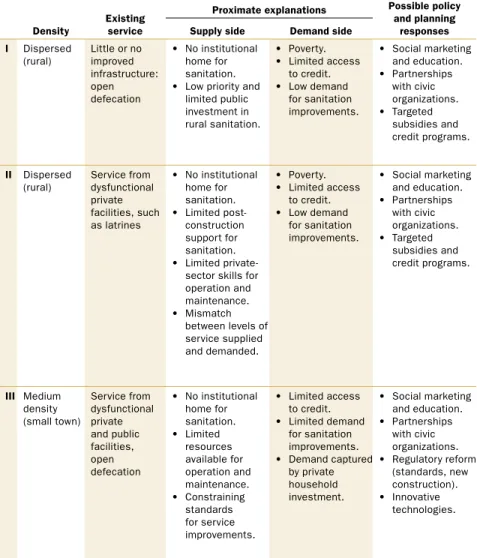
4.6 Typology of unserved and underserved communities for sanitation 60
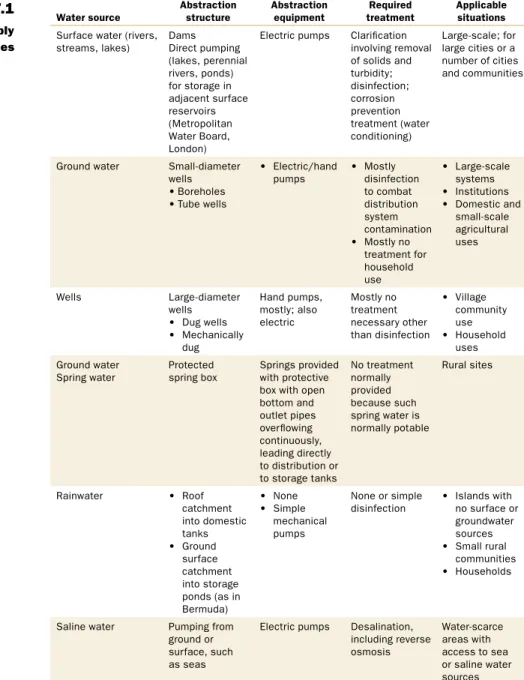
7.1 Water supply technologies 94
7.2 Selected technological options for sustainable access to sanitation 95
7.3 Water and sanitation service levels 97
8.1 Cost estimates for reaching the Millennium Development targets for water supply and sanitation, 2005–15 (billions of dollars) 103 8.2 Resource requirements for reaching target 10 in Ghana,
2005–15 110
8.3 Resource requirements for reaching target 10 in five low-income countries, 2005–15 111
9.1 Unserved people: where are they? 114
9.2 Distribution of the global population without access to safe water supply 115
9.3 Distribution of the global population without access to basic sanitation 115
9.4 Potential domestic resource mobilization for the Millennium Development Goals 119
10.1 Contribution of improved water resources management to the Millennium Development Goals 129
14.1 Priority actions for national and subnational governments 176 14.2 Priority actions for bilateral and multilateral development assistance
agencies 177
14.3 Priority actions for the United Nations system 177 14.4 Priority actions for service providers 178
14.5 Priority actions for civic and community organizations 178 14.6 Priority actions for international networks and partnerships 178 14.7 Priority actions for research organizations 179
14.8 Priority actions for all actors throughout the Millennium Development process and beyond 179
Task force coordinators
Roberto Lenton, The Earth Institute at Columbia University Albert M. Wright, Independent consultant
Task force members
Ingvar Andersson, Senior Freshwater Advisor, United Nations Development Program (through June 2004)
Jamie Bartram, Coordinator, Water, Sanitation and Health Programme, World Health Organization (permanent observer as chair of UN-Water and on behalf of WHO)
Margaret Catley-Carlson, Chair, Global Water Partnership; Chair, Interna-tional Center for Agricultural Research in Dry Areas
Ivan Cheret, Independent consultant, Paris
Kamla Chowdhry, Chair, Vikram Sarabhai Foundation, New Delhi Bill Cosgrove, President, World Water Council (through December 2004) Jennifer Davis, Professor of Development Planning, Massachusetts Institute
of Technology, Cambridge, Mass.
Manuel Dengo, Chief, Water and Natural Resources, United Nations Depart-ment of Economic and Social Affairs
Halifa Drammeh, Deputy Director, Division of Policy Development and Law, United Nations Environment Programme
Gourisankar Ghosh, Executive Director, Water Supply and Sanitation Col-laborative Council
Mi Hua, Sanitation Specialist, UN Millennium Project Technical Support Centre, Nairobi
Hans Olav Ibrekk, Adviser, Norwegian Agency for Development Coopera-tion, Oslo
Sir Richard Jolly, Fellow, Institute for Development Studies, University of Sussex, United Kingdom
Torkil Jonch-Clausen, Senior Advisor, Global Water Partnership, Copenhagen Mike Muller, Director General, South Africa Department of Water Affairs,
Pretoria
Dennis Mwanza, Managing Director, Water Utility Partnership, Dakar Ravi Narayanan, Director, WaterAid, London
Noma Nyoni, Deputy Director, Institute of Water and Sanitation Develop-ment, Harare
Kalyan Ray, Chief, Building and Infrastructure Technology, United Nations Human Settlements Programme
Frank Rijsberman, Director General, International Water Management Insti-tute, Colombo
Jamal Saghir, Director, Energy and Water, World Bank David Seckler, Independent consultant, Greeley, Colo.
Vanessa Tobin, Chief, Water, Environment and Sanitation, United Nations Children’s Fund
Gordon Young, Coordinator, World Water Assessment Programme Task force secretariat
Kristen Lewis, Senior Policy Advisor and Task Force Manager Christie Walkuski, Administrative Assistant
Other key contributors
Barbara Evans, Independent consultant, Macclesfield, U.K. Guido Schmidt-Traub, Policy Advisor, UN Millennium Project
Susmita Shekhar, Senior Vice President, Sulabh International Social Service Organization, New Delhi
At the United Nations Millennium Summit in September 2000, the largest-ever gathering of world leaders adopted the Millennium Declaration. From the Declaration emerged the Millennium Development Goals, an integrated set of time-bound targets for extending the benefits of globalization to the world’s poorest citizens and making real progress, by 2015, in tackling the most press-ing issues facpress-ing developpress-ing countries.
Among those targets is Millennium Development target 10: to cut in half, by 2015, the proportion of people without sustainable access to safe drinking water and basic sanitation. In addition, sound water resources management and development is a key to achieving all of the Goals.
To help the international community as a whole reach the Millennium Development Goals, the UN secretary-general and the administrator of the United Nations Development Programme (as chair of the United Nations Development Group) commissioned the UN Millennium Project, as an inde-pendent advisory body. The UN Millennium Project was a three-year effort to identify the best strategies for meeting the Goals. Ten task forces, each one focused on a specific substantive area and made up of independent experts from the relevant disciplines and sectors, performed the bulk of the UN Mil-lennium Project’s work; each task force was responsible for identifying what it would take to achieve one or more of the targets.
What’s new about this report?
In the past 25 years, a number of commissions, expert groups, and high-level panels have produced reports and recommendations on water and sanitation. Indeed, many task force members have themselves been involved in these valu-able exercises, and in our work we have deliberately sought not to “reinvent the wheel,” but rather to build on past efforts and ongoing processes.
The UN Millennium Project Task Force on Water and Sanitation, together with the larger UN Millennium Project, of which it is an integral part, repre-sented a unique opportunity to tackle two tasks that have heretofore not been undertaken: Identifying what it will take to meet the targets on water and sani-tation, including pinpointing the actions needed in other sectors; and identify-ing the actions needed in the water resources sector to meet the Millennium Development Goals as a whole. In building on the excellent work of previous bodies, therefore, the task force has brought two new dimensions to the table.
First, it has set out to answer a very different question from that addressed by previous initiatives: given the urgency of achieving the Goals and the repeated international commitments to achieve them, what specific policies and resources are needed to meet the Goals, and who needs to take responsibil-ity for ensuring they are in place?
Second, it has identified the specific policies and resources needed to meet the Goals as part of a larger UN Millennium Project. Therefore, the task force could not only determine the actions needed in the water sector within a broader context but also pinpoint the actions needed in other sectors if the targets on water and sanitation are to be met. This broad context is critical, given that advances in a number of areas—from poverty reduction to gender equality to improvements in the international terms of trade—strongly affect the ability of countries to meet the water and sanitation target and to optimize water use.
Other characteristics that differentiate the report include:
• Its ability to dovetail an action plan for water in the larger context of action plans to achieve the Millennium Development Goals.
• The authority and visibility that comes from its association with the UN Millennium Project.
• The intellectual independence that has been granted to the UN Mil-lennium Project, as well as the analytical strength that derives from the project’s overall framework and methodology.
• The overall international context of support for the Goals.
This document, the final report of the task force, is intended primarily for the policy and technical communities concerned with the achievement of the Goals, particularly target 10, in governments, international organizations, bilateral donor agencies, specialized nongovernmental organizations, water agencies, and academia. We have sought to strike a balance between providing sufficient background information to make the report accessible to the nonex-pert and maintaining a focus on what it will take to achieve the Goals. Definitions
Since the term water in the name of the task force embraces both domestic water supply (as in target 10) and water resources management, we attempt throughout the report to use terminology that clearly differentiates the term
in each case. Thus, we employ the terms domestic water supply and sanitation services or simply water supply and sanitation when we refer to water and sanita-tion in the context of target 10. We use the terms water resources management, water as a resource, or simply water resources when we refer to the management of water as a resource for meeting the Goals as a whole, including the infra-structure needed to manage the resource. We use the term water resources devel-opment and management to mean the infrastructure, governance, and manage-ment measures required to manage and control freshwater to meet human and environmental needs. We use the overall terms water or water and sanitation
only when we explicitly wish to embrace both domestic water supply and water resources management. We define safe drinking water as water that is safe to drink and available in sufficient quantities for hygienic purposes. Our work-ing definition of basic sanitation is the lowest-cost option for securing sustain-able access to safe, hygienic, and convenient facilities and services for excreta and sullage disposal that provide privacy and dignity while ensuring a clean and healthful living environment both at home and in the neighborhood of users.1
This final report is the culmination of three years of analysis, consultation with others, and substantial debate and interchange among the members of the task force. Task force members met in Delhi, Nairobi, New York, and Stockholm from October 2002 to September 2004 and frequently exchanged views through numerous electronic discussions. The report draws heavily on the interim report prepared by the task force in December 2003 and incorpo-rates the feedback received from various sources. It also incorpoincorpo-rates material from several analyses that the task force commissioned in early 2004 with sup-port from the government of Norway.
The members of the task force have contributed actively and in their per-sonal capacity to the work of the group, whose conclusions are embodied in this report. The views expressed do not necessarily reflect those of the organi-zations with which task force members are affiliated.
This final report is complemented by a companion short document—the final report, abridged edition—which serves as both a free-standing statement of the main recommendations and an executive summary. The document in hand contains considerable additional material substantiating the principal arguments in the abridged report, but no change in the argument itself.
This report has been prepared by a small writing and editing team consisting of Kristen Lewis, senior policy advisor and task force manager, and ourselves. As task force coordinators, we wish to express a special appreciation to Kristen Lewis, whose superb writing skills, ability to understand and communicate the big picture, capacity to address the very large number of issues raised by task force members and external reviewers on the various drafts of this report, and constant energy and enthusiasm have proved absolutely invaluable to task force members and ourselves alike. We also thank Christie Walkuski for her generous assistance in the preparation of the report, including the annexes and
figures, with unfailing good humor under significant time pressure, and for her consistent support to the task force throughout the entire project. The final report was edited and produced by Meta de Coquereaumont, Carol Rosen, Bruce Ross-Larson, Christopher Trott, and Elaine Wilson of Communications Development Incorporated.
We also wish to acknowledge, with thanks, the extensive contributions of several people and organizations to the development of this report. In particu-lar, we would like to thank Guido Schmidt-Traub of the UN Millennium Proj-ect for the sProj-ection on the projProj-ect’s needs assessment methodology, as well as for his gracious, unflagging, and truly invaluable support throughout the life of the task force; Jennifer Davis, task force member, for her work to devise the community typology outlined in the report and her extensive contributions, particularly to chapters 5 and 6 and the plan of action; Mi Hua, task force member, for her contributions to chapters 6 and 8; Barbara Evans, indepen-dent consultant, for her work preparing a background paper that formed the basis for chapter 6; Michael Krause and Alice Wiemers of the UN Millennium Project Secretariat for assistance in data analysis; Adam Storeygard and Marc Levy of CIESIN for their assistance in the preparation of maps in chapter 4; Jon Lane, Judith Rees, and Peter Rogers for their insightful comments as exter-nal reviewers of an advanced draft of the report; and Anupa Fabian for a heroic marathon of fact-checking in the final days. In addition, we greatly appreci-ated the contributions of the UN Human Settlements Programme, the UN Department of Economic and Social Affairs, the United Nations Develop-ment Programme, the United Nations EnvironDevelop-ment Programme, the United Nations Children’s Fund, the World Bank, and the World Health Organiza-tion, whose documents we drew on extensively in several parts of this report and whose staff assisted us in numerous ways.
Finally, the report could not have been written without the task force mem-bers and other key contributors listed in the preceding pages: their tremendous efforts, wealth of knowledge and expertise, personal dedication to the issues, and commitment to creating a consensus document made our work together deeply rewarding. The coordinators take full responsibility for any errors or omissions in the contents of this report.
Roberto Lenton and Albert Wright Task force coordinators
������ ������ ������ ������ ������ ��������� ����������������������������������������������������������������������� ������������������ ��������� ����������������������������������������������������������������������������� ��������� �������������������������������������������������������������������������������������������� �������������������������������� ��������� ������������������������������������������������������������������������������������������ ������������������������������������������ ��������� �������������������������������������������������������������������������� � ������ ��������� ����������������������������������������������������������������������������� ��������� ���������� ���� ����������� ��� ������������ ������������ ����� �������� ��������� ���� ��������� ������������������������������������������������ ���������� ������� ��� ������ ���� ����������� ��� ������� �������� ������������ ������� ��� ����� ��������� ��������������������������� ���������� ����� ��������� ��� ����� �� ������������ ������������ ��� ���� ������ ��� ��� ������ ���� �������� ������������� ���������� �������� ��� ����� ��� ������ ������������ ������������� ���������������� �� �������� ���� ������������������������������������������������������������������������������������� ���������������������������������������������� ���������� �������������������������������������������������������������������������������������������� ������������������������������������������������������������������������������������������� ��������� ����� ���������� �������� ���� ������������� ��� ��������� ���������� ������ ���� ����� �������������������������������������������������������������������������������������� ���������� ����������������������������������������������������������������������������������������� ������� ��������� ���� �������� ��� ������� ���� ���� ������������ ������������ ��� ������ ������� ������������������������������������������������������� ���������� ����� ���������������� ����� ���� ����� ��������� ��� ����������� ���������� �������� ��������� ����������������������������������������������������������������������������� ����� ��� ���� ����������� ������� ������ ���� ���������� ����������� ���� ���� ������ ���������� ��������������������������������������������������������������������������������������� ���������� ��� ������������ ����� ����������� ����������� �������� ���� ���������� ����������� ���� ������� ������������������������������ ���������� ��� ������������ ����� ��������������� ����������� �������� ������� ��� ����������� ���������� ����������������������������� ���������� ��� ������������ ����� ���� �������� �������� ����� ���������� ���� ��������� ��� ���� �������������� ������������������������������������������������������ ������ ��������� ��������������������������������������������������������������� ��������� ������������������������������������������������������������������������������������������ �
����������������������������
���������� ���������������� ���������� �������� ������������������ ��������� ��������������� ������������� ������������� ������������� ��������� ��������� ��������������� ������� �������������� �������������� ������ ����������������� ���������������� ����������� �������� ���������� ������������� �������������������� ������ ������ ������ ������ ��������� ����������������������������������������������������������������������� ������������������ ��������� ����������������������������������������������������������������������������� ��������� �������������������������������������������������������������������������������������������� �������������������������������� ��������� ������������������������������������������������������������������������������������������ ������������������������������������������ ��������� �������������������������������������������������������������������������� � ������ ��������� ����������������������������������������������������������������������������� ��������� ���������� ���� ����������� ��� ������������ ������������ ����� �������� ��������� ���� ��������� ������������������������������������������������ ���������� ������� ��� ������ ���� ����������� ��� ������� �������� ������������ ������� ��� ����� ��������� ��������������������������� ���������� ����� ��������� ��� ����� �� ������������ ������������ ��� ���� ������ ��� ��� ������ ���� �������� ������������� ���������� �������� ��� ����� ��� ������ ������������ ������������� ���������������� �� �������� ���� ������������������������������������������������������������������������������������� ���������������������������������������������� ���������� �������������������������������������������������������������������������������������������� ������������������������������������������������������������������������������������������� ��������� ����� ���������� �������� ���� ������������� ��� ��������� ���������� ������ ���� ����� �������������������������������������������������������������������������������������� ���������� ����������������������������������������������������������������������������������������� ������� ��������� ���� �������� ��� ������� ���� ���� ������������ ������������ ��� ������ ������� ������������������������������������������������������� ���������� ����� ���������������� ����� ���� ����� ��������� ��� ����������� ���������� �������� ��������� ����������������������������������������������������������������������������� ����� ��� ���� ����������� ������� ������ ���� ���������� ����������� ���� ���� ������ ���������� ��������������������������������������������������������������������������������������� ���������� ��� ������������ ����� ����������� ����������� �������� ���� ���������� ����������� ���� ������� ������������������������������ ���������� ��� ������������ ����� ��������������� ����������� �������� ������� ��� ����������� ���������� ����������������������������� ���������� ��� ������������ ����� ���� �������� �������� ����� ���������� ���� ��������� ��� ���� �������������� ������������������������������������������������������ ������ ��������� ��������������������������������������������������������������� ��������� ������������������������������������������������������������������������������������������ �
����������������������������
���������� ���������������� ���������� �������� ������������������ ��������� ��������������� ������������� ������������� ������������� ��������� ��������� ��������������� ������� �������������� �������������� ������ ����������������� ���������������� ����������� �������� ���������� ������������� ��������������Four of every ten people in the world do not have access to even a simple pit latrine; and nearly two in ten have no source of safe drinking water. This silent humanitarian crisis kills some 3,900 children every day; thwarts progress toward all the Millennium Development Goals, especially in Africa and Asia; and robs the poorest—particularly women and girls—of their health, time, and dignity. Water supply and sanitation services, as well as water as a resource, are critical to sustainable development—from environmental protection and food security to increased tourism and investment, from the empowerment of women and the education of girls to reductions in productivity losses due to morbidity and malnutrition.
The UN Millennium Project Task Force on Water and Sanitation sought to answer two questions: what will it take to expand water supply and sanita-tion coverage dramatically and sustainably? How can the use of water as a resource be optimized to achieve the Millennium Development Goals?
At the conclusion of its three-year project, the task force was unanimous in its belief that the water and sanitation target, “to halve, by 2015, the proportion of people without sustainable access to safe drinking water and basic sanita-tion,” will not be reached unless:
• There is a deliberate commitment by donors to increase and refocus their development assistance and to target sufficient aid to the poorest low-income countries.
• There is a deliberate commitment by governments of middle-income countries that do not depend on aid to reallocate their resources so that they target funding to their unserved poor.
• There are deliberate activities to create support and ownership for water supply and sanitation initiatives among both women and men in poor communities.
• There is a deliberate recognition that basic sanitation in particular requires an approach that centers on community mobilization and actions that support and encourage that mobilization.
Furthermore, our group is convinced that the Millennium Development Goals as a whole will not be met unless:
• There is deliberate planning and investment in sound water resources management and infrastructure.
The task force identified 10 critical actions for achieving the water and sanitation target and fostering the sound management of water resources for all the Goals. They are:
Action 1. Governments and other stakeholders must move the sanitation crisis to the top of the agenda.
Action 2. Countries must ensure that policies and institutions for water supply and sanitation service delivery, as well as for water resources manage-ment and developmanage-ment, respond equally to the different roles, needs, and pri-orities of women and men.
Action 3. Governments and donor agencies must simultaneously pursue investment and reforms.
Action 4. Efforts to reach the water and sanitation target must focus on sustainable service delivery, rather than construction of facilities alone.
Action 5. Governments and donor agencies must empower local authori-ties and communiauthori-ties with the authority, resources, and professional capacity required to manage water supply and sanitation service delivery.
Action 6. Governments and utilities must ensure that users who can pay do pay in order to fund the operation, maintenance, and expansion of services— but they must also ensure that the needs of poor households are met.
Action 7. Within the context of national poverty reduction strategies based on the Millennium Development Goals, countries must elaborate coherent water resources development and management plans that will support the achievement of the Goals.
Action 8. Governments and their civil society and private sector partners must support a wide range of water and sanitation technologies and service lev-els that are technically, socially, environmentally, and financially appropriate.
Action 9. Institutional, financial, and technological innovation must be promoted in strategic areas.
Action 10. The United Nations system organizations and their member states must ensure that the UN system and its international partners provide strong and effective support for the achievement of the water supply and sani-tation target and for water resources management and development.
p
te
r 1
Water is life
Water is life for people and for the planet. It is essential to the well-being of humankind, a vital input to economic development, and a basic require-ment for the healthy functioning of all the world’s ecosystems. Clean water for domestic purposes is essential for human health and survival; indeed, the combination of safe drinking water, adequate sanitation, and such hygienic practices as hand washing is recognized as a precondition for reductions in morbidity and mortality rates, especially among children.
Water is also critical to other facets of sustainable development—from envi-ronmental protection and food security to increased tourism and investment, from the empowerment of women and the education of girls to reductions in productivity losses due to illness and malnutrition. Thus, increasing access to domestic water supply and sanitation services and improving water resources management are catalytic entry points for efforts to help developing countries fight poverty and hunger, safeguard human health, reduce child mortality, pro-mote gender equality, and manage and protect natural resources. In addition, sufficient water for washing and safe, private sanitation facilities are central to the basic right of every human being for personal dignity and self-respect.
For the world’s poorest citizens, however, the right to safe water and adequate sanitation remains a promise unfulfilled. At least 1.1 billion people lack access to safe water, and 2.6 billion lack access to basic sanitation, a silent humanitar-ian crisis that each day takes thousands of lives, robs the poor of their health, thwarts progress toward gender equality, and hamstrings economic develop-ment, particularly in Africa and Asia (WHO/UNICEF JMP 2000).
Every year millions of people, most of them children, die from diseases associated with inadequate water supply, sanitation, and hygiene (WHO 2004a). According to the World Health Organization, each and every day some 3,900 children die because of dirty water or poor hygiene; diseases
trans-mitted through water or human excrement are the second-leading cause of death among children worldwide, after respiratory diseases (WHO 2003). Water scarcity, poor water quality, and inadequate sanitation negatively impact food security, livelihood choices, and educational opportunities for poor fami-lies across the developing world. The current gulf in water use between rich and poor countries is wide—people in industrialized countries use 30–50 times more water than people in developing countries (UN/WWAP 2003). Yet, although far more people suffer the ill effects of poor water supply and sanitation services than are affected by such headline-grabbing topics as war and terrorism, those issues capture the public imagination—as well as public resources—in a way that water and sanitation issues do not.
Water challenges will increase significantly in the coming years. Continu-ing population growth and risContinu-ing incomes will lead to greater water consump-tion, as well as more waste. The urban population in developing countries will grow dramatically, generating demand well beyond the capacity of already inadequate water supply and sanitation infrastructure and services. By 2050, at least one in four people is likely to live in a country affected by chronic or recur-ring shortages of freshwater (UN/WWAP 2003). This may seriously constrain the availability of water for all purposes—particularly for agriculture, which currently accounts for 70 percent of all water consumed (UN/WWAP 2003).
The world is waking up to the water and sanitation crisis. At the United Nations Millennium Summit in September 2000, the largest-ever gathering of world leaders adopted the Millennium Declaration; from the Declaration emerged the Millennium Development Goals, an integrated set of time-bound targets for extending the benefits of globalization to the world’s poorest citi-zens.1 Among them was target 10, to cut in half the proportion of people
with-out sustainable access to safe drinking water (box 1.1). At the World Summit for Sustainable Development in 2002, this target was expanded to include basic sanitation, and water as a resource was recognized as a critical factor for meeting all the Goals.2
The historical context
The goals and targets relating to water and sanitation outlined in the United Nations Millennium Declaration and in the Millennium Development Goals and targets were not developed in a vacuum. Indeed, they were the culmina-tion of several decades of internaculmina-tional deliberaculmina-tions on the subject.
Box 1.1 Millennium Development target 10
To halve, by 2015, the proportion of people without sustainable access to safe drinking water and basic sanitation.
For the
world’s
poorest
citizens, the
right to safe
water and
adequate
sanitation
remains a
promise
unfulfilled
International conferences and agreements on water and sanitation Over the past 30 years numerous conferences and international agreements have provided the broad background for today’s water resources policies and deci-sionmaking (UN WEHAB Working Group 2002).3 In the past decade many
international conferences have discussed and agreed on steps required to speed up the implementation of Agenda 21, a comprehensive plan of action for sustain-able development adopted by more than 178 governments at the United Nations Conference on Environment and Development (UNCED) held in Rio de Janeiro in 1992. Water for sustainable development was discussed at the intergovern-mental level in the sixth session of the Commission on Sustainable Development in 1998, and broad consensus was reached on key water issues; further interna-tional water meetings (such as the Second World Water Forum in the Hague in 2000 and the International Conference on Freshwater in Bonn in 2001) served as important forums for multistakeholder dialogues and generated new recom-mendations on how to address increasing water challenges. The United Nations Millennium Declaration and the preparatory process leading up to the World Summit on Sustainable Development further affirmed the role of water as a key to sustainable development and the urgency of immediate action.
The Millennium Declaration and the Goals and targets relating to water and sanitation
Water and sanitation are dealt with in several ways in the United Nations Mil-lennium Declaration and in the final list of MilMil-lennium Development Goals and targets (UN General Assembly 2000).4
In chapter 4 (“Sustaining Our Future”) of his report to the Millennium Summit the secretary-general urged the Summit “to adopt the target of reduc-ing by half, between now and 2015, the proportion of people who lack sustain-able access to adequate sources of affordsustain-able and safe water” (UN 2000). In the Millennium Declaration the heads of state gathered at United Nations Headquarters in New York in September 2000 resolved, under the heading “protecting our common environment,”
To stop the unsustainable exploitation of water resources by developing water management strategies at the regional, national, and local levels, which promote both equitable access and adequate supplies.
This resolution is explicitly highlighted as a goal in the secretary-general’s report to the UN General Assembly on the follow up to the outcome of the Millennium Summit (UN 2001, p. 34). In the statement of the United Nations Millennium Development Goals and targets, however, the overall goal relevant to this area (Goal 7) is stated more generally as “ensuring environmental sustainability,” with three specific targets:
• Integrate the principles of sustainable development into country policies and programs; reverse loss of environmental resources.
The world is
waking up to
the water and
sanitation
crisis
• Halve by 2015 the proportion of people without sustainable access to safe drinking water and basic sanitation.
• Achieve significant improvement in the lives of at least 100 million slum dwellers by 2020.
Two conclusions can be drawn: first, the goal of “stopping the unsustainable exploitation of water resources by developing water management strategies at the regional, national, and local levels, which promote both equitable access and adequate supplies” appears to have been incorporated in that part of the first target that refers to reversing the “loss of environmental resources.” Second, the target urged by the secretary-general in his report to the Millennium Summit was incorporated (with some modifications) in the second target to reduce by half the proportion of people without sustainable access to safe drinking water. The World Summit on Sustainable Development
One of the main outcomes of the World Summit on Sustainable Development (WSSD) in September 2002 was that water and sanitation were recognized as being inextricably linked to the eradication of poverty and to the achievement of sustainable development (UNDESA 2002b).5 Water was identified by the
secretary-general as one of the five specific “WEHAB” areas (water, energy, health, agriculture, and biodiversity) in which concrete results are both essen-tial and achievable. To provide focus and impetus to action on water issues, a document entitled “A Framework for Action on Water and Sanitation” was prepared for WSSD; it outlined the larger context in which the targets were established and provided a holistic view of the multiple impacts of increasing sustainable access to water supply and sanitation by the poor (UN WEHAB Working Group 2002).
WSSD reiterated the Millennium Development Goal to halve, by 2015, the proportion of people who are unable to reach or to afford safe drinking water and to set a new target on halving the proportion of people who do not have sustainable access to basic sanitation. This sanitation objective is now an integral part of target 10.
Several elements for a program of action on sanitation were clearly estab-lished in the WSSD Plan of Implementation (UNDESA 2002a), which par-ticularly highlighted the need to incorporate sanitation within strategies for integrated water resources management. The water and sanitation targets are set out under the Plan of Implementation chapters on poverty eradication and protecting the natural resource base. Water resource management and protec-tion were also recognized as fundamental to sustainable management of the natural resource base for economic and social development. It was also recom-mended that the participation of women be facilitated at all levels in support of policies and decisionmaking related to water resources management and project implementation. Water-related policies were included in virtually all of the natural resource objectives of the Plan of Implementation.
Further
international
deliberations
on water and
sanitation
have helped
advance
cooperation
and action
Notably, the Plan of Implementation took a broad view of the actions required to achieve the Millennium Development Goal on water and sanitation, emphasizing the need, for example, to intensify water pollution prevention to reduce health hazards and protect ecosystems, and to adopt measures to promote sustainable water uses and address water shortages. The plan made a strong call for integrated water resources management by setting a new time-bound tar-get to “develop integrated water resources management and efficiency plans by 2005, with support to developing countries, through actions at all levels.” Developments following the summit
Since Johannesburg, further international deliberations on water and sanita-tion have helped advance cooperasanita-tion and acsanita-tion in this area. In late 2002, the United Nations affirmed the Right to Water, noting that such a right is “indis-pensable for leading a life in human dignity” and “a prerequisite for the realiza-tion of other human rights.” In early 2003 water and sanitarealiza-tion (together with human settlements) were selected as the first themes to be discussed systemati-cally by the Commission on Sustainable Development in the post-WSSD era, and became the focus of review and policy discussions of the UN Commis-sion on Sustainable Development in 2004 and 2005. The Third World Water Forum in Kyoto, Japan, in March 2003 and the International Conference on Water for the Poorest in Stavanger, Norway, in November of that year also drew further attention to the subject.
In late 2003 the UN General Assembly adopted a resolution that pro-claimed the period 2005–15 as the International Decade for Action—Water for Life (UN General Assembly 2004). The decade will officially start on World Water Day, March 22, 2005. Goals for the decade will be a greater focus on water-related issues and for actions to ensure the participation of women in water-related development efforts. Focus will also be on furthering cooperation at all levels, so that the water-related goals of the Millennium Declaration, the Johannesburg Plan of Implementation of the World Summit for Sustainable Development, and Agenda 21 can be achieved. The resolution emphasized “that water is critical for sustainable development, including environmental integrity and the eradication of poverty and hunger, and is indispensable for human health and well-being.”
The institutional context
Although there is no global, comprehensive, intergovernmental structure for water, there is a very dynamic process of advancing international understand-ing and cooperation on water for sustainable development. These efforts are led by different governments; by the private sector and members of the civil society; by the work of various UN system entities and by other important regional and intergovernmental bodies; by such NGOs as WaterAid; and by several organized networks or partnerships, such as the Water Supply and
There is a
very dynamic
process of
advancing
international
understanding
and
cooperation
on water for
sustainable
development
Sanitation Collaborative Council (WSSCC) and its WASH (Water Sanitation and Hygiene for All) partnership, the Global Water Partnership (GWP), the Gender and Water Alliance, and the World Water Council. Progress on water for sustainable development requires by its very nature a multistakeholder approach (UN WEHAB Working Group 2002).
Within the UN system, a number of different entities are involved in water and sanitation-related issues. Perspectives and approaches vary according to the mission and mandates that the governing bodies provide to the differ-ent UN differ-entities. These differ-entities have recdiffer-ently formed UN-Water, the United Nations Inter-Agency Committee on Water Resources, which was formally established as the interagency mechanism for follow-up of the WSSD water-related decisions and the Goals concerning freshwater in 2003. The way in which the international community as a whole currently supports water and sanitation issues is discussed in greater detail in chapter 12.
Global strategies, frameworks, and plans of action
The development of global plans or frameworks for action has been an inher-ent part of the process of advancing international cooperation on water and sanitation, starting with the International Drinking Water Supply and Sanita-tion Decade (box 1.2). Other important frameworks for acSanita-tion on water or sanitation since the decade ended include:
• The Dublin Statement and Report of the Conference on Water and Environment (1992).
• “Towards Water Security: A Framework for Action” prepared by the Global Water Partnership to achieve the Vision for Water in the Twenty-first Century (2000).
• Framework for Action outlined in the WSSCC’s document, “Vision 21: A Shared Vision for Hygiene, Sanitation, and Water Supply and A Framework for Action” (2000).
• Numerous national and community level plans prepared under Vision 21’s umbrella.
• Bonn Plan of Action (2001).
• “Framework for Action on Water and Sanitation” prepared by the WEHAB Working Group for the World Summit on Sustainable Devel-opment (2002).
Most of these plans and frameworks for action, however, have fallen short of a full strategy, in that they do not lay out the organizational means required for implementation, nor provide clarity on the amount, nature, and sources of financing required.
Local institutions
It is widely recognized that water services are often most effectively deliv-ered through decentralized organizations and that voluntary community
Water
services are
often most
effectively
delivered
through
decentralized
organizations
participation is critical to their success. Many institutions of local governance that now have a broader role were initially established to manage water. Aside from the ancient riverine civilizations of Asia and Africa, local governments in
Box 1.2 Lessons from the International Drinking Water Supply and Sanitation Decade
Source: Drawn from material contributed by task force member Gouri Ghosh.
The Mar del Plata United Nations Conference on Water held in 1977 was the first inter-governmental conference devoted exclusively to water, a milestone in the history of water development. As a result of the Mar del Plata action plan, the United Nations General Assembly in 1980 proclaimed the period 1981–90 as the International Drinking Water Supply and Sanitation Decade (IWSSD). The IWSSD was a period of accelerated and concerted effort to expand water supply and sanitation services to the unserved and underserved poor populations, spearheaded by a group of UN agencies (UNICEF, WHO, and UNDP) and the World Bank. The official reporting of progress was entrusted to WHO. The Interagency Steering Committee for Co-operative Action for the International Drinking Water Supply and Sanitation Decade succeeded in improving the coordination and coop-eration among the multilateral and bilateral agencies participating.
Although the IWSSD did not reach its goal of total access in quantitative terms, much was learned from the experience of the IWSSD, including the further realization of the importance of partnerships, advocacy, knowledge dissemination, and comprehensive and balanced country-specific approaches to water and sanitation. Most important, perhaps, was the realization that the achievement of the goal would take far more time and cost far more money than was originally thought. Throughout the decade international organiza-tions and bilateral donors developed a highly qualified group of dedicated water profes-sionals, and water and sanitation were high on the development cooperation agenda.
As a result of the IWSSD new partnerships were developed, including the UNDP–World Bank Water Supply and Sanitation Programme (now the Water and Sanitation Programme), administered by the World Bank and funded by many bilateral donors, and the Water Sup-ply and Sanitation Collaborative Council (WSSCC). The UN General Assembly resolution in December 1990 at the end of the decade emphasized the importance of intensifying the coordination of national activities undertaken with the assistance of all relevant agencies in the field of water supply and sanitation, in particular through the interagency group and the WSSCC. The WSSCC is a unique experiment of partnership within the UN system, providing an open platform to civil society, government, private sector, and research insti-tutions to come together.
The Global Consultation for Safe Water 2000 held in New Delhi, September 1990, drew lessons from the decade, resulting in the New Delhi Statement: “Some for all rather than more for some.” At the World Summit for Children in 1990, the goal of universal access to safe water and sanitation by the year 2000 was adopted to promote the survival, protection, and development of children. The 1992 International Conference on Water and the Environment, held in Dublin, developed four principles for water management and put integrated water resources management on the political agenda. The importance of universal access to drinking water supply and sanitation was further reiterated at the 1992 United Nations Conference on Environment and Development. There, world lead-ers endorsed Agenda 21’s recommendations on the protection of freshwater resources. Thereafter, many other crucial international conferences recognized water and sanitation as the bedrock of public health and social progress and the key to improving people’s survival, health, and development, including the World Summit on Sustainable Develop-ment in 2002.