ARCHIVED PUBLICATION
The attached publication,
NIST Special Publication 800-30
(dated July 2002),
has been superseded and is provided here only for
historical purposes.
For the most current revision of this publication, see:
Special Publication 800-30
Risk Management Guide for
Information Technology Systems
Recommendations of the National Institute of
Standards and Technology
NIST Special Publication 800-30
Risk Management Guide for
Information Technology Systems
Recommendations of the
National Institute of Standards and Technology
Gary Stoneburner, Alice Goguen1, and
Alexis Feringa1
C O M P U T E R
S E C U R I T Y
Computer Security Division Information Technology Laboratory
National Institute of Standards and Technology Gaithersburg, MD 20899-8930
1Booz Allen Hamilton Inc. 3190 Fairview Park Drive Falls Church, VA 22042 July 2002
U.S. DEPARTMENT OF COMMERCE Donald L. Evans, Secretary
TECHNOLOGY ADMINISTRATION Phillip J. Bond, Under Secretary for Technology
NATIONAL INSTITUTE OF STANDARDS AND TECHNOLOGY Arden L. Bement, Jr., Director
Reports on Computer Systems Technology
The Information Technology Laboratory (ITL) at the National Institute of Standards and Technology promotes the U.S. economy and public welfare by providing technical leadership for the nation’s measurement and standards infrastructure. ITL develops tests, test methods, reference data, proof-of-concept implementations, and technical analyses to advance the development and productive use of information technology. ITL’s responsibilities include the development of technical, physical, administrative, and management standards and guidelines for the cost-effective security and privacy of sensitive unclassified information in federal computer systems. The Special Publication 800-series reports on ITL’s research, guidance, and outreach efforts in computer security, and its collaborative activities with industry, government, and academic organizations.
National Institute of Standards and Technology Special Publication 800-30
Natl. Inst. Stand. Technol. Spec. Publ. 800-30, 54 pages (July 2002)
CODEN: NSPUE2
Certain commercial entities, equipment, or materials may be identified in this document in order to describe an experimental procedure or concept adequately. Such identification is not intended to imply recommendation or endorsement by the National Institute of Standards and Technology, nor is it intended to imply that the entities,
materials, or equipment are necessarily the best available for the purpose.
Acknowledgements
The authors, Gary Stoneburner, from NIST and Alice Goguen and Alexis Feringa from Booz Allen Hamilton wish to express their thanks to their colleagues at both organizations who reviewed drafts of this document. In particular, Timothy Grance, Marianne Swanson, and Joan Hash from NIST and Debra L. Banning, Jeffrey Confer, Randall K. Ewell, and Waseem Mamlouk from Booz Allen provided valuable insights that contributed substantially to the technical content of this document. Moreover, we gratefully acknowledge and appreciate the many comments from the public and private sectors whose thoughtful and constructive comments improved the quality and utility of this publication.
TABLE OF CONTENTS
1.
INTRODUCTION...11.1 AUTHORITY...1
1.2 PURPOSE...1
1.3 OBJECTIVE ...2
1.4 TARGET AUDIENCE ...2
1.5 RELATED REFERENCES...3
1.6 GUIDE STRUCTURE...3
2.
RISK MANAGEMENT OVERVIEW ...42.1 IMPORTANCE OF RISK MANAGEMENT ...4
2.2 INTEGRATION OF RISK MANAGEMENT INTO SDLC...4
2.3 KEY ROLES ...6
3.
RISK ASSESSMENT ...83.1 STEP 1: SYSTEM CHARACTERIZATION...10
3.1.1 System-Related Information...10
3.1.2 Information-Gathering Techniques ...11
3.2 STEP 2: THREAT IDENTIFICATION...12
3.2.1 Threat-Source Identification...12
3.2.2 Motivation and Threat Actions ...13
3.3 STEP 3: VULNERABILITY IDENTIFICATION...15
3.3.1 Vulnerability Sources...16
3.3.2 System Security Testing ...17
3.3.3 Development of Security Requirements Checklist...18
3.4 STEP 4: CONTROL ANALYSIS...19
3.4.1 Control Methods ...20
3.4.2 Control Categories ...20
3.4.3 Control Analysis Technique...20
3.5 STEP 5: LIKELIHOOD DETERMINATION...21
3.6 STEP 6: IMPACT ANALYSIS ...21
3.7 STEP 7: RISK DETERMINATION...24
3.7.1 Risk-Level Matrix...24
3.7.2 Description of Risk Level...25
3.8 STEP 8: CONTROL RECOMMENDATIONS ...26
3.9 STEP 9: RESULTS DOCUMENTATION...26
4.
RISK MITIGATION ...274.1 RISK MITIGATION OPTIONS...27
4.2 RISK MITIGATION STRATEGY...28
4.3 APPROACH FOR CONTROL IMPLEMENTATION...29
4.4 CONTROL CATEGORIES ...32
4.4.1 Technical Security Controls...32
4.4.2 Management Security Controls...35
4.4.3 Operational Security Controls...36
4.5 COST-BENEFIT ANALYSIS ...37
4.6 RESIDUAL RISK ...39
5.
EVALUATION AND ASSESSMENT...415.1 GOOD SECURITY PRACTICE...41
5.2 KEYS FOR SUCCESS ...41
Appendix A—Sample Interview Questions ... A-1 Appendix B—Sample Risk Assessment Report Outline ...B-1
Appendix C—Sample Implementation Safeguard Plan Summary Table ...C-1 Appendix D—Acronyms ... D-1 Appendix E—Glossary...E-1 Appendix F—References... F-1
LIST OF FIGURES
Figure 3-1 Risk Assessment Methodology Flowchart...9
Figure 4-1 Risk Mitigation Action Points...28
Figure 4-2 Risk Mitigation Methodology Flowchart...31
Figure 4-3 Technical Security Controls...33
Figure 4-4 Control Implementation and Residual Risk ...40
LIST OF TABLES Table 2-1 Integration of Risk Management to the SDLC...5
Table 3-1 Human Threats: Threat-Source, Motivation, and Threat Actions ...14
Table 3-2 Vulnerability/Threat Pairs ...15
Table 3-3 Security Criteria ...18
Table 3-4 Likelihood Definitions ...21
Table 3-5 Magnitude of Impact Definitions ...23
Table 3-6 Risk-Level Matrix ...25
Table 3-7 Risk Scale and Necessary Actions ...25
1.
INTRODUCTIONEvery organization has a mission. In this digital era, as organizations use automated information technology (IT) systems1 to process their information for better support of their missions, risk management plays a critical role in protecting an organization’s information assets, and therefore its mission, from IT-related risk.
An effective risk management process is an important component of a successful IT security program. The principal goal of an organization’s risk management process should be to protect the organization and its ability to perform their mission, not just its IT assets. Therefore, the risk management process should not be treated primarily as a technical function carried out by the IT experts who operate and manage the IT system, but as an essential management function of the organization.
1.1 AUTHORITY
This document has been developed by NIST in furtherance of its statutory responsibilities under the Computer Security Act of 1987 and the Information Technology Management Reform Act of 1996 (specifically 15 United States Code (U.S.C.) 278 g-3 (a)(5)). This is not a guideline within the meaning of 15 U.S.C 278 g-3 (a)(3).
These guidelines are for use by Federal organizations which process sensitive information. They are consistent with the requirements of OMB Circular A-130, Appendix III.
The guidelines herein are not mandatory and binding standards. This document may be used by non-governmental organizations on a voluntary basis. It is not subject to copyright.
Nothing in this document should be taken to contradict standards and guidelines made
mandatory and binding upon Federal agencies by the Secretary of Commerce under his statutory authority. Nor should these guidelines be interpreted as altering or superseding the existing authorities of the Secretary of Commerce, the Director of the Office of Management and Budget, or any other Federal official.
1.2 PURPOSE
Risk is the net negative impact of the exercise of a vulnerability, considering both the probability and the impact of occurrence. Risk management is the process of identifying risk, assessing risk, and taking steps to reduce risk to an acceptable level. This guide provides a foundation for the development of an effective risk management program, containing both the definitions and the practical guidance necessary for assessing and mitigating risks identified within IT systems. The ultimate goal is to help organizations to better manage IT-related mission risks.
1 The term “IT system” refers to a general support system (e.g., mainframe computer, mid-range computer, local area network, agencywide backbone) or a major application that can run on a general support system and whose use of information resources satisfies a specific set of user requirements.
In addition, this guide provides information on the selection of cost-effective security controls.2 These controls can be used to mitigate risk for the better protection of mission-critical
information and the IT systems that process, store, and carry this information.
Organizations may choose to expand or abbreviate the comprehensive processes and steps suggested in this guide and tailor them to their environment in managing IT-related mission risks.
1.3 OBJECTIVE
The objective of performing risk management is to enable the organization to accomplish its mission(s) (1) by better securing the IT systems that store, process, or transmit organizational information; (2) by enabling management to make well-informed risk management decisions to justify the expenditures that are part of an IT budget; and (3) by assisting management in authorizing (or accrediting) the IT systems3 on the basis of the supporting documentation resulting from the performance of risk management.
1.4 TARGET AUDIENCE
This guide provides a common foundation for experienced and inexperienced, technical, and non-technical personnel who support or use the risk management process for their IT systems. These personnel include
• Senior management, the mission owners, who make decisions about the IT security budget.
• Federal Chief Information Officers, who ensure the implementation of risk
management for agency IT systems and the security provided for these IT systems
• The Designated Approving Authority (DAA), who is responsible for the final decision on whether to allow operation of an IT system
• The IT security program manager, who implements the security program
• Information system security officers (ISSO), who are responsible for IT security
• IT system owners of system software and/or hardware used to support IT functions.
• Information owners of data stored, processed, and transmitted by the IT systems
• Business or functional managers, who are responsible for the IT procurement process
• Technical support personnel (e.g., network, system, application, and database administrators; computer specialists; data security analysts), who manage and administer security for the IT systems
• IT system and application programmers, who develop and maintain code that could affect system and data integrity
2 The terms “safeguards” and “controls” refer to risk-reducing measures; these terms are used interchangeably in
this guidance document.
3 Office of Management and Budget’s November 2000 Circular A-130, the Computer Security Act of 1987, and the
Government Information Security Reform Act of October 2000 require that an IT system be authorized prior to operation and reauthorized at least every 3 years thereafter.
• IT quality assurance personnel, who test and ensure the integrity of the IT systems and data
• Information system auditors, who audit IT systems
• IT consultants, who support clients in risk management.
1.5 RELATED REFERENCES
This guide is based on the general concepts presented in National Institute of Standards and Technology (NIST) Special Publication (SP) 800-27, Engineering Principles for IT Security, along with the principles and practices in NIST SP 800-14, Generally Accepted Principles and Practices for Securing Information Technology Systems. In addition, it is consistent with the policies presented in Office of Management and Budget (OMB) Circular A-130, Appendix III, “Security of Federal Automated Information Resources”; the Computer Security Act (CSA) of 1987; and the Government Information Security Reform Act of October 2000.
1.6 GUIDE STRUCTURE
The remaining sections of this guide discuss the following:
• Section 2 provides an overview of risk management, how it fits into the system development life cycle (SDLC), and the roles of individuals who support and use this process.
• Section 3 describes the risk assessment methodology and the nine primary steps in conducting a risk assessment of an IT system.
• Section 4 describes the risk mitigation process, including risk mitigation options and strategy, approach for control implementation, control categories, cost-benefit analysis, and residual risk.
• Section 5 discusses the good practice and need for an ongoing risk evaluation and assessment and the factors that will lead to a successful risk management program.
This guide also contains six appendixes. Appendix A provides sample interview questions. Appendix B provides a sample outline for use in documenting risk assessment results. Appendix C contains a sample table for the safeguard implementation plan. Appendix D provides a list of the acronyms used in this document. Appendix E contains a glossary of terms used frequently in this guide. Appendix F lists references.
2.
RISK MANAGEMENT OVERVIEWThis guide describes the risk management methodology, how it fits into each phase of the SDLC, and how the risk management process is tied to the process of system authorization (or
accreditation).
2.1 IMPORTANCE OF RISK MANAGEMENT
Risk management encompasses three processes: risk assessment, risk mitigation, and evaluation and assessment. Section 3 of this guide describes the risk assessment process, which includes identification and evaluation of risks and risk impacts, and recommendation of risk-reducing measures. Section 4 describes risk mitigation, which refers to prioritizing, implementing, and maintaining the appropriate risk-reducing measures recommended from the risk assessment process. Section 5 discusses the continual evaluation process and keys for implementing a successful risk management program. The DAA or system authorizing official is responsible for determining whether the remaining risk is at an acceptable level or whether additional security controls should be implemented to further reduce or eliminate the residual risk before
authorizing (or accrediting) the IT system for operation.
Risk management is the process that allows IT managers to balance the operational and
economic costs of protective measures and achieve gains in mission capability by protecting the IT systems and data that support their organizations’ missions. This process is not unique to the IT environment; indeed it pervades decision-making in all areas of our daily lives. Take the case of home security, for example. Many people decide to have home security systems installed and pay a monthly fee to a service provider to have these systems monitored for the better protection of their property. Presumably, the homeowners have weighed the cost of system installation and monitoring against the value of their household goods and their family’s safety, a fundamental “mission” need.
The head of an organizational unit must ensure that the organization has the capabilities needed to accomplish its mission. These mission owners must determine the security capabilities that their IT systems must have to provide the desired level of mission support in the face of real-world threats. Most organizations have tight budgets for IT security; therefore, IT security spending must be reviewed as thoroughly as other management decisions. A well-structured risk management methodology, when used effectively, can help management identify appropriate controls for providing the mission-essential security capabilities.
2.2 INTEGRATION OF RISK MANAGEMENT INTO SDLC
Minimizing negative impact on an organization and need for sound basis in decision making are the fundamental reasons organizations implement a risk management process for their IT
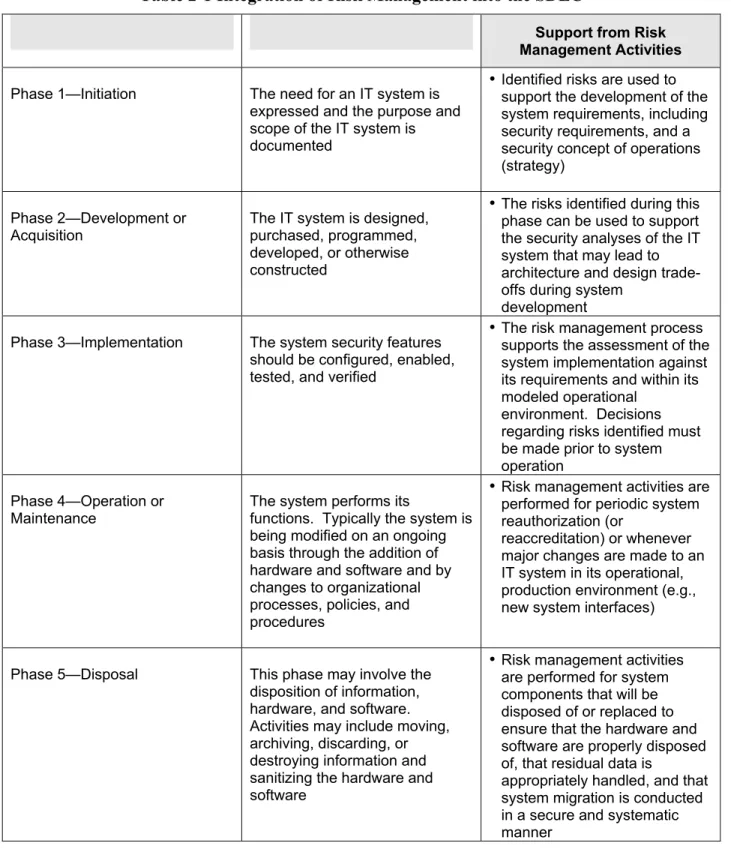
systems. Effective risk management must be totally integrated into the SDLC. An IT system’s SDLC has five phases: initiation, development or acquisition, implementation, operation or maintenance, and disposal. In some cases, an IT system may occupy several of these phases at the same time. However, the risk management methodology is the same regardless of the SDLC phase for which the assessment is being conducted. Risk management is an iterative process that can be performed during each major phase of the SDLC. Table 2-1 describes the characteristics
SDLC Phases Phase Characteristics
of each SDLC phase and indicates how risk management can be performed in support of each phase.
Table 2-1 Integration of Risk Management into the SDLC
Support from Risk Management Activities
Phase 1—Initiation The need for an IT system is expressed and the purpose and scope of the IT system is documented
• Identified risks are used to support the development of the system requirements, including security requirements, and a security concept of operations (strategy)
Phase 2—Development or Acquisition
The IT system is designed, purchased, programmed, developed, or otherwise constructed
• The risks identified during this phase can be used to support the security analyses of the IT system that may lead to architecture and design trade-offs during system
development Phase 3—Implementation The system security features
should be configured, enabled, tested, and verified
• The risk management process supports the assessment of the system implementation against its requirements and within its modeled operational
environment. Decisions regarding risks identified must be made prior to system operation
Phase 4—Operation or Maintenance
The system performs its
functions. Typically the system is being modified on an ongoing basis through the addition of hardware and software and by changes to organizational processes, policies, and procedures
• Risk management activities are performed for periodic system reauthorization (or
reaccreditation) or whenever major changes are made to an IT system in its operational, production environment (e.g., new system interfaces)
Phase 5—Disposal This phase may involve the disposition of information, hardware, and software. Activities may include moving, archiving, discarding, or destroying information and sanitizing the hardware and software
• Risk management activities are performed for system components that will be disposed of or replaced to ensure that the hardware and software are properly disposed of, that residual data is
appropriately handled, and that system migration is conducted in a secure and systematic manner
2.3 KEY ROLES
Risk management is a management responsibility. This section describes the key roles of the personnel who should support and participate in the risk management process.
• Senior Management. Senior management, under the standard of due care and ultimate responsibility for mission accomplishment, must ensure that the necessary resources are effectively applied to develop the capabilities needed to accomplish the mission. They must also assess and incorporate results of the risk assessment activity into the decision making process. An effective risk management program that
assesses and mitigates IT-related mission risks requires the support and involvement of senior management.
• Chief Information Officer (CIO). The CIO is responsible for the agency’s IT planning, budgeting, and performance including its information security components. Decisions made in these areas should be based on an effective risk management program.
• System and Information Owners. The system and information owners are responsible for ensuring that proper controls are in place to address integrity, confidentiality, and availability of the IT systems and data they own. Typically the system and information owners are responsible for changes to their IT systems. Thus, they usually have to approve and sign off on changes to their IT systems (e.g., system enhancement, major changes to the software and hardware). The system and
information owners must therefore understand their role in the risk management process and fully support this process.
• Business and Functional Managers. The managers responsible for business operations and IT procurement process must take an active role in the risk management process. These managers are the individuals with the authority and responsibility for making the trade-off decisions essential to mission accomplishment. Their involvement in the risk management process enables the achievement of proper security for the IT systems, which, if managed properly, will provide mission
effectiveness with a minimal expenditure of resources.
• ISSO. IT security program managers and computer security officers are responsible for their organizations’ security programs, including risk management. Therefore, they play a leading role in introducing an appropriate, structured methodology to help identify, evaluate, and minimize risks to the IT systems that support their
organizations’ missions. ISSOs also act as major consultants in support of senior management to ensure that this activity takes place on an ongoing basis.
• IT Security Practitioners. IT security practitioners (e.g., network, system, application, and database administrators; computer specialists; security analysts; security consultants) are responsible for proper implementation of security requirements in their IT systems. As changes occur in the existing IT system environment (e.g., expansion in network connectivity, changes to the existing infrastructure and organizational policies, introduction of new technologies), the IT security practitioners must support or use the risk management process to identify and assess new potential risks and implement new security controls as needed to
safeguard their IT systems.
• Security Awareness Trainers (Security/Subject Matter Professionals). The organization’s personnel are the users of the IT systems. Use of the IT systems and data according to an organization’s policies, guidelines, and rules of behavior is critical to mitigating risk and protecting the organization’s IT resources. To minimize risk to the IT systems, it is essential that system and application users be provided with security awareness training. Therefore, the IT security trainers or
security/subject matter professionals must understand the risk management process so that they can develop appropriate training materials and incorporate risk assessment into training programs to educate the end users.
3.
RISK ASSESSMENTRisk assessment is the first process in the risk management methodology. Organizations use risk assessment to determine the extent of the potential threat and the risk associated with an IT system throughout its SDLC. The output of this process helps to identify appropriate controls for reducing or eliminating risk during the risk mitigation process, as discussed in Section 4.
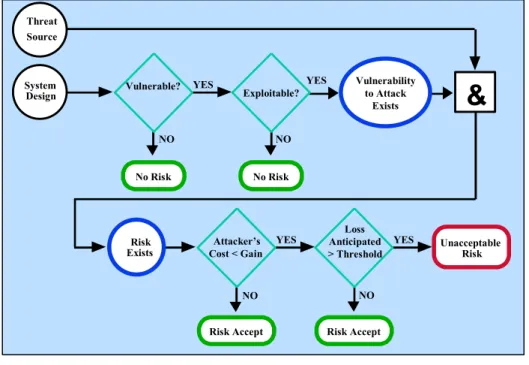
Risk is a function of the likelihood of a given threat-source’s exercising a particular potential vulnerability, and the resulting impact of that adverse event on the organization.
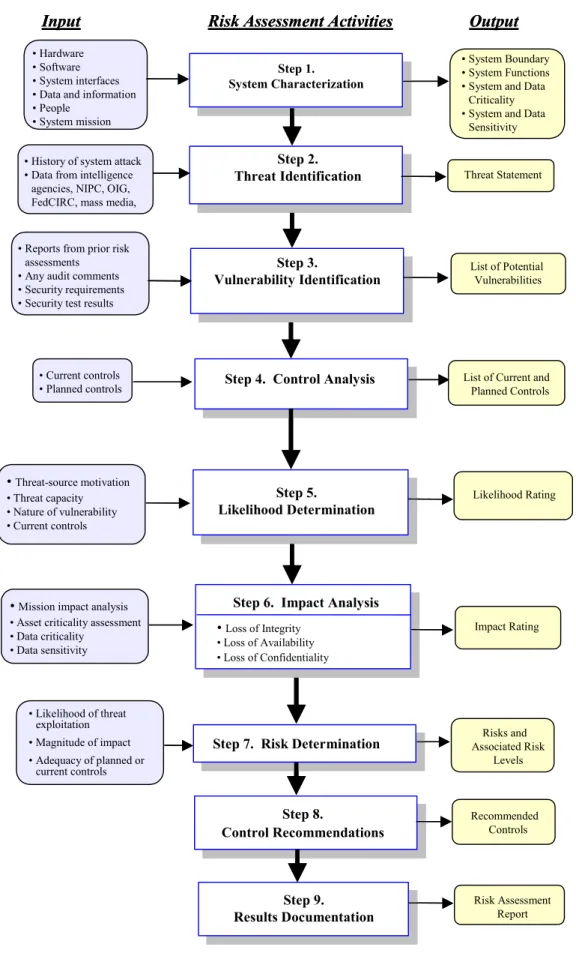
To determine the likelihood of a future adverse event, threats to an IT system must be analyzed in conjunction with the potential vulnerabilities and the controls in place for the IT system. Impact refers to the magnitude of harm that could be caused by a threat’s exercise of a vulnerability. The level of impact is governed by the potential mission impacts and in turn produces a relative value for the IT assets and resources affected (e.g., the criticality and sensitivity of the IT system components and data). The risk assessment methodology encompasses nine primary steps, which are described in Sections 3.1 through 3.9
• Step 1System Characterization (Section 3.1)
• Step 2Threat Identification (Section 3.2)
• Step 3Vulnerability Identification (Section 3.3)
• Step 4Control Analysis (Section 3.4)
• Step 5Likelihood Determination (Section 3.5)
• Step 6Impact Analysis (Section 3.6)
• Step 7Risk Determination (Section 3.7)
• Step 8Control Recommendations (Section 3.8)
• Step 9Results Documentation (Section 3.9).
Steps 2, 3, 4, and 6 can be conducted in parallel after Step 1 has been completed. Figure 3-1 depicts these steps and the inputs to and outputs from each step.
List of Current and Planned Controls
Step 4. Control Analysis
Threat Statement
Step 2. Threat Identification
List of Potential Vulnerabilities
Step 3.
Vulnerability Identification
• Reports from prior risk assessments
• Any audit comments • Security requirements • Security test results
• Hardware • Software • System interfaces • Data and information • People
• System mission
Step 1. System Characterization
Likelihood Rating
Step 5.
Likelihood Determination
•Threat source motivation • Threat capacity • Nature of vulnerability • Current controls
Step 9. Results Documentation
Risk Assessment Report
Step 6. Impact Analysis
•Loss of Integrity • Loss of Availability • Loss of Confidentiality
Impact Rating
•Mission impact analysis • Asset criticality assessment • Data criticality
• Data sensitivity
Risks and Associated Risk
Levels
Step 7. Risk Determination
• Likelihood of threat exploitation • Magnitude of impact • Adequacy of planned or
current controls
Recommended Controls
Step 8.
Control Recommendations
• System Boundary • System Functions • System and Data
Criticality • System and Data
Sensitivity
• Current controls • Planned controls • History of system attack • Data from intelligence
agencies, NIPC, OIG, FedCIRC, mass media,
List of Current and Planned Controls
• Reports from prior risk assessments
• Any audit comments • Security requirements • Security test results
• Current controls • Planned controls
Inp
Inpuutt RiRisksk AsseAssessmssmeenntt AcActtiivivittiieess Step 1. System Characterization Out Outpputut Threat Statement Step 2. Threat Identification • Hardware • Software • System interfaces • Data and information • People
• System mission
• System Boundary • System Functions • System and Data
Criticality • System and Data
Sensitivity
• History of system attack • Data from intelligence
agencies, NIPC, OIG, FedCIRC, mass media,
List of Potential Vulnerabilities
Step 3.
Vulnerability Identification
• Reports from prior risk assessments
• Any audit comments • Security requirements • Security test results
-List of Current and Planned Controls
Step 4. Control Analysis
Likelihood Rating
Step 5.
Likelihood Determination
• Threat-source motivation • Threat capacity • Nature of vulnerability • Current controls
• Current controls • Planned controls
• Mission impact analysis • Asset criticality assessment • Data criticality
• Data sensitivity
• Likelihood of threat exploitation • Magnitude of impact • Adequacy of planned or
current controls
Step 6. Impact Analysis
• Loss of Integrity • Loss of Availability • Loss of Confidentiality
Impact Rating
Step 7. Risk Determination Associated Risk Risks and Levels Step 9. Results Documentation Risk Assessment Report Recommended Controls Step 8. Control Recommendations
Figure 3-1. Risk Assessment Methodology Flowchart
3.1 STEP 1: SYSTEM CHARACTERIZATION
In assessing risks for an IT system, the first step is to define the scope of the effort. In this step, the boundaries of the IT system are identified, along with the resources and the information that constitute the system. Characterizing an IT system establishes the scope of the risk assessment effort, delineates the operational authorization (or accreditation) boundaries, and provides information (e.g., hardware, software, system connectivity, and responsible division or support personnel) essential to defining the risk.
Section 3.1.1 describes the system-related information used to characterize an IT system and its operational environment. Section 3.1.2 suggests the information-gathering techniques that can be used to solicit information relevant to the IT system processing environment.
The methodology described in this document can be applied to assessments of single or multiple, interrelated systems. In the latter case, it is important that the domain of interest and all interfaces and dependencies be well defined prior to applying the methodology.
3.1.1 System-Related Information
Identifying risk for an IT system requires a keen understanding of the system’s processing environment. The person or persons who conduct the risk assessment must therefore first collect system-related information, which is usually classified as follows:
• Hardware
• Software
• System interfaces (e.g., internal and external connectivity)
• Data and information
• Persons who support and use the IT system
• System mission (e.g., the processes performed by the IT system)
• System and data criticality (e.g., the system’s value or importance to an organization)
• System and data sensitivity.4
Additional information related to the operational environmental of the IT system and its data includes, but is not limited to, the following:
• The functional requirements of the IT system
• Users of the system (e.g., system users who provide technical support to the IT system; application users who use the IT system to perform business functions)
• System security policies governing the IT system (organizational policies, federal requirements, laws, industry practices)
• System security architecture
4 The level of protection required to maintain system and data integrity, confidentiality, and availability.
• Current network topology (e.g., network diagram)
• Information storage protection that safeguards system and data availability, integrity, and confidentiality
• Flow of information pertaining to the IT system (e.g., system interfaces, system input and output flowchart)
• Technical controls used for the IT system (e.g., built-in or add-on security product that supports identification and authentication, discretionary or mandatory access control, audit, residual information protection, encryption methods)
• Management controls used for the IT system (e.g., rules of behavior, security planning)
• Operational controls used for the IT system (e.g., personnel security, backup, contingency, and resumption and recovery operations; system maintenance; off-site storage; user account establishment and deletion procedures; controls for segregation of user functions, such as privileged user access versus standard user access)
• Physical security environment of the IT system (e.g., facility security, data center policies)
• Environmental security implemented for the IT system processing environment (e.g., controls for humidity, water, power, pollution, temperature, and chemicals).
For a system that is in the initiation or design phase, system information can be derived from the design or requirements document. For an IT system under development, it is necessary to define key security rules and attributes planned for the future IT system. System design documents and the system security plan can provide useful information about the security of an IT system that is in development.
For an operational IT system, data is collected about the IT system in its production environment, including data on system configuration, connectivity, and documented and undocumented procedures and practices. Therefore, the system description can be based on the security provided by the underlying infrastructure or on future security plans for the IT system.
3.1.2 Information-Gathering Techniques
Any, or a combination, of the following techniques can be used in gathering information relevant to the IT system within its operational boundary:
• Questionnaire. To collect relevant information, risk assessment personnel can develop a questionnaire concerning the management and operational controls planned or used for the IT system. This questionnaire should be distributed to the applicable technical and nontechnical management personnel who are designing or supporting the IT system. The questionnaire could also be used during on-site visits and interviews.
• On-site Interviews. Interviews with IT system support and management personnel can enable risk assessment personnel to collect useful information about the IT system (e.g., how the system is operated and managed). On-site visits also allow risk
assessment personnel to observe and gather information about the physical, environmental, and operational security of the IT system. Appendix A contains sample interview questions asked during interviews with site personnel to achieve a better understanding of the operational characteristics of an organization. For systems still in the design phase, on-site visit would be face-to-face data gathering exercises and could provide the opportunity to evaluate the physical environment in which the IT system will operate.
• Document Review. Policy documents (e.g., legislative documentation, directives), system documentation (e.g., system user guide, system administrative manual,
system design and requirement document, acquisition document), and security-related documentation (e.g., previous audit report, risk assessment report, system test results, system security plan5, security policies) can provide good information about the security controls used by and planned for the IT system. An organization’s mission impact analysis or asset criticality assessment provides information regarding system and data criticality and sensitivity.
• Use of Automated Scanning Tool. Proactive technical methods can be used to collect system information efficiently. For example, a network mapping tool can identify the services that run on a large group of hosts and provide a quick way of building individual profiles of the target IT system(s).
Information gathering can be conducted throughout the risk assessment process, from Step 1 (System Characterization) through Step 9 (Results Documentation).
Output from Step 1Characterization of the IT system assessed, a good picture of the IT system environment, and delineation of system boundary
3.2 STEP 2: THREAT IDENTIFICATION
A threat is the potential for a particular threat-source to successfully exercise a particular vulnerability. A vulnerability is a weakness that can
be accidentally triggered or intentionally exploited. A
threat-source does not present a risk when there is no Threat: The potential for a threat-vulnerability that can be exercised. In determining the source to exercise (accidentally trigger likelihood of a threat (Section 3.5), one must consider or intentionally exploit) a specific threat-sources, potential vulnerabilities (Section 3.3), vulnerability.
and existing controls (Section 3.4). 3.2.1 Threat-Source Identification The goal of this step is to identify the potential threat-sources and compile a threat statement
Threat-Source: Either (1) intent and method listing potential threat-sources that are applicable
targeted at the intentional exploitation of a to the IT system being evaluated.
vulnerability or (2) a situation and method that may accidentally trigger a vulnerability.
5 During the initial phase, a risk assessment could be used to develop the initial system security plan.
A threat-source is defined as any
circumstance or event with the potential to cause harm to an IT system. The common threat-sources can be natural, human, or environmental.
In assessing threat-sources, it is important to consider all potential threat-sources that could cause harm to an IT system and its processing environment. For example, although the threat statement for an IT system located in a desert may not include “natural flood” because
Common Threat-Sources
Natural Threats—Floods, earthquakes, tornadoes, landslides, avalanches, electrical storms, and other such events.
Human Threats—Events that are either enabled by or caused by human beings, such as unintentional acts (inadvertent data entry) or deliberate actions (network based attacks, malicious software upload, unauthorized access to confidential information).
Environmental Threats—Long-term power failure, pollution, chemicals, liquid leakage.
of the low likelihood of such an event’s occurring, environmental threats such as a bursting pipe can quickly flood a computer room and cause damage to an organization’s IT assets and
resources. Humans can be threat-sources through intentional acts, such as deliberate attacks by malicious persons or disgruntled employees, or unintentional acts, such as negligence and errors. A deliberate attack can be either (1) a malicious attempt to gain unauthorized access to an IT system (e.g., via password guessing) in order to compromise system and data integrity,
availability, or confidentiality or (2) a benign, but nonetheless purposeful, attempt to circumvent system security. One example of the latter type of deliberate attack is a programmer’s writing a Trojan horse program to bypass system security in order to “get the job done.”
3.2.2 Motivation and Threat Actions
Motivation and the resources for carrying out an attack make humans potentially dangerous threat-sources. Table 3-1 presents an overview of many of today’s common human threats, their possible motivations, and the methods or threat actions by which they might carry out an attack. This information will be useful to organizations studying their human threat environments and customizing their human threat statements. In addition, reviews of the history of system break-ins; security violation reports; incident reports; and interviews with the system administrators, help desk personnel, and user community during information gathering will help identify human threat-sources that have the potential to harm an IT system and its data and that may be a concern where a vulnerability exists.
Threat-Source Motivation
Table 3-1. Human Threats: Threat-Source, Motivation, and Threat Actions Threat Actions
Hacker, cracker
Challenge Ego Rebellion
• Hacking
• Social engineering
• System intrusion, break-ins
• Unauthorized system access
Computer criminal
Destruction of information Illegal information disclosure Monetary gain
Unauthorized data alteration
• Computer crime (e.g., cyber stalking)
• Fraudulent act (e.g., replay, impersonation, interception)
• Information bribery
• Spoofing
• System intrusion
Terrorist
Blackmail Destruction Exploitation Revenge
• Bomb/Terrorism
• Information warfare
• System attack (e.g., distributed denial of service)
• System penetration
• System tampering
Industrial espionage (companies, foreign governments, other government interests) Competitive advantage Economic espionage
• Economic exploitation
• Information theft
• Intrusion on personal privacy
• Social engineering
• System penetration
• Unauthorized system access (access to classified, proprietary, and/or technology-related information)
Insiders (poorly trained, disgruntled, malicious, negligent, dishonest, or terminated employees) Curiosity Ego Intelligence Monetary gain Revenge
Unintentional errors and omissions (e.g., data entry error, programming error)
• Assault on an employee
• Blackmail
• Browsing of proprietary information
• Computer abuse
• Fraud and theft
• Information bribery
• Input of falsified, corrupted data
• Interception
• Malicious code (e.g., virus, logic bomb, Trojan horse)
• Sale of personal information
• System bugs
• System intrusion
• System sabotage
• Unauthorized system access
An estimate of the motivation, resources, and capabilities that may be required to carry out a successful attack should be developed after the potential threat-sources have been identified, in order to determine the likelihood of a threat’s exercising a system vulnerability, as described in Section 3.5.
Vulnerability Threat-Source
The threat statement, or the list of potential threat-sources, should be tailored to the individual organization and its processing environment (e.g., end-user computing habits). In general, information on natural threats (e.g., floods, earthquakes, storms) should be readily available. Known threats have been identified by many government and private sector organizations. Intrusion detection tools also are becoming more prevalent, and government and industry organizations continually collect data on security events, thereby improving the ability to realistically assess threats. Sources of information include, but are not limited to, the following:
• Intelligence agencies (for example, the Federal Bureau of Investigation’s National Infrastructure Protection Center)
• Federal Computer Incident Response Center (FedCIRC)
• Mass media, particularly Web-based resources such as SecurityFocus.com, SecurityWatch.com, SecurityPortal.com, and SANS.org.
Output from Step 2A threat statement containing a list of threat-sources that could exploit system vulnerabilities
3.3 STEP 3: VULNERABILITY IDENTIFICATION
The analysis of the threat to an IT system Vulnerability: A flaw or weakness in system must include an analysis of the security procedures, design, implementation, or vulnerabilities associated with the system internal controls that could be exercised
environment. The goal of this step is to (accidentally triggered or intentionally exploited) develop a list of system vulnerabilities and result in a security breach or a violation of the (flaws or weaknesses) that could be system’s security policy.
exploited by the potential threat-sources.
Table 3-2 presents examples of vulnerability/threat pairs.
Table 3-2. Vulnerability/Threat Pairs
Threat Action
Terminated employees’ system identifiers (ID) are not removed from the system
Terminated employees Dialing into the company’s
network and accessing company proprietary data Company firewall allows inbound
telnet, and guest ID is enabled on XYZ server
Unauthorized users (e.g., hackers, terminated employees, computer criminals, terrorists)
Using telnet to XYZ server and browsing system files with the guest ID
The vendor has identified flaws in the security design of the system; however, new patches have not been applied to the system
Unauthorized users (e.g., hackers, disgruntled employees, computer criminals, terrorists)
Obtaining unauthorized access to sensitive system files based on known system vulnerabilities
Vulnerability Threat-Source Threat Action
Data center uses water sprinklers to suppress fire; tarpaulins to protect hardware and equipment from water damage are not in place
Fire, negligent persons Water sprinklers being
turned on in the data center
Recommended methods for identifying system vulnerabilities are the use of vulnerability sources, the performance of system security testing, and the development of a security requirements checklist.
It should be noted that the types of vulnerabilities that will exist, and the methodology needed to determine whether the vulnerabilities are present, will usually vary depending on the nature of the IT system and the phase it is in, in the SDLC:
• If the IT system has not yet been designed, the search for vulnerabilities should focus on the organization’s security policies, planned security procedures, and system requirement definitions, and the vendors’ or developers’ security product analyses (e.g., white papers).
• If the IT system is being implemented, the identification of vulnerabilities should be expanded to include more specific information, such as the planned security features described in the security design documentation and the results of system certification test and evaluation.
• If the IT system is operational, the process of identifying vulnerabilities should include an analysis of the IT system security features and the security controls, technical and procedural, used to protect the system.
3.3.1 Vulnerability Sources
The technical and nontechnical vulnerabilities associated with an IT system’s processing environment can be identified via the information-gathering techniques described in Section 3.1.2. A review of other industry sources (e.g., vendor Web pages that identify system bugs and flaws) will be useful in preparing for the interviews and in developing effective questionnaires to identify vulnerabilities that may be applicable to specific IT systems (e.g., a specific version of a specific operating system). The Internet is another source of information on known system vulnerabilities posted by vendors, along with hot fixes, service packs, patches, and other remedial measures that may be applied to eliminate or mitigate vulnerabilities. Documented vulnerability sources that should be considered in a thorough vulnerability analysis include, but are not limited to, the following:
• Previous risk assessment documentation of the IT system assessed
• The IT system’s audit reports, system anomaly reports, security review reports, and system test and evaluation reports
• Vulnerability lists, such as the NIST I-CAT vulnerability database
(http://icat.nist.gov)
• Security advisories, such as FedCIRC and the Department of Energy’s Computer Incident Advisory Capability bulletins
• Vendor advisories
• Commercial computer incident/emergency response teams and post lists (e.g., SecurityFocus.com forum mailings)
• Information Assurance Vulnerability Alerts and bulletins for military systems
• System software security analyses.
3.3.2 System Security Testing
Proactive methods, employing system testing, can be used to identify system vulnerabilities efficiently, depending on the criticality of the IT system and available resources (e.g., allocated funds, available technology, persons with the expertise to conduct the test). Test methods include
• Automated vulnerability scanning tool
• Security test and evaluation (ST&E)
• Penetration testing.6
The automated vulnerability scanning tool is used to scan a group of hosts or a network for known vulnerable services (e.g., system allows anonymous File Transfer Protocol [FTP], sendmail relaying). However, it should be noted that some of the potential vulnerabilities identified by the automated scanning tool may not represent real vulnerabilities in the context of the system environment. For example, some of these scanning tools rate potential vulnerabilities without considering the site’s environment and requirements. Some of the “vulnerabilities” flagged by the automated scanning software may actually not be vulnerable for a particular site but may be configured that way because their environment requires it. Thus, this test method may produce false positives.
ST&E is another technique that can be used in identifying IT system vulnerabilities during the risk assessment process. It includes the development and execution of a test plan (e.g., test script, test procedures, and expected test results). The purpose of system security testing is to test the effectiveness of the security controls of an IT system as they have been applied in an operational environment. The objective is to ensure that the applied controls meet the approved security specification for the software and hardware and implement the organization’s security policy or meet industry standards.
Penetration testing can be used to complement the review of security controls and ensure that different facets of the IT system are secured. Penetration testing, when employed in the risk assessment process, can be used to assess an IT system’s ability to withstand intentional attempts to circumvent system security. Its objective is to test the IT system from the viewpoint of a threat-source and to identify potential failures in the IT system protection schemes.
6 The NIST SP draft 800-42, Network Security Testing Overview, describes the methodology for network system
testing and the use of automated tools.
Security Area
The results of these types of optional security testing will help identify a system’s vulnerabilities. 3.3.3 Development of Security Requirements Checklist
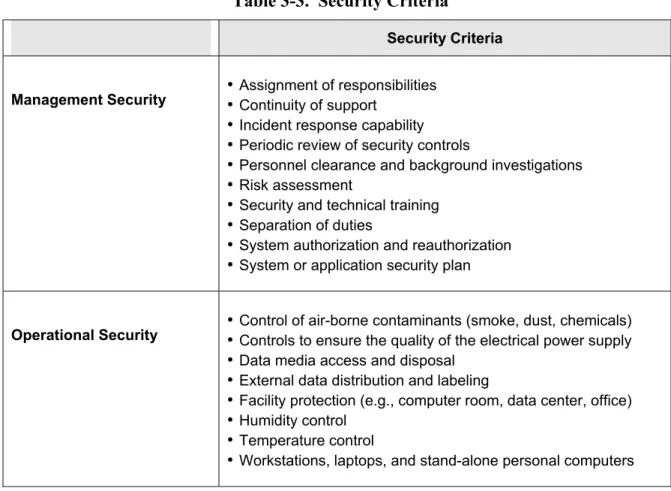
During this step, the risk assessment personnel determine whether the security requirements stipulated for the IT system and collected during system characterization are being met by existing or planned security controls. Typically, the system security requirements can be presented in table form, with each requirement accompanied by an explanation of how the system’s design or implementation does or does not satisfy that security control requirement. A security requirements checklist contains the basic security standards that can be used to systematically evaluate and identify the vulnerabilities of the assets (personnel, hardware, software, information), nonautomated procedures, processes, and information transfers associated with a given IT system in the following security areas:
• Management
• Operational
• Technical.
Table 3-3 lists security criteria suggested for use in identifying an IT system’s vulnerabilities in each security area.
Table 3-3. Security Criteria
Security Criteria
Management Security • • Assignment of responsibilities Continuity of support • Incident response capability
• Periodic review of security controls
• Personnel clearance and background investigations
• Risk assessment
• Security and technical training
• Separation of duties
• System authorization and reauthorization
• System or application security plan
Operational Security • • Control of air-borne contaminants (smoke, dust, chemicals) Controls to ensure the quality of the electrical power supply • Data media access and disposal
• External data distribution and labeling
• Facility protection (e.g., computer room, data center, office)
• Humidity control
• Temperature control
• Workstations, laptops, and stand-alone personal computers
Security Area
Security Criteria
Technical Security • • Communications (e.g., dial-in, system interconnection, routers) Cryptography • Discretionary access control
• Identification and authentication
• Intrusion detection
• Object reuse
• System audit
The outcome of this process is the security requirements checklist. Sources that can be used in compiling such a checklist include, but are not limited to, the following government regulatory and security directives and sources applicable to the IT system processing environment:
• CSA of 1987
• Federal Information Processing Standards Publications
• OMB November 2000 Circular A-130
• Privacy Act of 1974
• System security plan of the IT system assessed
• The organization’s security policies, guidelines, and standards
• Industry practices.
The NIST SP 800-26, Security Self-Assessment Guide for Information Technology Systems, provides an extensive questionnaire containing specific control objectives against which a system or group of interconnected systems can be tested and measured. The control objectives are abstracted directly from long-standing requirements found in statute, policy, and guidance on security and privacy.
The results of the checklist (or questionnaire) can be used as input for an evaluation of compliance and noncompliance. This process identifies system, process, and procedural weaknesses that represent potential vulnerabilities.
Output from Step 3A list of the system vulnerabilities (observations)7 that could be exercised
by the potential threat-sources
3.4 STEP 4: CONTROL ANALYSIS
The goal of this step is to analyze the controls that have been implemented, or are planned for implementation, by the organization to minimize or eliminate the likelihood (or probability) of a threat’s exercising a system vulnerability.
7 Because the risk assessment report is not an audit report, some sites may prefer to address the identified
vulnerabilities as observations instead of findings in the risk assessment report.
To derive an overall likelihood rating that indicates the probability that a potential vulnerability may be exercised within the construct of the associated threat environment (Step 5 below), the implementation of current or planned controls must be considered. For example, a vulnerability (e.g., system or procedural weakness) is not likely to be exercised or the likelihood is low if there is a low level of threat-source interest or capability or if there are effective security controls that can eliminate, or reduce the magnitude of, harm.
Sections 3.4.1 through 3.4.3, respectively, discuss control methods, control categories, and the control analysis technique.
3.4.1 Control Methods
Security controls encompass the use of technical and nontechnical methods. Technical controls are safeguards that are incorporated into computer hardware, software, or firmware (e.g., access control mechanisms, identification and authentication mechanisms, encryption methods,
intrusion detection software). Nontechnical controls are management and operational controls, such as security policies; operational procedures; and personnel, physical, and environmental security.
3.4.2 Control Categories
The control categories for both technical and nontechnical control methods can be further classified as either preventive or detective. These two subcategories are explained as follows:
• Preventive controls inhibit attempts to violate security policy and include such controls as access control enforcement, encryption, and authentication.
• Detective controls warn of violations or attempted violations of security policy and include such controls as audit trails, intrusion detection methods, and checksums.
Section 4.4 further explains these controls from the implementation standpoint. The implementation of such controls during the risk mitigation process is the direct result of the identification of deficiencies in current or planned controls during the risk assessment process (e.g., controls are not in place or controls are not properly implemented).
3.4.3 Control Analysis Technique
As discussed in Section 3.3.3, development of a security requirements checklist or use of an available checklist will be helpful in analyzing controls in an efficient and systematic manner. The security requirements checklist can be used to validate security noncompliance as well as compliance. Therefore, it is essential to update such checklists to reflect changes in an
organization’s control environment (e.g., changes in security policies, methods, and requirements) to ensure the checklist’s validity.
Output from Step 4List of current or planned controls used for the IT system to mitigate the likelihood of a vulnerability’s being exercised and reduce the impact of such an adverse event
Likelihood Level
3.5 STEP 5: LIKELIHOOD DETERMINATION
To derive an overall likelihood rating that indicates the probability that a potential vulnerability may be exercised within the construct of the associated threat environment, the following governing factors must be considered:
• Threat-source motivation and capability
• Nature of the vulnerability
• Existence and effectiveness of current controls.
The likelihood that a potential vulnerability could be exercised by a given threat-source can be described as high, medium, or low. Table 3-4 below describes these three likelihood levels.
Table 3-4. Likelihood Definitions Likelihood Definition
High The threat-source is highly motivated and sufficiently capable, and controls to prevent the vulnerability from being exercised are ineffective.
Medium The threat-source is motivated and capable, but controls are in place that may impede successful exercise of the vulnerability.
Low The threat-source lacks motivation or capability, or controls are in place to prevent, or at least significantly impede, the vulnerability from being exercised.
Output from Step 5Likelihood rating (High, Medium, Low)
3.6 STEP 6: IMPACT ANALYSIS
The next major step in measuring level of risk is to determine the adverse impact resulting from a successful threat exercise of a vulnerability. Before beginning the impact analysis, it is necessary to obtain the following necessary information as discussed in Section 3.1.1:
• System mission (e.g., the processes performed by the IT system)
• System and data criticality (e.g., the system’s value or importance to an organization)
• System and data sensitivity.
This information can be obtained from existing organizational documentation, such as the mission impact analysis report or asset criticality assessment report. A mission impact analysis (also known as business impact analysis [BIA] for some organizations) prioritizes the impact levels associated with the compromise of an organization’s information assets based on a qualitative or quantitative assessment of the sensitivity and criticality of those assets. An asset criticality assessment identifies and prioritizes the sensitive and critical organization information assets (e.g., hardware, software, systems, services, and related technology assets) that support the organization’s critical missions.
If this documentation does not exist or such assessments for the organization’s IT assets have not been performed, the system and data sensitivity can be determined based on the level of
protection required to maintain the system and data’s availability, integrity, and confidentiality. Regardless of the method used to determine how sensitive an IT system and its data are, the system and information owners are the ones responsible for determining the impact level for their own system and information. Consequently, in analyzing impact, the appropriate approach is to interview the system and information owner(s).
Therefore, the adverse impact of a security event can be described in terms of loss or degradation of any, or a combination of any, of the following three security goals: integrity, availability, and confidentiality. The following list provides a brief description of each security goal and the consequence (or impact) of its not being met:
• Loss of Integrity. System and data integrity refers to the requirement that
information be protected from improper modification. Integrity is lost if unauthorized changes are made to the data or IT system by either intentional or accidental acts. If the loss of system or data integrity is not corrected, continued use of the contaminated system or corrupted data could result in inaccuracy, fraud, or erroneous decisions. Also, violation of integrity may be the first step in a successful attack against system availability or confidentiality. For all these reasons, loss of integrity reduces the assurance of an IT system.
• Loss of Availability. If a mission-critical IT system is unavailable to its end users, the organization’s mission may be affected. Loss of system functionality and operational effectiveness, for example, may result in loss of productive time, thus impeding the end users’ performance of their functions in supporting the
organization’s mission.
• Loss of Confidentiality. System and data confidentiality refers to the protection of information from unauthorized disclosure. The impact of unauthorized disclosure of confidential information can range from the jeopardizing of national security to the disclosure of Privacy Act data. Unauthorized, unanticipated, or unintentional disclosure could result in loss of public confidence, embarrassment, or legal action against the organization.
Some tangible impacts can be measured quantitatively in lost revenue, the cost of repairing the system, or the level of effort required to correct problems caused by a successful threat action. Other impacts (e.g., loss of public confidence, loss of credibility, damage to an organization’s interest) cannot be measured in specific units but can be qualified or described in terms of high, medium, and low impacts. Because of the generic nature of this discussion, this guide designates and describes only the qualitative categories—high, medium, and low impact (see Table 3.5).
Magnitude of
Impact
Table 3-5. Magnitude of Impact Definitions Impact Definition
High Exercise of the vulnerability (1) may result in the highly costly loss of major tangible assets or resources; (2) may significantly violate, harm, or impede an organization’s mission, reputation, or interest; or (3) may result in human death or serious injury.
Medium Exercise of the vulnerability (1) may result in the costly loss of tangible assets or resources; (2) may violate, harm, or impede an organization’s mission, reputation, or interest; or (3) may result in human injury.
Low Exercise of the vulnerability (1) may result in the loss of some tangible assets or resources or (2) may noticeably affect an organization’s mission, reputation, or interest.
Quantitative versus Qualitative Assessment
In conducting the impact analysis, consideration should be given to the advantages and disadvantages of quantitative versus qualitative assessments. The main advantage of the qualitative impact analysis is that it prioritizes the risks and identifies areas for immediate improvement in addressing the vulnerabilities. The disadvantage of the qualitative analysis is that it does not provide specific quantifiable measurements of the magnitude of the impacts, therefore making a cost-benefit analysis of any recommended controls difficult.
The major advantage of a quantitative impact analysis is that it provides a measurement of the impacts’ magnitude, which can be used in the cost-benefit analysis of recommended controls. The disadvantage is that, depending on the numerical ranges used to express the measurement, the meaning of the quantitative impact analysis may be unclear, requiring the result to be
interpreted in a qualitative manner. Additional factors often must be considered to determine the magnitude of impact. These may include, but are not limited to—
• An estimation of the frequency of the threat-source’s exercise of the vulnerability over a specified time period (e.g., 1 year)
• An approximate cost for each occurrence of the threat-source’s exercise of the vulnerability
• A weighted factor based on a subjective analysis of the relative impact of a specific threat’s exercising a specific vulnerability.
Output from Step 6Magnitude of impact (High, Medium, or Low)
3.7 STEP 7: RISK DETERMINATION
The purpose of this step is to assess the level of risk to the IT system. The determination of risk for a particular threat/vulnerability pair can be expressed as a function of
• The likelihood of a given threat-source’s attempting to exercise a given vulnerability
• The magnitude of the impact should a threat-source successfully exercise the vulnerability
• The adequacy of planned or existing security controls for reducing or eliminating risk.
To measure risk, a risk scale and a risk-level matrix must be developed. Section 3.7.1 presents a standard risk-level matrix; Section 3.7.2 describes the resulting risk levels.
3.7.1 Risk-Level Matrix
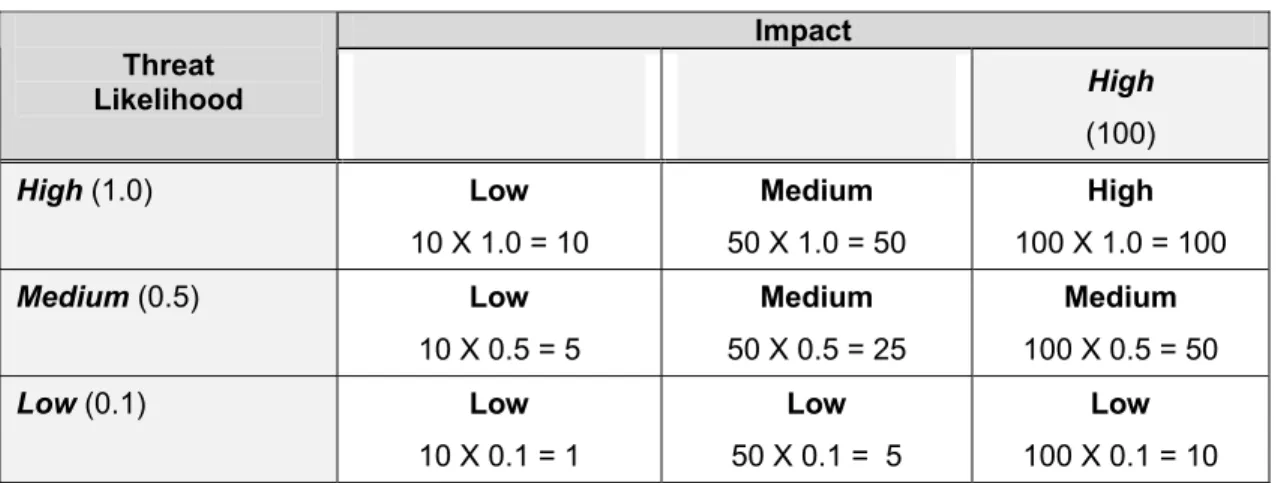
The final determination of mission risk is derived by multiplying the ratings assigned for threat likelihood (e.g., probability) and threat impact. Table 3.6 below shows how the overall risk ratings might be determined based on inputs from the threat likelihood and threat impact categories. The matrix below is a 3 x 3 matrix of threat likelihood (High, Medium, and Low) and threat impact (High, Medium, and Low). Depending on the site’s requirements and the granularity of risk assessment desired, some sites may use a 4 x 4 or a 5 x 5 matrix. The latter can include a Very Low /Very High threat likelihood and a Very Low/Very High threat impact to generate a Very Low/Very High risk level. A “Very High” risk level may require possible system shutdown or stopping of all IT system integration and testing efforts.
The sample matrix in Table 3-6 shows how the overall risk levels of High, Medium, and Low are derived. The determination of these risk levels or ratings may be subjective. The rationale for this justification can be explained in terms of the probability assigned for each threat likelihood level and a value assigned for each impact level. For example,
• The probability assigned for each threat likelihood level is 1.0 for High, 0.5 for Medium, 0.1 for Low
• The value assigned for each impact level is 100 for High, 50 for Medium, and 10 for Low.
Low
(10)
Medium
(50)
Risk Level
Table 3-6. Risk-Level Matrix Threat
Likelihood
Impact
High
(100)
High (1.0) Low
10 X 1.0 = 10
Medium
50 X 1.0 = 50
High
100 X 1.0 = 100
Medium (0.5) Low
10 X 0.5 = 5
Medium
50 X 0.5 = 25
Medium
100 X 0.5 = 50
Low (0.1) Low
10 X 0.1 = 1
Low
50 X 0.1 = 5
Low
100 X 0.1 = 10
Risk Scale: High ( >50 to 100); Medium ( >10 to 50); Low (1 to 10)8
3.7.2 Description of Risk Level
Table 3-7 describes the risk levels shown in the above matrix. This risk scale, with its ratings of High, Medium, and Low, represents the degree or level of risk to which an IT system, facility, or procedure might be exposed if a given vulnerability were exercised. The risk scale also presents actions that senior management, the mission owners, must take for each risk level.
Table 3-7. Risk Scale and Necessary Actions Risk Description and Necessary Actions High
If an observation or finding is evaluated as a high risk, there is a strong need for corrective measures. An existing system may continue to operate, but a corrective action plan must be put in place as soon as possible.
Medium If an observation is rated as medium risk, corrective actions are needed and a plan must be developed to incorporate these actions
within a reasonable period of time.
Low If an observation is described as low risk, the system’s DAA must determine whether corrective actions are still required or decide to
accept the risk.
Output from Step 7Risk level (High, Medium, Low)
8 If the level indicated on certain items is so low as to be deemed to be "negligible" or non significant (value is <1
on risk scale of 1 to 100), one may wish to hold these aside in a separate bucket in lieu of forwarding for management action. This will make sure that they are not overlooked when conducting the next periodic risk assessment. It also establishes a complete record of all risks identified in the analysis. These risks may move to a new risk level on a reassessment due to a change in threat likelihood and/or impact and that is why it is critical that their identification not be lost in the exercise.