Report from a joint workshop hosted by the Academy of Medical
Sciences, the British Academy, the Royal Academy of Engineering
and the Royal Society.
to ensure these are translated into benefits for patients. The Academy’s Fellows are the United Kingdom’s leading medical scientists from hospitals, academia, industry and the public service.
British Academy
The British Academy, established by Royal Charter in 1902, champions and supports the humanities and social sciences. It aims to inspire, recognise and support excellence in the humanities and social sciences, throughout the UK and internationally, and to champion their role and value. The British Academy is an independent, self-governing fellowship of scholars elected for their distinction and achievement.
Royal Academy of Engineering
As the UK’s national academy for engineering, we bring together the most successful and talented engineers from across the engineering sectors for a shared purpose: to advance and promote excellence in engineering. We provide analysis and policy support to promote the UK’s role as a great place from which to do business. We take a lead on engineering education and we invest in the UK’s world class research base to underpin innovation. We work to improve public awareness and understanding of engineering. We are a national academy with a global outlook and use our international partnerships to ensure that the UK benefits from international networks, expertise and investment.
The Royal Society
The Royal Society is a self-governing Fellowship of many of the world’s most distinguished scientists drawn from all areas of science, engineering, and medicine. The Society’s fundamental purpose, as it has been since its foundation in 1660, is to recognise, promote, and support excellence in science and to encourage the development and use of science for the benefit of humanity. For more information visit royalsociety.org
Report from a joint workshop hosted by the Academy of Medical
Sciences, the British Academy, the Royal Academy of Engineering
and the Royal Society.
Royal Society came together to consider the implications of human enhancement technologies for the future of work. The Academies convened a small policy-focused workshop on 7 March 2012, which brought together policy-makers with leading experts from across engineering, science, social science, the humanities and industry. The Academies are very grateful to the steering committee, chaired by Professor Genevra Richardson CBE FBA, which has overseen this project. This is the first time that these four academies have combined their expertise to consider the policy implications of developments in a diverse range of research fields.
This report captures the themes and questions that emerged from the workshop and does not necessarily represent the views of the four host academies.
All web references were accessed in October 2012. © The Academy of Medical Sciences
Contents
Summary 5
1 Introduction 9
2 Cognitive enhancement 13
3 Physical enhancement 23
4 Commercialisation opportunities and challenges 33
5 Potential implications for the future of work 37
6 Policy and regulatory implications 49
7 Conclusion 53
Annex I Workshop programme 55
Annex II Steering committee membership 57
Annex III Workshop participants 59
Over the next few decades, the nature of paid work is likely to change significantly owing, for example, to the ageing workforce and changing working practices. Although human enhancement technologies might aid society in dealing with this transition, their use at work is likely to have implications that require careful consideration, particularly by policy-makers, employers, employees, researchers and wider society. Any such use would have impacts across the population and on individuals both employed and not employed. Human enhancement has been widely debated and discussions usually focus on the desire to improve performance. Although the context of work is clearly a primary application of these technologies, debate around human enhancement has not specifically considered the context of work.
Cognisant of the lack of debate about the potential impact of human enhancement in the workplace, the Academy of Medical Sciences, British Academy, Royal Academy of Engineering and Royal Society jointly hosted a workshop to consider this topic on 7 March 2012. Human enhancement refers to endeavours that are designed or used to restore or improve human performance, thus overcoming the current limits of one’s human body (see Box 1). This workshop was concerned with novel technologies that have the potential to extend an individual’s capacities beyond their current limits. This interdisciplinary workshop brought together policy-makers with leading experts from across engineering, science, social science, the humanities and industry. The workshop provided insights into enhancements that might arise from advances in science and engineering that are likely to impact on the future of work, and it considered the associated opportunities and challenges for all stakeholders and for policy in particular. To capture the range of future technologies most accurately, the workshop primarily focused on technologies likely to impact on work in the next decade.
A fundamental aspect of this discussion relates to the ultimate objective of enhancement. Potential outcomes exist along a spectrum, from increasing participation in work among those who might otherwise be disadvantaged or excluded, to improving the performance and efficiency of all employees beyond the current limits of human capacity. Any effective regulatory framework would need to reflect these different objectives. Attention also needs to be given to the risk that people will be put under pressure to enhance their ability to tolerate demanding work such as shift working; this risk will be greatest for those with the weakest labour market conditions. Attendees were keen to stress that these technologies are not a substitute for improving conditions of work.
This report outlines selected developments from across science and engineering that could enable both cognitive and physical enhancement, although it is not exhaustive. It summarises the themes and issues raised during the workshop. Given that there is currently little debate about the use of
enhancements at work or an academic research base to draw upon, the report aims to highlight possible implications of such use, which are likely to be complex, and to identify potential areas for debate. Key messages identified by workshop participants include the following: • Enhancement technologies could
change how people work. Work
will evolve over the next decade, with enhancement technologies potentially making a significant contribution. Widespread use of enhancements might influence an individual’s ability to learn or perform tasks and perhaps even to enter a profession; influence motivation; enable people to work in more extreme conditions or into old age, reduce work-related illness; or facilitate earlier return to work
after illness.
• Implications will be complex and there
will be multiple political and social tensions. There are many instances where
the possible implications of enhancement at work will be complex and potentially divisive. Enhancement could benefit employee efficiency and even work–life balance, but there is a risk that it will be seen as a solution to increasingly challenging working conditions, which could have implications for employee wellbeing. Enabling an ageing workforce to delay retirement would have implications for youth employment.
• The distinction between enhancement
and restoration is difficult. The
workshop aimed to consider enhancement technologies as both restorative and taking individuals ‘beyond the norm’. Although ‘norm’ is a challenging concept, this distinction may be integral to considerations of the acceptability of new technologies, and thus to regulatory decisions. The use of restorative
technologies might facilitate a diminishing of the line between the disabled and the non-disabled with both negative and positive consequences.
• The use of enhancements will vary
with context. Usefulness will vary
between individuals and occupations. In addition, work will evolve over the next decade and beyond, and this will influence the role that enhancements play in the future. To maximise any benefit from enhancement technologies, we must understand the complexities of these context-specific outcomes and involve individuals in the design and integration of technologies, and in the design of any regulatory frameworks.
• It is helpful to identify whether issues
are unique to human enhancement.
If the issues raised are familiar, we must identify relevant contexts from which we can learn. In cases where unprecedented concerns exist, careful consideration and wider dialogue will be important.
• A range of policy questions will need
to be addressed. Although enhancement
technologies might bring opportunities, they also raise several health, safety, ethical, social and political challenges, which warrant proactive discussion. Very different regulatory regimes are currently applied: for example, digital services and devices (with significant cognitive enhancing effects) attract less, if any, regulatory oversight than pharmacological interventions. This raises significant questions, such as whether any form of self-regulation would be appropriate and whether there are circumstances where enhancements should be encouraged or even mandatory, particularly where work involves responsibility for the safety of others (e.g. bus drivers or airline pilots). • Empirical data are needed to guide
policy. ‘Known unknowns’ need to be
addressed by studies on short- and long-term impacts (both positive and negative) of enhancements on individuals with detailed consideration of social and ethical impacts using deliberative dialogue with users, potential users and wider society and the development of a market map to guide commercialisation. Continuous monitoring to inform the re-assessment of any policy or regulatory decisions is vital but will also require these underpinning data.
• Policy must be informed by open
dialogue. We must engage publics in
open dialogue about the prospects of enhancement technologies and how they might be used at work, particularly given that use at work would affect the entire population, both those employed and not employed. Sources of input should include users of enhancements, older populations, trade unions, as well as those with expertise with novel innovations and technologies. Policy-makers and publics must be equipped to recognise circumstances in which, for example, claims around the benefits of new technologies are inflated.
• The cost of technologies will be
crucial. Cost and cost–benefit analysis
are clearly key factors in determining who funds provision, which in turn will impact on equality and justice. Cost also drives investment decisions and will therefore be important in determining commercialisation opportunities.
• Development of enhancement
technologies might offer economic opportunities. There may be an
opportunity to create a new human enhancement industry in the UK; bringing together the UK’s leading innovators in the fields of physics, biology, chemistry, engineering and design in addition to the application of enhancements to employees working within current UK industries to increase the competitiveness of the workforce.
• The international aspect of
enhancement is inescapable. Regulation
will need to be sensitive to technological development and international competition, both in terms of developing technologies and using them to improve performance.
• The availability of enhancements will
be influential. Although the cost of some
enhancement technologies will render them inaccessible to all but the very few, raising questions of equality and justice, other technologies such as pharmacological cognition enhancers, are already readily available through the internet—posing imminent challenges for effective regulation. Likewise, digital devices and services with the potential to influence cognition are emerging continuously with little research into the risks and benefits. • Interdisciplinary approaches
will be key to moving forward. In
developing new technologies, whether they are cognitive training or bionic limbs, interdisciplinary approaches will facilitate better understanding of how best to proceed. This also applies to implementation: if any enhancement is seen as valuable, scientists need to work together with social scientists, philosophers, ethicists, policy-makers and the public to discuss the ethical and moral consequences of enhancement, and thus to harness maximum benefit with minimal harm.
Box 1 What is meant by human enhancement?
The term ‘human enhancement’ encompasses a range of approaches that may be used to improve aspects of human function (e.g. memory, hearing, mobility). This may either be for the purpose of restoring an impaired function to previous or average levels, or to raise function to a level considered to be ‘beyond the norm’ for humans.
This is often achieved through technological means, with examples including the following: • The use of cognitive enhancing drugs to improve memory and concentration.
• The use of hearing aids and retinal implants to improve sensory perception. • The use of bionic limbs to restore mobility.
These examples demonstrate that new enhancement techniques arise from a range of disciplines including biotechnology, engineering, neuroscience and computing. The social, political, ethical, economic and regulatory issues raised by their use further highlight the interdisciplinary nature of this topic.
Human enhancement refers to endeavours that are designed or used to restore or improve human performance, thus overcoming the current limits of one’s human body. Advances in fields such as biotechnology, engineering, neuroscience and computing bring the potential for novel enhancement technologies that could have significant implications for individuals and society. The development and use of these enhancements raise a range of scientific, engineering, social, political, ethical, economic and regulatory issues. In using the term ‘enhancement’ throughout this report we do not intend to imply that a consensus exists on how and whether humans might be ‘improved’ or that there will only be positive outcomes to any enhancement. Alternative terms such as ‘modulation’ have been suggested and there is merit in considering such alternatives as debate about the application of these technologies progresses.
The UK will see significant changes to its demographics over the next decade and beyond. For example, there are currently 10 million people in the UK who are over 65 years old. It is estimated that this figure will rise by approximately 5.5 million over the next 20 years and almost double to around 19 million by the year 2050.1 Demographic shifts will be
accompanied by changes to the nature of work, and both of these transitions will influence the context in which enhancements might be used. The workshop focused primarily on paid work, rather than domestic and unpaid labour that often provide vital care functions. Box 2 outlines some of the ways in which the nature of paid work might change over the next decade and beyond.
The joint academies’ workshop was concerned with novel technologies that have the potential to extend an individual’s capacities beyond their current limits. This working definition encompasses restorative enhancements and those that could take individuals ‘beyond the norm’, by which we mean both beyond an individual’s ‘norm’ and beyond the ‘norm’ of current human limits.2 In considering
implications for the future of work, we felt it important to include the whole spectrum of enhancement technologies.
In considering the application of human enhancement to work, much discussion at the workshop focused on its potential role in increasing the access of disabled people to work. The Department of Work and Pensions has estimated that there are over 10 million disabled people in the UK.3 Over 6 million
report significant problems with mobility, a similar number with lifting and carrying, and over 2 million report problems with dexterity and/or coordination. Of the people living with disabilities, about 50% are of working age. However, employment rates among individuals with a disability that limits their daily activities (DDA disabled) are well below the national average for those who are not DDA disabled (45.6% compared with 76.2%), with the lowest rates for those with depression, mental illness and learning difficulties.4 The use of
enhancement technologies that restore capacity could therefore have significant implications for this community, and, commonly, technologies used to enhance healthy individuals often emerge from those that were originally designed to be restorative.
1 Introduction
1 Cracknell R (2010). The ageing population. http://www.parliament.uk/documents/commons/lib/research/key_issues/Key%20Issues%20 The%20ageing%20population2007.pdf
2 Defining the ‘norm’ is complex. For example, in the elderly, cognition may be normal for the age but cognitive performance may have declined from performance when young. Additionally, for example, in spectrum disorders, extreme conditions may be clearly diagnosable but those on the borderline may blend with healthy controls (e.g. as for attention-deficit–hyperactivity disorder).
3 Office for Disability Issues, Department of Work and Pensions (2001). Disability prevalence estimates 2009/10. http://odi.dwp.gov.uk/docs/res/factsheets/disability-prevalence.pdf
Our working definition includes all forms of enhancement that directly alter the individual, but excludes the wider environment, i.e. alterations to the environment itself that enhance human interactions with it. There are interesting developments in efforts to enhance the environment in which people work, and moves towards assisted living (i.e. assistance with the activities of daily living) bring technical interventions that could allow people to stay in their own home for longer, particularly in old age. However, these were outside of the remit of this particular workshop. Education is relevant in its role in preparing individuals for work and ongoing training throughout the life course (e.g. lifelong learning), but was not considered a focus of this meeting.
This report seeks to capture the themes and questions that emerged from the workshop and does not necessarily represent the views of the four host academies. The report will be of interest to policy-makers, researchers in science and engineering, experts in the social sciences and humanities, research funders, industry, investors and publics, both within the UK and internationally. Chapters 2 and 3 explore the science and engineering developments that could give rise to physical and cognitive enhancement. Opportunities and challenges relating to investment and commercialisation are outlined in Chapter 4. Chapter 5 discusses possible implications for the future of work and society. Potential policy and regulatory implications are considered in Chapter 6.
Box 2 Examples of potential changes to the nature of work in future
Composition and diversity of the workforce
Owing to the ageing population, we are likely to see individuals working at an older age, resulting in a more multigenerational workforce. Different generations are likely to have different attitudes towards, and experiences of, technology. Further changes to, for example, gender balance and migration, will combine to generate additional diversity.
Working practices
Workers are likely to have increasing expectations of, and access to, flexible working. This might be in terms of working hours, location and further changes to the global nature of business and work.
Evolving nature of work
The UK has seen a transition from the production of goods to the provision of information and services, which is set to continue. Different skills will be expected from employees, which could impact on health and safety, such as the nature of work-associated illnesses.
Economics
Global economies will be in recovery for several years. We are likely to see further growth in international competition and evolution of the form and structure of organisations.
Disease trends
The conditions that will have greatest impact on the working population will be musculoskeletal disorders and mental illness. Sensory disorders will remain prevalent and lifestyle diseases will continue to rise. As the nature of, and attitudes towards, illnesses change, and as medicine progresses, it will become much more likely that individuals will work while in ill health or with disabilities.
The role of work
Work is increasingly seen as a source of wellbeing. Being in work is beneficial to physical and mental wellbeing. Employers are assuming a greater degree of responsibility for the welfare of their employees and are well placed to promote a healthy lifestyle among workers.
2 Cognitive enhancement
Overview
There are several ways to enhance cognition in humans. Education and physical exercise are two well-established cognition enhancers not considered in detail here. Over the next decade, the ageing population will render efforts to restore and maintain cognition increasingly important. Emerging approaches include the following:
• Cognition enhancing drugs used to treat individuals with neuropsychiatric disorders could also improve mental faculties such as memory and concentration in healthy individuals, enabling them to work more efficiently or for longer.
• Drugs could also facilitate cognitive maintenance, which could be particularly beneficial to the ageing workforce. Revealing the optimal timing of treatment onset, as well as the risk factors that could facilitate cognitive decline, will be invaluable.
• Cognitive training delivered by computer may be able to improve learning, and research into the ways in which the brain responds to training is beginning to inform software design. Cognitive training will be most useful if it can provide transferable improvements, rather than just better performance on specific tasks.
• Brain stimulation, particularly non-invasive techniques, might facilitate improved learning and training outcomes, but further research will be needed to reveal how it should be used. • Collective cognition could also facilitate enhanced performance at work. The rise in
ubiquitous communications technologies over the past decade has changed how we work and is likely to improve efficient and inexpensive coordination and knowledge-sharing. This brings new opportunities to harness technology to boost the power of a collective network to solve complex problems. Individuals will in turn use the outputs of collective efforts to enhance their individual performance.
Pharmacological cognitive
enhancement
Recent developments in our approaches to neuroscience and mental health policy have seen a shift in focus from attempts to treat chronic, relapsing mental health disorders to the prevention and early detection of such disorders.5 Research focuses on successful
and resilient neurodevelopment.6 Participants
emphasised that preserving mental wellbeing in this way is important to enabling people to stay in work. This was a key feature of the
2008 Foresight project on ‘Mental Capital and Wellbeing’ by the UK Government Office for Science.7
Cognitive maintenance and
restoration
Research on degenerative diseases such as dementia reflects a shift in focus to prevention. Life expectancy increases linearly by two years every decade.8 There are currently 820,000
people with dementia in the UK and this is expected to double over the next 30 years.9 5 Beddington J, et al. (2008). The mental wealth of nations. Nature 455, 1057–1060.
6 Sahakian BJ, Malloch G & Kennard C (2010). A UK strategy for mental health and wellbeing. Lancet 375, 1854–1855.
7 Foresight Mental Capital and Wellbeing Project (2008). Final project report – executive summary. The Government Office for Science, London.
8 Population Reference Bureau (2006). The future of human life expectancy: have we reached the ceiling or is the sky the limit? www.prb.org/pdf06/NIA_FutureofLifeExpectancy.pdf
9 Alzheimer’s Research Trust (2010). Dementia 2010: the economic burden of dementia and associated research funding in the United Kingdom. http://www.dementia2010.org/reports/Dementia2010Full.pdf
Current medications such as cholinesterase inhibitors target disease symptoms with the aim of delaying cognitive decline. However, novel medications that improve episodic memory more effectively, and neuroprotective medications, are needed. New approaches target the molecular pathways, such as the amyloid cascade in the brain, or the formation of insoluble tau protein, but we are yet to find a treatment that truly modifies the degeneration. It may be that the hypotheses relating to disease processes need to be reconsidered, as other factors, such as inflammation, may be more important than previously thought. However, Professor John O’Brien, Professor of Old Age Psychiatry at Newcastle University, told the workshop that there is a growing consensus that we are currently identifying and treating patients at too late a stage. It is likely that there is a 10–20 year asymptomatic stage before disease onset; targeting this might hold the key to improving methods of cognitive maintenance. This theory not only reflects our greater understanding of molecular mechanisms causing dementia but also how risk factors such as diet and activity and vascular risk during middle age affect health later in life; we must understand the risk factors for cognitive decline to improve our management of it. Professor O’Brien reported that patients seek disease stabilisation and cognitive maintenance. In moving forward, research must firstly look to further our understanding of the fundamental science of neurodegeneration, and secondly reveal the optimal timing for the delivery of such treatments, which will depend on whether they seek to prevent the underlying molecular changes, or modify risk factors.
Cognitive-enhancing drugs have not only been developed for the treatment of
neurodegenerative diseases, but also for other neuropsychiatric disorders, including attention-deficit–hyperactivity disorder (ADHD) and schizophrenia. Such disorders are characterised by cognitive manifestations including
attentional biases, aberrant learning, memory impairments, dysfunctional reward systems and a lack of top-down cognitive control by the prefrontal cortex.10 Professor Barbara Sahakian
FMedSci, Professor of Clinical Neuropsychology at the University of Cambridge, told the workshop that it is most often the decline in these cognitive abilities that inhibits individuals with depression or schizophrenia from returning to work.11,12 Cognitive enhancers can treat
cognitive disabilities and improve mental capital and wellbeing, but also an individual’s quality of life and their ability to work.13
The annual costs of these kinds of disease, including those related to lost earnings and lost productivity, mean that there are economic benefits to effective treatment of all neuropsychiatric disorders. It is estimated that by 2026, the cost of mental health disorders in England will rise to £88.4 billion, nearly half of which will be as a result of lost earnings (£40.9 billion).14
Cognitive enhancement of healthy
individuals
Box 3 outlines the kinds of cognitive enhancer on the market. Professor Sahakian reported that we are increasingly seeing some of these drugs used by healthy individuals, among whom there is evidence that they do improve
10 Sahakian BJ (2011). American College of Neuropsychopharmacology 50th Annual Meeting, 4 December 2011.
11 Scoriels L, et al. (2012). Effects of modafinil on cognitive functions in first episode psychosis. Psychopharmacology 220(2), 249–258. 12 Clark L, Chamberlain SR & Sahakian BJ (2009). Neurocognitive mechanisms in depression: implications for treatment. Annual Review of
Neuroscience 32, 57–74.
13 Morein-Zamir S & Sahakian BJ (2011). Pharmaceutical cognitive enhancement. In Illes J & Sahakian BJ, eds. (2011) Oxford Handbook of Neuroethics. Oxford University Press, Oxford UK.
14 King’s Fund (2008). Paying the Price: The cost of mental health care in England to 2026. http://www.kingsfund.org.uk/publications/paying_the_price.html
performance. For example, methylphenidate improves short-term (or working) memory in healthy volunteers, as well as in those with ADHD.15,16 It also increases the ‘efficiency’
of the prefrontal cortical network in healthy volunteers.17 Furthermore, stimulant drugs
exert their effects in a baseline-dependent manner, so stimulants will improve low performance in individuals regardless of whether the individual is a healthy volunteer or has ADHD.18 It has been shown that modafinil
improves planning in healthy volunteers.19
Research has explored whether cognitive enhancers might be of use in workers who are sleep deprived. A 2011 study found that modafinil reduces impulsive behaviour and improves cognitive flexibility in sleep-deprived doctors.20 This group of individuals often use
caffeine to improve alertness, which in higher doses is accompanied by side effects such as tremor and heart palpitations. These effects are not seen with modafinil.
Several surveys have investigated trends in the use of cognitive enhancers among student populations, with varying results, but Professor Sahakian reported that 16% may be a realistic estimate for the prevalence of use among students in the USA.21 There is also
evidence that use among healthy individuals
is rising among school students, and stimulant prescription rates in England have been rising steadily from 220,000 in 1998 to 418,300 in 2004.22 Research indicates that some
academics also make use of enhancers such as modafinil and for a variety of reasons, e.g. to overcome jetlag and to improve productivity for particularly challenging tasks.23 An online
poll by the journal Nature found that of 1,400 respondents from 60 countries, one in five said they had used drugs for non-medical reasons as a cognitive enhancer.24
The Royal Society concluded in 2011 that education is the ‘most broadly and consistently successful cognitive enhancer’.25 However, the
attraction of cognitive enhancement might lie in gaining a small but significant competitive edge. The Academy of Medical Sciences reported in 2008 that small percentage increments in performance can lead to significant improvements in functional outcome; it is conceivable that a 10% improvement in memory score could lead to an improvement in an A-level grade or degree class.26 The attraction may also
stem from the increased pleasure experienced in performing a task. There is evidence that cognitive-enhancing drugs such as modafinil can increase motivation and the pleasure gained from performing routine cognitive tasks, compared with placebo.27
15 Elliott R, et al. (1997). Effects of methylphenidate on spatial working memory and planning in healthy young adults. Psychopharmacology 131, 196–206.
16 Turner DC, et al. (2005). Neurocognitive effects of methylphenidate in adult attention-deficit/hyperactivity disorder. Psychopharmacology 178, 286–295.
17 Mehta MA, et al. (2000). Methylphenidate enhances working memory by modulating discrete frontal and parietal lobe regions in the human brain. The Journal of Neuroscience 20, RC65.
18 Del Campo N, Müller U & Sahakian BJ (2012). Neural and behavioral endophenotypes in ADHD. Current topics in Behavioural Neurosciences 11, 65–91.
19 Turner DC, et al. (2003). Cognitive enhancing effects of modafinil in healthy volunteers. Psychopharmacology 165, 260–269.
20 Sugden C, et al. (2011) Effect of pharmacological enhancement on the cognitive and clinical psychomotor performance of sleep-deprived doctors: a randomized controlled trial. Annals of Surgery 255, 222–227.
21 Babcock Q & Byrne T (2000). Student perceptions of methylphenidate abuse at a public liberal arts college. Journal of American College Health 49, 143–145.
22 Parliamentary Office of Science and Technology (2007). Better brains. http://www.parliament.uk/briefing-papers/POST-PN-285.pdf 23 Morein-Zamir S & Sahakian BJ (2007). Professor’s little helper. Nature 450, 1157–1159.
24 Maher B. (2008). Poll results: look who’s doping. Nature 452, 674–675.
25 Royal Society (2011). Brain waves module 2. Neuroscience: implications for education and lifelong learning. http://royalsociety.org/uploadedFiles/Royal_Society_Content/policy/publications/2011/4294975733.pdf
26 Academy of Medical Sciences (2008). Brain science, addiction and drugs. http://www.acmedsci.ac.uk/download.php?file=/images/ publication/Report.pdf
27 Müller U, et al. (2012) Effects of modafinil on non-verbal cognition, task enjoyment and creative thinking in healthy volunteers. Neuropharmacology, http://dx.doi.org/10.1016/j.neuropharm.2012.07.009
However, it is not clear that such enhancers will benefit all types of work. For example, participants at the workshop discussed how the effects on creativity are not clear. Research yields mixed results, but there is evidence that, for at least some cognitive-enhancing drugs, such as stimulants, effects might depend on the baseline creativity of an individual: increasing it in lower performing individuals, but inhibiting creativity in naturally high performing individuals.31 It is likely that some
enhancements will be more useful to some types of worker, for example shift workers, and that there will be individual differences in the effects of each enhancement. Where drugs are concerned, in future it might be possible to use techniques such as pharmacogenomics to determine which individuals might benefit from the use of specific cognitive-enhancing drugs. Cognitive enhancers are a significant area for pharmaceutical investment. As our
understanding of the brain improves, it may inform the development of new enhancers, for example the synaptic changes required for memory encoding.
Non-pharmacological cognitive
enhancement
Brain stimulation
There are also several non-pharmacological options for enhancing cognition. Deep brain stimulation has offered very effective symptomatic relief in some patients with Parkinson’s disease, and the technique may have potential in treatment-resistant depression.32 However, such an invasive
technique is unlikely to have widespread applications. Dr Roi Cohen Kadosh, Wellcome Research Career Development Fellow at the University of Oxford, told the workshop that non-invasive brain stimulation could be a
28 Royal Society (2011). Brain Waves module 1. Neuroscience, society and policy.
http://royalsociety.org/uploadedFiles/Royal_Society_Content/policy/publications/2011/4294974932.pdf
29 Chamberlain SR, et al. (2007). Atomoxetine improved response inhibition in adults with attention deficit/hyperactivity disorder. Biological Psychiatry 62, 977–984.
30 Scoriels L, Jones PB & Sahakian BJ (2012). Modafinil effects on cognition and emotion in schizophrenia and its neurochemical modulation in the brain. Neuropharmacology. http://dx.doi.org/10.1016/j.neuropharm.2012.07.011
31 Farah MJ (2008). When we enhance cognition with Adderall, do we sacrifice creativity? A preliminary study. Psychopharmacology 202, 541–547.
32 Holtzheimer PE (2012). Subcallosal cingulate deep brain stimulation for treatment-resistant unipolar and bipolar depression. Archives of General Psychiatry 69, 150–158.
Box 3 Examples of cognitive enhancers currently in common use
Methylphenidate (Ritalin) increases the synaptic concentration of the neurotransmitters
dopamine and noradrenaline by blocking their reuptake.
Atomoxetine (Strattera) is a relatively selective noradrenaline reuptake inhibitor. Although
Ritalin has low abuse potential when prescribed correctly, its action on the dopaminergic system brings a risk of substance misuse. By not acting on dopamine, Atomoxetine is not accompanied by such risks.
Modafinil (Provigil) is an atypical stimulant. Its cognitive enhancing effects are likely to be
due to effects on noradrenaline and possibly dopamine.
Some cognitive-enhancing drugs do not produce extreme changes in mood that usually accompany recreational use, such as a ‘high’ or ‘rush’, and do not lead to obvious physical dependence.28 This applies to drugs such as atomoxetine and modafinil.29,30
more applicable technique and of widespread use in the next years. The most used non-invasive transcranial stimulation methods are transcranial magnetic stimulation, in which a magnetic coil is placed above part of the skull to deliver magnetic pulses to the brain area beneath the skull, and to induce action potentials; and transcranial electrical stimulation, in which low electrical currents are applied to the skull through one or more electrodes, to modulate neuronal excitability in brain areas beneath the skull. Transcranial electrical stimulation offers the most possibilities for cognitive enhancement at home, office, clinics and educational institutes as it is a relatively inexpensive, portable and painless method of enhancing cognitive abilities by modulating brain activity. Currently the data from low electrical stimulation studies do not reveal any risk or major side effects. There is evidence that transcranial direct electrical stimulation shows potential in enhancing the learning and cognition of healthy adults and those with neurological impairment, and its effects could be relatively long-term in nature (e.g. between six and twelve months after treatment).33,34,35,36 More research is required
to establish how useful it might be, especially in the elderly and in children with atypical development, where experimental evidence is relatively scarce. It is also not clear whether improvements in performance are transferred to other tasks, and research is required particularly to determine optimal use, which might differ for different populations, for example:
• Point at which the technique should be used during learning.
• Duration, number of repetitions and timing of stimulation (e.g. before or during the task).
• Position on the skull for the apparatus to be placed and whether this is task-dependent. • Intensity of stimulation and whether this
varies, for example between tasks. As well as stimulating the brain, monitoring its activity may offer new opportunities to restore brain function in some disorders. Participants noted that methods in neurofeedback are being explored for the treatment of several cognitive disorders. The technique makes use of sensors placed on the scalp to record central nervous system activity (e.g. by electroencephalography or functional magnetic resonance imaging (fMRI)), which provide immediate feedback about brain activity in a way that can be used to modulate training and deliver improvements in physical, emotional or cognitive states. Research suggests that neurofeedback is an effective intervention to address the inattention, impulsivity and hyperactivity experienced by patients with ADHD and may have applications to other disorders, including Parkinson’s disease and schizophrenia.37,38,39
Cognitive training
Another way in which technology could support the development of cognitive capabilities is through cognitive training. More efficient learning could be of value in the education and training that prepare individuals to work and enable ongoing improvement. Workshop participants highlighted particular examples that will be increasingly important as the nature of work changes, such as language learning. Dr Paul Howard-Jones, Senior Lecturer in Education at the University of Bristol,
told the workshop that there are three key characteristics of digital technology that make it
33 Cohen Kadosh R, et al. (2010). Modulating neuronal activity produces specific and long lasting changes in numerical competence. Current Biology, 20, 2016–2020.
34 Dockery CA, et al. (2009). Enhancement of planning ability by transcranial direct current stimulation. The Journal of Neuroscience,
29, 7271–7277
35 Holland R, et al. (2011). Speech facilitation by left inferior frontal cortex stimulation. Current Biology 21(16), 1403–1407. 36 Fridriksson J, et al. (2011). Transcranial direct current stimulation improves naming reaction time in fluent aphasia: a double-blind,
sham-controlled study. Stroke 42(3), 819–821.
37 Arns M, et al. (2009). Efficacy of neurofeedback treatment in ADHD: the effects on inattention, impulsivity and hyperactivity: a meta-analysis. Clinical EEG and Neuroscience 40, 180–189.
38 Subramanian L, et al. (2011). Real-time functional magnetic resonance imaging neurofeedback for treatment of Parkinson’s disease. The Journal of Neuroscience 31, 16309–16317.
39 Ruiz S, et al. (2011). Acquired self-control of insula cortex modulates emotion recognition and brain network connectivity in schizophrenia. Human Brain Mapping doi: 10.1002/hbm.21427.
well-suited to supporting cognitive training: • It is adaptive: technologies can be
programmed to tailor experiences to the individual.
• It is responsive: technologies can provide immediate feedback.
• It is patient: activities can be repeated limitlessly.
Two main types of initiative look to enable brain training. Commercial ‘brain training’ software targets multiple faculties, including memory (short term, visuospatial or episodic), executive control (attention switching) and visuomotor skills. Laboratory studies normally make use of bespoke software and specifically target working memory. Although commercial training software is generally unevaluated, there is growing evidence that software used in laboratory studies can improve cognition. However, generating improvements that are transferable to tasks that have not been the focus of training presents a significant challenge.
These technologies, particularly those that are commercially available, target multiple audiences, from young to old and including those with and without cognitive impairment. Research indicates that cognitive training might support cognitive maintenance. One study found improvements in memory, reasoning and speed of processing in individuals over 65 years of age.40 However, this was not transferred
to a measurable improvement in real-life tasks, although there were fewer self-reported difficulties after the trial. Other studies have indicated that such transfer might be possible. Improvements in performance on cognitive tasks within this same age group have been reported, which subsequently translated into improvements on generalised measures of
memory and attention, for which participants had not been trained.41 Small-scale studies also
indicate that regularity may aid effectiveness: elderly participants playing training games for 15 minutes per day for at least five days a week saw improvements in executive functions and processing speed.42 In fact, regular training
may improve executive functions across all age groups in a transferable manner.43
The key to improving training methods again lies in embracing a new approach: a new science of learning, in which interdisciplinary collaboration is essential to maximising the potential of cognitive training.44 Psychology,
neuroscience, education and the use of machine learning must all interact to generate an iterative design loop where, for example, neuroscience provides insights that inform the development of technologies, which then provide a platform on which further neuroscience studies can be performed. Although such collaborations are still at a very early stage and can yield apparently conflicting findings, studies are beginning to offer insights into the underlying neural mechanisms of cognitive training. Such insights could inform better software design and offer opportunities to develop training that delivers better transfer of skills.
Current evidence suggests that, during training, activity decreases in regions of the brain concerned with general processes, for example attentional control, but increases in regions that perform task-specific functions. Fourteen hours of training over five weeks was associated with increased brain activity on a working memory task and changes in dopamine receptor D1 binding potential in the same areas.45 Further,
studies are beginning to reveal the brain
40 Ball K, et al. (2002) Effects of cognitive training interventions with older adults: a randomized controlled trial. Journal of the American Medical Association 288, 2271–2281.
41 Smith E, et al. (2009). A cognitive training program based on principles of brain plasticity: results from the Improvement in Memory with Plasticity-based Adaptive Cognitive Training (IMPACT) Study. Journal of the American Geriatrics Society 57, 594–603.
42 Nouchi R, et al. (2012). Brain training game improves executive functions and processing speed in the elderly: a randomized controlled trial. PLoS ONE, doi:10.1371/journal.pone.0029676
43 Karbach J & Kray J (2009). How useful is executive control training? Age differences in near and far transfer of task-switching training. Developmental Science 12, 978–990.
44 Meltzoff AN, et al. (2009). Foundations for a new science of learning. Science 325, 284–288.
45 Olesen PJ, Westerberg H & Klingberg T (2004) Increased prefrontal and parietal activity after training of working memory. Nature Neuroscience 7(1), 75–79. McNab F, et al. (2009) Changes in cortical dopamine D1 receptor binding associated with cognitive training. Science 323(5915), 800–802.
areas involved in performing particular tasks. For example, comparing the brain activity of children with developmental dyscalculia (difficulty with understanding and using
numbers) with that seen in children without this disorder, while playing mathematics games, can reveal differences in brain activity.46 This
information can in turn inform the evaluation of the training game in question and aid its further development. In elderly individuals, fMRI studies have revealed that computer-based training can lead to changes in brain structure in areas known to deteriorate with age.47
These studies use games designed to enhance cognition, and a variety of longitudinal, experimental and correlation studies have shown that playing action video games can enhance skills in a manner that is transferable to other contexts.48 These effects are seen
in seasoned gamers, as well as in non-game players49, and can include the following:
• Performance on visuomotor tasks. • Switching of visual attention. • Suppression of visual distraction.
• Inference of an action’s probable outcome. • Contrast sensitivity (which is a primary
factor limiting sight).
• Affective response (both aggressive and prosocial behaviour, such as empathy). Thus, video games might have potential applications to training for work. Research with surgeons indicates that those who regularly play video games pick up certain surgery skills more quickly and that training on video games appears to improve performance.50 Studies also
indicate that gaming can provide transferable skills to army pilots.51 Interdisciplinary
approaches are again key to progress, and although the neuroscience of video gaming is still in its infancy, studies are showing promise in revealing the processes involved in training. Video games may be good tools for cognitive training because they are so engaging. In fact, they can be addictive, triggering similar neuronal networks to those stimulated in drug and gambling addicts.52 It is this property
that may make them useful because the brain’s dopaminergic reward system, which is stimulated by these games, is implicated in plasticity and thus in learning. Studies in neuroscience are beginning to explore the plasticity involved in the transfer of trained abilities to real-world tasks, as well as revealing how different training strategies (e.g. focusing on individual elements of a task or a whole task in general) might impact on learning.53,54
For example, games could be designed so that the reward element is maximised to increase the likelihood of effective learning. Video games could also offer promise in cognitive maintenance. Research in patients with
Alzheimer’s disease indicates that brain training games might be more effective than traditional psychostimulation methods in reducing both cognitive decline and depressive symptoms.55
This interdisciplinary approach has the potential to lead to better incorporation of video game processes with learning and training processes.
46 Kucian K, et al. (2011). Mental number line training in children with developmental dyscalculia. Neuroimage 57, 782–795. 47 Lovden M, et al. (2010). Experience-dependent plasticity of white-matter microstructure extends into old age.
Neuropsychologia 48, 3878–3883.
48 Bavelier D, et al. (2011). Brains on video games. Nature Reviews Neuroscience 12, 763–768.
49 Green CS & Bavelier D (2003). Action video game modifies visual selective attention. Nature 423, 534–537. 50 Lynch J, Aughwane P & Hammond, TM (2010). Video games and surgical ability: a literature review.
Journal of Surgical Education 67, 184–189.
51 Gopher D, Weil M & Bareket T (1994). Transfer of skill from a computer game trainer to flight. Human Factors 36, 387–405. 52 Han DH, et al. (2011). Brain activity and desire for internet video game play. Comprehensive Psychiatry 52, 88–95. 53 Howard-Jones PA, et al. (2011). Toward a science of learning games. Mind, Brain and Education 5, 33–41.
54 Voss MW, et al. (2012). Effects of training strategies implemented in a complex videogame on functional connectivity of attentional networks. Neuroimage 59, 138–148.
55 Fernandez-Calvo B, et al. (2011). Efficacy of cognitive training programs based on new software technologies in patients with Alzheimer-Type dementia. Psicothema 23, 44–50.
Collective enhancement
Although the term ‘enhancement’ traditionally implies that individuals are the target, we could also consider it in terms of collective cognition. Much technology already exists that might enable this kind of enhancement. Technological development is offering the potential to create a truly remarkable range of applications to enhance human cognition. Such development sees disciplines converge, particularly device engineering, computer science, psychology and neuroscience. Interdisciplinary working will be key to exploiting this potential.
According to Moore’s law, the number of transistors that can be placed in a microprocessor chip doubles approximately every 18 to 24 months. The degree of memory density that can be achieved in computing devices is also doubling at similar rates. This steady progress makes developments in engineering very predictable. We can fairly accurately predict what we will be able to design and when over the next decade, and beyond. Consequently, we can look to draw conclusions about what the implications might be.
Professor Nigel Shadbolt FREng, Professor of Artificial Intelligence at the University of Southampton, told the workshop that, as a result, we are moving towards a new kind of augmented intelligence, defined by harnessing both decision support systems and ambient computing. To maximise the potential of augmented intelligence, decision support systems must be supplemented by a computing ‘fabric’ – the digital environment within which we are now immersed – that enables us to harness collective cognition routinely. This kind of enhancement can support humans to solve problems individually and collectively that were previously beyond our capacity.
A good example, so routine now that we do not necessarily recognise it as enhancement, is provided by the development of internet search engines.56 These facilities were
significantly improved by the introduction of PageRank, an algorithm that assigns relative importance to web pages based on connections that users make between them. This process aims to contextualise information and optimise its relevance to the user. The result, apart from the creation of Google itself, is near instantaneous access to billions of pages of information across the Web. This has already transformed the range of information we can individually and collectively draw on, and with developments in next-generation technologies such as the Semantic Web we can anticipate information retrieval that is even more customised to our needs.57
Uniting decision support systems with ambient computing can also help us to harness collective intelligence to augment, for example, problem solving through content creation. After the earthquake in Haiti, the rescue efforts required accurate maps of the capital, Port-au-Prince. However, existing maps did not provide sufficient detail and much of the landscape had changed due to the earthquake. Mappers from across the world used a combination of fresh satellite imagery and open-source software using open standards to generate the missing maps. This was achieved by providing relief workers on the ground with the ability to upload their Global Positioning System (GPS) data along with annotations they had made about the routes they had taken that day. The result was the crowd-sourced creation of a detailed image of the city layout within 12 days.58 No less
impressive is the collective content generation that results in resources such as Wikipedia,
56 Cascio, J (2009) Get smarter. The Atlantic Magazine, July/August 2009 http://www.theatlantic.com/magazine/archive/2009/07/get-smarter/7548/
57 Shadbolt N, Berners-Lee T & Hall W (2006) The semantic web revisited. IEEE Intelligent Systems, 21 (3), 96–101. 58 United Nations Foundation (2011). Disaster Relief 2.0: the future of information sharing in humanitarian emergencies.
where the core articles compare favourably to the very traditional encyclopaedias.59
Collective intelligence of this kind also brings the advantage of resilience in the face of attack or misinformation.
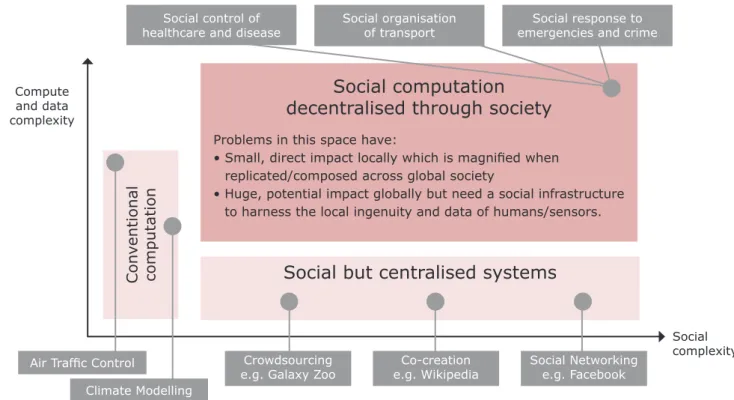
Professor Shadbolt reported that the most successful methods for harnessing collective intelligence to solve complex problems will rely on combining conventional computation with social computation, as outlined in Figure 1.
59 Giles, J (2005) Internet Encyclopedias go head to head. Nature 438, 900–901 60 Figure reproduced with the permission of Professor Nigel Shadbolt.
61 O’Hara K, et al. (2006). Memories for life: a review of the science and technology. Journal of the Royal Society Interface 3(8), 351–365. 62 De Jager D, et al. (2011). A low-power, distributed, pervasive healthcare system for supporting memory. In, 1st ACM MobiHoc Workshop on
Pervasive Wireless Healthcare.
63 Hodges S, et al. (2006). SenseCam: a retrospective memory aid. In: 8th International Conference of Ubiquitous Computing.
Of course, such technological developments can also benefit individuals. For example, Professor Shadbolt reported that within 15 years, we will have devices small enough to record an individual’s entire experience throughout their life as a continuous video feed, effectively providing a ‘life logging’ function.61 Such a device could be of use
to individuals with memory disorders.62
In clinical trials, patients show better memory recall and consolidation when presented with images than when using written logs.63
Mixed or augmented reality will be routine in the next decade. For example, Google is developing glasses that they anticipate will give the user real-time information about their environment, such as encyclopaedic knowledge, in a similar way to the current Social control of
healthcare and disease Social organisation of transport emergencies and crimeSocial response to
Climate Modelling
Con
ventional
computation
Social computation
decentralised through society
Problems in this space have:
• Small, direct impact locally which is magnified when replicated/composed across global society
• Huge, potential impact globally but need a social infrastructure to harness the local ingenuity and data of humans/sensors. Compute
and data complexity
Social but centralised systems
Air Traffic Control Co-creation
e.g. Wikipedia Social Networkinge.g. Facebook Crowdsourcing
e.g. Galaxy Zoo
Social complexity
Figure 1: Combining the power of social computation with conventional computation can enable
small, direct, local impacts that could potentially have huge global impacts.60 Compute complexity
mapping software that uses augmented reality on mobile devices.64 Immersive
technology that substitutes reality altogether has been discussed for decades and now has an established role in training, for example, jet fighter pilots. As we approach an age where we can deliver information of unsurpassed fidelity, substituting reality in this way could become a lot more efficient and applicable to other situations. In future, we will see an evolving information ecosystem, ubiquitous in our everyday lives and delivered by mobile and pervasive computing. This offers unprecedented opportunities to harness collective cognition, and the social aspect of computing will be a key element of driving progress.
Despite the immense growth in technological development, there is little empirical data on how cognition is improved with any of these tools. Participants discussed the fact that such tools can enter the market without needing to demonstrate any effects of this nature, meaning that there is currently little motivation to collect data on efficacy. With many of the technologies described, the process of finding and presenting results is
not entirely transparent to the user. Where search engines are used, biased results could be presented to the user, unknown to them if they do not understand the PageRank process or the process by which search results are further filtered. Cognition is enhanced, but there are questions about the extent to which this can be considered enhancement if users are remote from the process. Furthermore, not understanding how an enhancement works arguably compromises the use of that enhancement, and the user’s ability to optimise their use of it.
Impacts on employee motivation
Participants also discussed the use of tools such as drugs or brain stimulation in relation to mood enhancement for individuals who are not currently suffering from a mood disorder. For example, the use of cognition enhancers or brain stimulation might be of interest to employees who find aspects of their work less stimulating. Many of the enhancements discussed in this chapter have obvious ethical and social implications, which are discussed in Chapter 5.Although we consider somatic gene therapy in this chapter, which is currently being used for restoration and could be adapted for enhancement, we deliberately chose to exclude germ-line gene modification because this is unlikely to be considered a reasonable approach for technical and ethical reasons for at least the next 10 years.65 (It is also prohibited in the
UK and all countries with regulation covering human fertility and embryo research.)
Sensory enhancement
Cognitive and physical enhancements overlap when we consider enhancing human senses. Restoring lost functionality and delaying degeneration is of particular interest to an ageing population. In such contexts, it is difficult to identify the boundary between restoration and enhancement: for example, an individual may have abilities that are
3 Physical enhancement
Overview
To date, physical enhancement has been developed primarily with a focus on restoration, although over the next decade we are likely to see this extend to applications in healthy individuals. Developments include the following:
• As the average age of the working population rises, individuals are likely to seek to maintain or restore declines in sensory perception. Better-quality devices like hearing
aids will support prolonged auditory abilities, but could also be useful to individuals with
normal hearing in challenging situations, such as in the military. Equally, new techniques to
restore and maintain vision are in development, such as retinal implants, gene transfer
and replacing photoreceptors in the eye.
• Technologies external to the body can support restoration of mobility and limb function, and future applications in healthy individuals might include those whose jobs involve manual labour. Design of devices like bionic limbs and exoskeletons must overcome the traditional challenges of user control, energy efficiency and usability if they are to become more automated and easy-to-use, and thus more accurately mimic or surpass the functionality of human limbs.
• Tissue engineering and regenerative medicine are offering new opportunities to replace degenerating tissues. Less complex applications, such as bone and joint tissues, are entering clinical trials and we are seeing progress in more complex tissues like tracheas. The most complex cases will produce entire organs, but less involved techniques that target specific parts of an organ might turn out to be sufficiently effective. Research to integrate stem cell work with cardiac pumps is another avenue, which might also be applied to other organs.
• Good nutrition is clearly vital to health and wellbeing, and there may be particular nutritional approaches that benefit specific aspects of performance, such as stamina, strength and recovery time. Future applications could be improved by determining the neuronal basis of overcoming fatigue.
• Cosmetic enhancement could be appealing to some members of an ageing workforce, in which younger appearance might be believed to have implications for one’s
employment prospects.
65 The only possible exception, currently being considered, is to replace defective mitochondrial DNA, but there are no attempts being made to alter nuclear DNA.
considered normal for someone of their age, but they may consider the reduced capacity as a disability. There may also be motives to enhance non-disabled individuals, for example to hear or see in challenging situations.
Human hearing
Hearing loss affects individuals increasingly with age. For the adult population as a whole, hearing loss of 25 decibels or more affects 16% of the population. However, progressive decline in hearing from the age of 20 causes this figure to rise to 37% in those aged between 61 and 70 years, and further to 60% in those between 71 and 80.66 Professor Brian Moore
FRS FMedSci, Professor of Auditory Perception at the University of Cambridge, outlined that, in the context of work, hearing enhancement might have the following benefits:
• Allow older people to continue functioning successfully in the workplace, by effective restoration or maintenance.
• Enhance hearing for people with normal perception in noisy or reverberant situations. Most hearing loss arises in the cochlea. Individuals experience difficulties in perceiving low-level sounds and a reduced range of sound intensities over which sounds are heard comfortably, accompanied by a reduced ability to differentiate between the different frequencies in complex sounds. This results in an impaired ability to understand speech, particularly where background noise is present. Cochlear implants, which have been developed and refined over the past 40 years, are surgically implanted to restore some of the function of the cochlea, for people with profound or total hearing loss. They often enable patients to understand speech and to identify environmental sounds, although the quality of sounds is not as good as with natural hearing. Implants consist of an external microphone, speech processor and
transmitter, connected to an internal receiver and stimulator. The stimulator converts signals into electric impulses, which are sent through an internal cable to an array of electrodes along the length of the cochlea.
Hearing aids have become increasingly sophisticated to try to overcome some of the problems of hearing loss. For example, with multi-channel compression, sounds are split into several frequency bands and each one is amplified to a different extent depending on the frequency and the input sound level. This addresses issues with the limited range of audible and comfortable sound intensities, but there are limitations in practice. Other developments look to improve the perception of speech in background noise. For example, hearing aids make use of directional
microphones to detect sounds selectively from the front. Signals can be further enhanced using digital processing and by using bilaterally fitted hearing aids (one on each ear) that can communicate with each other and be remotely controlled. In the future, remote controls could be replaced with a sensor that detects brain signals, but this is many years away. A novel method of sound delivery for those with mild to moderate hearing loss is incorporated in the EarLens system. Sound is picked up by a microphone in or near the ear canal, and audio signals and power are transmitted by a laser to a receiver and transducer that vibrates the eardrum directly. This provides high-fidelity amplification over a wide frequency range. Another benefit is that the ear canal remains open, meaning that sounds not produced by the device can still be heard and the voice of the user sounds natural. There is also potential for the remote transmission of signals to this device, which could be of use in individuals without hearing impairments.
Hearing enhancement in healthy individuals could be brought about by other arrangements of radio systems, in which sounds are
transmitted directly to the ear of the listener. This reduces background noise and reverberation and has multiple potential applications. Immediate applications include the following: in the classroom, with children who have attention disorders; with devices in the home, such as a television; in noisy factories and other working environments, or with the military, to allow communication signals to be received effectively while hearing protection is being worn.
Further in the future, intensive research is being conducted on hair cell regeneration. Damage to the inner and outer hair cells is a common cause of cochlear impairment. Hair cell regeneration occurs naturally in birds after damage, providing an extra impetus for research into how this might be replicated in humans.
Visual enhancement
In industrialised countries, retinal degeneration is most commonly caused by age-related macular degeneration (AMD), which usually affects individuals over 65 years of age and accounts for approximately 50% of those registered blind in the UK. Inherited retinal degeneration affects younger patients and can lead to many years spent with disability. Treatments that use recombinant antibodies for the treatment of some forms of AMD show some promise, but are expensive and require regular injections, for example every month. Dr Matteo Rizzi, Postdoctoral Fellow at
University College London with Professor Robin Ali FMedSci, told the workshop that a stable, viable and one-off solution is therefore sought. He described three methods by which this might be achieved in future:
• Retinal implants electronically stimulate retinal cells when placed either on or behind the retina. Integration of such implants presents a significant challenge, however, given the complexity of the neuronal network from the retina. In addition, only very low resolution images can currently be generated, for example those that allow identification of a bright object against a dark background.67
• To date, about 150 different genes associated with retinal dystrophy have been identified. Efficient gene
supplementation in the retina, using
viral vectors, has been achieved in mouse models and, more recently, in patients.68,69,70 In other cases, where
supplementing a specific gene is not sufficient, the use of light-sensitive proteins (e.g. channelrhodopsin-2 from algae) may help to restore light responses in retinal cells, including those that are not normally photosensitive.71 However,
several limitations currently exist for this approach. First, very bright light is required. Secondly, bypassing the normal retina circuitry by stimulating downstream cells will miss important steps in the processing of visual stimuli. More generally, the production of large volumes of clinical-grade viral vectors remains difficult and expensive, and the changes to the connectivity of the degenerating retina present another obstacle.
• Cell replacement represents a promising solution to restoring function after photoreceptor degeneration. It has recently been shown that transplanted rod photoreceptor precursors do integrate in the recipient mouse retina, form synaptic connections with the correct partners and are able to send a signal to downstream
67 Zrenner E, et al. (2010). Subretinal electronic chips allow blind patients to read letters and combine them to words. Proceedings of the Royal Society B 278, 1489–1497.
68 Smith AJ, et al. (2012). Gene supplementation therapy for recessive forms of inherited retinal dystrophies. Gene Therapy 19(2), 154–161. 69 Bainbridge JWB, et al. (2008). Effect of gene therapy on visual function in Leber’s congenital amaurosis. The New England Journal of
Medicine 358, 2231–2239.
70 Maguire AM, et al. (2008). Safety and efficacy of gene transfer for Leber’s congenital amaurosis. The New England Journal of Medicine 358, 2240–2248.
71 Busskamp V, et al. (2010). Genetic reactivation of cone photoreceptors restores visual responses in retinitis pigmentosa. Science 329, 413–417.