Job Satisfaction and Work Performance
Yamin Danish
Research Scholar
Abstract
Motivation automatically comes when proper employee engagement is there. Managers views about the current motivational approaches offered by their employers, for example are organizations using the right approach? And what are the key factors which motivate managers? Proper communication, learning, work environment, career development, performance management are some key indicators of measuring motivators. The purpose of this research paper is to show that motivation and employee engagement are critical areas that can help organisations be more effective. Research on motivation and employee engagement has attracted academic and corporate entities over the last two decades. In the present study, authors have reviewed the intense literature to extract all possible dimensions of motivation, having direct and indirect impact on motivation techniques. This has examined the multidimensionality of motivation from the existing literature and present a conceptual framework based on it, and it is experienced that various motivation techniques are having a positive impact on both employee satisfaction and the quality of performance in the organization Motivation and employee engagement are inter related with each other, one’s direction to behavior, what causes a person to want to repeat a behavior and vice a versa.
INTRODUCTION
Most often employee engagement has been defined as emotional and intellectual commitment to the organisation or the amount of discretionary effort exhibited by employees in their job. Although it is acknowledged and accepted that employee engagement is a multi-faceted construct.
Truss et al define employee engagement simply as ‘passion for work’, a psychological state which is seen to encompass the three dimensions of engagement, and captures the common theme.
Employee Engagement is typically measured by conducting periodic surveys followed by
announcements of new HR practices or incremental process improvements. These rarely make a significant difference. Instead, a more proactive approach that addresses and helps resolve the root causes is required. Sapience is a unique technology solution that provides Automated Visibility and Analytics about individual and team engagement and their contributions. It empowers each stakeholder in the business to help improve Employee Engagement in their own circle of influence:
Employees: Sapience provides an application on each user’s desktop, that profiles their work
time, activities and habits. It is their own data on their PC. The user learns how to avoid distractions, stay focused and deliver the results expected of him/her in reasonable time. This enables each employee to become more effective at work while avoiding burnout.
Managers: For the first time, managers get accurate team insights that help them to delegate
effectively, balance workload across team members, and guide the team to stay focused on the right activities that result in the best possible outcome.
Business Leaders: Sapience helps create organizational structures that inspire the employees to
take pride in their work. It provide insights about exact utilization levels at all levels, based on which they can optimally align their workforce to strategy.
MOTIVATION
There tends to be a general consensus as to the definition of motivation which reflects that: (1)
motivation is goal directed , (2) motivation outlines the achievement and pursuit of goals and (3)
motivation is environmentally dependent. Campbell and Pritchard define motivation as being the set
of psychological processes that cause the initiation, direction, intensity, and persistence of behavior.
Because motivation is so difficult to define, it may help in determining what motivation is not.
Motivation is not: (1) directly observable, (2) the same as satisfaction, (3) always conscious, and (4)
directly controllable.
Figure 1: Motivation: between the organisation and manager
Nearly half, more than four in ten YES 54%
respondents, say that their
organisation does not take the right NO 46% approach in order to motivate them
Figure 2: Motivation: between the manager and their staff
The majority of managers, seven strongly agree 30 in ten, say that it is easy to motivate agree 60 the staff that report to them disagree 70
This indicates that the relationship between people is more important from a motivational
perspective than the relationship between the organisation and its people. We would offer the
following practical model to help you assess your own motivation, your organisations approach to
The framework above suggests that there are five inter linked aspects of your working life that contribute to motivation.
Motivation is not directly observable. “Motivation is an internal state that causes people to behave
in a particular way to accomplish particular goals and purposes. It is possible to observe the outward
manifestations of motivation but not motivation itself”. For instance, the acquisition of money may
be an extrinsic motivator, but it is simply the manifestation of the internal drive to meet intrinsic
needs like purchasing food, paying rent for shelter, or acquiring high social status.
Motivation is not the same as satisfaction. “Put simply, satisfaction is past oriented, whereas
motivation is future oriented”. While a worker may be very satisfied by the compensation of their
job, there are countless instances where these workers are not entirely motivated to continue doing
what they.
What does your organisation do to demotivate you?
Poor management/leadership, slow decision making, risk aversion at the top “risk averse and will always
err on side of caution”, “going back on decisions”, “lack of leadership from immediate manager”
Poor top managers and leaders “too many people who lack the skills to be top managers and leaders”, “who
What does your organisation do to motivate you?
What else could your organisation do to motivate you?
LITERATURE REVIEW
Research on motivation has attracted academic and corporate entities over the last two decades. In the study, authors have reviewed the intense literature to extract all possible dimensions of motivation, having direct and indirect impact on motivation techniques. This has examined the multidimensionality of motivation from the existing literature and present a conceptual framework based on it, and it is experienced that various motivation techniques are having a positive impact on both employee satisfaction and the quality of performance in the organization; however, the model
Autonomy, empowerment, trust and freedom “trust being shown in me to deliver important
outcomes”, “freedom to create” Shares the vision, values and beliefs; engaged “clear
communicated picture of expectations of our division”, “clear values which are shared”
Involved, consulted and values my opinions “values my contributions”, “informs me and involves me”, “I can suggest changes and be listened to”
Pay and rewards
“acceptable level of reward”, “salary (obviously!)”, “a reasonable
financial package”, “an OK salary.”
More recognition, thanks, encouragement and feedback. “some kind of formal recognition would be
good”, “better recognition of good work”, “wider recognition of success”, “say thank you occasionally”
Improved communications, more visibility of top team, contact, talk more, be more open “better
communications and a couple of „thank you‟ comments occasionally”
this paper related to employee motivation, a large body of literature mainly from different journals have been incorporated.
How Organisations Motivate Managers
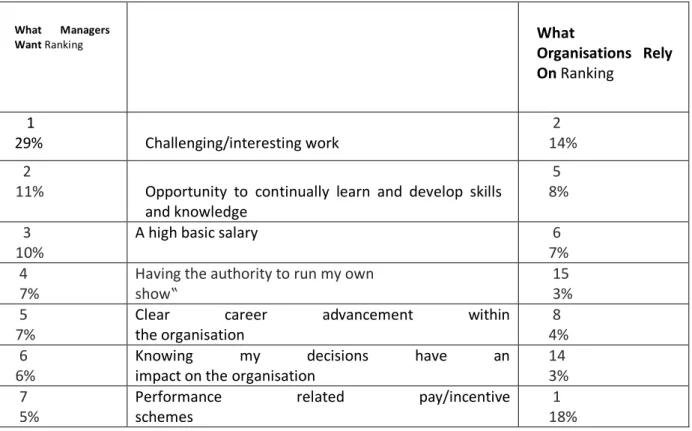
we listed a number of key motivators and rank them accordingly in relation to importance to themselves and also with regard to how their organisation viewed them as motivators for employees. The following table highlights the major responses:
Table 1: The 7 Key Factors for Motivation and Engagement
What Managers
Want Ranking What
Organisations Rely On Ranking
1
29% Challenging/interesting work
2 14% 2
11% Opportunity to continually learn and develop skills and knowledge
5 8%
3 10%
A high basic salary 6
7% 4
7%
Having the authority to run my own show‟
15 3% 5
7%
Clear career advancement within
the organisation
8 4% 6
6%
Knowing my decisions have an
impact on the organisation
14 3% 7
5%
Performance related pay/incentive
schemes
Employers
%
49 career development opportunities (lack of) 48 promotion opportunities (lack of) 43 base pay (dissatisfaction with)
All Employees
%
35 stress levels 34 base pay
27 promotion opportunities 25 career development opportunities 20 work/life balance
Top-performing Employees
%
39 base pay
37 stress levels
27 promotion opportunities 20 career development opportunities 19 work/life balance
Approaches used by Managers who Find it Easy to Motivate Staff
“I coach them” “Give them freedom to
organise their own work”
“Tasks in our department link to the strategy”
“I trust them and delegate to the maximum”
“Let them use their own initiative”
“Am open, honest, encouraging and supportive”
“We respect each other” “I support my direct reports to learn and develop through making their own decisions and mistakes”
“Make my staff feel they are valued”
“I am approachable and people feel they can come to me as necessary”
“Always ensuring they receive the praise for an idea, not me or someone higher up the organisation”
“Listen and take note of staff ideas”
“I involve them in decisions and strategy and they are keen to do well”
“We have a joint process of motivation, reviewing performance together”
“We support and challenge each other well”
Ten key areas for Measuring Motivation
Communication
Management style
Teamwork
Motivation
Learning and development
Learning and development
Work relationships
Work environment
Performance Management Career development
Thus, we can say that there are different motivational approaches which help to build a healthy relationship between managers and employees. Some key indicators are necessary to considered when we are talking about motivation and employee engagement.
CONCLUSION
REFERENCES
1. Otken, A.B & Erben, G.S (2010) Investigating the Relationship Between Organizational Identification and Work Engagement and the Role of Supervisor Support. Journal of Economics & Administrative Sciences, Vol. 12, Issue 2, pp.93-118.
2. Punia, B. K & Sharma, Priyanka (2008) Employees Perspective on Human Resource
Procurement Practices as Retention Tool in Indian IT Sector. Journal of Organizational, Vol. 12, Issue 4, pp.57- 69. Rehman, M.S & Waheed Ajmal (2011) An Empirical Study of Impact of Job Satisfaction on job Performance in the Public Sector Organizations. Interdisciplinary Journal of Contemporary Research in Business, Vol. 2, Issue 9, pp.167-181.
3. Rettab, B et al (2009) A Study of Management Perceptions of the Impact of Corporate Social Responsibility on Organisational Performance in Emerging Economies:The Case of Dubai. Journal of Business, Vol. 89, pp. 371-390.
4. Sharma, Baldev. R et al (2010) Determinants of Employee Engagement in a Private Sector Organization: An Exploratory Study, Advances in Management, Vol. 3, Issue 10, pp.52-59. 5. Smith, E et al (2003) Differentiating Work Autonomy Facets in a Non- Western Context.
Journal of Organizational Behavior, Vol. 24, pp.709- 731.