Contents lists available atScienceDirect
Physics
Letters
B
www.elsevier.com/locate/physletb
Constraining
spatial
variations
of
the
fine-structure
constant
in
symmetron
models
A.M.M. Pinho
a,b,c,
M. Martinelli
d,
C.J.A.P. Martins
a,e,∗
aCentrodeAstrofísica,UniversidadedoPorto,RuadasEstrelas,4150-762Porto,Portugal bFaculdadedeCiências,UniversidadedoPorto,RuadoCampoAlegre687,4169-007Porto,Portugal
cInstitutfürTheoretischePhysik,Ruprecht-Karls-UniversitätHeidelberg,Philosophenweg16,69120Heidelberg,Germany dInstituteLorentz,LeidenUniversity,POBox9506,Leiden2300RA,TheNetherlands
eInstitutodeAstrofísicaeCiênciasdoEspaço,CAUP,RuadasEstrelas,4150-762Porto,Portugal
a
r
t
i
c
l
e
i
n
f
o
a
b
s
t
r
a
c
t
Articlehistory:
Received13February2017
Receivedinrevisedform11April2017 Accepted12April2017
Availableonline14April2017 Editor: M.Trodden
Keywords: Cosmology
Fundamentalcouplings Fine-structureconstant Astrophysicalobservations
Weintroduceamethodologytotestmodelswithspatialvariationsofthefine-structureconstant
α
,based onthe calculation ofthe angularpower spectrum ofthesemeasurements. Thismethodologyenables comparisonsofobservationsandtheoreticalmodelsthroughtheirpredictionsonthestatisticsoftheα
variation.Hereweapplyittothecaseofsymmetronmodels.Wefindnoindicationsofdeviationsfrom the standard behavior, with currentdata providingan upper limitto thestrength ofthe symmetron couplingtogravity(logβ2<−0.9)whenthisistheonlyfreeparameter,andnot abletoconstrainthe modelwhenalsothesymmetrybreakingscalefactoraS S Bisfreetovary.
©2017TheAuthor(s).PublishedbyElsevierB.V.ThisisanopenaccessarticleundertheCCBYlicense (http://creativecommons.org/licenses/by/4.0/).FundedbySCOAP3.
1. Introduction
Astrophysicaltestsofthestabilityofdimensionless fundamen-talcouplingssuchasthefine-structureconstant
α
areapowerful probeof cosmology aswell as offundamental physics [1,2]. The analysisofa datasetof293archival datameasurementsfromthe Keck and VLT telescopes by Webb et al. provided an indication of spatial variations with an amplitude of a few parts per mil-lion,withastatisticalsignificanceof4−
σ
[3].Eventhoughthere are concerns aboutpossible systematiceffects inthis dataset [4] andthe statistical significance itself decreases when this dataset is analyzed jointly withmore recent data [5], it is important to considerthe theoreticalimplications of such results,alsobearing inmindthatforthcomingastrophysical facilitieswillenable much moreprecisetestsinthenearfuture.Ataphenomenologicallevelitiscommontofitthe astrophys-icalmeasurementswithasimpledipole,withorwithoutan addi-tionaldependenceonredshiftorlook-backtime[3,5].Ontheother hand, from a theoretical point of view simplistic dipole models wouldrequirestrong fine-tuning toexplain such abehavior, and
*
Correspondingauthorat:CentrodeAstrofísica,UniversidadedoPorto,Ruadas Estrelas,4150-762Porto,Portugal.E-mailaddresses:[email protected](A.M.M. Pinho), [email protected](M. Martinelli),[email protected] (C.J.A.P. Martins).
aphysicallymotivatedapproachwouldrelyonenvironmental de-pendencies[6].Thisthereforecallsformorerobustmethodologies whichenableaccuratecomparisonsbetweenmodelsand observa-tions.EarlyworkalongtheselineswasdonebyMurphyet al.,who calculatedthetwo-pointcorrelationfunctionoftheKeck subsam-pleoftheaforementionedarchivaldata,findingittobeconsistent withzero[7].Inthispaperwe movefromthetwopoint angular correlationfunction tothecalculationoftheangularpower spec-trumofthesemeasurements.Theaimofadoptingthisapproachis tobe abletocompress thedatainformationinsucha wayto al-lowforcomparisonwiththepredictionsoftheoreticalmodels.As aproofofconcept,inthispaperweapplythismethodtothecase ofthesymmetronmodel,forwhichtheenvironmentaldependence of
α
hasbeenpreviouslystudiedusingN-bodysimulations[8].InSection 2we presentaconciseoverviewofthesymmetron model.Section3presentsthe methodologyusedtocompress the
α
measurements intoangularpower spectra.Insection 4we cal-culate the theoretical power spectrum for thesymmetron model andpresentouranalysis methodology,leading to theresults dis-cussedinSection5.Finally,inSection6wesummarizeourresults andtheoutlookforthismethodology.2. Symmetronmodel
The symmetron modelis a scalar-tensormodification of grav-ity,introducedinordertoachieve anadditionallongrangescalar
http://dx.doi.org/10.1016/j.physletb.2017.04.027
force while still satisfyinglocal gravity constraints thanks to the environment density dependence of its coupling to matter. This modificationofgravityisdescribedbytheaction[9]
S
=
dx4
√
−
gR2M
2 pl
−
1 2
(∂φ)
2
−
V(φ)
+
Sm(m;
gμνA2
(φ))
(1)
where g
=
det(
gμν),
Mpl=
1/
√
8
π
G andSm isthematter-action. The conformal coupling between the scalar field and the matter fieldsmexpressedby
˜
gμν=
gμνA2(φ)
,isassumedtobethe sim-plestoneconsistentwiththepotentialsymmetry,A
(φ)
=
1+
1 2φ
M
2,
(2)withMand
μ
arbitrarymassscales.Thiscouplingleadstoafifth force,whichinthenon-relativisticlimitisgivenby− →
Fφ
≡
d A
(φ)
d
φ
− →∇
φ
=
φ
− →
∇
φ
M2
.
(3)Thepotentialischosentobeofthesymmetrybreakingform
V
(φ)
= −
12
μ
2
φ
2+
14
λφ
4
.
(4)The dynamicsof the scalarfield
φ
is determinedby an effective potentialwhichinthenon-relativisticlimit(relevantforthe astro-physicalmeasurements)hastheformVe f f
(φ)
=
V(φ)
+
A(φ)
ρ
m=
1 2
ρ
mμ
2M2−
1μ
2φ
2+
14
λφ
4
;
(5)thismeansthatintheearlyUniverseor,ingeneral,whenthe mat-terdensityis high, the effective potential hasa minimum
φ
=
0 where thefield will reside. As the Universe expands, the matter densitydilutes untilitreachesa criticaldensityρS S B
=
μ
2M2 for whichthesymmetrybreaksandthefieldmovestooneofthetwo newminimaφ
= ±
φ
0= ±
μ
/
√
λ
.The fifth-forcebetweentwo testparticles residing in aregion ofspacewherethefieldhasthevalue
φ
=
φ
local canbecalculated tobe[9]Fφ
Fgravity
=
2
β
2φ
local
φ
0 2∼
2β
21
−
ρ
μ
2M2,
(6)for separations of the Compton wavelength
λ
local=
1/
Ve f f,φφ(φ
local)
, where the coupling strength to gravity is given byβ
=
φ
0MplM2 (7)
For larger separations or in the cosmological background before symmetry breaking,
φ
local≈
0 and the force is suppressed. After symmetry breaking, the field moves towardsφ
= ±
φ
0 and the force is comparable to gravity forβ
=
O
(
1)
. Non-linear effects inthe field-equationensure that theforce is effectivelyscreened inhigh densityregions. The symmetry breaks atthe scale factoraS S B
=
(
ρm
,0/
ρS S B
)
andtherangeofthefifth-forcewhenthe sym-metry is broken isgiven byλ
φ0=
1/(
√
2
μ
)
, where localgravity constrains satisfyλ
φ01 Mpc/h for symmetry breaking closeto today,i.e.aS S B≈
1[10].Sincethesymmetronscalarfieldisadynamicaldegreeof free-dom, one naturally expects it to couple to the other degrees of freedom inthe Lagrangian,unless a newsymmetry ispostulated to suppressthesecouplings. Inparticular, we can assume that it coupleswiththeelectromagneticsectorofthetheory[8]
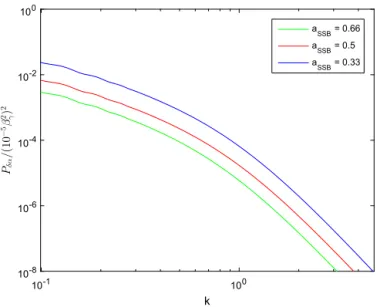
Fig. 1.TheoreticalpowerspectrumPδα(k,a)givenbyeq.(10)asafunctionofthe wavenumberkfora=1,β=1,λφ0=1 Mpc/handdifferentsymmetrybreaking scalefactorsaS S B= [0.33,0.5,0.66].Notethatstrictlyspeakingeq.(10)only ap-pliesinthelinearregime,sothebehavior beyondthisshouldbetakenwithcare. Following[8]anormalizationfactorx=0.06(0.5/aS S B)wasused.(For interpreta-tionofthereferencestocolorinthisfigurelegend,thereaderisreferredtothe webversionofthisarticle.)
SE M
= −
dx4
√
g BF(φ)
1 4F
2
μν
,
(8)where BF is the gauge kinetic function which leads to
α
=
α
0B−1F(φ)
. Withthesame choiceof quadraticcoupling B−1F(φ)
=
1
+
12β
γ2 φM
2onegetsthefollowingvariationofthefinestructure constant
δ
α≡
α
α
=
α
(φ)
−
α
0α
0=
B−1F
(φ)
−
1=
1 2β
γφ
M
2.
(9)Consideringperturbations ofthe scalarfield inFourierspace, the power spectrum for variations of
α
in the linear regime can be connectedtothematterpowerspectrum Pm(
k,
a)
asfollows[8]Pδα
(
k,
a)
=
3
m
H20β
γ2β
2a
(
k2+
a2m2φ
)
φ
φ
0 22Pm(k
,
a),
(10)where
mand H0 arethepresent-daymatterdensityandHubble parameter,
β
γ isthescalar-photon couplingrelative tothe scalar-mattercoupling,kistheco-movingwavenumber,m2φ
=
Ve f f,φφ(
φ)
¯
is thescalarmass inthecosmologicalbackground,and(φ/φ
0)
is thebackgroundscalarfieldvalue.Fora≥
aS S B wecanwriteφ (
a)
φ
0 2=
1
−
aS S Ba
3,
m2φ
(
a)
=
1λ
2φ0=
1−
aS S B
a
3.
(11)Pδα isplottedinFig. 1;itisalsousefultowriteitas
Pδα
(
k,
a)
=
0
.
33m
10−6β
γ2β
2a
((
k/
mφ)
2+
a2)
λ
φ0Mpc
/
h 22Pm(k
,
a).
(12)3. Observationaldata
of sight of bright quasars. In addition to the 293 archival mea-surementsofWebbet al.[3]there are 20morerecentdedicated measurements discussedin[11],making a totalof 313 measure-ments. From now on we refer to the formeras Webb andasAll
to the combination of these with the latter. For each of them, apartfrom themeasurement of the relative variationof
α
itself, the sky coordinates and redshift of the absorber (spanning the range 0.
2<
z<
4.
2) are known with negligible uncertainty. We cancompress thisinformationinan angular powerspectrum C, tobecomparedwithstatisticalpredictionscomingfrom theoreti-calmodels.Inordertodothis,weobtainthetwo-pointcorrelationfunction
c
(ϑ)
fromtheδ
α(θ,
φ)
measurements[7]c
(ϑ)
=
1¯
n2fsky
< δ
α(θ, φ)δ
α(θ
, φ
) >,
(13)where the brackets
< .
>
correspond to the average taken over all possible orthodromic separationsϑ
. Since the measurements ofδ
α are sparse on the sky (effectively point sources), the dis-creteness of the data has been taken into account following the procedure of[12]: 4π
fsky steradians is the assumed coverage of the sky ofthe dataset andn¯
=
N/(
4π
fsky)
is the corresponding meannumberdensityover theobserved partofthe sky(withN asthe numberof sources).The data we considerhere are effec-tively sparse point sources spread over the whole sky, therefore wetake fsky=
1.Thisassumptionprovidesaconservativeestimate ofthemeasurements densityn¯
andthereforeofthepower spec-trumestimation,despitealsoaffectingcosmicvariance,decreasing itsimpact ontheestimatornoise. Futuremorecompletedatasets willallowtodealproperlywiththeseaspects,exploitingalso tech-niquescommonlyusedforothercosmologicalobservables,suchas CMBorgalaxysurveys,andthereforetoobtainamoreprecise es-timateoftheerrorcontributions.Inthisworkwearealsoneglectingtheredshiftinformationof the
δ
α measurements; in practice we are assuming thatδ
α has noredshift dependenceand all thedeviations fromthe standard value are brought by spatial variations. This approach is accept-able withthe current state of the data, butit will be crucial to includeredshiftinformationwhenthedatawillreachasensitivity allowingforatomographicreconstructionofδ
α.Moreover, includ-ing the possibility ofδ
α(
z)
will be necessary to test theoretical modelswhichalsopredict atime evolutionforthe finestructure constant.WecaninprincipleperformaLegendretransformofthe angu-larcorrelationin orderto obtainthe angularpowerspectrum C as[13]
C
=
c
(ϑ)
P(
cosϑ)
d,
(14)whereP
(
cosϑ)
istheLegendrepolynomialandthesolidangle. Inpractice,wecomputethepowerspectrumestimatorC
ˆ
asˆ
C=
2πϑ
c
(ϑ)
P(
cosϑ)
sinϑϑ
(15)with
ϑ
beingthe differencebetween consecutivevaluesof the angularseparationϑ
. Theexpected errorof thepower spectrum estimatorcanbeobtainedfrom[12]2
=
2(
2l+
1)
fskyσ
f2¯
n+ ˆ
C 2(16)
whichincludesbothcontributionsoftheshotnoise
S N and cos-micvariance
C V thatcanbeexpressedas
S N
=
2(
2l+
1)
fskyσ
2 f¯
n
,
C V
=
2(
2l+
1)
fskyˆ
C
.
(17)σ
f isobtainedfromthemeasurements’errors1σ
jweightingeach measurementwithafactor w2i givenbyw2i
=
Nσ
−2 i
j
σ
j−2(18)
whichyieldstheaforementionedquantity
σ
f asσ
2f=
N
j
σ
−2j.
(19)Often there are several measurements of
δ
α at different red-shiftsalongthesamelineofsightasthelightfromthequasarcan gothroughmorethanoneabsorptionclouduntilitreachesEarth. Toavoid nullangularseparations inthe computation ofEq.(13), we chooseto usetheweighted meanmeasurement for measure-mentsinthesamelineofsight.Ourfulldatasetincludes measure-mentsfrom156independentlinesofsight.Beforecomputingthe correlation function,thedatasetisanalyzedandreplacedby new valuesofweightedredshift,zw,weightedδ
α,w andits correspond-ingweightederror,σw
describedbyzw
=
iwi
×
ziiwi
,
α
α
w=
iwi
×
ααiiwi
,
σ
w2=
1iwi
(20)
where w istheweight givenby wi
=
1/
σ
i2 andtheindex i runs overthemeasurementsoneachlineofsight.Fig. 2shows theangular power spectra C
ˆ
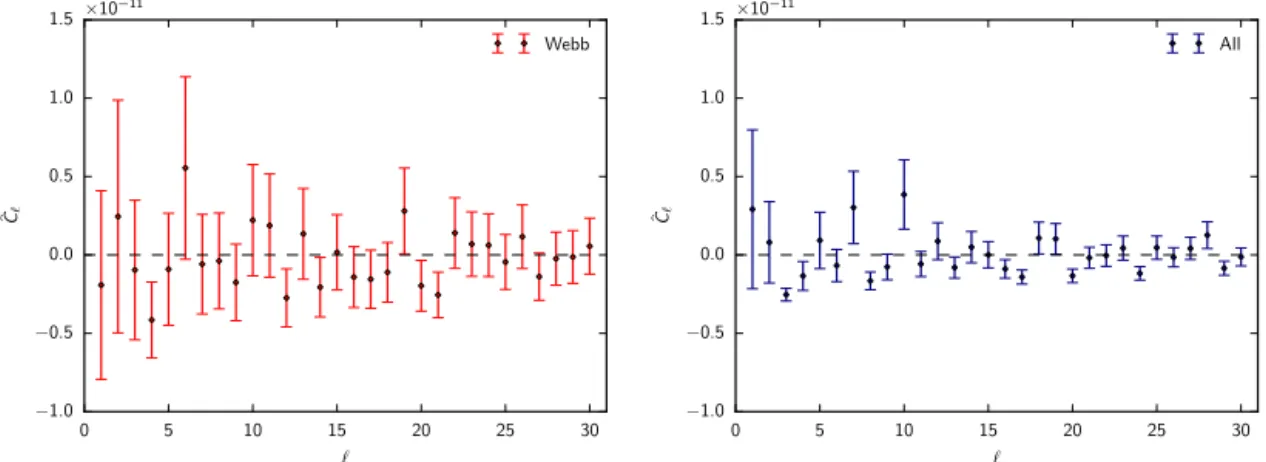
obtainedwith the procedure described above, considering the Webb dataset (left panel) andtheAll combination(right panel).We notice how the inclusion of the new data, although limited in the number of sources, leads to an improvement of the measured power spec-trum,thankstotheincreasedsensitivity.Fig. 3showsinsteadtheglobalerroronthemeasurementsand the contributions coming from shot noise and cosmic variance, where we can notice how the former dominates over the latter evenatthelargescalesconsidered.
4. Theoreticalpredictionsanddataanalysis
Wecannowcomparetheobservationalpowerspectrawiththe predictionsmadebythesymmetronmodel.Thisentailsexpressing Eq.(10)intheformofanangularpowerspectrum.Genericallythis can bewritten as2D projection ofthe 3Ddensityfield which in thiscaseisthelinearpowerspectrum P
(
k,
z)
.InthispaperweexploittheLimberapproximation,which sim-plifiesthecalculationsbyavoidingintegrationsofBesselfunctions. Wewarn thereaderthatthisapproximationcan significantly im-pact the calculation of the power spectra [13], especially atthe angular scales considered here; however, since the sensitivity of the currentlyavailable data is farfrom allowing precision recon-structionsof Pδα,theuseofmorerefinedmethods isoutsidethe aim of this paper, but this should be taken into account when more precise measurements willbe available.In this approxima-tion,wecancomputetheangularpowerspectrumas[13]
Fig. 2.Angular power spectrum estimationCˆ as a function of the multipolewith its expected errorfor theWebbdataset, and for theAllcombination.
Fig. 3.ContributionstotheerrorcomingfromshotnoiseS N(bluelines)andcosmicvarianceC V (redlines).TheleftpanelreferstotheWebbdatasetwhiletheright oneshowsthecaseoftheAllcombination.(Forinterpretationofthereferencestocolorinthisfigurelegend,thereaderisreferredtothewebversionofthisarticle.)
Fig. 4.Leftpanel:Sourcedistributionfunctioninredshiftspaceforthearchivaldatasetof[3].Rightpanel:TheoreticalpowerspectrumCforthesymmetronmodelfor differentvaluesofthescalefactorforthesymmetrybreakingaS S B.
C
≈
dzW2
(
z)
H(
z)
d2A
(
z)
Pδαk
=
l+
1/
2 r;
z(21)
whereW
(
z)
isthenormalizedsourcedistributionfunctionin red-shift space, H(
z)
is the Hubble parameter function, dA(
z)
is the angular diameter function and P(
k,
z)
is the linear power spec-trumpreviouslyobtainedinEq.(10),withk=
l+1r/2,andristhe comoving distance. We reconstruct the source distribution func-tionwitha 20bins histogramfromeach datasetconsidered. The exampleofthearchivaldatasetsourcedistributioncanbefoundin Fig. 4.In order to comparethese theoretical spectrawith the obser-vational data, we use the publicly available code
COSMOMC
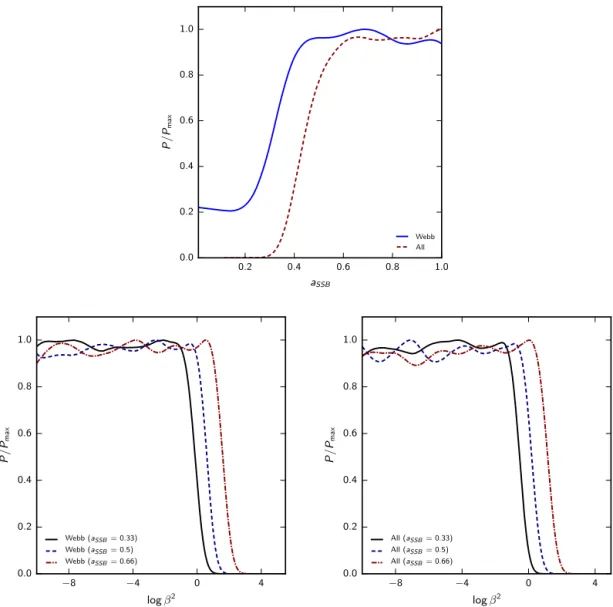
[14], modified insuch awaytocompute fromasetofparameters the theoretical power spectrum of Eq. (21), where Pδα is given by Eq.(11).princi-Fig. 5.Toppanel:1 and2−σ confidenceregionsintheaS S B−logβ2planeobtainedusingtheWebb(bluecontours)andtheAll(redcontours)datasets.Bottompanels: posteriordistributionsforaS S B (leftpanel)andlogβ2(rightpanel),wherebluesolidlinesrefertotheresultsobtainedusingtheWebbdatasetandreddashedones referto theAllcombination.(Forinterpretationofthereferencestocolorinthisfigurelegend,thereaderisreferredtothewebversionofthisarticle.)
ple,alsothestandardcosmologicalparametersshouldbeincluded inthe analysis as they affect the calculation of the power spec-tra through Eqs. (10), (21). However, current
α
datasets would not be able to simultaneously constrain the standard and sym-metronparameters, thereforeadditionalobservablessuch asCMB orsupernovaeshouldbeincluded,providedtheimpactofaspatial variationofα
isincludedalsointheanalysisofthese. Wedecide toleavetheseconsiderationsforafuture,moredetailed,paperon thetopic andrather take for the standard cosmological parame-tersthe marginalizedvalue from Planck2015[15],focusing only onconstraintsofthesymmetronparameters.5. Results
Inthis section we highlight theresults obtainedapplying the analysisdescribedabove.Inourfirstanalysis,weallowbothaS S B andlog
β
2 to varyassuming flatprior distributions,2 while fixingλ
φ0=
1 Mpc/h.Fig. 5showstheposteriordistributionforeachof thetwofreeparameterusingdifferentdatasets.Overallwe findthat theWebbdatasetis notable toconstrain thetwoparameterssimultaneouslyandnodeviationsfroma
van-2 We samplelog
β2 insteadofβ2 inordertobettersamplethelowcoupling limit.
ishing
α
variation are found. As the recent dedicated measure-ments areconsistentwithanon-varyingα
,whencombinedwith the largerarchival dataset,they leadagainto an agreementwith a vanishingβ
2,but they are still not able to putbounds on the parameters.Wealsoperformouranalysiswithonlyonefreeparameter, fix-inglog
β
2=
1 andλ
φ0=
1 Mpc/h,againonthegroundsthatthey wereusedintheN-bodysimulationsof[8],wefindthattheWebbdatasetisnotabletoconstrainaS S B,whilefortheAllcombination we finda 2
−
σ
lower limitaS S B>
0.
43, asdisplayed inthetop panelofFig. 6.Onthe otherhand,considering log
β
2 astheonly free param-eterwhilefixingλ
φ0=
1 Mpc/h anddifferentvaluesoftheepoch ofsymmetrybreaking(specifically aS S B=
0.
33,
0.
5 and0.
66), the resultsshowninFig. 6andTable 1show that,asexpected, ifthe symmetrybreaksmorerecentlyalargercouplingvalueisallowed. Again therecentmeasurementsimprovethe constraintsfromthe archivalmeasurements and,alsointhiscase,we findthat the re-sultsareconsistentwithavanishingβ
.6. Conclusionsandoutlook
Fig. 6.Toppanel:posteriordistributionfortheaS S B parameter,usingtheWebbdataset(bluesolidlines)andtheAllcombination(reddashedlines).Herewehavefixed log(β2)=1 andλ
φ0=1.Bottompanels:posteriordistributionforthelogβ2parameterwithdifferentvaluesofaS S B.OntheleftpanelweusetheWebbdataset,andonthe rightpaneltheAllcombination.Inallbothcaseswekeepλφ0=1 fixed.
Table 1
Two-σ constraints on the symmetron parameter logβ2
givenbytheWebbdatasetandtheAllcombination,for dif-ferentfixedvaluesofaS S B;λφ0=1 Mpc/hwasalsoused throughout.
aS S B=0.33 aS S B=0.50 aS S B=0.66 Webb <−0.5 <0.2 <1.2 All <−0.9 <−0.2 <0.7
dependent)variations of thefine-structure constant
α
. Theseare basedon thecalculation oftheangular powerspectrum ofthese measurements,whicharestandardinothercosmologicalcontexts. Forconcreteness we have alsoapplied thesetools to thecase ofα
variations in symmetron models. We findthat currently avail-abledataarenotabletoconstrainthesymmetronparametersaS S B andlogβ
2 whenthey are both considered as free parameters. If instead the only free parameter is the strength of the coupling to gravityβ
2, we find that thedata do not show anydeviations fromthestandardbehaviorandratherprovideanupperlimit for thiscoupling,whichislogβ
2<
−
0.
9 inthemostconstrainingcase consideredhere.Ourresultshighlightthefactthatarelativelysmallnumberof stringentmeasurements—therecentdedicated measurements
dis-cussed in [11]—lead to stronger constraints when they are com-bined with the larger dataset of earlier measurements. The cur-rentbestconstraintsontheparameter
β
comefrompulsartiming constraints on Brans–Dicke type scalar tensor theories (of which symmetronsareanexample),whichcorrespondtoβ
10−2 [10]. While our constraint is weaker, it comes fromα
measurements alone. Combining this withother cosmological datasets will lead to morestringentconstraints;we leavethisextendedanalysisfor subsequentwork.including a tomographic analysis (dividing the data into several differentredshiftbins)and,shouldvariationsbeconfirmed,model selectionstudiescomparingvariouspossibletheoreticalparadigms. Adiscussionofthesepossibilitiesisleftforsubsequentwork.
Acknowledgements
We are grateful to Luca Amendola, Micol Bolzonella and Adi Nusserfor several discussions anduseful suggestions during the variousstagesofthiswork.
ThisworkwasdoneinthecontextofprojectPTDC/FIS/111725/ 2009 (FCT, Portugal). CJM is also supported by an FCT Re-searchProfessorship, contractreferenceIF/00064/2012,funded by FCT/MCTES (Portugal) and POPH/FSE. MM is supported by the Foundation for Fundamental Research on Matter (FOM) and the Netherlands Organization for Scientific Research/Ministry of Sci-enceandEducation (NWO/OCW). MM andCJM acknowledge ad-ditionalsupportfromtheCOSTAction CA1511(CANTATA),funded byCOST(EuropeanCooperationinScienceandTechnology).
References
[1]J.-P.Uzan,Varyingconstants,gravitationandcosmology,LivingRev.Relativ.14 (2011)2.
[2]C.J.A.P.Martins,FundamentalcosmologyintheE-ELTera:thestatusandfuture roleoftestsoffundamentalcouplingstability,Gen.Relativ.Gravit.47(2015) 1843.
[3]J.K.Webb,J.A.King, M.T. Murphy,V.V.Flambaum,R.F.Carswell, M.B. Bain-bridge,Indicationsofaspatialvariationofthefinestructureconstant,Phys. Rev.Lett.107(2011)191101.
[4]J.B.Whitmore,M.T.Murphy,Impactofinstrumentalsystematicerrorson fine-structureconstantmeasurementswithquasarspectra,Mon.Not.R.Astron.Soc. 447(2015)446–462.
[5]A.M.M.Pinho,C.J.A.P.Martins,Updatedconstraintsonspatialvariationsofthe fine-structureconstant,Phys.Lett.B756(2016)121–125.
[6]K.A. Olive,M.Pospelov,Environmental dependenceofmassesand coupling constants,Phys.Rev.D77(2008)043524.
[7]M.T.Murphy,J.K.Webb,V.V.Flambaum,Furtherevidenceforavariable fine-structureconstantfromKeck/HIRESQSOabsorptionspectra,Mon.Not.R. As-tron.Soc.345(2003)609.
[8]M.F.Silva,H.A.Winther,D.F.Mota,C.J.A.P.Martins,Spatialvariations ofthe fine-structureconstantinsymmetronmodels,Phys.Rev.D89(2014)024025. [9]K. Hinterbichler, J. Khoury, Symmetron fields: screening long-range forces
throughlocalsymmetryrestoration,Phys.Rev.Lett.104(2010)231301. [10]K.Hinterbichler,J.Khoury,A.Levy,A.Matas,Symmetroncosmology,Phys.Rev.
D84(2011)103521.
[11]C.J.A.P. Martins, A.M.M. Pinho, Stability of fundamental couplings:a global analysis,Phys.Rev.D95(2017)023008.
[12]A.Nusser,E.Branchini,M.Feix,Adirectprobeofcosmologicalpowerspectra ofthepeculiarvelocityfieldandthegravitationallensingmagnificationfrom photometricredshiftsurveys,J.Cosmol.Astropart.Phys.2013(2013)018. [13]M. LoVerde, N. Afshordi, Extended limber approximation, Phys. Rev. D 78
(2008)123506.
[14]A.Lewis,S.Bridle,CosmologicalparametersfromCMBandotherdata:a Monte Carloapproach,Phys.Rev.D66(2002)103511.
[15]P.A.R.Ade,etal.,PlanckCollaboration,Planck2015results.XIII.Cosmological parameters,Astron.Astrophys.594(2016)A13.
[16]F.Pepe,S.Cristiani,R.Rebolo,N.C.Santos,H.Dekker,D.Mégevand,F.M.Zerbi, A.Cabral,P.Molaro,P.DiMarcantonio,M.Abreu,M.Affolter,M.Aliverti,C. Allende Prieto,M.Amate,G.Avila,V.Baldini,P.Bristow,C.Broeg,R.Cirami, J.Coelho,P.Conconi,I.Coretti,G.Cupani,V.D’Odorico,V.DeCaprio,B. De-labre, R.Dorn, P.Figueira, A.Fragoso,S. Galeotta,L. Genolet,R. Gomes,J.I. GonzálezHernández,I.Hughes,O.Iwert,F.Kerber,M.Landoni,J.-L.Lizon,C. Lovis,C.Maire,M.Mannetta,C.Martins,M.A.Monteiro,A.Oliveira,E.Poretti, J.L.Rasilla,M.Riva,S.SantanaTschudi,P.Santos,D.Sosnowska, S.Sousa,P. Spanò,F.Tenegi,G.Toso,E.Vanzella,M.Viel,M.R.ZapateroOsorio,ESPRESSO: anEchelleSPectrographforRockyExoplanetsSearchandStableSpectroscopic Observations,Messenger153(2013)6–16.