Lung Stem Cell Update:
Promise and Controversy
I.P. Neuringer, S.H. Randell
The concept of transdifferentiation, here de-fined as the ability of a cell from one tissue type to generate differentiated cells of another tissue type, is highly controversial. Specifically, there is debate surrounding the ability of circulating bone marrow derived cells to generate lung-specific cell types. Such transdifferentiated cells can either contribute to the development of pathology, as in fibrosis, or may be able to serve a protective function, as in endothelial or epithelial regeneration. Publications highly relevant to lung stem and progenitor cells, postdating our prior review [1], are summarized in table 1. We apologize in advance for any studies omitted due to oversight or space limitations. Fur-thermore, we did not exhaustively critique techni-cal aspects of many of the studies individually. It is important to remember that, where applicable, each article variably characterized the starting cell populations, that technical standards for determi-nation of cell origin and phenotype by imaging methods are in flux, and that few if any articles have shown clonal expansion of transdifferentiated lung cells. Our general approach in this brief up-date, with some exceptions, is to state the take home message of the study. We recommend that critical analysis of each paper is necessary to de-cide how well the data supports the conclusions.
Lung somatic stem cells. There are new data regarding local cell renewal within distinct anatomic and cellular lung compartments. Kim et
al. identified a regional bronchio-alveolar
epithe-lial stem cell population, confined to the junction between airway and alveoli and expressing charac-teristic markers, which was capable of clonal mul-ti-potential growth, including generation of adeno-carcinoma [2]. The extent of the proximal airway
and distal alveolar epithelium supported by this stem cell niche remains to be determined. Starting with mixed populations of dissociated tissue cells from 3 adult human bronchi, Sabatini et al. cul-tured fibroblasts that displayed markers common to bone marrow stromal cells (MSCs), that re-tained the ability to follow adipogenic, chondro-genic, or osteogenic lineages and may contribute to lung repair and remodeling [3]. Summer et al. analyzed embryonic mouse lung side population cells, capable of dye efflux analogous to bone mar-row hematopoietic stem cells (HSCs), and charac-terized them as a complex mixture of both hematopoietic (CD 45+) and non-hematopoietic (CD 45-) progenitors, the latter containing both smooth muscle or endothelial progenitors that when co-cultured formed tubular, vessel-like structures [4]. The molecular characteristics and full differentiation potential of the CD 45- lung side population cells require further study.
Transdifferentiation. Bone marrow cells of traditional hematopoietic lineages normally mi-grate to the lungs, and this process is dramatically accelerated in lung injury and pathology. Leuko-cytes characteristic of acute and chronic inflam-matory processes are undoubtedly physiologically important, but the ability of circulating cells to generate lung-specific cell types by fusion or transdifferentiation is hotly debated, fueled by both supportive and negative studies. In general, the contribution of bone marrow to lung is direct-ly correlated with the degree of lung injury, typi-cally ablative radiation prior to bone marrow trans-plant followed by experimental injury in animals, or injury accompanying bone marrow or lung transplantation in people. Abe et al. created para-Keywords: Somatic stem cells, transdifferentiation, embryonic stem cells.
Division of Pulmonary and Critical Care Medicine; Departments of Medicine and Cellular and Molecular Physiology; The University of North Carolina; Chapel Hill, North Carolina, USA.
Correspondence: Scott H. Randell, Ph.D.; UNC Cystic Fibrosis Center, CB 7248; Room 4011 Thurston-Bowles Building; Chapel Hill, NC, USA 27599; e-mail: [email protected]
ABSTRACT: Lung Stem Cell Update: Promise and
Controversy. I.P. Neuringer, S.H. Randell.
Currently, there is great enthusiasm about potential stem cell therapies for intractable diseases. We previously reviewed the topic of stem cells in lung injury and repair, including the role of endogenous, tissue (somatic) stem cells and the contribution of circulating cells to the lung
parenchyma. Our purpose here is to provide a concise up-date in this fast-moving field. New information and ongo-ing debate focus attention on basic issues in lung stem cell biology and highlight the need for additional studies to es-tablish the feasibility of cell therapies to prevent or treat lung diseases.
Study Type Animal, in-vivo Human in-vivo and in-vitro Animal, in-vivo Animal in-vivo Animal, in-vivo Animal, in-vivo Animal, in-vivo Human, in-vivo Animal, in-vivo Human in-vivo Animal in-vivo Human, in-vitro Animal, in-vivo Human, in-vivo Human, in-vivo Human in-vivo Animal, in-vivo Animal, in-vivo Animal, in-vivo Animal, in-vitro Animal, in-vitro Animal, in-vitro Animal, in-vitro Disease or Model Not applicable Not applicable BMT Parabiotic mice Bleomycin injury, myelosuppression Polidoconol injury and BMT LPS-induced lung injury Pneumonia Monocrotaline pulmonary arterial hypertension Human acute lung injury
Elastase lung injury
Co-culture BMT and naphthalene Human lung transplant Human lung transplant Human lung and BMT BMT BMT
Endotoxin or NO2 lung injury In-vitro differentiation In-vitro differentiation In-vitro differentiation In-vitro differentiation Tissue of Origin Not applicable Not applicable
Embryonic mouse lung side population
Partner mouse
MSCs
Side-population HSCs
Fetal liver, whole bone marrow
Bone marrow
Endothelial-like progenitor cells, +/- eNOS expression
Circulating endothelial cell progenitors
Endotracheal GFP+ embryonic fibroblasts
MSCs and airway epithelial cells
Stroma and total marrow from wild type mice
Sex-mismatched transplant
Sex-mismatched transplant
Sex-mismatched transplant
Whole BM, HSC from SPC-GFP mice
Whole BM, HSC from SPC-GFP, and LacZ mice
Sex-mismatched, GFP+ whole bone marrow
ES cells
ES cells
ES cells
ES cells
Lung Cell Type Formed / Frequency
Putative bronchiole-alveolar epithelial stem cell, co-expresses CCSP and SPC, increased in oncogenic K-ras mouse tumor model
MSC-like bronchial fibroblast that generates adipogenic, chondrogenic, or osteogenic lineages
HSCs, endothelial cells, and smooth muscle cells
Hematopoeitic cells, epithelial cells, fibroblasts
Fibroblasts, type I and type II cells, endothelium
0.83% Y chromosome/cytokeratin+ epithelial cells
Alveolar epithelium and endothelium, ~10% total GFP+
Reduced circulating endothelial cells in patients developing fibrosis
Endothelium of arterioles, reversal of hypertension
Increased progenitors associated with improved survival
GFP+ fibroblasts present for 20 days
Cytokeratin 18 positive cells expressing CFTR from MSCs
0.01% of airway epithelial cells positive for CFTR
Bronchial ~1.4% and alveolar ~3.6% chimerism, no cell fusion
Type II cells, ~0.55%
Type II cells, macrophages, endothelium, qualitative
No donor lung cell types expressing GFP
No donor lung cell types expressing GFP or LacZ
Alveolar epithelium ~0.5%
Airway epithelium
Type II cells
Type II cells
Type II cells
Method of Detection
Immunohistochemistry, Cell culture of purified cells
Flow cytometry and RT-PCR
Immunohistochemistry, FACS, RT-PCR, cell culture
FACS, immunohistochemistry,
in-vitro culture
Immunohistochemistry
FACS, RT-PCR, FISH, immunohistochemistry
Flow cytometry and immunohistochemistry
Di-acLDL, lectin, VEGF2, and CD31 expression
Microangiography, RT-PCR
Cell culture, Di-acLDL and lectin stain
Immunohistochemistry, Northern blot
Immunohistochemistry, RT-PCR, Cl-efflux assay
Y chromosome FISH, RT-PCR and FACS
Y chromosome FISH, immunohistochemistry
Y chromosome FISH, immunohistochemistry
Y chromosome FISH, immunohistochemistry
Flow cytometry, RT-PCR
Immunohistochemistry, deconvolution microscopy, flow cytometry
FISH for Y chromosome, immunohistochemistry
Immunohistochemistry, RT-PCR, Western blotting
RT-PCR Histology, RT-PCR Histology, RT-PCR Ref. [2] [3] [4] [5] [6] [7] [8] [9] [10] [11] [12] [13] [14] [15] [16] [17] [19] [20] [21] [22] [23] [24] [25] Table 1. - Recent studies addressing lung somatic stem cells and generation of lung cell types by exogenous progenitors or ES cells
biotic pairs of mice, one ubiquitously expressing green fluorescent protein (GFP) and the other, wild type [5]. After injuring the lungs of the wild type mice, they observed GFP-positive hematopoietic and lung parenchymal cell types. GFP-positive, fi-broblast-like cells were cultured from the wild-type lungs, but their clonal growth or ability to be pas-saged was not assessed. Rojas and colleagues found that myelo-suppression increased homing and localization of a mixed, CD 45-depleted popu-lation of donor MSCs to bleomycin-injured lung, where they reportedly differentiated into fibrob-lasts, type I and type II alveolar epithelium, and en-dothelium [6]. After host irradiation and transplan-tation of bone marrow side population cells highly enriched for their stem cell potential, MacPerson
et al. detected Y chromosome-positive donor cells
expressing cytokeratin at a frequency of 0.8% in recipient lung tissue [7]. Yamada et al. found that LPS-induced lung inflammation recruited bone marrow derived progenitor cells, which reported-ly differentiated into endothelial and epithelial cells and protected the lung [8]. In parallel, these investigators identified circulating endothelial cell progenitors in humans with bacterial pneumonia, which were reduced in number when fibrosis en-sued, further suggesting a role for bone marrow derived cells in lung repair [9]. Work by the group of Dr. Stewart showed that bone marrow-derived endothelial-like progenitor cells reversed monocrotaline-induced pulmonary arterial hyper-tension in rats [10], and this preclinical data has supported a human trial of endothelial progenitor cell therapy for pulmonary hypertension (http://www.stemcellnetwork.ca/news/articles.php ?id=889). A recent study suggests that increased numbers of circulating endothelial-like progenitor cells are associated with survival in human acute lung injury [11]. Thus, while the actual prospects remain unknown, pulmonary endothelial cell sup-plementation with putative circulating progenitors to treat or reverse vascular injury is at the forefront of potential lung cell therapies. Also of note re-garding cell therapy is that embryonic mouse lung fibroblasts instilled down the trachea of elastase-treated mouse lungs apparently penetrated into the lung interstitium, where they persisted for 20 days [12]. The prospects for treatment of lung diseases characterized by epithelial dysfunction with bone marrow-derived stem cells are less certain, and hinge on the controversy surrounding the extent of transdifferentiation, again here defined as the gen-eration of cells of one tissue type by cells of a dif-ferent tissue type. Wang and colleagues procured MSCs from cystic fibrosis (CF) patients, intro-duced a correct copy of the CFTR gene, and co-cultured them with airway epithelial cells from CF patients [13]. The studies suggested that CFTR gene-corrected MSCs converted into airway ep-ithelium and promoted chloride transport. Howev-er, the magnitude of the correction in comparison to normal chloride transport in non-CF epithelial cells was not determined. In fact, a very recent study in CFTR gene-deleted mice illustrated that transdifferentiation followed by CFTR protein
ex-pression was extremely rare, occurring in 0.01% of epithelial cells [14], arguing against the feasibility of bone marrow transplantation to treat CF.
Sex-mismatched human bone marrow and lung transplantation provides an opportunity to as-sess transdifferentiation, and recent studies again yielded conflicting results. Spencer et al. exam-ined serial biopsies from 2 boys receiving female lung allografts and suggested significant tissue chimerism, namely, 1.6% and 3.6% of airway and alveolar Y chromosome-positive epithelial cells, respectively [15]. On the other hand, Zander et al., using a similar approach, typically found only one Y chromosome-positive, cytokeratin-positive alveolar epithelial cell, estimated to be 0.5% of alveolar epithelium, in 9 of 25 specimens [16]. Al-bera et al. studied 8 lungs from female donors transplanted into male recipients, then explanted at re-transplantation for chronic rejection, and also 3 lungs at autopsy from females receiving male bone marrow transplants [17]. Their results were com-pletely qualitative, but suggested the possibility of exogenous cells contributing to lung epithelium. Common to many investigations in this field, these studies all rely on finicky and somewhat subjective staining and imaging techniques, in this case made even more difficult by variable tissue sampling, post mortem changes, and/or the length of fixation. Recent studies have revisited earlier animal experiments that initially supported a bone marrow contribution to lung parenchymal cells. Kotton et
al. used mice expressing GFP driven by the
sur-factant protein C (SPC) promoter, which is a spe-cific reporter system for alveolar type II cells [18]. They transplanted bone marrow cells from these mice into lethally irradiated adult mice, which were then treated with bleomycin [19]. Similarly, Chang et al. studied neonatal mice following bone marrow transplantation from donors ubiquitously expressing marker genes or from SPC-GFP mice [20]. The investigators carefully employed flow cytometry, deconvolution microscopy, and SPC gene expression and reported the absence of alve-olar epithelial reconstitution by whole bone mar-row or HSCs. The results from both studies sug-gest that artifactual co-localization of markers, in the face of a flood of phagocytic hematopoietic cell types, many dead cells, and abundant autoflu-oresence in lung tissue, is more likely than actual transdifferentiation. Another recent study in mice reports absence of significant parenchymal en-graftment of marrow-derived cells after endotoxin or NO2lung injury [21].
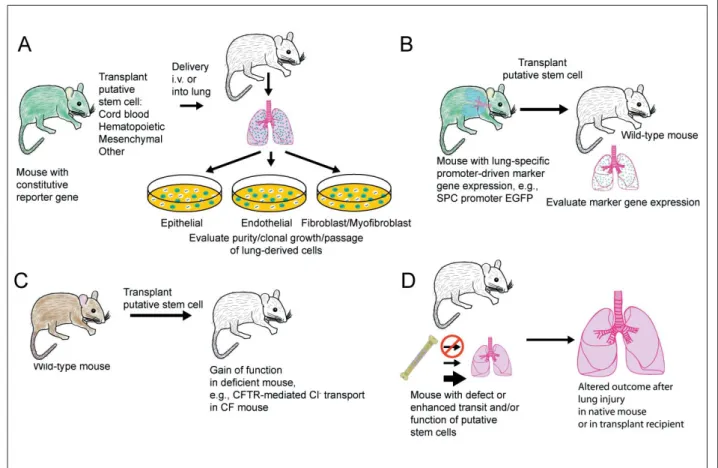
cul-ture, clonal growth and sub-passaging comparable to endogenous lung cells would be stronger proof. Furthermore, this method can theoretically be ap-plied to human transplant tissues. The approach of using donor cells with a reporter driven by a lung specific promoter (figure 1B) has already been tried, but with negative results [19, 20]. However, false negatives are possible, and additional studies using different constructs, donor populations, in-juries, etc. are warranted. Unequivocal gain of function in a deficient mouse (figure 1C), for ex-ample CFTR mediated chloride transport in CF mice, would obviously be precedent-setting. Final-ly, generation of mice with enhanced or depleted function of putative exogenously-derived lung cells, and demonstration of an altered outcome af-ter lung injury in either the native lung or in recip-ients of bone marrow transplants from the mutant mice, would provide functional evidence (figure 1D). It is important to note that, whether transdif-ferentiation of exogenous cells to lung cell types is ultimately deemed fact or fancy, circulating cells are likely integral, if not vital, to healing and strongly contribute to lung remodeling.
Embryonic stem cell (ES) generation of lung cells. Pluripotent ES cells offer promise as a po-tential source of lung endoderm, mesoderm, and ectoderm cell types. Murine embryonic stem cells grown as embryoid bodies, and then on collagen coated surfaces with growth factors, followed by replating at an air-liquid-interface developed into an epithelium with Clara, ciliated, basal, and inter-mediate cells [22]. Additional studies explored
conditions promoting mouse ES cell expression of Type II cell genes [23-25]. Similar studies with hu-man ES cells are likely imminent. Although an in-tial report of somatic cell nuclear transfer (SCNT, therapeutic cloning) to create human ES cells that were pluripotent, chromosomally normal, and with DNA and immunological haplotype identical to the donor specimen has now been discredited [26], it is likely that this technique will ultimately be ap-plied to humans. Respiratory epithelium is com-monly observed in teratomas derived from human ES cells, and the ultimate success of SCNT with human cells will enable study and potentially ther-apeutic employment of a patient’s own cells. Re-cent advances and setbacks highlight opportunities for novel lung research using ES cells and the need for more studies to determine the practical rele-vance and safety of using ES cells for cell therapy. In summary, many challenges remain to bet-ter understand endogenous lung stem cells, to de-termine the role of exogenous cells in lung injury, repair and pathology, and to explore the potential uses of ES cells. Developing rational strategies for lung protective or regenerative cell therapy will require an intensive and scientifically rigor-ous effort.
Acknowledgements: The authors thank Dr. Susan
Ma-jka for critical review of the manuscript and stimulating dis-cussions and Lisa Brown for excellent graphics, editorial and production assistance.
References
1. Neuringer IP, Randell SH. Stem cells and repair of lung injuries. Respir Res 2004; 5: 6.
2. Kim CF, Jackson EL, Woolfenden AE, et al. Identifica-tion of bronchoalveolar stem cells in normal lung and lung cancer. Cell 2005; 121: 811-813.
3. Sabatini F, Petecchia L, Tavian M, Jodon de Villeroche V, Rossi GA, Brouty-Bove D. Human bronchial fibroblasts ex-hibit a mesenchymal stem cell phenotype and multilineage differentiating potentialities. Lab Invest 2005; 85: 962-971. 4. Summer R, Kotton DN, Liang S, Fitzsimmons K, Sun X, Fine A. Embryonic lung side population cells are hematopoietic and vascular precursors. Am J Respir Cell Mol Biol 2005; 33: 32-40.
5. Abe S, Boyer C, Liu X, et al. Cells derived from the cir-culation contribute to the repair of lung injury. Am J Respir Crit Care Med 2004; 170: 1158-1163.
6. Rojas M, Xu J, Woods CR, et al. Bone marrow-derived mesenchymal stem cells in repair of the injured lung. Am J Respir Cell Mol Biol 2005; 33: 145-152. 7. MacPherson H, Keir P, Webb S, et al. Bone
marrow-derived SP cells can contribute to the respiratory tract of mice in vivo. J Cell Sci 2005; 118: 2450.
8. Yamada M, Kubo H, Kobayashi S, et al. Bone marrow-derived progenitor cells are important for lung repair af-ter lipopolysaccharide-induced lung injury. J Immunol 2004; 172: 1266-1272.
9. Yamada M, Kubo H, Ishizawa K, Kobayashi S, Shinkawa M, Sasaki H. Increased circulating endothe-lial progenitor cells in patients with bacterial pneumo-nia: evidence that bone marrow derived cells contribute to lung repair. Thorax 2005; 60: 410-413.
10. Zhao YD, Courtman DW, Deng Y, Kugathasan L, Zhang Q, Stewart DJ. Rescue of monocrotaline-induced pulmonary arterial hypertension using bone marrow-de-rived endothelial-like progenitor cells. Efficacy of com-bined cell and eNOS gene therapy in established dis-ease. Circ Res 2005; 96: 442-450.
11. Burnham EL, Taylor WR, Quyyumi AA, Rojas M, Brigham KL, Moss M. Increased circulating endothelial progenitor cells are associated with survival in acute lung injury. Am J Respir Crit Care Med 2005; 172: 854-860. 12. Kuang PP, Lucey E, Rishikof DC, Humphries DE, Bronsnick D, Goldstein RH. Engraftment of neonatal lung fibroblasts into the normal and elastase-injured lung. Am J Respir Cell Mol Biol 2005; 33: 371-377. 13. Wang G, Bunnell BA, Painter RG, et al. Adult stem cells from bone marrow stroma differentiate into airway epithelial cells: potential therapy for cystic fibrosis. Proc Natl Acad Sci U S A 2005; 102: 186-191.
14. Loi R, Beckett T, Goncz KK, Suratt BT, Weiss DJ. Limited restoration of cystic fibrosis lung epithelium in vivo with adult marrow derived cells. Am J Respir Crit Care Med 2006;173: 171-179.
15. Spencer H, Rampling D, Aurora P, Bonnet D, Hart SL, Jaffe A. Transbronchial biopsies provide longitudinal evidence for epithelial chimerism in children following sex mismatched lung transplantation. Thorax 2005; 60: 60-62.
16. Zander DS, Baz MA, Cogle CR, Visner GA, Theise ND, Crawford JM. Bone marrow-derived stem-cell re-population contributes minimally to the type II pneu-mocyte pool in transplanted human lungs. Transplanta-tion 2005; 80: 206-212.
17. Albera C, Polak JM, Janes S, et al. Repopulation of hu-man pulmonary epithelium by bone marrow cells: a po-tential means to promote repair. Tissue Eng 2005; 11: 1115-1121.
18. Roper JM, Staversky RJ, Finkelstein JN, Keng PC, O’Reilly MA. Identification and isolation of mouse type II cells on the basis of intrinsic expression of en-hanced green fluorescent protein. Am J Physiol 2003; 285: L691-L700.
19. Kotton DN, Fabian AJ, Mulligan RC. Failure of bone marrow to reconstitute lung epithelium. Am J Respir Cell Mol Biol 2005; 33: 328-334.
20. Chang JC, Summer R, Sun X, Fitzsimmons K, Fine A. Evidence that bone marrow cells do not contribute to the alveolar epithelium. Am J Respir Cell Mol Biol 2005; 33: 335-342.
21. Beckett T, Loi R, Prenovitz R, et al. Acute lung injury with endotoxin or No2 does not enhance development of airway epithelium from bone marrow. Mol Ther 2005; 12: 680-686.
22. Coraux C, Nawrocki-Raby B, Hinnrasky J, et al. Em-bryonic stem cells generate airway epithelial tissue. Am J Respir Cell Mol Biol 2005; 32: 87-92.
23. Rippon HJ, Ali NN, Polak JM, Bishop AE. Initial ob-servations on the effect of medium composition on the differentiation of murine embryonic stem cells to alve-olar type II cells. Cloning Stem Cells 2004; 6: 49-56. 24. Van Vranken BE, Romanska HM, Polak JM, Rippon
HJ, Shannon JM, Bishop AE. Coculture of embryonic stem cells with pulmonary mesenchyma: A microenvi-ronment that promotes differentiation of pulmonary ep-ithelium. Tissue Eng 2005; 11: 1177-1187.
25. Qin M, Tai G, Collas P, Polak JM, Bishop AE. Cell ex-tract-derived differentiation of embryonic stem cells. Stem Cells 2005; 23: 712-718.
26. Hwang WS, Roh SI, Lee BC, et al. Patient-specific em-bryonic stem cells derived from human SCNT blasto-cysts. Science 2005; 308: 1777-1783.