Dr Vaidehi Kulkarni et al JMSCR Volume 06 Issue 10 October 2018 Page 91
A Correlative Study of ECG Changes in Dengue Fever
Authors
Dr Vaidehi Kulkarni
1, Dr Badal Taori
2, Dr Babita Ghodke
31
Senior Resident, 2Junior Resident, 3Associate Professor and Head of Unit
Abstract
Dengue is one of the most emerging viral diseases globally and it is classified as a major global health threat by world health organization (WHO).It is mosquito-borne viral infection caused by Flavivirus and transmitted by vector Aedes Aegypti. It is acute, infectious and self-limiting illness which has variable clinical manifestations ranging from asymptomatic to shock or death. Cardiac involvement is not uncommon in dengue, still in majority cases it remain underdiagnosed which further contributes to serious complications and sometimes leading to mortality
Aim and Objectives
1. To study the correlation between Dengue fever and its effect on Cardiac function through ECG
changes.
2. To find conclusive evidence of correlation between ECG and dengue associated cardiac
dysfunction
Methods: Patients admitted in our hospital with diagnosed Dengue will be enrolled. Patients will be evaluated on the basis of:
History of illness
Clinical examination
Relevant investigations
Treatment given
Response to treatment
Conclusion: Cardiac involvement is not uncommon in dengue ,still in majority cases it remain underdiagnosed which further contributes to serious complications and sometimes leading to mortality. The exact mechanism of involvement of heart in dengue remains unclear. Presence of myocarditis in dengue patients is not always significant but it should alert the treating clinicians that such patients may require regular and continuous monitoring. It is necessary to create awareness and knowledge of cardiac complication of dengue fever between clinicians and patients, which will help us in early recognition and prompt treatment.
Introduction
Dengue is one of the most emerging viral diseases globally and it is classified as a major global health threat by world health organization (WHO)(4).It is mosquito-borne viral infection
caused by Flavivirus and transmitted by vector Aedes Aegypti(1). It is acute, infectious and self-limiting illness which has variable clinical manifestations ranging from asymptomatic to shock or death(4). Cardiac involvement is not
www.jmscr.igmpublication.org Impact Factor (SJIF): 6.379
Index Copernicus Value: 79.54 ISSN (e)-2347-176x ISSN (p) 2455-0450
Dr Vaidehi Kulkarni et al JMSCR Volume 06 Issue 10 October 2018 Page 92 uncommon in dengue ,still in majority cases it
remain underdiagnosed which further contributes to serious complications and sometimes leading to mortality(1). The exact mechanism of involvement of heart in dengue remains unclear.
Aim and Objectives
1. To study the correlation between Dengue fever and its effect on Cardiac function through ECG changes.
2. To find conclusive evidence of correlation between ECG and dengue associated cardiac dysfunction.
Materials and Methods
The study was a prospective observational study conducted at MGM Medical College and Hospital, Navi Mumbai.
100 patients fulfilling the inclusion and exclusion criteria were enrolled in the study.
The study was conducted in November 2015 to November 2017 for a period of 3 years.
Inclusion Criteria
1. Patient age 16 to 60.
2. Patient must be Dengue IgM or NS1 or both positive
3. Negative for Malarial Parasite on Peripheral smear or Rapid Antigen Test
Exclusion Criteria
1. All patients with pre-existing cardiac disease
2. Patients with co-infection of malaria or leptospirosis
3. All patients on beta-blockers, Digoxin, Amiodarone, Anti-Neoplastic Drugs or similar drugs known to alter cardiac function(3).
4. Patients with other systemic diseases like Anemia, CKD or Sepsis.
Materials
Study Design: Prospective observational study Study population – Patients admitted in MGM Hospital & OPD patients with diagnosis of Dengue.
Duration: The study will be performed for a period of 3 years from November 2015 to November 2017.
Setting: Department of Medicine, MGM Medical College Hospital, Kamothe.
Methods
Patients admitted in our hospital with diagnosed Dengue will be enrolled.
Patients will be evaluated on the basis of: • History of illness
• Clinical examination • Relevant investigations • Treatment given • Response to treatment
Observation and Result
The present study was conducted in MGM Hospital, Navi Mumbai within span of 3 years and involved total 100 patients of dengue fever.
Dengue
Table 1 A: Dengue serotype distribution
Reactive NR Total Count Row N % Count Row N % Count Row N %
NS1 83 83.0% 17 17.0% 100 100.0%
IgM 23 23.2% 76 76.8% 99 100.0%
Dr Vaidehi Kulkarni et al JMSCR Volume 06 Issue 10 October 2018 Page 93
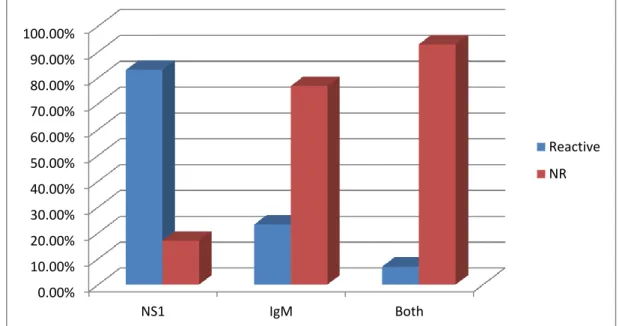
Chart 1 A: Dengue serotypes distribution (NS1,IgM,Both)
Our study included patients who were NS1 antigen, IgM and both positive.
Out of 100 patients 87 were NS1 positive (87%), 23 were IgM positive (23%) and 7 patients were positive (7%) for both NS1 as well as for IgM.
ECG Changes
Table 2B: Distribution of ECG changes in dengue fever
Yes No
Count Row N % Count Row N % SB 19 19.0% 81 81.0% FDHB 6 6.0% 94 94.0%
TWI 10 10.0% 90 90.0% RBBB 4 4.0% 96 96.0%
Chart 2 B: Distribution of ECG changes in dengue fever
In our study, we studied different ECG changes those were occurring in dengue positive patients with myocardial involvement. Observed ECG changes were Sinus bradycardia, First degree heart
block, T wave inversion and Right bundle branch block. From our study, we observed that out of 100 dengue positive 39 patients shows significant ECG changes.
0.00% 10.00% 20.00% 30.00% 40.00% 50.00% 60.00% 70.00% 80.00% 90.00% 100.00%
NS1 IgM Both
Reactive
NR
0.00% 10.00% 20.00% 30.00% 40.00% 50.00% 60.00% 70.00% 80.00% 90.00% 100.00%
SB FDHB TWI RBBB
Present
Dr Vaidehi Kulkarni et al JMSCR Volume 06 Issue 10 October 2018 Page 94
Out of 39 patients, 19(19%) patients showed sinus bradycardia, 10 (10%) patients showed T wave inversion, 6 (6%) patients showed First degree heart block and 4(4%) patients showed right bundle branch block.
Cardiac Markers against Dengue Comparison against NS1
Table 3 A: Comparison of cardiac marker and ECG Changes against NS1
NS1
Reactive NR
Count
Column N % Count
Column N % SB Yes 16 19.3% 3 17.6%
No 67 80.7% 14 82.4% FDHB Yes 6 7.2% 0 .0%
No 77 92.8% 17 100.0% TWI Yes 5 6.0% 5 29.4%
No 78 94.0% 12 70.6% RBBB Yes 3 3.6% 1 5.9%
No 80 96.4% 16 94.1%
Chi-Square test result
Table 3 B: Comparison of cardiac marker and ECG Changes against NS1
NS1
SB Chi-square .024
d.f. 1
p-value .876
FDHB Chi-square 1.307
d.f. 1
p-value .253
TWI Chi-square 8.575
d.f. 1
p-value .003*
RBBB Chi-square .189
d.f. 1
p-value .664
In our observational study, we also included the comparison of ECG changes with specific dengue antigens i.e. NS1, IgM and both.
Total 83 patients of NS1 antigen, 28 (33.7%), 16 (19.3%)patients showed sinus bradycardia, 6 (7.2%) were showing FDHB, 5 (6.0%) were showing TWI and 3 (3.6%) patients showing RBBB.
p-value for the chi-square test greater than that of 0.05 for indicates no significant association between the respective parameters; while as p-value less than that of 0.05 indicates significant association (values marked in bold are significant)(7)
Comparison with IgM
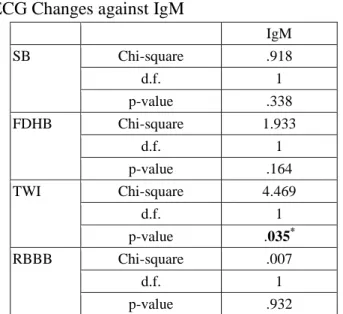
Table; 3 4A: Comparison of cardiac marker and ECG Changes against IgM
IgM
Reactive NR
SB Yes 6 26.1% 13 17.1% No 17 73.9% 63 82.9%
FDHB Yes 0 .0% 6 7.9%
No 23 100.0% 70 92.1%
TWI Yes 5 21.7% 5 6.6% No 18 78.3% 71 93.4%
RBBB Yes 1 4.3% 3 3.9% No 22 95.7% 73 96.1%
Pearson Chi-Square Tests
Table 4 B: Comparison of cardiac marker and ECG Changes against IgM
IgM
SB Chi-square .918
d.f. 1
p-value .338
FDHB Chi-square 1.933
d.f. 1
p-value .164
TWI Chi-square 4.469
d.f. 1
p-value .035*
RBBB Chi-square .007
d.f. 1
p-value .932
Dr Vaidehi Kulkarni et al JMSCR Volume 06 Issue 10 October 2018 Page 95
6(26.1%) showing SB, 5 (21.7%) were showing TWI, 1(4.3%) was showing RBBB and no one positive for FDHB with dengue IgM.
p-value for the chi-square test greater than that of 0.05 for indicates no significant association between the respective parameters; while as p-value less than that of 0.05 indicates significant association (values marked in bold are significant)(7).
Comparison against Both
Table A: Comparison of cardiac marker and ECG Changes against both serotype
Both
Reactive NR
Count
Column N
% Count
Column N %
SB Yes 4 57.1% 15 16.1% No 3 42.9% 78 83.9%
FDHB Yes 0 .0% 6 6.5%
No 7 100.0% 87 93.5%
TWI Yes 0 .0% 10 10.8%
No 7 100.0% 83 89.2%
RBBB Yes 0 .0% 4 4.3%
No 7 100.0% 89 95.7%
Pearson Chi-Square Tests
Table B: Comparison of cardiac marker and ECG Changes against both serotypes
Both SB Chi-square 7.115
d.f. 1
p-value .008*
FDHB Chi-square .480
d.f. 1
p-value .488 TWI Chi-square .836
d.f. 1
p-value .360
RBBB Chi-square .314
d.f. 1
p-value .575
We also compared ECG changes with Patients who are positive for Both(NS1 and IgM).
4(57.1%) patients had SB. Other changes such as FDHB, TWI and RBBB were not seen in these patients.
p-value for the chi-square test greater than that of 0.05 for indicates no significant association between the respective parameters; while as p-value less than that of 0.05 indicates significant association (values marked in bold are significant) (1).
Dr Vaidehi Kulkarni et al JMSCR Volume 06 Issue 10 October 2018 Page 96 abnormalities in the form first-degree AV block,
sinus bradycardia, T wave changes, and ST segment abnormalities 3/10 (30%) in dengue, 11/32 (34%) in DHF and 4/9 (44%) in DSS. Salgado et al study showed out 79 dengue positive patients 11 (14%) had ECG changes out of which 9 had Sinus Bradycardia, 2 had sinus tachycardia and 7 had T wave inversion. We also studied comparison of Cardiac markers with different serotypes of dengue, which showed:
1. Significant association between NS1 antigen and T wave inversion (as p-value 0.003) 2. Significant association between IgM and T
wave inversion (p-value 0.035)
3. Significant association between both (NS1/IgM) and sinus bradycardia (p value 0.008).
Conclusion
Cardiac involvement is not uncommon in dengue, still in majority cases it remain underdiagnosed which further contributes to serious complica-tions and sometimes leading to mortality(5)
The exact mechanism of involvement of heart in dengue remains unclear. Presence of myocarditis in dengue patients is not always significant but it should alert the treating clinicians that such patients may require regular and continuous monitoring. It is necessary to create awareness and knowledge of cardiac complication of dengue fever between clinicians and patients, which will help us in early recognition and prompt treatment.
References
1. Manson’s textbook of Tropical diseases. 2. Harrisons principles of Internal Medicine 3. API textbook of Medicine
4. Dengue and Dengue Hemorrhagic Fever: Information for Health Care Practitioners -CDC Division of Vector-Borne Infectious Diseases.
5. Gulati S, Maheshwari A. Atypical Manifestations of Dengue. Trop Med Int Health. 2007 Sep; 12(9):1087–1095.
6. World Health Organization (2009) Dengue: Guidelines for Diagnosis, Treatment, Prevention & Control.
7. Park’s Textbook of Preventive & Social Medicine – K. Park.
8. TDR/WHO. In Dengue: Guidelines for Diagnosis, Treatment, Prevention and Control. Geneva, Switzerland: World Health Organization; 2009.
9. Dengue virus infection: Clinical manifestations and diagnosis Stephen J Thomas, Alan L Rothman, Anon Srikiatkhachorn et al Uptodatesep 2017. 10.Dengue National guidelines 2014.
11.Handbook of clinical management dengue by WHO 2012.
12.Kuno G, Review of factors modulating dengue transmission, Epidemiology review 1995,17:321
13.Malavige G, Fernando S, Fernando D, Seneviratne S. Dengue viral infections. Postgraduate Medical Journal.2004; 80(948):588-601.
14.Raheel U, Faheem M, Riaz MN, Kanwal N, Javed F, Zaidi N, Qadri I (2011) Dengue fever in the Indian Subcontinent: an overview. J Infect DevCtries 5: 239-247. doi:10.3855/jidc.1017.
15.14.Rice CM. Flaviviridae: The viruses and their replication. In: Virology Fields BN, Knipe DM, Howley PM eds. 3rd ed., Philadelphia: Lippincott-Raven Publishers, 1996. p.931-59.
16.Chen L, Wilson ME. Non-vector transmission of dengue and other mosquito-borne flaviviruses. Dengue Bull. 2005;29:18–30
17.Sam SS, Omar SFS, Teoh BT, Abd-Jamil J, Abu Bakar S. Review of Dengue Hemorrhagic Fever Fatal Cases SeeDurga Among Adults: A Retrospective Study. Farrar J, ed. PLoS Neglected Tropical Diseases. 2013;7(5):e2194.
Dr Vaidehi Kulkarni et al JMSCR Volume 06 Issue 10 October 2018 Page 97 clinical features, laboratory investigations
and early diagnosis of dengue fever in adults: a descriptive study in Sri Lanka. Southeast Asian J of Trop Med & Pub Health 36: 686-692.
19.NS1 Antigen Capture ELISA an Effective Method for Diagnosis of Early Dengue Infection - Report of an Outbreak at Angul District, Odisha, India. Mahapatra D et al2014 Aug;8(8):DC08-10. doi: 10.7860/ JCDR/2014/8589.4697. Epub 2014 Aug 20.
20.Rigau-Pérez JG, Gubler DJ, Vorndam AV, Clark GG. Dengue surveillance--United States, 1986-1992. MMWR CDC Surveill Summ 1994; 43:7.
21.McBride WJ, Mullner H, LaBrooy JT, Wronski I. The 1993 dengue 2 epidemic in North Queensland: a serosurvey and comparison of hemagglutination inhibition with an ELISA. Am J Trop Med Hyg 1998; 59:457
22.http://www.cdc.gov/media/releases/2012/ p0620_ dengue_test.html (Accessed on July 17, 2012).
23.Bhatt S, Gething PW, Brady OJ, Messina JP, Farlow AW, Moyes CL et.al. The global distribution and burden of dengue. Nature; 496: 504-7
24.Brady OJ, Gething PW, Bhatt S, Messina JP, Brownstein JS, Hoen AG et al. Refining the global spatial limits of dengue virus transmission by evidence based consensus. PLoSNegl Trop Dis. 2012;6:e1760
25.Guzman MG, Halstead SB, Artsob H, Buchy P, Farrar J, Gubler DJ, et al. Dengue: a continuing global threat. Nat Rev Microbiol 2010; 8(12 Suppl):S7-16. 26.Miranda CH1, Borges Mde C, Matsuno
AK, Vilar FC, Gali LG, Volpe GJ et al. Evaluation of cardiac involvement during dengue viral infection. Clin Infect Dis. 2013 Sep;57(6):812-9.
27.Satarasinghe R. Asymptomatic Myocardial Involvement In Acute Dengue Virus Infection in A Cohort Of Adult Sri Lankans Admitted To A Tertiary Referral Centre. Br J Cardiol. 2007;14:171–3. 28.Miranda CH, Borges Mde C, Schmidt A,
Pazin-Filho A, Rossi MA, Ramos SG, Lopes da Fonseca BA (2013) A case presentation of a fatal dengue myocarditis showing evidence for dengue virus-induced lesion. Euro Heart J Acute Cardio Care 2: 127-130.
29.Ingole J. Relative Bradycardia in Dengue Fever. Indian Journal Of Applied Research. 2015; 5(1): 424-425.
30.Nimmannitya S, Thisyakorn U, Hemsrichart V (1987) Dengue haemorrhagic fever with unusual manifestations. Southeast Asian J of Trop Med & Pub Health 18: 398-406
31.Basilio-de-Oliveira CA, Aguiar GR, Baldanza MS, Barth OM, Eyer-Silva WA, Paes MV (2005) Pathologic study of a fatal case of dengue-3 virus infection in Rio de Janeiro, Brazil. Brazil J Inf Dis 9: 341-347.
32.Pesaro AE, D’Amico E, Aranha LF. Dengue: cardiac manifestations and implications in antithrombotic treatment. Arq Bras Cardiol 2007; 89:e12-5.
33.Gupta VK, Gadpayle AK. Subclinical cardiac involvement in dengue haemorr-hagic fever. JIACM 2010; 11:107-11. 34.Mitrakrishnan C Shivanthan,
Mitrakrishnan R Navinan, Godwin R Constantine, SenakaRajapakse Cardiac involvement in dengue infection J Infect Dev Ctries 2015; 9(4):338-346. doi:10.3855/jidc.6200
Dr Vaidehi Kulkarni et al JMSCR Volume 06 Issue 10 October 2018 Page 98 36.Naresh G, Kulkarni AV, Sinha N, Jhamb
N, Gulati S (2008) Dengue hemorrhagic fever complicated with encephalopathy and myocarditis: a case report. J Com Dis 40: 223-224.
37.Gupta N, Kulkarni AV, Sinha N, Jhamb R, Gulati S (2010) Dengue hemorrhagic fever complicated with encephalopathy and mycocarditis. J Com Dis 42: 297-299. 38.Lee IK, Lee WH, Liu JW, Yang KD
(2010) Acute myocarditis in dengue hemorrhagic fever: a case report and review of cardiac complications in dengue-affected patients. Int J Inf Dis 14: e919-922.
39.Obeyesekere I, Hermon Y (1972) Myocarditis and cardiomyopathy after arbovirus infections (dengue and chikungunya fever). Brit Heart J 34: 821-827.
40.Miranda CH, Borges Mde C, Schmidt A, Pazin-Filho A, Rossi MA, Ramos SG, Lopes da Fonseca BA (2013) A case presentation of a fatal dengue myocarditis showing evidence for dengue virus-induced lesion. Euro Heart J Acute Cardio Care 2: 127-130.
41.Sangle SA, Dasgupta A, Ratnalikar SD, Kulkarni RV (2010) Dengue myositis and myocarditis. Neurol India 58: 598-599. 42.Friedrich MG, Sechtem U, Schulz-Menger
J, Holmvang G, Alakija P, Cooper LT et al. Cardiovascular magnetic resonance in myocarditis: A JACC White Paper. J Am CollCardiol 2009; 53:1475-8.
43.Weerakoon KG, Kularatne SA, Edussuriya DH, Kodikara SK, Gunatilake LP, Pinto VG, Seneviratne AB, Gunasena S (2011) Histopathological diagnosis of myocarditis in a dengue outbreak in Sri Lanka, 2009. BMC Res Notes 4: 268.
44.Nagaratnam N, Siripala K, de Silva N (1973) Arbovirus (dengue type) as a cause of acute myocarditis and pericarditis. Brit Heart J 35: 204-206.
45.Torres AF, Braga DN, Muniz F, Mendonca C, Oliveira DN, de Souza ET, Burke A, Tavora F (2013) Lymphocytic myocarditis at autopsy in patients with dengue fever. Brazil J Inf Dis 17: 619-621. 46.Lateef A, Fisher DA, Tambyah PA (2007) Dengue and relative bradycardia. EmergInf Dis 13: 650-651.
47.Kaushik JS, Gupta P, Rajpal S, Bhatt S (2010) Spontaneous resolution of sinoatrial exit block and atrioventricular dissociation in a child with dengue fever. Sing Med J 51: e146-148.
48.Donegani E, Briceno J (1986) Disorders of atrio-ventricular conduction in patients with hemorrhagic dengue. Minerva Cardioangiolog 34: 477-480.
49.Khongphatthallayothin A, Chotivitayatarakorn P, Somchit S, Mitprasart A, Sakolsattayadorn S, Thisyakorn C (2000) Morbitz type I second degree AV block during recovery from dengue hemorrhagic fever. Southeast Asian J of Trop Med & Pub Health 31: 642-645.
50.Chuah SK (1987) Transient ventricular arrhythmia as a cardiac manifestation in dengue haemorrhagic fever--a case report. Sing Med J 28: 569-572.
51.La-Orkhun V, Supachokchaiwattana P, Lertsapcharoen P, Khongphatthanayothin A (2011) Spectrum of cardiac rhythm abnormalities and heart rate variability during the convalescent stage of dengue virus infection: a Holter study. An Trop Paed 31: 123-128.
52.Neeraja M, Lakshmi V, Teja VD, Lavanya V, Priyanka EN, Subhada K, Parida MM, Dash PK, Sharma S, Rao PV, Reddy G (2014) Unusual and rare manifestations of dengue during a dengue outbreak in a tertiary care hospital in South India. Arch Virol 159: 1567-1573.
Dr Vaidehi Kulkarni et al JMSCR Volume 06 Issue 10 October 2018 Page 99 Cardiac complications of a dengue fever
outbreak in Sri Lanka, 2005. Trans Royal Soc Trop Med &Hyg 101: 804-808.
54.Satarasinghe RL, Arultnithy K, Amerasena NL, Bulugahapitiya U, Sahayam DV (2007) Asymptomatic myocardial involvement in acute dengue virus infection in a cohort of adult Sri Lankans admitted to a tertiary referral centre. Brit J Cardiol 14: 171-173.
55.Kularatne SA, Pathirage MM, Medagama UA, Gunasena S, Gunasekara MB (2006) Myocarditis in three patients with dengue virus type DEN 3 infection. Ceylon Med J 51: 75-76.
56.Mahmod M, Darul ND, Mokhtar I, Nor NM, Anshar FM, Maskon O (2009) Atrial fibrillation as a complication of dengue hemorrhagic fever: non-self-limiting manifestation. Int J Inf Dis 13: e316-318. 57.Pelupessy JM, Allo ER, Jota S (1989)
Pericardial effusion in dengue haemorrhagic fever. PaedIndonesiana 29: 72-75.
58.Nagaratnam N, Siripala K, de Silva N (1973) Arbovirus (dengue type) as a cause of acute myocarditis and pericarditis. Brit Heart J 35: 204-206.
59.Tayeb B, Piot C, Roubille F (2011) Acute pericarditis after dengue fever. Ann CardiolAngeio (Paris) 60: 240-242.
60.Hober D, Poli L, Roblin B, Gestas P, Chungue E, Granic G, Imbert P, Pecarere JL, Vergez-Pascal R, Wattre P (1993) Serum levels of tumor necrosis factor-alpha (TNF-factor-alpha), interleukin-6 (IL-6), and interleukin-1 beta (IL-1 beta) in dengue-infected patients. Am J Trop Med Hyg 48: 324-331.
61.Hober D, Delannoy AS, Benyoucef S, Groote DD, Wattré P (1996) High levels of sTNFR p75 and TNF alpha in dengue-infected patients. MicrobiolImmunol 40: 569-573.
62.Rong-Fu C, Jien-Wei L, Wen-Ting Y, Lin W, Jen-Chieh C, Hong-Ren Y, Jiin-Tsuey C, Kuender DY (2005) Altered T helper 1 reaction but not increase of virus load in patients with dengue hemorrhagic fever. FEMS Immunol Med Microbiol 44: 43-50. 63.Mahmod M, Darul ND, Mokhtar I, Nor NM, Anshar FM, Maskon O (2009) Atrial fibrillation as a complication of dengue hemorrhagic fever: non-self-limiting manifestation. Int J Inf Dis 13: e316-318. 64.Vijayabala J, Attapaththu M, Jayawardena
P, de Silva SG, Constantine G (2012) Sympathetic dysfunction as a cause for hypotension in dengue shock syndrome. Chin Med J (Engl) 125: 3757-3758.
65.Rajapakse S (2011) Dengue shock. J Emerg Trauma Shock 4: 120-127.
66.Premaratna R, Rodrigo KM, Anuratha A, de Alwis VK, Perera UD, de Silva HJ (2012) Repeated dengue shock syndrome and 'dengue myocarditis' responding dramatically to a single dose of methyl prednisolone. Int J Inf Dis 16: e565-569. 67.Gubler DJ. Aedesaegypti and
Aedesaegypti-borne disease control in the 1990s. Charles Franklin Craig Lecture. Am J Trop Med Hyg 1989; 40:571
68.Halstead SB. Selective primary health care: strategies for control of disease in the developing world. XI. Dengue. Rev Infect Dis 1984; 6:251
69.Durbin AP, Whitehead SS. Dengue vaccine candidates in development. Curr Top MicrobiolImmunol 2010; 338:129. 70.Guirakhoo F, Pugachev K, Zhang Z, et al.
Safety and efficacy of chimeric yellow Fever-dengue virus tetravalent vaccine formulations in nonhuman primates. J Virol 2004; 78:4761.
71.Clinical guidelines – diagnosis and treatment manual 2016 edition by WHO. 72.Rajapakse S, Rodrigo C, Rajapakse A
Dr Vaidehi Kulkarni et al JMSCR Volume 06 Issue 10 October 2018 Page 100 73.Vishal Kumar Gupta, AK Gadpayle.
Subclinical cardiac Involvement in Dengue Hemorrhagic fever. JIACM. 2010; 11(2): 107-11.
74.Sheetal S, Elizabeth J. A Study on the Cardiac Manifestations of Dengue. Journal of The Association of Physicians of India.2016; 64: 30-34.
75.Study of cardiac manifestations in patients with seropositive dengue fever Prakash V Fichadiya, SachinBongale,, S SBhat Innovative Journal of Medical and Health Science 6:6 November – December (2016) 163 – 166
76.Salgado DM, Eltit JM, Mansfield K, Panqueba C, Castro D, Vega MR, Xhaja K, Schmidt D, Martin KJ, Allen PD, Rodriguez JA, Dinsmore JH, López JR, Bosch I (2010) Heart and skeletal muscle are targets of dengue virus infection. PedInt Care J 29: 238-242.
77.Weerakoon KG, Kularatne SA, Edussuriya DH, Kodikara SK, Gunatilake LP, Pinto VG, Seneviratne AB, Gunasena S (2011) Histopathological diagnosis of myocarditis in a dengue outbreak in Sri Lanka, 2009. BMC Res Notes 4: 268.