Abstract
Introduction Plant derived preparations have been essential components for maintenance of oral hygiene and the treatment of oral diseases globally since ancient times. Acacia chundra Willd, Adhatoda vasica Nees., Mimusops elengi L., Piper nigrum L., Pongamia pinnate L. Pirerre, Quercus infectoria Olivier., Syzygium aromaticum L., Terminalia chebula Retz., Zingiber offici-nale Roscoe., individually or in combination, have been used for this purpose because of their beneficial effects.
Objectives To study the efficacy of an Ayurvedic toothpaste containing these herbs in patients with chronic gingivitis. Methods Otherwise healthy males and non-pregnant females (n=80) aged 18-35 years with ≥20 teeth were randomly assigned to Group 1 (herbal toothpaste) and Group 2 (placebo toothpaste). Quigley Hein plaque index (PS), bleeding on probing (BOP) and probing pocket depth (PPD), were recorded for all teeth at six sites, and one ml of resting saliva was collected to ascertain anaerobic and aerobic bacterial counts at baseline, and at 4, 8, 12 and 24 weeks. Full-mouth prophylaxis was performed and instructions for brushing with the allocated toothpaste for 6 months were given at baseline. Sixty-six participants, 34 in Group 1 and 32 in Group 2 completed the study. Clinical examinations were performed by the same examiner blinded to group allocation.
Results Linear mixed model analysis revealed significant reductions of PS, BOP, PPD (p<0.0001) and total salivary anaerobic counts (p<0.05) in Group 1 at all prescribed visits compared to Group 2. Moreover the reduction increased overtime. No unpleasant effects of toothpaste use were reported.
The effects of an Ayurvedic medicinal toothpaste on clinical,
micro-biological and oral hygiene parameters in patients with chronic
gingivitis: a double-blind, randomised, placebo-controlled, parallel
allocation clinical trial
J Howshigan1, K Perera2, S Samita3, P S Rajapakse1
Departments of 1Oral Medicine and Periodontology, 2Engineering Mathematics and 3Crop Science, University of Peradeniya, Sri Lanka.
Correspondence: PSR, e-mail: <[email protected]>. Received 20 April and revised version accepted 10 October 2015.
Ceylon Medical Journal 2015; 60: 126-132
(Index words: herbal medicinal toothpaste, chronic gingivitis, salivary anaerobe counts, clinical trial, gingival bleeding)
Introduction
Plaque induced chronic gingivitis is an oral health problem prevalent worldwide, affecting the dentition in people of all ages. Dental plaque, a well organized biofilm, has been established as the cause of chronic gingivitis [1]. Chronic gingivitis may progress to more destructive chronic and aggressive periodontitis, leading to loss of teeth [2, 3].
There is evidence that oral biofilm-associated diseases may affect systemic health by mechanisms such as spreading infections to adjacent tissues and spaces, hematogenous dissemination of oral biofilm organisms, or inflammatory mechanisms [4]. Elevated surrogate markers of inflammation in patients with periodontitis in cross-sectional studies substantiate this notion [5]. Further, evidence suggests that oral biofilm-associated chronic periodontitis enhances the risk of coronary heart disease and cerebrovascular disease, and that poor glycaemic control in diabetic patients with periodontitis is a concern for clinicians [6-8].
Hence the prevention and treatment of chronic gingivitis is important for maintenance of good oral health as well as general health. At present toothbrushes, Conclusions This study provides robust evidence of the beneficial antiplaque and antigingivitis effects of the test herbal toothpaste Sudantha® on patients with chronic gingivitis.
dental floss and toothpicks are employed for mechanical removal of the oral biofilm. However, this approach relies heavily on motivation and the ability of the individual to remove dental plaque efficiently on a daily basis. It has been reported that most people find brushing teeth and flossing difficult tasks, and are not able to remove plaque completely from all tooth surfaces [9]. So ineffective removal of plaque can lead to gingivitis, especially at difficult to reach sites of the dentition.
The use of chemotherapeutic agents is an accepted adjunctive mode for reducing plaque build-up, and incorporation of antiplaque and anti-gingivitis agents to the oral hygiene regimen has been found to be beneficial [10, 11]. These antimicrobial agents may be chemicals or herbal preparations. Various medicinal plants, individually or in combination, have been used in Sri Lanka for over 2000 years to maintain oral hygiene and to prevent periodontal diseases. Among these are Acacia chundra Willd., Adhatoda vasica Nees., Mimusops elengi L., Piper nigrum L., Pongamia pinnata (L.) Pirerre, Quercus infectoria Olivier., Syzygium aromaticum L., Terminalia chebula Retz., Zingiber officinale Rosce. Studies have shown beneficial therapeutic effects; antibacterial, antioxidant, antifungal, antiplasmodial and anti-inflammatory effects of these herbs.
We studied the therapeutic effects of a proprietary herbal toothpaste which has been formulated with an extract of these nine herbs. It is registered as Sudantha®, an Ayurvedic medicinal tooth-paste widely used in Sri Lanka (Reg.No.02/01/PV/08/143).
Methods Trial design
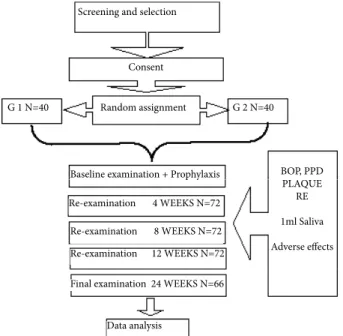
Our study was a randomised, placebo-controlled, parallel allocation, 6-month clinical trial with blinding of the participants, clinical assessor and statistician. It was conducted at the Clinical Oral Microbiology Industry Collaborative Research Unit of the Faculty of Dental Sciences, University of Peradeniya, Sri Lanka. Approval for the trial was given by the Research and Ethics Review Committee of the Faculty of Dental Sciences of the University, and it was registered at the Sri Lanka Clinical Trials Registry (No.SLCTR/2010/012). All participants consented by voluntarily signing a witnessed agreement after receiving verbal and written information about the study. The trial was conducted in harmony with the guidelines for evaluating chemotherapeutic products for the control of gingivitis outlined by the American Dental Association [12, 13]. The outline of the study protocol is given in Figure 1
Study population
Based on a previous study of this herbal toothpaste, a sample of 35 was needed in each group to detect 30% reduction in bleeding on probing with 85% power. We
recruited a sample of 80 in view of possible withdrawal of participants for non-compliance or reasons not related to the trial.
Recruitment of participants commenced in November 2010 and the trial was completed in June 2012. Participants were selected from patients attending the diagnostic clinic of the Faculty of Dental Sciences, University of Peradeniya, and from the dental clinic of the Teaching Hospital, Kandy, Sri Lanka, after an oral and periodontal examination. Patients with generalised chronic gingivitis with over 30% sites with bleeding were selected as participants subject to the following inclusion criteria: non-smoking men and non-pregnant women between 18-35 years of age with at least 20 teeth, willingness to cooperate with the study protocol and attend all visits and agreeing to sign the consent form. The exclusion criteria were presence of gross oral pathology, presence of medical conditions that affect the integrity of periodontium or oral mucosa, any other chronic diseases that have an effect on periodontal disease, presence of teeth with defective or extensive restorations (including prosthetic crowns), pulpitis, caries, cracked enamel, use of any intra-oral appliances, perio-dontitis or history of treatment for periodontitis within the past twelve months, past history of known allergy to oral care products, regular use of anticonvulsants, anti-histamines, sedatives, tranquillizers, anti-inflammatory drugs or analgesics, need for antibiotic prophylaxis before the dental examination, or history of antibiotic use within the past three months.
Selected participants were randomly assigned to either the Group 1 or the Group 2 by a computer generated randomisation list (http://www.random.org.). Investigator not involved in clinical examinations generated the random numbers and they were kept sealed until
Figure 1. Study Protocol
Baseline examination + Prophylaxis
Re-examination 4 WEEKS N=72
Re-examination 8 WEEKS N=72 Re-examination 12 WEEKS N=72
Final examination 24 WEEKS N=66
Data analysis Screening and selection
Consent
Random assignment
G 1 N=40 G 2 N=40
BOP, PPD PLAQUE
RE
1ml Saliva
preliminary statis-tical analysis was over. Toothpaste tubes were in bags numbered 1-80. Participants were assigned the bags based on the number. Allocation ratio was 1:1.
Baseline examination was performed to assess the levels of plaque, bleeding on probing and pocket depth. All examinations were carried out by a single assessor, standardised with an experienced clinician and calibrated for intra-examiner variability (Kappa value 0.99 for PPD and 0.75 for plaque score). The examiner was blinded to the group allocation of the participant. At baseline, BOP and PPD using 15NC periodontal probe with a ball ended tip were recorded at 6 sites per tooth; mesio-facial, mid-facial, disto-facial, mesio-lingual, mid-lingual and disto-lingual. Then plaque score was recorded at 6 sites using Turesky modification of the Quigley and Hein plaque index (PS) after a plaque disclosing solution (Dent. Liquid plaque tester, Japan) was applied on all tooth surfaces [14, 15]. Thereafter, all participants were given brushing instructions and oral prophylaxis. No other instructions were given with regard to the use of toothpaste or brushing during the trial period. Participants were given the allocated toothpaste for home use and advised to brush twice daily for 24 weeks.
The test herbal toothpaste and placebo toothpaste were packed in identical tubes and dispensed by an investigator not involved with clinical examinations. The assessor performing clinical examination and salivary microbial analyses was blinded to the group allocation of the participants. The participants were also not aware of the type of toothpaste allocated to them. All measure-ments were repeated at 4, 8, 12 and 24 weeks. For clinical examinations, participants were instructed to refrain from brushing for about 12 hours before the clinic visit to standardize the time of collection of saliva for microbial culture. Saliva was collected and immediately cultured before the clinical examination.
Microbiological procedures
One ml of resting saliva was collected and centrifuged at 4000 rpm for 5 minutes and the pellet obtained was re-suspended in 1000ml of sterile isotonic saline and 10-fold dilutions of the re-suspended sample were prepared. Then 100ml of three dilutions 10-5, 10-6 and 10-7 dilutions were separately cultured in 5% sheep blood agar plates and incubated aerobically and anaerobically at 37°C. Total aerobic and anaerobic colony forming units (CFU) were counted after 24 and 48 hours. Total CFUs were calculated per one ml of saliva.
Statistical analysis
Analysis of data was performed using a statistical package Statistical Analysis Software SAS 9.1. Identity of each toothpaste tube was revealed at the end of the trial after the preliminary statistical analysis. Each participant was considered as an observational unit of analysis. For each variable i.e. PS, BOP and PPD values
(six sites for each tooth was recorded and overall average was taken as the observation for analysis for each visit). Each parameter was recorded at baseline, 4, 8, 12 and 24 weeks. Likewise, each subject had 5 readings for salivary aerobic and anaerobic counts at baseline, 4, 8, 12 and 24 weeks examinations.
Since our data set includes multiple observations of clinical and microbiological parameters of same sampling unit (participant) over a six month period the analysis must address the issue of correlation between measures of the same sampling unit. Hence linear mixed model analysis was used as the statistical method in the data analysis.
Results
Study population
Sixty six participants (test n=34, placebo n=32) completed the 24-week trial. Mean age of the participants in Group 1 was 24.5±4.7 years and Group 2 it was 24.5±4.8 years. Six participants dropped out at 12 weeks for reasons not related to the trial, and 8 participants dropped out after the baseline examination. Hence 72 participants (31 male, 41 female) attended re-examination at 4 weeks, 8 weeks, 12 weeks ( Group 1 Male – 17, Female – 19, Group 2 Male – 14, Female – 22). Another six participants were dropped out due to reasons not related to the trial. As a result, 66 participants completed all re-examination visits (Group 1 Male – 16 , Female - 18, Group 2 Male – 12, Female – 20).
Baseline data
At the baseline there were no significant differences between mean values of Group 1 and Group 2 with
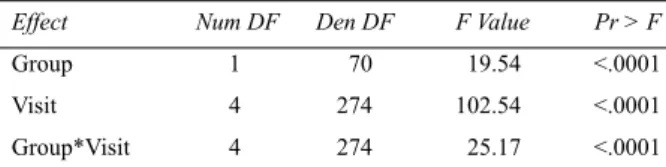
A: Type 3 Tests of Fixed Effects
Effect Num DF Den DF F Value Pr > F
Group 1 70 19.54 <.0001
Visit 4 274 102.54 <.0001
Group*Visit 4 274 25.17 <.0001
B: Least Squares Means for Group Visit Interactions
Effect Group Visit Estimate Standard
Error
Group*Visit 1 1 2.6604 0.08683
Group*Visit 1 2 1.7067 0.08683
Group*Visit 1 3 1.4617 0.08683
Group*Visit 1 4 1.3617 0.08683
Group*Visit 1 5 1.2842 0.08797
Group*Visit 2 1 2.5011 0.08683
Group*Visit 2 2 2.1146 0.08683
Group*Visit 2 3 2.0179 0.08683
Group*Visit 2 4 1.9950 0.08683
Group*Visit 2 5 2.1289 0.08923
respect to all clinical parameters: PS (2.66, vs 2.50 with SED=0.1315, t=-1.21, p=0.23), BOP ( 0.59 vs 0.57 with SED=0.0293, t=-1.14, p=0.26), PPD ( 2.309 vs 2.305 with SED=0.0607, t= 0.07, p=0.94), for all three variables.
Plaque scores, bleeding on probing, probing pocket depth during the trial
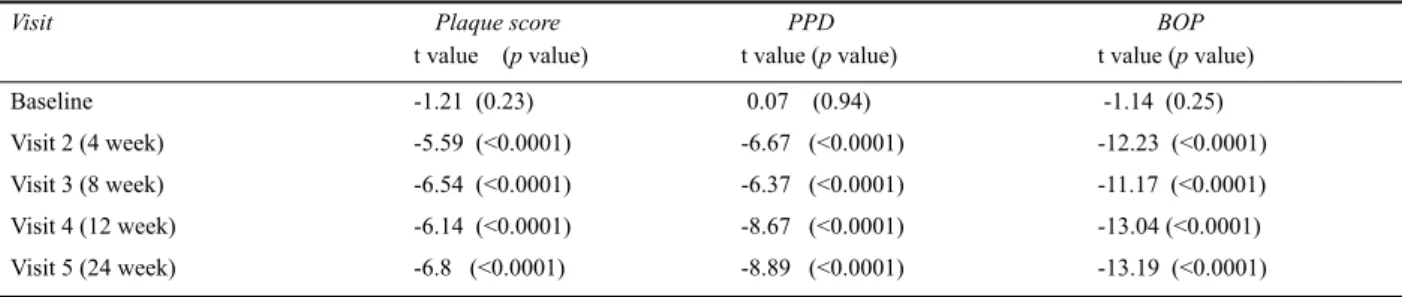
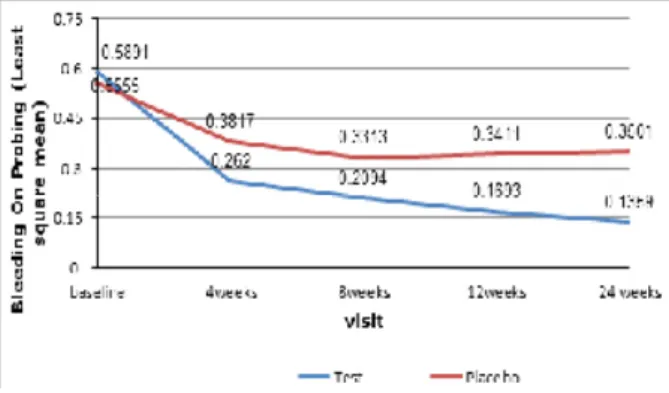
The results with respect to all three clinical variables PS, PPD and BOP were similar. The type 3 test of fixed effects for the three effects-Group (1 and 2), visit (baseline, 4,8,12 and 24 weeks) and interaction between group and visit, (Tables 1A & B, 2A & B and 3A & B) show that the type 3 test for all three effects are statistically significant (p<0.0001) in relation to all three clinical parameters. Figures 2, 3 and 4 show a general trend of a gradual reduction of all three parameters – plaque score, probing pocket depth and bleeding on probing, with time. It is also evident from the Figures 2, 3 and 4 that, at each visit the gap between values of two groups has increased and the decrease in all three parameters over time is greater in group 1 than the group 2. These differences between group 1 and group 2 were statistically significant at all visits – at 4, 8, 12 and 24 weeks (p<0.0001) in relation to all three clinical parameters – PS, PPD and BOP (Table 4).
Salivary microbial counts
Table 5A and 5B show the type 3 test of fixed effects for the three effects (group, visit and group*visit) in relation to the total salivary aerobic and anaerobic counts. According to Table 5A, type 3 test for visit is highly significant (p<0.0001) indicating that there is a reduction of total aerobic counts with time in both groups but there is no significant group effect (p>0.05) indicating herbal toothpaste had no significant effect on aerobic counts. There is also no significant effect on the counts due to the combined effect of visit and group indicating the effect did not vary due to the interaction between the test toothpaste use and the duration of its use (p>0.05)
Table 5B shows the type 3 test of fixed effects for dependent variable total anaerobic counts in saliva. It indicates that all three effects – visit, group and interac-tion between group and visit are statistically significant (p< 0.001, p<0.05 and p<0.05 respectively). It also shows that there was a reduction of anaerobic counts during the trial irrespective of group, the group which used the herbal toothpaste had significantly lower counts compared to the group which used the placebo toothpaste (p= 0.04).
Visit Plaque score PPD BOP
t value (p value) t value (p value) t value (p value)
Baseline -1.21 (0.23) 0.07 (0.94) -1.14 (0.25)
Visit2 (4 week) -5.59 (<0.0001) -6.67 (<0.0001) -12.23 (<0.0001)
Visit 3 (8 week) -6.54 (<0.0001) -6.37 (<0.0001) -11.17 (<0.0001)
Visit 4 (12 week) -6.14 (<0.0001) -8.67 (<0.0001) -13.04 (<0.0001)
Visit 5 (24 week) -6.8 (<0.0001) -8.89 (<0.0001) -13.19 (<0.0001)
Table 4. Differences between PS, PPD and BOP in Group 1 and Group 2 during the trial visits A: Type 3 Tests of Fixed Effects
Effect Num DF Den DF F Value Pr > F
Group 1 69.9 8.14 0.0057
Visit 4 274 103.41 <.0001
Group*Visit 4 274 12.70 <.0001
B: Least Squares Means for Group Visit Interactions
Effect Group Visit Estimate Standard Error
Group*Visit 1 1 2.3094 0.03925
Group*Visit 1 2 1.9781 0.03925
Group*Visit 1 3 1.9232 0.03925
Group*Visit 1 4 1.8715 0.03925
Group*Visit 1 5 1.8441 0.03960
Group*Visit 2 1 2.3050 0.03925
Group*Visit 2 2 2.0959 0.03925
Group*Visit 2 3 2.0430 0.03925
Group*Visit 2 4 2.0942 0.03925
Group*Visit 2 5 2.0953 0.04000
Table 2. Effect of different toothpaste use on probing pocket depth during the trial
A: Type 3 Tests of Fixed Effects
Effect Num DF Den DF F Value Pr > F
Group 1 69.9 21.68 <.0001
Visit 4 274 192.69 <.0001
Group*Visit 4 274 22.58 <.0001
B: Least Squares Means for Group Visit Interactions
Effect Group Visit Estimate Standard Error
Group*Visit 1 1 0.5891 0.02201
Group*Visit 1 2 0.2620 0.02201
Group*Visit 1 3 0.2094 0.02201
Group*Visit 1 4 0.1673 0.02201
Group*Visit 1 5 0.1368 0.02232
Group*Visit 2 1 0.5555 0.02201
Group*Visit 2 2 0.3817 0.02201 Group*Visit 2 3 0.3313 0.02201
Group*Visit 2 4 0.3411 0.02201
Group*Visit 2 5 0.3537 0.02267
Figure 2. Change of Plaque Score during the trial period
Figure 3. Change of Probing Pocket Depth
during the trial period
Figure 4. Change of Bleeding on Probing during the trial
Null Model Likelihood Ratio Test
DF Chi-Square Pr > ChiSq 1 48.18 <.0001
Solution for Fixed Effects
Effect group Estimate Error DF t Value Pr > |t|
Intercept 8.3665 0.09170 112 91.24 <.0001
Visit -0.03207 0.005750 316 -5.58 <.0001
Group 1 -0.01486 0.09938 315 -0.15 0.8812
Group 2 0 . . . . Visit*Group 1 -0.00380 0.008053 316 -0.47 0.6373 Visit*Group 2 0 . . . .
Type 3 Tests of Fixed Effects
Effect Num DF Den DF F Value Pr > F
Group 1 315 0.02 0.8812
Visit*Group 1 316 0 . 2 2
Null Model Likelihood Ratio Test
DF Chi-Square Pr > ChiSq 1 12.90 0.0003
Solution for Fixed Effects
Effect group Estimate Error DF t Value Pr > |t| Intercept 8.7165 0.09405 187 92.68 <.0001 Visit -0.03701 0.006824 313 -5.42 <.0001 Group 1 -0.2451 0.1190 312 -2.06 0.0402 Group 2 0 . . . . Visit*Group 1 -0.01906 0.009623 312 -1.98 0.0485 Visit*Group 2 0 . . . .
Type 3 Tests of Fixed Effects
Effect Num DF Den DF F Value Pr > F
Visit 1 313 9 3 . 3 8
<.0001
Group 1 312 4.24 0.0402
Table 5A. Effect of different toothpaste use on the salivary aerobic counts during the trial
Table 5B. Effect of different toothpaste use on the salivary anaerobic counts during the trial
It also shows that group and visit interaction is present and the estimate is negative (-0.2451) and it is statistically significant (p=0.04). Taken all these findings together herbal toothpaste use has resulted in greater reduction in anaerobic counts compared to the placebo use and this reduction also increased with each visit during the trial period.
Discussion
statistically significant reduction of total salivary aerobic counts in both groups over time when compared with baseline counts. However these reductions were not statistically significant between groups. The salivary anaerobic counts were also reduced in both groups with observed reduction in the Group1 which used herbal toothpaste being greater compared to that of the placebo group (p=0.0001). The reduction of anaerobic counts in the group which used herbal toothpaste was also increased with the duration of its use (p=0.04 Table 5B). Initial oral prophylaxis and the Hawthorn effect may have contributed partly to the general reduction of all clinical parameters and aerobic and anae-robic bacterial counts in this clinical trial. However, the finding that the use of herbal toothpaste resulted in statistically significantly greater reduction of all clinical parameters and anaerobic bacterial counts could be due to the antibacterial and antiinflammatory properties of the herbal ingredients used in the toothpaste.
This is the first study reporting a six-month clinical trial using a toothpaste formulated with a mixture of herbal extracts, in which the clinical, microbial and oral hygiene parameters have reduced significantly when compared with a placebo toothpaste which had the same ingredients in the herbal toothpaste except the herbal extract. Another finding of this study is the absence of any significant difference in aerobic bacterial counts between the two groups suggesting that this herbal toothpaste does not significantly alter the aerobic bacterial counts. This is a favourable finding as the aerobic bacteria in the oral microbiome are associated with gingival health.
The reduction of anaerobes during the trial period explains the clinical improvement of gingivitis as resolution of gingival inflammation is associated with concomitant reduction of anaerobes in the oral biofilm. Further, the improvements obtained in BOP and plaque score in this study with the use of the test herbal toothpaste was better than in studies which used either the twice daily antimicrobial mouth rinses in addition to routine toothbrushing [16, 17, 18], or the combined effect of antiseptic mouth rinse and antigingivitis and antiplaque dentifrice in another study [19]. Hence the use of antimicrobial rinses as an adjunct to tooth brushing would appear to be superfluous. An added advantage of using the test toothpaste is the complete absence of tooth staining and taste alterations related to its use, when compared to other agents such as chlorhexidine [20].
This trial was a sequel to our previous study with volunteers [21] which showed that three months’ use of this particular herbal toothpaste conferred significant improvement in PS, BOP and salivary anaerobic counts, with no significant effect on the total salivary aerobic counts [20]. It is noteworthy that the beneficial effects observed in this study were with twice a day, unsuper-vised home use of this toothpaste, with no reinforcement of oral health or brushing instructions during the trial.
In conclusion, this trial provides evidence for the
therapeutic benefits of the Ayurvedic medicinal test toothpaste through its anti-inflammatory effects and confirms the previously docmented anti-inflammatory and antibacterial properties of the herbs used in this formula.
Acknowledgements
We are grateful to the staff of the Veterinary Research Institute, Gannoruwa, Sri Lanka for providing sheep blood for this study, Mrs. M R D M Senanayake, for technical assistance, the staff of the Division of Microbiology for helping in many ways for this project, and Link Natural Products (Pvt) Ltd., Sri Lanka, for funding this study.
Conflicts of interest
This study was sponsored by Link Natural Products Private Limited which produces the test herbal toothpaste Sudantha. Study was conducted, data collected and analysed at University of Peradeniya. PSR had full access to all the data in this study and takes complete responsibility for the integrity of the data, and the accuracy of the data analysis.
References
1. Loe H, Theilade E, Jensen SB. Experimental gingivitis in man. J Periodontol 1965; 36:177-87.
2. Al-Shammari KF, Al-Khabbaz AK, Al-Ansari JMN, et al. Risk indicators for tooth loss due to periodontal disease. J Periodontol 2005; 76: 1910-8.
3. Burt, B. Position paper: epidemiology of periodontal diseases. J Periodontol 2005; 76: 1406-19.
4. Thoden V and Abraham-Inpijn L. Plaque and systemic disease: a reappraisal of the focal infection concept. J Clin Periodontol 1984; 11: 209-20.
5. Dave S, Vane Dyke T. The link between gingivitis and periodontal disease is probably inflammation. Oral Disease 2008; 14: 95-101.
6. Loesche WJ, Schork A, Terpenning MS, et al. Assessing the relationship between dental disease and coronary heart disease in elderly U.S. Veterans. J Am Dent Assoc 1998;
129: 301-11.
7. Pussinen PJ, Alfthan G, Rissanen H, et al. Antibodies to periodontal pathogens and stroke risk. Stroke 2004; 35: 2020-3.
8. Taylor GW, Burt BA, Becker MP, Genco RJ, et al. Severe periodontitis and risk for poor glycemic control in patients with non-insulin-dependent diabetes mellitus. J Periodontol 1996; 67: 1085-93.
9. Lindhe J, Koch G. The effect of supervised oral hygiene on the gingiva of children. Lack of prolonged effect of supervision. J Periodontol Res 1967; 2: 215-22.
11. Gunsolley JC. A meta-analysis of six-month studies of antiplaque and antigingivitis agents. Am Dent Assoc2006;
137: 1649-57.
12. Guidelines for acceptance of chemotherapeutic products for the control of supragingival dental plaque and gingivitis. Council on Dental Therapeutics. Am Dent Assoc 1986; 112: 529-32.
13. Recommended Revisions to American Dental Association Guidelines for Acceptance of Chemotherapeutic Products for Gingivitis Control. J Periodontal Res 1994; 29: 299-304. 14. Turesky S, Gilmore ND, Glickman I. Reduced plaque
formation by the chloromethyl analogue of vitamin C. J Periodontol 1970; 41: 41-3.
15. Quigley G, Hein J, Comparative cleaning efficiency of manual and power brushing. J Am Dent Assoc1962; 65: 26-9.
16. Mankodi, Bauroth K, Witt JJ, Bsoul S, et al. A 6-month clinical trial to study the effects of a cetylpyridinium chloride mouthrinse on gingivitis and plaque. J Am Dent Assoc 2005.
17. Mankodi S, Bartizek RD,Winston JL, et al. Antigingivitis efficacy of a stabilized 0.454% stannous fluoride/ sodium hexametaphosphate dentifrice. J Clin Periodontol 2005;
32: 75-80.
18. Sharma N, Charles CH, Lynch MC, et al. Adjunctive benefit of an essential oil-containing mouthrinse in reducing plaque and gingivitis in patients who brush and floss regularly: a six-month study. J Am Dent Assoc 2004; 135: 496-504. 19. Charles CH, Sharma NC, Galustians HJ, et al. Comparative
efficacy of an antiseptic mouth-rinse and an antiplaque/ antigingivitis dentifrice. A six-month clinical tri J Am Dent Assoc 2001, 132: 670-5.
20. Charles CH, Sharma NC, Galustians HJ, et al. Comparative efficacy of an antiseptic mouthrinse and an antiplaque/ antigingivitis dentifrice. A six-month clinical tri JJ Am Dent Assoc 2001, 132: 670-5.
21. Yates R, Jenkins S, Newcombe R, Wade W, et al. A 6-month home usage trial of a 1% chlorhexidine toothpaste (1). Effects on plaque, gingivitis, calculus and toothstaining. J Clin Periodontol 1993; 20: 130-8.