MORE PEOPLE BUT LESS MIND: HOW NUMBER AFFECTS MIND PERCEPTION AND DECISIONS TO HARM
Erin Cooley
A dissertation submitted to the faculty of the University of North Carolina at Chapel Hill in partial fulfillment of the requirements for the degree of Doctor of Philosophy in the Department
of Psychology.
Chapel Hill 2015
Approved by: Sara Algoe
Barbara Fredrickson Kurt Gray
©2015 Erin Cooley
ABSTRACT
Erin Cooley: More People But Less Mind: How Number Affects Mind Perception and Decisions to Harm
(Under the direction of B. Keith Payne)
Most moral codes agree that harming another person is wrong. However, instances in which people cause widespread harm abound. One reason for this discrepancy between moral values and behavior may be that people have difficulty imagining groups of people experiencing suffering. In this research, I first propose that people sometimes harm groups more readily than individuals. Second I propose that greater harm for groups (versus individuals) may be driven by the perception that groups are less capable of mentally experiencing sensations such as pleasure and pain. In a Preliminary Study I tested whether people are more likely to harm many than one when the targets are outgroup members. Contrary to hypotheses, participants were more likely to harm one than many regardless of group membership. Next, in Study 1, I examined whether people perceive mind differently in groups of people as compared to individuals from those groups. As predicted, across 19 categories, groups were perceived as having less mental capacity for experience than individuals. Study 2 extended these findings to examine whether reduced perceptions of experience among groups is driven by cues to being a group and to evaluate implications for decisions to harm. Results revealed that participants attributed less experience to a group described as a single entity as compared to a group described as a collection of
ACKNOWLEDGEMENTS
Completing a doctoral program is not easy. I want to thank the following people for giving me the support, strength, and guidance to make it to this point. I am honored and grateful to have had the opportunity to go through this process surrounded by such awe-inspiring people.
Keith Payne, for your patient mentoring throughout the past six years. I honestly could
not imagine having a better mentor throughout this journey. As I mentor my own students, I often notice that the words that I use, and the research strategies that I share, come directly from lessons you have taught me. Your guidance about how to evaluate whether an idea will advance theory and how to write simply about complex topics are
indispensable. In addition to giving me advice about how to be a good academic, you have always provided a morale boost when I most needed it. I look forward to continuing to bounce ideas off of you and learning from you for the rest of my career.
Chet Insko, for being a patient and open mentor who taught me an immense amount
about the research process. Your research was some of the first that really hooked me into social psychology and sparked my interest in studying ideas I am passionate about (i.e., intergroup conflict). Thank you for helping to shape me into a better researcher and scholar.
Barbara Fredrickson, for being a role model for how to be a world-renowned,
distinguished professor, while also maintaining a genuine humbleness and concern for the well-being of those around you. You have made me feel cared for not only as a
hope I am lucky enough to have you as a life-long mentor as I continue to grow and develop as a researcher and as a person.
Sara Algoe, Kurt Gray, Beth Kurtz-Costes, Melanie Green and Sophie Trawalter, for
your guidance and support on my masters, dissertation, grant proposals, and general life as an academic. I admire you all greatly and feel honored to have been able to work with you. I am excited to continue learning from all of you and working together in the future.
Barry Schlenker, for teaching my undergraduate methods course and inspiring me to
pursue social psychology as a career. Our philosophical discussions about how to present research findings in a compelling, yet transparent, way stay with me to this day. I am extremely grateful that you empowered me to enter a doctoral program and pursue the research questions that I feel are so important.
To my research assistants and students, not only for helping with the research process,
but for helping me to become a better researcher, teacher, and mentor. Some research assistants and students who stand out are Jean Phillips, Jessica Curtis, Erika Scheib, Shilpi Misra, Michael Parrish, Brooke McKenna, Hannah Brown, Alexy Hernandez, and Morgan Lancaster.
My fellow graduate student friends and colleagues, Jazmin Brown-Iannuzzi, Kristjen
hours, random Davie hallway conversations, among many other memories. I have felt so grateful to be surrounded by such brilliant, yet warm and humble, people. You all
motivate me to be a better academic and a better person.
My unwavering supporters and friends Brooke Magnus and Jordy Carpenter for having
been by my side for the weddings and the funerals, the struggles and the successes, and everything else that occurs in the span of 5 to 6 years of graduate school. I have not met such incredible and loyal friends before in my life and can’t imagine finding anyone better to call life-long friends.
Ankita Rao, for being a moral guide, an inspiration, and one of the most fantastic people I
have ever met. Your mission, your values, and your dedication to making the world a better place are unrivaled. Although our journeys may keep us living in separate countries, I cherish our friendship. Honestly, I am honored to be your friend.
My parents, Margaret and Guy Cooley, for giving me unwavering love and support—
even at times when I am sure that was not easy. You are the most brilliant and kind people I have ever met: you inspire people, help others when they are in need, and you continuously give without seeming to ever take for yourselves. You have shaped my values of compassion, empathy, and perspective-taking. Everything that is good about me comes from you.
My brother, Bryan Cooley, for having always inspired me as my older brother. I have
My grandfather, Leo Nussbaum, for helping to shape my values of education, a global
mindset, and attempting to mitigate inequality in all forms. Your dedication to racial equality at a time when racial prejudice was more socially acceptable than it is today serves as a continual source of inspiration. I hope to carry forward the best of your legacy.
To all of my extended family, I could not be who I am without you all. I am so incredibly
lucky and grateful to feel so supported and inspired by each of you.
My husband, Joshua Wilson, for taking this journey of life by my side. You have been
TABLE OF CONTENTS
LIST OF TABLES…….………...xi
LIST OF FIGURES………...………...xii
CHAPTER 1: INTRODUCTION……... 1
CHAPTER 2: LITERATURE REVIEW AND THEORETICAL BACKGROUND…... 3
Moral Decision-Making and Number………..………... 3
Dehumanization Enables Harm………... 5
Mind Attributions and Group Harm………... 7
CHAPTER 3: OVERVIEW OF STUDIES………... 11
CHAPTER 4: PRELIMINARY STUDY………...13
Method………... 14
Results……… 15
Discussion……….. 17
CHAPTER 5: STUDY 1……… 20
Method………..………... 20
Results………..………... 22
Discussion………..……… 24
CHAPTER 6: STUDY 2………..………... 28
Method………... 28
Discussion………... 33
CHAPTER 7: GENERAL DISCUSSION……… 36
Alternative Mechanisms for Greater Harm of Many than One…………... 40
Understanding Mind Perception of Groups………... 42
Future Directions………... 46
Conclusion………. 47
APPENDIX: MATERIALS………... 49
TABLES……… 57
FIGURES ……….. 61
LIST OF TABLES Table
1. Mind perception across non-company targets, Study 1………..………… 57 2. Associations between prejudice and mind perception, Study 1……..………... 59 3. Mind perception controlling for stereotypes of warmth and competence,
LIST OF FIGURES Figure
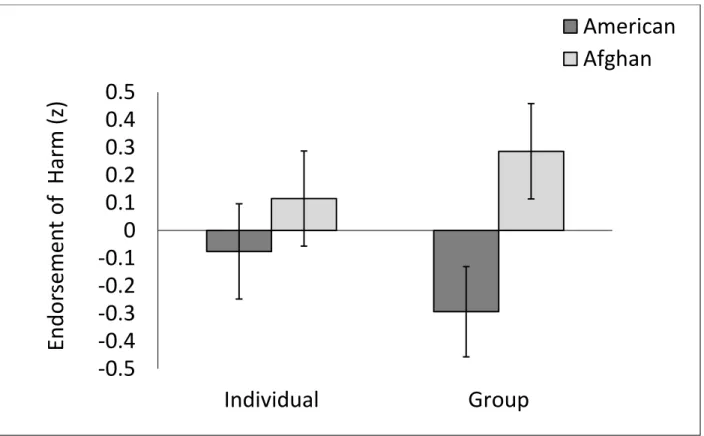
1. Endorsement of collateral damage based on number and group membership of victims, Preliminary Study, Partial Sample………..………. 61 2. Endorsement of collateral damage based on number and group membership
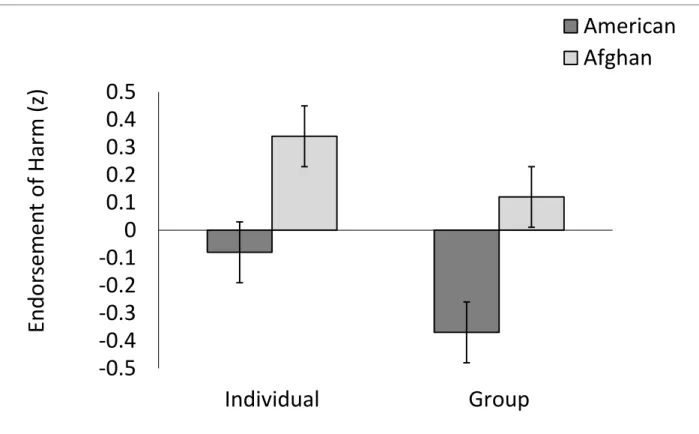
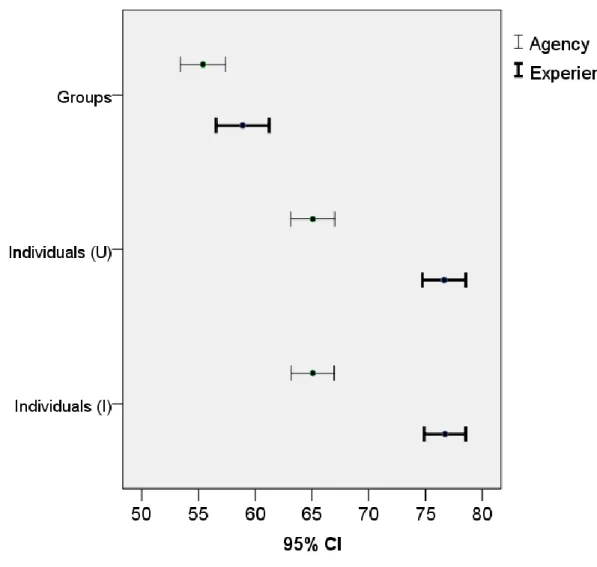
of victims, Preliminary Study, Full Sample………..………. 62 3. 95% confidence intervals of experience and agency ratings across all groups,
unidentified individuals, and identified individuals, Study 1..………..………. 63 4. Mind perception of companies and individuals from those companies, Study
1………...………..………. 64 5. 95% confidence intervals of experience and agency ratings for an accounting
company (comprised of 15 people), 15 people (who compose an accounting company), and a man who works for an accounting company, Study
CHAPTER 1: INTRODUCTION
In 2011 Occupy Wall Street protesters spread from the confines of Wall Street to stage a country-wide protest against wealth inequality in America. A unifying theme behind the
movement was that the greed and corruption of the wealthiest 1% led the majority of the wealth to remain in the hands of a few. Building from this rhetoric, reports concurrently began to surface that Wall Street workers (often considered to be among the wealthy 1%) scored higher on measures of psychopathy than the general population (Decovny, 2012; Silver, 2012). Despite ultimately being discredited (Grohol, 2012), this link between Wall Street and psychopathy was intuitively appealing. How else does one explain the behaviors of people such as Bernie Madoff or the executives behind the Enron scandal who caused widespread financial harm to many people with a seeming lack of remorse?
Like the financial harm visible at the national level, physical harm, too, is sometimes directed toward many people at once—especially in the context of global conflict. For example, when deciding to launch a military attack, leaders are making a decision that will physically harm groups of people rather than individuals. Thus, sources of conflict, both within our country and internationally, highlight the importance of understanding how people conceive of harming many people at once.
imagining the suffering of a group of people may be more difficult to do. An interesting
implication of perceiving the mind of a group as less capable of experiencing pain and suffering is that harming a group may ironically feel more moral than harming an individual--despite the fact that more harm is objectively being caused. To test these ideas, I will first examine
CHAPTER 2: LITERATURE REVIEW AND THEORETICAL BACKGROUND Moral Decision-Making and Number
Although no existing research has manipulated the number of potential victims in decisions to harm, research has examined the effect of number on another dimension of moral decision making: the choice to engage in helping behaviors. In deciding to help, number has a surprising effect. The more people who are suffering, the less people feel compassion or
sympathy for their plight. This reduction in compassion as the number of victims rises has been called the “collapse of compassion” (Slovic, 2007). Because compassion helps motivate people to help (Batson et al. 1991), this collapse of compassion means that many suffering victims are ironically less likely to receive help than a single suffering individual (Slovic, 2007; Small, Loewenstein, & Slovic, 2007). This is why hearing about a single American soldier who was killed by a roadside bomb abroad can instill more compassion and distress than hearing statistics summarizing the thousands of Americans who died in the war in Iraq. Because the idea that people feel less compassion for many than for one is not intuitively obvious, much research has explored mechanisms that may explain this finding.
receive less compassion, not because of the number of victims, but because group members are not individually identified. More recent research, however, conflicts with this interpretation. Kogut and Ritov (2005) gave some participants information about multiple identified victims and others information about a single identified victim. Next they examined emotional responses and decisions to help. Interestingly, even when people received the same identifying information about groups as they had about an individual, insensitivity to mass suffering remained. Not only did participants show decreased compassion for an identified group as compared to an identified individual (Kogut & Ritov, 2005), but they also reported less blame for perpetrators who had harmed many identified victims as compared to one identified victim (Nordgren & McDonnell, 2011). Although these findings do not rule out the possibility that even identified groups are more abstract than identified individuals, it does indicate that the collapse of compassion is not fully accounted for by a lack of identification of groups. More recent research argues that
reduced compassion for groups is not driven by the way that groups are mentally represented, but rather by the motivations of the perceiver.
If groups of suffering victims elicit less help than a suffering individual then groups may also elicit more harm than an individual. However, the differences between helping and harming are also important to consider. Most people actively work to avoid harming others (do-no-harm principle; Baron, 1995; Baron & Ritov, 2004; Hauser, Tonnaer, & Cima, 2009). In fact, harm is so undesirable that people struggle to harm one person even when that harm will result in saving many (Foot, 1967; Greene, Sommerville, Nystrom, Darley, & Cohen, 2001; Petrinovich, O'Neill, & Jorgensen, 1993; Mikhail, 2002). Harm aversion even extends to fake harm (Cushman, Gray, Gaffey, & Mendes, 2012). In two studies, Cushman and colleagues (2012) found that
participants exhibited higher levels of physiological stress both when imagining and enacting fake harm to another individual (e.g., slicing someone’s throat with a fake knife) as compared to witnessing the same harmful actions done by others. Given this strong aversion to actively causing harm to an individual, why is it that harm still occurs? Research suggests that one of the central ways that people enact harm while maintaining their sense of moral integrity is through denying the experience of suffering to a potential victim. In essence, they deny the victim a human mind.
Dehumanization Enables Harm
cause (Osofsky, Bandura, & Zimbardo, 2005). Together this research suggests that dehumanization may enable moral disengagement such that causing harm no longer feels blameworthy (Bandura, 1999; Leidner, Castano, Zaiser, & Giner-Sorolla, 2010; Harris & Fiske, 2011). A more nuanced form of dehumanization is infrahumanization. Infrahumanization denies others uniquely human emotions such as guilt and shame but not emotions that are shared with animals such as anger and fear (Cortes, Demoulin, Rodriguez, Rodriguez, & Leyens, 2005; Leyens, Paladino, Rodriguez-Torres, Vaes, Demoulin, Rodriguez-Perez, & Gaunt, 2000; Leyens, Rodriguez‐Perez, Rodriguez‐Torres, Gaunt, Paladino, Vaes, & Demoulin, 2001; Haslam 2006). In effect, targets are denied a uniquely human essence making them indistinguishable from non-human species (Leyens et al., 2001). Importantly even this subtle denon-humanization has big consequences. In one study, outgroups who were manipulated to be the most infrahumanized were discriminated against the most (Pereira, Vala, & Leyens, 2009). Similarly, recent research has linked ethnoreligious and political conflict to reduced perceptions of outgroups’ ability to experience love (a secondary emotion) as compared to hate (a primary emotion; Waytz, Young, & Ginges, 2014).
framework of Gray and colleagues’ (2012) theory of dyadic morality. Within this theory, the authors argue that mind perception underlies all moral judgments—including, decisions to harm (Gray, Young, & Waytz, 2012; Gray & Wegner, 2011).
Mind Attributions and Group Harm
In their theoretical account of morality, Gray and colleagues (2012) argue that the
perception of two interacting minds forms a stable template which underlies all moral judgments. This dyadic interaction of minds consists of both a moral agent who enacts help or harm and a moral patient who is the recipient of these behaviors. Importantly, these interacting minds are not one-dimensional. In a large internet survey of over 2000 people, mind perception was
characterized by two distinct dimensions: experience and agency (Gray, Gray, & Wegner, 2007). Furthermore, central to the topic of the current proposal, this survey found that mind perception in terms of experience was more strongly correlated with desires to avoid harm than mind perception in terms of agency.
event. In this scenario, observers would likely say that the group as a whole prefers jazz but would not attribute this preference to any individual member of the group.
Other research has compared group mind to individual mind, but by operationalizing mind in terms of a capacity for agency rather than beliefs and preferences. In particular, Watyz and Young (2012) found that groups are attributed less agency than individual members of that group; however they also found evidence for a trade-off such that the more that the group as a whole was attributed a mind in terms of agency, the less agency that was attributed to individuals within that group. Furthermore, these authors found that groups who were most group-like or entitative (e.g., high in proximity, similarity and common fate; Campbell, 1958) were more likely to be attributed a unified group mind than less entitative groups. Together these findings, along with those of Jenkins and colleagues (2014), converge on the idea that groups can be attributed minds of their own. The present research will extend these findings to examine how perceptions of mind in terms of experience vary in response to groups as compared to individuals from those groups. I expect that groups, and especially entitative groups, will be perceived as having less of a capacity for mind in terms of experience than individuals from those groups. Furthermore, I expect this reduced perception of experience within groups to have potential implications for decisions to harm groups.
experimenter bias (Strickland & Suben, 2012; Phelan, Arico, & Nichols, 2012). In particular, the researchers who generated the sentences that were then rated on “strangeness” by participants were not blind to hypotheses. Furthermore, as others have pointed out, results may have been driven by participants’ stereotypes of companies as being agentic rather than biased perceptions of mental capacities of groups in general (Rai & Diermeier, 2015).
Addressing some of the concerns with the work of Knobe and Prinz (2008), Rai and Diermeier (2015) recently compared mind perception of companies with individual
entrepreneurs in terms of both experience and agency. This research also manipulated whether the target was a victim of a moral transgression or a perpetrator of a moral transgression. When couched as victims, companies were attributed less experience than individual entrepreneurs; when couched as villains, companies and individual entrepreneurs were attributed similar levels of agency. However, because experience was only measured among participants assigned to the victim condition (but not the perpetrator condition), this research does not test how experience is attributed to groups as compared to individuals from those groups in a neutral context.
stereotypes in analyses examining mind perception in order to establish the unique effects of being a group on mind perception beyond the influence of stereotypes.
CHAPTER 3: OVERVIEW OF STUDIES
CHAPTER 4: PRELIMINARY STUDY
In a Preliminary Study that motivated this dissertation project, I tested whether groups, and especially groups of outgroup members, were more likely to be harmed than individuals in the context of global warfare. In particular, participants reported their endorsement of launching a drone that would injure innocent groups or individuals that belong to an ingroup (i.e.,
Americans) or an outgroup (i.e., Afghans). I predicted that there would be a main effect of group membership such that people would be more likely to endorse harm toward the outgroup. This idea is supported by decades of research on love for the ingroup and biases toward outgroups (e.g., Brewer, 1999). However, I expected this main effect to be qualified by an interaction of number and group membership. In particular, when deciding to harm one’s ingroup, I expected participants to be sensitive to number in an intuitive way: harming a group of ingroup members should be less likely than harming a single ingroup member. I reasoned that because ingroups are often perceived to be less homogenous than outgroups (Park & Rothbart, 1982; Linville, Fischer, & Salovey, 1989; Park & Judd, 1990; Ostrom, Carpenter, Sedikides, & Li, 1993), that ingroup groups may be perceived as multiple individuals with high levels of experience and, thus, difficult to harm. For outgroups, however, I expected number to be important in a
Data collection for Study 1 had already begun at the time of my dissertation proposal. First I will report the pattern of findings that was apparent in the partial sample at the time of my proposal, then I will report the final results with the full sample.
Method Participants
Participants were 297 students1 in a marketing course at University of North Carolina at Chapel Hill who completed the study for course credit.I collected part of this sample (N = 119) before my dissertation proposal and completed data collection in the following semester. Design
The design was a 2(Group Membership of Collateral Damage: ingroup vs. outgroup) X 2(Amount of Collateral Damage: 1 vs. 11 people harmed) factorial design with both factors manipulated between-subjects.
Procedure
After agreeing to an electronic informed consent participants learned that there would be an attention check within the study. Next participants read a brief piece of information about the controversy of drone strikes launched by America abroad. They also learned that they would be asked to make a decision about a drone strike in a hypothetical scenario that would follow.
Participants were then given a scenario in which they had to decide whether to launch a drone strike in an area of Afghanistan. This strike would kill a known terrorist leader, but would also cause varying amounts of collateral damage. Some learned that the drone would kill 11 innocent Afghan civilians, some learned the drone would kill 11 innocent American civilians, some learned the drone would kill one identified Afghan civilian, and some learned the drone
would kill one identified American civilian (see Appendix for wording). Identified single victims were identified through a first and last name.Participants indicated how much they supported the drone strike (“How supportive would you be of the decision to go ahead with this drone strike?) and how approving they would be of the drone strike (“How approving would you be of this drone strike?”) on 1 (not at all) to 100 (extremely) sliding scales. Participants also were asked to imagine that the decision was time urgent and that they needed to make a forced choice of “Yes”
or “No.”
Directly after making this forced choice rating, participants were asked to report how similar Americans are to one another and how similar Afghans are to one another on a 1 (not at all) to 100 (extremely) sliding scale as a measure of group homogeneity. Participants completed the study by indicating whether they identified as an American and reported other demographic information such as gender, overall political conservatism, and separate items for social and economic conservatism. Finally, they completed the attention check which instructed them to ignore the actual statements on that survey page (“This study was easy to complete,” “This study was worthwhile,” and “This study was confusing”) and instead respond with 1 (strongly
disagree) to all questions. Results
Preliminary Analyses
Main Analyses Partial Sample (N = 119)
At the time of the proposal I had collected about half of the desired sample. To test my main hypothesis on the partial sample, I conducted a 2 (Group Membership of Collateral Damage: ingroup vs. outgroup) X 2 (Number of Collateral Damage: 1 vs. 11) between-subjects ANOVA predicting endorsement of harm. First, a main effect of group membership of the target revealed that participants were less likely to harm American targets (M = -.19; 95% CI
[-.42, .05]) than Afghani targets (M = .20; 95% CI [-.04, .44]), F(1, 115) = 5.17, p = .03, ηp2 = .04. The predicted interaction was not significant but the means were in the predicted direction, F(1, 115) = 1.31, p = .25, ηp2 = .01 (see Figure 1). In particular, means indicated a diverging effect of number of people harmed based on group membership. Groups of Americans were less likely to be harmed (M = -.29; 95% CI[ -.42, .05]) than an individual American (M = -.08; 95% CI[-.42, .26]). This pattern was reversed for outgroup members. In particular, groups of Afghan civilians were descriptively more likely to be harmed (M = .29; 95% CI [.05, .63]) than an individual Afghan civilian (M = .12; 95% CI[-.23, .45]). This pattern of effects was consistent with my hypotheses.
Main Analyses Full Sample (N = 297)
ηp2= .06. The main effect of number indicated that participants were less likely to endorse the
drone strike when it would harm many people (M = -.12; 95% CI [-.27, .02]) as compared to a single individual (M = .13; 95% CI [-.02, .28]), F(1, 291) = 5.64, p = .02, ηp2 = .02. The
predicted interaction of group membership X number was not significant, F(1, 291) = .11, p
= .74, ηp2= .00. Thus, inconsistent with the pattern in the partial sample, group membership did
not moderate the effect of number of potential victims on endorsement of harm. Instead,
participants showed an ingroup bias, avoiding harming ingroup members more so than outgroup members. Furthermore, reflecting predominantly utilitarian motives, participants seemed
motivated to minimize harm overall. Discussion
In a Preliminary Study, I tested whether, in the context of outgroups, people may be more likely to harm many than one. Results revealed two intuitive main effects, but not the predicted interaction of group membership and number. In particular, participants were less likely to harm groups as compared to individuals and showed a general preference for the ingroup such that drone strikes were less likely to be endorsed when the collateral damage would be people from America as compared to people from Afghanistan. These findings are consistent with research on harm aversion (Baron, 1995) such that participants were more reticent to harm many than one as well as intergroup biases such that participants were more averse to harming ingroup members than outgroup members (Brewer, 1999).
liberalism/conservativism, etc.) were likely operating. For example, it is possible that only those with high levels of prejudice toward people from Afghanistan, positive attitudes toward drone strikes, or who are in support of the war in Afghanistan would be motivated to harm many outgroup members more than one. Because I did not measure these factors, I was unable to examine their potential role as moderators. Furthermore, because people in general have such a strong aversion to causing physical harm, utilitarian motives may, under most circumstances, overwhelm factors that may otherwise lead people to harm groups of people. Perhaps more subtle sources of harm, such as reputational or financial harm, would be more susceptible to motives distinct from utilitarianism.
Because the Preliminary Study did not support my hypothesis that outgroup groups would be harmed more than individuals, in Study 1, I tested my second hypothesis that people would exhibit differential mind perception of groups as compared to individuals from those groups. Previous research on mind perception has found that mind perception can be explained by two distinct factors: experience and agency. In the following study, I thus examined
perceptions of experience and agency for groups and individuals from a variety of categories. I expected that people may find it more difficult to consider groups having a mind in terms of experience and thus, groups may be attributed lower capacities for experience than individuals from those groups. For individual targets I included both identified (by name) and unidentified individuals. Because groups are often unidentified (i.e., individual members are not referenced by name) this allowed me to test whether any differences in mind perception between groups and individuals is driven by differences in identification rather than being perceived as a group.
CHAPTER 5: STUDY 1
In Study 1 I examined perceptions of experience and agency of groups and individuals from 19 different categories (e.g., companies, national groups, racial/ethnic groups etc.). Overall, I predicted that groups would be attributed less mind in terms of experience than either identified or unidentified individuals from those groups.
Additionally, for the racial/ethnic categories, I included measures of prejudice in order to examine whether greater prejudice moderates reduced ascription of mind to groups as compared to individuals from those categories. I reasoned that perceiving disliked groups as low in the capacity to experience could be one way that people justify widespread harm toward disliked groups. Other recent research has found that motivations can affect which types of mind people attend to (Waytz & Young, 2014). Here, I attempted to extend these existing findings to examine how motivations affect perceptions of an underlying capacity for different types of mind.
Method Participants
Participants were 177 workers2 collected through Amazon Mechanical Turk (Mturk) who received $.55 in exchange for completing the study. Participants were, on average, in their early 30s (M = 33), a majority female (60%), and White (81%).
Design
Participants made ratings of a randomly selected type of target (group, identified
individual, unidentified individual) on mind attributions in terms of both agency and experience across 19 categories. Each participant made ratings of all 19 categories; however for each category, participants only rated either an individual or a group.
Procedure
After signing an informed consent and completing a brief attention check, participants learned that they would read about a variety of social targets and be asked to rate to what degree each target is capable of things such as self-control or pain and pleasure. Next, participants rated 19 different social targets. Seven of these targets were taken from previous work on mind
perception of individuals (Gray et al., 2007; i.e., dog, wild animal, baby, young girl, dead woman, robot, person in vegetative state), five targets represented companies (i.e., accounting company, advertising agency, Google, Facebook, investment firm), and six targets were racial/cultural groups (i.e., Afghans, Americans, Canadians, Russians, Black Americans, and White Americans). Finally, one target was a sports team. Participants rated each of these targets on 8 items which assessed different perceptions of mind on 0 (not at all) to 100 (extremely) sliding scales. Four items assessed capacities for experience (i.e., perceived capacity for hunger, physical or
emotional pain, physical or emotional pleasure, and fear) and four items assessed capacities for agency (i.e., perceived capacity for planning, exercising self-control, remembering, and acting morally). Participants were randomly selected to rate either a group, unidentified individual or identified individual separately for each of the 19 categories.
participants rated their feelings toward each target from 0 (cold/unfavorable) to 100
(warm/favorable). Participants concluded the study by reporting demographic information and receiving a randomly generated completion code to enter on Mturk in order to receive their subject payments.
Results
Preliminary Analyses
First, I calculated perceptions of agency and experience separately for each type of target by averaging responses across the four items assessing agency (α = .94) and the four items assessing experience (α = .95). Higher numbers on both experience (M = 70.75, SD = 35.79) and agency (M = 61.87, SD = 33.30) indicate greater mind perception.
Main Analyses
Mind Perception across Targets. First I collapsed across type of target and plotted the means and 95% confidence intervals separately for ratings of agency and experience for groups, unidentified individuals, and identified individuals. As can be seen in Figure 3, results revealed the predicted effect of type of target on mind perception. In particular, overall, groups were rated as significantly lower in experience (M = 58.89; 95% CI [56.85, 60.94]) and agency (M = 55.41; 95% CI [53.48, 57.35]) than either identified or unidentified individuals. However ratings of identified individuals on both experience (M = 76.71; 95% CI [74.67 78.74]) and agency (M = 65.07; 95% CI [63.14, 66.99]) did not differ from ratings of unidentified individuals on
were rated as significantly lower in experience than either identified or unidentified individuals. Identified and unidentified individuals did not significantly differ from one another.
Interestingly, when I looked at the 95 % confidence intervals separately for each type of target, the predicted pattern of reduced mind attribution to groups, especially in terms of
experience, was particularly apparent and consistent toward the five different types of companies that were included in the study (see Figure 4). In particular, for each company, the company as a whole was rated as significantly lower in experience and agency than either the identified or the unidentified individuals. Consistent with hypotheses, this reduced mind perception of companies, as compared to individual company members, was significantly stronger for perceptions of experience. (Summary statistics of mind perception for non-company categories appear in Table 1.)
Results of these analyses revealed that for ratings of Black Americans, White Americans, Canadians, and people from Afghanistan, the Type of Target X Prejudice interaction did not significantly predict perceptions of experience or agency, all Fs > 1. This finding conflicts with my hypothesis that people with higher levels of prejudice toward a particular social category may be motivated to ascribe less experience to groups from that category as compared to an
individual from that category as a way to justify widespread harm.
Interestingly, there was a main effect of level of prejudice on perceptions of both experience and agency for each category. In particular, across all national/racial categories, people with higher levels of prejudice toward that category also perceived less experience and agency in the mind of that social category regardless of the type of target (see Table 2). In sum, although prejudice did not lead to reduced mind attribution to groups more than individuals, prejudice did decrease perceptions of both agency and experience for all of the national/racial categories examined.
Discussion
Across 19 different categories, results indicated that groups were perceived as having different types of minds than individuals. In particular, groups were attributed significantly less experience and agency than individuals from those groups regardless of whether those
In Study 1, I also tested whether prejudice toward social categories may drive reduced ascription of mind to groups from those categories as compared to individuals from those categories. I reasoned that such a pattern of findings would be consistent with motivated mind perception such that people with greater prejudice may be motivated to ascribe less mind to groups in order to justify harming more people from disliked categories. I did not find evidence for this hypothesis. Instead there was simply a main effect of prejudice such that greater
prejudice toward the category led to less ascriptions of mind in terms of both experience and agency regardless of the type of target (i.e., group or individual). This is consistent with other research which finds that people engage in motivated mind perception. For example, research has indicated that when participants learned that their ingroup engaged in a massive killing of outgroup members, they subsequently denied that outgroup emotional experiences—especially emotional experiences that had been linked to humanity in previous research (Castano & Giner-Sorollo, 2006).
First, I attempted to replicate the finding that groups are attributed less mind in terms of experience than individuals. However in addition to comparing perceptions of a group with an individual, I also added in another group condition that altered the focus of participants from the group as a whole to the collection of individuals that compose the group. This subtle
manipulation stems from some of my related research which has found that entitative groups (i.e., those described as high in proximity, similarity, and common fate; Campbell, 1958) are
attributed less mind in terms of experience than less entitative groups. In particular, in previous unpublished data I have found that 5 colleagues headed to the same business meeting (an entitative group) are rated as significantly lower in experience than 5 people headed to separate business meetings (a non-entitative group; Cooley & Payne, unpublished data). Thus, it seemed possible that reduced attributions of experience for groups as compared to an individual would be strongest when participants were led to focus on the group as a whole as compared to the individuals that compose the group.
more likely that mind perception is a prerequisite for stereotyping to occur. For example, if someone does not have the capacity to experience emotional pleasure or pain, it should be unlikely that judgments of emotional warmth will be relevant. However, to statistically rule out this alternative explanation, Study 2 directly measured and controlled for stereotyping of companies. In particular, I measured stereotyping along two dimensions under which previous research indicates that all stereotypes can be organized: warmth and competence (Fiske, Cuddy, & Glick, 2007). These two dimensions of stereotyping are particularly appropriate in the present research because of the surface similarity of stereotypes of warmth with mind attributions of experience and stereotypes of competence with mind attributions of agency. Because of the surface similarity of these constructs, demonstrating that differences in mind perception of companies occur above and beyond stereotypes would provide strong support for my hypotheses.
CHAPTER 6: STUDY 2
In Study 2, I had multiple goals. First, I examined whether decreased perceptions of experience for companies in Study 1 was driven by cues to being an entitative group. To do this, Study 2 compared mind perception of a company as a whole (group-focus) with mind perception of a collection of individuals who comprised the company (group-composition-focus) or an individual working for the company (individual-focus). I hypothesized that the company in the group-focus condition would be rated as the lowest in experience due to the perception of a single group mind, while the company in the group-composition focus would be rated as the highest in experience due to the perception of multiple individual minds. I expected perceptions of the experience of an individual to fall between these two conditions. Second, I examined whether decreased mind perception of groups in terms of experience mediated greater harm of groups. Finally, I attempted to differentiate mind perception of experience and agency from stereotypes of warmth and competence (Fiske, Cuddy, & Glick, 2007) by measuring and then controlling for stereotypes in analyses of mind perception.
Method Participants
Design
Study 2 was a one-way (Type of Target: group-focus, group-composition focus,
individual-focus) between-subjects design. The main dependent variables were the same items measuring perceptions of experience and agency as in Study 1 as well as decisions to cause reputational harm.
Procedure
After signing an electronic informed consent, participants completed a brief attention check and then were randomly assigned to read about a small accounting company in New York or an individual from that company. Those who read about the company read one of two
descriptions of the company that varied only slightly in focus. The group-focus condition
emphasized the company as a group (i.e., “an accounting company comprised of 15 people”) and the group-composition focus emphasized the multiple individuals that composed the company (i.e., “15 people who compose the accounting company”). Next participants rated their randomly assigned target on the same four items assessing experience and agency as used in Study 1 as well as four items assessing stereotypes of warmth (i.e., unfriendly, insensitive, sociable, caring) and four items assessing stereotypes of competence (i.e., skilled, capable, disorganized, lazy). Ratings of mind and stereotypes appeared in a randomly generated order and were answered on -10 (not at all) to 10 (extremely) scales.
To assess decisions to harm, participants were next given a hypothetical scenario
The participant was then asked to choose how much he or she would decide to financially benefit from the mistake. In particular, the participant could choose to benefit $15,000 and cause severe
reputational damage (1), benefit $10,000 and cause moderate reputational damage (2), benefit $5,000 and cause mild damage (3), or take no action (4). Finally participants reported how similar they thought employees of the accounting company were to one another, a measure of implicit emotions, and demographic information before being debriefed (see Appendix for all materials).
Results
Preliminary Analyses
As in Study 1, one of the main dependent variables was perceptions of mental capacities for agency and experience. I calculated perceptions of agency and experience by calculating the average response across the four items assessing agency (α = .87) and the four items assessing experience (α = .93). Higher numbers on both experience (M = 5.57, SD = 4.71) and agency (M
= 6.02, SD = 3.10) indicate greater perceptions of experience and agency. Next, I calculated average stereotypes of warmth (M = 2.28, SD = 3.06) and competence (M = 4.46, SD = 2.95) so that I could examine the effect of condition on mind perception above and beyond the influence of stereotypes. Both measures of warmth and competence were relatively reliable (α = .73; α = .75 respectively). The other dependent variable was one item assessing decisions to harm which was reverse coded so that higher numbers indicated greater harm (M = 1.99, SD = 1.12). Main Analyses
(Type of Target: group-focus, group-composition focus, individual-focus) ANOVAs predicting average mind perception in terms of experience and agency separately. These analyses revealed that the type of target affected both perceptions of experience, F(2, 246) = 30.34, p < .001, ηp2
= .20, as well as agency, F(2, 246) = 6.36, p = .002 (see Figure 5). Thus, I next explored the difference in perceptions of experience and agency for each pairwise contrast.
First I compared mind perception in the group-focus condition with mind perception in the group-composition focus or the individual-focus conditions. Consistent with hypotheses, and with Study 1, the group-focus condition yielded lower ratings of experience (M = 2.67; 95% CI[4.40, 5.71]) than the group-composition focus condition (M = 7.53; 95% CI[6.60, 8.46]), F(1, 161) = 46.81, p < 001, ηp2 = .23), or the individual-focus condition (M = 6.56; 95% CI[5.66,
7.46] ), F(1, 167) = 29.18, p < .001, ηp2 = .15. Interestingly, the group-focus condition also led to
lower ratings of agency (M = 5.05; 95% CI [4.40, 5.71]) than the group-composition focus (M = 6.41; 95% CI [5.74, 7.08]), F(1, 161) = 7.80, p = .006, ηp2 = .05), or the individual focus (M =
6.59; 95% CI [5.94, 7.23] ), F(1, 167) = 10.21, p = .002, ηp2 = .06. Thus, consistent with
hypotheses, companies, when described as a group, were attributed less experience than the same company construed as multiple individuals. Replicating the results of Study 1, companies,
described as a group, were also attributed less experience than a single individual from the company. Interestingly, this pattern of findings replicated for perceptions of agency. However, as can be seen in Figure 5, the effect of reduced mind attribution for companies was most
consistent with predictions, companies described as an entitative group were particularly likely to be attributed low levels of mind, especially in terms of experience.
Next I compared mind attribution in the group-composition focus condition with mind perception in the individual-focus condition. Interestingly, the group-composition focus
condition yielded significantly greater ratings of experience than the individual-focus condition,
F(1, 164) = 3.45, p = .07, ηp2 = .02. However, ratings of the agency did not differ between these
two conditions, F(1, 164) = .15, p = .70, ηp2 = .00.
In sum, leading people to focus on the 15 people that composed the company led to the greatest amount of mind perception in terms of experience. However, leading people to focus on the company as a whole led to the least amount of mind in terms of both agency and experience.
Stereotypes and Mind Perception. Next I examined the possibility that decreased attributions of experience and agency to the company as a whole may be driven by greater application of corporate stereotypes to groups as compared to individuals. To test this I re-ran separate one-way (Type of Target: group-focus, group-composition-focus, individual-focus) between-subjects ANOVAs predicting mind perception in terms of both agency and experience; but, this time, added warmth and competence into the model as standardized covariates. These analyses revealed the same pattern of effects when controlling for stereotyping. In particular, condition predicted both perceptions of experience F(2, 244) = 34.47, p < .001, ηp2 = .22, and
agency, F(2, 244) = 5.48, p = .005, ηp2 = .04. Critically, the pattern of effects remained identical
to the model without warmth and competence added as covariates (see Table 3). These findings indicate that variations in mind perception are occurring independently from stereotypes.
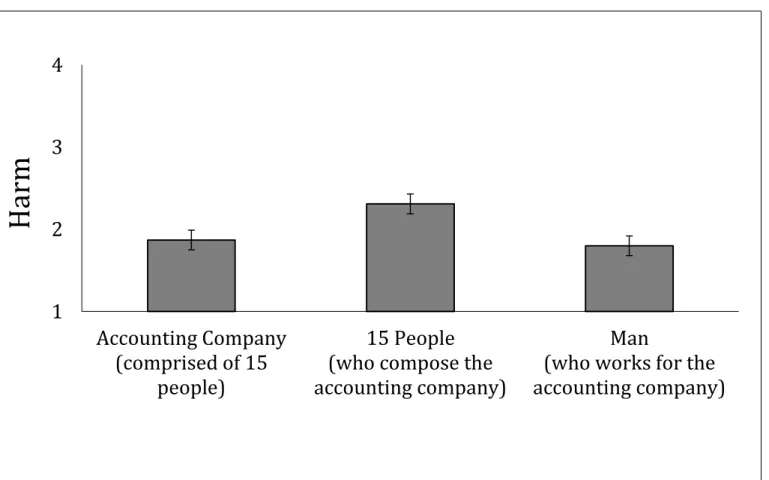
individual-focus) ANOVA predicting decisions to harm. Results revealed a significant effect of condition on decisions to harm, F(2, 246) = 5.04, p = .007, ηp2 = .04. As can be seen in Figure 6,
participants in the group-composition focus condition were significantly more likely to cause harm (M = 2.31; 95% CI [2.07, 2.56]) than participants in the group-focus condition (M = 1.87; 95% CI [1.64, 2.12]) or the individual-focus condition (M = 1.80; 95% CI [1.57, 2.04]). Thus, although a group described as a collection of 15 people was attributed the greatest amount of experience, they were also most likely to be harmed-- even more so than a single individual. In fact, contrary to hypotheses, this greater harm for 15 people was completely independent of mind attributions such that neither ratings of experience [r(1, 249) = -.07, p = .27] nor agency [r(1, 249) = .00, p = .98) predicted decisions to harm.
Discussion
In Study 2, as in Study 1, I found that a group was attributed less mind in terms of both agency and experience, but especially experience, as compared to an individual from that group. Furthermore, I found that reduced mind perception of the group was driven by considering the group as an entitative whole rather than a collection of individuals. In particular, describing the company as a “company composed of 15 people” led to significantly lower ratings of experience and agency than describing the same company as “15 individuals who comprise the company.” In fact, the latter description led to significantly higher perceptions of experience as compared to ratings of a single individual. Thus, even a very minor manipulation of focus, either on the company as a whole or all of the individuals that compose the company, had big effects on mind perception in terms of experience.
possibility is consistent with other research which indicates that groups accentuate the activation of stereotypes (Cooley, Payne, & Insko, under review). Thus, companies described as a group may be perceived more stereotypically than a single individual or multiple individuals who compose the company, and this may drive differences in mind perception. Critically, I found that even when I controlled for perceptions of the warmth and competence of the target, companies described as a group continued to be attributed significantly lower levels of experience and agency than the company described as multiple individuals or an individual.
Although results supported my hypotheses regarding differences in mind perception for groups, results were more complicated for decisions to harm. Consistent with hypotheses, overall participants caused more harm to many than one. However, inconsistent with hypotheses, this finding was driven by the fact that participants endorsed the most harm toward the company described a collection of individuals. This pattern of results indicates that, indeed, people are sometimes more likely to harm many than one. However, decisions to harm were completely independent of perceptions of mind in terms of experience. In fact, participants were most likely to harm the target that was attributed the most experience.
In sum, the results of Study 2 provide evidence for two separate phenomena. First, entitativity drives reductions in mind perception such that an entitative group is attributed less capacity for experience than a group described as a collection of individuals or a single
CHAPTER 7: GENERAL DISCUSSION
Mind perception is central to morality (Gray, Young, & Waytz, 2012). To be compelled to help another person one must first perceive that person as being capable of experiencing physical or emotional pain or struggle. Similarly, to perceive that one has caused harm, one must first perceive a mind to experience that harm. In the present research I tested whether groups of people are attributed less mind than individuals, especially in terms of the ability to have experiences such as pleasure and pain. Given the link between mind perception and moral decision making, and the link between perceptions of experience and harm more specifically, I further tested whether reduced attributions of experience to groups leads people to harm groups of people--sometimes more readily than a single individual.
First, in a Preliminary Study, I tested whether people are more likely to endorse harm of many than one. In particular, I hypothesized that groups, and especially groups of outgroup members, might be more vulnerable to harm than an individual. Although I did not directly measure mind perception in this Preliminary Study, my reasoning was that outgroup groups may be perceived as more homogenous and thus more likely to be perceived as having a unified group mind rather than multiple individual minds. Because I expected that group mind would be perceived as particularly low on experience, I reasoned that outgroup groups might be more likely to be harmed than an outgroup individual. For ingroups I expected decisions to be driven by utilitarian motives such that participants would be less likely to harm many than one.
Instead, results revealed that people were more likely to harm outgroups than ingroups and more likely to harm an individual than a group. Thus, participants indicated a preference for the ingroup (Brewer, 1999) and for minimizing harm (Baron, 1995)—two well-known effects. Because the results of the Preliminary Study did not support hypotheses, in the following study (Study 1) I directly tested my second hypothesis: that groups may be attributed less mind, especially less experience, than individuals.
To measure mind perception in Study 1, I examined perceptions of both agency and experience of groups and individuals from a broad range of categories. In particular, participants were randomly assigned to rate either a group, an identified individual, or an unidentified
individual from each of 19 categories. Overall, supportive of hypotheses, groups were attributed less capacity to experience than individuals. Interestingly, this pattern of reduced mind
perception of groups was apparent for perceptions of both experience and agency, but the effects were particularly strong in terms of ratings of experience.
Interestingly, reduced mind perception for groups as compared to individuals was particularly strong for the five categories that represented companies. Such a finding is noteworthy for both practical and theoretical reasons. Practically, understanding how people perceive mind in companies is directly relevant to the common “corporations are people” rhetoric that has been popular since the Citizens United v. Federal Election Commission (2010) ruling that corporations would be granted individual rights. Theoretically, these findings indicate that something about companies in particular might drive reduced mind perception of companies as compared to individuals from those companies. In Study 2, I addressed two plausible reasons for the strong and consistent effects for companies. One possible explanation is that companies tend to be perceived as a particularly entitative, or unified, group. This possibility is consistent with my reasoning that the more entitative a group, the more likely it will be to be attributed a group mind and thus low levels of experience. A second potential explanation is that people hold stereotypes of companies as cold and calculating, and that these stereotypes lead people to perceive companies as particular low in experience. To test both of these possibilities in Study 2, I directly manipulated whether the company was construed as an entitative group and measured its effects on perceptions of experience; furthermore, I directly measured stereotyping of companies.
In Study 2 participants were randomly assigned to either rate a company described as a group [i.e., an accounting company (comprised of 15 people)], a company described as a collection of individuals [i.e., 15 people (who work for an accounting company)], or an
significantly lower in experience than the company described as multiple individuals or the individual. The same pattern of results held for perceptions of agency. However, as in Study 1, reduced mind perception of groups was much stronger for perceptions of experience than agency. This finding is consistent with my hypothesis that entitative groups may be particularly likely to be considered as having a group mind that is low in experience. In fact, the company described as a collection of individuals was rated as significantly higher in experience than the company described as an entitative group or an individual. These findings are consistent with the
hypothesis that entitative groups will be attributed a group mind (which I find is perceived as low in experience), but that collections of individuals may actually be perceived as multiple
individual minds and thus higher in perceptions of experience.
Critically, results did not change when I controlled for stereotypes in my statistical
analyses. Thus, it does not seem that reduced perceptions of experience for companies as a whole are driven by stereotypes of companies as low in warmth. Instead, I would propose that the perception that an entity has the mental capacities for experience and agency might be a necessary prerequisite for developing stereotypes, but not an indication of whether stereotypes will form. After all, if an entity does not have a mind then it does not make much sense to attribute stereotypes such as “caring” or “conscientious” to that entity. Similarly, having the capacity to understand others’ emotions does not mean someone will be caring, nor does having the capacity to plan mean that someone will be “conscientious.”
Interestingly, Study 2 also revealed that sometimes people do harm many more readily than one. In particular, participants were more likely to harm the company described as a
Study 2 were more likely to harm multiple individuals than a single individual. One reason for this discrepancy may be that the Preliminary Study examined a more extreme form of harm (i.e., killing) versus the less extreme reputational harm in Study 2. Perhaps, then, the extremity of the harm to be caused moderates the effect of number of victims on decisions to harm.
Interestingly, although the Study 2 finding of greater harm for many than one supported the hypothesis that sometimes people will behave in a non-utilitarian way, it also diverged with my hypothesis that that the company as a group would be most likely to be harmed due to
decreased perceptions of experience for groups. Instead participants were most likely to harm the target that was attributed the greatest amount of experience---the collection of individuals. In fact, decisions to harm were completely independent of mind perception. What, then, might have driven greater harm of many than one?
Alternative Mechanisms for Greater Harm of Many than One
Although mind attributions, especially in terms of experience, have been linked to decisions to harm in previous research (Gray et al., 2007), mind perception is only one of many factors that could influence decisions to cause harm. After all, decisions to harm many and decisions to harm one differ in myriad ways. This leaves open the possibility for multiple mechanisms that may be simultaneously or individually operating to enable people to make decisions to cause harm to multiple people at once. Some possible mechanisms include
motivated emotion regulation, stronger prejudice toward groups as compared to individuals, and differences in the way that harm is conceptualized when directed toward collections of
individuals, groups, and individuals.
engage in behaviors that would otherwise challenge their morality—such as harming multiple others. Evidence for motivated emotion regulation would come from the finding that those who are the least skilled at regulating their emotions are also the most likely to experience more distress and/or empathy toward harming many outgroup members as compared to harming one. Additionally, those who have the highest levels of intergroup bias (and thereby the most
motivation to enact intergroup harm) may show lower levels of on-line distress and/or empathy when deciding whether to harm a group of outgroup members as compared to an individual outgroup member. In this case, people may down-regulate their experience of distress in order to justify the widespread harm that they desire to enact. In the context of Study 2, this means that people may have down-regulated their experience of distress toward multiple individuals in order to justify taking money for the self at the reputational cost of the individuals. Harming a
company described as a single entity or a single individual may not have elicited these same emotion regulation strategies.
Another plausible explanation for greater endorsement of harm toward many as
compared to one is that groups may both relax normal motivations to control prejudice as well as enhance negative affect elicited by outgroups. Both of these possibilities are supported by
previous research which indicates that groups more effectively elicit stereotypes and prejudice associated with their social category than do individuals (Cooley, Payne, & Insko, under review; Cooley & Payne, in preparation). In this research, enhanced stereotyping for groups was
normal constraints of social desirability, then this would lead to a greater possibility of harming groups as compared to individuals. This mechanism can be tested by examining whether groups (or collections of individuals) elicit greater prejudice and whether this prejudice mediates decisions to harm many more readily than one. Although this potential mechanism is worth testing in future research, it does not fit perfectly with the pattern of findings in Study 2. In particular, this explanation would predict that groups would trigger greater prejudice than collections of individuals, thus leading to the greatest harm of a group. However, Study 2
revealed that the company described as a group elicited less harm than the company described as a collection of individuals.
A final compelling explanation of my findings stems from the theoretical perspective that entitative groups are conceptualized in a way that is more similar to individuals than less
Given that mind perception is integral to morality (Gray, Young, & Waytz, 2012), it is important to understand variables that influence how we perceive mind in others. Previous research on denying others a mind has found that people are particularly likely to dehumanize those who belong to outgroups. Building from this work, I also predicted that differential mind perception of groups as compared to individuals might be exacerbated for outgroups. Because outgroups tend to be perceived of as more homogenous than ingroups (Park & Rothbart, 1982; Linville, Fischer, & Salovey, 1989; Park & Judd, 1990; Ostrom, Carpenter, Sedikides, & Li, 1993), I reasoned that outgroup groups may be more likely to be perceived as having a group mind while ingroup groups might be perceived as multiple individual minds. As a result, I predicted that outgroup groups may be attributed particularly low levels of experience and agency as compared to ingroup groups and thus may be particularly likely to be harmed.
However, results did not support this hypothesis in a Preliminary Study. Instead, people showed an overall effect of group membership such that they avoided harming ingroup members more than outgroup members regardless of the number of potential victims.
Although reduced mind perception of groups did not seem to depend on whether that group was an ingroup or an outgroup, the degree to which the group was perceived as
particularly homogenous or entitative did matter. In fact, in Study 2, even an extremely minor manipulation of focus, either on the company as a whole, or the multiple individuals that
This builds upon other research which has compared perceptions of agency (but not experience) in groups as compared to group members. In particular, Waytz and Young (2012) found that the more agency that is attributed to the group as a whole, the less agency that is attributed to its members. Furthermore, this research finds that the more entitative the group, the more agency it is ascribed. This finding is consistent with my finding that cues to entitativity increase the perception of a unified group mind (Waytz & Young, 2012); however, the meaning of a group mind in my research as compared to this previous research, varied in important ways. In particular, this previous research only measured mind in terms of agency and found that entitativity led to higher ratings of agency; I measured both agency and experience and found that entitativity led to lower ratings of agency, and especially low levels of experience as compared to a less entitative group or an individual. My findings are consistent with Waytz and Young (2012) in that they also found that the average group member was consistently attributed more mind than the group as a whole. However, while I found that entitativity decreased
attributions of mind in terms of both experience and agency, Waytz and Young (2012) found that entitative groups were attributed greater agency than less entitative groups. One reason why my findings may have conflicted with those of Waytz and Young (2012) is differences in the motivations of the perceivers. For example, when Waytz and Young manipulated entitativity they used groups of fish, while I used companies. People’s motivations in perceiving mind in these two distinct entities likely differ in a variety of ways that could account for the differences in mind perception.
when participants were motivated to affiliate with an outgroup, they showed a preferential focus on mind in terms of experience; conversely, when motivations to predict behavior predominated, participants showed a preferential focus on understanding the outgroup’s mind in terms of agency. Thus it is possible that motivations may also affect how people attribute basic mental capacities to groups. I found some evidence for this possibility in Study 1 in which I found that higher levels of prejudice toward a category led people to attribute both lower levels of
experience and agency to groups or individuals from that category. Future research could also examine how motivations affect perceptions of different types of mental capacities.
independent of stereotypes of warmth and competence, leads to dehumanization. Thus, a more basic precursor to dehumanization may be whether I perceive a target as a group or an individual. Further research should examine how considering the mental capacities for agency and
experience of groups versus individuals from particular social categories might lead to different neurological activation. For example thinking of a group of people being harmed may not
activate portions of the brain associated with person perception to the same degree as thinking of an individual being harmed.
Future Directions
attributions of group mind may affect the way people consider the morality of trading some lives in order to save many others. Future research could explore the implications of the present research for understanding variables that influence when people will choose utilitarian outcomes.
Research should also examine how different levels of mind perception in response to groups may affect decisions to help. In particular, research on the collapse of compassion finds that people down-regulate their experience of compassion when viewing many suffering victims as compared to salient individual who is suffering. However, it is less clear the strategies people use in order to down-regulate their compassion toward groups. One interesting possibility is that people may down-regulate compassion by attributing less experience to groups of people than individuals. Such a finding would provide a new perspective on how we think about the collapse of compassion: denying a target the ability to experience pain/suffering may precede, or enable, one’s ability to down-regulate compassion toward that target. After all, to feel empathy or compassion for another we must first perceive that that other has a mind.
Conclusion
APPENDIX: MATERIALS
Wording for moral scenarios, Preliminary Study:
Imagine that you must decide whether to launch a drone attack on Afghanistan and that this decision is extremely time urgent:
Intelligence indicates that a leader of a local terrorist group is temporarily in a rural area outside of Kabul, Afghanistan. This influential leader is thought to be plotting an attack on America. In the next few minutes you must decide whether to launch a drone that will kill this terrorist leader. This decision is time urgent (the terrorist is on the move) and you must decide now. The drone is in position and ready to launch.
Individual Afghan Condition
Intelligence also indicates that this drone attack will kill a single innocent Afghan civilian named Akhtar Muhammad. Travel documents indicate that this person is the only person staying in a local hostel and will be the only additional casualty to result from the drone strike.
Imagine that you must decide whether to launch a drone attack on Afghanistan and that this decision is extremely time urgent.
Individual American Condition
Intelligence also indicates that this drone attack will kill a single innocent American civilian named Brad Miller. Travel documents indicate that this person is the only person staying in a local hostel and will be the only additional casualty to result from the drone strike.
Imagine that you must decide whether to launch a drone attack on Afghanistan and that this decision is extremely time urgent:
American Group Condition
Intelligence also indicates that this drone attack will kill 11 innocent American civilians. Travel documents indicate that these 11 Americans are the only people staying in a local hostel and will be the only additional casualties to result from the drone strike.
Imagine that you must decide whether to launch a drone attack on Afghanistan and that this decision is extremely time urgent:
Afghan Group Condition