UDC: 811.111’276:81’271 DOI: 10.22190/JTESAP1702241H
CLIL AND ITS FORMS IN DIVERSE EDUCATION CONTEXT
Ľudmila Hurajová, Gabriela Chmelíková
Slovak University of Technology, Faculty of Materials Science and Technology in Trnava, Slovak Republic Phone: +421911883939, E-Mail: [email protected]; [email protected]
Abstract. Content and language integrated learning is approach that has been studied longer than 20 years on mostly Primary and Secondary level of education. Scholars conducted their research from various perspectives to find CLIL impacts on students´ performance at content subjects, at foreign language (that was used as CLIL language) and also on students´ awareness of subject professional vocabulary in mother tongue when the subject was taught via CLIL. The teachers were subjects of studies as well, scholars focus mainly on their linguistic, didactic readiness to establish effective CLIL learning environment, on CLIL teacher competences needed for CLIL application etc. Our contribution aims at presenting our insight about CLIL approach in diverse education context around Europe from practical perspective. It focuses on describing CLIL forms that are applied in the countries (Italy, Latvia, Lithuania and Sweden) that were the project partners in an ERASMUS+ project dealing with exchange of CLIL practice at Primary and Secondary schools. Some ways how to enhance CLIL awareness among teachers in Europe are presented. The project findings indicate that CLIL diversity is the way how this approach/method can be implemented into education to support dual integrated learning at Primary and Secondary schools in Europe and at same time demonstrate how Higher Education Institutions can benefit from CLIL application in Tertiary sector to support their internationalization process.
Key words: CLIL diversity, education context, cultural context, CLIL in Erasmus+ project
1.INTRODUCTION
Content and language integrated learning (CLIL) approach is not a new phenomenon in education. Since CLIL started being applied into lessons on Primary, Secondary and these days on Tertiary level, there have been some attempts to unify CLIL and also some voices have called for CLIL pedagogy. As CLIL application into education was mainly teachers´ initiative in many cases at the beginning, there are some countries where CLIL approach has been systematically applied into education several years such as Spain, Portugal, Finland etc. Besides, CLIL is being implemented into education compulsorily on Primary and Secondary level in Italy, where teachers are supposed to be trained how to build CLIL learning environment. What seems to be a new phenomenon is awareness of what CLIL is and who CLIL teachers are. Some teachers call CLIL – education in English, bilingual study programmes, EMI (English as a medium of instruction) and also ESP (English for specific purposes) might be found CLIL as well. In this contribution we find CLIL dual learning approach, no matter how much English and how often (or other CLIL languages) is used during the lessons. CLIL teachers are considered those ones who can manage to
keep the dual principle of teaching that might lead to students’ content and language (CLIL language) development. CLIL language is that language needed to be improved and it is not a mother tongue of students’ majority being taught in it.
To fulfil one of the EU missions to provide fair opportunity of education for all EU citizens and to share knowledge, competences, ideas, proposals among professionals common platform is needed. As the real life shows us, from a language perspective, English is that platform for sharing so it seems to be natural that in many CLIL application cases the CLIL language is just English. Although English looks like a major language platform for CLIL, there are many different CLIL forms that occur around Europe. This variety roots both in CLIL approach flexibility and wide range of education contexts within Europe. (Hurajová, 2016) Several international projects have dealt with CLIL application and CLIL impact on students´ performance, teachers’ burden and readiness for CLIL implementation etc. The aim of the contribution is to describe diverse forms of CLIL application as they
have been observed in an ERASMUS+ project with the title “Transnational exchange of
good practice among European Educational Institutions” and to propose how Higher
Education can benefit from CLIL implementation.
2.DIVERSE CLILFORMS
Within the project mentioned above some lessons in four European countries in Primary and Secondary schools were observed. Diverse cultural, historical and educational context resulted in diverse CLIL forms. CLIL dual teaching principle were more or less followed by teachers who led the lessons. English was mainly used as CLIL language, however, the lessons in French were observed too. CLIL teachers involved in the observed lessons were both foreign language and content teachers. CLIL was applied into full lessons not in partial activities within the lessons. Teachers applying CLIL had different level of experience with CLIL approach. Frequency of switch-code was observed within CLIL lessons.
2.1. Latvia
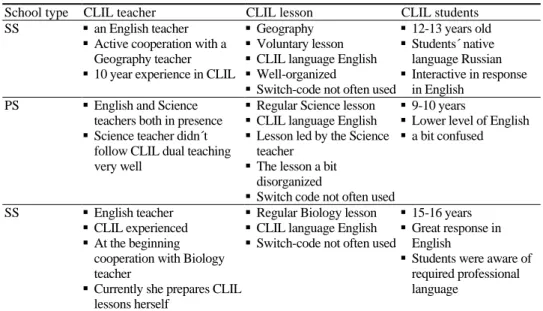
Daugavpils – the town in Latvia. Official state language is Latvian, however, Russian is used in some schools in this region, as Russian community lives there. Historically, Latvian language became official state language and the language at school when Latvia got its independence in 90s. In some cases Latvia was so-called CLIL language when it was implemented at schools. The lessons observed within the project were taught in English at a primary school and at two secondary schools. The CLIL forms are described in the following table 1.
2.2. Lithuania
Table 1 CLIL forms in Latvia, SS – secondary school; PS-Primary School
School type CLIL teacher CLIL lesson CLIL students SS an English teacher
Active cooperation with a Geography teacher
10 year experience in CLIL
Geography
Voluntary lesson
CLIL language English
Well-organized
Switch-code not often used
12-13 years old
Students´ native language Russian
Interactive in response in English
PS English and Science teachers both in presence
Science teacher didn´t follow CLIL dual teaching very well
Regular Science lesson
CLIL language English
Lesson led by the Science teacher
The lesson a bit disorganized
Switch code not often used
9-10 years
Lower level of English
a bit confused
SS English teacher
CLIL experienced
At the beginning cooperation with Biology teacher
Currently she prepares CLIL lessons herself
Regular Biology lesson
CLIL language English
Switch-code not often used
15-16 years
Great response in English
Students were aware of required professional language
Table 2 CLIL forms in Lithuania, PS – Primary School
School type CLIL teacher CLIL lesson CLIL students PS an English teacher
non experienced in CLIL
Regular English lesson
CLIL language English
Content – forest animals
8 - 9 years old
Basic level of English
PS A Music and French teacher
Good in FL didactics
optional Music lesson
CLIL language French
9-10 years
Great response to French instructions PS A Math teacher
Non experienced in CLIL
Linguistic mistakes made
Regular Math lesson
CLIL language English
Switch-code not often used
9-10 years
Great response to English instructions
PS A Science teacher
Non experienced in CLIL
Regular Science lesson
CLIL language English
Too much content in English delivered
9-10 years
Good response to English instructions
2.3. Italy
English than dual teaching approach. Most of the students were used to it. In some lessons a foreign pre-teacher delivered the lesson with the content teacher that enhanced authenticity. Students preparing for becoming teachers from foreign countries are addressed to come to teach Italian students during their internship. E found it very effective way how to arrange authentic international learning-teaching environment where English is medium for communication and enhancing intercultural awareness. From a language competence perspective, teachers’ level of English who were observed varied. We were not provided the information about their level of English according to CEFR. We can state based on our observations that Italy is trying to implement English into education via full lessons taught in English.
2.4. Sweden
Swedish project members were little or no experienced in CLIL application into their lessons. They were a bit skeptical if this approach is the suitable way how to start fostering students’ competence in professional English. All of them teach at a secondary vocational school. After being trained within the project they attempted to go off CLIL implementation. They were inspired by CLIL forms they observed in project partners’ countries and we could observe the lesson led by two teachers as we saw in Latvia and some lessons led by content teachers whose level of English was fluent enough for communication in English. Particularly the lesson led by two teachers - one English teacher and one content teacher - focused on the sanitary procedure to eliminate transmission of infection for students studying health care was a great example of mutual cooperation and of good preparation. The lesson also approved how important is to exchange practice among teachers within Europe or other continents. As the teachers told us their students loved the lessons and asked them for English and content driven way of learning. Swedish partners found the way how to extend interdisciplinary cooperation and the English teacher will cooperate and support other content teachers at school to prepare CLIL lessons or activities within their content subjects.
2.5. Slovakia
prepared too much subject content for being integrated into CLIL lessons. This resulted in overloading students but also themselves.
3.CLIL IN HIGHER EDUCATION CONTEXT
CLIL has been applied into education on Primary and Secondary level for more than two decades, but CLIL and its usage in Higher Education is a quite new issue to debate. How CLIL can be utilized on Tertiary level of education and why? Many approaches are mentioned in literature concerning foreign language development in Higher Education for instance ESP (English for specific purposes), EAP (English for academic language), EMI (English as medium for instructions), immersion programmes, etc. All of them were established on needs analysis what university students are required to achieve and deliver in foreign language particularly in English. Since Bologna process to ensure comparability in the standards and quality of higher education qualifications, internationalization of higher education has been enhanced. There is a great support in students’ and teachers’ mobility to ensure vivid and effective cooperation in academia in all areas, research, pedagogical services and curricular cooperation. To fulfill the Bologna Process missions a unified platform is needed. As it was mentioned before, linguistically, English seems to be that language platform for scholars, students, university management and other staff to cooperate deeply. Internationalization process in higher education means more courses in English taught at all degrees to provide studying environment for international students. Providing courses in English leads us to consider education context in particular university to be able to prepare the process of internationalization in effective way. In some cases it is not possible simply to start providing courses in English as the teaching staff, university management and also students might not be ready for this sudden and great shift because of various reasons. We think in these cases CLIL can be a good tool for enhancing the internationalization process, as it can ensure gradual deployment of English. Integration of English into subject courses requires close cooperation among English teachers and content teachers at university. ESP or EAP lessons might support CLIL application and can help students be ready for subject activities or full courses taught in English. Another issue is described in Chmelíková (2016, p.73) where she states the solution to the difficult situation at the universities, which currently suffer from lowering the load of English lessons could be in close cooperation with subject-specific departments at the faculty or university in various interdisciplinary projects.
7. CONCLUSION
Acknowledgements. This contribution is published as a partial product of the international project ERASMUS+ 2015-1-SK01-KA201-008937 Transnational Exchange of good CLIL practice among European Educational Institutions. The European Commission support for the production of this publication does not constitute an endorsement of the contents which reflects the views only of the authors, and the Commission cannot be held responsible for any use which may be made of the information contained therein.
REFERENCES
David Lasagabaster and Aintzane Doiz (eds). CLIL experiences in secondary and tertiary education, Bern: Peter Lang AG, International Academic Publishers, 2016.
Immaculada Fortanet – Gómez, CLIL in Higher Education towards a multilingual Language Policy. Bristol-Buffalo-Toronto: Multilingual Matters, 2013.
Gabriela Chmelíková, “ CLIL lesson from the point of view of an ESP teacher.” In
Šimková, Z and Sorádová, D.(eds). LLCE2016: Súčasné výzvy vo vyučovaní jazykov:
Ako ďalej? Nitra:SlovakEdu. (2016) ISBN 978-80-89864-00-3 (69-76)
Ľudmila Hurajová, “Via International Cooperation towards CLIL Teacher Competence
Enhancement.” In Šimková, Z and Sorádová, D.(eds). LLCE2016: Súčasné výzvy vo
vyučovaní jazykov: Ako ďalej? Nitra:SlovakEdu. (2016) ISBN 978-80-89864-00-3
(76-84)
Ľudmila Hurajová and Jana Luprichová, “Being a CLIL teacher.” DOI: 10.17846/CLIL.
2015.99-11 in Pokrivčáková, S. et al. (2015). CLIL in Foreign Language
Education:e-textbook for foreign language teachers. Nitra: Constantine the Philosopher University. 282s.
Ľudmila Hurajová, “ Tertiary CLIL.” DOI: 10.17846/CLIL.2015.85-98 in Pokrivčáková,
S. et al. (2015). CLIL in Foreign Language Education:e-textbook for foreign