TECHNICAL UNIVERSITY OF CLUJ-NAPOCA
ACTA TECHNICA NAPOCENSIS
Series: Applied Mathematics, Mechanics, and Engineering Vol. 62, Issue III, September, 2019
THEORETICAL INTERPRETATIONS CONCERNING THE STABILITY OF
THE HUMAN HAND-ARM SYSTEM AT LOW FREQUENCIES,
SYSTEM COMPARATIVE WITH A MECHANICAL SYSTEM
Aurora Felicia CRISTEA
Abstract: The paper aims to demonstrate, from a theoretical point of view, how to stabilize and if stabilized the movement of a mechanical hand-arm system [4], a system subjected to vibrations and excited at its own excitatory frequency of 4.16 Hz. It is known that, at low frequencies (<25 Hz), changes occur in the normal state of system functionality, namely, disorders of the bone, nervous system, etc. [6], [7], and the author wishes to continue and deepen research in this field regarding the hand-arm system.
Key-words: stability, human hand-arm system, low frequencies
1. INTRODUCTION
The specialty literature, it is analyzed the effects of the mechanical vibration transmissibility about hand-arm system. These results cannot be explained based on a simplified mechanical model with concentrated parameters, so it would be necessary to model it based on a system with distributed parameters, including a visco-elastic environment, which is quite difficult to achieve in reality.
The stability of a system [3], [5] means its ability to return to its original state of equilibrium or motion after having undergone a disturbing action. The equilibrium is possible only when, are developed, sometimes certain forces that resist disturbance called restoring/equilibrium forces.
A stable system, at slow-moving disturbances, is said to have static stability, and if it is stable to sudden disturbances, then it exhibits dynamic stability.
Stability can be classified as follows:
- positive stability - if the system returns to its original state after a temporary disturbance; - neutral (neutral) stability - if the system after a disturbance reaches a new state of equilibrium, slightly different from the initial state;
- negative stability - if the system after a disturbance reaches a state very distant from the
initial state or is further away from this state. Negative stability is generally called instability. Regarding the notion of stability, an extension can be made to it, namely, it is known that a material system under the action of a forces system moves in space on a certain trajectory at a certain speed. If the velocity is "zero" to an inertial reference system, then the material system does not move relative to the benchmark and the forces are in equilibrium. The study of the movement of the material system takes into account the initial conditions, which may actually be the conditions (space, trajectory and speed - singular if it is a single-degree or plural system, if the material system has several degrees of freedom freedom) at the moment of disturbance forces (disturbing force or disturbing moment).
If very small disturbances of the initial conditions corresponding to movements, and which of point of view the trajectories and the speeds remained in the vicinity of the undisturbed points of movement, then this movement is considered stable, otherwise the undisturbed motion is unstable.
undisturbed movement, it is said that the movement is orbital stable.
2. According to this observation, a stable motion may under certain conditions be orbital stable, but a stable orbital motion is not generally stable.
2. MATHEMATICHAL MODEL OF THE HUMAN HAND-ARM SYSTEM
The hand-arm human system is a system of high complexity, inhomogeneous, continuous, with visco-elastic properties in the muscles, bones and skin [5], [8]. Dynamic features from the perspective of biomechanical model analysis require identification of the viscoelastic and inertial mechanical properties of the model under typical operating conditions. In the human arm movement, there are many factors that relate to its behavior, these factors are classified as follows:
a) Factors with static behavior;
b) Dynamic behavioral factors (e.g., passive moments of the joints, which depend only on the angles of the joints).
Regarding viscosity and passive moments, we can say that these are an internal property of all human joints, the effects of which are proportional to the angular velocity of the movement, especially the angular velocity of the joints.
The instantaneous position of a vibrant system at any moment of movement can be determined by a multitude of dynamic, independent or coordinated parameters called and degrees of dynamic freedom.
Fig. 1 Excitation source (machine - tool) of human hand - arm system. The position by which the operator catches the device fixed by the source has
the main vibration transmission direction, i.e. the anatomical zh axis [4].
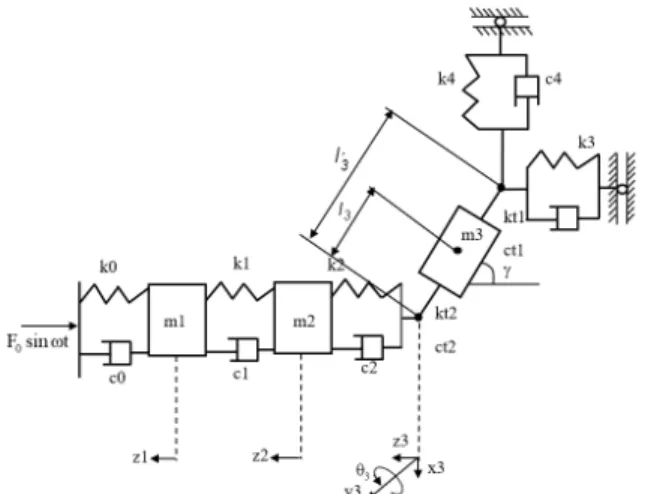
Fig. 2 Mechanical model of the hand-arm system (where: m1 – hand mass, m2 – forearm mass, m3 – arm mass) [4]. The mathematical model leads to the dynamic equilibrium equations of the vibrant model. In order to simplify the dynamic hand-arm model, this being a model with distributed masses, it will be transformed into a system with concentrated masses where m1 is the mass of the hand, m2 is the mass of the forearm, and m3 of the arm mass, each mass is considered concentrated in the center of the analyzed item. The differential equation of motion of the model can be represented as a matrix of the following form:
+ + = (1) where: [M], [C] and [K] are the matrixes of the inertia mass, the damping and the elasticity constants of the system. The matrix has the dimensions (5x5), and the excitation matrix {F} is of the size (5x1). {U} is the vector matrix of the generalized motion coordinates having the dimension (5x1), for which the transposed matrix is:
{ } {
U T = z1,z2,z3,x3,θ3}
.- The coordinate z1 represents the displacement along of the anatomical direction zh, of the mass m1 (the direction of the y axis is along the third metacarpian axis);
- The coordinate z2 represents the displacement along of the anatomical direction zh, of the mass m2;
- The coordinate x3 represents the displacement in xh direction of mass m3, according to the same anatomical coordinate system;
- θ3 represents the angular rotation of the mass m3 in the elbow joint, rotation about the yh direction according to the anatomical coordinate system.
- γ - the angle of the elbow vis a vis to the axis zh [degrees or radians];
- l3 - distance from elbow to center of mass m3 [m]; - distance from elbow to shoulder [m];
- Jc3 - axial moment of inertia of the arm [kg m2].
Tab. 1 The of the machine-tool [5].
It is considered the excitation frequency of the human hand-arm system, it is the frequency corresponding to the rotation of machine-tool (n = 250 RPM of some lathe, and its value is shown in table 1).
The wrist joint is neglected, because the hand is positioned on the excitation source (machine tool) while it performs a certain operation and the human operator having the arm with the elbow bent at 120 ° toward the xh axis, and shoulder rotation is considered in this study at 0° (Fig. 2). The conditions of manipulation of the work tool and the position of the human operator at this time are described in table 2.
Tab. 2 Data are taken from studies: T. Cherian, S. Rakheja, R.B. Bhat [4] and correspond to the elasticity and damping constants of the human hand - arm system.
3. SYSTEM OF DIFFERENTIAL
EQUATIONS OF HUMAN HAND-ARM SYSTEM
The system of differential equations corresponding to the dynamics of the human hand arm assembly is obtained through the following steps:
- each concentrated mass is isolated;
- it’s introduced the inertia, elastic and damping forces;
- the active and connecting forces are introduced;
- a direction of movement is adopted (in this case the anatomical coordinate system of the hand-arm human system must be taken into account, therefore the motion will be analyzed after the direction of the zh);
- the second principle of dynamics applies for each isolated mass of the system.
Tables 1 and 2 show the visco - elastic characteristics of the hand - arm human system, to which the mechanical parameters were taken in consideration, in according to the studies of T. Cherian, S. Rakheja, R.B. Bhat [4] and anthropometric parameters were determined in the laboratory. Anthropometric measurements were performed on a group of 5 subjects (men), then an average of these measurements was used, the mean used to determine the values of the center of gravity and axial inertial moment of the arm, hand, and forearm.
For the human hand - arm assembly shown in
figure 2, which has 5 degrees of freedom (4 translations after z1, z2, z3, x3 and a rotation
θ3), the differential equation system will be given by the relation (2).
In order to integrate the system of differential equations (with Runge-Kutta order 5) [5], it is ordered after unknowns and its derivatives and after ordering it takes in the same form [4]:
+ + ( ) + + ( ) =
= !" # ; (2) + ( ) + ( $) +
+ ( ) + ( $) = 0;
$ $+ ( $ ) + $ $+
+ ( $ ) + $ $+ $&$ !" ' ($+ + $&$′ !" ' ($+ &$′ !" ' ($= 0;
$)$+ *)$+ *)$ $&$ + ' ($ *&$′ + ' ($ *&$′ + ' ($= 0;
(,-$+ $&$)($+ $&$′ !" ' ($+ ( . + . )($+ + $&$′ !" ' ($+ ( . + . )($+
+ $&$ !" ' $+ &$′ $ !" ' $+ &$′ $ !" ' $ $&$ + ' )$ *&′$ + ' )$ *&$′ + ' )$
3. STABILITY OF A MECHANICAL SYSTEM
3.1 Stability of human hand-arm system
In the following study in concordance with [5], it will be checked the stability of the hand-arm human system, a system whose equations are given by relation (2). The system will be transformed into a system of homogeneous equations in order to obtain its own pulses (system of the homogeneous equations represents the system of the differential equations that characterized of the dynamic system upon which do not active the forces or disturbing moments act, so the mechanical system performs free vibrations). The next step is to replace unknowns in this system notated: zi,
3 , 1 =
i , x3şi θ3, respectively with [5]: zi =aiert
, i=1,3, rt
be
x3 = and
t r
ce = 3
θ , and their
dirivated with:
0 = 10234., i=1,3 )$= 5234., ($ = 234.,
0 = 102 34., i=1,3, )$ = 52 34. şi ($= 2 34. .
This will result in a system of the coordinates of the second order, in the generalized coordinates, whose determinant equal with zero, it leads at the determination of the trivial solution, respectively to the characteristic equation resulting from its development.
55 54 53 52 51 45 44 43 42 41 35 34 33 32 31 25 24 23 22 21 15 14 13 12 11 A A A A A A A A A A A A A A A A A A A A A A A A A
=0 (3)
at the matrix terms are:
A11 = m1r2+(c0+c1)r+(k0+k1);
A12 = −c1r−k1 ;
A13 = 0; A14 = 0; A15 = 0;
A21 = −c1r−k1;
A22 = 2 ( 1 2) ( 1 2);
2r c c r k k
m + + + +
A23 = −c2r−k2 ;
A24 = 0;
A25 = 0; A31 = 0;
A32 = −c2r−k2 ;
A33 = m3r2+(c2+c3)r+(k2+k3); A34 = 0;
A3= sin sin 'sin ;
3 3 ' 3 3 2 3
3l γr c l γ r k l γ
m + +
A41 = 0; A42 = 0; A43 = 0;
A44 = 4 4 ;
2
3r c r k
m + +
A45 = cos cos 4 3'cos ; '
3 4 2 3
3l γr c l γ r k l γ
m − −
− A51 = 0; A52 = 0;
A53= sin sin 33'sin ; '
3 3 2 3
3l γr cl γ r kl γ
m + +
A54= cos cos 43'cos ; '
3 4 2 3
3l γr cl γ r kl γ
m − −
−
A55=(,-$+ $&$)2 + 6 $&$′ !" ' +
+ *&$′ + ' + . + . 72 +
+( $&$′ !" ' + *&$′ + ' + . + . ).
The solutions of this determinant were
calculated with the MATHCAD 13
programming environment and their values are given by the column matrix of the solution of the characteristic equation [2]:
It can be noticed that the system of differential equations (3) has ten solutions, respectively five complex conjugate solutions. Because the real part of all these solutions is negative, it results that the studied system is stable. The values corresponding to the imaginary parts in the mode represent the own frequencies of the system exposed to the vibration action, written values in ascending order: 54,428, 162,603, 510,148, 555,142, 651,142 rad/s.
r =
0 -1.054 x 10³ + 555.142 i
1 -1.054 x 10³ - 555.142 i
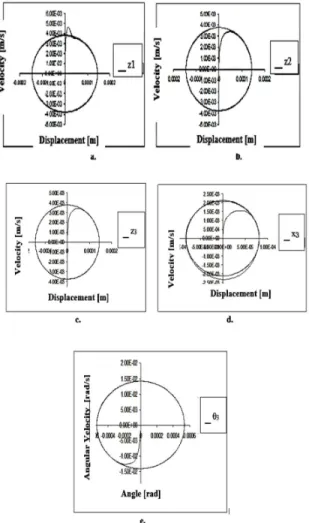
The charts of stability have as abscissa the displacements of the generalized coordinates, and as ordered their velocities are shown in figures 3a, b.
The groups Series i (Displacements), Series j (Velocities) are each appropriate for a designing a generalized coordinate motion graph (z1, z2, z3, x3, θ3). The i index is the index attributed to the displacements (i = 1, ..., 5) and j the index assigned to the velocities (j = 1, ..., 5) (e.g. Series 1 and Series 2 correspond at the stabilization of motion)).
It is recalled that the source of excitation of the human hand arm is a machine - tool (lathe) and the stability of the system is analyzed for the 250 RPM of the machine - tool.
From analysis of the graphical representation 3a, b, the vibrational movement of the hand-arm human system for excitation source f = 4.16 Hz to 10 Hz is stable, the graph being the closed elliptical curve.
Fig. 3 Stability of machine-tool.
The figures 3 present the stability of hand-arm human system for machine at the rotation of n = 250 RPM (ω = 26.17 rad/s)
where: - the figure 3a. presents the stability of the generalized coordinate z1,
- the figure 3b. presents the stability of the generalized coordinate z2,
- the figure 3c. presents the stability of the generalized coordinate z3,
- the figure 3d. presents the stability of the generalized coordinate x3,
- the figure 3e. presents the stability of the generalized coordinate θ3.
Fig. 4 General representation of stability.
In the figure 4 is presents the stability of the hand-arm human system for machine - tool rotation n = 250 RPM (ω = 26.17 rad/s) are corresponding to the generalized coordinates z1 - hand, z2 - forearm, z3 - arm, x3 - arm, θ3 - elbow.
4. CONCLUSIONS
Considering the theoretical presentation in chapter 2, it can be seen from figures 3a-e, or figure 4 comparatively, that a positive stability is obtained for all mana-arm (hand, forearm and arm) displacements. The instability of moving is stayed a short time (e.g., 0.002s or shorter), when the movement is unstable, immediately after entering the movement, stabilizing in an elliptical trajectory.
normal state of mana-arm functionality at 4.16 Hz. We do not know what happening at the higher frequencies of 10Hz. In the future we can make a comparative study.
The next study will be axed of the design of some dissipator of vibration mounted on the forearm in scope of minimize in scope of vibration reducing.
5. BIBLIOGRAFIE
[1] Bălcău, M., Arghir, M., The use of dynamical absorbers, 13th International Conference ,,Automation in Production Planning and Manufacturing“, Zilina, ISBN 978-80-89276-35-6, pag. 9-14, 2012.
[2] Bălcău Monica Carmen, Pop Aurora Felicia, Particular case study of dynamic absorber,
Annals of DAAAM for
2010&PROCEEDINGS of the 21th
International DAAAM Symposium
“Intelligent Manufacturing&Automation: Focus on Interdisciplinary Solutions” 20-23th October, Zadar, Croatia, pag. 0827-0828, ISSN 1726-9687, ISBN 978-3-901509-73-5, 2010. [3] Bălcău Monica, The mechanical system of
three reduced masses, with a dynamic absorber at one of the ends is forced by two
harmonics of X order, Acta Technica
Napocensis, 2007, seria Machines construction, Materials, nr.50, pag.39-42, 2007.
[4] Cherian, T., Rakheja, S., Bhat, R., B. – An analytical investigation of an energy flow divider to attenuate hand- transmitted vibration, Concordia University, Canada, 1995, pag. 455-467, 1995.
[5] Cristea A. Felicia – The vibration mechanical transmissibility upon hand-arm system, Technical University of Cluj-Napoca, Doctorate thesis, 2009.
[6] Daniel Pan,Xueyan S. Xu,Daniel E.
Welcome, Thomas W.
McDowell,Christopher Warren,John
Wu &Ren G. Dong - The relationships between hand coupling force and vibration biodynamic responses of the hand-arm system, Journal Eronomics,Volume 61, 2018 - Issue 6, pages 818-830, Published online: 17 Nov 2017.
[7] Khairil Anas Md Rezali et al. - Transmission of vibration through glove materials: effects of contact force, Ergonomics Volume 61, 2018 - Issue 9, pages 1246-1258, Published online: 26 Apr 2018.
[8] https://www.workareltd.co.uk/hand-arm-vibration-syndrome/ (accessed July 2019).
Interpretări teoretice privind stabilitatea sistemului uman mână-braţ la frecvenţe mici, sistem echivalat cu un sistem mecanic
Rezumat: Lucrarea îşi propune să demonstreze, din punct de vedere teoretic, cum se stabilizează şi dacă se stabilizează miscarea unui sistem mecanic mână-braţ [4], sistem supus la vibraţii şi excitat la o frecvenţa excitatoare proprie de 4,16 Hz. Se cunoaşte faptul că, la frecvenţe mici (<25 Hz) apar modificări în starea normală de funcţionalitate a sistemului şi anume, apar afecţiuni ale sistemului osos, nervos etc. [6], [7], iar autorul doreşte să continue şi să aprofundeze cercetările în acest domeniu privind sistemul mână-braţ.
CRISTEA Aurora Felicia – Associate Professor PhD, Eng., Technical University of Cluj – Napoca,