Tracking linkage to HIV care for former prisoners
A public health priority
Brian T. Montague,1,2,* David L. Rosen,3Liza Solomon,4Amy Nunn,1,2Traci Green,5Michael Costa,4Jacques Baillargeon,6
David A. Wohl3and David P. Paar7; Josiah D. Rich1,2on behalf of the LINCS Study Group
1Brown University/Miriam Hospital; Providence, RI USA;2The Center for Prisoner Health and Human Rights; Providence, RI USA;3University of North Carolina
at Chapel Hill; Chapel Hill, NC USA;4Abt Associates Inc.; Cambridge, MA USA;5Brown University/Rhode Island Hospital; Providence, RI USA; 6University of Texas Medical Branch; Galveston, TX USA;7SUNY Upstate Medical University; Syracuse, NY USA
Keywords:incarceration,linkage to care, treatment interruptions, HIV, minorities Submitted: 02/20/12
Revised: 04/16/12 Accepted: 04/18/12
http://dx.doi.org/10.4161/viru.20432
*Correspondence to: Brian T. Montague; Email: [email protected]
I
mproving testing and uptake to care among highly impacted populations is a critical element of Seek, Test, Treat and Retain strategies for reducing HIV inci-dence in the community. HIV dispro-portionately impacts prisoners. Though, incarceration provides an opportunity to diagnose and initiate therapy, treatment is frequently disrupted after release. Though model programs exist to support linkage to care on release, there is a lack of scalable metrics with which to assess adequacy of linkage to care after release. The linking data from Ryan White program Client Level Data (CLD) files reported to HRSA with corrections release data offers an attractive means of generating these metrics. Identified only by use of a confidential encrypted Unique Client Identifier (eUCI) these CLD files allow collection of key clinical indicators across the system of Ryan White funded providers. Using eUCIs generated from corrections release data sets as a linkage tool, the time to the first service at community providers along with key clinical indicators of patient status at entry into care can be determined as measures of linkage adequacy. Using this strategy, high and low performing sites can be identified and best practices can be identified to reproduce these successes in other settings.Though effective antiretroviral therapy (ARV) has markedly improved life expec-tancy for those living with HIV, efforts to reduce new HIV infections in the US have been significantly less successful. Indeed,
HIV incidence has been stable since 1991. Calls for expanding universal testing and treatment for HIV have been made based on models which suggest that aggressive expansion of HIV testing and treatment, a strategy now termed “Seek, Test, Treat and Retain,”may dramatically lower HIV incidence.1 The recent trial HPTN 052
which demonstrated a profound reduction in HIV transmission through antiretroviral therapy provided to infected persons provides key evidence to support the potential impact of these expanded testing and treatment strategies on new incident infections in the community.2The success
of this strategy will depend on the ability of testing programs to identify and engage in care the 25% of persons who do not know their HIV status.3
Since the early years of the HIV epide-mic, HIV has disproportionately impacted prisoners. In 2008, the HIV prevalence was 1.6% among the state prisoners, repre-senting 20,449 people.4It is estimated that
approximately 150,000 HIV-infected per-sons, 14% of all Americans with HIV, pass through corrections each year.5,6 The
pre-valence of HIV within correctional settings ranges from 2.5 to more than three times that of the general population with preval-ence in high prevalpreval-ence communities such as Baltimore and Washington DC as high as 6.6%.4,6,7 Following release from prison,
former inmates are often marginalized in their communities due to addiction, mental health disorders, unemployment and racial disparities, which can lead to decreased access to health care.8,9 Incarceration is
often the only time these individuals access HIV testing, education, counseling and PERSPECTIVE
treatment services.10 With as many as a
quarter of HIV-infected individuals are unaware of their status, incarceration repre-sents an important opportunity to provide testing and treatment for a high risk, underserved population.10
Periods of incarceration represent both opportunities and, as they reenter the community, challenges for those living with HIV.11,12 Incarceration may provide
an opportunity to establish persons in care and to initiate therapy in an observed and highly structured manner. The success of antiretroviral therapy in these settings may account for a portion of the decline in AIDS related deaths among prisoners.13
For those from medically underserved communities, the healthcare received in corrections may be markedly better than that available to them in the community. Disturbingly, the benefits of HIV-care in prison, however, may not extend beyond the prison gates as released prisoners often have difficulty accessing community HIV care in a timely manner.14-17In studies of
those reincarcerated following release into the community, CD4 counts were shown to be lower and viral loads higher at the time of follow-up than at last assessment prior to release.14,18 Among HIV infected
prisoners leaving corrections in Texas, only 5% were found to fill antiretroviral prescriptions in time to avoid an interrup-tion in care.16 In this same study, only
30% had filled prescriptions by 60 d post release suggesting very significant inter-ruptions in antiviral treatment.
The reason for the delays in connecting people to care upon release in a timely fashion are not entirely clear, but may involve a number of community-based factors including inadequate care resources in the community, delays in reinstating public and private health care benefits, social stigmatization of persons with HIV and other challenges surrounding re-entry.19 In a representative sample from
four states, 75% of former inmates were found to have no public or private insurance 2 to 3 months after release.19
Additionally, during the transition back to the community, former inmates are faced with a number of personal challenges which may obstruct their timely linkage to care. These include locating secure hous-ing, finding employment, reestablishing
ties with family members and in many cases coping with substance use and mental health problems.19-21
African Americans and Hispanics are incarcerated at rates six and two times those of whites, respectively.22 Similarly,
African Americans and Hispanics face seven and three times the respective rates of HIV infection as whites.23 The twin
epidemics of HIV/AIDS and incarceration are intricately interrelated; incarceration may contribute to and compound racial disparities in HIV infection.24-26The 2010
National AIDS Strategy calls for reduction in HIV incidence and reductions in racial disparities in HIV infection.27Expanding
linkage to HIV care following release from correctional settings therefore represents a prime opportunity for addressing racial disparities in HIV infection in the US.28
Though model programs to support linkage to care exist in some areas of the country, there is no systematic framework for evaluating linkage to HIV care and supporting the development of programs to improve linkage to HIV care on a larger scale.29-34 Development of metrics which
measure prisoner’s linkage to community HIV care may offer an empirical starting point for identifying best practices for supporting HIV-positive prisoners’healthy and successful return to the community. This article reviews the problem of assess-ment of linkage to care and proposes a framework for the development of such metrics based on available corrections and clinical care data sets.
Assessing the Adequacy of Linkage to Care
Adequacy of linkage to care is defined both in terms of the timeliness and the quality of care received by former prisoners on reentry. Time to receipt of first service is the most basic metric of timeliness of care following release. This metric requires a means of linking corrections release data for HIV-positive prisoners with the dates of services of received in the community. More informative measures could be generated if data are available describing the former prisoner’s health status at the time of their first clinic visit. This strategy has been used in prior evaluations of outcomes for released prisoners with
HIV.14Data regarding the clinical status
at the time of release, where available, may be important as well to allow more accurate assessment of changes in clinical status prior to their initial care visit in the community. Though virologic suppression and CD4 count remain priority indicators of health status, it is also important to con-sider the adequacy of treatment of mental health and substance abuse disorders after release given the profound impact that these comorbid conditions can have on outcomes for patients living with HIV. Demonstrat-ing the success of linkage to ancillary care services may give some indication of the quality of care in the community.
Linking corrections and outpatient clinical care data are challenging at multiple levels. Protections exist around the confidentiality of information related to HIV status that may limit the ability to access information of HIV infected per-sons both from corrections and from outpatient care settings. In addition, at the time of release, individuals may not have identified their site for HIV care in the community. For those with prior relationships with providers, at the time of release they may relocate to other geographic areas or change providers based on the loss of insurance. Identifying the site of initial follow-up therefore, may require pooling data from multiple pro-viders in the community. Lastly, the use of aliases and misreporting of other personal identifiers such as birth date makes systematic linkage between data sets without a common identifier challenging. The three largest public payers of HIV care are the federal-funded Medicare and federal- and state-funded Medicaid entitle-ment programs, and the discretionary Ryan White HIV/AIDS Program.35,36
the major source of care for recently released inmates because this population often lacks health insurance (including Medicaid) and, especially if maintained on HAART throughout incarceration, released inmates are often too healthy to qualify for HIV-related disability.37 In
addition to providing direct support for ambulatory medical care services, Ryan White funds may support the cost of medications through the AIDS Drug Assistance Programs (ADAP) and funding other wrap-around services such as case management, mental health, substance abuse treatment, oral health, housing and other ancillary care services.
Starting in 2009, all Ryan White funded HIV/AIDS care programs were required to submit client level data to the Health Resources and Services Administration (HRSA) for reporting. The goal of these submissions is to obtain a single, unduplicated count of all persons receiving care from Ryan White providers across the nation. The reporting of client level data on HIV care through the Ryan White HIV/AIDS Program represents an unprecedented opportunity to evaluate, in tremendous detail, the care provided and client health outcomes across Ryan White CARE sites. Given that HIV care in many locations reflects the complementary effort of multiple independent providers, the aggregation of client-level data across clinical sites allows for the development of metrics which reflect the quality of care across an entire system.
Optimal Record Linkage Strategy
An optimal strategy to match and link records between prison and community databases would allow for a high level of accuracy in record matching across data-bases while preserving the confidentiality of the patients whose data are being accessed. In order to assure scalability of the linkage strategy, this strategy would need to require only the minimum of invested effort on the part of the com-munity care and correctional sites. In order to support the amalgamation of client level data across Ryan White funded care sites, HRSA developed a strategy for linking records based on the use of an encrypted Unique Client Identifer (eUCI). This
identifier is generated using the first and third characters of the first and last names, the full date of birth, and the gender which are combined and encrypted using a secure hash algorithm SHA-1 developed by the National Security Agency.38,39This
algori-thm has the important property that once the encryption has taken place, the source identifiers cannot be reconstructed from the encrypted identifier, thus maintaining the confidentiality of individual patients.
Though developed for use with the Ryan White care program, the algorithm for generation of the eUCI can be applied to any data set containing name and birth date data. Generation of eUCIs in both correctional prisoner-release data, which is public record, and Ryan White client-level data, could provide a means to efficiently and scalably link these data sets for the generation of metrics of quality of linkage to care. Use of aggregated incarceration data through the Bureau of Justice Statistics National Corrections Reporting Program would minimize the need for multiple independent requests to correc-tional systems.
In small scale testing, the reported false positive and false negative error rates are 3.8% and 5% respectively.39False positive
matches occur when the same eUCI is generated for persons for different indivi-duals. False negative matches occur when two eUCIs are generated for a single individual based on differences in record-ing of their name, date of birth or gender. Though identifiers including segments of the social security number were considered as part of strategies to make the eUCI, collection of social security numbers at clinical care sites raised confidentiality con-cerns and risked deterring some patients from care. In addition the improved accuracy of the match based on SSN (where available) would be offset by the potential for reductions in accuracy based on incom-plete or inaccurate reporting of SSN. Given that the level of error achieved with the implemented eUCI was deemed acceptable by HRSA for quality review and reporting, the final identifier was based on name, date of birth and gender only.
Obtaining accurate linkages between corrections release data and aggregated community clinical care data poses some unique challenges. The deliberate use of
aliases among populations involved with the criminal justice system is common. Inconsistencies in recorded birthdates, variable patterns of hyphenation in names, and the use of maiden names by female prisoners have also been frequently noted. Since these are key components of the eUCI these variations may have a signifi-cant impact on the observed error rates when using the eUCI for matching. A linkage strategy that incorporates genera-tion of eUCIs based on aliases and other potential modifications of the name may be important to minimize the number of false negative linkages.
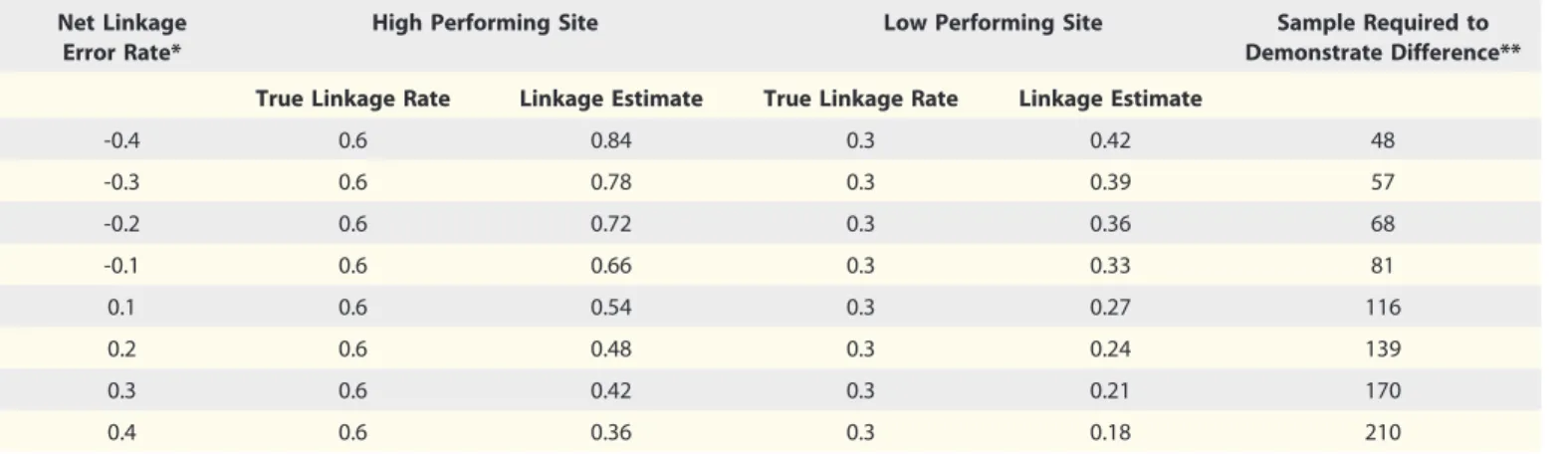
The tolerance for error in linkage assessments will vary based on the goals of the assessment. In order to establish a precise estimate of the success of linkage to care, a high level of linkage accuracy is required. This level of accuracy may not be achievable using the eUCI or other similar scalable metrics. Nonetheless, linkage strategies with higher error rates may still be useful as a means to distinguish high performing and low performing sites. As shown in Table 1, even with error rates substantially beyond the 8.8% combined false positive and false negative error rate reported from the HRSA validation, high performing sites could be distinguished from low performing sites with manage-able samples sizes. Given the use of aliases by persons in corrections and other potential inconsistencies in the recording of data between the correctional and clinical data systems, we expect that false negative matches will be more prominent than false positives though this assumption needs to be validated.
Metrics of Linkage Adequacy and Best Practices
management, substance abuse or mental health services where that data are avail-able. Because the need for ancillary services will not be documented in release records, it will not be possible to draw conclusions regarding failure to link to necessary services. High rates of linkage to ancillary services if correlated with high performing sites may suggest that these are important components of a successful strategy for linkage to care. Immunologic status and detectable viremia at follow-up, time to follow-up and time to filling of ARV prescriptions have been used as measures of adequacy of linkage to care in prior studies. Where clinical data are available from the time of release, declines in CD4 count can be an additional indicator of linkage failure.
Measures of linkage adequacy using this strategy could be utilized in multiple ways. Serial measures at a given site would allow program managers to assess the success of linkage programs and interventions as well. Comparing quality measures across sites and across regions would allow identification of model programs and best practices which could potentially be repli-cated at other sites. Lastly, generation of regional or national statistics regarding the adequacy of linkage may provide impor-tant feedback for policy development related to correctional health and HIV.
Tracking Linkage in a Changing Healthcare Environment
Although Ryan White funded care pro-grams are likely the first point of contact
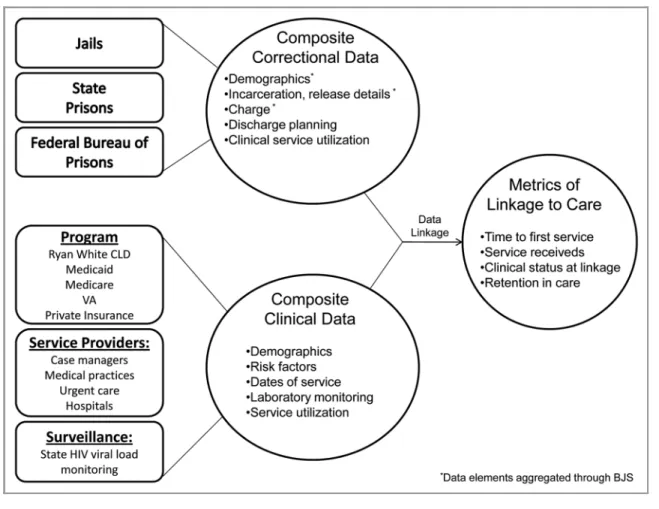
on reentry in most jurisdictions, access to other public and private insurance programs as a result of healthcare reform may significantly change this in the years to come. A linkage strategy validated using Ryan White care data could similarly be applied to aggregated client level data from other data sources or even multiple data sources. The confidentiality protection inherent in the use of the eUCI as a linkage strategy would be key in negotiating access to alternate clinical data sets. Other potential sources of data for linkage include Medicaid programs, state health programs such as Mass Health, pharmacy prescription data, data from the Veterans Administration health sys-tem, and urgent care and emergency care providers, and state or national laboratory surveillance data (see Fig. 1). Each of these data sets would include the necessary information to generate the eUCI and details of specific services funded or tracked through those programs. If accurate matching can be performed across data sets, the potential for aggrega-tion of data from multiple data sources in a manner that would create a composite picture of all the services received by an individual, enhancing the accuracy of linkage estimates.
Evaluating Reasons for Variability in Linkage Success
Once metrics are established for linkage to care, both from a research and from a quality and program planning point of view follow-up investigations will need to
be performed to identify the differences in performance between sites and within a site over time. This may include quanti-tative investigation of determinants of adequacy of linkage to care. Qualitative research that thoroughly explores the social processes and factors that influence how and whether inmates are effectively linked to care is an important complement to these analyses. First, qualitative analyses may help unpack and explain the observed linkage trends. Second, qualitative analyses will also help reveal how the“macro”level factors such as the local and national policy environments, resources, health infrastructure, leadership and other insti-tutional factors impact access to care upon release. For example, focus groups and interviews with Ryan White Care pro-viders and correctional administrators may illustrate the local factors and policies that explain linkage trends. Similarly, qualita-tive analyses that explore the inmates’ experiences with treatment and care ser-vices upon release may help highlight the “micro” or individual-level factors that affect inmates’ continuity in care. These might include substance abuse, stable housing, health insurance status, mental health, employment and other factors. In summary, qualitative research is an essential and complimentary com-ponent of understanding trends in linkage to care services for recently released inmates, and may help shed light on social factors and processes not observed in quantitative trends alone. Taken together, the quantitative and qualitative investi-gations will inform efforts to develop
Table 1.Simulated linkage estimates by true linkage rate and net error rate
Net Linkage Error Rate*
High Performing Site Low Performing Site Sample Required to
Demonstrate Difference**
True Linkage Rate Linkage Estimate True Linkage Rate Linkage Estimate
-0.4 0.6 0.84 0.3 0.42 48
-0.3 0.6 0.78 0.3 0.39 57
-0.2 0.6 0.72 0.3 0.36 68
-0.1 0.6 0.66 0.3 0.33 81
0.1 0.6 0.54 0.3 0.27 116
0.2 0.6 0.48 0.3 0.24 139
0.3 0.6 0.42 0.3 0.21 170
0.4 0.6 0.36 0.3 0.18 210
*Defined as the percent of false negative links2false positive links. **Calculated based on the comparison of proportions byx2test with continuity
effective programs supporting linkage to care for persons on reentry.
Challenges and Opportunities
There are several key challenges to be addressed in order to build a scalable system of assessment of linkage to care on entry. In order to be successful, a program of systematic analysis of the adequacy of linkage to care must be built in a collaborative manner with input and buy-in from all involved parties. This is particularly important with regard to the involvement of the correctional health system which faces the ongoing challenge of trying to provide the linkage services for detainees who have complex psychosocial needs, high rates of comorbid mental illness and substance addictions, and limited resources to care for themselves post release. Maintaining this support on the corrections side will require that corrections officials be involved from the outset in the review and dissemination of
data. Deficiencies identified need to be addressed as systems challenges rather than singular failings on the part of one agency. Assuring optimal linkage to care may require additional support for correc-tional linkage programs and these analyses may provide an important first step in making the case to policymakers for the need for additional support for discharge planning within the departments of corrections.
On the clinical side, assuring adequate measures are taken to maintain con-fidentiality is key. This involves the development and validation of linkage procedures that minimize disclosure of personal identifiers and protected health information. In addition, developing strategies for data linkage that use aggre-gated data either at the State or Federal level will minimize the need for trans-mission of data and thereby minimize the risk of unintended disclosures. If HRSA is able to link aggregated client level data for all Ryan White funded
providers to corrections release data, this would offer the real possibility that assessment of linkage to care across jurisdictions could become a standard component of quality monitoring for Ryan White care sites with a minimum risk to confidentiality. Aggregation of release data across correctional systems would in a similar way enhance the scalability of these linkage analyses. Use of aggregated data from the federal correc-tions system may provide a potential model for the use of centralized corrections data to assess linkage success across correc-tional systems.
Conclusions
Reporting of client level data allows an unprecedented opportunity to assess the adequacy of linkage to care to newly released HIV positives individuals. Linkage of the Ryan White Client Level Data to corrections release data may pro-vide an important tool for the development
of metrics of linkage adequacy that can be used to monitor quality improvement and program development. If proved successful this strategy with the con-fidentiality protections built into the use of the eUCI can be used with other data sets to evaluate service linkage across a variety of care environments. Ultimately, enhancing linkage to care services for
prisoners and recently released inmates will likely contribute to several important goals outlined in the 2010 National AIDS Strategy, including reducing: HIV incidence, reducing racial disparities in HIV infection and AIDS-related adverse health events. If individuals are success-fully linked to care and maintained on treatment, this strategy can contribute to
efforts to reduce community viral load which may have demonstrable impacts on HIV incidence.
Acknowledgments
This work was supported by the following NIH grants: R01DA030778, K24DA022112, T32DA13911 and CFAR P30AI042853.
References
1. Montaner JS, Lima VD, Barrios R, Yip B, Wood E, Kerr T, et al. Association of highly active antiretroviral therapy coverage, population viral load, and yearly new HIV diagnoses in British Columbia, Canada: a population-based study. Lancet 2010; 376:532-9; PMID:20638713; http://dx.doi.org/10.1016/S0140-6736(10)60936-1 2. Cohen MS, Chen YQ, McCauley M, Gamble T,
Hosseinipour MC, Kumarasamy N, et al. HPTN 052 Study Team. Prevention of HIV-1 infection with early antiretroviral therapy. N Engl J Med 2011; 365:493-505; PMID:21767103; http://dx.doi.org/10.1056/ NEJMoa1105243
3. Conway B, Tossonian H. Comprehensive Approaches to the Diagnosis and Treatment of HIV Infection in the Community: Can“Seek and Treat”Really Deliver? Curr Infect Dis Rep 2011; 13:68-74; PMID:21308457; http://dx.doi.org/10.1007/s11908-010-0151-y 4. BJS. Bulletin HIV in Prisons 2007-2008. In: Justice,
ed. Washington, DC: Department of Justice; 2009. 5. Spaulding AC, Seals RM, Page MJ, Brzozowski AK,
Rhodes W, Hammett TM. HIV/AIDS among inmates of and releasees from US correctional facilities, 2006: declining share of epidemic but persistent public health opportunity. PLoS One 2009; 4:e7558; PMID: 19907649; http://dx.doi.org/10.1371/journal.pone. 0007558
6. Boutwell A, Rich JD. HIV infection behind bars. Clin Infect Dis 2004; 38:1761-3; PMID:15227624; http:// dx.doi.org/10.1086/421410
7. Solomon L, Flynn C, Muck K, Vertefeuille J. Prevalence of HIV, syphilis, hepatitis B, and hepatitis C among entrants to Maryland correctional facilities. J Urban Health 2004; 81:25-37; PMID:15047781; http://dx.doi.org/10.1093/jurban/jth085
8. Cooke CL. Going home: formerly incarcerated African American men return to families and communities. J Fam Nurs 2005; 11:388-404; PMID:16287838; http://dx.doi.org/10.1177/1074840705281753 9. Courtenay-Quirk C, Pals SL, Kidder DP, Henny K,
Emshoff JG. Factors associated with incarceration history among HIV-positive persons experiencing homelessness or imminent risk of homelessness. J Community Health 2008; 33:434-43; PMID:18581214; http://dx.doi.org/10.1007/s10900-008-9115-7 10. Conklin TJ, Lincoln T, Tuthill RW. Self-reported
health and prior health behaviors of newly admitted correctional inmates. Am J Public Health 2000; 90: 1939-41; PMID:11111273; http://dx.doi.org/10.2105/ AJPH.90.12.1939
11. Springer SA, Friedland GH, Doros G, Pesanti E, Altice FL. Antiretroviral treatment regimen outcomes among HIV-infected prisoners. HIV Clin Trials 2007; 8:205-12; PMID:17720660; http://dx.doi.org/10.1310/ hct0804-205
12. Springer SA, Altice FL. Managing HIV/AIDS in correctional settings. Curr HIV/AIDS Rep 2005; 2:165-70; PMID:16343373; http://dx.doi.org/10.1007/ s11904-005-0011-9
13. Maruschak L. Bulletin HIV in Prisons 2007-2008. In: Statistics BoJ, ed. Washington, DC: Department of Justice 2009.
14. Springer SA, Pesanti E, Hodges J, Macura T, Doros G, Altice FL. Effectiveness of antiretroviral therapy among HIV-infected prisoners: reincarceration and the lack of sustained benefit after release to the community. Clin Infect Dis 2004; 38:1754-60; PMID:15227623; http://dx.doi.org/10.1086/421392
15. Palepu A, Tyndall MW, Chan K, Wood E, Montaner JS, Hogg RS. Initiating highly active antiretroviral therapy and continuity of HIV care: the impact of incarceration and prison release on adherence and HIV treatment outcomes. Antivir Ther 2004; 9:713-9; PMID:15535408
16. Baillargeon J, Giordano TP, Rich JD, Wu ZH, Wells K, Pollock BH, et al. Accessing antiretroviral therapy following release from prison. JAMA 2009; 301:848-57; PMID:19244192; http://dx.doi.org/10.1001/jama. 2009.202
17. Baillargeon J, Giordano TP, Harzke AJ, Spaulding AC, Wu ZH, Grady JJ, et al. Predictors of reincarceration and disease progression among released HIV-infected inmates. AIDS Patient Care STDS 2010; 24:389-94; PMID:20565323; http://dx.doi.org/10.1089/apc. 2009.0303
18. Stephenson BL, Wohl DA, Golin CE, Tien HC, Stewart P, Kaplan AH. Effect of release from prison and re-incarceration on the viral loads of HIV-infected individuals. Public Health Rep 2005; 120:84-8; PMID:15736336
19. Mallik-Kane KVC. Health and Prisoner Reentry: How Physical, Mental, and Substance Abuse Conditions Shape the Process of Reintegration 2008. http://www. urban.org/url.cf?=ID=411617. Accessed 2/2/2011. 20. Binswanger IA, Stern MF, Deyo RA, Heagerty PJ,
Cheadle A, Elmore JG, et al. Release from prison–a high risk of death for former inmates. N Engl J Med 2007; 356:157-65; PMID:17215533; http://dx.doi. org/10.1056/NEJMsa064115
21. Baillargeon J, Penn JV, Thomas CR, Temple JR, Baillargeon G, Murray OJ. Psychiatric disorders and suicide in the nation’s largest state prison system. J Am Acad Psychiatry Law 2009; 37:188-93; PMID:19535556 22. Sabol WW. HC; Cooper M. Prisoners in 2008.BJS
Bulletin. 2010:46. http://bjs.ojp.usdoj.gov/content/
pub/pdf/p08.pdf. Accessed 2/2/2011.
23. Hall HI, Song R, Rhodes P, Prejean J, An Q, Lee LM, et al.; HIV Incidence Surveillance Group. Estimation of HIV incidence in the United States. JAMA 2008; 300:520-9; PMID:18677024; http://dx.doi.org/10. 1001/jama.300.5.520
24. Khan MR, Miller WC, Schoenbach VJ, Weir SS, Kaufman JS, Wohl DA, et al. Timing and duration of incarceration and high-risk sexual partnerships among African Americans in North Carolina. Ann Epidemiol 2008; 18:403-10; PMID:18395464; http://dx.doi.org/ 10.1016/j.annepidem.2007.12.003
25. Khan MR, Wohl DA, Weir SS, Adimora AA, Moseley C, Norcott K, et al. Incarceration and risky sexual partnerships in a southern US city. J Urban Health 2008; 85:100-13; PMID:18027088; http://dx.doi.org/ 10.1007/s11524-007-9237-8
26. Doherty IA, Schoenbach VJ, Adimora AA. Sexual mixing patterns and heterosexual HIV transmission among African Americans in the southeastern United States. J Acquir Immune Defic Syndr 2009; 52:114-20; PMID:19506485; http://dx.doi.org/10. 1097/QAI.0b013e3181ab5e10
27. Policy OoNA. National HIV/AIDS Strategy for the United States. 2010; http://www.whitehouse.gov/ administration/eop/onap/nhas/. Accessed 2/2/2011. 28. Greifinger R, ed.Public Health Behind Bars: From Prisons
to Communities.1 ed. New York: Springer; 2007.
29. Rich JD, Holmes L, Salas C, Macalino G, Davis D, Ryczek J, et al. Successful linkage of medical care and community services for HIV-positive offenders being released from prison. J Urban Health 2001; 78:279-89; PMID:11419581; http://dx.doi.org/10.1093/jurban/78. 2.279
30. Zaller ND, Holmes L, Dyl AC, Mitty JA, Beckwith CG, Flanigan TP, et al. Linkage to treatment and supportive services among HIV-positive ex-offenders in Project Bridge. J Health Care Poor Underserved 2008; 19:522-31; PMID:18469423; http://dx.doi.org/10. 1353/hpu.0.0030
31. Wohl DA, Scheyett A, Golin CE, White B, Matusczewski I, Bowling M, et al. Intensive Case Management Before and After Prison Release is No More Effective Than Comprehensive Pre-Release Discharge Planning in Linking HIV-Infected Prisoners to Care: A Randomized Trial. AIDS Behav 2011; 15:356-64; PMID:21042930; http://dx.doi.org/10.1007/s10461-010-9843-4 32. Nunn A, Cornwall A, Fu J, Bazerman L, Loewenthal H,
Beckwith C. Linking HIV-positive jail inmates to treat-ment, care, and social services after release: results from a qualitative assessment of the COMPASS Program. J Urban Health 2010; 87:954-68; PMID:21046470; http://dx.doi.org/10.1007/s11524-010-9496-7 33. Copenhaver M, Chowdhury S, Altice FL. Adaptation
of an evidence-based intervention targeting HIV-infected prisoners transitioning to the community: the process and outcome of formative research for the Positive Living Using Safety (PLUS) intervention. AIDS Patient Care STDS 2009; 23:277-87; PMID: 19260773; http://dx.doi.org/10.1089/apc.2008.0157 34. Laufer FN, Arriola KRJ, Dawson-Rose CS, Kumaravelu
K, Rapposelli KK. From Jail to Community: Innovative Strategies to Enhance Continuity Of HIV/AIDS Care. The Prison Journal 2002; 82:84-100; http://dx.doi.org/ 10.1177/003288550208200106
35. Foundation KF. The Ryan White Program 2008. 36. IOM. Public Financing and Delivery of HIV/AIDS
Care: Securing the Legacy of Ryan White. In: Medicine Io, ed. Washington, DC2004.
37. HIV/AIDS B. The Use of Ryan White HIV/AIDS Program Funds for Transitional Social Support and Primary Care Services for Incarcerated Persons. 38. Secure Hash Standard. In: Standards FIP, ed1995. 39. Institute TS. UCI and You. 2008. http://www.