Innovative Practice in Higher Education 67 ©IPiHE 2019
ISSN: 204-3315
Collective case building – an extended approach to case
based learning
Saad Qureshi
King’s College, London
Corresponding author: [email protected]
Abstract
Case based learning (CBL) has not seen many innovations in recent times. This research conceptualises a new extended approach to CBL called ‘collective case building’ where students are involved in co-constructing cases. It then explores whether this approach can improve students’ skills in co-constructing a case (called ‘case augmentation abilities’) and students’ discipline specific knowledge; in this case knowledge in Corporate Social Responsibility (CSR). A small scale quantitative study is conducted with 40 undergraduate students on a business course split into 8
groups. Students complete a questionnaire, and existing data on their module marks are collated. The study measures their ‘collectiveness’ via collective efficacy and team work. Satisfaction with the collective case building approach is also assessed along with students CSR knowledge eand case augmentation abilities. The small scale study means that the findings may be treated with caution. Nevertheless the results reveal high satisfaction with the collective case building approach, and that some variables in the regression analysis are significant in predicting students’ case augmentation abilities and discipline specific (CSR) knowledge. The initial findings from this small scale study suggest that those using case based learning should consider involving students in the co-construction of cases. Collective case building is a promising extended approach to case based learning grounded in theory and is among one of the first studies to involve students in the co-construction of a case. Key words: collective case building, case based learning, participatory learning, students as partners, collective efficacy, corporate social responsibility
Introduction
Providing students with real world insights into professional practice can be
incredibly challenging as it requires them to develop practical knowledge and skills, whilst they are undertaking their learning in an educational setting rather than the work place; unless of course they are partaking in a work-based degree such as apprenticeship degrees, part time study (whilst working), or other models.
Innovative Practice in Higher Education 68 ©IPiHE 2019
ISSN: 204-3315
The dilemma facing many educators then is how to provide students with at least a glimpse of such real life scenarios experienced in the work place, in a classroom environment. There exist some pedagogical approaches in this regard. Popular methods include simulation exercises from enterprise challenges where students need to solve business problems mimicked on real situations (King and Newman, 2009; Snow, Gehlen and Green, 2002), to role plays and interactive drama (Boggs, Mickel, and Holtom, 2001), and case based learning which provides sufficient stimuli to encourage discussion on thought provoking topics (Thomas et al, 2001).
Of the above methods to develop real world application, this present research is concerned with developing approaches to case based learning. Case based learning uses narratives or problem statements that identify provoking questions (Srinivasan et al, 2007) presented as a ‘case study’ that is essentially like a story with a
reflective narrative that creates an active learning environment (Mayer, 2009). It is designed to provide students with an in depth understanding of a situation. Case based learning would contrast with the traditional method of teaching students about a topic via a content transfer approach in a lecture. Case based learning, if used correctly, can foster self-directed learning as students have to navigate the issues in the case themselves (Lowenstein and Bradshaw, 2001). However the
teacher develops the case study and will act as a facilitator to help frame questions.
The first question in this present research explores the role of students in the co-construction of a case study within case based learning, referred here as ‘collective case building’. Until now a case study has typically been designed by a teacher (Hong and Yu, 2017), with no involvement of students in the design process. Collective case building is consistent with literature on participatory learning with students actively immersed in the learning process (Hedges and Cullen, 2012) through providing students with some control over the case design and learning process. This could be a way to make the case more ‘authentic’, which, according to participatory learning makes the learning process real and enables learners to
Innovative Practice in Higher Education 69 ©IPiHE 2019
ISSN: 204-3315
pursue what is of ‘intrinsic interest and importance to them’ (Walsh, McGuinness and Sproule, 2017).
Further still, student informed case design adheres to the students as partners approach to the co-creation of the curriculum and teaching methods. For example, Healey et al (2014) outline several ways in which students can work in partnership with faculty, including scholarship of learning and teaching such as co-authoring research with students, and course and assessment design. Others have supported the role of students in curriculum and assessment design (Cook-Sather, Bovill, & Felten, 2014; Meer and Chapman, 2015). The involvement of students in co-construction of a case study through collective building is an example of the ‘students as partners’ model in action.
The second research question considers the effectiveness of collective case building in developing students’ skills in co-constructing a case (referred here as ‘case
augmentation’ abilities) and in discipline specific knowledge. Though this extended case based method can be used in any discipline, given the author’s prior expertise in teaching Corporate Social Responsibility (CSR), the chosen discipline domain is CSR.
This research presents a brief literature review on case-based learning, including a conceptualisation of the collective case building approach, and a review of CSR literature as the discipline context in which collective case building is applied. The methods for the research are then discussed. The findings are presented and a discussion is held on the potential for collective case building as an extended method of case based learning with a conclusion providing indications for future research.
Literature review
Case based learning
The cased based learning method encourages partnership between students and teachers and provides students the opportunity to see multiple perspectives
Innovative Practice in Higher Education 70 ©IPiHE 2019
ISSN: 204-3315
(Kaddoura, 2011). It can also support information recall, and enable students to gain new experiences (Thomas et al, 2001). The role of case based learning is therefore useful to explore issues that otherwise may only be faced in a real life situation. However the drawback of case based learning is that it requires a great deal of ‘imagination’ and creativity on part of the students (Thistlethwaite et al, 2012) to realise its aims. The need to embed creativity and emotion in the case study to foster students’ imagination and engagement has been increasingly called for
(Palmer, 2013; Greiner et al, 2003). Case based learning must adopt a greater active and participatory approach to learning in order to be effective (Tomey, 2003).
Until now, research has proposed that the effectiveness of case based learning depends on a number of factors such as: case selection, case design, case
complexity, case length and the number of cases (Hong and Yu, 2017; Andersen and Schiano, 2014). For example, case based learning can be ineffective if the case is too complex or lengthy for students to comprehend but must be sufficiently detailed to stimulate debate (Harman et al, 2015). The very choice of case selected for the classroom can also determine the success or failure of case based learning, where the case should be related to the discipline being taught (McLean, 2016). The case enables students to achieve the learning outcomes on the course and therefore case based learning should develop students’ discipline specific knowledge (Macho-Stadler and Elejalde-Garcia, 2013). However, despite the variety of the above case related factors, the role of students in case design has not been researched.
The new approach of ‘collective case building’ involves students in the case design, and could provide an opportunity for greater imagination from students; it may increase connectivity with the case subject matter, and make the issues ‘live’. The notion of collective case building as a teaching method is a new proposition in this present research and therefore requires some conceptualisation.
Innovative Practice in Higher Education 71 ©IPiHE 2019
ISSN: 204-3315
Collective case building
Firstly, collective case building should be distinguished from a ‘collective case study’ which is a popular type of qualitative methodology research tool, that combines several cases to explore related "phenomenon, population, or general condition" (Stake, 2000). Collective case building on the other hand is a teaching tool. It is defined for the purposes of this research as a ‘process that involves the participants in the social construction of a phenomenon’. In this sense, it is distinguished from the qualitative research methodology as it is can be participant-led as opposed to researcher-led.
For ease, distinction is also made between the proposed new collective case building approach, and the current form of case study referred to as the ‘traditional’ case based method. Typically traditional case studies are active and self-directed in that they require learners to themselves develop responses to the issues in the case. In the traditional case study the students are only participants in the discussion (Anderson and Schiano, 2014) but not in the case design.
A traditional case study is pre-set by the teacher, and could be purposely developed or chosen from an existing template (Hay and Katsikitis, 2008), such as from a book or indeed a newspaper article. Typically students reflect on the case subject, and seek to find solutions to the pre-set case. The case is designed by the teacher (Hong and Yu, 2017) who has ‘editorial control’ over at least four features of a case defined in this present research as: content, context, problem and outcomes. A successful case study includes a problem, has engaging content, and sufficient context capable of leading to possible outcomes (Anderson and Schiano, 2014). These four structural features of the case study are crucial as students should not only be able to
understand the details of the case (content), but also why they are relevant (context), the challenge that needs to be resolved (problems) and the possible solutions that may be provided to the challenges (outcomes).
Innovative Practice in Higher Education 72 ©IPiHE 2019
ISSN: 204-3315
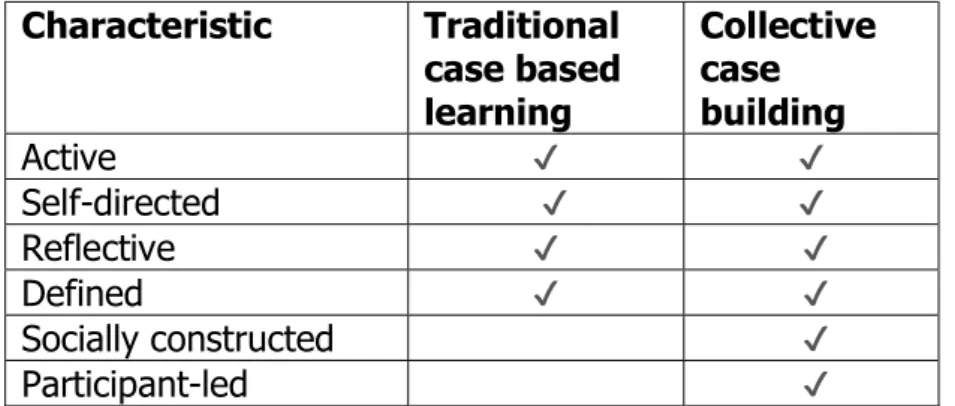
As an approach within the family of traditional case based learning, it is proposed that collective case building is also active, self-directed, and reflective. However it is asserted that the extent to which the case is defined and constructed differs from traditional cases. A key feature of collective case building is student involvement in co-constructing or augmenting the case in terms of some of the four features discussed earlier. It is ‘collective’ because it is developed by both teacher and students, and also between students who work collectively as peers due to its team learning nature (Michaelsen and Richards, 2005). The case that is built is meant to take on a new form than what is originally designed. It is not final or structured definitively in the way traditional cases can be.
The table below illustrates some of the key characteristics of case based learning and the potential contributions that collective case building can make.
Table 1: Proposed characteristics of collective case building Characteristic Traditional
case based learning
Collective case building
Active ✔ ✔
Self-directed ✔ ✔
Reflective ✔ ✔
Defined ✔ ✔
Socially constructed ✔
Participant-led ✔
Indeed, it is posited that the success of this teaching method could be determined by the extent to which the socially constructed case is different from the original case. In this sense the teacher provides the initial impetus for students, but it is suggested in this present research that students must ‘augment the case’. Case augmentation is therefore in itself a skill that students must develop and therefore can be considered a valuable improvement in student outcomes.
Innovative Practice in Higher Education 73 ©IPiHE 2019
ISSN: 204-3315
The approach adopted for student augmentation in the present research is where the teacher essentially only develops part of the case study. Thereafter, as shown in Table 2, there could be partial student case augmentation or full student case
augmentation with the latter suggesting that the case is extended in all four features of a case. The table compares editorial control between the traditional and the
collective case method. Augmentation inherently suggests that existing features of a case already exist. Indeed students would always be involved in determining the outcome of the case in both traditional and collective case building as that is the aim of case based learning; for the students to develop their problem solving abilities.
Therefore it is suggested that, of the four structural features of a case, the teacher should at least provide the ‘problem’ and some ‘content’. This is consistent with student as partners’ literature, where it is stated that students need guidance in developing course or assessment materials (Bovill et al, 2016). In partial case
augmentation students can then choose to simply add additional content in the case that is based on their perceptions of the case subject matter. The purpose of doing so enables students to shape the narrative of that case which can be a form of collaborative learning (Barkley, Cross and Major, 2005).
In full augmentation, students can also engage in further problematising and
contextualising the case, taking the narrative of the case in a new direction if they so wish. This can of course develop new possible outcomes and lines of inquiry. The key aim is that this augmentation process will engage students’ imagination in developing a case and resolving the issues through their own understanding. Having greater editorial control and pursuing new lines of inquiry can be powerful within itself as a mode of discovery (Alfieri et al, 2011). This is pursued in sciences where through inquiry based learning the learner formulates their own hypotheses and tests them by conducting experiments or making observations (Pedaste et al, 2015; Pedaste, Mäeots, Leijen, & Sarapuu, 2012) and thus may be a higher form of self-regulation.
Innovative Practice in Higher Education 74 ©IPiHE 2019
ISSN: 204-3315
In addition to the inherent problem, inquiry based and participatory learning approaches, there are numerous other theoretical lenses that could support the collective case building approach. For example, social constructivism posits that knowledge and reality are developed through human activity, and thus learning is ultimately a social process (Kukla, 2000). Collective case building is described as a social process and would require the sharing of knowledge and perceptions and goals among the student group. In addition, self-directed learning can be fostered through students sourcing their own material to build a collective case study.
Table 2: Editorial control shared between teacher and students Editorial control of a case
Traditional case Collective case building Features of a case
study Developed by teacher by students Developed Developed partly by teacher
Augmented by students
Partly Fully
Content
Details of the case ✔ ✔ ✔ ✔
Context
In what scenarios are the issues relevant
✔ ✔
Problem(s)
The challenges that need to be resolved
✔ ✔ ✔
Outcome(s)
The possible solutions that may be provided to the challenges
✔ ✔ ✔
Moreover, the ‘collective’ dimension inherent in collective case building can be informed by the notion of perceived collective efficacy, which Bandura (1982, 143) said will “influence what people choose to do as a group, how much effort they put into it, and their staying power when group efforts fail to produce results”. This links well to the earlier claim that the success of a collective case building exercise rests in the final form of the case – in other words, collective case building could
Innovative Practice in Higher Education 75 ©IPiHE 2019
ISSN: 204-3315
indeed be a pedagogical process that may benefit from high collective efficacy. It will require a group, in any context, to understand themselves and regularly update their knowledge (Hipp, 2016).
Higher collectiveness should lead to improved student outcomes such as improved CSR knowledge. In addition, students’ team working abilities are important in order for collective case building to work. As discussed earlier, case based learning is chosen purposely to develop students’ subject knowledge. The collective case building approach should be able to be applied in any discipline however the case study must be related to the discipline being taught (McLean, 2016; Macho-Stadler and Elejalde-Garcia, 2013). The chosen discipline for this present research is Corporate Social Responsibility (CSR) and a brief review of what CSR means is provided.
Corporate social responsibility (CSR)
Corporate social responsibility has many meanings and can often be interpreted based on individuals’ own perceptions thus causing confusion (Tench, Sun and Jones, 2012). However, most literature agrees that CSR is about obligations to society and the planet (Maignan and Ferrell, 2004).
The importance of teaching CSR in the curriculum cannot be understated. The increasing scandals that have caused concern in the business community and beyond have meant that businesses have to be more socially responsible. This means that future leaders, many of whom receive their grounding and decision making frameworks, are built through their education in schooling years and indeed higher education. As stewards and leaders of the future students must be taught these concepts earlier on and educational institutions have a crucial role to play (Lanero, Buguete and Munoz-Adanez, 2015).
Many corporations engage in CSR activities for a number of reasons including reputational value to offset irresponsible actions (Kotchen and Moon, 2012), to
Innovative Practice in Higher Education 76 ©IPiHE 2019
ISSN: 204-3315
respond to pressure groups, or due to a genuine sense of civic duty (Tilt, 2016).The CSR concept is particularly broad and encompasses work to benefit society, but it is not just external, it is also internal within the organisation. The phrase ‘charity starts from home’ rings true where a firm cannot espouse its excellent profile in the
community if it has not sought to improve the experience and fortune of its own people, its staff, such as improving equality in pay and conditions between males and females and full time and contract based staff.
This present research used the company Tata, on which a case study was prepared and used with students to develop their understanding of CSR.
Methods
The purpose of this research is to explore whether collective case building could be a useful teaching method to develop students’ skills and knowledge. Research was undertaken in 2016 with 40 business students studying sustainable business strategy on an undergraduate business course. The 40 students were split equally into
groups of five, totalling 8 groups. Each group was given a case study on Tata which formed part of a summative assessment and was graded out of 100. This case was chosen because it is can introduce students to both a socially responsible employer but as it is a manufacturing company it also shows how the company is being sustainable in its manufacturing processes and materials.
The case study was developed by the teacher and was issued to students at the start of the module, with three questions to guide students in analysing the case study. However, as part of the collective case building approach students were asked to conduct their own research over the subsequent seven weeks on Tata prior to their lecture in which the case study was examined in class. Students were asked to augment the case study in any of the four features of the case study considered in Table 2: content, context, problem, and outcomes. Their aim was to augment and further develop the case study on Tata’s CSR activities through other reports on the company, social media entries, etc.
Innovative Practice in Higher Education 77 ©IPiHE 2019
ISSN: 204-3315
Tata was chosen because it focuses on three key areas for its CSR strategy:
volunteering, responding to emergencies and disasters and group programmes[1]. Tata is further exemplary because it combines CSR, ethics and sustainability into all its efforts. For example, its work on sustainability is proven by its commitment to source energy from only renewable sources [2].
There were eight groups and therefore eight group marks awarded according to a pre-set mark scheme that assessed the following: a) students’ knowledge on CSR; b) team work abilities; c) ability to augment and extend the case.
A quantitative approach was used by analysing questionnaire results via descriptive statistics and regression. The sample is small and may be underpowered, thus caution is applied, but statistical power can be increased by using a valid
measurement tool and reducing sample variance (Hopkin, Hoyle, and Gottfredson, 2015).
Measurements
To measure the success of the collective case study initiative, two main scales were used: collectiveness of students, and student outcomes. These two were assessed at student group level. Satisfaction was also measured but at the individual level.
Collectiveness: Building on existing research, the independent variable is the ability of the students to work collectively on the case study which was measured by perceived collective efficacy and team work.
Collective efficacy – There are two methods in the literature to assess collective efficacy. The first method aggregates the individual members’ score of their personal ability to carry the tasks of the group (Bandura, 1982; 2006). The second method aggregates group members’ assessment of their group’s ability rather their own
Innovative Practice in Higher Education 78 ©IPiHE 2019
ISSN: 204-3315
individual ability. The second method was adopted given the case study was a collective exercise. The sum method for aggregating the scores was used.
Though team efficacy has been measured in pedagogical research (Lin, Baruch and Shih, 2012; Shabana and Ravlin, 2016) these methods were not suitable as they were based on the first aggregation method discussed above and not directly on team ability to conduct the task. These previous studies were also not specific to case building. Thus a new scale was developed using the basic tenants of case building (Walker et al, 2015; Thomas et al, 2001) and statements from Bandura’s suggested Perceived Collective Efficacy scales (Bandura, 2006). Collective efficacy was therefore measured using a single question in a questionnaire in a Likert Scale from 1 to 5 (1 equalling strongly disagree and 5 equalling strong agree) with three statements: “Please express how likely or unlikely it is that your group would be able to: 1) agree on issues that are relevant to the topic being discussed; 2) can put aside any differences in order to reach a collective decision; 3) build respect for each other's particular interests.
Team work – this was measured via the marks attained by students in this section of the mark scheme which account for 25% of the final mark for the collective case study assessment; that is 25 marks out of 100.
Student outcomes: The dependent variable is the student outcomes, determined by their case augmentation abilities and their discipline specific knowledge (CSR
knowledge). Higher collective efficacy and team working should improve students’ abilities in case augmentation and CSR knowledge.
Case augmentation – students were graded in this area as part of their final
assessment and contributed towards 25% of the marks; that is the maximum marks for this component was 25 out of 100. A high mark would be given for students who added new aspects to the case.
Innovative Practice in Higher Education 79 ©IPiHE 2019
ISSN: 204-3315
CSR knowledge – students were graded in this area as part of their final assessment and contributed towards 50% of the marks; that is the maximum marks for this component was 50 out of 100.
Student satisfaction with the collective case building approach is also measured.
Satisfaction - as part of the final modular survey, one additional question was added (to the existing 16 questions) to test satisfaction of each of the 40 students with the collective case building method. This was measured on a Likert scale from 1 to 5 with one question: “building a case study with peers was a useful way to learn”.
Results
The descriptive statistics are available in Appendix A. They show a high level of collectiveness through collective efficacy (x̄=3.6, 72% of maximum value) and teamwork (x̄=17, 68% of maximum value). Student outcomes also showed high tendencies through case augmentation (x̄=16, 64% of maximum value) and CSR knowledge (x̄=33, 66% of maximum value). The spread sample variance was
relatively low particularly for collective efficacy (S2=1.6) and teamwork (S2=4.1) but was higher for case augmentation (S2=11.3) and CSR knowledge (S2=56.8).
Overall group assessment marks were variable (min=52, max=88). The average group mark was 67 (Table3).
In addition to the descriptive statistics which reveal strong results, regression was carried out. These are available in Appendices B (Model 1) and C (Model 2). In Model 1, when success of the collective case study was measured in predicting case augmentation abilities, it was found that collective efficacy (β=2.00, p=.02) was a significant predictor however team work was not (β=0.3, p=.4). The model was overall a good fit (R2=0.73, Adjusted R2=0.63). . The Adjusted R2 is preferred over the normal R2 value because it illustrates the effect of the predictors the dependant
Innovative Practice in Higher Education 80 ©IPiHE 2019
ISSN: 204-3315
variable and is a more reliable measure (Devore, 2011).Thus research question 1 is partially supported.
In Model 2, when success of the collective case study was measured in predicting CSR knowledge, it was found that collective efficacy (β=8.36, p=.001) and team work (β=1.2, p=.04) were both significant predictors (see Appendix C). The model fit was also a good fit (R2=0.92, Adjusted R2=0.89).
Table 3: Overall group assessment marks
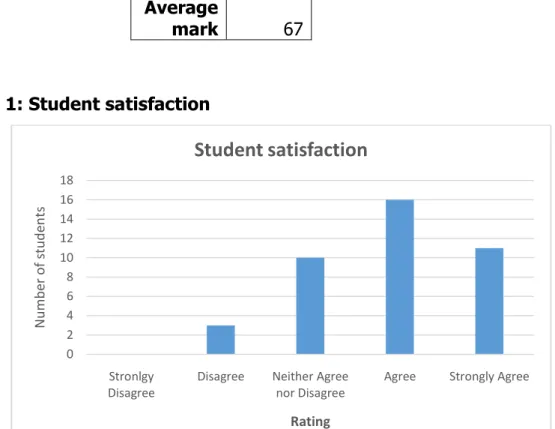
Figure 1: Student satisfaction
0 2 4 6 8 10 12 14 16 18
Stronlgy Disagree
Disagree Neither Agree nor Disagree
Agree Strongly Agree
N
um
be
r o
f s
tu
de
nt
s
Rating
Student satisfaction
Group Marks
1 76
2 88
3 69
4 74
5 66
6 63
7 52
8 54
Average
Innovative Practice in Higher Education 81 ©IPiHE 2019
ISSN: 204-3315
Student satisfaction with the collective case building method was also high as shown in Figure 1, with 27 (67%) ofstudents agreeing or strongly agreeing that building a case study with peers was a useful way to learn. Appendix A shows that the average satisfaction score was high (mean=3.8, S2=0.8)
Discussion
The purpose of this research was to explore a new method of collective case building as part of a small scale study.
A high level of collective efficacy was found to be positively associated with
Corporate Social Responsibility (CSR) knowledge and case augmentation. This could be due to a number of factors. Both collective efficacy and CSR are social processes and rely on shared knowledge and understanding and the collective case building approach helps create a participatory space that encourages learning (Dooley et al, 2016). In this sense it suggests that collective case building is not just a case design process, but a learning process in itself. The method may encourage learner
immersion in the activity similar to that which is experienced in games based learning (Shernoff et al, 2016). It also creates a high level of interactivity by
enabling the students to influence the shape of the case narrative through editorial control which is empowering for students (Sharpe, Beethan and de Freitas, 2010).
Moreover, though there was high collective efficacy on average, there were still some groups with low collective efficacy. Ultimately collective efficacy is based on perception and therefore may not fully explain the individual perceptions of efficacy. An additional measure of collectiveness, team work, was therefore included in this research. Team working abilities were high (x̄=17.8) and ultimately was a significant predictor of CSR knowledge (p=0.04) but not of case augmentation abilities and thus this requires further analysis. Team work has long been considered an
important mechanism to facilitate learning. Students learn from each other in a peer setting (Topping, 2005).
Innovative Practice in Higher Education 82 ©IPiHE 2019
ISSN: 204-3315
There was a spread of assessment marks which could be explained. This could be impacted by students’ prior knowledge or predispositions of CSR. For example, those who have a negative view of CSR (e.g. that a company may only superficially
engage in CSR for reputational purposes) may have been less engaged in the social construction of the case study. CSR is also a topic that can be difficult to engage with because it is not a lived experience (Cobb et al, 2009).
For the collective case building method to be effective, students must be involved in collectively designing the case study which acts as a learning process. This research posits that ‘case augmentation’ could be an important skill that should be cultivated in students. In doing so they are not just taking on the role to resolve the issues presented in the case study, they are also taking on the role of positioning the issues in the case relative to their own perspective. The mean case augmentation score was relatively high (x̄=16.8), however there was a wider range of marks in this component. This suggests that this requires further study in this area, particularly larger scale studies on student-led case augmentation, due to the small scale nature of this study being a limitation. Nevertheless, collective efficacy was seen as a significant predictor of case augmentation (p=0.02).
Conclusion
The purpose of this research was to explore the teaching method of ‘collective case building’ as a new case based learning approach. The first research question was to consider how students could be involved in the case building process, and the second encompassed whether it could develop students skills (specifically in case augmentation) and discipline specific knowledge, in this case, Corporate Social Responsibility (CSR) knowledge.
The small scale nature of this study is acknowledged and the findings can be further tested in subsequent research (Hopkin, Hoyle, Gottfredson, 2015) such as
Innovative Practice in Higher Education 83 ©IPiHE 2019
ISSN: 204-3315
Nevertheless the preliminary findings are encouraging. Collectiveness of students was measured along with student outcomes. The initial findings from this study support the original notion that collective case building can be an innovative, useful and highly effective pedagogical approach and teaching tool. All groups passed their assessment with relatively high scores. This study also shows the importance of collective efficacy in developing students CSR knowledge, thus building on existing research in this field (Lin, Baruch and Shih, 2012).
Student-led case augmentation was developed as a characteristic of this new collective case building approach. It is a new phenomenon and with larger scale studies, this could in itself potentially lead to a new field of inquiry. What are the further antecedents to successful student-led case augmentation? In this research collective efficacy was found to be significant in developing case augmentation abilities in the small sample studied. Clearly an improvement in CSR knowledge and skills in case augmentation are just two positive student outcomes. What are the additional benefits of collective case building? These can be extended further. Students must be involved in collectively designing the case study, where co-construction has numerous benefits including learners understanding the subject matter better (Herreid, 2007).The participatory learning approach develops an active environment for students to learn. In doing so they are not just taking on the role to resolve the issues presented in the case study, they are also taking on the role of determining the issues. It would be interesting to study the nature of issues and additional material that students chose to include alongside the four features considered by the current case study.
Declaration
The author declares no conflicts of interest.
References
Alfieri, L., Brooks, P. J., Aldrich, N. J., Tenenbaum, H. R. (2011). Does discovery-based instruction enhance learning? Journal of Educational Psychology, 103(1), 1-18
Innovative Practice in Higher Education 84 ©IPiHE 2019
ISSN: 204-3315
Anderson, E. and Schiano, B. (2014). Teaching with Cases: A Practical Guide. Harvard Business School Publishing 2014
Bandura, A. (1982). Self-efficacy mechanism in human agency. American Psychologist,37(2), 122-147.
Bandura, A. (2006). Toward a Psychology of Human Agency. Perspectives on Psychological Science, 1(2), 164-180
Barkley, E. F., Cross, K. P. and Major, C. H. (2005). Collaborative Learning Techniques: A Handbook for College Faculty. San Francisco: Jossey-Bass.
Boggs, J. G., Mickel, A. E. and Holtom, B. C. (2007). Experiential Learning Through Interactive Drama: An Alternative To Student Role Plays. Journal of Management Education, 31(6), 832-858
Bovill, C., Cook-Sather, A., Felten, P., Millard, L., & Moore-Cherry, N. (2016). Addressing potential challenges in co-creating learning and teaching: Overcoming resistance, navigating institutional norms and ensuring inclusivity in student-staff partnerships. Higher Education, 71(2), 195-208.
Cobb, S., Heaney, R., Corcoran. O. and Henderson-Begg, S. (2009). The Learning Gains and Student Perceptions of a Second Life Virtual Lab. Bioscience Education,
13(1), 1-9
Cook-Sather, A., Bovill, C., & Felten, P. (2014). Engaging students as partners in teaching and learning: A guide for faculty. San Francisco, CA: Jossey-Bass.
Devore, J. L. (2011). Probability and Statistics for Engineering and the Sciences (8th ed.). Boston, MA: Cengage Learning. pp. 508–510. ISBN 978-0-538-73352-6.
Dooley, C. M., Ellison, T. L., Welch, M. M., Allen, M. and Bauer, D. (2016). Digital Participatory Pedagogy: Digital Participation as a Method for Technology Integration in Curriculum. Journal of Digital Learning in Teacher Education, 32(2), 52-62
Greiner, L. E., Bhambri, A. and Cummings, T. G. (2003). Searching for a Strategy to Teach Strategy. Academy of Management Learning and Education, 2(1), 402–420 Harman, T., Bertrand, B., Greer, A., Pettus, A., Jennings, J., Wall-Bassett, E. and Babatunde, O. T. (2015). Case-Based Learning Facilitates Critical Thinking in
Undergraduate Nutrition Education: Students Describe the Big Picture. Journal of the Academy of Nutrition and Dietetics, 115(3), 378-388
Hay, P. J. and Katsikitis, M. (2008). The ‘expert’ in problem‐based and case‐based learning: necessary or not? Medical Education, 35(1), 22-26
Healey, M., Flint, A. and Harrington, K. (2014) Students as partners: Reflections on a conceptual model. Teaching and Learning Inquiry, 4(2), 1-76
Innovative Practice in Higher Education 85 ©IPiHE 2019
ISSN: 204-3315
Hedges, H. and Cullen, J. (2012). Participatory Learning Theories: A Framework for Early Childhood Pedagogy. Early Child Development and Care, 182(7), 921-940 Herreid, C. F. (2007). Start with a Story: The Case Study Method of Teaching College Science. US: National Science Teachers Association.
Hipp, J. R. (2016). Collective efficacy: How is it Conceptualized, How is it Measured, and Does it Really Matter for Understanding Perceived Neighborhood Crime and Disorder? Journal of Criminal Justice, 46(1), 32–44
Hong. S. and Yu. P. (2017). Comparison of the effectiveness of two styles of case-based learning implemented in lectures for developing nursing students' critical thinking ability: A randomized controlled trial. International Journal of Nursing Studies, 68, 16-24
Hopkin, C. R., Hoyle, R. H. and Gottfredson, N. C. (2015). Maximizing the Yield of Small Samples in Prevention Research: A Review of General Strategies and Best Practices. Prevention Science, 16(7), 950-955
Kaddoura, M. A. (2011). Critical Thinking Skills of Nursing Students in Lecture-Based Teaching and Case-Based Learning. International Journal for the Scholarship of Teaching and Learning, 5(2), Article 20
King, M. and Newman, R. (2009). Evaluating Business Simulation Software: Approach, Tools and Pedagogy. On the Horizon, 17(4), 368-377
Kotchen, M. and Moon, J. J. (2012). Corporate Social Responsibility for Irresponsibility. The B. E. Journal of Economic Analysis & Policy, 12(1), 1-21 Kukla, A. (2000). Social Constructivism and the Philosophy of Science. New York: Routledge.
Lanero, A., Burguete, J. L. V. and Munoz-Adanez, A. (2015) A social cognitive model of entrepreneurial intentions in university students. Anales de Psicología, 31(1), 243-259
Lin, C., Baruch, Y. and Shih, W. (2012). Corporate Social Responsibility and Team Performance: The Mediating Role of Team Efficacy and Team Self-Esteem. Journal of Business Ethics, 108(2), 167–180
Lowenstein, A. J., and Bradshaw, M. J. (2001). Fuszard’s Innovative Teaching Strategies in Nursing (3rd ed.). Gaithersburg, MD: Aspen.
Macho-Stadler, E. and Elejalde-Garcia, M. J. (2013). Case study of a problem-based learning course of physics in a telecommunications engineering degree. European Journal of Engineering Education, 38(4), 408-416
Innovative Practice in Higher Education 86 ©IPiHE 2019
ISSN: 204-3315
Maignan, I. and Ferrell, O. C. (2004). Corporate Social Responsibility and Marketing: An Integrative Framework. Journal of the Academy of Marketing Science, 32(1), 3–19
Mayer, R. E. (2009). Multi-media learning (2nd ed.) New York: NY: Cambridge University Press.
McLean, S. F. (2016). Case-based learning and its application in medical and health-care fields: a review of worldwide literature. Journal of Medical Education Curriculum Development, 3(4), 39-49
Meer, N. and Chapman, A. (2015). Co-creation of Marking Criteria: Students as Partners in the Assessment Process. Business and Management Education in HE, doi.org/10.11120/bmhe.2014.00008
Michaelsen, L. and Richards, B. (2005). Drawing conclusions from the team-learning literature in health-sciences education: A commentary. Teaching and Learning in Medicine, 17(1), 85-88.
Palmer, G. C. A. (2013). Below the Surface, Behind the Headlines, Beyond
Cognition? A Case of Creating Cases. World Association for Case Method Research and Application, 30th Conference, Berlin.
Pedaste, M., Mäeots, M., Siiman, L. A., de Jong, A. J. M., van Riesen, S., Kamp, E. T. and Tsourlidaki, E. (2015). Phases of inquiry-based learning: Definitions and the inquiry cycle. Educational research review, 14, 47-61
Pedaste, M., Mäeots, M., Leijen, Ä., Sarapuu, S (2012). Improving students' inquiry skills through reflection and self-regulation scaffolds.Technology, Instruction, Cognition and Learning, 9(1/2), 81-95
Shabana, K. M. and Ravlin, E. C. (2016). Corporate Social Responsibility Reporting as Substantive and Symbolic Behavior: A Multilevel Theoretical Analysis. Business and Society Review, 121(2), 297-327
Sharpe, R., Beetham, H. and de Freitas, S. (2010). Rethinking Learning for a Digital Age: How Learners are Shaping their Own. New York, NY: Routledge.
Shernoff, J., Rowe, E, Coller, B., Asbell-Clarke, J. and Edwards, T (2016).
Challenging Games Help Students Learn: An Empirical Study on Engagement, Flow and Immersion in Game-based Learning. Computers in Human Behaviour, 54, 170-179
Snow, S. C., Gehlen, F. L. and Green, J. C. (2002). Different Ways to Introduce a Business Simulation: The Effect on Student Performance. Simulation and Gaming, 33(4), 526-532
Innovative Practice in Higher Education 87 ©IPiHE 2019
ISSN: 204-3315
Srinivasan, M., Wilkes, M., Stevenson, F., Nguyen, T. and Slavin, S. (2007). Comparing Problem-Based Learning with Case-Based Learning: Effects of a Major Curricular Shift at Two Institutions. Academic Medicine, 82(1), 74-82
Stake, R. E. (2000). Case studies. In N. K. Denzin & Y. S. Lincoln (Eds.), Handbook of qualitative research, 2nd Ed., 435-454. Thousand Oaks, CA: Sage Publications. Tench, R. and Jones, B. Corporate Social Irresponsibility: A Challenging Concept. Bingley, UK: Emerald Group Publishing.
Thistlethwaite, J. E., Davies, D., Ekeocha, S., Kidd, J. M., MacDougall, C. and Matthews, P. (2012). The Effectiveness of Case-based Learning in Health Professional Education. Medical Teacher, 34(6), 421-444
Thomas, M. D., O'Connor, F. W., Albert, M. L., Boutain, D. and Brandt, P. A. (2001). Case-Based Teaching And Learning Experiences. Issues in Mental Health Nursing,
22(5), 517-531
Told, C. A. (2016). Corporate social responsibility research: the importance of context. International Journal of Corporate Social Responsibility, 1(2), 1-9 Tomey, A. M. (2003). Learning with cases. Journal of Continuing Education in Nursing, 34(1), 34-38
Topping, K. J. (2005). Trends in Peer Learning. Educational Psychology, 25(6), 631-645
Walker, A. E., Leary, H., Hmelo-Silver, C. E. and Ertmer, P. A (2015). Essential Readings in Problem-based Learning. West Lafayette, Indiana: Purdue University Press
Walsh, G., McGuinness, C. and Sproule, L. (2017). It’s teaching…but not as we know it’: using participatory learning theories to resolve the dilemma of teaching in play-based practice. Early Child Development and Care,
doi.org/10.1080/03004430.2017.1369977
End Notes
[1] BT Online (2016). Tata Group adopts three-pronged approach toward CSR, available at: https://www.businesstoday.in/current/corporate/tata-group-adopts-three-pronged-approach-toward-csr/story/237329.html [Accessed 6 February 2019] [2] Tata Sons Private Limited (2019). Gardens of Green, available
Innovative Practice in Higher Education 88 ©IPiHE 2019
ISSN: 204-3315 Appendices
Appendix A: Descriptive Statistics
Satisfaction
Mean 3.846154
Standard Error 0.144809
Median 4
Mode 4
Standard Deviation 0.904331
Sample Variance 0.817814
Range 3
Minimum 2
Maximum 5
Sum 150
Count 40
Collective Efficacy Teamwork
Mean 3.625 Mean 17.875
Standard Error 0.460493 Standard Error 0.71807
Median 3.5 Median 17.5
Standard Deviation 1.30247 Standard Deviation 2.03101
Sample Variance 1.696429 Sample Variance 4.125
Range 3 Range 6
Minimum 2 Minimum 15
Maximum 5 Maximum 21
Count 8 Count 8
Case Augmentation CSR knowledge
Mean 16.875 Mean 33
Standard Error 1.186795 Standard Error 2.665923
Median 16 Median 33.5
Standard Deviation 3.356763 Standard Deviation 7.540368
Sample Variance 11.26786 Sample Variance 56.85714
Range 10 Range 22
Minimum 13 Minimum 22
Maximum 23 Maximum 44
Innovative Practice in Higher Education 89 ©IPiHE 2019
ISSN: 204-3315
Appendix B: Model 1 – Collective Efficacy and Teamwork Impact on Case Augmentation - Summary Output of Regression
Regression
Statistics
Multiple R 0.85905881
R Square 0.737982039
Adjusted R
Square 0.633174855
Standard
Error 2.033060091
Observations 8
Coefficients Standard Error t Stat P-value Lower 95%
Intercept 3.666666667 6.8016023 0.53908866 0.612953863 -13.81740866 Collective
Efficacy 2 0.619236478 3.229783891 0.023211411 0.408201959
Teamwork 0.333333333 0.397111391 0.839395045 0.439524759 -0.687473994
Appendix C: Model 2 –Collective Efficacy and Teamwork Impact on CSR Knowledge - Summary Output of Regression
Regression
Statistics
Multiple R 0.96008144
R Square 0.921756372
Adjusted R
Square 0.890458921
Standard Error 2.495634743
Observations 8
Coefficients Standard Error t Stat P-value Upper 95.0%
Intercept 6.659036145 8.349145745 - 0.797570955 0.461300303 - 14.80312625 Collective
Efficacy 4.613253012 0.760129066 6.069039087 0.00175389 6.567226982 Teamwork 1.28313253 0.487464678 2.632257448 0.046406862 2.536200378