The Early Results of a New Health Care Program Implementation
in HBV Screening: an Iranian Experience
ABSTRACT
BACKGROUND
According to the reports of World Health Organization (WHO) and Centers for Disease Control and Prevention, the prevalence of chronic hepatitis B in-fection in Iran has decreased from 2-7% in 2001 to 1.3-0.8% in children aged 2-14 years. In 2010 the Institute of Medicine recommended more comprehensive screening by primary care physicians (PCPs) for evaluation, vaccination, and management of infected patients for further decrease in the prevalence of chronic HBV infection. Thus, with contribution of the Health Department, we developed a practical flowchart for PCPs to start active screening of hepatitis B virus (HBV) in all visited patients and refer the positive cases for further evaluation and man-agement to Taleghani Hospital.
METHODS
With collaboration of Health Department of Shahid Beheshti University of Medical Sciences), physicians of health centers were asked to screen all their patients for HBsAg. Positive cases were referred to Taleghani Hospital. They were first registered and educated about their disease, life style, and prevention methods. Their first degree families were screened for HBV infection too and were referred for vaccination if needed. According to the results of lab tests, ap-propriate management was done by a hepatologist.
RESULTS
Since implementation of this program, we have encountered a significant rise in patient detection (even in high risk groups). Many of them were not aware of their disease and most of those who were aware of their disease were not managed appro-priately. Family screening and vaccination were inadequate and need more emphasis. CONCLUSION
Although health system is active about screening of HBV infection in high risk populations, it is not perfect. It seems that health system needs to upgrade the screening and management programs of HBV infection.
KEyWORDS
Health Care; HBV; Screening; Iran
1. Associate Professor, Basic and Molec-ular Epidemiology of Gastrointestinal Disorders Research Center, Shahid Be-heshti University of Medical Science, Tehran, Iran
2. Researcher, Basic and Molecular Epi-demiology of Gastrointestinal Disor-ders Research Center, Shahid Beheshti University of Medical Science, Tehran, Iran
3. Assistant Professor, Basic and Molecu-lar Epidemiology of Gastrointestinal Disorders Research Center, Shahid Be-heshti University of Medical Science, Tehran, Iran
4. Researcher, Department of Health, Iran University of Medical Sciences, Teh-ran, Iran
5. Assistant Professor, Liver & Digestive Research Center, Kurdistan University of Medical Sciences, Sanandaj, Iran 6. Professor, Basic and Molecular
Epi-demiology of Gastrointestinal Disor-ders Research Center, Shahid Beheshti University of Medical Science, Tehran, Iran
Afsaneh Sharifian1, Nostratollah Naderi1*, Azar Sanati2, Seyed Reza Mohebi3, Pedram Azimzadeh2,
Ali Golmohamadi4, Simin Nori4, Mahsa Khanyaghma2, Farshad Sheikhesmaeili5, Mohamad Reza Zali6
* Corresponding Author:
Nostratollah Naderi, MD
Basic and Molecular Epidemiology of Gastrointestinal Disorders Research Cen-ter, Shahid Beheshti University of Medical Science, Tehran, Iran
Tel: + 98 21 22432521 Fax:+ 98 21 22432517 Email: [email protected] Received: 28 May 2015 Accepted: 18 Jul. 2015
Please cite this paper as:
Sharifian A, Naderi N, Sanati A, Mohebi SR, Azimzadeh P, Golmohamadi A, Nori S, Kh-anyaghma M, Sheikhesmaeili F, Zali MR. The Early Results of a New Health Care Pro-gram Implementation in HBV Screening: an Iranian Experience. Middle East J Dig Dis
INTRODUCTION
Hepatitis B virus infection is a global public health problem. More than 300 million HBV car-riers are living worldwide, and approximately 500,000 patients die annually from HBV-related liver disease. Despite the availability of HBV vac-cines, the rate of HBV-related hospital admissions, cancers, and deaths in the United States have more than doubled during the past decade.1 According to
the reports of World Health Organization (WHO) in 2001 and Centers for Disease Control and Preven-tion (CDC) in 2005, prevalence of chronic hepatitis B infection ranged between 2-7% in Iran.2 In 1991
WHO recommended universal childhood vaccina-tion. While due to effective mass vaccination of neonates (since 1993), the infection rate in children aged 2-14 years decreased from 1.3% to 0.8% (p < 0.05) and the number of HBV carriers declined, the average age of infected individuals has increased and the prevalence of HBV is between 2-4% in middle and old aged Iranians.3-5
Despite these improvements, HBV related mor-bidity and mortality are high and have more than doubled during the past decade in the United States. In 2010 Institute of Medicine (IOM) had a very im-portant report, which concluded that lack of aware-ness in public and health providers, led to lack of public resource allocation. At risk people are not aware about infection prevention and may not have access to preventive services. Also, chronically in-fected patients who are not aware of their disease do not seek medical attention and are not careful about spreading the infection to other people. On the other hand health providers do not screen gen-eral population and do not manage diagnosed pa-tients properly. In addition to these facts, there is inadequate access to medical testing, management, and disease surveillance systems.6 All these data led
to update on American Association for the Study of Liver Diseases(AASLD) practice guideline, which recommended screening for HBV in populations with intermediate prevalence rates (3-5%).7
Currently indications for HBV screening in health care system of Iran are: blood donors, blood or blood
products recipients before 1985, organ transplants re-cipients before 1985, health care and emergency room workers, after contact with probable HBsAg positive blood, patients undergoing renal dialysis chronically, pregnant women (third trimester), intravenous drug abusers, infants born from HBs Ag positive moth-ers (9-15 months), patients with signs and symptoms of acute hepatitis, lab data in favor of acute hepatitis (ALT *5), family screening (first degrees), patients with signs and symptoms of chronic hepatitis, and lab data in favor of chronic hepatitis (ALT *1.5-2 times).8
Keeping in mind that we have to consider the prevalence of HBV as intermediate in Iranian older than 24 years old, it is acceptable to start active screening of HBV in general population according to 2009 AASLD practice guideline. Fortunately in Iran, there is a good healthcare infrastructure, which is under supervision of the local School of Medi-cine.9 In Tehran most of health care systems are
under supervision of Shahid Beheshti University of Medical Sciences. In 2011, 11812 persons were reported to be HBS Ag positive in Iran, of whom 2515 individuals were from Tehran and 2203 were under supervision of Shahid Beheshti University of Medical Sciences.10 Therefore it seemed feasible to
start active screening for HBV in the patients who were visited in the clinics affiliated to the Univer-sity’s health care system and evaluate its effect.
MATERIALS AND METHODS
In 2010 we held three discussion sessions with Shahid Beheshti’s health department headquarters. They agreed to collaborate with our center (Gas-troenterology and Liver Disease Research Center of Shahid Beheshti University of Medical Science, Tehran, Iran). At the first step we conducted eight seminars for primary health care physicians who worked in the health system. In these seminars we asked them to start active screening for HBsAg in all their patients (with or without risk factors), if they were not screened before. Also a flow chart was introduced to guide them how to check and re-fer their patients to Taleghani Hospital for further evaluation (figure 1). Ethics Committee of
Univer-sity approved this study. Patients were informed about this study and agreed to pay for the tests.
Fifteen health care centers (Varamin, Robat Karim, Gharb, Shahriyar, Baharestan, Emam Khomeini, Lavasanat, Shabani, Shemiranat, Shargh, Pakdasht, Ferdosieh, Shomal Gharb, Besat) contributed. From each health center two primary health care physicians were selected to participate in this program. They at-tended in monthly educational hepatitis classes to be trained as viral hepatitis focal points.
Patients who were referred to Taleghani Hospital were at first registered and then our researchers com-pleted a detailed data collection form for them. In the forms we asked them about their martial statues, family history, possible routes of transmission, and
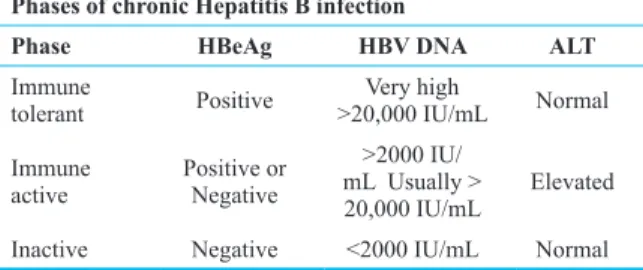
the related signs and symptoms. Also our researchers educated the patients about chronic HBV disease, its course and complications, proper life style, transmis-sion prevention methods, and family screening. Then the patients were referred for blood sampling and the samples were sent to the laboratory for required tests (AST, ALT, HBV DNA PCR quantitative, HBc Ab IgG, HBeAg, and HBeAb). Thereafter the patients were referred to the hepatitis clinic (with results of lab tests and abdominal ultrasonography) to consult with a hepatologist. During this visit for each patient, the phase of chronic HBV infection was determined (table 1), and appropriate management (according to the guidelines) was started.
In 2015 further sub classification for chronic HBV infection phases, especially HBeAg negative patients was suggested by Anna Lok (table 2). A sec-ond analysis was performed using this classification. A value of 40 U/L was used to define the upper limit of normal (ULN) for ALT. A second analysis was performed with an ULN of ALT of 19 for wom-en and 30 for mwom-en.
Obtained data were transferred into SPSS software version 21 (SPSS, Inc, Chicago, IL) for analyses.
RESULTS
In 2011 (before initiation of active screening), 94 patients were referred from health centers to Taleghani Hospital for further management. Sixty nine of these patients were new cases. In 2012 (after initiation of active screening) this number increased to 333, of whom 203 were newly diagnosed cases.
In 2011, family screening was performed for 300 persons, of whom 42 were HBsAg positive, while 38 had cleared the disease and successful vaccina-Fig. 1: HBV referral flow chart
Table 1: Phase of HBV infection11
Phases of chronic Hepatitis B infection
Phase HBeAg HBV DNA ALT
Immune
tolerant Positive >20,000 IU/mLVery high Normal Immune
active Positive or Negative
>2000 IU/ mL Usually >
20,000 IU/mL Elevated Inactive Negative <2000 IU/mL Normal
tion was done only for 12 persons. In 2012, family screening was performed for 616 family members and 48 new cases were found, while 434 individu-als needed vaccination (figure 2).
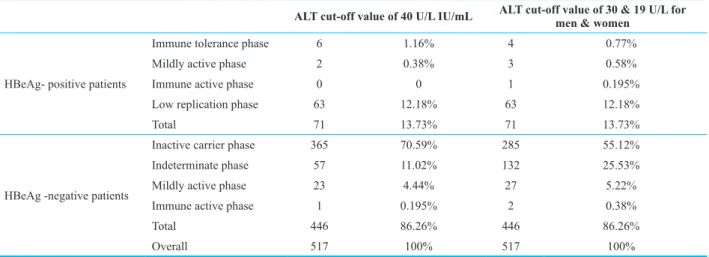
Totally in 2011 and 2012, 427 HBsAg positive patients were referred to Taleghani Hospital and 90 more patients were diagnosed by family screening. The mean age of the patients was 39.1±15.1 years (ranged from 5 to 85 years old) and 51.5% of them were men while 48.5% were women. HBeAg was positive in 71 (13.7 %) patients. In HBeAg positive cases, seven patients were in immune tolerant and five were in immune active phases when a value of 40 U/L was used to define the ULN, but when we used the value of 30 U/L for men and 19 U/L for women these numbers where 4 and 15 respectively. Most of these changes were in female patients (7 out of 10). Other HBeAg positive patients did not fulfilled the
criteria of each phase and could not be classified. In HBeAg negative cases, 10 patients were classified as immune active with ALT upper limit of 40 U/L, but this number increased to 22 when we used the values of 30U/L for men and 19 U/L for women.
By using the new classification, the patients were more precisely classified (table 3).
DISCUSSION
Historically, health services in the western world are based on providers and policy makers under-standing of the population health status. The optimal model of care dictates that services meet the genu-ine health needs of the general population. Data on community incidence, prevalence of disease, and the effectiveness of interventions form the tradi-tional method of determining need. In comparative approach, the services provided for a defined popu-Table 2: Definitions of Phase of chronic HBV infection12
HBV DNA level, IU/mL ALT level, ULNa
HBeAg- positive patients Immune tolerance phase ≥ 20,000 <ULN Mildly active phase ≥ 20,000 1-2 × ULN Immune active phase ≥ 20,000 > 2 × ULN Low replication phase <20,000 Any level of ALT HBeAg -negative patients Inactive carrier phase < 2000 <ULN
Indeterminate phase < 2000
> 2000 >ULN<ULN Mildly active phase ≥ 20,000 1-2 × ULN Immune active phase ≥ 20,000 > 2 × ULN
aULN (upper limit of normal) for ALT is according to the traditional cut-off value of 40 U/L Table 3: Frequency of HBV Phase in referred patients
ALT cut-off value of 40 U/L IU/mL ALT cut-off value of 30 & 19 U/L for men & women
HBeAg- positive patients
Immune tolerance phase 6 1.16% 4 0.77%
Mildly active phase 2 0.38% 3 0.58%
Immune active phase 0 0 1 0.195%
Low replication phase 63 12.18% 63 12.18%
Total 71 13.73% 71 13.73%
HBeAg -negative patients
Inactive carrier phase 365 70.59% 285 55.12%
Indeterminate phase 57 11.02% 132 25.53%
Mildly active phase 23 4.44% 27 5.22%
Immune active phase 1 0.195% 2 0.38%
Total 446 86.26% 446 86.26%
Overall 517 100% 517 100%
lation contrasts with those elsewhere or within the same population over time, and therefore may accel-erate the achievement of equity in health planning.13
Good quality means providing patients with ap-propriate services in a technically adequate method, by good communication, shared decision making, and cultural understanding. Too much care (e.g., providing unnecessary tests, medications, and pro-cedures, with associated risks and side effects), too little care (e.g., not providing an indicated diagnos-tic test or a lifesaving surgical procedure), or the wrong care (e.g., prescribing medicines that should not be given together, using poor surgical tech-nique) are practical examples of poor quality.14
The Alma Ata declaration15 highlighted the
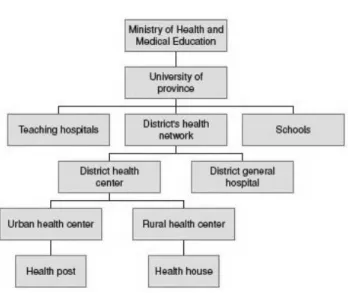
im-portance of primary care, and many countries in-cluding Iran revised their healthcare system to meet the global aim of ‘Health for All’ by 2000. There is a good healthcare system in Iran,9 and as it can be
seen in the figure 3, president of medical university in every province has the highest health authority in the area and is in charge of public health.
This network consists of a referral system, start-ing at primary care centers (in the periphery), gostart-ing through secondary-level hospitals in the provincial capital and tertiary hospitals in major cities.16
In 2010, report of Institute of Medicine (IOM) concluded that lack of awareness in public and health providers resulted in inadequate preventive means, disease surveillance, and screening systems
and consequently inappropriate management of in-fected patients. As the consequence, morbidity and mortality related to HBV is high and even have more than doubled during the past decade in the United States.6 All these data led to update on AASLD
prac-tice guideline, which recommended screening for HBV in populations with intermediate prevalence rates (3-5%).7 Keeping in mind that the prevalence
of HBV is between 2-4% in middle and old aged Ira-nian population,3-5 it seems appropriate to start HBV
screening for them. At present indications for HBV screening in health care system of Iran are just for high-risk individuals.8 According to these criteria,
2189 individuals were screened by heath system in 2011 and 2372 persons were screened in 2012 (after implementation of this program) (table 4).
This increase in case finding, even in high-risk groups (especially pregnant women and family members of HBV positive patients), demonstrates that screening is suboptimal and needs reinforce-ment. Also we have to keep in mind that many of HBsAg positive patients have no signs and symp-toms and specially middle and old aged patients are not in high risk groups so more intensive screen-ing seems appropriate for these patients. In 2011 (before initiation of active screening), 94 patients were referred from health centers to Taleghani Hos-pital for further management. Sixty nine of these patients were new cases. In 2012 (after initiation of active screening) this number increased to 333, of whom 203 were newly founded cases.
Another point is that recognized HBV positive pa-Fig. 3: Health System in Iran16
Table 4: Frequency of HBV positive patients in high risk groups according to Health Department of Shahid Beheshti University of Medical Sciences reports10,17
Screening groups 2011 2012 IV drug abusers 238 158
Family members 43 97
Blood or blood products 35 32
Unprotected Sex 5 16
Pregnancy 164 243
Hemodialysis 11 7
Others 1693 1819
tients and their families are not managed appropri-ately in the present health system. Family screening was done on 300 and 616 first degree family mem-bers of the referred patients in 2011 and 2012, and 42 and 48 new cases were found respectively (figure 3). Although anti HBV vaccination was done for 80 family members in 2012 and has increased consider-ably compared with 2011 which was only 12 persons (probably due to the better education of primary care physicians), It is noteworthy to perpend that 220 and 434 of these family members were at risk of HBV in-fection and needed vaccination in 2011 and 2012 re-spectively (figure 1). These data confirm the need for hepatic centers in health system and closer collabora-tion of health system with tertiary therapeutic centers to refer the diagnosed patients for proper manage-ment. The proposed algorithm (figure1) fills this gap.
Implementation of this program has economic burden on health system. Financial long term ben-efits of early disease detection, management, and prevention of complications should be assessed against the increased cost of screening in another study. We suggest similar pilot studies in other parts of the country. We also suggest preparation of short guidelines and algorithms for referral of patient to secondary and tertiary centers and also more educa-tion for health care providers such as physicians, and nurses for more cost effective strategies for screen-ing, evaluation, and management of these patients. Although health system is active about screening of HBV infection in high risk populations, it is not perfect. There is no specific clinic for patients with HBV in health system. Primary health care physi-cians need more education about referring protocols. We propose that health system needs to upgrade the screening and management programs of HBV in-fection. We also propose active HBV screening for people more than 20 years old who have not been vaccinated in the national vaccination programs and never been tested for HBV before.
CONFLICT OF INTEREST
The authors declare no conflict of interest related to this work.
REFERENCES
1. Anna SF Lok, Rafael Esteban, Jennifer Mitty. Overview of the management of hepatitis B and case examples. UPTo-Date 2003.
2. Poorolajal J, Majdzadeh R. Prevalence of chronic hepa-titis B infection in Iran: a review article. J Res Med Sci 2009;14:249–58.
3. Zali MR, Mohammad K, Noorbala AA, Noorimayer B, Shahraz S. Rate of hepatitis B seropositivity following mass vaccination in the Islamic Republic of Iran. East Mediterr Health J 2005;11:62–7.
4. Porajal J, Majdzadeh R. Prevalence of Chronic Hepatitis B Infection in Iran. J Res Med Sci 2009;14:249-58.
5. Asadi-Lari M, Sayyari AA, Akbari ME, Gray D. Public health improvement in Iran--lessons from the last 20 years. Public Health 2004;118:395-402.
6. Mitchell AE, Colvin HM, Beasley RP. Institute of Medi-cine recommendations for the prevention and control of hepatitis B and C. Hepatology 2010;51:729–33.
7. Lok AS, McMahon BJ. Chronic hepatitis B: update 2009. Hepatology 2009;50:661-2.
8. Asghari F, Haghazali M, Esteghamati A, Hajirasoliha H. National guide for hepatitis B surveillance. 1st ed. Tehran: Center for disease control; 2007. [In Persian]
9. Miri SM, Alavian SM. Risk factors of hepatitis B infection: Health policy makers should be aware of their importance in each community. Hepat Mon 2011;11:238-9.
10. Deputy of health, Iranian ministry of health annual report of hepatitis B ,2011; Tehran, Iran: MOH;2012[unpublished data]
11. Natural History of Chronic Hepatitis B Infection. Brian J. McMahon, David H. Spach . http://depts.washington.edu/ hepstudy/images/hepB/HBV_nhx_d01.png.[Accessed at: April 14 2015]
12. yapali S, Talaat N, Fontana RJ, Oberhelman K, Lok AS. Outcomes of Patients With Chronic Hepatitis B Who Do Not Meet Criteria for Antiviral Treatment at Presentation. Clin Gastroenterol Hepatol 2015;13:193-201.
13. Asadi-Lari M, Sayyari AA, Akbari ME, Gray D. Pub-lic health improvement in Iran—lessons from the last 20 years. Public Health 2004;118:395-402.
14. Schuster MA, McGlynn EA, Brook RH. How Good Is the Quality of Health Care in the United States? Milbank Q 2005;83:843–95.
15. International Conference on Primary Health Care: Report of the International Conference on Primary Health Care, Alma Ata, USSR World Health Organization, Geneva (1978) p. 79
16. Mehrdad R. Health System in Iran. JMAJ 2009:52: 69–73. 17. Deputy of health, Iranian ministry of health annual report
of hepatitis B,2012; Tehran, Iran: MOH;2013[unpublished data]