ISSN 1479-4403 99 ©Academic Conferences Ltd Reference this paper as:
Bell, M. and Farrier, S. “Measuring Success in Learning – a Multi-Dimensional Approach.” The Electronic Journal of e-Learning Volume 6 Issue 2, pp 99 - 110, available online at www.ejel.org
Measuring Success in e-Learning – A Multi-Dimensional
Approach
Malcolm Bell and Stephen Farrier
Northumbria University, Newcastle upon Tyne, UK
[email protected] [email protected]
Abstract: In 1999 Northumbria University published a strategy document entitled “Towards the web-enabled University”. This prefaced an assessment of need and of available platforms for developing online teaching and learning which, in turn, led in 2001 to the roll out and institution-wide adoption of the Blackboard Virtual Learning Environment (VLE) now referred to as our eLearning Platform or eLP. Within a very few years we had over 90% take-up by academic staff and the eLP had become integral to the learning of virtually all our students.
What has always been relatively easy to measure has been the number of users, frequency of use, number of courses, levels of technological infrastructure, etc. However, with the publication of the Higher Education Funding Council for England (HEFCE) e-learning strategy in 2005 it became apparent that such quantitative data was not particularly helpful in measuring how the university matched onto the 10-year aspirations of that document and its measures of success. Consequently an on-going exploration was embarked upon to try to measure where we were and what we should prioritise in order to embed e-learning, as envisaged within the HEFCE strategy. This involved a number of key approaches:
̇ The measures were broken down into manageable sizes, creating sixteen measures in all with descriptors for “full achievement” through to “no progress to date” with suggested sources of information which would support the description. A series of interviews with key staff were set up in which they were asked to rank where they felt the university stood against each measure and what evidence would support their views.
̇ An academic staff survey was developed on-line which invited staff to explore a number of statements based around the HEFCE criteria and express degrees of agreement. This was followed up by a range of face-to-face interviews. ̇ An online student survey was developed and students were asked to express degrees of agreement with these.
Student responses were followed up with an independent student focus group exploring issues in greater depth. The outcomes of the three approaches were then combined and an interim report prepared which identified strengths and areas for further development. Some of the latter are already being addressed.
Subsequently, the university joined phase 2 of a national benchmarking e-learning in Higher Education exercise, running from May to December 2007, supported by the Higher Education Academy (HEA) and the Joint Information Systems Committee (JISC). During this exercise we engaged in a deeper exploration against a wider set of criteria, based upon the “Pick & Mix” (Bacsich, 2007) methodology. Pick&Mix comprises 20 core criteria and the option of a number of supplementary criteria. Through these approaches we will be able to set a baseline for where we currently are and it will allow us to revisit criteria later to measure our progress in those areas we identify for development.
This paper shares methodologies used, identifies key outcomes and reflects upon those outcomes from both an institutional and sectoral perspective.
Keywords: measuring, benchmarking, methodology
1. Background
Northumbria University is a large metropolitan university based in Newcastle upon Tyne in the north-east of England. It currently has over 1100 academic staff (full- and part-time) and in excess of 32 000 registered students.
In 1999 the university’s senior management group developed a paper, “Towards the web enabled university”, which outlined a strategic plan for the development of what is now known as e-learning across the university. A major strand in this strategy was the exploration and introduction of a virtual leaning environment (VLE) and to that end, a number of potential platforms was explored. By early 2001 the decision was made to run a proof of concept exercise with the Blackboard VLE. This proved very successful and consequently the VLE was rolled out across the university for academic year 2001-2. Later, in 2003, we introduced the fully integrated managed learning environment (MLE). By 2005 we had over 90% take-up by academic staff with 32000+ students attached to live sites (Bell & Bell, 2005). Later we introduced the integrated content management system and have subsequently undergone further upgrades.
The university recognises that e-learning is not simply making use of a VLE but covers a broader spectrum of information and communication technologies (ICT). To that end, for the purposes of the exercise described here, we have adopted the HEFCE (2005) definition, “The Government e-learning strategy defines e-learning as any learning that uses ICT.” (HEFCE, 2005) and, more succinctly from JISC, “Learning facilitated and supported through the use of information and communications technology.” (JISC, 2005).
2. Rationale
Why did we want to measure our progress in e-learning? After six years during which teaching and learning had made integral use of both the VLE and other ICTs it was timely to see where we were and how we compared with the sector. A key driver for this came from senior management who wanted to assess how well we stood in comparison to three key papers, both external and internal. The first of these is the HEFCE learning strategy, (HEFCE, 2005) which gave a blueprint of where the successful implementation of e-learning would take the UK higher education sector over the succeeding 10 years. The second external driver is the government’s Department for Education and Skills (DfES) document, “Harnessing Technology: Transforming Learning and Children’s Services” (DfES, 2005) which looks at how e-learning should contribute to all education, including school, further education, higher education and life-long learning, setting targets for each sector. A third major driver was Northumbria’s own Learning and Teaching strategies (2003-2006 and 2007 - 2010) in which e-learning is embedded.
Finally, in an increasingly competitive market, the university is keenly aware of the need to remain at the forefront. To that end we need to be able to measure ourselves against the competition.
3. What did we want to measure?
The problem facing Northumbria, in common with other educational organisations, is that many of the things which are easy to measure e.g. numbers of users, of courses, page hits etc. only provide quantitative data. This kind of data provides information on quantity and extent of use but not on quality and depth of that use. Excellence in provision of infrastructure can be gathered from a range of sources, for example, Northumbria’s IT provision has led to it being named “the UK's most IT-enabled Organisation” at the Computing Awards for Excellence, 2006. Whilst this recognises the excellent work undertaken to ensure technical infrastructures are firmly in place, it was important that we also reflected on how effectively that technology was impacting upon the learner’s experience and upon teaching and learning across the institution, and those qualitative things are what is hard to measure.
The HEFCE (2005) measures provided a sound framework around which to build our exploration. These state:
“We consider the Higher Education (HE) sector to have embedded e-learning where:
1. ICT is commonly accepted into all aspects of the student experience of higher education, with innovation for enhancement and flexible learning, connecting areas of HE with other aspects of life and work.
2. Due to more coherence and collaboration, technical issues have been addressed to give better value for money.
3. Students are able to access information, tutor support, expertise and guidance, and communicate with each other effectively wherever they are. They are able to check and record their achievement in a form designed for multiple uses to enable personal and professional development.
4. Tutors have tools for course design to enable better communication between them and their students, giving feedback and targeted support. Individual teachers have access to information about the materials available, and support for continuous improvement of them. 5. Subject communities are able to share materials in ways that enhance their ability to produce
customised high quality courses. They are supported to work collaboratively in designing materials, which are effectively quality assured and widely disseminated. They have access to research information to inform curriculum development and research-based teaching.
6. Institutions are able to build appropriate infrastructure and resources support for integrating registration and learning functions. They have links with regional networks of institutions to support progression and community involvement.
7. Lifelong learning networks support connectivity between institutions to provide seamless access for students and staff.
Malcolm Bell and Stephen Farrier
www.ejel.org 101 ISSN 1479-4403
8. Staff are supported at all stages to develop appropriate skills in e-learning, and these skills are recognised in their roles and responsibilities and in reward structures. They have access to accreditation for their level of skills and professional practice in linking learning technology with teaching.”
HEFCE strategy for e-learning, March 2005, pg.9
4. How – the multi-dimensional approach
At the end of the 2005-2006 academic year we set in train a number of actions in order to try to get to the rich data which would allow us to measure our progress against the HEFCE strategy’s aspirations. In order to get as full a picture as possible it was essential to involve as many stakeholders as possible.
Essentially we wanted to know:
̇ What management thought was happening; ̇ What those at the chalk-face experienced; ̇ What those on the receiving end felt, and
̇ What additional evidence supported these perspectives
4.1 Management
The HEFCE document was broken into 16 strands (Bell, 2006, pp 19-21) with statements which would indicate the degree of progress towards achievement of that element. In addition suggested areas to look for evidence which might indicate progress were identified. Respondents were asked to rate progress towards the strand using a 3 – 0 scale with 3 being “fully achieved” and 0 being “no progress yet”.
The second stage was to identify the appropriate people to interview to gain their views on progress towards the targets. Accepting that there was no single individual in a position to address all 16 aspects a range of key people from across the university were interviewed. Amongst other aspects, these included senior colleagues from Learning and Teaching Support, IT Services, Library and Learning Services, Academic Registry, Human Resources and the University Learning and Teaching Committee. Evidence in support of the responses, including reviewing policies, was then collected.
4.2 Students
The HEFCE strategy is very broad in its range and not all sections will have a direct impact upon students. Consequently a questionnaire was developed which would address those aspects of the strategy which students would be in a position to respond to (see Bell, 2006 p. 23). The survey was carefully constructed to gather information around nine aspects of e-learning. For each aspect two conflicting statements were developed (this was to ensure validity). These were arranged on the questionnaire in such a way that conflicting statements were not adjacent to one another. The survey was then put online and also made available in hard copy and students who responded offered entry to a prize draw in order to encourage participation. Available responses were “totally agree”, “partially agree”, “partially disagree” and “totally disagree” (there was no option to sit on the fence). The survey was made available from April 10th to June 2nd 2006 and elicited responses from 1700 students although some students did not answer all questions. An independent qualitative data collection exercise took place during Semester 1 2006-7. Northumbria’s Students’ Union was commissioned to undertake this and set up focus groups to gather data.
The student survey covered the following areas:
̇ How integrally ICT was incorporated in their everyday experience - levels of perceived computer use;
̇ Their perception of access to an appropriate range of software;
̇ How easy it was for them to access study materials and support off-campus;
̇ Whether they were able to use ICT effectively for their personal development plans (PDPs); ̇ How effectively the technology enabled them to communicate with their peers (initially there
were also statements about the levels of contact, feedback and support from tutors but these were withdrawn in the light of sensitivity about the industrial dispute as perceived as being potentially critical of academic staff);
̇ How well they felt catered for in terms of open-access ICT facilities;
̇ How easy it was for them to gain access to specialist/course critical software;
̇ How effectively they felt the ICT support infrastructure provided them with help and assistance; ̇ How effectively they felt ICT support worked when they were working off-campus;
4.3 Staff
A survey of staff perceptions was begun in June 2006 and was available online until the end of October 2006. This survey had 15 statements which closely reflected the HEFCE strategy as well as the 16 strands of the management audit (see Bell, 2006 p. 24). Respondents select responses from “totally agree”, “partially agree”, “partially disagree” and “totally disagree”, again with no option to sit on the fence. Once the survey closed a qualitative data collection exercise was undertaken through individual interviews to add further rich data to the outcomes.
4.4 Other sources
In addition to the surveys and questionnaires described earlier, a broad range of other sources were accessed to help provide a broader and deeper picture. These included:
̇ Learning & Teaching Strategy 2003-2006 ̇ IT Strategy
̇ Library and Learning Services Strategy ̇ Strategy for research and consultancy ̇ Schools’ Academic Development Plans ̇ VLE statistics,
̇ Staff development statistics ̇ Help-line information ̇ Access statistics
̇ Distance learning courses survey ̇ E-learning enhancement group minutes ̇ Course information
̇ Job vacancies web-site
̇ etc.
Many of these sources needed to be revisited in the next phase of our exploration, as part of the e-learning benchmarking exercise of which we are currently approaching completion. It also enabled us to do some drilling down into specific areas of the university’s provision as detailed in section 5.3.
5. The second phase
At the same time that we were exploring how we stood against the HEFCE measures, a national programme for benchmarking e-learning in Higher Education was under way. In 2006 a pilot exercise took place followed by phase 1 which ended in early 2007. Northumbria took the decision that the logical next step for us was to become involved in phase 2 of this national project. That phase ran from May 2007 to January 2008. At the time of writing we are in the final stages of the exercise.
5.1 Background to the HEA/JISC benchmarking exercise
When the HEFCE e-Learning Strategy was published in March 2005, it was a result of a wide-ranging consultation with the UK Higher Education community. One of the emerging issues from the feedback generated by that consultation was that it would be helpful to institutions to have some kind of benchmarking exercise to help them to judge how effectively e-learning had been embedded.
Malcolm Bell and Stephen Farrier
www.ejel.org 103 ISSN 1479-4403
Consequently the Higher Education Academy (HEA) put forward a proposal to HEFCE to take the lead in an e-learning benchmarking exercise in partnership with a team from the Joint Information Systems Committee (JISC). The HEA and JISC were given the go-ahead to embark on the exercise in mid-2005. By the end of that year consultants had been appointed and a number of institutions identified to be involved in the initial stages of the exercise.
In December 2006 the call went out for expressions of interest to be involved in phase 2 of the exercise and it was at that point that we decided it was both timely and appropriate to become involved.
5.2 Benchmarking methodology
The HEA offered a range of benchmarking methodologies (HEA, 2006) and after careful consideration and consultation Northumbria chose the Pick&Mix (Bacsich, 2006a) approach. This approach provides a range of criteria against which to measure the institution. The methodology comprises 20 core criteria with level descriptors from 1 – 5 for each with an additional level 6 to denote excellence. It also offers a range of supplementary, optional criteria and it is expected that institutions will choose a further five or six criteria from these. However, there is also the opportunity to develop local criteria or to use criteria from other benchmarking methodologies (HEA, 2006) or from within the European Association of Distance Teaching Universities’ (EADTU) E-xcellence project (EADTU, 2006).
5.3 Northumbria’s approach
Once our expression of interest (EoI) had been approved (Bell & Farrier, 2007) we set in train a number of actions. The submission of our EoI had the approval and support of an internal committee chaired by the Deputy Vice Chancellor (DVC) with responsibility for teaching and learning. It included a management structure for our benchmarking exercise. This comprised an advisory panel chaired by the DVC and with representation from all key university services (at director level) as well as representatives from schools (at associate dean level), chairs of e-learning groups and from the Students’ Union. The purpose of this panel was to support and guide the exercise and to provide access to sources of evidence. Alongside this was an operational group which included academic staff, a researcher and project assistant. This was the group which actually undertook the work. Resources for the exercise were principally provided internally with some input from HEA external consultants.
In terms of selecting supplementary criteria, a consultation exercise was undertaken and feedback from that enabled us to identify those six additional criteria which are of particular relevance to our institution. These relate to uniformity, ubiquity, widening participation, personalisation, student satisfaction and e-portfolios. To make the whole process manageable we undertook an exercise in order to “chunk” the criteria into achievable work packages. Two issues had a major bearing upon how the chunks were organised. Firstly we took into account the sources of evidence which would need to be explored in order to address the criteria. For example, some criteria require interviews to take place with members of senior management. These were chunked together to avoid the need for multiple interviews with the same people. Other criteria clearly lend themselves to desk research, and so on. This provided us with seven chunks which were then pulled together into six work packages:
Work package Criteria (numbers)
WP1 04 usability and 05 accessibility
WP2 02 VLE stage, 07 decisions (projects), 19 decisions (programmes) 20 Quality enhancement WP3 08 pedagogy, 14 evaluation, 17 quality assurance, 18 staff recognition and reward, 95
e-portfolios
WP4 06 e-learning strategy, 15, organisation, 72 personalisation, 94 student satisfaction
WP5 03 tools, 09 learning material, 16 technical support to staff, 51&52 uniformity and ubiquity, 70 widening participation
WP6 01 adoption, 10 training, 11 academic workload, 12 costs, 13 planning (annual) NB – criteria numbers relate to those in Pick&Mix – version 2.0 (Bacsich, 2006)
Work packages were then matched on to the particular expertise and strengths of operational group members. However, we recognised the need to remain flexible and it later proved desirable to revise the original work packages in the light of changes in staffing, pressures of workload and other responsibilities. It was also essential that each work package “owner” was supported by other members of the operational group and that close attention was paid to where evidence could be used to support outcomes of other work packages.
After attending an initial kick off meeting hosted by the HEA, Northumbria was joined by nine other UK institutions using the same methodology and this cohort was supported by external consultants employed by the HEA specifically to support the benchmarking process. In addition to organising a series of cohort meetings, part of the consultants’ roles has been to visit participating institutions several times during the exercise to support the process and to assist in the final scoring activity. Consultants also worked on the identification of sector-wide areas for development.
Given the tightness of the timescale (May 2007 to January 2008) the work was very intensive and one of the key early activities was to undertake a preliminary scoring activity which then provided us with an early indication of where in depth research would need to be focussed. If, for example, we allocated a score of 3 to criterion 95, e-portfolios, then how well did the evidence support this and might the reality actually be different?
A second priority concerned identifying areas where it was appropriate to undertake a “slicing” activity where an individual element of provision, be it a school, an approach to delivery (e.g. collaborative working with partner institutions) or even a service (e.g. library services). At this point we identified two schools with the potential for slicing and who were keen to undertake this, and a delivery area which concerned partnership franchises and collaborative ventures.
Interim outcomes from our initial exercise were reported in late 2006 (Bell, 2006) and final outcomes of the HEA benchmarking exercise are being reported in January 2008. Since the benchmarking exercise should provide us with a base-line assessment of our position, it will enable us to review future progress and development on a regular basis and it is our intention that the exercise be repeated, probably on a two- or three-yearly basis.
5.4 Data gathering
It was essential before we embarked upon the benchmarking exercise to engage in an interpretation of the criteria in the Northumbria context and to identify likely sources of data/information. This exercise was valuable since criteria were, in places, rather too generic.
The data gathering exercise began in earnest in June 2007 but hit a hiatus in late July and August due to the summer break. Much management, staff and student feedback was already available based upon questionnaires, interviews and focus group reports and this meant that the main focus for research was the documentary evidence – policies, minutes, papers, strategies – to support the investigation with interviews and focus groups being available if needed. In addition a presentation was given at the annual Northumbria Learning and Teaching Conference where participants were involved in engaging with the criteria.
An evidence room was set up for the documentation to be stored in appropriate criterion boxes and this resource continues to be built upon continuously as new policies are released and initiatives engaged in. Additionally, the bulk of “discovered” evidence is also available electronically, although a proportion is only available internally to the university.
By mid-November criterion sheets were completed for all criteria, although the team recognised that this was an arbitrary cut-off point, in order that they could be collated, edited and distributed in time for the final scoring meeting. For each criterion there were four main sections –
̇ Criterion interpretation and key questions;
̇ Sources of evidence (with links where appropriate); ̇ A commentary on case studies
̇ Two exemplars, one of typical practice and one of effective, innovative or noteworthy practice. The final scoring meeting was held in late November 2007, chaired by a senior member of university staff with both advisory panel and operational team members contributing, along with an external consultant. This then allowed the initial preparation of reports for a range of audiences – internal, public, the HEA and the consultants. The drafting and redrafting process is currently nearing completion.
Malcolm Bell and Stephen Farrier
www.ejel.org 105 ISSN 1479-4403
6. Initial findings:
The first stage of the exploration revealed a number of issues and indicators for future development and review. When allied to the outcomes of the benchmarking exercise, they indicate that Northumbria has a number of strengths in e-learning. Although the initial work packages offered coherence in terms of managing the exercise, when reviewing outcomes and areas the criteria cover we found it helpful to group them into five categories. Whilst there are overlaps in many cases, the categories offer a potentially coherent way forward.
The five categories are:
1. Organisational and technical infrastructures and strategic planning; 2. Quality assurance, enhancement and evaluation;
3. Staff experience, support and development; 4. The learning journey;
5. Student experience and support.
The diagram below illustrates how the categories interact with the Pick&Mix criteria.
Our findings indicate that Northumbria has a great deal to celebrate. The Computing Award for Excellence, 2006, reflects the breadth and strength of the underlying technical structures put in place by the university, including the VLE, campus-wide wireless access, thin client architecture, open access labs and excellent electronic library resources. In addition both staff and student surveys indicate a high level of satisfaction showing that ICTs form part of the everyday teaching and learning experience. The virtual universal take-up of the VLE and its on-going development indicate, again, the ubiquity of ICT use across the institution. Summarising some of the interim and final findings, the following areas are highlighted:
̇ Organisationally and technically there are many strengths. The range of ICT tools and facilities available to learners and teachers is excellent and the university has demonstrated expertise in the implementation of major elearning projects. At the same time sound, interconnected strategies have been developed incorporating elearning across a broad range of these. An excellent set of structures is in place to support staff training and development. Decision making for elearning developments is embedded within the work of schools, departments and subject divisions.
̇ Areas for further development include the need to incorporate elearning expertise into staff roles and into the staff recognition process. Furthermore, emphasis upon the different emerging pedagogies relating to online learning could form a key strand in future staff development to ensure effective development of new delivery approaches for programmes and modules. In common with many other Higher Education Institutions (HEIs), costing models and workload models which take into account the extra requirements for elearning have yet to be developed.
Further, we do not currently have a single locus for the coordination of developments within the elearning field.
̇ With respect to quality assurance, enhancement and evaluation, robust systems are in place to ensure that online teaching and learning materials adhere to appropriate standards particularly of accessibility and usability. Evaluation of provision is well regulated and effective. Approaches to quality enhancement are under constant review and needs responded to.
̇ In common with many similar institutions, ensuring current systems and approaches keep pace with elearning can be problematic. There is a need to ensure that staff development reflects this shifting arena. The burgeoning growth of online materials and delivery can present quality assurance difficulties and this is an area for further exploration and development. Indeed, many systems which are effective for conventional teaching may need to be reviewed to take account of the changes elearning brings.
̇ Staff at Northumbria have wholeheartedly adopted the use of our VLE and a range of rewards are available which recognise expertise in the area. There is good central support available to staff to assist in the development of elearning and in some areas of the university elearning development is recognised as being time-consuming and allowances are made for this.
̇ We recognise now the need to move on from baseline adoption where the VLE is used by a proportion of staff as a document repository and encourage the use of the technology for collaboration, communication and interaction within elearning. The changing and emerging pedagogies associated with this will require embedding. Greater access to support will become essential to engage all staff in using elearning at a deeper level.
̇ Our students’ learning journey is greatly enhanced through the use of online learning. Most provision matches well the Neilson (2003) usability criteria and access to elearning is both ubiquitous and uniform across all provision, both campus-based and beyond in partner institutions.
̇ There are, though, areas for development. In common with many other institutions engaged in the benchmarking exercise, accessibility is an issue. Efforts made to ensure software is accessible are to be celebrated but the same level of vigilance could be applied to all materials offered to learners within the VLE and elsewhere. There is also a need to ensure that, with expanding provision, access and uniformity of provision is maintained.
̇ Our students are very positive about their elearning experience. The student survey and other student feedback indicates that students are very happy with both the quality and quantity of facilities and see ICT as integral to their studies, with 89% expressing satisfaction with the former and 96% using ICT in their daily studies. They are also happy with the levels of support available.
̇ Two areas in particular suggest the need for further development. The full potential for e-portfolios for personal development planning is an area currently being explored. Given recent EU and national aspirations, on-going development is desirable. Secondly, the disparity found by students between different module sites within the VLE is of concern and consideration needs to be given as to how equality of provision can be maintained. This relates to consistency of approach and of use by academic staff.
The Benchmarking Exercise has revealed that Northumbria’s approach to elearning (and indeed to all learning and teaching) has a great deal to commend itself upon. What is also evident is that there are opportunities for further development which would contribute towards the delivery of an outstanding experience for all students and staff.
7. Initial responses
Following the preparation of the interim report presented to an e-learning strategic management group in late 2006 some actions have already been begun.
Reflecting on the patchy take-up electronic personal development plans (PDPs) an immediate response was to develop a strategy to encourage the development of these and to provide appropriate staff development. In terms of quality assurance of taught courses, we are actively reviewing the processes we have in place for validation of programmes, with an initial focus upon distance and blended learning. A key area for action concerned staff development and currently a review of our approaches to this has begun with the
Malcolm Bell and Stephen Farrier
www.ejel.org 107 ISSN 1479-4403
expectation that this will lead to greater coherence in this provision. Related to this, a review of how we recognise and reward staff skills and expertise in e-learning is being planned. In a further development, students are now able to access their record of achievement online.
The preparation of the new L&T strategy saw e-learning embedded within it and will be accompanied by the development of a number of implementation plans with one specifically for e-learning. In addition, individual schools’ academic development plans will need to indicate how e-learning will impact upon their future work. These are practical outcomes from the first phase of our measurement exercise. The second phase has highlighted a number of additional areas of strength and areas for development (see above). It is the ’s intention to prioritise these and to that end a process has begun which will involve a broad range of stakeholders in exploring and identifying where priorities are and where responsibility for their further development lies. Subsequently implementation plans will be put in place and actions reviewed on a periodic basis, leading to a repeat of the process in three years’ time.
8. Lessons
Engaging with the benchmarking process has a number of major benefits for the university. It has helped us to celebrate strengths and identify areas for further development. This is particularly relevant as elearning imposes different needs and constraints upon the planning, preparation, delivery and maintenance of learning and teaching situations.
The slicing aspect of benchmarking has provided the opportunity to explore local practice within the overall university context. One of the difficulties which arise in institutions of this size is the tendency for a silo effect to take place. The benchmarking exercise has allowed us to explore and celebrate effective practice across schools and should enable and encourage institution-wide dissemination. Slicing is still on-going and expected to report in early 2008.
In the same way, the identification and use of exemplars of both typical and innovative or noteworthy practice provides a picture of what is standard practice and what is achievable. It has helped to highlight areas for development and the art of the possible.
One of the difficulties we encountered when engaging for the first time with the HEFCE measures of success was that they were not broken down into manageable statements and needed time spent in order to make sense of them in a way which allowed comparison. Furthermore, it proved necessary to create a scoring system to apply to the measures. The advantage with the Pick&Mix methodology was that it had a recent history of development, had already been used in two earlier phases of the exercise and had, consequently, gone through an iterative process leading to a better focus and refinement. This meant that the methodology was quite straightforward to use. However, against that, because the methodology had been refined, it could become something of a straightjacket. As detailed in section 6.1, a number of criteria need to be reviewed. Further criteria which focus upon the student experience need to be incorporated and the rigidity of the core criteria would benefit from relaxation. Interpretation of criteria can also be problematic and a recommendation to the consultants would be to revisit core criteria and ensure their meaning is clearer. An interesting consequence of the exercise has been the opportunity to engage with the broader HE community. Within our specific cohort was a range of HE providers, from small focussed institutions to large institutions like ours. This meant that a variety of perspectives have been available. Interestingly, we have discovered a great deal of common ground in terms of areas for development and this has created the potential for collaborative activities.
Reflecting on process, a number of lessons have been learned and future benchmarking activities will benefit from these.
1. In future it would be advisable to create a clear division between project management/coordination and the collection of data. The complexity of the process and the changing availability of staff meant that there was limited slack and the project management ended up carrying a larger burden than was comfortable in terms of hands on data collection.
2. We discovered that a more effective approach than simply carving up criteria was to approach from two directions at the same time – criteria identifying and interrogating data and also data “tagging” criteria. This helped reduce duplication and repetition and speeded up the process.
3. Reliance on an external methodology was, in places, inhibiting. In future we would take only those elements which were appropriate to our context and cover other elements based upon our own criteria. We need to be able to find out what we need to know rather than cater to the needs of an external driver. 4. This exercise was partly to enable the HEA and JISC to gain a broad-brush impression of the state of
elearning across the sector. Any future benchmarking activity can focus upon the specific needs of Northumbria, relating closely to its policies and strategies and reflecting upon these in the light of national strategies.
It is also important to recognise the risks inherent in undertaking an exercise of this nature. Firstly, if undertaken in a totally impartial way, it can reveal uncomfortable disconnects within overall provision. Secondly, although the exercise is specifically about elearning, it is revelatory of the much broader learning and teaching practice identifying areas of concern which are not confined to elearning alone. Thirdly, there is a danger that, once completed, actions will be undertaken to tackle the “easy” areas for development and others may be left in abeyance or ignored. In a large institution like ours there is also a danger of the buck being passed and only limited action taken as the issues are “somebody else’s problem”.
However, the risks of not reviewing provision in such a robust way are also great. In the current highly competitive global higher education market, provision which fails to match need will suffer. By undertaking an exercise of this nature, institutions can ensure relevance and currency which match learners’ needs.
9. Conclusion
Although the measurement exercise has a largely internal focus we are also committed to disseminating outcomes more widely and, particularly through the HEA. In places the tools used are very specific to the UK, but the process and many of the associated actions are of relevance to all educational institutions who are engaged in aspects of e-learning. Interestingly, we have found that many of the criteria and measures we have used, with some additions, could be applied to learning as a whole. A broad version of the Pick&Mix criteria has been developed incorporating an additional 11 supplementary criteria with the specific intention that it can be applied to all learning and teaching, not only that which is prefixed with “e-“.
For Northumbria University, measuring our progress in e-learning has already helped us to focus upon areas for further development as well as areas of strength. The continuing cycle of improvement in which the university engages provides benefits for the whole institution, individual areas within it and for the wider HE community in the UK.
References
Bacsich, P. (2006a) Pick&Mix - version 2.0 beta 2. Available at:
http://elearning.heacademy.ac.uk/weblogs/benchmarking/wp-content/uploads/2006/12/PnM-2.0-b2-rel1.doc (Accessed: 30 May 2007)
Bacsich, P. (2006b) Pick&Mix 2 broad version. Available at:
http://elearning.heacademy.ac.uk/weblogs/benchmarking/wp-content/uploads/2006/09/PnM-broad-20060928.doc (Accessed 30 May 2007)
Bacsich, P. (2007) Pick&MixPhase 2. Available at: http://elearning.heacademy.ac.uk/weblogs/benchmarking/wp-content/uploads/2007/01/PnM-phase-2.doc (Accessed: 15 April 2007).
Bell, M. & Bell, W.D. (2005) 'It's installed... now get on with it! Looking beyond the software to the cultural change', British Journal of Educational Technology 36(4), pp. 643-656.
Bell, M. & Farrier, S. (2007) Northumbria University expression of interest in the e-learning benchmarking exercise, phase 2. Available at: http://elitnorthumbria.org/nube/images/d/df/Rationale_v3.doc (Accessed 30 May 2007) Bell, M. (2006) Measuring Progress in e-Learning at Northumbria Interim Report Available at:
http://northumbria.ac.uk/static/worddocuments/elitmeasuringinterim (Accessed: 30 May 2007) DfES, (2005) Harnessing Technology: Transforming Learning and Children’s Services. Available at:
http://www.dfes.gov.uk/publications/e-strategy/ .(Accessed: 16 May 2007)
EADTU (2006) E-xcellence. Available at: http://www.eadtu.nl/E-xcellence/ (Accessed: 30 May 2007) HEA (2006) E-Benchmarking and Pathfinder Wiki. Available at:
http://elearning.heacademy.ac.uk/wiki/index.php/Main_Page (Accessed 30 May 2007) HEFCE (2005) HEFCE e-learning strategy. Available at:
HEFCW (2007) Enhancing Learning and Teaching through Technology: a Strategy for Higher Education in Wales. Available at:
http://www.hefce.ac.uk/pubs/hefce/2005/05_12/05_12.doc (Accessed: 15 April 2007)
http://www.hefcw.ac.uk/LearningTeaching_Docs/W0742HE_circ.pdf (Accessed: 20 December 2007) JISC (2005) e-Learning pedagogy programme. Available at:
Malcolm Bell and Stephen Farrier
www.ejel.org 109 ISSN 1479-4403
Neilsen, J. (2003) Usability 101: Introduction to Usability. Available at: http://www.useit.com/alertbox/20030825.html (Accessed: 17 December 2007)
NUBE (2007) Northumbria University Benchmarking Exercise wiki and blog. Available at http://elitnorthumbria.org/nube/index.php/Welcome_to_NUBE (Accessed 20 January 2008)
ISSN 1479-4403 131 ©Academic Conferences Ltd Reference this paper as:
Burgess, J. “Is a Blended Learning Approach Suitable for Mature, Part-time Finance Students?” The Electronic Journal of e-Learning Volume 6 Issue 2, pp 131 - 138, available online at www.ejel.org
Is a Blended Learning Approach Suitable for Mature, Part-time
Finance Students?
Julia Burgess
University of Winchester, UK [email protected]
Abstract: Blended learning is a pedagogy that is sometimes heralded as the answer to some of the problems which part time students face. Creating a module for part-time students with some e-learning elements is time consuming and resource intensive. Therefore it must be demonstrated that the investment in such innovations will benefit the students and create wider learning opportunities in the most effective manner. A small investigation has been conducted which has looked at the learning needs of part-time finance students at The University of Winchester to see whether a blended approach would have benefited their studies. The results of this investigation have been used as the basis for developing the course to allow a more blended style. This paper attempts to outline how the course was designed and to do a preliminary analysis of the use of blended learning for part-time mature finance students.
Keywords: Blended-learning, finance, part-time, mature-student, e-learning
1. Introduction
The Business Management B.Sc. Programme at the University of Winchester contains a third year Financial Management module which is taught to a full time group of students and another part-time group at a different campus. The full time student group is made up of students who fit the younger profile of UK undergraduates; the part-time group is made up of mature students. As part of a policy of widening participation such mature students, who hold a merit profile Higher National Diploma (HND), achieve a degree within two years on a part-time basis. These Business and Management Bachelor of Arts (BAMBA) students undertake the study of modules sequentially, instead of concurrently. The Financial Management module is delivered to these part-time students in six lectures and two whole day intensive sessions. There are two major problems. Firstly, part-time students are subject to many distractions from work and family commitments. Secondly, the study of Financial Management, although very useful to students in their commercial careers, is often considered to be a difficult and dull subject. For example, Arthur et al (2004) reported that many students found that the initial accounting knowledge set to be both boring and difficult to assimilate and as a result, many students abandoned their accounting studies at this early point. However, Financial Management is a mathematical, precise and bounded subject lending itself to the use of information technology. It is potentially an ideal subject for the imaginative use of a blended learning approach to motivate and educate part-time mature students working in an online environment.
The term ‘blended learning’ covers a wide range of approaches. Grey (2006), summarized the rationale for using a blended learning approach as the selection of an effective and proven learning model, capitalizing on the strengths and benefits of technology-based training as well as classic self-study, classroom, and on-the-job instruction in a ‘mix and match’ format tailored to the specific training needs of each organization. Macdonald (2006) states that ‘blended learning’ is associated with the introduction of online media into a course or program, whilst recognizing the benefits of retaining face to face contact with students. Grey (2006) states that blended learning combines e-learning (using a mix of IT based learning resources) with a variety of other delivery methods to provide for a superior learning experience. Santy and Smith (2007) stress that e-learning techniques can be ‘networked’ via computer connection using an institutional virtual learning environment (VLE) or more likely the Internet to enhance knowledge, skills and performance. A short study investigated the learning needs of part-time mature finance students at the University of Winchester and concluded that such a ‘blended learning’ approach with the aim of providing a ‘superior learning experience’ using a mix of IT based resources coupled to continued ‘face to face’ instruction’ could be of benefit.
This development coincided with the timely availability of the Modular Object-Oriented Dynamic Learning Environment (Moodle) e-learning platform. This paper outlines how the development of the ‘blended learning’ approach to a Financial Management module was carried out and provides a preliminary analysis of effectiveness of a ‘blended learning’ approach in meeting the needs of part-time mature finance students.
2. The rationale for a blended learning development at the University of Winchester
The major institutional rationale can be seen in the context of the University of Winchester’s strategic objective to focus on the formative effects of challenging and supported higher education and to prepare individuals for employment and their subsequent lives. For part-time students at the University of Winchester, it has been found that trying to achieve this laudable objective can be degraded by lack of study time and the trade-off with ‘social’ or ‘family’ time. As found during surveys of BAMBA part-time students, other factors such as access to resources, lack of interaction with other students and travel time can also have a serious impact on part-time students. Internal curriculum design work has also shown that part-time Financial Management students need better cognitive and enabling skills in the areas of self-directed research, e-literacy skills and use of computerized spreadsheets as well as exposure to commercial accounting software to improve employability. There is also some external evidence from several UK universities that the use of blended learning techniques also helped them recruit and retain ‘full time’ students, who were really ‘part-time’ because of work commitments (Sharpe et al, 2006). Therefore, there are some compelling institutional reasons to develop the Financial Management module to support a diverse group of mature part-time students by meeting individual needs and provide for improved student skill development, in addition to any benefits to be gained by successful study of the subject of Financial Management.The course specific rationale for the introduction of a blended learning approach to the Financial Management module is based on the need to address specific issues identified during the 2005-6 semesters which were:
̇ The assignment and examination marks of part-time students were notably lower than those achieved by the full-time students.
̇ Many part-time students requested extension concessions for their assignment and the examination due to work/ personal life problems.
̇ There were a number of part-time students who missed classes because of commitments and who were unhappy about having to do so.
̇ Part-time students expressed real anxiety about the difficulty of studying Financial Management and that they lacked the time to study with the intensity that the module guidelines required. Blended learning research has shown that its use on specific courses generates favorable responses from students. Hall (2006) found that e-learning engagements can have a positive impact on the learning experience. Many of the case studies which have examined the effect of blended learning on the student learning experience note that the ‘virtual learning environment is more effective, efficient and satisfying than the traditional learning situation’ (Koskela et al, 2005, P.21) where there has been the ability to ask questions and evaluate their own learning. The literature also supports the idea that a more blended approach to learning may better suit mature part-time students. For example Hart et al (2005) examined using blended learning techniques in nurse training and found that it allowed these mature part-time students a more flexible and attractive route for learning. Blended learning is about providing a superior learning experience. Therefore, its adoption for part-time students must address their specific problems associated with lack of study time and the trade off of ‘study’ time with ‘social’ and ‘family’ time. A blended learning approach with access to online resources was seen as being flexible enough to cope with students’ absences and have a sufficiently rich content to remove students’ anxieties about the scope and level of the work.
The pedagogic rationale for the introduction of blended learning are summarized by Mayes and de Freitas (2004) cited in Sharpe (2006) which organized blended learning styles into ‘Associative’, ‘Constructivist’ (individual/cognitive or social) and ‘Situative’ models. Firstly, the associative learning model proposes that students learn by being able to relate concepts in a chain of reasoning. Computer quizzes are thought to aid associative learning as they are based on stimulus-response conditioning. It is proposed that by undertaking computer quizzes repeatedly, reproduction and recall are aided for example when such techniques were employed at the University of Dundee, the pass rate for a chemistry course increased significantly. Secondly, the constructivist learning model proposes that students learn through the assembly of ideas and skills though interaction, experimentation and feedback. In a constructivist model of blended learning such learning is enabled by allowing discussions, collaboration and social interaction. However, the implementation of a constructivist approach to learning can be varied. When discussion boards were used in a University of the West of England Nursing Module, it was found that students were reluctant to criticize other peoples work and no high level of constructionist learning was apparent. These were also the findings in a case study which examined the use of on-line ‘chat’ facilities. It was found that students did not use the forums in the way that was intended, predominantly using as a ‘fun’ forum and were reluctant to use it as a
Julia Burgess
www.ejel.org 133 ISSN 1479-4403
learning tool because they were aware that many other students may not be using it (Kirkpatrick, 2005). More positively, in an attempt to use online games to teach data base design based on problem base/constructionist pedagogy, it was found that the drop out rate for the course was reduced and the overall average mark for the course improved (Connolly et al, 2006). Thirdly, the situative learning model proposes that students learn though the participation in communities using observation, mentoring and problem solving. This model is perhaps more appropriate for post graduate and professional work (Sharpe et al 2006).
During this period the University of Winchester was starting to introduce a new VLE based on the Moodle Course Management System (CMS) which is widely used. Moodle is described as supporting a ‘social constructionist pedagogy’ (Rice, 2006, P.9) where the style of learning is highly interactive and ‘emphases that learners (and not just teachers) can organize and contribute to the educational experience in many ways. Moodle's features reflect this in various design aspects, such as ‘making it possible for students to comment on entries in a database (or even to contribute entries themselves), or to work collaboratively’ (Wikipedia, 2007). This philosophy ‘believes that people learn best when they interact with the learning material, construct new material from others and interact with other students about the material . . . the difference between a traditional class and the social constructionist philosophy is the difference between a lecture and a discussion’ (Rice, 2006, P. 9).
3. Using Moodle
The availability of Moodle provided the opportunity to develop a resource package for the part time mature Financial Management students that would use a range of blended learning tools as standard components within Moodle. The aim was to allow these students a more varied learning experience, offer greater resource access to part-time students and introduce pedagogic changes to the Financial Management module to support wider skills development. The Financial Management module was modeled in Moodle using the calendar features and where the course resources would be stored in a structured manner coupled to new online links for further research. The three main Moodle tools selected as the basis for pedagogic improvements were quizzes, wikis and forums. It was decided that:
1. The quizzes would be made up from a new extensive question bank which will form the basis for the multiple choice questions which are of the same type as Section A of the module examination. Quizzes will be used as a revision tool at the end of every major topic, but also as a guide for the lecturer who can look at the results of the quiz and analyze them to see if there are any topics that need to be revised. 2. The wikis would be used to allow students to a construct their own meaningful definitions store covering
the major themes/models covered in each topic. It will also direct them to carry out extra reading and research to be shared amongst the group and provide a useful tool for discussion and revision purposes. The use of wikis was designed to shift the emphasis from tutor delivery, to students researching and verbalizing their own meanings, which would then be assessed both by the tutor and other students. 3. The Financial Management Module forum would provide the ability for students to share ideas, discuss
issues and ask questions to the group. The plan was for the lecturer to check this regularly to identify and solve any issues that may arose.
4. Defining the dimensions of the blended learning development
Sharpe et al (2006) saw that the lack of formal definition for ‘blended learning’ as one of its advantages. Instead of providing a precise definition of blended learning, a set of eight generic defining dimensions were proposed and it provides a systematic way of describing and positioning any implementation of blended learning. Using this dimensions approach, the differences between the original traditional Financial Management Module and the developed blended learning based module are shown at Table 1.
Table 1: Financial management module (University of Winchester) blended learning dimensions (After Sharpe et al (2006))
Blended Learning Dimensions
Original Traditional Teaching
Approach Target Blended Learning Approach
Delivery
Different modes (face to face and distance education)
Face to face classroom instruction of theory and methods.
Face to face classroom instruction maintained, but supported with IT based resources.
Resource package developed in Moodle (wikis, quizzes, journals, forums) PowerPoint and Word documents covering course material.
Reference list now included. (Delivery Developed) Technology
Mixtures of (web based) technologies
Use of the VLE. Static course notes and PowerPoint presentations available.
Use of existing VLE and Moodle to post structured interactive material enriched with static notes, papers, Internet links and PowerPoint material. Students have started to use online.
(Developed – but awaits full Moodle implementation by the University) Chronology
Synchronous and asynchronous interventions
Formal structured
synchronous presentation of material.
Formal structured synchronous presentation of material.
Retain a chronology
Presentation method has continued to provide stable organized core of learning materials for set student attendance periods.
(Developed) Locus
Practice based vs. class-room based learning
Classroom based learning using worksheet and practice questions.
Classroom/IT suite based using worksheets and IT based interactive questions and tools. New worksheets developed and presented using Moodle.
Question Item Bank now included.
Interactive worksheets under development. Allows constructive breaks with formal lectures and where students can carry on in their own time things they stared in class.
(Under Development) Roles
Multi-disciplinary or professional groupings
BAMA students only No change.
Pedagogy
Different pedagogical approaches
Limited pedagogic approach with no matching to the problems of mature part-time students.
Attempting to match pedagogic approach to mature part time students
All material is online
Interactive tests with results can be carried in students own time
Focus
Acknowledging different aims
Singular focused aim of passing examination.
Dual aim passing examination, wider interest in the subject and improving IT skills
(Improving IT skills still underdevelopment) Direction
Tutor-director vs autonomous or leaner-directed learning
Tutor led programme. Tutor led programme, but increased emphasis on personal research and sharing/reviewing
information with other students using IT tools. (Under development)
5. The learning and teaching development strategy
Salmon (2003) provides a 5 stage model for the design and implementation of learning and teaching online. It proposes the creation of a multi-stage environment with increasing levels of student interaction at each stage. Each stage requires participants to master certain technical skills and calls for different e-moderating skills. This model is useful in structuring an approach to blended learning and has been adopted a basis for designing this case study. The 5 Stage Model assumes much intensive work at the beginning of a period of study making sure students are happy with the various media. Thomas (2007) outlined some of the factors that are involved with reaching the higher Salmon model stages and these are:
̇ Use of regular meetings.
Julia Burgess
www.ejel.org 135 ISSN 1479-4403
̇ Regular participation.
̇ Agreed success criteria and evaluation. ̇ Model of teaching and learning online.
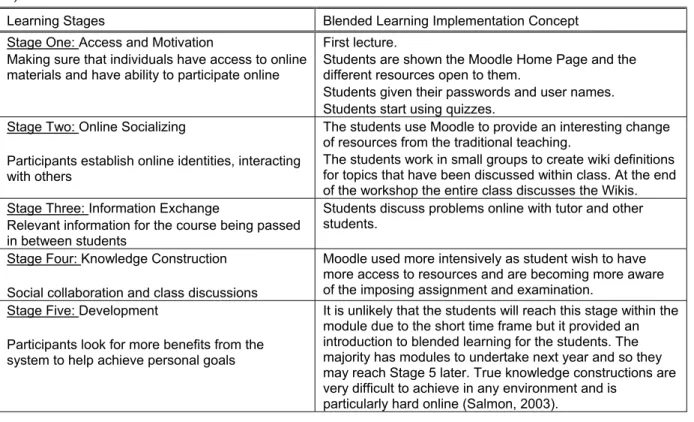
The 5 stage development model was used to provide a framework for an operating approach using Moodle. The plan identified the different IT based resources to be used each week alongside traditional face to face teaching. The implementation concept for the blended learning module Financial Management module was based on the 5 stage Model and is summarized at Table 2.
Table 2: Financial management module blended learning: teaching and learning strategy (after Salmon, 2003)
Learning Stages Blended Learning Implementation Concept
Stage One: Access and Motivation
Making sure that individuals have access to online materials and have ability to participate online
First lecture.
Students are shown the Moodle Home Page and the different resources open to them.
Students given their passwords and user names. Students start using quizzes.
Stage Two: Online Socializing
Participants establish online identities, interacting with others
The students use Moodle to provide an interesting change of resources from the traditional teaching.
The students work in small groups to create wiki definitions for topics that have been discussed within class. At the end of the workshop the entire class discusses the Wikis. Stage Three: Information Exchange
Relevant information for the course being passed in between students
Students discuss problems online with tutor and other students.
Stage Four: Knowledge Construction Social collaboration and class discussions
Moodle used more intensively as student wish to have more access to resources and are becoming more aware of the imposing assignment and examination.
Stage Five: Development
Participants look for more benefits from the system to help achieve personal goals
It is unlikely that the students will reach this stage within the module due to the short time frame but it provided an introduction to blended learning for the students. The majority has modules to undertake next year and so they may reach Stage 5 later. True knowledge constructions are very difficult to achieve in any environment and is
particularly hard online (Salmon, 2003).
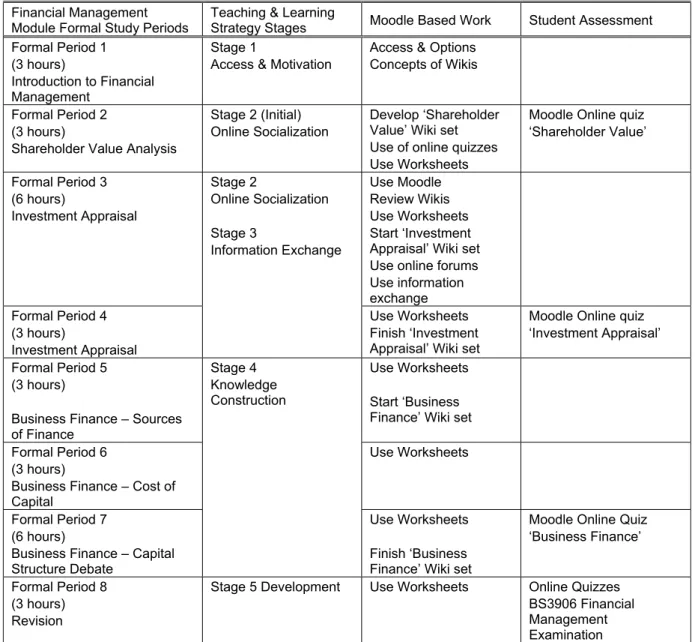
Table 3 illustrates the Financial Management module Implementation Plan which follows the teaching and learning strategy of the 5 Stage Model. The Implementation Plan shows how topics of shareholder value, investment appraisal and business finance are distributed as themes through the module and how Moodle is to be used at each formal stage. The Implementation Plan identifies the different IT based resources to be used each week alongside traditional face to face teaching and students’ own online studies.
6. Evaluation and findings of the case study
This Case Study has provided the opportunity to reflect on current practice and the pedagogic reasons for the design and presentation of a module for an important subject which students find difficult and dislike. It has also provided an opportunity to introduce a blended learning approach and to start to determine its effectiveness. Unfortunately, the student cohorts are small at 10 students each and the module is only repeated on an annual basis. This frequency and low population makes it difficult to provide objective measures to evaluate the effectiveness of the blended learning approach however the findings so far are: 6.1 Impact of blended learning approach on the teaching and learning issues
The main driver for the introduction of a blended learning approach had been that the assignment and examination marks of part-time students were notably lower than those achieved by the full-time students. The first results from the blended learning approach have shown that marks from assessments for the part-time students are now on average about 8% higher.
Table 3: Financial module blended learning: teaching and learning strategy implementation summary (after Salmon, 2003)
Financial Management Module Formal Study Periods
Teaching & Learning
Strategy Stages Moodle Based Work Student Assessment Formal Period 1
(3 hours)
Introduction to Financial Management
Stage 1
Access & Motivation
Access & Options Concepts of Wikis
Formal Period 2 (3 hours)
Shareholder Value Analysis
Stage 2 (Initial) Online Socialization
Develop ‘Shareholder Value’ Wiki set Use of online quizzes Use Worksheets
Moodle Online quiz ‘Shareholder Value’
Formal Period 3 (6 hours) Investment Appraisal Use Moodle Review Wikis Use Worksheets Start ‘Investment Appraisal’ Wiki set Use online forums Use information exchange Formal Period 4
(3 hours) Investment Appraisal Stage 2 Online Socialization Stage 3 Information Exchange Use Worksheets Finish ‘Investment Appraisal’ Wiki set
Moodle Online quiz ‘Investment Appraisal’ Formal Period 5
(3 hours)
Business Finance – Sources of Finance
Use Worksheets Start ‘Business Finance’ Wiki set Formal Period 6
(3 hours)
Business Finance – Cost of Capital
Use Worksheets
Formal Period 7 (6 hours)
Business Finance – Capital Structure Debate Stage 4 Knowledge Construction Use Worksheets Finish ‘Business Finance’ Wiki set
Moodle Online Quiz ‘Business Finance’
Formal Period 8 (3 hours) Revision
Stage 5 Development Use Worksheets Online Quizzes BS3906 Financial Management Examination
Many part-time students had previously requested extension concessions for their assignment and the examination due to work/personal life problems. 5 students (50%) requested extensions in the previous conventional course, where as only 1 student asked for the concession following the blended learning course. There were a number of part-time students who missed classes because of commitments and who were unhappy about having to do so. Part-time students still miss classes – but the anecdotal evidence is that students are now less anxious, because they know all the course material and self assessment work are available in a structured way via Moodle. Part-time students expressed anxiety about the difficulty of studying Financial Management and that they lacked the time to study with the intensity that the module guidelines required. Unfortunately part-time students, although now less anxious about the Financial Management module, are still concerned about its intensity and still lack confidence about the mathematical components.
6.2 Teaching and learning strategy
It was a quick and easy exercise to establish the structure of the blended learning course in Moodle according to the selected teaching and learning strategy following the Salmon 5 Stage Model. This model proved to be a useful guide to establishing a positive student response to the blended learning approach and to providing a target development structure for the students. Students worked through the planned Stages 1-4 efficiently and within the periods as planned. As identified by Thomas (2007), regular meetings (sessions), rapid movement through the socialization stages, regular participation, agreed success criteria and
Julia Burgess
www.ejel.org 137 ISSN 1479-4403
evaluation, and a clear model of teaching and learning online contributed to the early success of the blended learning approach for the revised Financial Management module. However, as predicted the Financial Management module is not of sufficient length or diversity for students to migrate to the planned Stage 5: Development, where the emphasis is on achieving personal goals. However, the students are now well prepared for other modules which will use blended learning approaches later in their course.
6.3 Using Moodle
Students liked the structure and availability of Moodle. They found the quizzes with immediate feedback to be effective and motivating. In general, the students wanted more quiz material and access to more online links. However, like Kirkpatrick (2006), it was found there was poor take up of the online ‘public’ forum facility. While Stage 3 of the Learning and Teaching Strategy was focused on information exchange, students wanted to take individual email addresses, so they could email each other privately. Additionally, the tutor was still receiving individual emails concerning queries, rather than via the forum. The reasons for this are unclear and it may be that better explanation of the forum facility and the restriction in the use of email with the tutor might provide some improvement.
6.4 Evaluation questionnaire
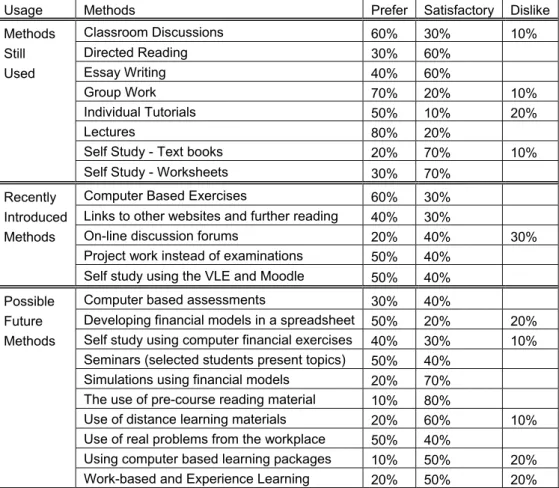
It was found that during the blended learning courses students started to use the Internet at home and work to support their studies with a dramatic shift to the use of the University’s VLE and Moodle. Whereas 50% of students had previously reported a low level of IT knowledge during the conventional course, at the end of the blended learning course most students reported a ‘medium’ or higher level of IT knowledge and skills. There was also an apparent shift in the preferences of students towards using various learning methods. Because of the low numbers of students involved some care must be taken in interpreting these results, however Table 4 shows that the new methods were received favorably. The dislike of using online discussion forums needs further investigation.
Table 4: BAMBA part-time students teaching/learning methods preferences (Not all respondents completed all lines in their evaluation questionnaires)
Usage Methods Prefer Satisfactory Dislike
Methods Classroom Discussions 60% 30% 10%
Still Directed Reading 30% 60%
Used Essay Writing 40% 60%
Group Work 70% 20% 10%
Individual Tutorials 50% 10% 20%
Lectures 80% 20%
Self Study - Text books 20% 70% 10%
Self Study - Worksheets 30% 70%
Recently Computer Based Exercises 60% 30%
Introduced Links to other websites and further reading 40% 30%
Methods On-line discussion forums 20% 40% 30%
Project work instead of examinations 50% 40%
Self study using the VLE and Moodle 50% 40%
Possible Computer based assessments 30% 40%
Future Developing financial models in a spreadsheet 50% 20% 20%
Methods Self study using computer financial exercises 40% 30% 10%
Seminars (selected students present topics) 50% 40%
Simulations using financial models 20% 70%
The use of pre-course reading material 10% 80%
Use of distance learning materials 20% 60% 10%
Use of real problems from the workplace 50% 40%
Using computer based learning packages 10% 50% 20%
Work-based and Experience Learning 20% 50% 20%
Overall, the blended learning approach described in this paper has had some success in managing the issues of part-time students studying a subject which is perceived to be difficult. This success was supported