Mobile
Virtual
Network
Operator
Contents 03 Introduction
04 Different approaches to mobile services
04 The Reseller
04 The Service Operator 05 The Full MVNO
06 Choosing the right approach 07 The MVNE
08 Execution/Fulfillment
08 Business Planning 08 Business Design 08 Business Infrastructure 08 Technical Infrastructure 09 Implementation 09 Production Support
09 Nokia Siemens Networks and MVNOs/MVNEs 10 Conclusion
Introduction
The Mobile Virtual Network Operator (MVNO) market is multifaceted, offering a wide range of operating models. Selecting the correct model is critical to the success of any new venture.
This White Paper describes the three main models for operating an MVNO:
• the Reseller, offering the products and services of its operator partner
• the Service Operator, taking on some operator responsibilities to offer innovative pricing and its own service packages • the Full MVNO, which has full
control of its service offerings and effectively operates as a Mobile Network Operator (MNO), but without its own radio network. The White Paper also looks at how an MVNO operating model should be selected and the different approaches of each model to the mobile market. The paper shows how each MVNO operating model fits different business scenarios. The Reseller model suits businesses that want to leverage their existing brand and retail infrastructures as a differentiator. The Service Operator model suits businesses with brands or service concepts that differentiate them from existing players.
Meanwhile, the Full MVNO model suits businesses that aim to engage fully in the telecommunications industry, to offer leading edge services and to create and capture new markets.
This White Paper shows how customer ownership, control over services, the ability to innovate, and responsibility for call control and termination, can make the Full MVNO a compelling proposition for the right player.
The Mobile Virtual Network Enabler (MVNE) is then discussed. This special case of the Full MVNO is an entity that can offer value to other MVNO players, by building infrastructure to supply network services. To fulfill this role, the company will usually have a telecommunications or IT background.
An overview of the specific issues, both business and technical, that must be considered in planning, designing, and implementing an MVNO entity is also given.
The Full MVNO model suits
businesses that aim to engage
fully in the telecommunications
industry, to offer leading edge
services and to create and
capture new markets.
Different approaches
to mobile services
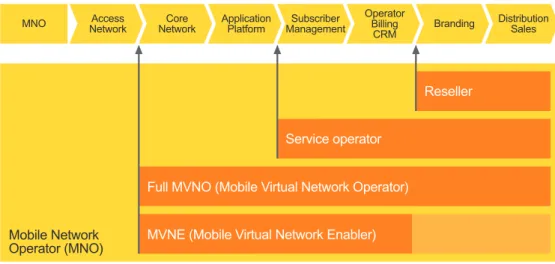
“MVNO” is a potentially confusing term, as it conventionally covers a range of different business approaches to providing mobile services. There are three emerging and commonly accepted operating models: the Reseller, the Service Operator and the Full MVNO, as illustrated in Figure 1. The growth in MVNOs has also created the opportunity for MVNEs, to act as an interface between a Reseller or Service Operator and a host MNO.
The Reseller
A Reseller focuses on sales and the customer interface, leveraging its close customer relationships, strong brand, or sales and distribution channels. The Reseller adds value by linking a mobile offering with existing non-mobile products or services. Resellers do not operate mobile telecommunications components or infrastructure, but buy the necessary services from a partner, which may be an MNO, an MVNE, or a Service Operator. A Reseller’s products and services, along with its pricing structure, will typically reflect its partner’s offerings. The partnership
agreement is often based on sales commission or “retail minus” wholesale pricing. However, as resellers generally have an amortized cost base they can use a new, incremental consumer pricing
model that is both complementary and competitive with their host MNO. The main advantage of the Reseller approach is that market entry is relatively straightforward because the model is simple to implement and attractive to network partners (that is the host MNO). The model appeals to prospective network partners because the Reseller’s customers use SIM cards provided by the partner MNO or MVNE, making network switching impractical and creating churn resistance. In addition, the partner usually maintains all the customer details for billing purposes. Resellers can thus benefit from adding mobility to its proposition, but must work beyond this to sustain long term growth. There is little scope to innovate beyond the service offerings available from the network partner.
Core Network Access
Network
Mobile Network
Operator (MNO) MVNE (Mobile Virtual Network Enabler) Full MVNO (Mobile Virtual Network Operator)
Service operator
Reseller Subscriber
Management DistributionSales Application
Platform
MNO OperatorBilling
CRM Branding
The Service Operator
The Service Operator, an intermediate model between the Reseller and Full MVNO, takes on greater responsibility for billing, customer management and service provisioning, as shown in Table 1. The Service Operator’s objective of building services differentiated from those of Resellers, other Service Operators and MNOs, drives the need for a close customer relationship. The use of branded SIM cards, along with its own prefixes and number ranges can help a Service Operator create the perception that it is independent of other mobile service providers. However, the Service Operator is effectively tied to its host MNO because changing host would involve the fairly impractical step of exchanging customers’ SIM cards. Unlike the Reseller, the Service Operator owns its customers and accrues the associated goodwill,
but is still dependent on a host MNOs core network.
The Service Operator approach provides more flexibility and control than the Reseller model, but suffers from increased technical complexity in its implementation.
Technical complexity arises because the Service Operator takes on responsibility for its own IT and network systems. Less obvious, is the issue of interfacing with the host MNO. At first sight, the Service Operator is using interfaces similar to those in the host’s infrastructure. However, complexity arises because these interfaces may not be
designed to accommodate external systems, particularly if the MNO has a legacy infrastructure (true for many MNOs.) Consequently, MNOs may be less keen to support Service Operators.
These technical issues and the implementation of service delivery systems, such as a Short Message Service Center (SMSC), real-time communications systems (for example IMS), an e-mail platform, or WAP gateway, often results in Service Operators outsourcing their infrastructure delivery and management.
Service Operators, unlike Resellers, may compete with their host MNO on price. If the Service Operator controls service delivery, it may also be competing on higher margin services and some MNOs may be less likely to enter into a partnership. This makes it important that before setting-out to attract a host MNO, the prospective Service Operator creates a proposition that is attractive to the host MNO and to develop a strong partnership offering with clear synergies benefiting the host MNO.
While a Service Operator enjoys more opportunities for long term growth than the Reseller, this growth is limited because new services, such as SIP-based services and Voice over IP (VoIP), require core network components controlled by the host MNO.
The Full MVNO
Unlike the Reseller and Service Operator, the Full MVNO is different from an MNO principally because it does not have its own Radio Access Network (RAN). A Full MVNO will maintain core network and service platforms, as well as have its own International Mobile Subscriber Identity (IMSI) codes, Subscriber Identity Module (SIM) cards, numbering space and interconnection rights and
responsibilities. As with the Service Operator, a Full MVNO owns its customers and accrues the associated goodwill.
A Full MVNO has three main advantages over the Service Operator. It can terminate calls, flexibly select the most appropriate host MNO, and can innovate at the leading edge, ahead of other players in the market.
The ability to terminate calls may provide the Full MVNO with new margin opportunities because of differences in incoming call revenues and outgoing call costs. These opportunities are not available to Resellers or Service Operators. The margins arise from the
interconnection arrangements in the wholesale agreement that the Full MVNO has with its host MNO. The Full MVNO gains additional independence from its host MNO through the ability to switch host
MNO without changing its customers’ SIM cards. The Full MVNO can achieve this because it has its own Mobile Network Code (MNC), against which the physical network is defined, and its own numbering system, thus its own IMSI numbers on customer SIM cards. The Full MVNO model involves a more complex infrastructure, comprising core network, service creation and delivery platforms and CRM/Billing systems, making its implementation and operation more challenging. However, the Full MVNOs interfaces to its host MNO can be considerably less complex than those required by a Service Operator. This is because the Full MVNO interfaces with its host MNO using the same well-defined interfaces (such as intra-public land mobile network [PLMN] backbone network [Gn], or inter-PLMN backbone network [Gp]) that all MNOs and fixed line operators use when exchanging calls.
The Full MVNOs independence means it can shop around for the best network deal, whether that is driven by radio network capability (2G versus 3G), coverage, capacity or price. The Full MVNOs control of its customers, pricing, service offering and the ability to implement leading edge technologies means it can achieve high levels of service innovation, beyond those of Resellers or Service Operators.
Service Operator focus Infrastructure used Control Gained
Billing Billing systems Call, messaging, and data
pricing
CRM CRM / Customer Lifecycle
Management, Customer care, and Service Provisioning systems
Increased control of the customer touch points, interaction and dialog Service Provisioning
Service control Service Enablers Value added services
Choosing the
right approach
The choice of MVNO operating model is complex. The benefits, shown in Figure 2, need to be weighed against the issues of operator acceptance and infrastructure complexity. Generally, the various MVNO operating models fit with the MVNO business models as follows:
• The Reseller model suits an organization that can leverage its existing distribution channels to sell mobile services, but has little need to innovate in the services it provides or differentiate itself from other players. Typically this means no-frills voice and messaging services.
• The Service Operator model suits those organizations that wish to gain control over the services they provide, both in terms of pricing and service innovation. This means the Service Operator model suits players that seek to address specific customer segments, by differentiating themselves from other players in those segments through
innovation in pricing or service content or both.
• The Full MVNO suits players aiming to achieve additional differentiation from Service Operators and MNOs, by offering leading edge products and services, and also achieve a high degree of independence at the outset.
However, the Full MVNO model may be the best approach for some players who would otherwise select the Reseller or Service Operator models and introduce differentiating services into their offering at a later date. This is because the control provided by the Full MVNO model may offer better short term and long term opportunities.
For example, an MVNO may want to introduce an innovative bundle of video call, push-to-talk and other value added services, with campaign pricing to kick-start the take-up of services. Acting as a Reseller or Service Operator would often mean persuading the host MNO to plan, source, procure and implement the underlying solutions. This would mean implementing service offerings within the host MNOs infrastructure but with differentiated billing. Such projects can easily take more than a year, negating the clear advantage of flexibility, responsiveness and speed.
However, by adopting the Full MVNO model, the MVNO would have full control of services decisions, delivery models (for example hosted services) and the project’s timelines.
The Full MVNO would be in full control to ensure timely introduction of services, business models, pricing and promotion to the market. As a Full MVNO, a service provider can adapt to market changes and obtain a competitive edge, in a way that a Reseller or Service Operator could not achieve.
Another key advantage of the Full MVNO model for Resellers and Service Operators is the leverage they gain in negotiating wholesale rates, because they own their customers and can switch networks. Although this may be a potential barrier from the host MNOs perspective, it is balanced by significant advantages to the host MNO. More customers may allow the host MNO to make more efficient use of its Radio Access Network (RAN), through the additional wholesale volumes. The Full MVNO may also reduce complexity in the MNOs wholesale interface, because the Full MVNO simply requires access to the RAN and handles all other service aspects, including billing, customer support,
provisioning, service and delivery. This approach may also allow the host MNO to concentrate on
Service Operator +
• Control over customer relationship
• Control over service creation and introduction
• Control over end-user pricing • Wholesale revenues
(termination fees) • Increased independency on
Host – MNO
Reseller +
• Flexibility in customer relationship management • Flexibility in end-user pricing • Flexibility in service packaging • Control over customer care
and billing • Access to mobile market
• Utilization of existing assets, e.g. in marketing, sales and distribution
• Traffic and service revenues • Bundling mobile services with
existing offering
MVNO/MVNE Service Operator
Reseller
The MVNE
A special case of the MVNO model is the MVNE. An MVNE provides the technical architecture and may enter into a wholesale agreement with a host MNO, to enable mobile service provision. However, the MVNE does not directly provide services to mobile users. Instead, it acts as an enabler for any number of MVNOs; an MNO can also become an MVNE in order for it to directly support MVNO Resellers and Service Operators.
The operating scope of MVNEs mirrors that of MVNOs, such that: • Full MVNEs operate a core
mobile telecommunication infrastructure, building the capability and capacity to enable wholesale services from MNOs. This type of MVNE parallels the Full MVNO by implementing the same technical architecture and host MNO wholesale agreements, but with partner companies creating the end-user services and interacting with the customer. The Full MVNE is the
intermediary between the host MNO and a Reseller or Service Operator.
• Limited MVNEs operate elements of the service delivery infrastructure, in much the same way as a Service Operator, but leave the mobile service provision to partner companies. The Limited MVNE is also the intermediary between the host MNO and a Reseller or Service Operator, but cannot offer the service innovation that a Full MVNE can provide.
• Solutions Providers supply components of the service delivery infrastructure to Resellers and Service Providers, but usually do not enter into a wholesale agreement with a host MNO. The MVNE is emerging because most MNOs have systems and approaches optimized to serve the mass market. This often makes it difficult for them to efficiently support third-party suppliers that address niche market segments with services that differ from the host MNO portfolio. MVNEs seek to fill this gap by providing the flexibility to support diverse services provided by a number of segment-specific third-parties.
Leveraging an MVNE brings the MNO the benefit of significant wholesale traffic volumes from multiple third-party service providers. The MVNE offers third-party
providers economies of scale, access to new service platforms, flexible service deployment and the operational simplicity of a hosting service.
The technical issues of setting up an MVNE are similar to those faced by an MVNO. They both need to support elements of the core network and service delivery
platform infrastructure. The difference is in the customer interface, where the MVNE is selling B2B.
developing its core brand value, without diluting it with multiple service offerings.
There is a gradual evolution towards the Full MVNO model by both existing and new third-party mobile service providers. In addition to the advantages of the Full MVNO model already discussed, the gradual expansion towards a service oriented model focusing on service differentiation and segmentation, is being driven by:
• Market saturation
• Increased end-user and network competition
• A focus on customer differentiation and customer loyalty
• 3G service opportunities and new wireless access technologies • The separation of access and
services
• Regulatory pressure
• The value of service bundles in strengthening competitiveness and dealing with competitive elements
As a result, Full MVNOs are likely to play an increasingly important role in providing mobile services across several markets.
Launching an MVNO or MVNE involves many of the practices and processes required to implement any new business: business planning, confirming the viability of the plan, designing business and technology systems, implementing the business, and then managing it for growth. However, there are a number of decisions and processes that are unique to the MVNO and MVNE. This section provides an overview of these items.
Business Planning
Good planning is essential for an MVNO or MVNE. Effective planning is built on a solid understanding of the commercial or consumer mobile telecommunications market and is essential to determine both the service offering and the appropriate operating model.
Planning the service offering typically involves:
• Definition of the target market • Selection of appropriate services
and service charges for the target market
• Ensuring, for an existing brand, that the products and services reflect the brand’s core values While service offering goes a long way towards determining the appropriate MVNO model and the required investment in infrastructure, the level of knowledge and
experience within the
telecommunications industry must also be considered. Issues such as service delivery and Quality of Service, assurance, interconnection management, number portability management and regulatory requirements help to determine how much of the Full MVNO model should be adopted. While these issues need to be considered by a prospective MVNO they are clearly fundamental for an MVNE.
At the end of this process the business should know what to offer customers and the infrastructure that is needed. In addition, it is prudent to make a decision about how the infrastructure will be managed, entirely in-house, in-house but using a managed service, out-sourced but owned by the business, or purchased as a service from an MVNE.
Business Design
Once the business plan has been validated and the go-ahead approved, the supporting business and technology systems can be designed and the detailed implementation can be created. Business Infrastructure
The business infrastructure that any MVNO or MVNE will need to design includes:
• Host MNO selection – A host MNO must be located and contracts drawn up to cover commercial and technical
aspects. Ongoing management of this relationship is vital.
• Core business systems – As well as standard accounting and operational business systems, an MVNO or MVNE will need to manage customer facing logistics, including retail outlets, handset
provision and servicing, management of the customer lifecycle, and the marketing of new services and offerings. • Value added services –
A service-focused MVNO will need to select service platforms and end-to-end solutions for creating a differentiated portfolio of end-user services. A Services portfolio may consist of SMS and MMS services, as well as richer communications services such as Push-to-talk Over Cellular (PoC) / push-to-X, Instant Messaging, Email, Mobile Blogging, Location Based Services, Mobile TV, Streaming video, Presence and more.
• Content services – Where
end-user services involve content delivery, sources for this content and download platforms must be found. This may involve engineering existing content for mobile, sourcing existing content from a developer or content aggregator, or locating a developer or designer to create bespoke content. It may also include systems to manage downloads and billing. • Mobile phones – Suppliers of
mobile phones will need to be found, either direct from the manufacturer or using an established distributor.
Technical Infrastructure
The technical infrastructure must be identified, including:
• Core network systems • Service delivery platforms • Customer relationship
management Systems (CRM) • Billing systems
• Customer care systems
• Network management
Execution/
These systems must be interfaced with the host MNOs infrastructure, other networks and service operators, as well as common support systems, such as a number portability platform, legal
interception, interconnection with other networks and roaming arrangements.
Implementation
Once the business and technical infrastructure has been defined, an implementation plan can be devised and executed. The critical activities will include:
• Service specification and testing • Interface development and
testing
• Hardware and software procurement and installation • Hardware and software
integration
• System, integration,
interoperability, interconnection and performance testing • Data conversion from existing
systems
• Delivery system content population
• Live deployment and switch-over
Production Support
Production support includes day-to-day operational activities such as: • Hardware maintenance, including
both physical maintenance and repair, as well as firmware and software maintenance
• Performance monitoring, to ensure that the appropriate quality of service is being provided
• Load balancing and other activities to maintain quality of service and optimize use of the infrastructure
In addition, processes and
procedures are required to monitor marketplace performance to ensure existing services remain competitive and new ones are developed. These activities might include: • Competitive analysis, maintaining
intelligence on market competitors • New technology analysis,
maintaining intelligence on emerging technologies • New content acquisition,
maintaining a fresh catalog for content based services • New services definition and
deployment, identifying and implementing new services for the target market
• Service retirement, retiring old services and ensuring customer migration to new services
Nokia
Siemens
Networks and
MVNOs/MVNEs
Finding the right business partnercan be the key to success for an MVNO or MVNE. Nokia Siemens Networks is in a unique position to offer support. As a supplier to more than 600 mobile, fixed and hybrid customers in 150 countries, Nokia Siemens Networks’ world-leading experience in all areas of the mobile industry offers a low risk approach. The key Nokia Siemens Networks products and services include: • Mobile services, innovative and
proven solutions for value added services
• Infrastructure hardware, for service delivery platforms and core network infrastructure • Managed Services, for on-site
management of infrastructure components
• Mobility Hosting, for full off-site hosted service of applications and infrastructure
• Convergent online charging,
billing and care, flexible and pre-integrated solutions with advanced and rich connectivity to support interfaces to all networks for MNO and MVNO voice and data services
• Consulting services, for business and technical planning, design and implementation
• Terminal, device and mobile computing configuration management
Nokia Siemens Networks’ experience in helping businesses deliver successful mobile products and services to consumers worldwide allows it to:
• Enable fast time to market – Nokia Siemens Networks and its strong, proven partners ease the operational challenges and provide quick deployment
• Remove complexity –
Market-leading offerings and experience across mobile software platforms, infrastructure, billing, systems integration and solutions, coupled with familiarity with all the components within the MVNO/ MVNE operation, allow Nokia Siemens Networks to ensure the delivery of optimum solutions
• Reduce risk – Nokia Siemens
Networks’ years of industry experience means much lower risk. The ability to call on business and technical expertise from any discipline within the infrastructure domain helps to avoid roadblocks. Low OPEX and CAPEX services improve the MVNO’s ability to properly manage its business case.
• Build success through strong collaboration – Nokia Siemens Networks builds long lasting collaboration with its customers and invests to ensure success for both parties.
Conclusion
As traditional MNOs concentrate on optimizing their Radio Access Network usage and delivering mass market systems, the scope for MVNOs and MVNEs is increasing. Ovum estimated in 2005 that by 2009 around 10% of all mobile subscribers could be served by an MVNO, with compound annual growth rates of between 8% and 20%. While many businesses will be served well by implementing Reseller and Service Operators MVNO models, the Full MVNO operating model offers compelling advantages, regardless of the underlying service offering. With full ownership of the customer, the ability to terminate calls, and close control over the service, a Full MVNO offers the greatest flexibility in going-to-market and then sustaining long term growth.
Nokia Siemens Networks offers MVNOs and MVNEs a collaborative approach to building their
businesses. Leveraging its extensive world-leading knowledge, Nokia Siemens Networks offers a low risk approach to full in-house deployment and options for management or fully-hosted approaches.
To be successful as an MVNO, any player must create the right mix of products and services, and support it with the correct infrastructure. In choosing an infrastructure partner, an MVNO or MVNE needs to consider the depth and breadth of mobile telecommunications skills that their partner brings to the venture. Nokia Siemens Networks has an unrivalled history of serving the mobile telecommunications market and possesses the technical and business acumen to guide any MVNO or MVNE project to successful implementation and long term growth.
To be successful as an MVNO, any player must create the right mix of products and services, and support it with the correct infrastructure.
Glossary
3GPP 3rd generation partnership program developing global specifications
BSC Base Station Controller
BTS Base Transceiver Station
Core Network
The systems that control traffic flowing to and from the RAN
CRM Customer Relationship Management
CS Circuit Switching
GCS Gateway Control Server
GGSN Gateway GPRS Support Node
Gn Intra-PLMN backbone network
Gp Inter-PLMN backbone network
GPRS General Packet Radio Service
HLR Home Location Register
IMS IP Multimedia Subsystem
IMSI International Mobile Subscriber Identity
IP Internet Protocol
ISN Intelligent Service Node
IT Information Technology
MGW Media Gateway
MMSC Multimedia Messaging Service Center
MNC Mobile Network Code
MNO Mobile Network Operator (host)
MSC Mobile services Switching Center
MSS Mobile Switching Solution
MVNE Mobile Virtual Network Enabler
MVNO Mobile Virtual Network Operator
OSS Operation and maintenance subsystem
OTA Over-the-air technology
PLMN Public Land Mobile Network
PoC Push-to-talk Over Cellular
PS Packet Switching
RAN Radio Access Network
RNC Radio Network Controller
Service Delivery Platform
A platform used to deliver non-voice services to a mobile customer
SGSN Serving GPRS Support Node
SIM Subscriber Identity Module
SMSC Short Message Service Center
SS7 Signaling System no 7
UMA Unlicensed Mobile Access
VMSC Visited Mobile services Switching Center
VoIP Voice over IP
WAP Wireless Access Protocol
The contents of this document are copyright © 2007 Nokia Siemens Networks. All rights reserved.
A license is hereby granted to download and print a copy of this document for personal use only. No other license to any other intellectual property rights is granted herein. Unless expressly permitted herein, reproduction, transfer, distribution or storage of part or all of the contents in any form without the prior written permission of Nokia Siemens Networks is prohibited.
The content of this document is provided “AS IS”, without warranties of any kind with regards its accuracy or reliability, and specifically excluding all implied warranties, for example of merchantability, fitness for purpose, title and non-infringement. In no event shall Nokia Siemens Networks be liable for any special, indirect or consequential damages, or any damages whatsoever resulting form loss of use, data or profits, arising out of or in connection with the use of the document. Nokia Siemens Networks reserves the right to revise the document or withdraw it at any time without prior notice. Nokia Siemens Networks and the Wave-logo are registered trademarks of Nokia Siemens Networks. Nokia Siemens Networks product names are either trademarks or registered trademarks of Nokia Siemens Networks. Other product and company names mentioned herein may be trademarks or trade names of their respective owners.
www.nokiasiemensnetworks.com
Copyright © 2007 Nokia Siemens Networks. All rights reserved.
Nokia Siemens Networks and the wave logo are registered trademarks of Nokia Siemens Networks.
Other company and product names mentioned herein may be trademarks or trade names of their respective owners. Products and solutions herein are subject to change without notice.