Prof. Shervin Shirmohammadi CEG 4395 19-1
Lecture 19:
Web Based Management
Prof. Shervin Shirmohammadi
SITE, University of Ottawa
Prof. Shervin Shirmohammadi CEG 4395 19-2
Using the Web for Management
• Web browser UI
connects with the management system,
allowing NMS functionality from any node browser that
has access to the network.
– Economical
– Ubiquitous access
• Not to confuse
Web Interface
and
Web-based management
• Web Interface to Management
– System still primarily SNMP-based, web interface an added
feature
• Web-based management
– Desktop management interface
– Web-based enterprise management
– Java management extensions
Prof. Shervin Shirmohammadi CEG 4395 19-3
Web Interface
• SNMP-based NMS
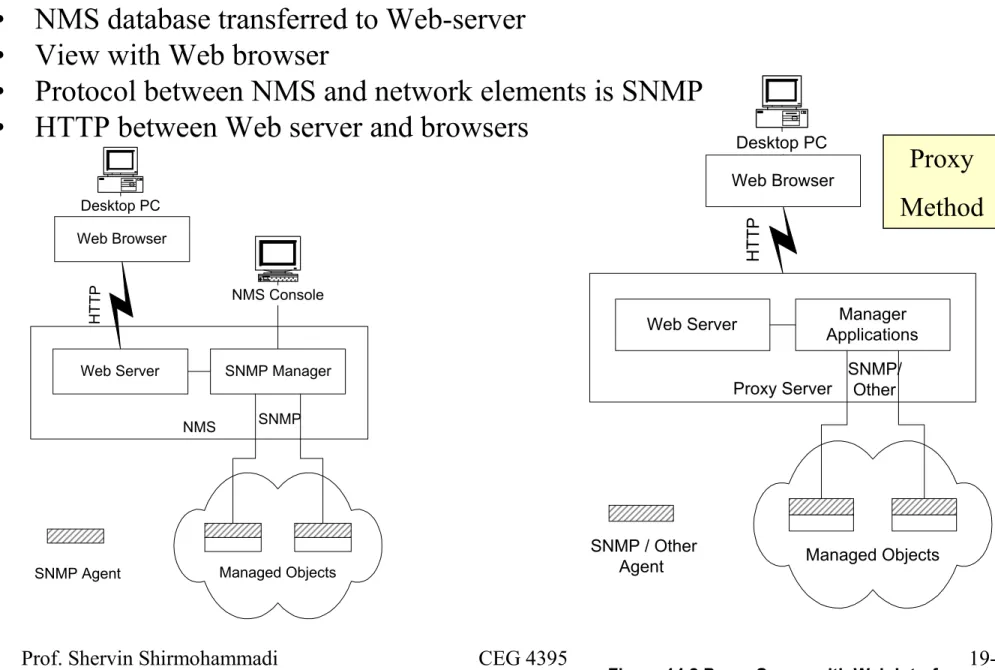
• NMS database transferred to Web-server • View with Web browser
• Protocol between NMS and network elements is SNMP • HTTP between Web server and browsers
NMS
SNMP Manager
Managed Objects SNMP Agent
Web Server Web Browser
NMS Console Desktop PC
Figure 14.1 SNMP NMS with Web Interface
SNMP
H
T
TP
Proxy Server
Manager Applications
Managed Objects SNMP / Other
Agent
Web Server
Web Browser Desktop PC
Figure 14.2 Proxy Server with Web Interface
SNMP/ Other
H
TT
P
Proxy Method
Prof. Shervin Shirmohammadi CEG 4395 19-4
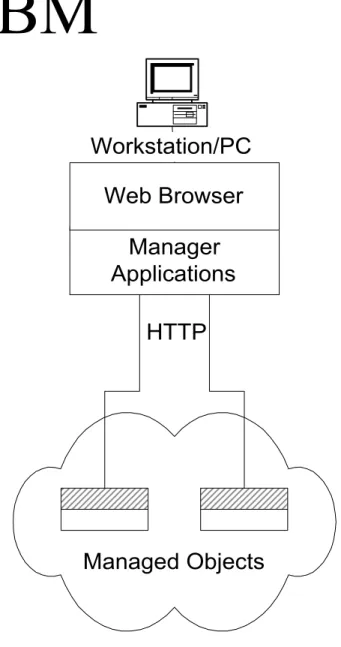
Manager Applications
Managed Objects Web Server
Web Browser Workstation/PC
Figure 14.3 Embedded WBM Configuration
HTTP
Embedded WBM
• Web servers are embedded in managed objects
• Data is pushed by the
management agents in managed objects to the manager
applications
• These management agents can have extra computing capabilities • Opens the market for proprietary
solutions that are customized to the product.
• Advantages? • Disadvantages?
Prof. Shervin Shirmohammadi CEG 4395 19-5
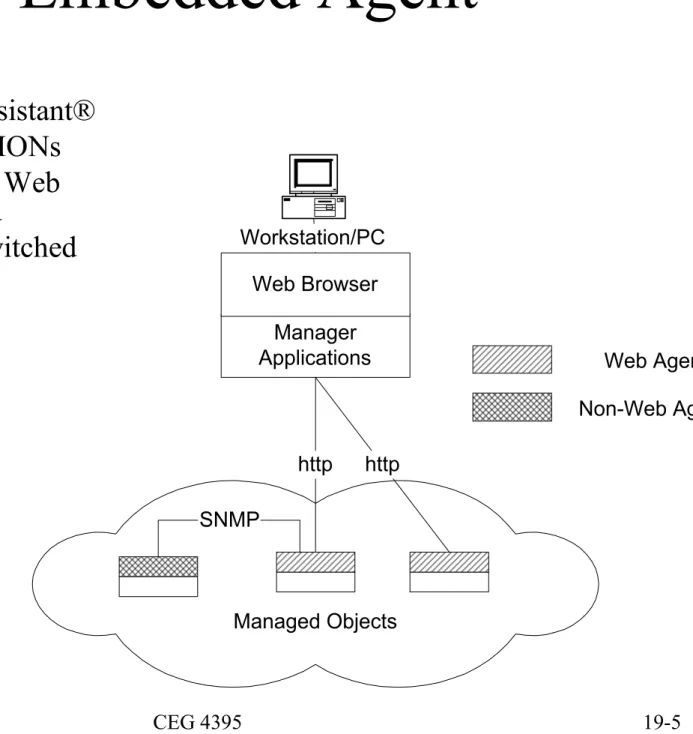
Manager Applications
Managed Objects http
Web Agent Web Browser
Workstation/PC
Figure 14.4 Hewlett-Packard Embedded Agent Configuration
http SNMP
Non-Web Agent
HP Embedded Agent
• HP AdvanceStack Assistant® • Web agents act as RMONs • Network element w/o Web
agent can be managed
• Remote probing of switched LANs
Prof. Shervin Shirmohammadi CEG 4395 19-6
Desktop Management Interface (DMI)
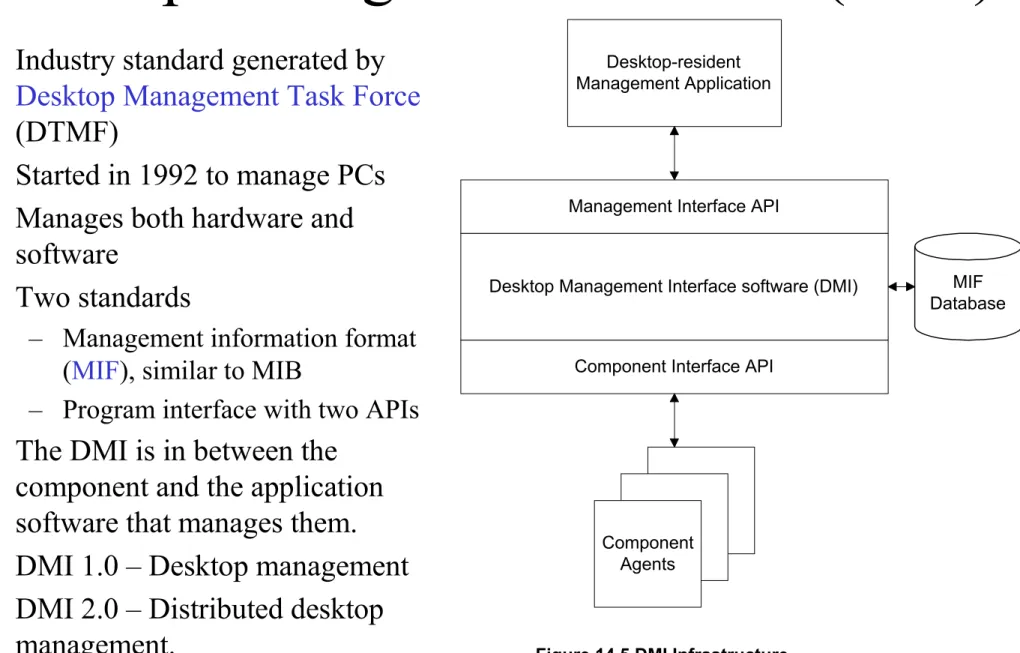
• Industry standard generated by
Desktop Management Task Force
(DTMF)
• Started in 1992 to manage PCs • Manages both hardware and
software
• Two standards
– Management information format (MIF), similar to MIB
– Program interface with two APIs
• The DMI is in between the component and the application software that manages them.
• DMI 1.0 – Desktop management • DMI 2.0 – Distributed desktop
management.
Desktop Management Interface software (DMI) Management Interface API
Component Interface API
Component Agents
Desktop-resident Management Application
MIF Database
Prof. Shervin Shirmohammadi CEG 4395 19-7
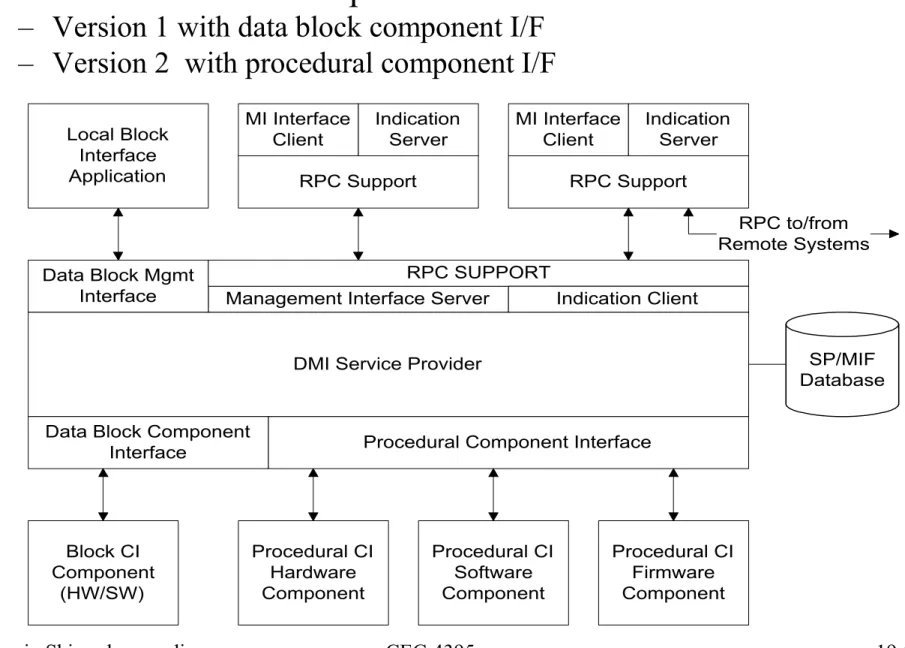
DMI Service Provider SP/MIF Database Management Interface Server
RPC Support MI Interface Client Indication Server RPC Support MI Interface Client Indication Server Local Block Interface Application
Data Block Mgmt Interface
RPC SUPPORT
Indication Client
Data Block Component
Interface Procedural Component Interface
Block CI Component (HW/SW) Procedural CI Hardware Component Procedural CI Software Component Procedural CI Firmware Component RPC to/from Remote Systems
Figure 14.6 DMI Functional Block Diagram
DMI 2.0 Functions
• Architecture has dual representation
– Version 1 with data block component I/F – Version 2 with procedural component I/F
Prof. Shervin Shirmohammadi CEG 4395 19-8
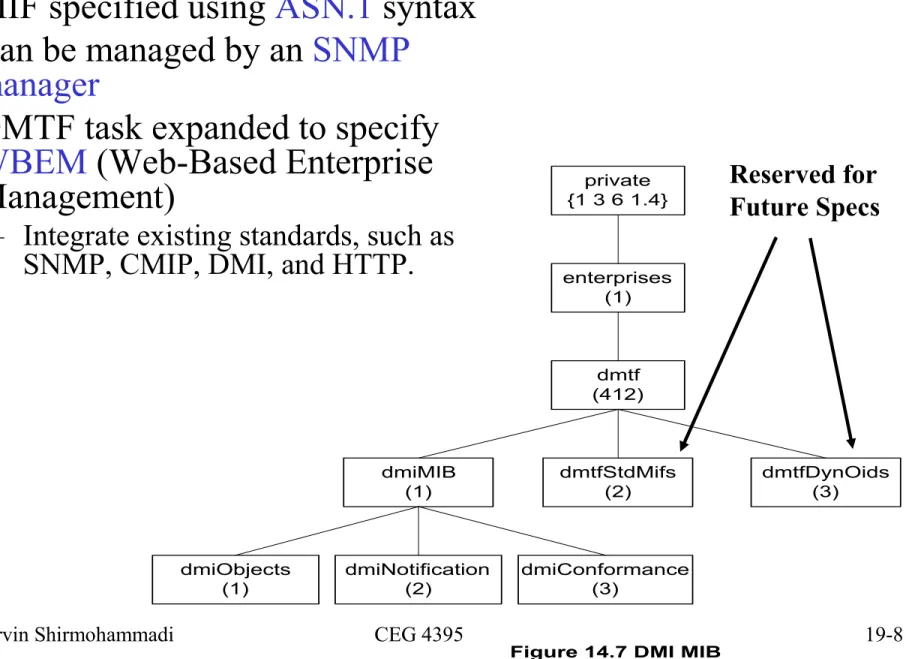
enterprises (1)
dmtf (412)
dmiMIB (1)
dmtfStdMifs (2)
dmtfDynOids (3)
dmiConformance (3)
dmiNotification (2)
private {1 3 6 1.4}
dmiObjects (1)
Figure 14.7 DMI MIB
DMI MIB
• MIF specified using
ASN.1
syntax
• Can be managed by an
SNMP
manager
• DMTF task expanded to specify
WBEM
(Web-Based Enterprise
Management)
– Integrate existing standards, such as SNMP, CMIP, DMI, and HTTP.
Reserved for Future Specs
Prof. Shervin Shirmohammadi CEG 4395 19-9
Web-Based Enterprise Management
• WBEM based on
Common
Information Module
, developed
by Microsoft
• CIM is information-modeling
framework intended to
accommodate all protocols and
frameworks
• Object-oriented
• Five components:
– Web client
– CIM object manager (CIMOM) – CIM schema
– Management protocol
– Managed objects with protocol-specific agents
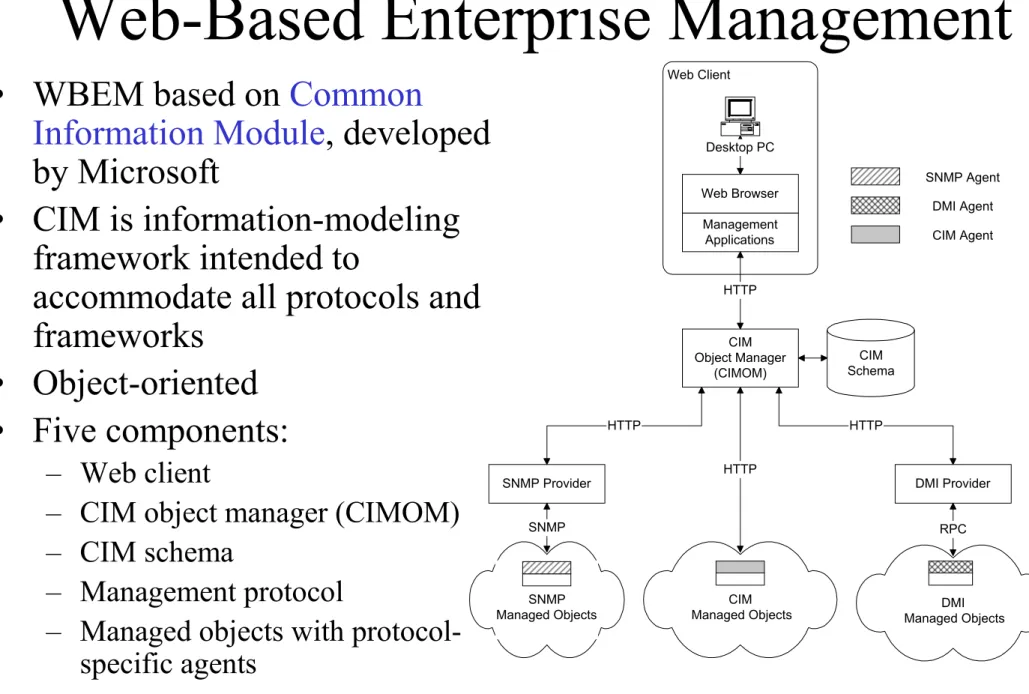
Web Client
SNMP
Managed Objects Managed ObjectsDMI
DMI Provider SNMP Provider CIM Object Manager (CIMOM) CIM Schema Management Applications Web Browser Desktop PC HTTP HTTP HTTP SNMP RPC CIM Managed Objects HTTP
Figure 14.8 WBEM Architecture
SNMP Agent DMI Agent CIM Agent
Prof. Shervin Shirmohammadi CEG 4395 19-10
WBEM
• Web client is
Web browser with management applications
:
Application requests use CIM schema
• Multiple instances of Web clients feasible
• CIM object manger
mediates
between Web clients, managed
objects, and CIM schema
– Microsoft Windows Management Instrumentation uses Distributed Component Object Model (DCOM)
– Sun’s CIMOM uses JMX
• The CIM Schema is used to determine which protocol system
the managed object belongs to as well as perform MIB
translations.
• CIM modules:
– Core model: high level framework applicable to all management domains.
– Common models: applicable to protocol-specific domains. Includes information on systems, applications, devices, users, and networks.
– Extension model: technology-specific extensions of the common model, such as UNIX or MS Windows OS specifics.
Prof. Shervin Shirmohammadi CEG 4395 19-11
Common Information Module Core Model
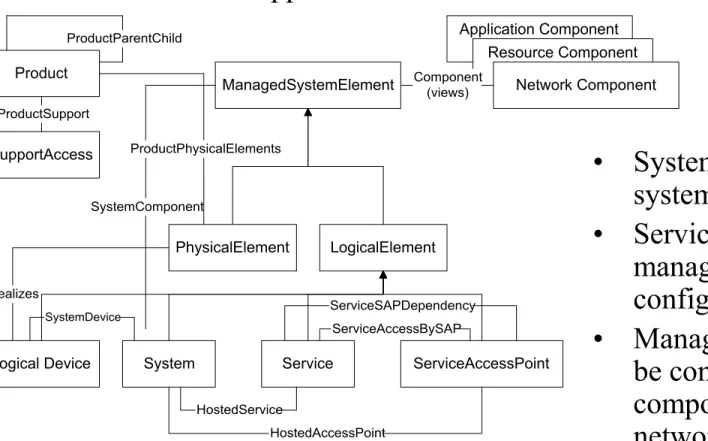
• System is aggregate of managed system elements
• Service access point is
management, measurement, and configuration of a service
• Managed system elements may be considered as groups of
components, for example network, resource, and applications.
Application Component Resource Component ManagedSystemElement
PhysicalElement LogicalElement
System
Network Component
Logical Device Service ServiceAccessPoint
Realizes
Component (views)
ServiceSAPDependency
Figure 14.9 WBEM CIM Core Model
SystemDevice
HostedService
ServiceAccessBySAP SystemComponent
Product
SupportAccess
ProductSupport
ProductPhysicalElements ProductParentChild
HostedAccessPoint
• Solid lines indicate inheritance, dashed lines indicate association
• PhysicalElement (e.g. interface card) and LogicalElement (e.g IP address) subclasses of ManagedSystemElement
• Logical Device is the functionality that the Physical Element supports. e.g. a network card can support modem or NIC.
Prof. Shervin Shirmohammadi CEG 4395 19-12
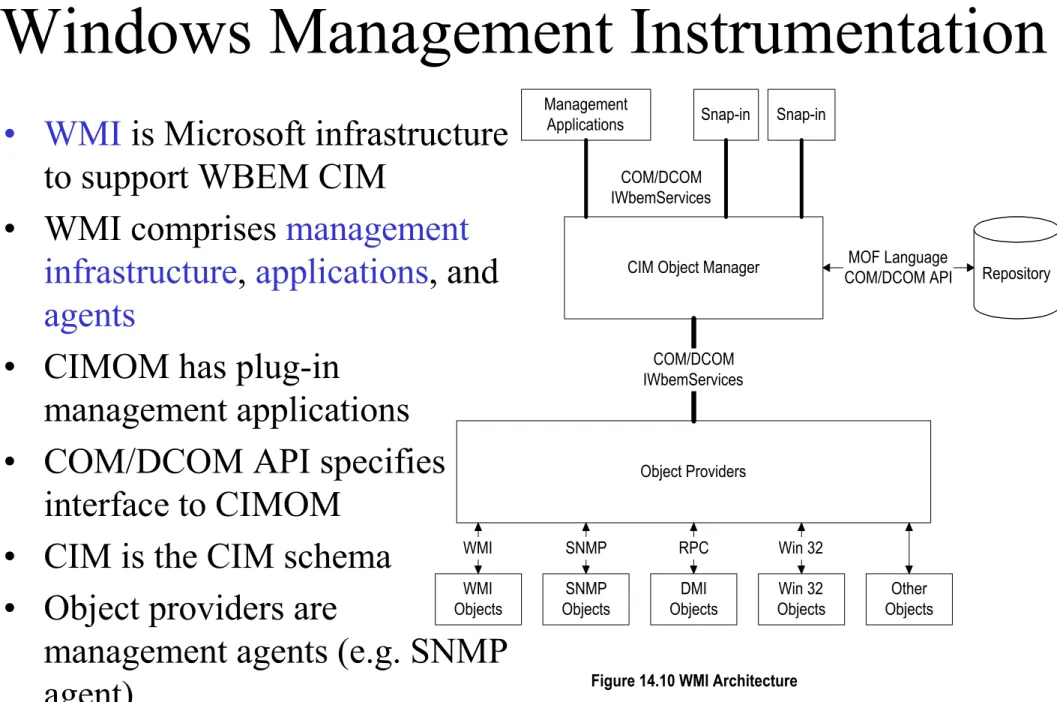
Windows Management Instrumentation
• WMI
is Microsoft infrastructure
to support WBEM CIM
• WMI comprises
management
infrastructure
,
applications
, and
agents
• CIMOM has plug-in
management applications
• COM/DCOM API specifies
interface to CIMOM
• CIM is the CIM schema
• Object providers are
management agents (e.g. SNMP
agent)
CIM Object Manager MOF Language Repository COM/DCOM API
Object Providers
WMI Objects
WMI
SNMP Objects
SNMP
DMI Objects
RPC
Win 32 Objects Win 32
Other Objects COM/DCOM
IWbemServices Management
Applications Snap-in Snap-in
COM/DCOM IWbemServices
Prof. Shervin Shirmohammadi CEG 4395 19-13
Java Management Extensions
• JMX
is another approach for total management using
Web technology
• JMX defines
– Management architecture
– APIs
– Management services
• Based on
Java Dynamic Management Kit
, a
technology introduced by
Sun Microsystems
for the
Prof. Shervin Shirmohammadi CEG 4395 19-14
Service Driven Network
• Service Driven Network: network of services (instead
of network of components)
• Service needs provisioning and management
• Let’s use as an example
Webphone
: Internet analogy to
telephone
– Webphone is network-centric device
– thin client
– hand-held device
– a plug-in device in service network
• Java technology calls plug-in JavaBean
• MBean is management JavaBean
Prof. Shervin Shirmohammadi CEG 4395 19-15
JDMK
• Java dynamic management tool kit to build Java-based NMS
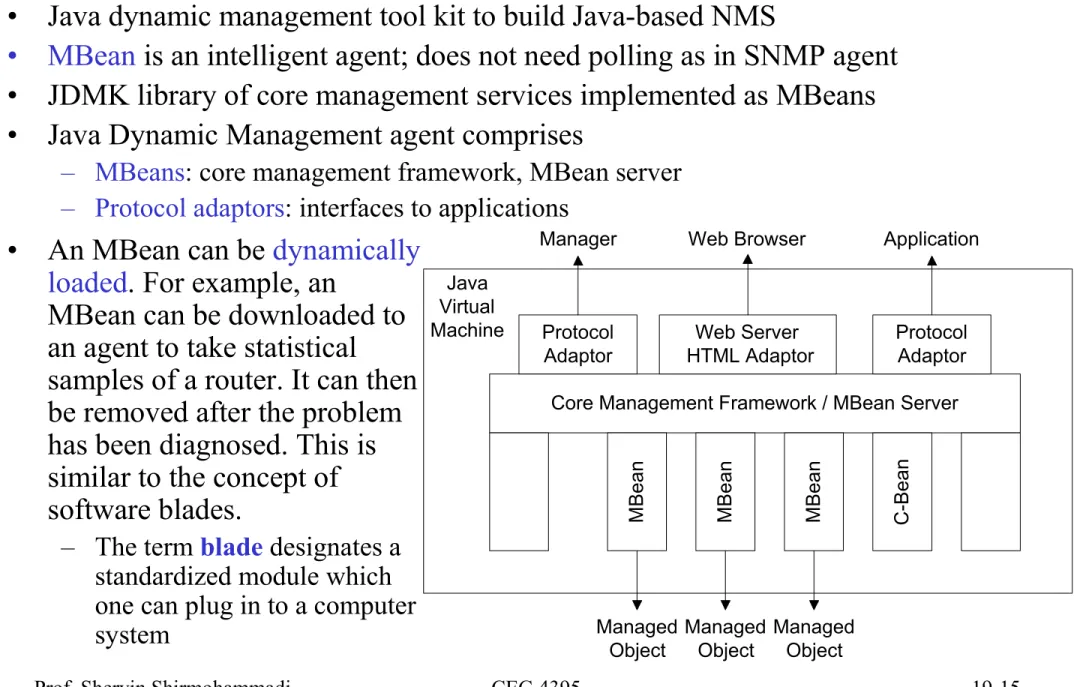
• MBean is an intelligent agent; does not need polling as in SNMP agent • JDMK library of core management services implemented as MBeans • Java Dynamic Management agent comprises
– MBeans: core management framework, MBean server – Protocol adaptors: interfaces to applications
Core Management Framework / MBean Server
M B e a n M B e a n M B e a n C -B e a n Protocol Adaptor Protocol Adaptor Web Server HTML Adaptor
Figure 14.11 Java Dynamic Management Agent Architecture
Manager Web Browser Application
Managed Object Managed Object Managed Object Java Virtual Machine
• An MBean can be dynamically loaded. For example, an
MBean can be downloaded to an agent to take statistical
samples of a router. It can then be removed after the problem has been diagnosed. This is similar to the concept of software blades.
– The term blade designates a standardized module which one can plug in to a computer system
Prof. Shervin Shirmohammadi CEG 4395 19-16
Core Management Framework
M
B
M
B
Agent Profile A
Java DMK Master
Agent Manager
MB http://URLA/<Management AppletA>
http://URLB/<Management AppletB> http://URLC/<Management AppletC>
Web Server
MB
Figure 14.12 Management Bean (MB) Flow Diagram
MB
B C
Management Bean
• JDMK agents are under the control of master JDMK agent
– hierarchical structure
• Manager is NMS
• Web server stores management services as applet files with the agents’ URL • MBean pulled out of the Web server at boot time
Prof. Shervin Shirmohammadi CEG 4395 19-17
JMX Architecture
• JMX architecture comprises
three levels
• Instrumentation
– JMX-manageable resources - network devices, applications, service entities, and systems MBean Server Service Protocol Adaptor Web Server HTML Adaptor
Figure 14.13 JMX Components Java Virtual Machine
Managed Object Connector Instrumentation Level Agent Level Web Browser Proprietary Management Application Proprietary Management Application JMX Manager MBean Server Service
Java Virtual Machine Connector SNMP Manager API CIM/WBEM API TMN Manager API Additional Manager APIs Manager Level Managed
Object ManagedObject
– Developed in Java or Java wrappers as MBeans
– MBeans implemented either static or dynamic
• Agents
– MBean server is a set of services for handling MBeans
Prof. Shervin Shirmohammadi CEG 4395 19-18
JMX Agents
• Agents
– MBean server is a set of services for handling MBeans
– JMX-manageable
resources register
with an agent
– I/F
adaptor
to Web browser contains a Web server
– I/F to JMX manager called a
connector
– Protocol adaptors represents MBeans in another
protocol, such as SNMP
– Agent-Manager communication infrastructure uses
HTTP, CORBA/IIOP, etc.
Prof. Shervin Shirmohammadi CEG 4395 19-19
JMX Manager
• Manager
– Comprises
management applications
,
network manager
,
and
browser
– Interfaces with agents via the connector (JMX manager)
or protocol adaptors
– CIM/WBEM APIs are grouped into CIM, client, and
provider.
– CIM API represents CIM elements as Java class objects
– JMX manager interfaces with external database using
Prof. Shervin Shirmohammadi CEG 4395 19-20