A PRACTICAL SOFTWARE TOOL
FOR GENERATOR MAINTENANCE
SCHEDULING AND DISPATCHING
C. Sharma & S. Bahadoorsingh
Preventive maintenance scheduling and economic dispatch, have found prominent positions in the operation of power systems. A new heuristic algorithm based on the tabu search has been proposed as a solution method to the maintenance problem. This algorithm seeks to satisfy an objective function that can either maximize or minimize spinning reserve capacity of the power system over the entire planning horizon while satisfying constraints. Maximizing the reserve capacity provides a method of maintaining and increasing overall system reliability. This paper presents a PC-based Windows application software tool for production of optimized maintenance schedules, performing economic dispatch, predicting actual dates for long-term maintenance scheduling and querying the current status of a generating unit from data files. The Power Generation Company of Trinidad and Tobago has an installed capacity of 1159MW with 21 generating units. Using this company as the testing ground the software tool was developed and implemented in MATLAB 6.5 providing user-friendly Graphical User Interfaces (G.U.I.s). Numerical results have been obtained and the effectiveness of this developed software has been demonstrated. Selected results of the software are presented in this paper for illustration purposes.
Keywords: Preventative maintenance scheduling, economic dispatch, tabu search, heuristic algorithm,
software tool
1. Introduction
1.1 General Background
Power generating companies must generate sufficient electrical power to cater for the varying demands of consumers. Electricity cannot be easily and cheaply stored, so it must be continuously generated based on the customers’ demand. The generating company has a declared capacity at any given instant and must supply this contracted demand from its resources. These resources include the generating units, transformers and transmission lines. There are many types of generating units that collectively constitute the power system. The generating unit is an electro-mechanical device. An attribute of such equipment is periodic maintenance due to deterioration as a result of prolonged usage. This maintenance is
necessary in order to extend the life and improve the overall availability of the equipment. Hence the manner of scheduling this maintenance is of utmost importance from economic and engineering perspectives. Therefore, the optimum schedule is one, which satisfies the many constraints yet maximizes service reliability and minimizes production cost. The production of this optimal schedule has been a topic of study for power engineers over the last three decades. [1] These engineers are also faced with the challenge of economic dispatch, that is, operating the power system to supply all demands at minimum production costs, whilst satisfying several constraints.
1
1.2 Salient Features of Software Tool
This paper describes the development and functionality of a user-friendly software tool developed for power generating companies. The specifications of this tool are that it must include an interactive Graphical User Interface (GUI) that outputs an optimized maintenance outage schedule, power outputs of online generating units from economic dispatch and a searching method for querying the current status of a particular generating unit within a data file. The developed system has been applied to The Power Generation Company of Trinidad and Tobago (Powergen). Analysis of the current method used by the above mentioned generating company for scheduling maintenance and economic dispatch will be compared to the outputs of the developed software. The ultimate goal is to improve the reliability and lower the operating costs.
The problem can be divided into four sub-problems:
a) Optimizing of maintenance outage schedule over one (1) year horizon; b) Economic dispatch;
c) Five (5) year scheduling of a single generating unit; and
d) Excel link.
1.2.1 Optimizing of Maintenance Outage
Schedule Over One (1) Year Horizon
In this software, there are two major constraints that must be satisfied for outage scheduling. These include time constraint and load limit requirement. Firstly, the time constraint simply introduces the requirement that a given generating unit must undergo maintenance for a predetermined length of time, during a specified interval of the time horizon where either the start time or end time of the maintenance governs when the maintenance must be started. Secondly, the load limit requirement represents the system load or contracted figure for which the generating company must be able to generate power to meet at every interval of the horizon, regardless of maintenance on generating units. This requirement figure includes spinning reserve capacity. Maintenance on generating
units means that these units will be able to partially or not at all contribute to meet this limit. Hence, the resultant schedule must optimally satisfy both constraints if possible.
1.2.2 Economic Dispatch
In this software, there are two major constraints that must be satisfied for the economic dispatching of generating units. The first constraint is load limit requirement as explained in the previous sub-section. The second is the heat rate limit requirement that is a measure of efficiency of the power system and is the contracted figure for which the generating company must strive not to exceed or a penalty is incurred. Hence, the result must be the effective order of loading the generating units at specific outputs. This leads not to exceed the heat rate limit requirement yet meet the load limit requirement.
1.2.3 Five (5) Year Scheduling of a Single
Generating Unit
All generating units of a power system require maintenance on a periodic basis. This software tool must provide a forecast of the maintenance schedule over a five (5) year horizon for a single generating unit, predicting actual dates for the maintenance activities for the generating unit in question.
1.2.4 Excel Link
In power systems, there are records of the current status of each generating unit. These records are necessary to keep track of the duration over which the unit in question was available or unavailable. These records are usually stored in a predefined spreadsheet format. This software must be able to query these records and produce suitable search results. Powergen’s records are stored in Excel Spreadsheet files. This sub-problem has been termed, “Excel Link”.
2. Outage Scheduling
2.1 Model Formulation
2.1.1 Variables
Here are the variables used in the model formulation:
I = Number of generating units
(weeks [Max = 52]).
j
Limit = Demand/Load at period j.
(Assume Limitj constant for all j)
i
P = Rated output of generating unit i.
j
R = Reserve capacity of I generating units at period j.
i
M = Maintenance duration of generating unit i.
ij
X = State Variable if generating unit I is in maintenance at period j then
ij
X = 1; otherwise Xij= 0.
i
DS = Derated state of generating unit i during Mi. 0 < DSi ≤ 1
ij
P = Output of generating unit i at period j. This output is a function of the state variable and the derated state of the generating unit over the planning horizon.
i
ST = Earliest absolute start time for maintenance durationMion unit i.
i
ET = Absolute end time at which maintenance duration Mion unit i must conclude.
i
PS = Possible number of schedules for generating unit i duringMi.PSi is determined by the number of times Mi can uniquely fit during the maintenance window STi ≤ j ≤
i
ET .
A generating unit i can undergo maintenance such that it is totally (100%) unavailable and therefore the DSi = 1. A generating unit i
cannot have DSi = 0, this means that it is totally available and this does not represent behaviour under preventive maintenance. Hence 0 < DSi ≤ 1 represents either no output or partial output for generating unit i duringMi. Each unit 1 ≤ i ≤ I, must be maintained forMi.
2.1.2 Constraints
Several constraints are identified as follows:
Once maintenance of unit i has begun the maintenance must continue for Mi without interruption.
The absolute end time for a scheduled maintenance must not be earlier than its absolute start time.
Maintenance durationMion unit I must fit within the maintenance window which is the time between the STi and
i
ET inclusive.
The sum of the outputs of the I
generating units over the horizon must meet the load demand for the generated schedule to be valid.
2.1.3 Objective Functions
The objective function can be either one (1) of the following: [2]
1. Minimize the reserve capacityRj over the planning horizon OR
2. Maximize the reserve capacityRj over
the planning horizon
2.1.4 Fitness Function
The schedule that satisfies the appropriate objective function and the constraints must then be evaluated with the fitness function. This fitness function determines an index for each schedule generated. The magnitude of this index provides a simple relationship with the optimal solution found. An index with the largest magnitude correlates to the schedule for maximizing the reserve capacity. Similarly, an index of the smallest magnitude correlates to the schedule for minimizing the reserve capacity.
2.2 Scheduling Methodology Employed
The method employed was a Redefined Tabu Search because of the simplicity in understanding and implementing the Tabu Search. The following are the general steps used for this method: [3]
1. For the I generating units calculate, PSi and store in tabu list.
I
i i
PS = max iterations.
2. Determine stopping criteria, number of iterations to perform, where, 1 ≤ number of iterations ≤ max iterations.
3. Generate a random trial schedule: using the tabu list random integers generated to change the STi for the I generating
units
4. Validate trial schedule against constraints, if schedule valid, evaluate objective function and appropriate fitness function.
5. Store as optimal solution if fitness function regards the trial schedule as optimal.
6. Instead of changing the STi for one
generating unit as in a normal tabu search go to step 3 and repeat for the number of iterations.
Optimal solution(s) from the number of iterations defined are available. However in actual implementation of the Redefined Tabu Search, the optimization of the code involved some principles of the Integer Programming Method. Hence, the Redefined Tabu Search has undergone genetic mutation. For large systems, the random technique employed (in Redefined Tabu Search) to move within areas of the entire search space can result in the optimal solution(s) being found, if it exists in a smaller computational run time. The negative aspect of this method is; the same optimal solution, for a given problem, can be encountered more than once. This is due to the random generation of schedules. However the probability of this occurrence has an inverse relationship with the number of iterations set by the user and the number generating units under analysis. The maximum number of iterations the user can set is determined by
I
i i
PS . This is directly related to the maintenance windows of these generating units under analysis. The greater the number of iterations the method is allowed to
perform the higher the probability of finding better quality solutions. [4]
3. Economic Dispatch
3.1 Constraints Affecting Economic
Dispatch
There are many constraints within the economic dispatch problem. [5] These include:
Minimum and maximum power output of each generating unit;
Heat rate limit (see subsection 1.2.2); Load limit requirement (see subsection
1.2.1); and
Availability of generating units.
3.2 Factors Affecting Cost
There are many factors, which affect the final cost of generating power from a generating unit, they include:
Fuel Costs
Incremental Operational and Maintenance Costs
Fixed Costs of Operation Efficiency of Generating Unit
In order to take into consideration losses in transmission lines between generating units belonging to different power plants, the system cost function becomes an augmented cost function Eq(1) called the lagrangian.
n n
loss n n
n n n
nP COSINC O M P LOAD P P
F
Cost($) &
Eq (1) Where:
Fn = Fuel Input
COSINCn = Incremental fuel cost of the
nth unit
O&Mn = Incremental O&M cost of nth
unit
Pn = Power output from nth unit
LOAD = Total power received by the loads
Ploss = Transmission losses
The lagrangian equation Eq(1) represents an unconstrained problem in which it is required to minimise the Cost function with respect to λ and the generator outputs. Therefore for minimum cost we require the derivative of Eq(1) with respect to each Pn to be equal to zero, giving the dispatch condition Eq(2).
1 &
0
n loss n
n n
n n
dP dP M O COSINC dP
P
dF . Eq (2)
In power systems, an approximation is usually made to reduce computer simulation costs, in power generation planning. This approximation consists of representing the incremental transmission loss term
n loss dP dP
1
1 as a constant
penalty factor, Ln, where Ln
may be in the range of 1.0 ≤ Ln ≤ 1.10. Further approximation for simulation exercises, results in Eq(3) being approximated where Ln=1 and
n
M
O& is neglected to produce.
.
COSINC MinCost($)
dP P dF
n n
n
n Eq (3)
4. Software Design and Implementation
The software model, which has been applied to the creation of this software tool, was the Waterfall Model with Prototyping. The options provided to the user (see section 1.2) were implemented as modules. Detailed help screens were designed for all input and output screens.
5. Software Testing
In order to verify the accuracy of this software, results were subjected to analysis with the Institute of Electronic and Electrical Reliability Test System (IEEE RTS). This test system comprises thirty-two (32) generators. The IEEE RTS has benchmarked system reliability indices, being the Loss Of Load Expectation (LOLE) and Loss Of Energy Expectation (LOEE) indices for the above specified test system. The L.O.L.E. index represents the number of hours per year that the system load shall exceed the available
generating capacity while the LOEE index represents the severity of this deficiency in power (usually MW) per year. This test system performs analysis for maintenance scheduling of the 32 generating units. Hence this software can be applied to this test system via a generated schedule. This result (schedule) must then be used to compute the relevant reliability indices. This computation can be done manually or by using reliability software tools which have been previously calibrated according to the IEEE RTS or equivalent. The latter method was selected, using Monte Carlo Simulation.
5.1 IEEE RTS Test Case
This test involved generating a schedule for the IEEE RTS system where the weekly load demand values were used to heuristically formulate the maintenance windows for the 32 generating units. The schedule produced was used to compute the respective LOLE and LOEE indices using the Monte Carlo Simulation method. The results are illustrated in Table 1.
TABLE 1: Comparison of IEEE Results
IEEE RTS Schedule
Developed Schedule
LOLE Hr/Yr 22.00 25.58
LOEE MWHr/Yr 2600 3175
5.2 Case Study of Powergen
5.2.1 Maintenance Scheduling
Powergen has a contracted obligation to the Trinidad and Tobago Electricity Commission (T&TEC) to supply 719MW capacity and 100MW spinning reserve. This study includes analysis of the current methods of scheduling [6] and economic dispatch performed by Powergen and comparison of the results produced using THE DEVELOPED SOFTWARE. The Excel Link was successfully applied to Powergen since the format of the Spreadsheet for proper functioning of that module was adhered to Powergen’s 2000 Maintenance Schedule was
used as a test case, where the horizon under analysis was the entire year 2000 (i.e. 52 weeks).
TABLE 2: Comparison of case study results for
maintenance scheduling in 2000
5.2.2 Economic Dispatch
A 24-hour hourly analysis was performed using Powergen’s generating data (dated 2003/01/31). The results obtained provided an hourly analysis of how Powergen’s generating units should be loaded, given their respective availabilities and declared capacities for successful economic dispatch. Table 3 illustrates cumulatively the hourly results.
6. Further Study and Upgrades to the Developed Software
The following are proposals to increase the functionality of this developed software tool:
a) Scheduling can integrate the use of weekly load values to produce a more flexible maintenance schedule. This schedule can then be evaluated by a fitness function which produces LOLE and LOEE indices.
b) The Redefined Tabu Search Algorithm can be modified so that visited areas of the search space are not revisited, thus increasing the probability of finding unique solutions faster.
c) The economic dispatch can be made to accommodate the constraints of ramping the generating units during startup, shutdown and intermediate stages. d) Additional constraints for economic
dispatch include using tie line constraints for multi-area and interconnected systems and revising the objective function to include
environmental consideration. The latter can control and reduce the emission of nitrogen and sulphur oxides by fossil-fuel generating units.
e) The economic dispatch can make practical recommendations for the modeling of combined cycle generation plants.
7. Conclusion
This paper provided a review of outage scheduling, examined the economic dispatch principle based on incremental cost curves and described the development of a practical MATLAB software tool. This developed software successfully performed maintenance scheduling, for a maximum of thirty-two generating units, seeking to either maximize or minimize the spinning reserve capacity whist satisfying the load demand as well as the maintenance window constraints for each generating unit. A very simple, user friendly GUI was developed. It highlighted the periods during the specified horizon when every generating unit under analysis was online and offline. Accompanying each produced schedule was an analysis of the total power available and the corresponding spinning reserve for every week. Another function successfully implemented was the economic dispatch (again for a maximum of 32 generating units) over an hourly period and a 12-hour period. The latter period provided the option for every generating unit available to be shutdown and or started up once during this period. Here, an hourly report is generated which suggests how the available generating units should be loaded to achieve minimal cost and maximum efficiency (minimum heat rate). The report also highlights these minimal cost and heat rate figures. The 5-year maintenance forecast for each generating unit and the process of querying the outage records (excel spreadsheets) to determine a generating unit’s status, were both successfully implemented.
The developed software was applied to a practical power system, the Power Generation Company of Trinidad and Tobago. All the functionalities of the developed software were
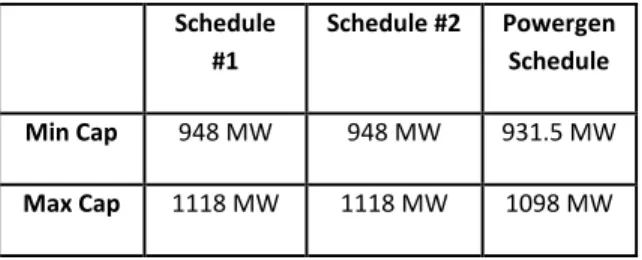
Schedule #1
Schedule #2 Powergen Schedule
Min Cap 948 MW 948 MW 931.5 MW
successfully applied. Currently at this company, no software tool is available to assist in the maintenance scheduling and economic dispatch operations. An analysis using the developed software of Powergen’s maintenance schedule for the year 2000 illustrated that, its schedule could have been optimized to produce increased minimum and maximum total power online. The analysis also revealed that an online capacity greater than the desired 920 MW could have been achieved. The results of the economic dispatch for a given 24-hour period, revealed that the net heat rate and production cost figures achieved by Powergen can be reduced by 8.32 % and 10.05 % respectively. Hence, in order to achieve this reduction in production cost and heat rate, the current strategy used at Powergen to load the generating units must be revisited. In conclusion, since maintenance scheduling determines the availability of generating units for economic dispatch, a software tool such as this, when applied to practical power systems can result in an improvement in system reliability and economic operation.
References
[1] Billinton, R. and Allan, Ronald N. (1984), Reliability Evaluation of Power Systems, Pitman Advanced Publishing Program, Great Britain, p.398.
[2] Knight, U.G., (1972), Power Systems Engineering and Mathematics, Pergeamon Press, p. 6-13
[3] Marwali, M. and Shahidehpour, M. (2000), Maintenance Scheduling In Restructured Power Systems, Kluwer Academic Publishers, p.14
[4] Pfleeger, S. (1998), Software Engineering”, Prentice Hall, p. 35
[5] Stoll G. Harry, (1989), Least-Cost Electric Utility Planning, Wiley Interscience, p. 421-423.
[6] Yamayee, Z. A. (1982), “Maintenance scheduling: description, literature survey and interface with overall operations scheduling”, IEEE Transactions on Power Apparatus and Systems, PAS-101, No.8, pp.2770-2779.