ISOLATION AND IDENTIFICATION OF MARINE
PHYTOPLANKTONS FOR PRODUCTION OF
CARBOHYDRATE TYPE BIOMASS
Syahruddin Kasim
[a]and
M. Sjahrul
[a]*Keywords: Types of sea phytoplankton, Biomass production, Carbohydrate content, Phytoplankton culture, Arschat medium
The primary aim of the present study was to isolate and identify a number of sea phytoplanktons for biomass production and determination of carbohydrate content. Sea phytoplankton was cultivated in cultured media “Ares-chat” to multiply seeds and cultivated stocks. In the mass media cultivation, isolation and identification of sea plankton was done based on size and some specific characteristics. The measurement of temperature, salinity and pH was also done in the media. The biomass weight of the density of selected phytoplankton was done by gravimetric method and the carbohydrate content was determined by glucose with Luff School method. The isolation results indicate six different types of sea phytoplanktons: Chlorella sp., Dunaliella sp., Tetraselmis chuii,Chaetoceros calcitrans, Chaetoceros gracilis, and Chaetoceros Isocrysis galbana. The highest biomass content 0.34 gL-1 was on Chlorella sp. and the lowest 0.14 gL-1 was on
Isocrysis galbana. The carbohydrate content was also varied, the highest 31.99% on Dunaliella sp. and the lowest 4.70% on Chaetoceros gracilis.
* Corresponding Authors
E-Mail: [email protected]
[a] Department of Chemistry, University of Hasanuddin F.MIPA, Makassar, Indonesia
Introduction
Microsize water organisms floating with the water movement are known as plankton.1 Plankton concentration at the surface of sea water varies from 500 cells/mL to 10 cells m/L.2 Plankton plays an important role and sometimes dominates material cycle in sea.3 Planktons are divided into two groups: phytoplankton and zooplankton.4,5
Most phytoplankton are very small to see by the naked eye, but large in number. They appear as green in color in water due to chlorophyl in their cells, although the real color is varied for each species due to the presence of an extra pigment such as phycobiliprotein.6,7 Phythoplankton usually gathers at the euphotic zone where light intensity that makes photosynthesis possible (Arinardi et al., 1997 and Richtel, M., 2007). Phytoplankton gets energy by photosynthesis,8,9 for which they must be on the sea surface (called as euphotic zone), lake or other source of water. Through photosynthesis, phytoplankton produces a lot of oxygen into the earth’s atmosphere.10 Because of the photosynthesis, the organism lives on the surface of water, and are also able to produce carbohydrate (glucose).11,12 The ability of phytoplankton to synthesise its organic material, make them to be the main source of food chain in the sea ecosystem and fresh water (Fig.1)12
This planktonic organism is usually colleted by using a net. Based on the size of mesh of the net, phytoplankton is classified as megaplankton (bigger than 0.2 mm;) and macro lankton (0.2-2.0 mm).
Microplankton is sizes 20-0.2 mm.13 A plankton which is captured by filter milipore is known nanoplankton, whereas
a very small plankton sizes 2-20 µm, ultraplankton, a smaller plankton less than 2 µm.14
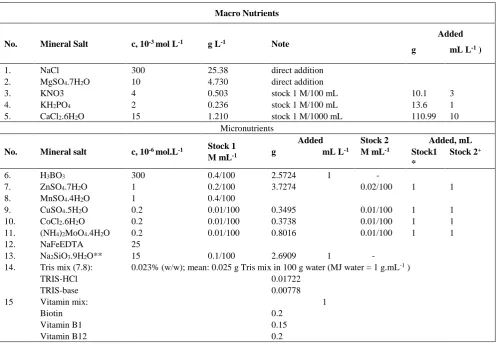
Table 1. Macronutrients (A) and micronutrients (B) for marine alga production
Macro Nutrients
No. Mineral Salt c, 10-3 mol L-1 g L-1 Note
Added
g mL L-1 )
1. NaCl 300 25.38 direct addition
2. MgSO4.7H2O 10 4.730 direct addition
3. KNO3 4 0.503 stock 1 M/100 mL 10.1 3
4. KH2PO4 2 0.236 stock 1 M/100 mL 13.6 1
5. CaCl2.6H2O 15 1.210 stock 1 M/1000 mL 110.99 10
Micronutrients
No. Mineral salt c, 10-6 mol.L-1 Stock 1 M mL-1
Added Stock 2 M mL-1
Added, mL
g mL L-1 Stock1
*
Stock 2+
6. H3BO3 300 0.4/100 2.5724 1 -
7. ZnSO4.7H2O 1 0.2/100 3.7274 0.02/100 1 1
8. MnSO4.4H2O 1 0.4/100
9. CuSO4.5H2O 0.2 0.01/100 0.3495 0.01/100 1 1
10. CoCl2.6H2O 0.2 0.01/100 0.3738 0.01/100 1 1
11. (NH4)2MoO4.4H2O 0.2 0.01/100 0.8016 0.01/100 1 1
12. NaFeEDTA 25
13. Na2SiO3.9H2O** 15 0.1/100 2.6909 1 -
14. Tris mix (7.8): 0.023% (w/w); mean: 0.025 g Tris mix in 100 g water (MJ water = 1 g.mL-1 )
TRIS-HCl 0.01722
TRIS-base 0.00778
15 Vitamin mix: 1
Biotin 0.2
Vitamin B1 0.15
Vitamin B12 0.2
Notes: * Use 1 mL of stock solution to make a stock solution of 2; + Use 1 mL of stock solution 2 to make 1 L medium; ** Use for diatom
Experimentals
Materials and methods
Seeds extracted from pure cultures Pitoplankton Research Institute of Fisheries and Marine Maros, South Sulawesi.
Instrument and Apparatus
Equipment cups: Consists of the culture vessel, covering 1000 mL bottle size, tank size of 60 liters and a set of glassware. Salinity was measured salinity meter.
Identification of types of sea plankton with high carbohydrate content
Isolation and identification of phytoplanktons
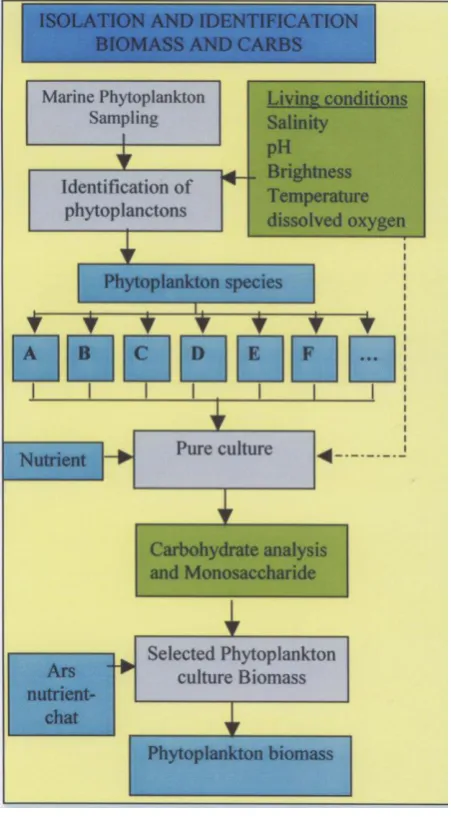
Isolation of phytoplankton in the present study was done by taking samples of mass culture result for shrimp feed which contains bacteria and/or other microorganism such as Protozoa. In order to get pure phytoplankton strain, washing the cell at the new culture media and planted in medium to be selected for study. The culture medium used was modification of several culture media with artifial sea water which is known as “Ars-chat” which stands for
Arifin-Syahrul-Syahruddin-Henk Schat. Whereas the jelly medium was made by mixing the gelatin in medium solution of Ars-chat as much as 1% (10 grams). After autoclaved, it was poured into a gelatin plate each about 20 ml. When the gelatin plate is cool, 3 drops are spread over the surface of gelitin plate by a sterile pipette. After a span of 3 to 5 days the growth of phytoplankton cell colony was observed and found that phytoplankton did not associate with colony of bacteria. Further, 2-5 cells of phytoplankton were implanted in a test tube containg Ars-chat for phytoplankton culture of about 5-10 mL. After a span of 8 – 15 days the phytoplankton cell would grow with high density (103 – 106 cells/mL). Then the seed of this phytoplankton cell was planted in the medium Ars-chat of which the volume was more (in Erlenmeyer glass of 50 mL, 250 mL, and 500 mL) then in culture bottle 1000 mL.
Further culture was done to multiply the seed aside from being kept for culture stock.
Physico-chemical parameters of water samples
Figure 2. Research method
Pure Culture of Phytoplankton
Pure culture of phytoplankton was initiated by innoculating seed of phytoplankton cell into a culture tube with density of low phytoplankton cell in Erlenmeyer flask of 500 mL. After observing for 8 days,the culture condition was seen to be old enough (density ranges from 105-106 sel/mL) the culture was divided into 3 parts. The first and second parts each 200 mL was put into a culture bottle volume 1 liter. Whereas the rest 100 mL was added with medium Ars-chat as much as 400 mL, to make it to 500 mL culture volume in erlenmeyer flask as culture stock again kept for 8 days in the future. Whereas the 1 Liter volume culture after 8 days was shifted to aquarium volume of 60 liters. For both culture bottles of 1 liter, each of its growth pattern was observed daily for ten days by using Haemositometer through microscope.. At this culture the flow of its specific growth was observed using the formula:
0 lnNt lnN
t
(1)
where
Nt is the density of the cell population at the time t
(cells mL-1)
N0 is the density of the cell population at baseline
(cells mL-1)
µ is the specific growth rate constant (hr-1) t is the time (hours)
The amount of bomass in each liter culture volume was observed by filtering culture medium during the optimum growth by using a suitable filter paper as per the size of phytoplankton. The weight of phytoplankton was set by weiging the filter paper used before and after.
Biomass culture of selected phytoplankton types and Its weight determination.
Referring to physico-chemical parameter, the growth condition of phytoplankton in field measured in situ, selected phytoplankton was cultured in large amount at aquarium of 60 liters. After the density of optimal phytoplankton, 1 liter was taken out for the mass culture to determine its biomass gravimetrically. Then harvesting process was done by stopping the light and aeration for about 3 days for the separation between water and phytoplankton by sedimentation.
Analyzing carbohydrate contents of selected phytoplankton.
Carbohydrate analysis was done by using glucose reduction determination method of Luff Schoorl.
Results and Discussion
Isolation and Identification of sea phytoflankton
This study has been carried out for the isolation and identification of a number of marine phytoplanktons from both, dinoflagellate and diatom groups: Dinoflagellate consists of Chlorella sp., Dunaliella sp., and Tetraselmis chuii, diatom species of Chaetoceros calcitrans consist of,
Chaetoceros gracilis and Chaetoceros Isocrysis Galbana
(Table 2).
Observation result on the growth of flagellate types:
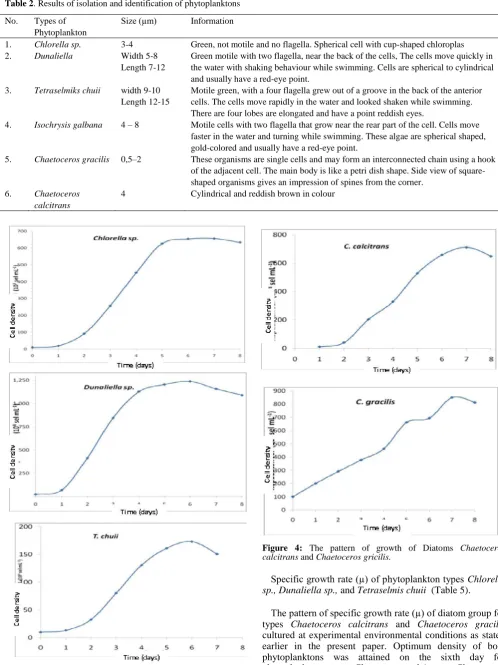
Chlorella sp., Dunaliella sp., and Tetraselmis chuii, in artificial water medium (Fig.3). Observation result of growth pattern of diatom Chaetoceros calcitrans and
chaetoceros gracilis in artificial water medium (Fig. 4).
The growth pattern of the three phytoplanktons viz.
Chlorella sp., Dunaliella sp. and Tetraselmis chuii cultured at experimental environmental conditions, such as culture temperature, continuous light, nutrient used, salinity of sea water for each species of phytoplankton. Water pH applied and aeration CO2, show growth pattern similar to one which underwent 3 stages of growth, namely adjustment, splitting and growth-dead. Optimum density was attained on the seventh day for pythoplankton type Chlorella sp. and for
Table 2. Results of isolation and identification of phytoplanktons No. Types of
Phytoplankton
Size (µm) Information
1. Chlorella sp. 3-4 Green, not motile and no flagella. Spherical cell with cup-shaped chloroplas 2. Dunaliella Width 5-8
Length 7-12
Green motile with two flagella, near the back of the cells, The cells move quickly in the water with shaking behaviour while swimming. Cells are spherical to cylindrical and usually have a red-eye point.
3. Tetraselmiks chuii width 9-10 Length 12-15
Motile green, with a four flagella grew out of a groove in the back of the anterior cells. The cells move rapidly in the water and looked shaken while swimming. There are four lobes are elongated and have a point reddish eyes.
4. Isochrysis galbana 4 – 8 Motile cells with two flagella that grow near the rear part of the cell. Cells move faster in the water and turning while swimming. These algae are spherical shaped, gold-colored and usually have a red-eye point.
5. Chaetoceros gracilis 0,5–2 These organisms are single cells and may form an interconnected chain using a hook of the adjacent cell. The main body is like a petri dish shape. Side view of square-shaped organisms gives an impression of spines from the corner.
6. Chaetoceros calcitrans
4 Cylindrical and reddish brown in colour
Figure 3. Growth pattern of dinoflagellate species Chlorella sp.,
Dunaliella sp., and Tetraselmis chuii.
Figure 4: The pattern of growth of Diatoms Chaetoceros calcitrans and Chaetoceros gricilis.
Specific growth rate (µ) of phytoplankton types Chlorella sp., Dunaliella sp., and Tetraselmis chuii (Table 5).
The pattern of specific growth rate (µ) of diatom group for types Chaetoceros calcitrans and Chaetoceros gracilis
Table 4. Phytoplankton density of Chlorella sp., Dunaliella sp.,
Tetraselmis chuii, at the 8th day of culture
Table 5. Phytoplankton cell density and specific growth rate ()
Table 7. Phytoplankton cell density and specific growth rate ()
Biomass culture and determination of dry weight of selected phytoplankton
Determination of the relationship between biomass dry weight of phytoplankton and culture volume in optimum phase (Table 8).
Table 8. Relationships of phytoplankton biomass dry weight and 1 liter of culture volume in the optimum phase
To predict the biomass obtained from mass culture of phytoplankton, dry weight test was done. Based on dry weight test of biomass of phytoplankton cultured with Arschat medium, it was observed that for phytoplankton of dinoflagellata type was having higher dry weight as compared to phytoplankton of diatom type. From the data it can be concluded that to obtain biomass in large amount, it is suggested to culture the type of dinoflagellata with dry weight as much as 0.34 mg/L, 0.33mg/L, and 0.28 mg/L mass culture medium respectively for phytolanktons
Chlorella sp., Tetraselmis chuii, and Dunaliella sp.
Table 6. Density and Chaetoceros calcitrans phytoplankton
Chaetoceros gracilis cultures on 8th day
Specific growth rate (µ) of pythoplankton types
Chaetoceros calcitrans and Chaetoceros gracilis can be seen in Table 7.
Carbohydrate analysis of selected phytoplankton
The results of carbohydrate test contained in each sea phytoplankton are recorded in Table 9.
Table 9. Carbohydrate levels on various types of species of phytoplankton biomass in the culture.
No. Types of phytoplankton
Carbohydrate levels (%)
1. Chlorella sp. 30,75 2. Dunaliellasp. 31.99 3. Tetraselmis chuii 26,68 4. Chaetoceros
calcitrans
6,02
5. Chaetoceros gracilis 4,70 6. C. Isocrysis galbana 12,00
On the basis of the type of cultured phytoplankton, it is apparent to note that phytoplankton which has higher percentage of carbohydrate content is from dinoflagelata group, and that are of phytoplankton types Dunaliella sp., Chlorella sp. and Tetraselmis chuii, which have carbohydrate content up to 31.99%, 30.75% and 26.68% respectively.
Time (days)
Types of Phytoplankton density, cells mL-1
Chlorella sp.
(105)
Dunaliella sp.
(104) T. chuii (10 4)
0 10,000 25,000 10.000
1 19,583 69,333 13.167
2 92,000 412,667 32.333
3 257.000 844,333 80.333
4 453,833 1.126,500 130.667
5 627,333 1.204,667 161.333
6 654,000 1.238,333 173.250
7 656,333 1.158,667 150.667
8 634,000 1.089,333 131.255
Species Size µm t, days Observations, cells mL-1 µ, d-1)
No Nt
Chlorella sp. 3–4 6 1.000.000 66.000.000 0.0318
Dunaliellasp. 8 6 250.000 13.500.000 0.0302
Tetrasel mis chuii 10–15 7 100.000 1.725.000 0.0198
Species Size (µm) t, days Observation cells mL-1 µ, d-1
Noa Nt
Chaetoceros calciptrans 4 6 100.000 7.133.333 0.0291
Chaetoceros gracilis 0,5–2 6 25.000 2.236.667 0.441
No. Types of phytoplankton
Biomass dry weight, mg L-1
1. Chlorella sp. 0,34 2. Dunaliellasp. 0,28 3. Tetraselmis chuii 0,33 4. Chaetoceros calcitrans 0,27 5. Chaetoceros gracilis 0,24 6. C. Isocrysis galbana 0,14
Time, days
Types of phytoplankton density, cells mL-1
Chaetoceros calcitrans (104)
Chaetoceros gracilis
(104)
0 10,000 2,500
1 42,167 10,333
2 206,667 51,667
3 331,667 112,000
4 533,333 174,667
5 660,000 198,333
6 713,333 223,667
7 650,000 216,667
Conclusions
Isolation results for six types of phytoplanktons are obtained. They are Chlorella sp., Dunaliella sp., Tetraselmis chuii,. Chaetoceros calcitrans, Chaetoceros gracilis and
Chaetoceros Isocrysis galbana. The highest biomass 0.34 g/L is of Chlorella sp. of dinoflagellata type and the lowest is 0.14 g/L of Isocrysis galbana of diatom type, whereas the highest carbohydrate content is in Dunaliella sp. i.e. 31.99% of dinoflagellata type and the lowest is in Chaetoceros gracilis i.e. 4.70% of diatom type. Phytoplankton with high carbohydrate content is suggested to be processed further to become vegetable fuel.
References
1Arinardi, O.H., A.B. Sutomo, S.A. Joseph, Trianingnsih, E. Asnaryanti and S. H. Riyono.. Plankton Abundance composition range and predominant in Indonesia East Regioun at Territolrial of the See. P3O-LIPI. Jakarta. 1997
2Bu-Olayan, A.H., Al-Hassan, R., Thomas, B.V., Subrahmanyan, M. N., Environ. Int.2001, 26(4), 199.
3Brand Larry E., Sunda William G., and Guillard R. R. L.. J.Exp.
Marine Biol. Ecol., 1986, 96(3), 225.
http://dx.doi.org/10.1016/0022-0981(86)90205-4)
4Bold, H. C., Wynne, M. J. Introduction to the algae: Structure
and Reproduction, 2nd Ed., Prentice-Hall. Inc., New Jersey
1985.
5Botes. L, Phytoplankton Identification Catalogue, Globallast Monograph Series No.7. IMO London, Saldanha Bay, South Africa, 2001.
6Cermeno, P., de Vargas, C., Abrantes, F., Falkowski, P. G. PLOS
ONE2010, 5(4), e10037.
7Jobman, D., Will ethanol produce a bull market in Corn? Chicago Board of Trade, 2006.
(http://www.cbot.com/cbot/docs/74305.pdf) 8Fenchel. T., Ann. Rev. Ecol. Syst., 1988, 19.
9Joint, I., Jordan, M. B., J. Plymouth Marine Lab., 2008, 30(2), 199.
10Methods of Biochemical Analysis and Food Analysis using Test
Combination, Boehringer Mannheim GmbH Biochemica, Germany, 1987.
11Miljanovic, B., Mijic, I., Jovanovic, V., Sipos, S., Response of
Phytoplankton Association of Zavoj Reservoir to Seasonal Variation in Hydrochemical Parameters, Balwois, Ohrid, Republic of Macedonia, 2010, No.25.
12Morel, F. M. M., J. Compilation Geobiol.,2008, 6, 318. 13Newell, G. E., Newell, R. C., Marine plankton: A practical guide,
Hutchinson Educational LTD Great Portland Street, London, 1963, vol.1. 178-202.
14Parker D. L., Rai, L. C., Mallick, N., Rai, P. K., Kumar, H. D., J.
Appl. Environ. Microbiol., 1988, 64(4), 1545. 15Richtel. M, The New York Times, 01 May, 2007
16Thurman. H. V, Introductory Oceanography, Prentice Hall College, New Jersey, USA,1997; Kotai, L., Gacs, I., Eur. Chem. Bull., 2012,1(1), 1;
17Yamaji. I, Ilustrations of the marine plankton of Japan. Hoikusha publishing Co., Ltd. 1982.