International Journal of Advances in Management and Economics
Available online at:
www.managementjournal.info
RESEARCH ARTICLE
The Industry Driving Effect and Development Strategy of Macao
Convention and Exhibition Industry
Yang Shao-hua, Liu Yang*
International Business School,Jinan University, Qianshan, Zhuhai, Guangdong, China.
*Corresponding Author:[email protected]
Abstract
In recent years, Macao's pillar industry-gambling industry has declined. Gambling industry‘s proportion of GDP in 2015 has been reduced to 34%, facing the industrial restructuring and economic adjustment. The exhibition industry, as the leading industry in Macao, is one of the choices to promote the economic diversification and promote the economic transformation of Macao. Based on this, this paper uses exhibition industry data and related index data of the period from 2007 to 2016. Through the cointegration analysis and Granger causality test method, the paper analyzes the driving effect of Macao exhibition industry. The results show that the exhibition industry in Macao has not only stimulated the tourism industry, hotel industry and retail industry, but also has important stimulating and economic effects on other related industries, so as to put forward the strategy of further development of the exhibition industry.
Keywords: Exhibition Industry, Industry - driven effect, Industry linkage, Industrial development strategy.
Introduction
With a land area of 32.8 square kilometers and a population of 580,000, Macao is a micro-economic entity. Since the reunification, Macao’s economic and industrial development has been changing with each passing day. As the leading industry in Macao, the gaming industry has provided powerful conditions for further economic and cultural advancement in Macao. Driven by the gaming industry, Macao’s economy has grown rapidly, with a GDP of 370 billion patacas in 2015.
However, the status quo of “one industry alone” in the gaming industry has created a single industrial structure in Macao, posing certain risks to the long-term prosperity of the economy, becoming an unstable factor in Macao’s economic and social development and detrimental to sustainable development.
In the past two years, the sharp decline in revenue of the gaming industry has dropped from 352.7 billion patacas in 2014 to 231.8 billion patacas in 2015, which has had a more adverse impact on the economy. Under the national “One Belt and One Road” policy, the economy of Macao needs moderate diversification, while opportunities and challenges coexist.
Review of Related Literature
Liu Yang et. al.| May-June 2018 | Vol.7 | Issue 3 |33-46 34
the added value of the exhibition industry has increased by nearly six times in ten years, which has promoted economic growth from various aspects such as investment and consumption. Based on the well-developed service industry base in Macao, the development of the convention and exhibition industry will have a positive effect on the tourism, hotel industry, retail industry, and accommodation and catering industries.
It will become the optimal choice for Macao to implement its industrial diversification strategy. The development of the exhibition industry to promote the appropriate diversification of the Macao economy and foster the new growth point of Macao's economic development has strategic and theoretical values that cannot be ignored. At present, domestic and international research on the MICE industry in Macao mainly focuses on the following aspects:
Comparative Study on the Development of MICE Industry in Macao and Other Exhibition Cities
Leong [1] advocated that the development of MICE industry in Macao should draw on the experience of major exhibition cities in Mainland China such as Beijing, Shanghai, Guangzhou, Dalian and Shenzhen. Tan [2] conducted a comparative analysis of the attractiveness of Macao and Singapore as international conference and exhibition cities. The results show that compared with Singapore, Macao has advantages in economic development and infrastructure, but in terms of service quality, air environment, and international direct flights, Macao is on the disadvantages.
Glyn Wootton & Terry Stevens [3] analyzed the current state of industrial development in Wales and found that the exhibition industry provided a value of 294 million francs for Wales' industrial development through the survey data of 74 hotels. Glyn & Terry believes that the exhibition tourism industry is developing rapidly and is expected to
replace the declining tourist hotel industry as a new economic growth point, spur the development of other industries, and have the potential for further promotion. Johnson Foo & O’Halloran [4] analyzed the status of the Australian convention and exhibition industry and found that the Australian convention and exhibition industry can bring about 7 billion yuan in direct economic income to Australia each year, which greatly promoted the economic development.
In general, both have their own lengths. Liang Wenhui [5] compared and analyzed the conditions of the development of Macao and Las Vegas and Atlantic City, and found out the gap between the developments of Macao as a competitive conference tourism city, and proposed that the language communication ability and service standards should be strengthened. Besides, Macao needs to increase the venue of the exhibition and improve the exhibition infrastructure and services.
Study on the relationship between the MICE industry and other industries in Macao
Liang Wenhui and Nadkarni [6] explored the advantages and disadvantages of Macao as a convention and exhibition city, based on the direction of Macao’s tourism development. Through investigations and studies on related stakeholders in the industry, the future prospects for the development of the convention and exhibition industry in Macao are explained.
Luo Wei [7] studied the interactive effect of exhibition economy and urban economy. The co-integration analysis and Granger causality analysis to empirically study the interactive relationship between urban exhibitions and urban economy, and established a vector error correction model between urban exhibitions and other industrial structures.
Hu Meng and Wang Haiyu [8] believe that the impact of the development of the convention and exhibition industry on urban economic growth can be divided into a one-time direct economic impact and a persistent indirect economic impact.
Chen Zhangxi and Wang Jiang [9] used the grey relational analysis method to empirically analyze the relevant industrial data from 2000-2009 in the Macao region, showing that the Macao convention and exhibition industry has made a significant contribution to the tertiary industry in Macao and has also led to retail sales, etc. The development of the industry drives investment, employment and economic growth. Han Tingyang and Wang Zhen [10] used a multiple linear regression model to analyze the relationship between the MICE industry and related industries in Macau, and used a grey model to empirically study how the MICE industry in Macau can greatly promote the development of the tertiary industry.
A theoretical assessment model for the impact of the convention and exhibition industry on urban economic growth was constructed and the exhibition industry was measured. Yue Hao and Li Xinyi et al. [11] believe that there is a condition for mutual development between the Macau gaming industry and the convention and exhibition industry. The exhibition industry can use its strong linkage effect to drive the development of related industries and improve the unreasonable industrial structure in Macao. Macao's industrial diversification goal.
Regional Cooperation Research on the Development of MICE Industry in Macao
Lin Zhou [12] analyzed the competitive situation formed by the domestic convention and exhibition industry under the framework of CEPA. The development of the convention and exhibition industry in the Greater Pearl River Delta Economic Zone identified the unique advantages of developing the convention and exhibition industry in Macao,
and proposed that developing the convention and exhibition industry in Macao should seek complementary cooperation.
Chen Na [13] analyzes the feasibility of the cooperation between Macao and Guangdong in developing MICE industry from the perspective of regional cooperation and proposes development strategies and measures for the cooperation between MICE industry and Guangdong.
Influencing Factors
This article believes that the factors affecting the MICE industry can be summarized as:
Production Factors
The factor of production refers to the performance of a country in relation to production in the competition of a particular industry, and it must be possessed by each country. It includes knowledge and human resources, natural resources, capital resources, and infrastructure. It is the most basic element of industrial competitiveness and the most important competitive condition for any industry.
There are few natural resources in Macao and it is difficult to develop agriculture and industry. As an island city, it does not have an advantage in resource endowment. Compared to island cities such as Hong Kong, the natural ecological coastline of Macao is largely absent and the geological structure has undergone certain changes. Without excellent ports, it is difficult to develop large-scale logistics industry.
Liu Yang et. al.| May-June 2018 | Vol.7 | Issue 3 |33-46 36
From the perspective of human resources, Macao has a large population density, a low level of higher education, and lack of professional labor, which has become a constraint on economic development. High-quality talents mostly choose employment in the Pearl River Delta and Hong Kong, and the brain drain is serious. The gaming industry has a low threshold and high income.
In 2015, the average monthly salary of Macao’s gambling industry personnel was 19,000 patacas, equivalent to approximately RMB 16,171, which is a great temptation for young people. With the economic development, due to the low quality of the overall workforce, the phenomenon of lack of professional workers may also continue, and the relative shortage of talents that can meet the development of the convention and exhibition industry.
Requirements
Porter's theory places great emphasis on the role of domestic demand in stimulating and improving industrial development. From the perspective of GDP, Macao's GDP grew rapidly from 2000 to 2015, rising from 49,828 million patacas to 368,728 million patacas, an increase of nearly 6 times. In terms of employment opportunities, the total unemployment rate in Macao was 6.8% in 1999. By 2015, the unemployment rate was only 1.8%.
Judging from the industrial structure, since the 1980s, gaming tourism, export processing, real estate construction, and finance and insurance have become four pillar industries. After opening up the gaming operation rights in 2002 and the central government’s implementation of the “free movement” of mainland residents to Hong Kong and Macao in 2003, Macao’s gaming and tourism industry has achieved an astonishing development. The gaming industry’s share of GDP has remained above 80% for 7 years, and the gaming industry has gradually
become the main pillar of economic growth in Macao.
Internal Factors
The internal factors of the development of the exhibition industry mainly include the exhibition venues, exhibition personnel and industry associations. The exhibition venues are the venues for holding exhibitions and events and have a direct relationship with the development of the exhibition industry.
Good infrastructure construction is an indispensable hardware condition for carrying out convention and exhibition activities. Since 2006, the Macao Tower Convention and Exhibition Arts Museum, the University of Macao Conference Center, the Tourism Activity Center, and the Macao World Trade Center have been completed one after another. In particular, the Macao Venetian Golden Light Convention and Exhibition Center, officially opened on October 1, 2007,which is an international exhibition venue covering an area of 800,000 square meters.
In 2015, there were 67 professional exhibition venues with an area of 854,095 square meters. With the opening of the Parisian Resort in Macao in September 2016, it will bring new venues to the city. The annual number of exhibitions will reach 100 billion. More international clients will come to Macao to hold the conference. The exhibition industry in Macao has been greatly improved.
However, compared with many industry associations in many developed countries, the establishment of industry associations was too short and was constrained by various factors and conditions. There are many institutional and normative standards in the industry associations of the convention and exhibition industry, and there is still space for improvement.
Convention and Exhibition Policy
Since the signing of CEPA in 2011, it has become more convenient for mainlanders to visit Macao. The Macao Tourism Administration has updated the “Incentives for the Development of the Business Travel Market” and has stimulated the development of the Macao convention and exhibition industry through generous exhibition subsidies.
In 2012, the Macao Tourism Administration launched the “MICE Event Incentive Plan” to provide eligible exhibition venue rental subsidies and certain discounted hotel house price allowances for eligible exhibitions to attract exhibitors and promote the development of the Macao convention and exhibition industry.
The country pointed out in the “Outline” of the “Thirteenth Five-Year Plan” that it supports Macao’s efforts to build a “World Tourism and Leisure Center”, a business service cooperation platform between China and Portuguese-speaking countries, and
actively develop industries such as convention and exhibition, commerce and trade, and promote the moderate diversification of Macao’s economy. The development of the MICE industry in Macao provides a good opportunity and platform.
Empirical Analysis
Data Analysis
This article takes the development of the MICE industry in Macao as the research object and selects the value added from the MICE industry in Macao as the development level of the MICE industry as a dependent variable. According to the industry association of exhibition economy and the status quo of the development of the MICE industry in Macao, this article selected the tourism industry, wholesale and retail industry, warehousing, transportation and communication industry, and hotel industry which are closely related to the development of the MICE industry in Macao. It has analyzed the industrial driving capacity and industrial structure of the MICE industry in Macao.
Taking into account the representativeness and availability of data, the tourism industry has taken the added value of tourism, the retail industry has taken retail revenue, the hotel industry has taken in the hotel industry, and the transportation industry has gained value from the transportation industry.
Table1: 2007-2015 Macao Convention and Exhibition Industry and Related Industries Development Data(Thousand pandas)
Year MICE TRA RAT HOTEL TRAF
2007 1977 500379 303464 2369248 2630265
2008 10390 472851 284990 4364011 2178183
2009 14964 508833 318808 5177192 2236221
2010 28994 561568 319973 7091779 3227060
2011 40147 618793 375809 9336059 3578074
2012 71839 784567 472926 10314683 4138308
2013 77599 820214 472291 12285194 4717794
2014 53943 1046479 455116 14511807 5599016
2015 70115 953649 420162 13172811 6121257
2016 103498 944459 395776 14178565 6972462
Liu Yang et. al.| May-June 2018 | Vol.7 | Issue 3 |33-46 38
This article adopts the single factor analysis method and uses the time series analysis model to test the stationarity of variables, Granger causality test, and cointegration test. Finally, an error correction model is established. A cointegration test with two variables was used to analyze whether there was an equilibrium relationship between the MICE industry and related industries in Macao.
When establishing a co-integration regression model, it is required that the time series must be stable. First, the time series should be tested for stationarity. The so-called time series data refers to statistical data of various variables arranged in chronological order, and the time series analysis method is selected. The steps to establish a time series analysis model are: 1.ADF unit root test on the original sequence.2.after a smooth
cointegration test, or after a difference, the cointegration test is performed after the difference is smooth.3.The Granger causality test is performed.
Stationary Test
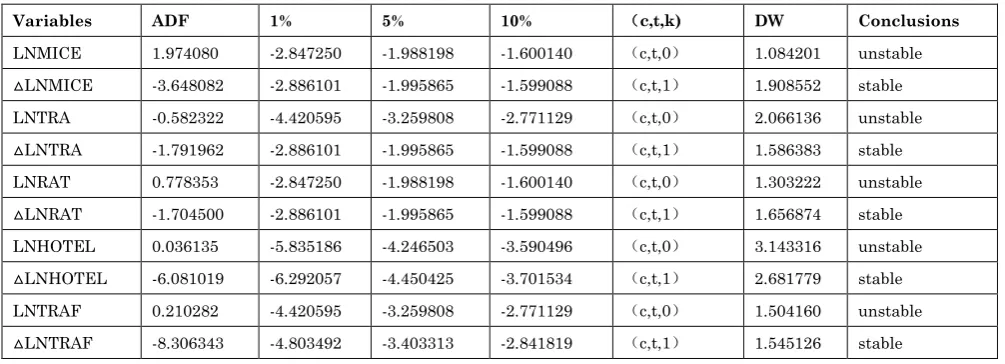
In the process of dynamic econometric modeling, the time series involved are all stationary time series. However, in practical problems, most of the time series are not stationary time series and need to be adjusted by using the difference method. Therefore, when a random time series is obtained, it is firstly judged whether the sequence is stable. Stationarity tests are divided into using scatter plot tests, sample autocorrelation function tests, and unit root tests. Due to the higher accuracy of the unit root test, the ADF unit root test is used in this paper to check the stability of the time series data.
Table 2: Unit root test results
Variables ADF 1% 5% 10% (c,t,k) DW Conclusions
LNMICE 1.974080 -2.847250 -1.988198 -1.600140 (c,t,0) 1.084201 unstable
△LNMICE -3.648082 -2.886101 -1.995865 -1.599088 (c,t,1) 1.908552 stable
LNTRA -0.582322 -4.420595 -3.259808 -2.771129 (c,t,0) 2.066136 unstable
△LNTRA -1.791962 -2.886101 -1.995865 -1.599088 (c,t,1) 1.586383 stable
LNRAT 0.778353 -2.847250 -1.988198 -1.600140 (c,t,0) 1.303222 unstable
△LNRAT -1.704500 -2.886101 -1.995865 -1.599088 (c,t,1) 1.656874 stable
LNHOTEL 0.036135 -5.835186 -4.246503 -3.590496 (c,t,0) 3.143316 unstable
△LNHOTEL -6.081019 -6.292057 -4.450425 -3.701534 (c,t,1) 2.681779 stable
LNTRAF 0.210282 -4.420595 -3.259808 -2.771129 (c,t,0) 1.504160 unstable
△LNTRAF -8.306343 -4.803492 -3.403313 -2.841819 (c,t,1) 1.545126 stable
According to the ADF test, the variables LNMICE, LNTRA, LNTAT, LNHOTEL, and LNTRAF are single integer time series I(1).
Cointegration Test
Macao's convention and exhibition industry is a new industry in Macao. With a short development period and limited data availability, this paper adopts the E-G two-step method for co-integration testing. An important condition for cointegration is that the residual estimator ut of the regression equation is smooth. In this paper,
the two-variable E-G two-step test is used to perform least-squares regression on the variables and then test the stationarity of the residual sequence. If the residual sequence is stationary, there is a cointegration relationship between the variables, otherwise it does not exist.
Liu Yang et. al.| May-June 2018 | Vol.7 | Issue 3 |33-46 39
have a cointegration relationship. If the two time series {Xt}, {Yt} are non-stationary, they cannot generally be directly used for regression analysis, and they can easily lead to spurious regression. However, if they are co-integrated, the least square method can be used for regression estimation.
The steps of the E-G two-step cointegration test based on residuals are:
First check whether the non-stationary sequences Yt and Xt are all I (1).
If the sequences are all I (1), the least-squares method (OLS) is used to estimate the cointegration regression model (long-term equilibrium model).
Estimate the regression model using the OLS method. The following cointegration test of the data:
oThe exhibition industry is the dependent variable and the tourism industry is the independent variable. It is derived from the least square method.
LNMICE = −33.24901 + 3.241042LNTRA + et After adding the lag item, the model is:
LNMICEt= −0.93 + 0.53LNMICE(t−1)− 0.31LNTRAt+ 0.77LNTRA(t−1) Next, check the stationarity of the residual sequence. The test results are as follows:
ADF 1% 5% 10% p conclusion
-4.050795 -4.420595 -3.259808 -2.771129 0.0165 stable
Given the significant level of 10%, the concomitant probability is less than 0.1, indicating that there is no non-stationary factor in the residual sequence e𝑡, and there
is a long-term co-integration relationship between the MICE industry and the tourism industry in Macao. To make the model shift:
∆LNMICE𝑡 = −0.93 − 0.31∆LNTRA𝑡− 0.47(LNMICE𝑡−1− 0.98LNTRA𝑡−1)
LNMICE𝑡−1− 0.98LNTRA𝑡−1 is the error correction term ECM. It shows that the short-term fluctuations of ∆ LNMICEt are affected by LNTRAt on the one hand, and the error correction term ECM on the other. ECM reflects the extent to which the short-term fluctuations of the variables deviate from equilibrium. From this, it can be concluded that the long-term relationship between the
two variables is INMICE=0.98LNTRA, indicating that every 1% increase in the MICE industry in Macao will affect the increase in tourism value by 0.98%.
oThe exhibition industry is the dependent variable and the retail industry is the independent variable. It is obtained by the least squares method:
LNMICE = −54.76614 + 5.071682LNRAT + e𝑡
The coefficient of determination of the model is 0.89, which shows that the model has a
good fitting effect. When considering adding a lag item, the model that results in a lag phase is:
LNMICE𝑡= −6.66 + 0.48LNMICE(𝑡−1)+ 0.52LNRAT𝑡+ 0.45LNRAT(𝑡−1)
Next, check the stationarity of the residual sequence. The test results are as follows:
ADF 1% 5% 10% p conclusion
-3.740006 -4.420595 -3.259808 -2.771129 0.0254 stable
Liu Yang et. al.| May-June 2018 | Vol.7 | Issue 3 |33-46 40
indicating that there is no non-stationary factor in the residual sequence e𝑡, and there
is a long-term co-integration relationship
between the MICE industry and the retail industry.To make the model shift:
∆LNMICE𝑡 = −6.66 + 0.52∆LNRAT𝑡− 0.52(LNMICE(𝑡−1)− 1.87LNRAT(𝑡−1))
LNMICE(𝑡−1)− 1.87LNRAT(𝑡−1) is the error correction term ECM. It illustrates the short-term fluctuations of ∆LNMICEt. It is affected by LNRATt on the one hand and error correction term ECM on the other. ECM reflects the extent to which short-term fluctuations of the variables deviate from equilibrium. From this, it can be concluded that the long-term relationship between the two variables is INMICE=1.87LNRAT.The
above formula shows that for every 1% increase in the Macao convention and exhibition industry, it will affect retail sales growth by 1.87%.
oThe exhibition industry is the dependent variable and the hotel industry is the independent variable. It is obtained by the least square method:
LNMICE = −21.00867 + 1.970490LNHOTEL + e𝑡
The coefficient of determination of the model is 0.95, which shows that the model has a
good fitting effect. When considering adding a lag item, the model that results in a lag phase is:
LNMICE𝑡 = −10.45 + 0.14LNMICE(𝑡−1)+ 0.94LNHOTEL𝑡+ 0.29LNHOTEL𝑡−1
Next, check the stationarity of the residual sequence. The test results are as follows:
ADF 1% 5% 10% p conclusion
-2.853641 -2.847250 -1.988198 -1.600140 0.0099 stable
Given the significant level of 10%, the concomitant probability is less than 0.1, indicating that there is no non-stationary factor in the residual sequence e𝑡, and there
is a long-term co-integration relationship between the exhibition industry and the hotel industry in Macao. To make the model shift:
∆LNMICE𝑡 = −10.45 + 0.94∆LNHOTEL − 0.86(LNMICE(𝑡−1)− 1.43LNHOTEL(𝑡−1))
LNMICE(𝑡−1)− 1.43LNHOTEL(𝑡−1) is the error correction term ECM, which illustrates the short-term fluctuations of ∆ LNMICEt, which are affected by NLNHOTELt on the one hand, and the error correction term ECM on the other hand. ECM reflects the extent to which the short-term fluctuations of the variables deviate from equilibrium. From this, it can be concluded that the long-term relationship between the two variables is INMICE=1.43LNHOTEL。
The formula above shows that for each 1% increase in the Macao convention and exhibition industry, the value added of the hotel industry will increase by 1.43%.
o The exhibition industry is the dependent variable and the transportation industry is the independent variable. It is derived from the least square method.
Liu Yang et. al.| May-June 2018 | Vol.7 | Issue 3 |33-46 41
When considering adding a lag item, the model that yields a lag is:
LNMICE𝑡 = −6.48 + 0.32LNMICE(𝑡−1)+ 1.01LNTRAF𝑡− 0.1LNTRAF(𝑡−1)
Next, check the stationarity of the residual sequence. The test results are as follows:
ADF 1% 5% 10% p conclusion
-6.431656 -5.521860 -4.107833 -3.515047 0.0042 stable
Given the significant level of 10%, the concomitant probability is less than 0.1, indicating that there is no non-stationary factor in the residual sequence e𝑡, and there
is a long-term co-integration relationship between the MICE industry and the transportation industry in Macao.
To make the model shift:
∆LNMICE𝑡 = −6.48 + 1.01∆LNTRAF𝑡− 0.68(LNMICE(𝑡−1)− 1.34LNTRAF(𝑡−1))
LNMICE(𝑡−1)− 1.34LNTRAF(𝑡−1) is the error correction term ECM, it illustrates the short-term fluctuations of ∆ LNMICEt, which are affected by LNTRAFt on the one hand and the error correction term ECM on the other hand. ECM reflects the extent to which the short-term fluctuations of the variables deviate from equilibrium. From this, it can be concluded that the long-term relationship between the two variables is INMICE=1.34LNTRAF。The above formula shows that for each 1% increase in the Macao convention and exhibition industry, the value-added growth of the transport industry will be affected by 1.34%.
Granger Causality Test
It is a powerful tool for analyzing the existence of causality in economic variables. Because the correlation between variables does not equal to causality, a causality test is required to determine the causal direction of variables and to observe the long-term trends of variables.
If for all s > 0, predict with(yt , yt-1,…, the mean square error and the mean squared error with(yt,yt-1…)and(xt,xt-1,…)are the same, y is not caused by x Grange, that is, x is about the future y radio performance information, or x is exogenous to y. Grange causality test method is to use F test for joint test:
:There is at least one q so that makes the statistical test quantity 0
) (
12
q
a :
If F Fa, reject the null hypothesis, that is,
Xt is the Grange cause of
Yt . When theGaussian distribution assumption is satisfied, the test statistic has an accurate F distribution. If not, the asymptotic equivalence test is:
Table 3: Granger test results
Granger causality F P conclusions
LNTRA does not Grange cause LNMICE 1.22374 0.3110 accept
LNMICE does not Grange cause LNTRA 8.46981 0.0270 refuse
) 1 2 /(
/ )
p T RSS
p RSS
RSS F
ed unrestrict
ed unrestrict restricted
(
) ~ )
- 2
1 1 0
2 p
RSS RSS RSS T
S ( (
, ,..., 2 , 1 , 0 : 12( )
0 a q p
H q
1
Liu Yang et. al.| May-June 2018 | Vol.7 | Issue 3 |33-46 42 LNRAT does not Grange cause LNMICE 0.42423 0.5390 accept
LNMICE does not Grange cause LNRAT 4.40093 0.0807 refuse
LNHOTEL does not Grange cause LNMICE 0.74098 0.5476 accept
LNMICE does not Grange cause LNHOTEL 6.62178 0.0794 refuse
LNTRAF does not Grange cause LNMICE 2.24776 0.1845 accept
LNMICE does not Grange cause LNTRAF 10.7765 0.0168 refuse
As can be seen from Table 3, there is a one-way Granger causality between the added value of the MICE industry in Macao and the tourism, retail, hotel, warehousing, transportation, and communications industries. The increase in the added value of the MICE industry can affect these 4 variables.
Estimated Value-added of Macao MICE Industry (2016-2025)
The exponential smoothing method is a prediction method developed on the basis of the moving average method, and considers the situation of the time series to be stable or regular, and the time series can be reasonably postponed.
The recent past trend, to some extent will continue in the future, so put the larger weights in the most recent period. The forecast expression involves only the most recent forecast and actual demand for the current period. Because the exponential smoothing value has the problem of hysteresis deviation, it cannot be directly used for forecasting. It uses the primary, secondary and tertiary exponential smoothing values to establish and correct the prediction model for re-prediction. Assume that the
prediction model is:
Y
T1a
1
b
1T
Where aand b are exponential smoothing coefficients.
(1) (2)
2
al El El ;
(
)
1
b
lE
l(1)
E
l(2)
Table 4: Growth of Exhibition Industry in Macao, 2007-2015
Year 2007 2008 2009 2010 2011 2012 2013 2014 2015
MICE 1977 10390 14964 28994 40147 71839 77599 53943 70010
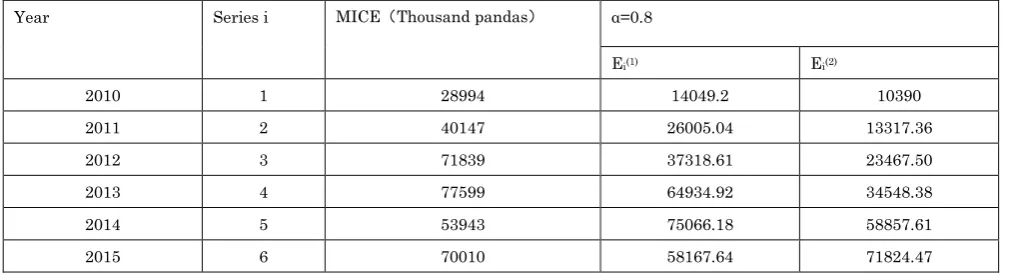
Based on the raw data in Table 4, the indicators in Table 5 can be predicted.
Table 5: Exponential smoothness prediction equation coefficient
Year Series i MICE(Thousand pandas) α=0.8
Ei(1) Ei(2)
2010 1 28994 14049.2 10390
2011 2 40147 26005.04 13317.36
2012 3 71839 37318.61 23467.50
2013 4 77599 64934.92 34548.38
2014 5 53943 75066.18 58857.61
2015 6 70010 58167.64 71824.47
From this, we can get the prediction equation and predict the added value of the exhibition industry from 2016 to 2025.
Table 6: Predicted value of added value for the exhibition industry in 2016-2025 (thousand pandas)
Year 2017 2018 2019 2020 2021 2022 2023 2024 2025
Liu Yang et. al.| May-June 2018 | Vol.7 | Issue 3 |33-46 43 0
Speed(%) - 112.2 110.8 109.8 108.9 108.2 107.6 107.04 106.6
Conclusions and Strategies
This article takes Macao as the research object, and through the time series data of 2007-2016, conducts the cointegration test and the Granger causality test on the value-added of Macao's exhibition industry and related industries, and empirically studies the development of Macao's convention and exhibition industry and its leading effects of tourism, retailing, hospitality, warehousing, transportation and communications industries.
In the economic system of Macao, the
exhibition industry has developed rapidly. The convention and exhibition industry has gradually become an important part of the Macao economy because of its advantages of being green and environmentally friendly, and being low in cost and capable of making full use of the existing infrastructure construction in Macao.
Based on the industrial research theory, this paper analyzes the industry leading effect of the Macao convention and exhibition industry on tourism, retail, hotel industry, warehousing and transportation industry through quantitative analysis and model inspection.
It is concluded that the development of the Macao convention and exhibition industry has a significant driving effect on the main industries in Macao. Among them, the driving effect of the hotel industry was the largest, followed by the retail industry, warehousing and transportation, and the driving effect on tourism was weakened.
Based on the above findings, this paper puts forward the countermeasures for the development of the MICE industry in Macao:
Strengthening the Construction of Convention and Exhibition Facilities
Both Macao and Zhuhai attach great importance to the development of the convention and exhibition industry and regard it as the key point of the city’s economic development. The two sides have geopolitical advantages and industries complement each other and can consider cooperation and development.
The cooperation between the convention and exhibition industry in Zhuhai and Macao needs to be differentiated based on the actual conditions of the two markets, that is, to use comparative advantages and cooperate with one another to promote resource sharing. The relative advantage of the convention and exhibition industry in Macao lies in the international platform and the popularity of the city. The relative advantage of Zhuhai's convention and exhibition industry lies in the fact that it is geographically wider than that of Macao. When the duration of conventions and exhibitions and venue resources are relatively tight, Macao can consider putting some appropriate medium-sized convention and exhibition activities in Zhuhai.
Liu Yang et. al.| May-June 2018 | Vol.7 | Issue 3 |33-46 44
It is suitable for professional training and team development activities. As far as the types of exhibitions are concerned, Macao is suitable to hold similar tourism exhibitions, cultural exhibitions, and leisure industry exhibitions focusing on the tertiary industry. Zhuhai can appropriately hold light industry exhibitions and yacht exhibitions based on existing industries.
Coordinated Development with Other Related Industries
The development of the exhibition industry is closely related to the growth of the industrial economy in the city. The foregoing empirical evidence also proves that the exhibition industry through its own development can effectively promote the rational allocation of resources and drive the development of related industries.
The holding of the convention and exhibition activities will bring a lot of logistics to Macao and increase the demand for all aspects of the urban economy, thus promoting the development of various industries. The holding of convention and exhibition activities will often attract a large number of tourists to Macao, stimulate the development of tourism in Macao, and also promote the construction of transportation infrastructure.
During the exhibition, a large number of exhibitors and visitors will stay in hotels in Macao, bringing benefits to the hotel industry; The influx of customers has a rigid demand for daily necessities. In addition, it may also purchase a large number of regional products, which provides a good business opportunity for the retail industry in Macao.
The development of other industries is also conducive to creating good supporting conditions for convention and exhibition activities. It can draw on Las Vegas, which is also known as “Casino City”. Las Vegas is famous for the world of gambling industry and it is in the process of urban economic development.
China has gradually completed the transformation of its urban functions, shifted its development focus to the convention and exhibition industry, and developed new economic growth points such as tourism, retail, hotels, transportation, and entertainment. This not only disperses the gaming industry’s impact on the overall economy, but also avoids a waste of resources for the gaming industry industry. It has also developed a number of new industries and realized the diversified development of the industrial chain.
Strengthening Cooperation with Zhuhai MICE Industry
Both Macao and Zhuhai will include the exhibition industry as a key industry for the development of the city, and it will also have a geographical advantage. Both industries will also have certain complementarities. The international level of Zhuhai's convention and exhibition industry is not high and it is stunted.
It is slightly behind that of cities like Guangzhou, Zhongshan, Huizhou and Foshan. The capital of Macao's convention and exhibition industry is abundant and the degree of internationalization is much higher than that of the inland, but the scale of the city is small and the development space is limited. Macao can develop regional cooperation with Zhuhai, build its own professional exhibition brand, and adopt the same-period exhibition, federation exhibition, traveling exhibition and other ways to expand influence, so that the regional exhibition industry will become internationalized and open up overseas markets.
and medium-sized exhibitions to Zhuhai when their exhibition schedule is tense.
Macao is suitable for conferences, incentive travel and large-scale international conferences, direct sales, and large-scale new product launches. Zhuhai is more suitable for hosting special meetings, training, and team development training. In terms of exhibitions, Macao is suitable for consumer, leisure, betting fairs, tourism exhibitions, cultural exhibitions, etc. Zhuhai is suitable for exhibitions supporting industries, such as boat shows, printing consumables exhibitions, and some industrial exhibitions.
In Macao, it is possible to hold prominent exhibitions with distinctive features, such as gambling exhibitions, game shows, and tourism and cultural exhibitions. As long as you go to Macao, Zhuhai can take advantage of the port and attract most of the guests to Zhuhai. In the education, training and planning consultation of the exhibition, Macao has rich training resources and a high degree of internationalization, which can provide intellectual support for Zhuhai.
Extending the Macao Convention and Exhibition Industry to Hengqin
Hengqin New District has superior geographical conditions, is located on the west bank of the Pearl River estuary, and is close to Hong Kong and Macao. In 2009, the State Council issued a new plan, making the development of Hengqin New District a long-term national strategy, and proposed to provide Hengqin New District has a more
generous preferential policy than the special economic zone and has officially developed Hengqin. The plan mainly includes innovating the customs clearance system, implementing preferential tax policies, and supporting the development of the Guangdong-Macao Cooperative Industrial Park.
Macao should support Zhuhai in developing its convention and exhibition industry in Hengqin and coordinate the professional division of labor with the Macao convention and exhibition. Hengqin can focus on the development of professional conference and exhibition services and high-level international conferences and exhibitions that are misplaced in Macao, linking the convention and exhibition markets of the two cities to form a golden belt for the Macao-Macao Conference and Exhibition. It will bring into play the agglomeration effect and achieve resource sharing and linkage development. The Macao Convention and Exhibition Company can make full use of geographical advantages and cooperate with convention and exhibition companies and trade promotion associations in Zhuhai to transfer some of the large-scale exhibitions with high demand for venues to Hengqin.
The conference and forums will be held in Macao, so that advantages can be realized. Complementary, reducing the cost of the development of the MICE industry in Macao and expanding the space for the development of its convention and exhibition industry.
References
1 Leong MW(2002)Reference to the successful
experiences of the major MICE cities in the PRC and investigating the development and strategies of Macao MICE industry. Journal of Convention and Exhibition of the Association Macau Association for Convention and
Exhibition, p.34 -36.
2 Cheong Su Richard Tan (2007) A comparative
analysis Of MICE destinations between Macau
And Singapore . http: /
/digitalcommons . library . unlv . edu
Liu Yang et. al.| May-June 2018 | Vol.7 | Issue 3 |33-46 46
3 Glyn Wootton, Terry Stevens (1995) Business
tourism: A study of the market for hotel-based meetings and its contribution to Wales's tourism. Tourism Management, 16(4):305-313.
4 Johnson L, Foo LM, O’Halloran M (1999)
Meetings make their mark: Characteristics and economic contribution of Australia’s meetings and exhibitions sector. Occasional paper No 6, BTR, Canberra.
5 Liang Wenhui (2007) Macau MICE tourism with
a closer review of the Las Vegas and Atlantic City experiences. Journal of Macau University of Science and Technology, 1(2):55 -70.
6 Liang Wenhui, Sanjay Nadkarni (2006) The
status and prospects of Macao as a conference Sightseeing City. Travel Science, p.46 - 51.
7 Luo Wei (2008) Interaction effect between
exhibition economy and urban economy, Great Economy and Trade, p. 78-80.
8 Hu Meng, Wang Haiyu (2010) Evaluation of
urban exhibition industry's impact on urban economic growth, Journal of Qingdao University of Science and Technology: Social Science Edition, p. 27-31.
9 Cheng Changxi, Wang Jiang (2012) The
Economic Effects of MICE Industry in Macao and the Cooperation between Guangdong and Macao MICE Industry. Sankei Review, p.73-81.
10 Han Ting yang, Wang Zhen (2014) Whether or
not Macau's gaming industry can continue to develop in the future – to explore the
relationship between gaming industry,
convention and exhibition industry and tourism industry. Modern Business, p. 264-266.
11 Yue Hao, Li Xinyi (2015) Research on the
mutual integration of Macao MICE industry and gaming industry. Guangdong Economic Journal, 12: 60-67.
12 Lin Zhou (2006) Contemplation on the
Development Status and Trends of the MICE Industry in Macao under the Framework of CEPA, Special Zone Economy, February, p. 71, 72.
13 Chen Na (2010) Macao conference industry