Expert Journal of Marketing, Volume 7, Issue 2, pp. 93-99, 2019 © 2019 The Authors. Published by Sprint Investify. ISSN 2344-6773 Marketing.ExpertJournals.com
Analysis of Behavioral Intention to Use a
Community-based Information System in the
City of Banda Aceh, Indonesia
Aulia RACHMANA PUTRA, Said MUSNADI and Syafruddin CHAN
*Syiah Kuala University, Indonesia
The purpose of this study was to examine and analyze the quality of information, quality of the SIPMB website, trust, and behavioral intention to use of SIPMB information on the Government of Banda Aceh. More specifically, the research focused on the impact of information quality, website quality, and user trust on the behavioral intention of using SIPBM and the impact of information and website quality on behavioral intention through a mediating variable, namely trust The subjects of this study were employees of government agencies SKPK in Banda Aceh and the study gathered 140 responses. The results showed that all five hypotheses were accepted, as the study examined direct and indirect relationships. In terms of the direct hypothesis testing, the results showed a significant influence of the independent variables to the dependent variable. The results of indirect hypothesis testing, that examined the quality of information and the quality of the website on behavioral intention through trust, were significant in the context of the model. For these results, trust has a partial mediating role. From the findings of this study, it is evident that the quality of information acts as the biggest trigger on promoting greater user interest in the use of data or information contained in this SIPBM website than any other examined variable.
Keywords: information quality, website quality, trust, behavioral intention
JEL Classification: M31
1. Introduction
Quality public services are one of the pillars of conveniently indicating a change in governance in favor of the increase in social welfare. Public service reflects self-reliance in the areas concerned with the efforts to obtain information and satisfy service to improve their welfare and it is fully recognized by the Government of Banda Aceh.
Quality public services must be supported by a well-qualified work program, including the work program on target. The quality planning work program must be supported by good and comprehensive information that describes the real state of the community as the target of development and improvement of public services. To that end the government of Banda Aceh, is running a public information-based development
*Corresponding Author:
Syafruddin Chan, Faculty of Economics and Business Syiah Kuala University, Indonesia Article History:
Received 24 August 2019 | Accepted 9 September 2019 | Available Online 17 September 2019 Cite Reference:
program called Community Driven Development Information System (SIPMB). This program was initiated in 2015 in collaboration with Katahati Institute and it is also fully supported by UNICEF. This collaboration gave birth to innovation in online SIPBM development. Simply put, SIPBM can be viewed as a database and information development that was developed based on community participation. SIPBM encourages public participation in the process of data collection and delivery of information more effective, efficient, transparent and accountable because it is done by the community. This participation form enables people to obtain data and information in an easy and reliable.
Community-based information systems development in Banda Aceh was based on the needs of the development of information and the necessity of accurate data to plan and implement development. Development of information and data that is gathered from 90 villages in Banda Aceh should be able to run well so that development activities are carried out according to the needs of society. Currently, the Online Community-Driven Development Information System (SIPBM) in Banda Aceh was started with nine villages, namely Gampong Seutui, Kuta Baru, Blang Oi, Kampung Pineung, Lueng Bata, Lampaseh Kota, Lhong, Lamteumen, and Lamteh.
Behavioral intention reflects the extent to which a person has formulated a deliberate plan to do or not to do a specified future behavior (Cheng and Huang, 2013). In this context, behavioral intention refers to to use of a database in SIPBM.
Many previous researchers have examined behavioral intention and its determinant factors such as Chen and Barnes (2007) who investigated the effect of initial trust on online buyer behavior. Moreover, Cheng and Huang (2013) examined antecedents and consequences variables of online group-buying intention.
The purpose of this study was to examine and analyze the quality of information, quality of the SIPMB website, trust, and behavioral intention to use of SIPMB information on the Government of Banda Aceh. More specifically, the research focused on the impact of information quality, website quality, and user trust on the behavioral intention of using SIPBM and the impact of information and website quality on behavioral intention through a mediating variable, namely trust.
2. Literature Review
In the literature review, a broader theory and discussion of the Community Based Development Information System and public services will be elaborated. The literature review collected will be the basis for the model framework, which will be expressed in hypotheses.
2.1. Behavioral Intention
Behavioral intention reflects the deliberateness of a consumer to do something. This concept is closely linked to the tendency of consumers to make purchases that are considered able to meet their needs. When associated with the user information then it will reflect a user's tendency to use the information provided by the provider on his behalf (Al-Maghrabi and Dennis, 2011). Behavioral intentions (BI) will influence certain participants "(Communication Committee for Behavior Change in the 21st Century, 2002, p. 31). Behavior intention is determined by the desires of consumers to behave in certain ways that involve, dispose of, and use products or services. In this research, measuring behavioral intentions implied the use of Likert scales, with types of questions, such as "I intend to [behavior]," to measure the relative strength of intention. The scales were adapted from Corner et al. (2016).
2.2. Customer Trust
Customer trust is not only important in environments where customer expectations are increasing every day and intense competition, but it is also essential as a brand differentiator that can make or break a business. McKnight et al. (2002), expressed confidence that the brand can be a guarantee of the issue in the future. Most organizations know that thee trust placed by consumers can also ensure the company’s survival in the future. But few companies achieve adequate confidence in the brand, because they do not properly investigate the real problem and the needs of their customers.
Koufaris and Hampton-Sosa in Gregg and Walczak (2010) argue that brand trust is more important than ever for today's consumers who are currently bombarded with a variety of options. What is often used to be a choice between two brands, it is now the global mix of hundreds of brands, which makes consumers ask additional questions before they buy, and it also raises the issue of trust. (Ambartiasari et al., 2017).
2.3. Information Quality
Rachmana Putra, A., Musnadi, S. and Chan, S., 2019. Analysis of Behavioral Intention to Use a Community-based Information System in the City of Banda Aceh, Indonesia. Expert Journal of Marketing, 7(2), pp.93-99.
relevance (utility) of the information provided by the website. In this case, Purnama, BE (2010) defines the quality of information as how much information is available about the attributes of a product, brand or company useful for customers, which helps them evaluate the object. He completes this idea by saying that customer perception is interactive and allows them to search positively related to overall customer evaluations of the quality of information available online such.
2.4. Website Quality
In the context of online shopping, according to Leitch and Davis in Jogiyanto (2005), the quality of information can reflect the product or service quality that way, allowing customers to have and tend to perform evaluations concerning aspects or essential attributes of a product or service because customers can just evaluate the product or service based on the information presented on web sites, while in traditional retail, this evaluation can be done in practice. Therefore, customers rely on the information available on the website and the quality of information offered by the website is a very important factor in the success of an online purchase website.
3. Research Hypotheses
Based on the framework of research that has been described above, the hypotheses of the study can be established as follows:
H1. Information Quality affects trust in information available in SIPMB regarding Banda Aceh city government.
H2. Website Quality affects trust in information available in SIPMB regarding Banda Aceh city government.
H3. Customer Trust affects the behavioral intention to use information SIPMB in the Banda Aceh city government.
H4. Information Quality affects the behavioral intention to use information SIPMB in Banda Aceh city government.
H5. Website Quality affects the behavioral intention to use information SIPMB in Banda Aceh city government.
4. Research Methodology
This section discusses in detail the research methodology used in online information research in Indonesia.
4.1 Location and Research Objects
The research was conducted on Government Agencies in the city of Banda Aceh that uses SIPBM online from the Social Department, the Education Office, Banda Aceh Planning, Health Agency, the Department of Labor and the Administrative District in Banda Aceh. The object of this research is to discover perceptions related to Quality Information, Website Quality, Trust and Behavioral Intention to Use the Online SIPBM system.
4.2 Data Collection and Sampling
The number of samples used is to follow the rules set forth by Hair et al. (2006) which states that an adequate number of samples is 5-10 times the amount of survey indicators. Because this study only had 20 indicators, the number of samples included in this study is 140 respondents. The use of the 7 multiplier is still in the proposed range and the sample size is adjusted to the probability that the results obtained would be representative. The sampling method used is convenience sampling. Convenience sampling is sampling based on the availability of elements and the ease of getting them. Samples are selected because the samples are in the right place and time. The reason why this type of sampling method was chosen was based on the people involved in the development planning of the Banda Aceh city using SIPBM online. There are 46 regional development unit offices in Banda Aceh City. On average, there are 3 people in each office responsible for planning the Banda Aceh development program through their respective offices, except for the Bappeda office with 5 respondents, bringing the total sample to 140 people.
4.3. Research Paradigm
Figure 1. Framework model
5. Analysis and Results
5.1. Loading Factor with measurement test
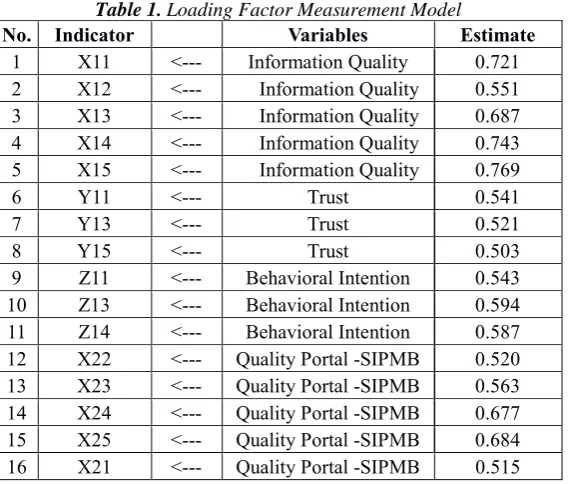
Because we know the variables consist of indicators, it needs to be confirmed whether the selected indicators can describe the latent variables. In other words, how much the contribution of the indicators in the variable respectively. The test results show that some indicators of measurement of the variables have values below the loading factor of 0.5. The following table of net measurement test results that can later be included in the structural testing.
Table 1. Loading Factor Measurement Model
No. Indicator Variables Estimate
1 X11 <--- Information Quality 0.721
2 X12 <--- Information Quality 0.551
3 X13 <--- Information Quality 0.687
4 X14 <--- Information Quality 0.743
5 X15 <--- Information Quality 0.769
6 Y11 <--- Trust 0.541
7 Y13 <--- Trust 0.521
8 Y15 <--- Trust 0.503
9 Z11 <--- Behavioral Intention 0.543 10 Z13 <--- Behavioral Intention 0.594 11 Z14 <--- Behavioral Intention 0.587 12 X22 <--- Quality Portal -SIPMB 0.520 13 X23 <--- Quality Portal -SIPMB 0.563 14 X24 <--- Quality Portal -SIPMB 0.677 15 X25 <--- Quality Portal -SIPMB 0.684 16 X21 <--- Quality Portal -SIPMB 0.515
Table 1 shows the loading factor of all existing indicators in the model and they all qualify for further analysis because they have a loading factor> 0.5 (Hair et al., 2006). To test the fit of the model, it has been used some criteria provided such as Chi-Square, CMIN / DF, GFI, AGFI, CFI, PNFI, and RMSEA. As all the test results meet all the criteria, the research model is said to be fit.
Table 2. Criteria Table Goodness of Fit Measurement Models
Criteria Index Size Cut-off Value Results Analysis Model Evaluation
Chi-Square - 134.356 Fit
CMIN / DF CMIN / DF <2 1.371 Fit
GFI ≥ 0.90 0.889 Fit
AGFI ≥ 0.90 0.846 Fit
CFI ≥ 0.90 CFI Above 0.5 Marginally Fit
PNFI 0-1 PNFI 0-1 Fit
RMSEA <0.08 0.055 Fit
Information
Quality
Trust Behavioral
Intention
Website
Rachmana Putra, A., Musnadi, S. and Chan, S., 2019. Analysis of Behavioral Intention to Use a Community-based Information System in the City of Banda Aceh, Indonesia. Expert Journal of Marketing, 7(2), pp.93-99.
5.2. Direct and Indirect Hypothesis Testing
5.2.1. Structural Analysis
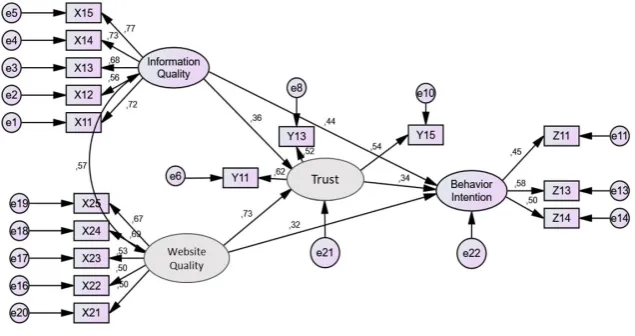
The most crucial stage in conducting data analysis is to look for answers to hypotheses that have been developed. Testing the hypotheses was carried out using a Structural Model, as presented below.
Figure 2. Structural Equation Model
Figure 2 describes the influence between the latent variables. The highest standardized coefficient is on the influence of website quality on trust, which is 0.73. Then, the effect of information quality on behavioral intention is 0.44. While the influence of website quality on behavior intention is only 0.32 and the influence of trust on behavior intention is 0.34. Hypothesis testing along with the results shown in Table 3 below:
Table 3. Conclusion of Hypothesis Hypothesis Standardized
Coefficient off > 1.96) CR (Cut P-Value Result
Information quality → Trust 0.36 2.565 * H1 Accepted
Website quality → Trust 0.73 3.691 * H2 Accepted
Trust → Behavioral Intention 0.34 3.173 ** H3 Accepted
Information quality → Behavioral Intention 0.54 2.480 * H4 Accepted
Website quality → Behavioral Intention 0.32 3.169 ** H5 Accepted
Note: ** Significant at p <0.005; * Significant at p <0.010
All direct hypotheses were accepted because all hypotheses tested to meet the CR and P-value requirements at 0.1 and 0.05 thresholds. This means there were significant influences of the independent variable to dependent variables of each developed hypothesis. Quality information had a significant impact on trust. Website quality also had a significant impact on trust. Trust had a significant impact on behavior intention. Quality information had also a significant impact on behavior intention. Lastly, the quality of the website had a significant impact on behavior intention.
Table 4. Conclusion Indirect Hypothesis
No Indirect Hypothesis P-Value
<0,05 Beta Direction
Mediating Role
1 The role of trust in mediating the effect of information
quality on behavior intention to use * 0.120 Accepted Partial
2 The role of trust in mediating the influence of website
quality on behavior intention to use * 0.244 Accepted Partial
Note: ** Significant at p <0.005; * Significant at p <0.010
quality on behavioral intention to use and also the influence of website quality on behavioral intention to use, even though its role is only reflected in partial mediating.
6. Discussion and Conclusion
The conclusions drawn from this study are presented in the following sections.
6.1. Theoretical Contributions
Testing the hypothesis was achieved by using a one-sample t-test with a cut-off value of 3.4. The mean of all five variables has met the criteria for them to be accepted since they have a p-value lower than 0.05. Thus, we can conclude that all the variables analyzed in this research have been perceived quite well by the respondents. All 5 hypotheses tested were significant which means there is a significant impact of the independent variables to the dependent variable that can be used to achieve the intervention by the manager to increase the intention to use the SIPBM system. Indirect testing to see the role of trust as a mediating variable which affects of the quality of information on behavioral intention to use and the role of trust in mediating the influence of the website quality to behavioral intention to use were proved to be eligible for further testing because of the influence of the significant MV to the IV. In other words, it can be statted that there is a real and significant role of trust in mediating the influence of quality of information on behavioral intention to use and also the website quality to behavioral intention to use SIPBM.
The above findings are in line with the research conducted by Rolland and Freeman (2010) and Chen (2013) who have examined the ease of access, quality of information to user trust. Other researchers found a significant influence between the quality of the website and user trust. Al-Dwairi (2013) examining the relation of website quality including security system, privacy, design, and content of a website to user trust. O'Cass and Carlson (2012) studied the website feature innovation and its relation with trust, while Rolland and Freeman (2010) revealed the relationships of easy access, information, services, security to user trust. Al-maghrabi and Dennis (2010) mentioned the attractive appearance of the layout, the navigation and informative content, as well the ease of shopping, website design, information availability, transaction security, payment systems, and services, all of which are also be related to the user trust.
While the influence of trust on behavioral intention is in line with the findings of research conducted by McKnight et al. (2002) who examined the model of consumer confidence in a website in conducting online transactions. Then Shankar et al. (2002) examined the consumer's trust in conducting online transactions that are influenced by the characteristics of the website, and the quality of the information. Yu and Barnes (2007) also examined the dimensions of consumer confidence in online purchases.
6.2. Implications for Managers
From the findings of this study, it is evident that the ‘information quality’ variable has the largest beta coefficient number which can be described as the biggest trigger in increasing user interest in using data or information contained in this SIPBM website compared to other variables.
Therefore, if the Banda Aceh City Government wants to increase the utilization stage of the information contained in the SIPBM website in developing real conditions based on the work development programs in the community, it must be done through improving the quality of the information uploaded to the website, so that the credibility of the information is evident in the eyes of the users who will increase their confidence in the existing SIPBM information system.
6.3 Limitation and Future Direction of the Research
Since this research only covered Banda Aceh City, it will be more comprehensive if future research will be expanded to cover all 23 provinces in Aceh Province. Thus, the results will be more accurate in describing and representing behavioral intention to use the online SIPMB information system.
References
Al-Dwairi, R. M., 2013. E-commerce Web sites trust factors: An empirical approach. Contemporary
Engineering Sciences, 6(1), pp.1-7.
Al-Maghrabi, T. and Dennis, C., 2011. What drives consumers' continuance intention to e-shopping? Conceptual framework and managerial implications in the case of Saudi Arabia. International Journal
Rachmana Putra, A., Musnadi, S. and Chan, S., 2019. Analysis of Behavioral Intention to Use a Community-based Information System in the City of Banda Aceh, Indonesia. Expert Journal of Marketing, 7(2), pp.93-99.
Ambartiasari, G., Lubis, A. R. and Chan, S., 2017. The Effect of Service Quality, Trust and Campus Facilities on Satisfaction and Its Impact on the Loyalty of Venezuelan Indonesian Polytechnic Students. Journal
of Management and Innovation, 8 (3), pp.12-23.
Chen, L. Y., 2013. The quality of the mobile shopping system and its impact on purchase intention and performance. International Journal of Managing Information Technology, 5(2), p.23.
Chen, Y. H. and Barnes, S., 2007. Initial trust and online buyer behavior. Industrial management and data
systems, 107(1), pp.21-36.
Cheng, H. H. and Huang, S. W., 2013. Exploring antecedents and consequence of online group-buying intention: An extended perspective on the theory of planned behavior. International Journal of
Information Management, 33(1), pp.185-198.
Gregg, D. G. and Walczak, S., 2010. The relationship between website quality, trust and price premiums at online auctions. Electronic Commerce Research, 10(1), pp.1-25.
Jogiyanto, H., 2005. Technology Information system. Yogyakarta: Andi Yogyakarta.
Jurnaiti, J. and Lubis, A. R., 2017. The Influence of Consumer Involvement, Credibility of Information Sources and Consumer Satisfaction on Repurchase Decisions (Study on Drug Consumers at Pharmacies in Banda Aceh City). Journal of Management and Banking Perspectives, 8 (3).
Martilla, J. A. and James, J. C., 1977. Importance-performance analysis. Journal of Marketing, 41(1), pp.77-79.
Matzler, K., Sauerwein, E. and Heischmidt, K., 2003. Importance-performance analysis revisited: the role of the factor structure of customer satisfaction. The Service Industries Journal, 23(2), pp.112-129. Mc.Lean and DeLone, W. H., 2003. Information Systems Success: The Quest for the Dependent Variable.
Information Systems Research. 3(1), pp.60-95.
McKnight, D. H. and Chervany, N. L., 2001. What trust means in e-commerce customer relationships: An interdisciplinary conceptual typology. International Journal of Electronic Commerce, 6(2), pp.35-59. O’Cass, A. and Carlson, J., 2012. An e-retailing assessment of perceived website-service innovativeness: Implications for website quality evaluations, trust, loyalty, and word of mouth. Australasian Marketing
Journal (AMJ), 20(1), pp.28-36.
Purnama, B. E., 2010. Development of Poor People's Data Collection Information System for Poor Rice (Raskin) Program in Mantren Village, Kebonagung District, Pacitan Regency. Speed-Research and
Engineering Research Center, 2 (4).
Rolland, S. and Freeman, I., 2010. A new measure of e-service quality in France. International Journal of
Retail and Distribution Management, 38(7), pp.497-517.