AJPRHC
Research Article
FORMULATION AND EVALUATION OF TOPICAL DICLOFENAC SODIUM GEL USING DIFFERENT GELLING AGENT
Y. S. TANWAR1 , AMIT KUMAR JAIN*2
For Author affiliations see end of the text This paper is available online at www.jprhc.in
ABSTRACT:
The present research has been undertaken with the aim to develop a topical gel formulation of Diclofenac sodium using different gelling agent carbopol, Na CMC, HPMC (K4M) and sodium alginate in different concentration, which would attenuate the gastrointestinal relater toxicities associated with oral administration. They were evaluated for physicochemical properties such as homogeneity, grittiness, viscosity, pH, Spreadability, drug content, skin irritancy, in vitro drug release, stability studies. The in vitro drug release rate of gel was evaluated using Franz diffusion cell containing cellophane membrane with phosphate buffer pH 6.8 as the receptor medium. Studies showed that drug release was decrease with increase in gelling agent concentration because polymer concentration increases, viscosity increases. Drug was absorbed from site of application as long as it remains in higher concentration gelling agent in solution form.
Keywords: Diclofenac Sodium, carbopol, hydroxyl propyl methyl cellulose, sodium alginate anti‐inflammatory activity. INTRODUCTION
Diclofenac Sodium is a potent member of the nonsteroidal anti-inflammatory drugs (NSAIDs), widely used because of its strong analgesic, antipyretic and anti-inflammatory effects (1-2).
Oral dose of diclofenac potassium causes an increased risk of serious gastrointestinal adverse events including bleeding, ulceration and perforation of the stomach or the intestines which could be fatal. Due to the presence of these oral adverse effects necessitate the need for investigating other route of drug delivery of diclofenac potassium. Transdermal delivery of the drug can improve its bioactivity with reduction of the side effects and enhance the therapeutic efficacy (3-4).
Delivery of drugs to the skin is an effective and targeted therapy for local dermatological disorders. This route of drug delivery has gained popularity because it avoids first pass effects, gastrointestinal irritation, and metabolic degradation associated with oral administration (5-6). Topical gel formulations provide a suitable delivery system for drugs because they are thixotropic, greaseless, easily spreadable, easily removable, emollient, nonstaing, compatible with several excipients and water-soluble or miscible. Percutaneous absorption of drugs from topical formulations involves the release of the drug from the formulation and permeation through skin to reach the target tissue. The release of the drug from topical preparations depends on the physicochemical properties of the vehicle and the drug employed. (7-9)
Skin is one of the most readily accessible organs of human body for topical administration and main route of topical drug delivery system. Numbers of medicated products are applied to the skin or mucous membrane that either enhance or restore a fundamental function of a skin or pharmacologically alter an action in the underlined tissues. (10) Topical drugs used to control pain act locally on damaged or dysfunctional soft tissues or peripheral nerves, and their actions may be on the inflammatory response itself or on sensory neurons (11).
An improved Diclofenac formulation with a high degree of skin permeation could be useful in the treatment of not only locally inflamed skin tissues, but also inflammatory and painful states of supporting structures of the body bones, ligaments, joints, tendons and muscles. (12)
The objective of present study was conducted to develop a topical gel formulation of diclofenac sodium using four types of gelling agents: carbopol 934, hydroxypropylmethylcellulose (HPMC), carboxymethylcellulose sodium (Na CMC) and sodium alginate for enhancing the skin penetration. Effect of penetration enhancer (propylene glycol) on the release has been studied. The gels were evaluated for physical appearance, rheological behaviour, drug release and stability. The drug release from all gelling agents through a standard cellophane membrane was evaluated using Franz diffusion cell.
MATERIALS
Diclofenac Sodium (Gift sample, DD Pharma Jaipur) carbopol-934, Na CMC salt medium viscosity 200-400 cPs, HPMC (K4M), sodium alginate, propylene glycol, triethanolamine, propylparaben, sodium hydroxide, potassium di hydrogen ortho phosphate, ethanol used were analytical grade.
METHODS Preparation of gels:
allowed to equilibrate for at least 24 hours at room temperature prior to performing rheological measurements (13-14).(Table 1)
Other gel formulations were prepared by dispersing HPMC, Na CMC and sodium alginate in water by continuous stirring. Diclofenac sodium was dissolved in propylene glycol or ethanol and the solution was added gently to HPMC, Na CMC and sodium alginate dispersion under continuous stirring. The mixture was stirred gently with a spatula until homogeneous gel was formed. All the samples were allowed to equilibrate for at least 24 h at room temperature prior to performing rheological measurements.
Characterization of Formulations
The prepared diclofenac sodium gels were inspected visually for their homogeneity, grittiness, viscosity, Spreadability, pH, drug content, skin irritancy, in vitro drug release, stability studies.
Homogeneity
All developed gels were tested for homogeneity by visual inspection after the gels have been set in the container. They were tested for their appearance and presence of any aggregates. (15)
Grittiness
All the formulations were evaluated microscopically for the presence of particles if any no appreciable particulate matter was seen under light microscope. Hence obviously the gel preparation fulfils the requirement of freedom from particular matter and from grittiness as desired for any topical preparation. (15)
Viscosity
The measurement of viscosity of the prepared gel was done with a Brookfield viscometer. The gels were rotated at 20 and 30 rpm using spindle no. 64. At each speed, the corresponding dial reading was noted. (15)
Spreadability
Spreadability is expressed in terms of time in seconds taken by two slides to slip off from gel and placed in between the slides under the direction of certain load, lesser the time taken for separation of two slides, better the spreadability. (15) It is calculated by using the formula: S = M. L / T
Where M = weight tied to upper slide L = length of glass slides
T = time taken to separate the slides
pH
The pH was measured in each gel, using a pH meter, which was calibrated before each use with standard buffer solutions at pH 4, 7, 9. The electrode was inserted in to the sample 10 min priors to taking the reading at room temperature. (16) Drug content
To ensure uniform formulation of the gel, it was sampled from the different locations in the mixer and assayed for the drug content. Drug content of the gels was determined by dissolving an accurately weighed quantity of gel (about 1 gm) in about 100 ml of pH 6.8 phosphate buffer. (17) These solutions were quantitatively transferred to volumetric flasks and appropriate dilutions were made with the same buffer solution. The resulting solutions were then filtered 0.45 mm membrane filters before subjecting the solution to spectrophotometric analysis for diclofenac sodium at 276 nm. Drug content was determined from the standard curve of diclofenac sodium.
Skin irritation
The albino mice of either sex weighing 20‐22gms were used for this test. The intact skin was used. The hair was removed from the mice 3 days before the experiment. The animals were divided into two batches and each batch was again divided into two groups. The gel containing drug was used on test animal. A piece of cotton wool soaked in saturated drug solution was placed on the back of albino mice taken as control. The animals were treated daily up to seven days and finally the treated skin was examined visually for erythema and edema.
In Vitro Release
The in vitro release experiments were carried out by using Franz-diffusion cells apparatus from different formulations. An exact amount of formulations (1.0 g) was spread out on membrane positioned between the donor and receptor chambers with an available diffusion area. The receptor compartment was filled with phosphate buffer pH 6.8 and continuously stirred with a small magnetic bar at a speed of 50 rpm during the experiments to ensure homogeneity and maintained at 37.2±0.5 0
C. The samples were withdrawn at various time intervals and replaced with the same volume of PBS. Sink conditions were met in all cases. The samples were analyzed spectrophotometrically at 276 nm (Shimadzu UV-Visible-1800).
Stability study
For the evaluation of stability study, maintaining the formulations at an ambient condition over a period of two months. The physical appearance, pH value, drug content, rheological properties, drug release studies were determined periodically after the 1st and 2nd month after topical gel preparations.
RESULTS AND DISCUSSION Characterization of Formulations
The prepared formulations shared a smooth and homogeneous appearance. The Carbopol diclofenac sodium gels were transparent while HPMC and Na CMC gels were white viscous and sodium alginate gels were brownish gummy with smooth and homogeneous appearance.
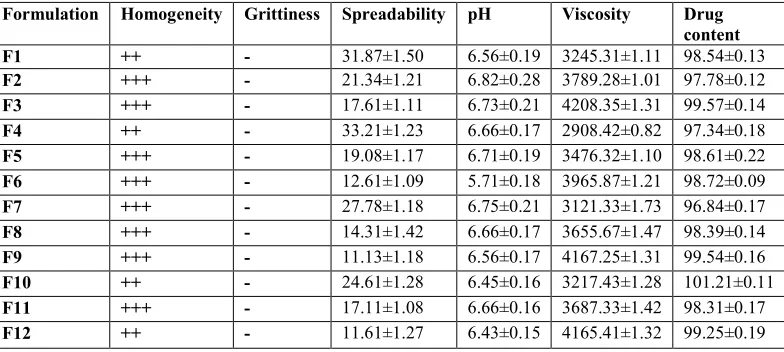
Viscosity increased (from 2930.42±0.82 cPs to 4208.35±1.31 cPs, Table 2) as polymer concentration increased. Increased consistency was ascribed to enhanced polymeric entanglements, thereby increasing the resistance to deformation. (20)
For all formulations the viscosity was found to be lower from 2.3 to 4.1 times as the rotational speed increased. In fact, when the speed increases, the normally disarranged molecules of the vehicle are caused to align their long axes in the direction of flow. Such orientation reduces the internal resistance of the material and hence decreases the viscosity.
The results of skin irritancy studies are shown that the prepared gels do not produce any skin irritation and are well tolerated by mice.
The result of stability studies are shown that there were no significant changes in the viscosity, drug content and physical appearance of the gel, after storing at different temperature conditions for three months. These results indicate that drug remain stable after stability studies.
In Vitro Release Results
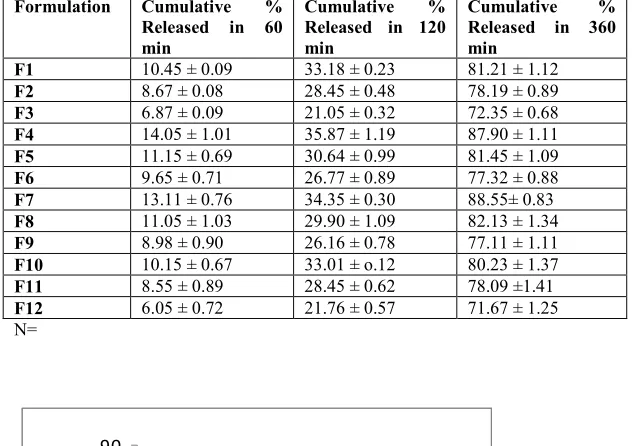
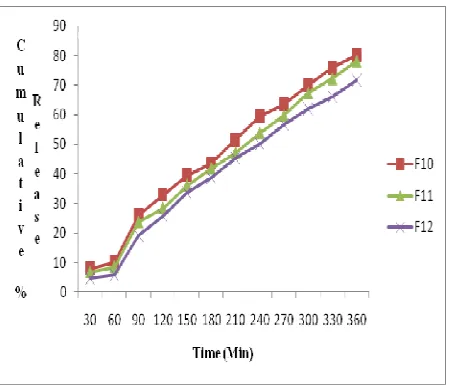
In vitro dissolution profile of diclofenac sodium gels containing different concentration of carbopol, HPMC, Na CMC and sodium alginate are shown in table 3 and fig. 1-4.
Release profiles of diclofenac sodium from various gel formulations across the cellulose membrane deplicated that drug release decrease with increase in concentration of the gelling agent. The drug release values were also found lower for the formulation in which polymer concentration was kept high (Table 3). In addition, viscosity increased (from 2967±0.23 cPs to 4687±0.31 cPs, Table2) as polymer concentration increased. Viscosity is negatively related to the release of active substance from formulations and its penetration through the diffusion barriers. The decrease in the release could be attributed to increased microviscosity of the gel by increasing polymer concentration. Thus, both high concentration of polymer and high viscosity compete each other in decreasing the release of active substance from the formulation. In our study, the finding that higher polymer concentration resulted in lower drug release from the vehicles is in agreement with Lauffer’s molecular diffusion theory of polymer gels, which states that the diffusion coefficient of a solute is inversely proportional to the volume fraction occupied by the gel-forming agent. (21-23)
Table 1: Different gel formulations
Table 2: Physicochemical characteristics of diclofenac sodium gels formulations
Formulation Homogeneity Grittiness Spreadability pH Viscosity Drug content
F1 ++ - 31.87±1.50 6.56±0.19 3245.31±1.11 98.54±0.13
F2 +++ - 21.34±1.21 6.82±0.28 3789.28±1.01 97.78±0.12
F3 +++ - 17.61±1.11 6.73±0.21 4208.35±1.31 99.57±0.14
F4 ++ - 33.21±1.23 6.66±0.17 2908.42±0.82 97.34±0.18
F5 +++ - 19.08±1.17 6.71±0.19 3476.32±1.10 98.61±0.22
F6 +++ - 12.61±1.09 5.71±0.18 3965.87±1.21 98.72±0.09
F7 +++ - 27.78±1.18 6.75±0.21 3121.33±1.73 96.84±0.17
F8 +++ - 14.31±1.42 6.66±0.17 3655.67±1.47 98.39±0.14
F9 +++ - 11.13±1.18 6.56±0.17 4167.25±1.31 99.54±0.16
F10 ++ - 24.61±1.28 6.45±0.16 3217.43±1.28 101.21±0.11
F11 +++ - 17.11±1.08 6.66±0.16 3687.33±1.42 98.31±0.17
F12 ++ - 11.61±1.27 6.43±0.15 4165.41±1.32 99.25±0.19
S.N Ingredients (%w/w)
Formulation
F1 F2 F3 F4 F5 F6 F7 F8 F9 F10 F11 F12
1 Diclofenac
sodium
1 1 1 1 1 1 1 1 1 1 1 1
2 Carbopol-934 1 1.5 2 - - - -
3 Na CMC - - - 1 1.5 2 - - - -
4 HPMC - - - 1 1.5 2 - - -
5 Sodium alginate - - - 1 1.5 2
6 Propylene
glycol
15 15 15 15 15 15 15 15 15 15 15 15
7 Triethanolamine 0.4 0.5 0.6 0.4 0.5 0.6 0.4 0.5 0.6 0.4 0.5 0.6
8 Ethanol 30 30 30 30 30 30 30 30 30 30 30 30
9 Propyl paraben 0.5 0.5 0.5 0.5 0.5 0.5 0.5 0.5 0.5 0.5 0.5 0.5
N=3
Excellent +++, Good ++, Satisfactory +, No grittiness ‐
Table 3: Cumulative % Drug release from gel formulations at different time intervals
Formulation Cumulative % Released in 60 min
Cumulative %
Released in 120 min
Cumulative %
Released in 360 min
F1 10.45 ± 0.09 33.18 ± 0.23 81.21 ± 1.12
F2 8.67 ± 0.08 28.45 ± 0.48 78.19 ± 0.89
F3 6.87 ± 0.09 21.05 ± 0.32 72.35 ± 0.68
F4 14.05 ± 1.01 35.87 ± 1.19 87.90 ± 1.11
F5 11.15 ± 0.69 30.64 ± 0.99 81.45 ± 1.09
F6 9.65 ± 0.71 26.77 ± 0.89 77.32 ± 0.88
F7 13.11 ± 0.76 34.35 ± 0.30 88.55± 0.83
F8 11.05 ± 1.03 29.90 ± 1.09 82.13 ± 1.34
F9 8.98 ± 0.90 26.16 ± 0.78 77.11 ± 1.11
F10 10.15 ± 0.67 33.01 ± o.12 80.23 ± 1.37
F11 8.55 ± 0.89 28.45 ± 0.62 78.09 ±1.41
F12 6.05 ± 0.72 21.76 ± 0.57 71.67 ± 1.25
N=
0
10
20
30
40
50
60
70
80
90
30 60 90120
150
180
210
240
270
300
330
360
Time (Min)
c
u
m
u
l
a
t
i
v
e
%
r
e
l
e
a
s
e
F 1
F 2
F 3
Figure 1: Cumulative %Drug release from carbopol 934 gel formulations at different time intervals
Figure 3: Cumulative %Drug release from HPMC gel formulations at different time intervals
Figure 4: Cumulative %Drug release from Sodium Alginate gel formulations at different time intervals
CONCLUSION
Diclofenac sodium is a non-steroidal anti‐inflammatory drug (NSAID) that exhibits anti‐inflammatory, analgesic, and antipyretic activities. To overcome the side effects associated with oral diclofenac sodium therapy and to have the benefits associated with topical therapy; diclofenac sodium topical gels are prepared in this study.
Studies showed that drug release was decrease with increase in gelling agent concentration because polymer concentration increases, viscosity increases. Drug was absorbed from site of application as long as it remains in higher concentration gelling agent in solution form. So with an intention to keep the diclofenac sodium in solution form, and thus prolonging the time of absorption, gel formulations were prepared.
Acknowledgements
The authors are thankful to Mahatma Gandhi College of Pharmaceutical Sciences for providing facilities.
REFERENCES
1. Sanna V, Peana TA, Moretti DLM. Effect of vehicle on diclofenac sodium permeation from new topical formulations: In vitro and In vivo studies.Current Drug Delivery. 2009, 6: 93-100.
2. Skoutakis VA, Carter CA, Mickle TR, et al. Review of diclofenac and evaluation of its place in therapy as a nonsteroidal anti-inflammatory agent. Drug Intell. Clin. Pharm. 1988,22: 850-59.
3. Kumar V, Sathali AH, Kumar A. Formulation and evaluation of diclofanac potassium ethosomes. Int. J. of Pharmacy and Pharm. Sci. 2010, 2: 82-86.
5. Kikwai L, Babu RJ, Prado RA, et al. In vitro and In vivo evaluation of topical formulations of spantide II. AAPS Pharm. Sci Tech. 2005, 6: E562-72.
6. Behl C, Char HS, Patel SB, et al. In vivo and in vitro skin uptake and permeation studies; critical considerations and factors, which affect them. In: Shah BP, Maibach HI, eds. Topical Drug Bioavailability, Bioequivalence and Penetration. New York, NY: Plenum Press; 1993, 225-259.
7. Green PG, Flanagan M, Shroot B, Guy RH. Ionotophoretic drug delivery. In: Walters K.A., Handgraft J. eds. Pharmaceutical skin penetration enhancement. New York, NY: Marcel Dekker. 1993, 311-333.
8. Patel J, Patel B, Banwait H, et al. Formulation and evaluation of topical aceclofenac gel using different gelling agent. Int. J. of Drug Dev. & Res. 2011, 3: 156-164.
9. Dey S, Mazumdar B, Patel JR. Enhance percutaneous permeability of acyclovir by DMSO from topical gel formulation. Int. J. of Pharma. Sci. and drug Res. 2009, 1: 13-18.
10. Gupta A, Mishra AK, Singh AK, et al. Formulation and evaluation of topical gel of diclofenac sodium using different polymers. Drug Invention Today. 2010, 2: 250-253.
11. Sawynok J. Topical and Peripherally Acting Analgesics. J. Pharmacol. Rev.2003,55: 1-20.
12. Shah NV, Sheth NS, Mistry RB, et al. IN vitro release of diclofenac sodium from different topical vehicles. Int. J. of Pharm. Sci. 2011, 2: S-31-39
13. Patel RP, Patel HH, Baria AH. Formulation and evaluation of carbopol gel containing liposomes of ketoconazole. Int. J. of Drug Del. Tech. 2009, 1: 42 – 45.
14. Arellano A, Santoyo S, Martin C, Ygartua P. Influence of propylene glycol and isopropyl myristate on the in vitro percutaneous penetration of diclofenac sodium from carbopol gels. Eur J. Pharm. Sci. 1998, 7: 129-35.
15. Kaur LP, Garg R, Gupta GD. Development and evaluation of topical gel of minoxidil from different polymer bases in application of alopecia. Int. J. Pharmacy and Pharm. Sci. 2010, 2: 43-47.
16. Shivhare UD, Jain KB, Mathur VB, et al. Formulation development and evaluation of diclofenac sodium gel using water soluble polyacrylamide polymer. Digest Journal of Nanomaterials and Biostructures. 2009, 4: 285 – 290. 17. Sera UV, Ramana MV. Invitroskin absorption and drug release – a comparison of four commercial hydrophilic gel
preparations for topical use. The Indian Pharmacist. 2006, 73: 356-360. 18. USP The Official Compendia of standard First annual Asian edition. 2002, 554.
19. Lucero MJ, Vigo J, Leon MJ. A study of shear and compression deformations on hydrophilic gels of tretinoin. Int. J. Pharm.1994,106: 125-33.
20. Pose-Vilarnovo B, Rodriguez-Tenreiro C, Dos Santos JFR, et al. Modulating the drug release with cyclodextrins in hydroxypropyl methylcellulose gels and tablets. J. Control. Release. 2004,94: 351-63.
21. Dhawan S, Medhi B, Chopra S. Formulation and evaluation of diltiazem hydrochloride gels for the treatment of anal fissures. Sci Pharm. 2009, 77: 465–482.
22. Prakash PR, Rao NGR, Chowdary S. Formulation, evaluation and anti-inflammatory activity of topical etoricoxib gel. Asian J. of Pharm. and Clinical Res. 2010, 3: 126.
23. Lauffer MA. Theory of Diffusion in Gels. 1961, 1: 205-213.
AUTHORS AFFILIATIONS AND ADDRESS FOR CORRESPONDENCE B. N. College of Pharmacy, Udaipur
Mahatma Gandhi College of Pharmaceutical sciences, Jaipur Email: [email protected]