SOLANACEAE PLANTS OF ISRAEL AND PALESTINE - RICH
SOURCE OF MEDICINALLY ACTIVE NATURAL PRODUCTS
Abdullatif Azab
[a]*Keywords:Solanaceae; alkaloids; physalins; withanolides; medicinal activity; psychoactive; poisoning.
Solanaceae is one of the most studied among all plant families. Plants of this family are very rich with medicinally active natural products, some of them, with nutritional importance. Some of these compounds are psychoactive and mind altering. Alkaloids, physalins and withanolides are the major notable active natural products present in these plants. In this review article, we will present the vast majority of published research about these plants. This work will include biological and medicinal activities, extended presentation of natural products, their activities and in some cases, their synthesis, biosynthesis and production, along with other chemical aspects. Despite all the wideness of this article, we have introduced limited (but not ignored. presentations of two important aspects of this plant family, mainly due to the large size of this article. One, ethnobotany and ethnomedicine uses of these plants, and two, the influence of various cultivation conditions on these plants, and the results of these conditions.
* Corresponding Authors Fax: +972-4-6205906 Phone: +972-50-5650025 E-Mail: [email protected]
[a] Eastern Plants Research Institute, Box 868, Arara, Israel 30026
INTRODUCTION
The Solanaceae plants family is one of the most known and used by humans since the early dawn of humanity. It comprises 90 genera and 3000-4000 species, including some domesticated plants like potatos (Solanum tuberosum), tomatos (S. lycopersicum), eggplant (S. melongena) and chili pepper (Capsicum annuum).1 These human cultivated
species are among the most important for human nutrition and possees high economical value. Life forms of these plants are diverse and range from trees to annual grass.
They attracted the attentions of humans since antiquity. One of the earliest documented uses of these plants for medicinal uses can be found in the "Dioscorides Codex" (815 A.D).2 All human civilizations utilized the plants of the
Solanaceae family, while ancient people of the Americas (Maya) were the first to use the plants for food, ritual and religious matters.3 These civilizations used a wide variety of
Solanaceae plants including the genera of Capsicum (some for war uses), Solanum, Datura and others. Shamanistic physicians of ancient Egypt used mandrake (Mandragora autumnalis) for several uses, including hypnosis, rituals and medications.4 Later studies showed that this type of use of
Solanaceae plants was very common among all civilizations of the "Old World".5
Like other peoples of the world, ancient nations of the Middle East used the Solanaceae plants for many purposes, and these uses found their respectful rank in traditional medicines of civilizations of this region.6 They used and still
use Lycium europeaum, Solanum nigrum, Hyoscyamus aureus, Hyoscyamus albus, Datura spp., Mandragora autumnalis and Wifhania somnifera. Arab-Palestinian ethnomedicine used these plants with clear caution and only in limited cases.7,8
Finally, in the region between the Mediterranean sea and the Jordan river (Israel and Palestine), there are 24 species of Solanaceae wild plants.9 All of them were thoroughly
studied except Solanum cornutum about which, as far as our knowledge could reach, there is not a single publication about its medicinal activities.
PUBLISHED REVIEW ARTICLES:
SOLANACEAE AND TROPANE ALKALOIDS
Expectedly, many review articles were published about this plant family that contains great numbers of biologically active natural products. In addition, some of the plants of this family are edible and highly nutritious (especially, the domesticated species), while some of the wild species, are highly toxic and psychoactive. In this part of our review, we will introduce some selected, previously published review articles, bearing in mind that many will not be presented here, since they contain almost the same information included in the articles that we will present. We will introduce these review articles as brief summaries rather than a table, since this presentation will include many figures and some notices. Each summary will present the reviewed species, major presented topics and references. The presentation is according to alphabetical order of the species names.
1. Datura ssp. focusing on D. stramonium. A comprehensive article that presents all ssp. of the genus of
Datura. It introduces some botany, ethnomedicine, modern medical uses (detailed), toxicity and some important active compounds.10
2. Datura ssp. Systematic, clearly presented and comprehensive review, with good figures and tables of active alkaloids of Datura. Ethno uses in Mexico and Spain are presented.11
Tandon et al. (ref. 12) attempted to review "most promising" natural products in Datura ssp. with antibacterial activity. The only structure that they chose to present is the structure of this steroidal alkaloid that was isolated from
Datura metel.
Figure 1. Wrong structure of steroidal alkaloid presented in reference 12
They cite: Okwu, D. E, Igara, E. C., Isolation, characterization and antibacterial activity of alkaloid from
Datura metel Linn leaves, Afr. J. Pharm. Pharmacol., 2009,
3, 277-281. Oddly enough, authors of the original research and the review article presented the structure of the alkaloid containing alkyne functional group with trans (E) stereochemistry instead of linear. Nonlinear geometry of alkynes exists only in reactive intermediates. See: Sanz, R., Recent Applications of Aryne Chemistry to Organic Synthesis. A Review, Org. Prep. Proced. Int., 2008, 40, 215-291.
4. Datura ssp. Very detailed review of pharmacological activities of Datura ssp., with clear presentations of the structures of active natural products. Detailed tables also presented. Error in reference 12 is repeated here13 (see
above).
5. Datura ssp. This very important review presents various Datura ssp. but focuses mainly on D. stramonium. The review introduces in great details its content of Tropane alkaloids (Figure 2), especially scopolamine and hyocsyamine, and the poisoning potential of the plants to animals.14
Figure 2. Tropane alkaloids, scopolamine and hyoscyamine
6. Datura ssp. This review focuses on D. stramonium and presents in very useful and detailed manner the different possibilities of Datura poisoning, its medical expressions and mechanisms, and most important, treatment of poisoning cases. It also presents some antidotes such as the natural alkaloid physostigmine (Figure 3).15-17
7. Datura stramonium. These comprehensive articles review the knowledge about this plant. Their major advantage is the detailed style but it lacks presentaion of important natural products structures. D. fastuosa is also
reviewed (ref. 18. but this plant does not exist in the region of the inerest of our article.18,19
Figure 3. Physostigmine, natural alkaloid, antidote of Datura poisoning.
8. Datura stramonium. It is an important review with brief presentation of pharmacological activities of the plant, but with a wide scan of toxicity. It also includes an important, clear part of active natural products structures, alkaloids and many others.20
9. Datura stramonium. A short document that presents active constituents.21
10. Datura stramonium. Another short document that presents in details active constituents, some structures, pharmacological activities, traditional uses (brief), with a list of amino acids present in the plant.22
11. Datura stramonium. It is a veryshort documents with very few details. Useful short introductions of the plant.23-26
12. Datura stramonium. A short review that focuses on neurotoxicity of this plant, and provides a detailed list (no structures) of active compounds.27
13. Datura stramonium. Despite the fact that the title of this short document gives the expression of presenting
Datura ssp., it actually presents the toxicity history of D. stramonium in the 18-19th centuries in Europe.28
14. Hyoscyamus ssp. This article reviews three plants of this genus namely H. albus, H. niger and H. reticulatus. It presents ethnobotanical uses, medicinal activities and list of some active natural products present in these species.29
15. Mandragora. In one of the most comprehensive and useful review articles about this genus authors have presented in a very clear manner, with detailed structures, the interesting active natural products contained in the plants of these plants. In addition to tropane alkaloids, hydroxy acids, esters resulting from previous two families, N-oxides of tropane alkaloids, very interesting epoxy carotenoids, the structues of polyhydroxy tropane alkaloids, named Calystegines and of the alkaloid Coscohygrine, are presented.30 In Figure 4 we present selected structures of
three calystegines and of coscohygrine.
Figure 4. Structures of selected calystegines and coscohygrine (ref. 30).
H N
HO
Wrong geometry
N
O O
CH2OH Hyoscamine
N
O O
CH2OH
O
Scopolamine
N N O
H N
N N
O
Coscohygrine
H N
OH OH
OH
H2N
H N
OH OH
OH
HO HO
16. Nicandra physalodes. The only published review about medicinal activities of this plant, and ethomedicinal uses are also presented. It lacks introduction of active natural products.31
17. Physalis angulata. One of the most comprehensive reviews about this plant. Information about traditional applications and medicinal activities is provided. Active natural products are extensively shown, clear structures and family classifications.32 Some of these natural products are
shown in Figure 5.
Figure 5. Selected natural products isolated from Physalis angulata (ref. 32).
18. Physalis angulata. A brief review that presents only medicinal activities.33
19. Physalis angulata. This review presents medicinal activities and list some of the active compounds but does not provide structures.34
20. Physalis ssp. Wide scan of traditional uses as well as systematic review of active natural pruducts and their structures (see Figure 6) are the two great adavantages of these reviews. They also include some medicinal activities.35,36
Figure 6. Structures of natural products isolated from Physalis ssp. (35).
21. Physalis peruviana. The main focus of these reviews (by the same author. is highlighting the nutritional importance of this plant. Medicinal activities and natural products are presented.37,38
22. Physalis peruviana. The morphology of the plant has been thoroughly discussed in this review, as well as its nutritional value. Limited chemical composition is presented.39
23. Physalis peruviana. This short review presents the protective potential of this plant against intoxications by cigarette smoke, acetaminophen, cadmium and CCl4.40
24. Solanum ssp. One of the most comprehensive and informative review articles about alkaloids of the Solanum
genus and their structures. The article presents the glycoalkaloids and their free forms (aglycons, without the saccharide units).41 In Figure 7, the structure of α-Solanine
is presented in both forms.
Figure 7. Glyco-α-solanine and its aglycon (ref. 41).
25. Solanum ssp. This review focuses on the medicinal activities of Solanum alkaloids, without presenting their chemistry or structures. Instead, it presents the basic structures of active natural products. For example, it presents the bicyclic skeleton on tropane alkaloids, without examples. Some of the structures are poorly presented.42
26. Solanum ssp. This wide review focuses on two glyco-streroidal-alkaloids found in Solanum plants: Solamargine and Solasonine (Figure 8). In addition to their structures and pharmacological activities, methods of their analysis are presented.43
Figure 8. Solamargine and Solasonine (ref. 43).
27. Solanaceae. This vast, excellent review, presents the different active compounds groups in the Solanaceae plant family, their biological activities, toxicity and mechanisms of action. In Figure 9, we present some alkaloids from
Nicotiana glauca.44
Figure 9. Selected alkaloids of Nicotiana glauca (ref. 44).
O O
O O
O
O HO
O O
O
Physalin F
O
OHO OH
OAc
O O
Withangulatin A
O
O OH
OAc
O O
Physagulin A
O
O HO
HO OH
O O
Withanolid E, P. preruviana
O
O
OH
O
CH2OH
O HO
Withaferin A, P. peruviana
HO O O
HO
O O
Physanolide A, P. angulata
N
O R
β-D-Glc(1-4)β
-D-Gal-1-α
-L-R
h
a
(1-2
)
RO
O HN
R=H, Solasodine
R= Rha-Glc- , Solamargine
Rh
a
-N N
Nicotine
N N H
Nornicotine N
N H
Anabasine
N N H
Anatabine
N N H
28. Solanaceae. In this large review, the focus is only on insecticidal activity of alkaloids of this plant family. It presents a brief introduction about the structures of these compounds, but provides a clear presentation of the mechanisms of action and structure activity relationship. It also provides very detailed (10 pages) table of plants, alkaloids and their bioinsecticidal activities.45
29. Solanum elaeagnifolium. This article discusses the botany and biology of this plant, that few decades ago was almost rare, and now, it is spreading rapidlay. In some areas of the Mediterranean basin, it became "monospecific". The article presents its negative effect on agricultural crops.46
30. Solanum incanum. Two short reviews about the ethnopharmacology, medicinal activities and very short presentations of the chemical compositions. In both reviews, structures are not presented.47,48
31. Solanum nigrum. Very colorful document, that presents the botany of the plant, very limited chemical composition (no structures. and some medicinal activities).49
32. Solanum nigrum. A partial and brief presentation of chemical composition and medicinal activities of this plant.50
33. Solanum nigrum. Despite the fact that the title of this article states that it discusses anticancer and antitumor activities of this plant, it also presents other activities.51
34. Solanum nigrum. A short review of the major active natural products.52
35. Solanum nigrum. Presentation of botany, partial composition and some medicinal activities of this plant.53
36. Solanum nigrum. An extended review that presents most topics related to this plant, including composition and medicinal activities. Special attention is drawn to the genetics of the plant, and some ethobotanical aspects are presented.54
37. Solanum nigrum. Very brief sections of traditional uses and chemical composition of the plant are presented, but a wider part of medicinal activities is provided.55
38. Solanum nigrum. Very short document that presents culinary uses and anti-inflammatory activity of the plant.56
39. Solanum nigrum. The capacity of this plant to hyperaccommulate heavty metals from contaminated soil or water is presented.57
40. Solanum villosum. Short review of botany, ethnomedicine, medicinal activities and very partial composition of the plant.58
41. Withania somnifera. In this comprehensive review about many medicinal activities of this plant, chemical composition is not presented.59
42. Withania somnifera. This excellent review, that focuses on antibacterial and antifungal activities of the plant,
includes short chemical composition description, with structures of selected active compounds. The various medicinal activities of the plants are presented, and the selected activities are very detailed in a very helpful table.60
43. Withania somnifera. This document summarizes the research of anticancer activity of this plant. Various types of cancer are reviewed, mechanisms of action are presented and partial chemical composition is listed, especially the natural products with anticancer activity.61
44. Withania somnifera. This excellent and very comprehensive review about this plant, presents very datailed structures of active natural products, their biosynthesis, and their medicinal activities. This review provides some explanations for understanding the structures of withanolides (Figure 10).62
Figure 10. General structure of withanolides (ref. 62).
45. Withania somnifera. A minireview of medicinal activities of this plant with some information about withanolides. Structure of withanolide A is presented.63
46. Withania somnifera. An extensive review of many medicinal activities of this plant, which includes almost every possible activity. Short chemical composition and ethnobotanical uses are presented.64
47. Withania somnifera. Many medicinal activities are presented in these reviews, chemical structures and ethnobotanical uses are presented.65-72
48. Withania somnifera. A very good review that extensively presents the biosynthesis of withanolides. An excellent scheme is presented (page 5). The article presents an expanded review of ezymatic and genetic aspects, and builds future perspectives.73
49. Withania somnifera. This review includes medicinal activities, partial chemical composition, genetic modifications, future perspective and molecular profiling. W. coagulans (that is not included in our review) is also discussed.74
50. Withania somnifera. This is a very important and highly informative review. It presents extensive chemical composition part, along with some interesting modifications of natural products (an example is shown in Figure 11)b.
Many medicinal activities are presented, focusing on anticancer activity (an excellent figure on page 5) and neuprotection activities (excellent figure page 6).75
HO O
O
R3 R2
O
R1
Figure 11. Aminolysis of Withaferin-A (ref. 75)b b. Citation of Joshi, P. et al., ref. 721.
51. Withania somnifera. This very extensive and excellent review presents various medicinal activities of the plant. Also, it includes a vast chemical composition section. But unlike all published reviews about this plant, this review specifies medicinal activity with single natural product. This information is summarized in clear, readable tables. In addition, it discusses the composition of the plant in two major habitats, India and Israel.76
52. Withania somnifera. Anticancer activity specific review. It presents in details the anticancer activity of the plant products, its active compounds, as well as detailed mechanisms of action.77
53. Withania somnifera. This review presents the beneficial effects of the plant products on human male fertility.78
54. Withania somnifera. An excellent review of male fertility benefits of this plant and its products. The article presents general background of treating male infertility and sexual weakness with medicinal plants, partial chemical composition of this plant and some medicinal activities of it. It presents in clear and useful manner (very helpful tables and figures) the mechanism of action of the plant and its products in enhancing male reproductivity and sexual functioning.79
55. Tropane alkaloids. This review is a followup of reference 14. It presents this family of natural products in clear link to Solanaceae plants, since these plants cause many cases of food contamination and poisoning, for humans and animals. The article provides chemical composition part, including general schemes of biosynthesis. But its main focus is toxicity of these compounds.80
56. Tropane alkaloids. These three articles focus on biosynthesis and laboratory synthesis of tropane alkaloids. Biosynthetic and synthetic paths are presented in general scopes. To use these schemes for practical purposes, readers must use the original research papers cited by these review articles.81-83
MEDICINAL, BIOLOGICAL AND OTHER
ACTIVITIES OF SOLANACEAE WILD PLANTS
In this much extended section, we will present the published articles about the medicinal, biological and other activities of these plants. But it is important in our opinion to make it clear that some types of articles will not be presented here, for example, most publications of reported methods of enhancing the production of active natural
products by these plants, through genetic engineering or various agricultural conditions. We cited some of them in order to enable the interested readers to start exploring this information, and continue their search if they want to. Due to the great phrmacological importance of these active natural products, an enormous number of researches have been published about this very important issue, a number of carefully selected articles of this type will be also presented in the next section.
The chemistry of the natural products that were isolated from the Solanaceae plants is very important and extremely interesting. But the vast majority of these publications are not included in this article. We have very carefully selected a few of them, which in our humble opinion, have special importance. These will be presented in a separate section.
Finally, the information in this section will be presented in tables, each presenting the published data about a single species. In this way, it is easier fot the interested readers to extract information about each plant. Publications are sorted by activity. All notes and figures related to a specific table will be shown right after it.
Datura ferox
This species is the less widespread among the three spcies that grow in our region (the others are D. innoxia and D. stramonium). But its natural habitat is very wide, including all continents. The activities of this plant are presented in Table 1.
Table 1. Medicinal, Biological and Other Activities of Datura ferox.
Activity/Property Major Findings/Reference
Defensive alkaloids Production of defensive alkaloids in leaves of this plant, mainly atropine, hyoscyamine, scopolamine and solanine; is adaptive to cope with herbivores.84 Alkaloids content
(Argentina)
The alkaloid content ranged from 0.02-0.52 g of total alkaloids in different parts of the plant, and 0.0029-0.32 g of scopolamine per 100 g of dried material.85
Alkaloids content (Algeria)
Qualitative study of alkaloid content revealed that hyoscyamine and scopolamie are major compounds.86
Alkaloids content (Argentina)
An extended qualitative study of alkaloids content (HPLC, GC-MS) found five additional alkaloids compared with previously punlished (ref. 85).87
Alkaloids content (Algeria)
Quantitative study of alkaloid content revealed that hyoscyamine is major compound.88
Alkaloid effect on hens and broilers
A mixture of scopolamine and hyoscyamine (98:2), was incorporated at different alkaloid levels, into a control diet fed to 100 egg-laying hens for 3 months. Various tests were performed to determine the effect of this treatment on different health aspects of the birds. Alkaloid dose as high as 75 mg kg-1 feed is safe.89,90
O
O HO
O O
CH2OH
Withaferin-A RNH2
O
HO
O O
CH2OH
HO NHR
Chemical
composition (partial)
Morphology and partial chemical composition, as well as general composition of the seeds were studied.91 Poisoning of horses Severe poisoning of horses by D. ferox
contaminated hay, that resulted serious health problems that lead to euthanasia in some case. Analysis showed that hyscyamine was the major toxin.92 Human pisoning,
special forensic method
A special method of forensic analysis
was developed for detection an
conformation of atropine and scopolamine, helped confirm the death cause of a man by this plant.93
Toxicity test for pigs Alkaloid toxicity for pigs showed a limit of 1.5 mg kg-1 feed, for animals with 20-60 kg weight.94
Datura innoxia (or inoxia)
In our region, D. innoxia is widespread like D. stramonium and most people can not distinguish between both species. It has been thoroughly studied, and a summary of these studies is presented in Table 2.
Table 2. Medicinal, biological and other activities of Datura innoxia.
Activity/Property Major Findings/Reference
Defensive alkaloids Production of defensive alkaloids in leaves of this plant, mainly atropine, hyoscyamine, scopolamine and solanine; is adaptive to cope with herbivores.84
Alkaloid content HPLC determination of total alkaloid
content in different parts of the plant. Hyoscyamine and scopolamine were tested as well.95 Determination of alkaloids with various liquid
chromatography techniques.96
Comprehensive analysis of 38 alkaloids, and comaprison between alkaloid content of the plants in Egypt and Bulgaria.97 Effect of various growing conditions on alkaloid content.98,99 GC-MS determination of 53 alkaloids contained in the plant in Morocco.100 Influence of quantification methods on results of alkaloid determination.101 Feeding plants with alkaloids with certain stereochemistry has no effect on the enantiomer composition and content.102
Analgesic Aqueous leaves extract was tested and
found active analgesic. It was analyzed for major active compounds.103
Antibacterial, antimicrobial, antifungal
Aerial parts were extracted with water and organic solvents. Extracts were tested against different bacteria. Methanolic extract was most active.104 Flowers were extracted with 90 % aqueous ethanol, folllowed by various organic solvents. Extract was active against different bacteria.105 Aqueous and methanolic extracts were prepared
from seeds, leaves and roots of the plant. They were tested against some bacteria and the methanolic extract was more active.106 Leaves were extracted with 95 % aqueous ethanol and the extract had clear antibacterial activity.107 Lectin was isolated from seeds of the plant and found antibacterial and antifungal.108 Ethanolic and aqueous extracts of leaves were tested, and ethanolic extract was found more active.109 Leaves and seeds aqueous extracts, that were fractionized by organic solvents, found active against some bacteria and fungi.110 Methanolic extract of aerial parts was found active against some bacteria strains.140
Anticancer and related activities
Leaves methanolic extract was found active against colon and breast cancer cells.111 Flowers methanolic extract was prepared and fractionized with other solvents. Extract and fractions showed clear cytotoxicity and anti-angiogenesis properties.112 Dinoxin B, was isolotared from the methanolic extract (and fractions) of leaves, and was found cytotoxic to cancer cells.113
Anti-inflammatory Aqueous leaves extract was tested and found active anti-inflammatory.103 Aqueous and methanolic extracts were prepared from seeds, leaves and roots of the plant. They were tested against Aspergillus niger fungus. Methanolic extract was more active.106
Antiparasitic, insecticide
Leaves and seeds were extracted with non-polar solvents. Extracts were active pediculocidal.116 Leaves aqueous extract had high nematicidal activity. General chemical composition was also reported.117 Leaves were extracted with water, methanol and hexane, and tested against Agonoscelis pubescens. Hexane extract had highest activity.118 Fruits aqueous extract found active against Holotrichia Serrata (Fab).119 Leaves aqueous had insecticidal activity against Locusta migratoria.120 Leaves were extracted with methanol and hexane. Both extracts found active against Spodoptera Litura (F.).121 Leaves were extracted with ethanol and extract was
found active against Meloidogyne
incognita. General chemical
composition of the extract was determine.122
Antioxidant Leaves and seeds aqueous extracts were
prepared and antioxidant capacity was
determined (DPPH).110 Leaves
solvents and antioxidant capacity was determined by two methods. General chemical composition was determined.123
Chemical composition
Leaves and seeds aqueous extracts were prepared and total phenolic contents and total flavonoid content were determined.110 Dinoxin B, a withanolide was isolated from the methanolic extract and characterized.113 See Figure 12. General composition was determine for all parts of the plant, separately.124,125 Quantitative analysis of Hyoscine (see Figure 12) in three extracts of seeds.126 Scopolamine and hyoscyamine content was determined in the seeds of diploid (2n) and induced autotetraploid (4n) forms.127 Total alkaloid content (1.75 %) and qualitative analysis of alkaloids was performed for leaves of Nigerian
species.128 Roots and leaves were
extracted with methanol and chloroform, successively, and phenylpropanoids and fatty acids were quantified.129
Enzyme inhibition Leaves and seeds aqueous extracts were prepared and protein kinase inhibition was tested.110
Phytoremediation The plant was found good
hyperaccumulator of Cd, Cu, Pb and Zn, for phytoremediation of contaminated soil.130
Toxicity Leaves were extracted with 95 %
aqueous ethanol and the extract had clear toxicity to rats.107 Leaves and seeds aqueous extracts were prepared and brine shrimp toxicity was determined.110 Aqueous and methanolic leaves extracts were found toxic to rats.131
Figure 12. Selected active compounds isolated from Datura innoxia (Table 2).
Datura stramonium
D. stramonium is the most widespread of Datura species in the reviewed area. This is the main reason for the large number of published studies about it. This is also the reason of the high number of poisoning by it to humans and
animals. Summary of selected published activities of this plant is presented in Table 3.
Table 3. Medicinal, Biological and Other Activities of Datura stramonium
Activity/Property Major Findings/Reference
Alkaloids Production of defensive alkaloids in
leaves of this plant, mainly atropine, hyoscyamine, scopolamine and solanine; is adaptive to cope with herbivores.84 Alkaloid analysis was done by GC-MS and the structures on new compounds were elucidated. Two of them are shown in Figure 13.132 This is a followup, expanded study of previous one.133 Ammonia assested, whole plant extraction yielded hyoscine and atropine as main alkaloids.134 The effect of nitrate fertilization on alkaloids production of the plant was tested. Results differ between young and mature plants.136 Effect of various hormones and fertilizers on alkaloid production is reported.137,138,139
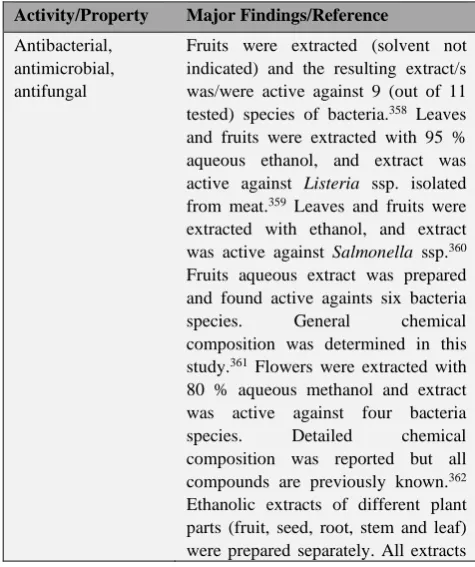
Antibacterial, antimicrobial, antifungal
Ethanolic and aqueous extracts of leaves were tested, and ethanolic extract was found more active.109 Methanolic extract of aerial parts was found active against some bacteria strains.140 Dry leaves were extracted with 95 % aqueous ethanol. Extract was active against some bacteria. General chemical composition was
determined.141 Methanolic and
ethanolic leaves extracts were tested against 7 bacteria, and found active against 4.142 Leaves were extracted with four organic solvents, and extracts were tested against some bacteria types. Chloroform extract was most active.143 Leaves were extracted with several organic solvents and extracts were tested against few bacteria. Hexane and ethyl acetate extracts were most active.144 Leaves were extracted with ethanol, and extract was found active against bacteria isolated from chicken.145 Leaves were extracted with 85 % aqueous ethnol, and extract was found active against Staphylococcus aureus isolated from sheep.146 Leaves were extracted with some organic solvents, and extracts were tested against several types of bacteria and found active. Against E. coli they had weak activity, but in combination with Abutilon indicum, synergism was observed.147 Aerial parts were extracted with ethanol, chloroform and benxene. All extracts showed antibacterial and antifungal activities.154 Methanol-Water (70 %) extract of aerial parts
O HO
HO
O O
O
1−β-D-Glc
Dinoxin B (ref. 113)
N
O
O
O CH2OH
had strong antifungal activity against Fusarium ssp.155,156 Leaves aqueous extract showed singnificant antibacterial activity against few types of bacteria. In this study, general chemical composition was also determined.157 Silver nanoparticles were prepared with leaves aqueous extract, and they had antibaterial activity.158 Ethanolic and aqueous extracts were prepared and found antibacterial. General chemical composition was determined in this study.159 Alkaloids were extracted (ethanol, H2SO4) and found very active against some types of bacteria. Alkaloids were isolated and characterized.160 Different parts of the plant were extracted separately with 4 organic solvents, and extracts were tested and found aftive against several types of bacteria. General chemical composition was also determined with special attention to glycoalkaloids.161 Ethanolic extract was found active antibaterial/ General chemical composition was determined.162 Leaves were extracted with 80% aqueous ethanol, and protiens were isolated and found active against several types of bacteria.163 Differenet parts of the plant were extracted separately with cold methanol. All extracts showed antibacterial activity. General chemical composition was also determined.164 Leaves were extracted with five organic solvents, and all extracts had antibacterial activity. Despite the article title, no chemical composition was reported.165 Fresh whole plant was extracted with 90 % aqueous ethanol, and extract showed strong antibacterial activity. Total alkaloid content was also determined.166 Leaves were extracted with Soxhlet assembly successively with petroleum ether, benzene, solvent ether, chloroform, acetone, ethanol and methanol, and all extracts showed antibacterial activity. General chemical composition was determined.167 Seeds were extracted with methanol and extract had strong antibacterial activity. Total alkaloid content was determined.168
Allelopathy Alkaloid wash inhibited the growth of
Helianthus annuus.148 Leaf leachate (contained high concentration of alkaloids) inhibited the germination of Linum usitatissimum.149 Extracts had
no effect on Sorghum halepense
germination but the inhibited its growth.150 A wide range of extract concentrations was studied for its effect
on Zeamays L. and Helianthus annuus. Interesting results were found, from growth stimulation to inhibition.151 Aqueous leaf concentrations (2-8 %)
inhibited the growth of Vigna
unguiculata and Triticum Aestivum.152 Leaves aqueous extract was prepared in concentrations of 1-5 %, and found to have negative effect on the growth of Phaseolus vulgaris, Vigna sinensis, Cajanus cajan and Medicago sativa.153 Essential oil was prepared and analyzed for chemical composition. The main components were phytosterols (see Figure 13). Saturated aqueous solution of this EO inhibited germination and growth of four crops.169 Aqueous extract was used to prepare MgO-NPs which had antibacterial activity.175,c Anticancer and
related activities
Flowers were extracted with several solvents, but only ethyl acetate extract had anticancer activity (liver). Unlike claimed in article, no pure compound was isolated.170 Seeds were extracted with methanol and the extract showed cytotoxic activity against MCF7 cell line. Two active compounds were identified by TLC, but they were not isolated.171 Leaves methaolic extract had immunomodulatory and anticancer (lung, breast) activities.172 Leaves were extracted with methanol, and extract was analyzed for alkaloids, yielding three known compounds. This fraction showed anticancer activity.173
Antidiabetic, antidyslipidemic and related activities
Leaves aqueous extract showed
singnificant α-amylase inhibition
activity.157 Roots were extracted with 70 % aqueous methanol. Extract was hypoglycemic (STZ-induced diabetic mice) and antidyslipidemic.174
Antioxidant, anti-inflammatory, anticoagulant, wound healing and related activities
Extract showed anti-inflammatory activity in carrageenan induced paw edema in rats.177,d Fresh leaves were extracted with methanol and extract had high antioxidant activity (DPPH).178 Leaves were extracted with several solvents and tested for antioxidant activity (DPPH, NO/super-oxide scavenging). Ethyl acetate had highest activity. General chemical composition was determined.179,180 Leaves were extracted with methanol and extract had high anioxidant activity (DPPH, ABTS).181 Essential oil was extracted from seeds by hydrodistillation and had anti-inflammatory activity.182 Leaves were extracted with petroleum ether and 50 % aq. EtOH. Extract showed analgesic activity in two tests in rats. General chemical composition was obtained.183 Leaves were extracted with 70 % aq. EtOH and extract had wound healing effect on rats.192
Chemical composition
Scopolamine and hyoscyamine content was determined in the seeds of diploid (2n) and induced autotetraploid (4n)
forms.127 Total alkaloid content
(1.29 %) and qualitative analysis of alkaloids was performed for leaves of Nigerian species.128 Roots and leaves were extracted with methanol and chloroform, successively, and phenylpropanoids and fatty acids were quantified.129 Alkaloids were extracted (ethanol, H2SO4) and characterized by GC-MS (see Figure 13).160 Essential oil was extracted from seeds by hydrodistillation and was analyzed by GC-MS. Terpenes were major compounds in this EO.182 Two studies of general chemical composition.184,185 Seeds were analyzed for chemical composition (GC-MS), yielding mainly alkaloids and terpenes.186 Seeds were analyzed by column chromatography, and some compounds were isolated for the first time from the genus Datura or from the Solanaceae family. Two of them are shown in Figure 13.187 Enzyme inhibition,
brain influencing, fertility influencing and related activities
Alkaloid extracts found as inhibitors of E-NTPDase, E-NTDase and ALP and stimulants of Na+/K+ ATPase.135 Leaves were extracted with MeOH and extract inhibited serine protease.181 Leaves were extracted with 90 % aq. EtOH and extract showed clear inhibition of acetylcholinesterase.188 Known alkaloids were extracted (hydroethanol) and analyzed by GC-MS. Extracts showed inhibitory activity of cholinesterase and monoamine oxidase.189 Seeds cold aqueous extracts
had sedative activity on mice, showed by elongation of diazepam-induced
sleeping periods.190 Leaves were
extracted with petroleum ether, ethanol and water. Ethanolic extract had clear antiovulatory activity.191
Insecticidal, antiparasitic and related activities
Leaves ethanolic extract showed high insecticidal activity against Aedes Aegypti and Culex Quinquefaciatus.193 Ethanolic seeds and leaves extract had efficient inseticidal activity against Tribolium castaneum.194 Acetone extract of aerial parts (excluding flowers) had lethal effect on Callosobruchus maculatus.195 Leaves were extracted with several solvents and ethanolic extract showed highest
activity against larvae of Culex
quinquefasciatus.196 Seeds were extracted with acetone, ethanol and chloroform, and acetone extract was most insecticidal against Sitophilus oryzae L.197 Shoots were extracted with methanol and extract had nematicidal activity.198
Metal chelating, accummulation and nanoparticles
Alkaloid extracts had Fe2+ and Cu2+
chelating abilities.135 Silver
nanoparticles (AgNP's) were prepared by reduction of Ag+
(aq) with leaves
aqueous extract, and they had antibaterial activity.158 Aqueous extract was used to prepare MgO-NPs.175,c Toxicity, body
changes after feeding
(c) This report (ref. 175) is unclear and even misleading. Authors claim that they used D. stramonium aqueous extract to prepare MgO-NPs. They report that the strating material was "magnesium nitrate, Mg(NO3).3H2O". To the best of our knowledge, Mg(I) nitrate does not exist. Moreover, in all reports of NPs green synthesis, plants extracts either reduce the ions in starting materials or do not change their oxidation state. In this report, the Mg+ ions were oxidized to Mg+2 (MgO). This contradicts all known published reports. In addition, we found no commercial suppliers of manesium nitrate trihydrate (only di- and hexahydrate are commercially available). See:
Imani, M. M., et al., MgO-NPs, https://doi.org/10.1155/
2019/6063832 ; Duong, T. H., et al., MgO-NPs,
https://doi.org/10.1155/2019/4376429; Ezealisiji, K.M., et al., ZnO-NPs green synthesis, DOI: 10.1007/s40089-018-0263-1 (d) In the experimental section of ref. 177 there is a mistake in one of the plant mentions. It is mentioned as Thevetia peruviana.
Figure 13. Selected active compounds in D. stramonium.
Hyoscyamus albus
Among the plants of the genus Hyoscyamus, this species,
H. albus is the most studied so far. But it is important to mention that this genus is currently less investigated than some (not all) other genera of this family. Summary of selected published activities of this plant is presented in Table 4.
Table 4. Medicinal, biological and other activities of Hyscoyamus albus.
Activity/Property Major Findings/Reference
Alkaloids Auxin, an indole alkaloid plant
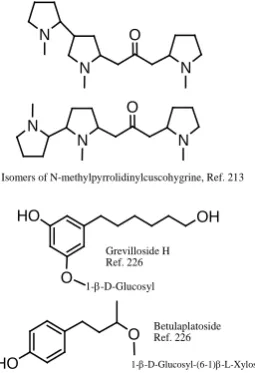
hormone, increased the production of hyoscyamine and scopolamine (Figure 2) in roots.212 Roots were analyzed for alkaloids, where some compounds were identified in this plant for the first time, along with some novel alkaloids. Two isomers are presented in Figure 14.213-215
Antibacterial, antimicrobial, antifungal, analgesic and related activities
Aerial parts were extracted with aqueous methanol (70 %) and extract was found active antibacterial against some types of bacteria. Total alkaloid content and general chemical
composition were determined.216
Leaves methanolic extract showed anlgesic (acetic acid, formalin) and antipyretic (Brewer’s yeast) activities. Extract had no toxicity for albino
rats.217 Leaves were extracted
successively with petroleum ether, chloroform and methanol. General chemical composition was determined, and extract was active against few bacteria species.218 Anticancer and
related activities
Aerial parts were extracted with methanol, and extract had antitumor activity several cancer cell lines.219 Atropine was isolated by HPLC and was active anticancer agent.222
Antidiabetic, antidyslipidemic and related activities
Seeds were extracted by ion exchange column and total fraction of calystegines (polyhydroxylated aminosugars, see Figure 4) was isolated. The toxicity of this fraction was measured (non-toxic up to 2000
mgkg-1) and had significant
antidiabetic activity (STZ-induced) in rats.220
Antioxidant, anti-inflammatory, anticoagulant, wound healing and related activities
Leaves were extracted successively with petroleum ether, chloroform and methanol. General chemical composition was determined and antioxidant capacity was measured with two methods.218 Seeds were extracted for calystegines-rich fraction, and its antioxidant (4 methods) and anti-inflammatory (carrageenan-induced paw edema) activities were tested.221 Leaves were extracted as in ref. 218. General chemical composition was determined and extract had antiulcer actvity induced by ethanol.223 Leaves were extracted as in ref. 218. General chemical composition was determined and extract had hepatoprotective actvity against CCl4-induce toxicity.224 Chemical
composition
Aerial parts were extracted with several solvents successively, and total lipid content as well as fatty acid composition were determined by TLC and GC-MS. C16:0, C17:0 and C18:0 were detected with highest concentrations.225 Aerial parts were extracted with several solvents successively and fractions were analyzed by TLC. Along with known compounds, two new natural products were isolated and their structures were elucidated by NMR spectroscopy (see Figure 14).226 Roots of the plants were fed with auxin-free supplements and Putrescine N-Methyltransferase was isolated from them. Alkaloid composition was also determined.227 N
OR R=
O
H3COCOH2C C6H5 O
OH
HOH2C C6H5 Ref. 132
H N
N N N
N O
O
Ref. 160
Me
CHMe2
HO
Ref. 169
OH HO
Daturadiol
Ref.187 FraxetinRef. 187
O O
OH
Figure 14. Selected compounds isolated from H. albus.
Hyoscyamus aureus
This plant is one of the least studied in the Solanaceae
family and in the Hyscyamus genus. Very few studies were published about its medicinal activities, and none about its complete chemical or alkaloid compositions. So, here in this part of this review, we will present the few published studies, and some will be presented in the Discussion section.
Composition: aerial parts were extracted with several solvents successively, and total lipid content as well as fatty acid composition were determined by TLC and GC-MS. C16:0, C18:0 and C17:0 were detected with highest concentrations.225
Alkaloid production: different growth promoters (mixtures) were used for cultivation of the plants, and total alkaloid content was measured.228
Insecticidal: leaves and flowers were extracted with 70 % aqueous ethanol, extract was dissolved in water, and the solution had insecticidal activity against three species of insect. Fatal concentration was 62.5 mgmL-1.229
Hyoscyamus desertorum
This is a typical desert plant that can be easily found in Southern Israel, Egypt and some regions of North Africa. Despite this, very few studies were published about its composition and medicinal properties, all were done in Egypt. Alkaloid composition of plants in Egypt was analyzed by GC-MS detecting 39 different compounds.214,230
Hyoscyamus muticus
On scanning the published literature about this plant, it is apparent that it has been very partially studied. Summary of these studies is presented in Table 5.
Table 5. Medicinal, biological and other activities of Hyoscyamus muticus.
Activity/Property Major Findings/Reference
Alkaloids Alkaloid composition of plants in
Egypt was analyzed by GC-MS detecting 39 different compounds.214 Antibacterial,
antimicrobial, antifungal
Aerial parts were extracted with aqueous methanol (70%) and extract was found active antibacterial against some types of bacteria. Total alkaloid content and general chemical composition were determined.216 Different species of fungi were exposed to hyoscyamine and scopolamine isolated from this plant. All fungi were tolerant to scopolamine but died when treated with
hyoscyamine.231 Ethanolic, chloroform and hexane extracts of aerial parts were prepared by cold extraction. Each extract was dissolved in DMSO and tested against positive and gram-negative bacteria. All extracts were active. General chemical composition was determined.232 Aerial parts were extracted with 80% aqueous ethanol and phenolic compounds were analyzed in extracts. No new
compounds were reported. Extract was active against several types of bacteria.233
Allelopathy Aqueous extract and alkaloid fraction
were prepared from the aerial parts. Both materials were tested and found active allelopathic against Cichorium intybus seeds germonation. Alkaloid fraction was analyzed and detailed compostion and structures are reported (all known compounds).235
Antioxidant Aerial parts were extracted with 80 %
aqueous ethanol and phenolic compounds were analyzed in extracts. Antioxidant activity was determined with DPPH test.233 Methanolic extract and essential oil of aerial parts were prepared and analyzed by GC-MS. No new compounds were reported. Both extract and EO were tested (DPPH) for antioxidant activity.234
Chemical composition
Whole plant was extracted with various solvents, and each extract was
analyzed by GC-MS. A detailed chemical composition is provided, including known compounds that were isolated for the first time from this plant (iso-fucosterol, scopoletin) and new withnolide, Muticin (Figure 15).236
Insecticidal, antiparasitic and related activities
Aerial parts were extracted with 80 % aqueous ethanol and phenolic compounds were analyzed in extracts. Extract found active against larvae of
O
N N
O
N N
N
N
Isomers of N-methylpyrrolidinylcuscohygrine, Ref. 213
HO
O
OH
1-β-D-Glucosyl Grevilloside H Ref. 226
Betulaplatoside Ref. 226
HO
O
Spodoptera littoralis (Egyptian cotton leafworm).233 Whole plant was extracted with various solvents, and each extract was analyzed by GC-MS. Chloroform root alkaloid extract had high activity against Teteranychus urticae.236
Figure 15. Structure of Muticin isolated from Hyoscyamus muticus (Ref. 236).
Hyoscyamus pusillus
The natural habital of this plant in the reviewed region is desert and semi-arid soils. Despite this, it is not a rare plant, but was very limitedly studied and published. Findings are summarized in Table 6.
Table 6. Medicinal, biological and other activities of Hyoscyamus pusillus.
Activity/Property Major Findings/Reference
Alkaloids Alkaloid content of whole plant was
extracted and fractionized by several solvents. All isolated alkaloids are know, including apohyoscine and tropine (Figure 16).237 Alkaloid content was analyzed in whole plant effected by two variables: growth stage and fertilizers supply. Flowering stage had the highest content and fertilizers enhanced the production of alkaloids. Hyoscyamine and scopolamine were major compounds.238 Genetic analysis of different species of Hyoscyamus in realtion with alkaloid production in plants, showed that in genetically close species, similar alkaloids were produced, mainly hyoscyamine and scopolamine.239 Comparison between
different species of Hyoscyamus
showed that H. pusillus contained mainly scopolamine.240
Antibacterial Ultrasound assisted extraction was
done to whole plant with water and ethanol. Both extracts were active against several types of bacteria.241
Anti-inflammatory Ultrasound assisted extraction was
done to whole plant with water and ethanol. Both extracts had anti-inflammatory activity (COX1-inhibition).241
Figure 16. Active compounds isolated from Hyoscyamus pusillus.
Hyoscyamus reticulatus
This species was also, like most plants of the Hyoscyamus
genus has been partially studied. But unlike most other species, studies of this plant are diverse. A summary is given in Table 7.
Table 7. Medicinal, biological and other activities of Hyoscyamus reticulatus.
Activity/Property Major Findings/Reference
Alkaloids, chemical composition
Aerial parts were extracted with several solvents successively, and total lipid content as well as fatty acid composition were determined by TLC and GC-MS. C16:0, C17:0 and C18:0 were detected with highest concentrations.225 Genetic analysis of different species of Hyoscyamus in realtion with alkaloid production in plants, showed that in genetically close species, similar alkaloids were produced, mainly hyoscyamine and scopolamine.239 Comparison between
different species of Hyoscyamus
showed that H. pusillus contained
mainly hyoscyamine.240 HPLC
analysis of different aerial parts of the plant revealed that leaves contain the highest level of tropane alkaloids.242
Antinociceptive Aerial parts were extracted with
methanol, and extract was active against pain in mice, induced by hot plate and acetic acid writhing.243 Antihyperuricemia Aqueous extract of aerial parts found
active Antihyperuricemic in mice.244
Antioxidant Aqueous extract of aerial parts found
active antioxidant (ABTS).244
Enzyme inhibition Aqueous extract of aerial parts found active xanthine oxidase inhibitor.244
Toxicity Case report of 19 children (Israel)
poisoning that was treated with
phytostigmine.245 Six females
(Turkey) were poisoned by consuming the plant and treated as mentioned before.246
Lycium depressum
Plants of the Lycium (4 in our region) were parially studied, and this one, is one of the least. Its chemical composition is completely unkown, and wether it contains alkaloids or not, is also unkown until today. Leaves were extracted with water or 80 % aqueous ethanol, and both extracts showed notable antioxidant (several methods)
O
HO O
HO
OH
O O
N
O O
CH2OH Tropine
Ref. 237
N
O O O
activity. Both extracts had no effect on four species of bacteria.247 In another study, leaves were extracted with
methanol, and extract had significant wound healing activity in diabetic rats.248
Lycium europaeum
One of the notable properties of this plant is that its aerial parts are not toxic, and it is used as medicinal food, although it contains alkaloids and other cytotoxic natural products. But despite this, it has also been partially studied. Summary of the published data is presented in Table 8.
Table 8. Medicinal, biological and other activities of Lycium europaeum.
Activity/Property Major Findings/Reference
Anticacer, cytotoxicity and related activities
Fruits were extracted with 80 % aqueous ethanol and extract had cutotoxic effect on A549 human lung cancer cells and PC12 rat adrenal medulla cancer cells.249 Fruits were extracted with supercritical CO2. Obtained oil inhibited Caco-2 cell growth. Oil was analyzed and its composition was determined (no new compounds).252
Antidiabetic and related activities
Aqueous leaves extract was prepared and was found antihyperglycemic and antihyperlipidemic in diabetic (alloxan) rats. Total phenolic and flavonoid contents were also determined.250 Antioxidant,
anti-inflammatory, analgesic
Fruits were extracted with 80 % aqueous ethanol and extract had antioxidant activity (H2O2).249 Aqueous leaves extract was prepared and was found active antioxidant (DPPH).250 Leaves were extracted with water and extract had antioxidant (DPPH, H2O2) activity.251 Fruits were extracted with supercritical CO2. Obtained oil had antioxidant activity (ABTS, DPPH).252 Whole plant methanolic extract was prepared and showed notable antioxidant (two methods) and analgesic (hot plate) activities.253 Polysaccharide was isolated from the aqueous extract of fruits. It had antioxidant (DPPH, H2O2) and anti-inflammatory (carrageenan-induced paw edema in rats) activities.254 Roots were extracted with several solvents, and extracts were analyzed for chemical composition. Main isolated compounds were terpenes and an alkaloid (see Figure 17). All extracts and isolated natural products had antioxidant (DPPH) activity.255
Internal organs protection, wound healing
Leaves were extracted with water and extract had kidney and liver protection activity against Cisplatin induced injuries .251 Whole plant methanolic extract was prepared and showed
notable hepatoprotective and nephroprotective activities against CCl4-induced injuries in mice .253 Polysaccharide was isolated from the aqueous extract of fruits. It had hepato and renal protection against CCl4 -induced toxicity.254
Enzyme inhibition Roots were extracted with several
solvents, and extracts were analyzed for chemical composition. All extracts and isolated natural products had acetylcholinesterase inhibition activity.255
Food Fruits are used in North Africa as
food.256
Figure 17. Selected compounds isolated from L. europaeum (Ref. 255).
Lycium chweinfurthii
As far as we could find in our published literature search, only two publications could be found. Different parts of the plant were extracted separately with several solvents. Each extract was analyzed and isolated compounds were characterized. No new compounds reported.257 A new
glucoside (3-methoxy-4-O-β-D-glucopyranosyl-methyl benzoate) that was isolated from fruit aqueous extract, showed α-glucosidase inhibition activity.258
Lycium shawii
A thorny plant with red fruits, that its natural habital is desert edge. It has been partially studied and a summary of published data is presented in Table 9.
Table 9. Medicinal, biological and other activities of Lycium shawii.
Activity/Property Major Findings/Reference
Antibacterial, analgesic and related activities
Leaves were extracted with methanol and extract was active against some drug resistant pathogens.260 Seeds were extracted with 70 % aqueous methanol and extract was very active against Staphylococcus aureus.261 Fruits were extracted successively with several solvents. Most extracts showed significant activity against bacteria strains.262
Anticacer, cytotoxicity and related activities
Leaves methanolic extract was prepared and found active against HEK293 cancer cell line.259 Aerial parts were defatted with n-hexane, suspended in aqueous ethanol (50 %) and extracted with several solvents.
O
OH
HO
Vomifoliol
N N H
OMe
Most extracts showed anticancer activity.263
Antioxidant, anti-inflammatory, wound healing
Leaves were extracted with methanol and extract had notable antioxidant activity (DPPH, ABTS). Geral chemical composition, total phenolic and total flavonoid contents we also determined260 Fruits were extracted successively with several solvents. Most extracts showed significant antioxidant activity. Total phenolic and total flavonoid contents were also determined.262 Aerial parts were defatted with n-hexane, suspended in aqueous ethanol (50 %) and extracted with several solvents. All extracts showed anticancer activity.263
Chemical composition
Aerial parts were defatted with n -hexane, suspended in aqueous ethanol (50 %) and extracted with several solvents. Ethyl acetate fraction was analyzed and detailed list of compounds is provided. No new compounds.263 Two new compounds were isolated and characterized (see Figure 18).264 Detailed chemical compositions were determined effected by seasonal variations. The components that were reported are: general chemical composition, saccharides, fatty acids, hydrocarbons (including three sterols), total alkaloid, phenols, flavonols and tannins.265 Chemotaxonomic significance study of the chemical composition. No new compounds.266
Internal organs protection
Aerial parts were defatted with n -hexane, suspended in aqueous ethanol (50 %) and extracted with several solvents. Most extracts showed hepatoprotective activity.263
Enzyme inhibition Active urease inhibitors were scanned and a structure-activity relationship study was performed.267
Mandragora autumnalis
M. autumnalis is a single species of the Mandragora
genus, that grows in the reviewed area. Ripe fruits are edible and have pleasant smell, but all other parts of the plant are highly toxic, as can be seen in Table 10.
Figure 18. Selected natural products isolated from L. Shawii.
Table 10. Medicinal, biological and other activities of Mandragora autumnalis.
Activity/Property Major Findings/Reference
Antioxidant Aerial parts were extracted with
acetone and methanol. Extracts showed high antioxidant capacity (4 methods) and metal chelating activity. Total phenolic and flavonoid contents were determined.268
Chemical composition
Aerial parts were extracted with acetone and methanol. Extracts were analyzed for fatty acids: 11 saturated (C8:0-C22:0) and 11 unsaturated (C14:1ω5-C20:2ω6).268 Roots were analyzed for alkaloids and some compounds were indentified for the first time in Mandragora plants. Two of these alkaloids are presented in
Figure 18.269 In these five
publications, detailed compositions of volatile and odoriferous compounds are presented after analysis or extraction of essential oil. Alkaloids or withanolides are not included.270-274 Composition and morphological characteristics are presented in order to avoid misidentification that leads to poisoning.275
Enzyme inhibition Aerial parts were extracted with
acetone and methanol. Extracts had notable enzyme inhibition (cholinesterase, tyrosinase, α-amylase,
α-glucosidase).268
Toxicity 72 Y.O. Female was poisoned after
eating fruits that she mistaked with edible Borago Officinalis.276 Two Greek and 15 Brazilian adults (separately) were treated with phytostigmine after being hospitalized with fruits eating poisoning.277,278
Nicandra physalodes
N. physalodes, known also as "Apple of Peru", is the most widespread species of the three included in the Nicandra
genus. It was partly investigated, and most published researches focus on its active ingredients (Table 11)
Figure 19. Natural products isolated from M. atumnalis.
O O O
O O
OH
OH HO HO
HO HOH2C
Ref. 264
O OH
O OH
Ref. 264
N O
O O
O Ref. 269
O
O
O O
N
N
Table 11. Medicinal, Biological and Other Activities of Mandragora autumnalis.
Activity/Property Major Findings/Reference
Antibacterial Leaves were extracted with acetone
and crude extract was fractionized with several solvents. Extract and fractions had various levels of antibacterial activity.287
Anti-inflammatory Fruits were extracted with 70 %
aqueous ethanol and 18 glycosides were isolated, 3 of them new. Extract and pure compounds showed anti-inflammatory activity (NO prodution inhibition).284
Diuretic Ethanolic and aqueous extracts of
whole plant found diuretic in Wistar rats.279
Insecticidal Petroleum ether extract was prepared
(plan part is not indicated) and was chromatographed for general composition: triterpenes, hydrocarbons and sterols. The crude extract and fraction had insecticidal activity against Spotted Spider Mites
(Tetranychus urticae).280
Nicandrenone, a natural product with insecticidal activity was isolated from leaves.283 Leaves were extracted with acetone and crude extract was fractionized with several solvents. Extract and fractions had various levels of insecticidal activity against Aedes aegypti.287
Chemical composition
General chemical composition was determined in fresh fruits tissue, and detailed composition of vitamins,
antioxidants and minerals.282
Nicandrenone was isolated and characterized (Figure 20).283 Three new glycosides were isolated from fruits, one of them is shown in Figure 20.284 Three new withanolides were isolated from the flowers and characterized. One of them (nicphysatone B) is shown in Figure 20.285 Nicanlodes A and B were isolated from the aerial
parts (Figure 20).286 Five new
withanolides were isolated from leaves acetone extract. One of them is presented in Figure 20.287
Nanoparticles and their applications
Leaves aqueous extract was prepared and used to reduce Ag+
(aq) ions, to prepare AgNP's, that had anti-mosquito activity.281
Nicotiana glauca
N. glauca is the only wild species of the Nicotiana genus (21), that grows in the reviewed area. Domesticated varieties of N. tabacum are cultivated and both species include many common natural products. N. glauca is toxic, as can be seen in Table 12.
Figure 20. Natural products isolated from N. physalodes.
Table 12. Medicinal, biological and other activities of Nicotiana glauca.
Activity/Property Major Findings/Reference
Allelopathic Aqueous extracts of different parts of
the plant were prepared and their effect on the growth of Juniperus procera was studied. Leaf extract promoted growth, while root extract supressed growth.288
Antibacterial Aerial parts were extracted with water and n-hexane, several times over a time period of one year, and seasonal as well as location influemces were studied. Extracts had notable antibacterial activity.289
Anti-inflammatory, antioxidant
Aerial parts were extracted with water and n-hexane, several times over a time period of one year, and seasonal as well as location influemces were studied. Content of different antioxidant compound families, including enzymes was determined.289 Who plant was defatted with n-hexane and extracted with methanol and for alkaloids. Each part of the plant was treated similarly, and all extracts were tested for anti-inflammatory (ear edema) and antioxidant (DPPH, ABTS) activities. General chemical composition is also reported.290
O O
HO
O OH
O
Ref. 283
O
OH O
HO
O
Ref. 285
O
OH O
O
O H N
R1
R2
R3
R
ef
. 2
8
6
Nicanlode A, R1=R2=H, R3=COOH
Nicanlode B, R1=OH, R2=COOH, R3=H
O
HO HO
OH O
Insecticidal Leaves were extracted for alkaloids and extract was analyzed by HPLC to obtain pure anabasine (Figure 9). Both alkaloid and anabasine showed high activity against cabbage white caterpillars (Pieris rapae).291
Chemical composition
Aerial parts were extracted with water and n-hexane, several times over a time period of one year, and seasonal as well as location influemces were studied. General chemical composition, fatty acids composition and enzyme composition, were
recorded.289 First isolation and
characterization of anabasine.292 High hydrocarbons (C29-C33) were
analyzed in leaves by GC-MS.293
Leaves essential oil was prepared by water distillation and analyzed by GC-MS.294
Corrosion inhibition,
metal
accummu-lation
Leaves aqueous extract was prepared and found efficient corrosion inhibitor of steel, under different conditions of acidity and salinity. Detailed potentiodynamic polarization curves are presented.295 General chemical composition was determined after extraction of leaves and flowers with several solvents. Metal accummulation in these plants parts (that grew in polluted habitat) was low.296
Toxicity Two cows died after eating leaves.
Postmortem analysis detected nicotine and anabasine in corpses.297 Seven ostriches that ate leaves died and anabasine was the major toxicant.298 Five reports of human poisoning by leaves of the plant, with some fatal cases.299-303
Physalis angulata
P. angulata is one of two species of the Physalis genus, that grow in our area. Both of them, were sufficiently studied until now. In addition, research included many areas and topics, as can be seen in Table 13.
Table 13. Medicinal, biological and other Activities of Physalis angulata.
Activity/Property Major Findings/Reference
Antibacterial, antimicrobial, antifungal
Fruits ethanolic extract found active against some bacteria, separately or
with ZnO in an formulation.304
Essential oils of aerial parts and roots were separately prepared by hydrodistillation. EO of aerial parts was more active against tested bacteria, and both EO's did not affect Staphylococcus aureus.305 Fruits ethanolic extract was against some bacteria species. Physalin B that was
isolated from this extract was proposed as the natural product responsible for this activity.306 Known physalins (B, D, F) were found active against several types of bacteria, while physalin D was most active. Some NMR results for physalin D are reported for the first time.343
Anticancer and related activities
Fruits were extracted with several solvents and all extracts were active against human breast cancer
MAD-MB 231 and MCF-7 cell lines.307
Leaves were extracted with 70 % aqueous ethanol, and extract was active against human ovary cancer cell lines (SKOV3) and human blood cancer cell lines (HL60).308 Whole plant was extracted with 96 % aqueous ethanol and extract was active against myeloma cell line.309 Ethanol and aqueous extracts of fresh leaves were prepared. Both extracts inhibited lymphocyte cell proliferation.310 Nine studies that present similar researches: anticancer actvities of natural products isolated from this plant (physalines and withanolides, see Figures 5, 6, 10). It is important to mention that many of these compounds are new. 311-319 Stems and leaves were extracted
with ethanol and methanol. Extracts had antitumor activity.324 Whole plant was extracted with dichloromethane and fractionized with several solvents. Physalin B and its 5,6-epoxide were isolated. Both compounds were cytotoxic (WI-38 cells).334 Physalin F was isolated (no plant part or solvent indicated) and proved antiproliferative against HTLV-1-infected cells.341 Leaves were extracted with ethanol and 15 physalins were isolated, five of them were new. All compounds had high anticancer activity against different human cancer cell lines.342 Cytotoxic compounds search using various methods and techniques, revealed many active natural products, some are new physlains, withanolides and physagulides.345-349
Antioxidant, anti-inflammatory and related activities