ARTIGO ORIGINAL
1. Departamento de Cirurgia. Faculdade de Medicina. Universidade do Porto. Porto. Portugal.
2. Serviço de Cirurgia Geral. Centro Hospitalar de São João/Faculdade de Medicina da Universidade do Porto. Porto. Portugal. Recebido: 16 de Março de 2013 - Aceite: 09 de Setembro de 2013 | Copyright © Ordem dos Médicos 2013
Sara LEITE1, António TAVEIRA-GOMES2, Hugo SOUSA2
Acta Med Port 2013 Nov-Dec;26(6):725-730
RESUMO
Introdução: O trauma abdominal é uma importante causa de morbi-mortalidade em todo o mundo, o que leva a que seja fulcral uma abordagem focada no rápido diagnóstico e tratamento. Este estudo tem como objetivos principais, por um lado, identificar dados epi-demiológicos globais do trauma abdominal no Centro Hospitalar de São João e, por outro, estudar as lesões traumáticas, tratamento
e outcome.
Material e Métodos: Análise retrospetiva do processo clínico de todos os doentes admitidos com traumatismo abdominal, durante um período de cinco anos, num hospital central universitário.
Resultados: A média total de idades foi de 42,6 anos e o sexo masculino, foi o mais afetado (74,2%). A maior parte dos doentes tinha um Revised Trauma Score > 4, na admissão. Os mecanismos traumáticos mais frequentes foram fechados por acidente de viação (39,9% em ocupantes de veículo e 10,7% por atropelamento) e queda (25,5%). O trauma perfurante, por lesão de arma branca ou de fogo, ocorreu em apenas 12,3% dos casos. As lesões de víscera oca ocorreram mais neste contexto. Em 19,5% dos casos ocorreu lesão de mais do que uma víscera abdominal. O tratamento conservador foi feito em 65,3% dos casos. A mortalidade total foi de 12%, sendo nula nos casos de lesão penetrante.
Conclusão: O trauma abdominal resulta de acidentes de viação e quedas, mais frequentemente, sendo fechado na maioria dos casos. Os órgãos mais vezes afetados são maciços e o tratamento conservador. As lesões de víscera oca continuam a ser de difícil diagnóstico.
Palavras-chave: Estudos Retrospectivos; Ferimentos e Lesões; Portugal; Traumatismos Abdominais; Traumatismos Múltiplos.
AbStRACt
background: Abdominal trauma is a major cause of morbi-mortality all over the world which makes it essential an approach focused on rapid diagnosis and treatment. The main goals of this study are to identify global epidemiologic data of abdominal trauma in our tertiary trauma center and to study traumatic lesions, treatment and outcome.
Material and Methods: Retrospective analysis of the clinical file of all patients admitted with abdominal trauma, over a period of 5 years, in a tertiary trauma center.
Results: the total mean of ages was 42.6 years and the male gender was the most affected (74.2%). At admission, most patients had a Revised Trauma Score > 4. The mainly causes of trauma were blunt from motor-vehicle collisions (39.9% as motor-vehicle occupant and 10.7% from pedestrian collisions) and falls (25.5%). Penetrating trauma, by abdominal stab wounds and gunshot wounds, occurred only in 12.3% of the cases. Hollow visceral injuries were more frequent in that context. In 19.5% of the cases multiple abdominal organ injury occurred. Conservative treatment was performed in 65.3% of the cases. Global mortality was 12%, being null after penetrating lesions.
Conclusions: Abdominal trauma, more frequently, is the result of motor-vehicle crashes and falls, being blunt in the majority of the cases. The most affected organs are solid and the approach is conservative. Hollow visceral lesions continue to be of difficult diagnose.
Keywords: Abdominal Injuries; Multiple Trauma; Portugal; Retrospective Studies; Wounds and Injuries.
INtRODUCtION
Abdominal trauma is a major cause of morbidity and mortality worldwide1-4 and, for that reason, early diagnosis
and treatment are crucial.5 There are two major mechanistic
groups of injury: the more prevalent are blunt injuries, due to road traffic accidents and falls, among others, and pen-etrating injuries, mainly stabbing and gunshot wounds,6,7
with an increasing incidence over the last decade.6
Intra-ab-dominal trauma may affect solid organs and induce several self-limited injuries6 or may be the cause of hollow visceral
injuries. These, although less prevalent (approximately 1% of blunt injuries),8 may imply a more difficult diagnosis, with
delayed treatment and therefore associated with increased morbidity and mortality.9-11 The liver and spleen are most
commonly affected7,12 with related hollow visceral injuries, in
up to 10% of patients.8 The most commonly used diagnostic
tests include FAST (Focused Assessment with Sonography in Trauma), which is portable, quick and non-invasive,13,14
allowing for the exclusion of intra-peritoneal, pleural or peri-cardial effusion15 and computed-tomography (CT scan),
a gold-standard in blunt injury,5 which has emerged as a
major aid in non-surgical therapeutic decision regarding he-patic, splenic and renal injuries.6,11 Laparoscopy is a quick
and minimally invasive procedure enabling the diagnosis and treatment of injuries16 and is used in the event of a
penetrating injury, in stable patients, in order to exclude a peritoneal perforation.6,16 Its role in a blunt injury is not yet
Visceral Injury in Abdominal trauma:
A Retrospective Study
ARTIGO ORIGINAL fully understood, but may be considered in stable patients with a suspected intra-abdominal injury.17 The most recent
reports demonstrate that an incorrect diagnosis is reached in up to 45% of the patients.17 There is an indication for
lap-arotomy in unstable patients with signs of peritonitis and hollow visceral injury3 however is no longer recommended
in penetrating injuries, due to the high rate of a non-thera-peutic laparotomies (approximately 38%).18 Therefore,
he-patic (without any increase of mortality rate, in 70% of the patients)11 and splenic injury (mainly in stable patients, after
a blunt injury)19 may involve non-surgical treatment or
sur-gery which, in 20 % of the patients,6 is performed in order to
re-establish physiology and haemostasis, by performing es-sential resections in some cases including temporary stoma (damage control surgery).6
The major objective of our study aimed to identify global epidemiological data of abdominal trauma in Centro Hospitalar de S. João and to study traumatic injuries, their treatment and outcome.
MAtERIAL AND MEtHODS
Our study involved a retrospective analysis of clinical records of all patients admitted in a central university hospital for abdominal trauma during a five-year period (May 2006 to May 2011), during which patients´ demographic data,
as well as the revised traumascore at the time of hospital admission, diagnostic and therapeutic approaches, time of stay and hospital discharge medical information was collected. In addition autopsy records of deceased patients at the Delegação do Norte do Instituto Nacional de Medicina Legal were reviewed
Data analysis used the SPSS version 19.0 software. Our study was approved by the Ethics Committee of Hospital de São João.
RESULtS
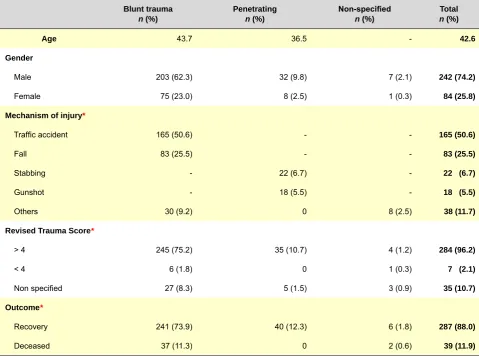
Abdominal trauma was the reason for hospital admission in 326 patients, between May 2006 and May 2011. The average age of the patients was 42.6, with a male predominance (74.2%). The most common forms of injury were road traffic accidents (39.9% involving vehicle passengers and 10.7% involving pedestrians) and falls (25.5%). Most patients had a revised trauma score > 4 at the time of hospital admission. The main demographic characteristics, severity scores and outcomes are presented in Table 1.
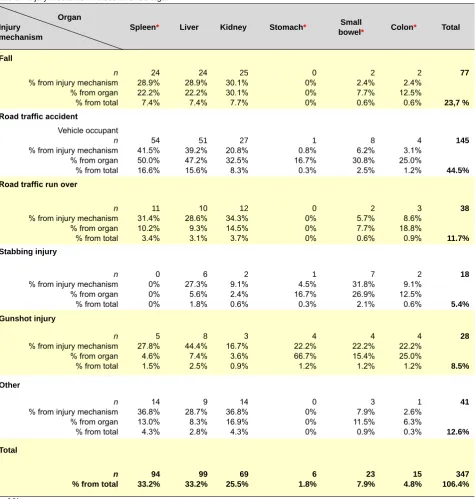
Blunt injuries, mainly due to road traffic accidents and falls, were the most common events in our group of patients (85.3%). Solid visceral injuries, namely involving the spleen, liver and kidney (Table 2) were the most prevalent (91.9%). Table 1 – Demographic characteristics, severity score and outcome
blunt trauma
n (%)
Penetrating
n (%)
Non-specified
n (%)
total
n (%)
Age 43.7 36.5 - 42.6
Gender
Male 203 (62.3) 32 (9.8) 7 (2.1) 242 (74.2)
Female 75 (23.0) 8 (2.5) 1 (0.3) 84 (25.8)
Mechanism of injury*
Traffic accident 165 (50.6) - - 165 (50.6)
Fall 83 (25.5) - - 83 (25.5)
Stabbing - 22 (6.7) - 22 (6.7)
Gunshot - 18 (5.5) - 18 (5.5)
Others 30 (9.2) 0 8 (2.5) 38 (11.7)
Revised trauma Score*
> 4 245 (75.2) 35 (10.7) 4 (1.2) 284 (96.2)
< 4 6 (1.8) 0 1 (0.3) 7 (2.1)
Non specified 27 (8.3) 5 (1.5) 3 (0.9) 35 (10.7) Outcome*
Recovery 241 (73.9) 40 (12.3) 6 (1.8) 287 (88.0)
Deceased 37 (11.3) 0 2 (0.6) 39 (11.9)
ARTIGO ORIGINAL Perforating injuries due to stabbing or gunshot occurred
in only 12.3% of the patients. Although rare, hollow visceral injuries, when compared with solid visceral injuries, occurred more often in this context, with 66.7% of stomach injuries and 25% of colon injuries due to gunshot and with 26.9% of small bowel injuries due to stabbing (Table 3). More than one abdominal organ was affected in 19.5% of the patients. Road traffic accidents (involving vehicle occupants) involved 8.9% of the total number of associated injuries. The most common injury associations involved the liver and the spleen (5%), liver and kidney (4.6%), spleen and kidney (3.7%) and small bowel and colon (1.5%). As regards diagnostic tests, these were not specified in 4.3% of the cases. Abdominal CT-scan was the most
commonly used test (71.5%) in 96.6% of the patients with a revised trauma score > 4, followed by abdominal ultrasound (62.6%). Diagnostic peritoneal lavage was rarely used (in 0.6% of the patients) and in 4% of the patients laparotomy was immediately performed.
Intra-abdominal visceral injury with a surgical indication was detected by diagnostic tests in 47.8% of the cases. The presence of non-identified injuries in blunt trauma patients submitted to surgery occurred in 75% of the patients. Single lesions of the small bowel, colon and liver were the less diagnosed by the tests (20.5%, 13.6% and 13.6% of the patients, respectively, with p < 0.05).
Non-surgical treatment was carried out in 65.3% of the patients and surgery was used in the remaining patients. Table 2 – Injury mechanism versus involved organ
Organ Injury
mechanism Spleen* Liver Kidney Stomach*
Small
bowel* Colon* total
Fall
n % from injury mechanism % from organ % from total
24 28.9% 22.2% 7.4% 24 28.9% 22.2% 7.4% 25 30.1% 30.1% 7.7% 0 0% 0% 0% 2 2.4% 7.7% 0.6% 2 2.4% 12.5% 0.6% 77 23,7 %
Road traffic accident
Vehicle occupant n % from injury mechanism % from organ % from total
54 41.5% 50.0% 16.6% 51 39.2% 47.2% 15.6% 27 20.8% 32.5% 8.3% 1 0.8% 16.7% 0.3% 8 6.2% 30.8% 2.5% 4 3.1% 25.0% 1.2% 145 44.5%
Road traffic run over
n % from injury mechanism % from organ % from total
11 31.4% 10.2% 3.4% 10 28.6% 9.3% 3.1% 12 34.3% 14.5% 3.7% 0 0% 0% 0% 2 5.7% 7.7% 0.6% 3 8.6% 18.8% 0.9% 38 11.7% Stabbing injury n % from injury mechanism % from organ % from total
0 0% 0% 0% 6 27.3% 5.6% 1.8% 2 9.1% 2.4% 0.6% 1 4.5% 16.7% 0.3% 7 31.8% 26.9% 2.1% 2 9.1% 12.5% 0.6% 18 5.4% Gunshot injury n % from injury mechanism % from organ % from total
5 27.8% 4.6% 1.5% 8 44.4% 7.4% 2.5% 3 16.7% 3.6% 0.9% 4 22.2% 66.7% 1.2% 4 22.2% 15.4% 1.2% 4 22.2% 25.0% 1.2% 28 8.5% Other n % from injury mechanism % from organ % from total
14 36.8% 13.0% 4.3% 9 28.7% 8.3% 2.8% 14 36.8% 16.9% 4.3% 0 0% 0% 0% 3 7.9% 11.5% 0.9% 1 2.6% 6.3% 0.3% 41 12.6% total n
% from total 33.2%94 33.2%99 25.5%69 1.8%6 7.9%23 4.8%15 106.4%347
ARTIGO ORIGINAL
Surgery was more frequent in patients with a penetrating injury (77.5%) and with a hollow visceral injury (87.5%). The patients with a blunt trauma and solid visceral injury, mainly hepatic, renal and splenic were treated conservatively (71.6%, 74.4% and 70.6%, respectively). Whenever a surgical approach was required, hepatic packing, vascular repair and resections were the most common surgical procedures.
Laparotomy without any additional procedure was performed in 12.4% of the patients (Table 4). There was an
increased mortality affecting those patients, mostly due to head injuries.
Surgical re-intervention was needed in 7.1% of the patients (more frequent in patients with a hollow visceral injury, affecting 14.3%). Only one patient died upon surgical re-intervention.
Patients with single hollow visceral injury had, on average, a longer hospital stay, than those who suffered a single solid visceral injury (24.3 days vs. 19.9 days). From the patients with a revised trauma score < 4, Table 3 – Penetrating injury versus involved organ
Organ Penetrating
injury Spleen Liver Kidney Stomach
Small
bowel Colon total
Stabbing injury
n % from injury mechanism % from organ % from total
0 0% 0% 0% 6 27.3% 5.6% 1.8% 2 9.1% 2.4% 0.6% 1 4.5% 16.7% 0.3% 7 31.8% 26.9% 2.1% 2 9.1% 12.5% 0.6% 18 5.4% Gunshot injury n % from injury mechanism % from organ % from total
5 27.8% 4.6% 1.5% 8 44.4% 7.4% 2.5% 3 16.7% 3.6% 0.9% 4 22.2% 66.7% 1.2% 4 22.2% 15.4% 1.2% 4 22.2% 25.0% 1.2% 28 8.5% total n
% from total 1.5%5 4.3%14 1.5%5 1.5%5 3.3%11 1.8%6 13.9%46
Table 4 – Outcome versus Treatment
treatment
Outcome
(Mortality) Laparotomy*
Solid visceral injury
treatment Hollow visceral injury treatment* total
Yes
n % from the outcome % from treatment % from total
8 44.4% 57.1% 7.1% 6 15.8% 10.5% 1.8% 1 2.6% 2.4% 0.3% 15 9.2%
Yes, with re-intervention
n % from the outcome % from treatment % from total
0 0% 0% 0% 0 0% 0% 0% 1 100.0% 2.4% 0.3% 1 0.3% No n % from the outcome % from treatment % from total
6 6.9% 42.9% 5.3% 49 17.5% 86.0% 15.0% 34 12.1% 82.9% 10.4% 89 30.7%
No, with re-intervention
n % from the outcome % from treatment % from total
0 0% 0% 0% 2 28.6% 3.5% 0.6% 5 71.4% 12.2% 1.5% 7 2.1% total n
% from total 12.4%14 17.4%57 12.541 42.3%112
ARTIGO ORIGINAL approximately 86% suffered blunt trauma (p = 0.026);
66.7% of the patients with a revised trauma score < 4 were submitted to surgery due to the presence of uncontrolled bleeding. All the patients with a single stomach injury, 14.3% of the patients with a simultaneous liver and spleen injury and 11.1% of the patients with a single colon injury presented a revised trauma score < 4 at admission. Mortality rate in our group of patients was 12%. Blunt trauma was the cause of death in 94.9% of the patients, mainly related to road traffic accidents (20% involving pedestrians and 17.7% involving vehicle occupants). Most deceased patients (74.1%) presented a revised trauma score > 4 at admission and 89.1% of the patients presented a serious single solid visceral injury. There was no mortality related with penetrating injuries.
DISCUSSION
Mechanisms underlying a traumatic injury are very important to determine individual diagnosis and therapy. In our study, in line with others,6,7 blunt trauma is most
frequent and is mainly related to road traffic accidents and falls, affecting mainly solid organs (liver and spleen). A penetrating injury requires a more careful approach, due to a higher percentage of underlying hollow visceral injury. As referred by several authors4,8-11 we found that clinical
detection of these injuries was more difficult, but of note, in contrast to previous reports, there was no increased mortality in the present study .4,8-11 FAST and CT-scan are
the preferred diagnostic tests1,5,6,8 and, in 41.1% and in
39.4% of the patients, respectively, they did not correctly detect all injuries, mainly in the presence of blunt trauma. Hollow visceral injuries were the least detected, namely when affecting the small bowel and the colon. These results are in line with previous descriptions5,6,8-11 referring to
FAST´s low sensitivity and specificity and CT-scan variable sensitivity in the detection of a hollow visceral injury, as major constraints.
Although some authors describe some advantages of diagnostic laparoscopy in a trauma context,16-18 this is not
frequently used. The highest percentage of laparotomies without any additional procedure was performed in patients involved in road traffic accidents (as vehicle occupants). Although 90.9% of the patients presented a revised trauma score > 4 at the time of hospital admission, an increased mortality was observed in these patients. These results are explained by serious deterioration due to extra-abdominal complications (due to a related head injury, in 97.4% of the
cases).
Trauma no longer means surgery,12,15,19 in line with the
observed increase in non-surgical therapeutic approaches, mainly in patients with blunt trauma. We found, in our study, a higher percentage of related injuries in this context, requiring a careful follow-up, with close surveillance of injury signs that may indicate the need for a surgical approach. On the other hand, surgery was the preferred approach upon penetrating injury. In these patients, there was no mortality, in line with a revised trauma score > 4 at the time of hospital admission.
The highest percentage of surgical re-intervention observed in patients who suffered hollow visceral injury is explained by a damage control initial approach, also referred by other authors,6,20 in addition to essential resections and
temporary stomata of colon and small bowel (in 75% of the patients). All patients submitted to re-intervention presented
a revised trauma score > 4 at the time of hospital admission, in line with an observed low mortality (only one patient died).
CONCLUSION
Abdominal trauma is a major cause of morbidity and mortality and the study of the epidemiological context in which it occurs is crucial for correct management. In our Hospital, blunt trauma is globally the most prevalent and is related to relatively stable traumatic injuries, allowing for non-surgical control. Nevertheless, due to the likely occurrence of hidden injuries, a careful follow-up is needed, in order to identify signs of non-diagnosed injuries that may require additional therapy. On the other hand, although less frequent, perforating trauma is responsible for a higher percentage of hollow visceral injuries, generally submitted to surgical treatment, with higher need of re-intervention and, therefore, with longer hospital stay. Trauma approach is increasingly aimed and has evolved to focus on a rapid diagnosis, with less invasive procedures and, whenever possible, with non-surgical treatment, seeking to minimise the risk of non-diagnosed injuries with a possible surgical indication.
CONFLICt OF INtEREStS
The authors have no conflict of interests to declare.
FINANCIAL SOURCES
No grant or allowance was received for the writing of this manuscript.
REFERENCES
1. Holmes JF, Wisner DH, McGahan JP, Mower WR, Kupperman N. Clini-cal prediction rules for identifying adults at very low risk for intra-abdom-inal injuries after blunt trauma. Ann Emerg Med. 2009;54:575-84. 2. Raja A, Zane RD. Initial management of trauma in adults. 2012;
20.9-20.31. [Consultado em 2012 Out 15]. Disponível em: http://www.upto-date.com.
3. Paydar S, Salahi R, Izadifard F, Jaafari Z, Abbasi HR, Eshraghian A, et al. Comparison of conservative management and Laparotomy in the management of stable patients with abdominal stab wound. Am J Emerg Med. 2011;30:1146-51.
4. Faria RG, Almeida AB, Moreira H, Barbosa E, Correia-da-Silva P, Cos-ta-Maia J. Prognostic factors for traumatic bowel injuries: Killing time. World J Surg. 2012;36:807-12.
5. Fleming S, Bird R, Ratnasingham K, Sarker S, Walsh M, Patel B. Accu-racy of FAST scan in blunt abdominal trauma in a major London trauma centre. Int J Surg. 2012;10:470-4.
6. Brooks A, Simpson J. Blunt and penetrating abdominal trauma. Abdomi-nal Surg. 2009;27:6.
ARTIGO ORIGINAL
http://www.uptodate.com.
8. McStay C, Ringwelski A, Levy P, Legome E. Hollow viscus injury. J Emerg Med. 2009;37:293-9.
9. Tan K, Liu JZ, Go T, Vijayan A, Chiu M. Computed tomography has an important role in hollow viscus and mesenteric injuries after blunt ab-dominal trauma. Int J Care Injured. 2010;41:475-8.
10. Campillo-Soto A, Soria-Aledo V, Renedo-Villarroya A, Millán MJ, Flores--Pastor B, Girela-Baena E, et al. Utilidad de la tomografía computari-zada para el diagnóstico de lesiones intestinales y mesentéricas en el trauma abdominal cerrado. Cir Esp. 2009;85:341-7.
11. Valcárcel CR, Fuentes FT, Gatica JC, Hermosa AR, Jiménez WV, Díaz DP, et al. Lesiones gastrointestinales y mesentéricas en el paciente politraumatizado: incidencia, demora diagnóstica y pronóstico. Cir Esp. 2009;86:17-23.
12. Saltzherr TP, van der Vlies CH, van Lienden KP, Beenen LF, Ponsen KJ, van Gulik TM, et al. Improved outcomes in the non-operative manage-ment of liver injuries. HPB.2011;13:350-5.
13. Cooper JG, Smith R, Cooper AJ. The incidence of abdominal injury in patients with thoracic and/or pelvic trauma. Injury Extra. 2005;36:259-63.
14. Helling TS,Wilson J,Augustosky K. The utility of focused
abdomi-nal ultrasound in blunt abdomiabdomi-nal trauma: a reappraisal. Am J Surg. 2007;194:728-33.
15. Gibson DE, Canfield CM, Levy PD. Selective nonoperative manage-ment of blunt abdominal trauma. J Emerg Med. 2006;31:215-21. 16. O’Malley E, Boyle E, O’Callaghan A, Coffey JC, Walsh SR. Role of
lapa-roscopy in penetrating abdominal trauma: A systematic review. World J Surg.2013;37:113-22.
17. Johnson JJ, Garwe T, Raines AR, Thurman JB, Carter S, Bender JS, et al. Use of laparoscopy in the diagnosis and treatment of blunt and penetrating abdominal injuries: 10-year experience at a level 1 trauma center. Am J Surg. 2013;205:317-20.
18. Schmelzer TM, Mostafa G, Gunter Jr OL, Norton HJ, Sing RF. Evalu-ation of Selective Treatment of Penetrating Abdominal Trauma. J Surg Educ. 2008;65:340-5.
19. Bruce PJ, Helmer SD, Harrison PB, Sirico T, Haan JM. Nonsurgical management of blunt splenic injury: is it cost effective? Am J Surg. 2011;202:810-16.