The Effect of Using
Tumblr
on the EFL Students’
Ability in Writing Argumentative Essays
Meiga Rahmanita
Graduate Program in ELT, Universitas Negeri Malang, Indonesia
Bambang Yudi Cahyono Universitas Negeri Malang, Indonesia
Abstract—Nowadays, many information and communication technology (ICT) tools have been integrated in
teaching and learning activities. In English language teaching (ELT), various ICT tools, especially those which belong to Social Networking Site (SNS) or social media, have been used as media to teach English language skills. One of these social media is Tumblr which has a mixture of characteristics of Blog, Instagram, and
Facebook. This research aimed to examine whether the use of Tumblr improves EFL student’ ability in writing argumentative essays. It involved 36 students of undergraduate program in English Department of Universitas Negeri Malang, Indonesia. The result showed that there is a significant improvement in students’ ability in writing after being taught by using Tumblr. This leads to the conclusion that Tumblr can be used effectively to help students improve their ability in writing argumentative essays.
Index Terms—Tumblr, EFL ability in writing, argumentative essay
I. INTRODUCTION
Information Technology and Communication (ICT) has rapidly turned into the most basic skill needed in various fields in today’s modern industrial society (Ghafivekr, Razak, Ghani, 2014, p. 25). Like in many other fields, ICT has been considered important in education field (Dudeney & Hockley, 2007). In English language teaching (ELT), in particular, ICT tools have been used as powerful media to enhance teaching and learning process (Drigas & Charami, 2014; Al-Munawwaroh, 2016; Kamilah & Anugerahwati, 2016, p. 133). In the teaching of writing, besides being used as a means for more effective teaching and learning, ICT is needed to vary the teaching and learning activities to avoid boredom on the part of the students. There are various ICT tools used as the media in teaching writing to improve students’ ability in writing, such as Storybird website and Blog.
Currently, there has been a change in technology for education which directs people’s attention into mobile learning (Zaki & Yunus, 2015, p. 11). This will influence the kinds of ICT tools which the teachers can choose as media for teaching writing. As the students have become more attached to mobile phones, especially smartphones, the teachers may consider Social Networking Sites (SNS)—based ICT to be used in their classroom. SNS is a web-based tool which is used as means to interact with other people, including all the social media that people used to interact with other people using internet connection (Yunus, Salehi & Chenzi, 2012, p. 42). One of the advantages of SNS—based ICT is that it can be accessed by using computers as well as mobile phones. Thus, it enables the users to use it efficiently.
There have been many research studies which examines various SNSs, such as Facebook, Instagram, Whatsapp and
Tumblr in the teaching of writing. The results commonly showed that the tools positively influence the students’ ability in writing (Shih, 2011; Ping & Maniam, 2015; Fattah, 2015; Listiani, 2016). Tumblr, in particular, can be said as the combination of Instagram, Facebook, and Blog for it combines all features that those three social media have. It has similar features and appearance as Instagram and Facebook, which also functions to share pictures and texts. However, Tumblr is also more like Blog, since there is no limit for words, like the one that Instagram has. That is why Matteson (2011) stated that Tumblr is the future of Blogging (p. 54). As a microBlogging service, Tumblr combines the benefits of having high quality content of Blog and online social networking services (Chang, Tang, Inagaki, & Liu, 2014).
In order to use it, Tumblr users need to create an account first. It can be accessed as website (www.tumblr.com) or downloaded in its mobile version into smartphones via Google Play Store. In Tumblr, the users can post and upload anything that they like, such as written texts, pictures, audio materials, videos, and links. They even can write down essays as long as they want since Tumblr does not have any word number limit. Like other SNSs, Tumblr enables its users to have interaction with other users through their posts and direct messages. Their posts can be seen, loved, commented, and shared by other users and vice versa. Therefore, there is a high possibility that the Tumblr users can learn from each others’ posts, show appreciation towards ones’ posts and, thus, encourage them to improve their works. Referring to the benefits that Tumblr has offered, it is believed that Tumblr will be beneficial to be used as a supporting medium in a writing class. It is also predicted that students’ writing performance can be improved by using Tumblr.
stated that Tumblr can be an effective medium for teaching writing (p. 388-389). They believe that Tumblr can increase students’ motivation and help them in finding inspiration and ideas to write. For example, in their classroom action research, Kurniati (2015) and Vitiara (2017) examined the use of Tumblr to improve students’ writing ability. They found out that by using Tumblr as the medium, students’ achievement as well as participation in writing class be increased. This indicates that Tumblr can be used to give a different nuance in teaching writing.
The result of this research is expected to share the information about the effect of Tumblr on students’ writing achievement as well as students’ perspective toward Tumblr in the argumentative writing class, which can be used as the consideration for the teachers who intend to apply a new supporting medium in their writing classes. Yet, it should be noted that some countries may not be able to access Tumblr freely due to the different policy that each country may apply. Indonesia, for example, recently has banned Tumblr due to pornography accounts issue, which resulted in the limited access of Tumblr and can only be accessed through Wi-Fi.
In light of the background, this research investigates the effect of the use of Tumblr on the students’ ability in writing and students’ responses on the use of Tumblr in the teaching of writing. The research questions are formulated as follows:
1. Do the EFL students have better ability in writing argumentative essays after being taught by using Tumblr? 2. What do the EFL students perceive on the use of Tumblr for the taching of writing?
II. METHOD
This research employed a pre-experimental design and it attempted to know the cause and effect of an implementation of a certain medium. Experimental research is the most suitable research design to use if ones want to investigate the cause-and-effect relationship among the research variables (Fraenkel, Wallen, & Hyun, 1932, p. 265). A pre-experimental design was chosen as this research only used one group of subjects (there were no separated experiment and control groups) and tried to find out the difference in the ability in writing before and after the treatment was implemented in that group.
This research was conducted in two of Argumentative Writing classes in undergraduate program of English Department, Faculty of Letters, Universitas Negeri Malang, Indonesia. There were 36 students in the two classes and they were considered as one group. When the research was conducted, these students were in the fourth semester of their four year education.
Argumentative writing is one of the writing course series offered in the English Department, Universitas Negeri Malang, Indonesia.The course can be taken after the students pass the two preceeding courses: Paragraph Writing and Essay Writing. This argumentative writing course is designed to enable the students to develop their ability in presenting logical, strong, and convincing arguments in two types of essay: opinion and argumentative essays. This research, however, only focused on argumentative essay. The materials for the teaching activity were taken from the coursebook used in the class. The coursebook was a compilation of opinion and argumentative essay chapters from several books: Oshima & Hogue (2006, p. 142-160), Oshima & Hogue (2007, p. 168-180), and Smalley, Ruetten, & Kozyrev (2001, p. 275-298).
In this research, one of us (the first author) had a role as the teacher who was responsible to implement the treatment and the other observed the teaching and learning activities. There were nine meetings conducted in this research. The first meeting was for the pre-test. The second up to eight meetings were used for the teaching and learning activities (treatment). In these meeting, the teacher taught the materials on argumentative writing by using Tumblr. She asked the students to create a Tumblr account and follow her account. Then, she asked them to do the exercises posted on Tumblr and asked them to post their works and give peer feedback to each other’s works on Tumblr. In the ninth meeting, the post-test was administered to the students and a questionnaire about the use of Tumblr in the Argumentative Writing course was given to them.
There were two instruments used in this research. The first one was writing tests for the pre-test and post-test. The tests were used to elicit students’ ability in writing before and after the treatment. There were two topics for each test. The topics for the pre-test were Online versus Conventional Public Transportation and Pre-school for Toodlers, while the topics for post-test were Online versus Traditional Shopping and Full Day School in Indonesia. The rubric used to give assessment contained five aspects of writing, each of which had different weight (Content 30%, Organization 25%, Grammar 20%, Vocabulary 15%, Mechanics 10%). The rating was done by two raters, the teacher and a colleague from the Graduate Program in ELT. The scores from each rater were compared to examine inter-rater reliability (see Appendix 1 for the pre-test and post-test scores).
III. FINDINGS
The findings of this research were based on the two research questions. The first finding is related to students’ ability in writing before and after being taught by using Tumblr and the second was the students’ perception on the use of Tumblr in the Argumentative writing class.
A. Improvement of the Students’ Ability in Writing
The data from this finding were gotten from students’ scores on test and post-test. The data obtained from pre-test and post-pre-test’s scores were analyzed by using SPSS (the Statistical Package for the Social Sciences) 20.0. This data analysis was carried out to find out whether the result was enough to reject the null hypothesis. The significance level set to reject the null hypothesis was .05. The Null hypothesis was “There is no difference on the EFL students’ ability in writing Argumentative essay before and after being taught by using Tumblr.”
From the descriptive analysis of pre-test and post-test’s scores, the results are shown in Table 1.
TABLE 1:
DESCRIPTIVE ANALYSIS BETWEEN PRE-TEST AND POST-TEST SCORES
N Minimum Maximum Mean Std. Deviation Std. Error Mean
Pre-test 36 43 72,5 56.24 7.22 1.20
Post-test 36 60 90 77.88 6.65 1.11
Table 1 shows that the mean of pre-test scores is 56.22, while the mean of post-test scores is 77.83. It can be seen that the mean of the post-test is higher than that of the pre-test. However, to check whether the difference between the two means is significant to reject the null hypothesis, the data needs to be analyzed further using t-Test. This t-Test is used to compare the different means from one group. The result of the data analysis is presented in Table 2.
TABLE 2:
RESULT OF THE PAIRED-SAMPLES T TEST BETWEEN PRE-TEST AND POST-TEST SCORES Paired Differences
T df
Sig. (2-tailed) Mean
Std. Deviation
Std. Error Mean
95% Confidence Interval of the Difference
Lower Upper
Pair 1 Pretest- Posttest -21.64 5.76 .960 -23.589 -19.689 -22.525 35 .000
From the result above, it can be seen that the Sig. (2-tailed) from the two data is .000, which is below .05 (.000 < .05). It means that the difference between the two means was significant and, therefore, it can be used to reject the null hypothesis. From the data analysis on students’ pre-test and post-test scores, it is found that the EFL students taught by using Tumblr achieved better ability in writing argumentative essay than before being taught by using Tumblr.
B. Students’ Perceptions on the Use of Tumblr
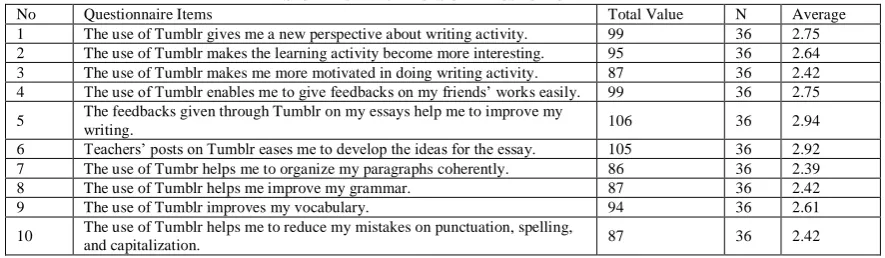
The data for students’ perceptions were obtained from the questionnaire. The items in the questionnaire were designed to know students’ perception on the use of Tumblr in writing argumentative essays and their ability in writing argumentative essay after being taught by using Tumblr. For easier analysis, each scale was given score as follows: strongly agree = 4, agree = 3, disagree = 2, strongly disagree = 1. The results of the questionnaire are presented in the Table 3.
TABLE 3:
STUDENTS’ PERCEPTIONS ON THE USE OF TUMBLR
No Questionnaire Items Total Value N Average
1 The use of Tumblr gives me a new perspective about writing activity. 99 36 2.75 2 The use of Tumblr makes the learning activity become more interesting. 95 36 2.64 3 The use of Tumblr makes me more motivated in doing writing activity. 87 36 2.42 4 The use of Tumblr enables me to give feedbacks on my friends’ works easily. 99 36 2.75
5 The feedbacks given through Tumblr on my essays help me to improve my
writing. 106 36 2.94
6 Teachers’ posts on Tumblr eases me to develop the ideas for the essay. 105 36 2.92 7 The use of Tumbr helps me to organize my paragraphs coherently. 86 36 2.39
8 The use of Tumblr helps me improve my grammar. 87 36 2.42
9 The use of Tumblr improves my vocabulary. 94 36 2.61
10 The use of Tumblr helps me to reduce my mistakes on punctuation, spelling, and capitalization. 87 36 2.42
From Table 3, it can be seen that for the first statement, the students agreed that Tumblr gives a new perspective in writing activity. In colum provided to write down their reasons, most of them admitted that they never used Tumblr before to do writing activity in the column provided. Related to this, for the second statement, the students also agreed
they were not really motivated in doing writing activities using Tumblr. Furthermore, for the fourth statement, the students agreed that the use of Tumblr enabled them to give feedback to their classmates’ works as they only needed to comment on the available comment section.
Next, talking about the students’ perception on their ability in writing after being taught by using Tumblr, for the fifth statement, the students agreed that the feedback given through Tumblr on their essays helped them improve their writing. Some of them admitted that it helped them to see their mistakes that they could directly edit on Tumblr after getting feedback, if they wanted. Also, for the sixth statement, the students agreed that the video and link of article that the teacher posted on Tumblr when introducing the topics to write helped them to develop ideas for their essay. They said that it gave them some background knowledge they needed before started writing.
Nevertheless, for the seventh statement, the students disagreed that Tumblr helped them improve their writing organization. They felt that their writing organization was just the same whether they wrote their essay on Tumblr or in the piece of paper. Furthermore, for the eighth statement, the students disagreed that Tumblr helped them improve their grammar. For the ninth statement, however, the students agreed that Tumblr had improved their vocabulary. That was because on Tumblr, they often found and read other posts or essays whose vocabulary is still unfamiliar for them. Also, when they read their friends’ work, they sometimes found vocabulary which they considered new to them. They admitted that those posts and essays helped them enrich their vocabulary. Next, the students’ response for the last statement showed that the students disagreed that Tumblr helped them reduce their mistakes on punctuation, capitalization, and spelling. They who felt no improvement in terms of organization, grammar, and mechanics argued that they did not feel any improvement when doing their essays on Tumblr or in a piece of paper. They said that if there was any improvement, it was because of the feedback and not the feature of Tumblr itself.
Thus, most of the students admitted that the use of Tumblr in writing activity was interesting and gave them several benefits. However, there are some external factors which made them unmotivated in doing the activity. They also thought that they were not really sure if the use of Tumblr was able to improve their writing ability.
IV. DISCUSSION
This research aimed to know whether students’ achieved better in writing argumentative essay after being taught by using Tumblr and their perception on their ability after being taught by Tumblr. From the analysis of data obtained from pre-test and post-test scores, it can be said that the students have better ability in writing argumentative essay after being taught by using Tumblr. There is a significant difference between students’ pre-test and post test mean in 95% level of significance. Students’ post-test mean is significantly higher than pre-test mean. This is in line with what Vitiara (2017) and Kurniati (2015) found in the results of their action research. In their research studies, the students gained improvement in writing activity after being taught by using Tumblr. Using tumblr helped them to improve their writing as they gave feedback to each other’s work using the comment feature on Tumblr. Feedback is considered as an important feature in writing as it provides the opportunity for the writers to see how the readers react on their writings and make an improvement by learning from the responses that they give (Hyland, 2003, p. 177). They were also able to find the online resources they needed for their essays through the teacher’s and other students’ posts on Tumblr. This helped them in developing their ideas before they started writing. The use of Tumblr also enabled students to use more various vocabulary, as they learn from their classmates’ works and other posts in Tumblr. These all prove that Tumblr can be used as an effective medium to improve students’ ability in writing.
From the questionnaire data, it can be concluded that most of the students agreed that the use of Tumblr gives a new atmosphere in writing activity and, hence, makes the teaching and learning activity more interesting. That is because as the digital natives, the students find out that the presentation of material through SNS is more familiar for them (Yunus, Salehi, & Chenzi, 2012, p. 44). However, some of the students did not feel that the use of Tumblr as the media in writing activity motivated them. This is contradictory with the result of research done by Yunus and Salehi (2012) as they claimed that the features of Tumblr increased students’ learning motivation. Those who disagreed stated that Internet connection problem and limited access of Tumblr were the reasons why they were unmotivated in using and accessing Tumblr as these two problems made it difficult for the students to access Tumblr. Thus, due to these external factors, the use of Tumblr in writing argumentative essay was not really successful in enhancing students’ motivation in writing activity.
Moreover, most students agreed that it was easy for them to give feedback to each other’s works and that the feedback given through Tumblr helped them improve the quality of their writing. Furthermore, the students agreed that the teacher’s posts on Tumblr gave them background knowledge to generate ideas for their writing. Tumblr provides various choices of posts which can be uploaded. The users can upload various features such as text only, pictures, video, and link. This gives variation in the teacher’s posts which are meant to give background knowledge to the students. Thus, the teacher was able to post video and link of article provided with the introduction to the topic to give the students background knowledge about what they were going to write.
they often read other posts or their own classmates’ works which used words which were still unfamiliar to them and tried to use them in their own essays. This way, they improved their vocabulary. This is also in line with what Tiryaki and Tütüniş (2012, p. 214) found in their research. They found that extensive reading gave positive contribution towards vocabulary enrichment. Moreover, it has been widely known that one of the ways to improve ability in writing is through reading. Reading can be a good source needed before one starts writing as they are likely to write from their observation on things that they have read (Brown & Lee, 2015, p. 443)
V. CONCLUSIONS
This research has reported that the use of Tumblr, one of the Social Nerworking Sites, effectively improved the undergraduate students’ ability in writing Argumentative essays. This was indicated by the mean of the students’ post-test scores which was significantly higher than the mean of their pre-post-test scores. In addition, it was found out that most of the students showed their positive responses towards the use of Tumblr in writing activities. However, there are some external factors, such as bad Internet connection and limited access to Tumblr, which made the students feel unmotivated in accessing Tumblr. Teachers who are interested to use Tumblr should consider these problems if they plan to use Tumblr as a medium in their teaching and learning activity. Moreover, teachers need to be as creative as possible to optimize the advantages of using Tumblr in the writing activities.
APPENDIX 1. STUDENTS’PRE-TEST AND POST-TEST SCORES
No Students’ Initials Pre-test Scores Post-test Scores
1 AMHL 53,5 70
2 EO 48,5 75
3 ENF 52,5 79,5
4 FPS 63,5 84
5 KCPS 72 88
6 MAP 47 75
7 MRY 56 81,5
8 MTN 45 68
9 NA 49 74
10 NDA 48,5 77
11 RSN 59 83
12 RNF 52 76
13 RFP 65 87
14 UP 55 85
15 ZR 60 83
16 AR 72,5 90
17 ARA 50 82
18 BTC 56,5 81
19 DP 65 81,5
20 ES 43 60
21 FYM 54 82
22 GNF 50 72
23 II 65 83
24 LRP 59 74
25 MR 56 62
26 MZM 47 77
27 NH 50,5 74
28 RASF 56,5 71
29 RK 60 80
30 RAK 62 75
31 RQ 57 83
32 RHR 52 79
33 SMF 58 74
34 TF 58 76
35 TNS 67 84
APPENDIX 2. QUESTIONNAIRE
No Statements Strongly
Agree Agree Disagree
Strongly Disagree
1 The use of Tumblr gives me a new perspective about writing activity.
Why do you agree/ disagree? Explain your answer
2 The use of Tumblr makes the learning activity become more interesting.
Why do you agree/disagree? Explain your answer
3 The use of Tumblr makes me more motivated in doing writing activity.
In what way do you feel motivated/unmotivated? Explain your answer
4 The use of Tumblr enables me to give feedbacks on my friends’ works easily.
Why do you agree/disagree? Explain your answer
5 The feedbacks given through Tumblr on my essays help me to improve my writing.
Why do you agree/disagree? Explain your answer
6 Teachers’ posts on Tumblr eases me to develop the ideas for the essay.
Why do you agree/disagree? Explain your answer
7 The use of Tumbr helps me to organize my paragraphs coherently.
Why do you agree/disagree? Explain your answer 8 The use of Tumblr helps me improve my grammar.
Why do you agree/disagree? Explain your answer 9 The use of Tumblr improves my vocabulary.
Why do you agree/disagree? Explain your answer
10 The use of Tumblr helps me to reduce my mistakes on punctuation, spelling, and capitalization. Why do you agree/disagree? Explain your answer
REFERENCES
[1] Al-Munawwarah, S. F. (2014). Teachers’ perceptions on the use of ICT in Indonesian EFL learning context. English Review: Journal of English Education, 3(1), 70-80.
[2] Brown, H. D., & Lee, H. (2015). Teaching by principles: An interactive approach to language pedagogy(4th ed). New York: Pearson Education.
[3] BSNP. (2016). Peraturan menteri pendidikan dan kebudayaan Republik Indonesia No 22/2016 tentang standar proses pendidikan dasar dan menengah [The rule of the minister of education and culture of the Republic of Indonesia No 22/2016 on process standard of basic and secondary education]. Retrieved December 2, 2017, from http://vervalsp.data.kemdikbud.go.id/. [4] Chang, Y., Tang, L., Inagaki, Y., & Liu, Y. (2014). What is Tumblr: A statistical overview and comparison. ACM SIGKDD
Explorations Newsletter – Special Issue on Big Data, 16(1), 21-29. Retrieved December 8, 2017, from https://arxiv.org/abs/1403.5206v2.
[5] Drigas, A., & Charami, F. (2014). ICTs in English learning and teaching. International Journal of Recent Contributions from Engineering, Science & IT, 2(4), 4-10.
[6] Dudeney, G., & Hockley, N. (2007). How to teach English with technology, Essex, UK: Pearson Education.
[7] Fattah, S. F. E. S. A. (2015). The effectiveness of using Whatsapp Messengers as one of mobile learning techniques to develop students’ writing skills. Journal of Education andd Practice, 6(32), 115-127.
[8] Fraenkel, J. R., Wallen, N.E., & Hyun, H. H. (1932). How to design and evaluate research in education(8th ed). New York: McGraw Hill.
[9] Ghavifekr, S.,Razak, A. Z. A., Ghani, M. F. A. et al. (2014). ICT integration in education: Incorporation for teaching and learning improvement.The Malaysian Online Journal of Educational Technology, 2(2), 25-45.
[10] Hyland, K. (2004). Second language writing. New York: Cambridge University Press.
[11] Listiani, G. (2016). The effectiveness of Instagram writing compared to teacher centered writing to teach recount text to students with high and low motivation: The case of eight grade students in Kesatrian Junior High School 1 at Semarang in the academic year of 2015/2016. ELT Forum: Journal of English Language Teaching, 5(1): 1-8.
[12] Kamilah, N., & Anugerahwati, M. (2016). Factors contributing to teachers’ resistance in integrating ICT in EFL classroom in senior high school. ELLITE – Journal of English Language, Literature, and Teaching, 1(2), 133-150.
[13] Kurniati, N. (2015). The use of Tumblr to enhance the students’ writing skill in recount text. Unpublished Thesis. Retrieved December 8, 2017, from eprints.walisongo.ac.id/5058/1/113411009.pdf.
[14] Matteson, A. (2011). Do tou tumble? Tumblr could change the way you blog. School Library Monthly, 27(5), 54-56. [15] Oshima, A., & Hogue, A. (2006). Writing academic English. White Plains, NY: Pearson.
[17] Ping, N. S., & Maniam, M. (2015). The effectiveness of Facebook group discussion on writing performance: A study in matriculation college. International Journal of Evaluation and Research in Education, 4(1), 30-37.
[18] Shih, R. (2011). Can Web 2.0 technology assist college students in learning English writing? Integrating Facebook and peer assessment with blended learning. Australasian Journal of Education Technology, 27(5), 829-845.
[19] Smalley, R. L., Ruetten, M. K., & Kozyrev, J. R. (2001). Refining composition skills: Rhetoric and grammar for ESL students. Boston, MA: Heinle & Heinle.
[20] Tiryaki, Z. M., & Tütüniş, B. (2012). The role of extensive reading on vocabulary development. ELT Research Journal, 1(4), 209-215.
[21] Vitiara, M. B. (2017). Teaching writing with Tumblr in senior high school. Jurnal Pendidikan dan Pembelajaran, 6(1), 1-12. [22] Yunus, M. M., Salehi, H., & Chenzi, C. (2012). Integrating social networking tools into ESL writing classroom: Strengths and
weaknesses. English Language Teaching, 5(8), 42-48.
[23] Yunus, M. M. & Salehi, H. (2012). Tumblr as a medium to improve students’ writing skills. Journal of Applied Science Research, 8(1), 383-389.
[24] Zaki, A. A., & Yunus, M. M. (2015). Potential of mobile learning in teaching of ESL academic writing. English Language Teaching, Vol. 8 (6): 11-19.
Meiga Rahmanita is a student of Graduate Program in English Language Teaching at Universitas Negeri Malang, Malang, East Java, Indonesia. She earned her S.Pd. (Bachelor degree in English Language Teaching) degree from the same university in 2015. Email: [email protected]