New
Lepidium
(Brassicaceae) from New Zealand
P. J. de Lange1, P. B. Heenan2, G. J. Houliston3, J. R. Rolfe4, A. D. Mitchell5
1 Science & Capability Group, Terrestrial Ecosystems, Department of Conservation, Private Bag 68908 New-ton, Auckland 1145, New Zealand 2 Allan Herbarium, Landcare Research, P.O. 69, Lincoln 7640, Canter-bury, New Zealand 3 Ecological Genetics Group, Landcare Research, P.O. 69, Lincoln 7640, Canterbury, New Zealand 4 Science & Capability Group, Terrestrial Ecosystems, National Office, Department of Conservation, P.O. Box 10420, Wellington 6143, New Zealand 5 Otago School of Medicine, University of Otago, Chri-stchurch, PO Box 4345, Christchurch 8140, New Zealand
Corresponding author:Peter de Lange ([email protected])
Academic editor:Karol Marhold | Received 22 November 2012 | Accepted 17 May 2013 | Published 00 June 2013
Citation: de Lange PJ, Heenan PB, Houliston GJ, Rolfe JR, Mitchell AD (2013) New Lepidium (Brassicaceae) from New Zealand. PhytoKeys 24: 1–147. doi: 10.3897/phytokeys.24.4375
Abstract
A revision of the New Zealand endemic Lepidium oleraceum and allied species is presented. Sixteen species are recognised, 10 of these are new. The new species are segregated on the basis of morphological charac-ters supported by molecular data obtained from three DNA markers (two rDNA and one cpDNA). One species, L. castellanumsp. nov., is endemic to the Kermadec Islands where it is sympatric with L. olera-ceum. The North Island of New Zealand supports four species, with two of them, L. amissumsp. nov. and L. obtusatum, now extinct. The South Island supports six species, that, aside from L. banksii, L. flexicaule and L. oleraceum, are all confined to the south-eastern half of the island (L. aegrumsp. nov., L. crassum
sp. nov. and L. juvencumsp. nov.). One of these, L. juvencumsp. nov., extends to Stewart Island. The
Chatham Islands support six species (L. flexicaule, L. oblitumsp. nov., L. oleraceum, L. oligodontumsp. nov., L. panniformesp. nov., and L. rekohuensesp. nov.), one of which, L. oligodontumsp. nov., extends to the Antipodes Islands group. The remote, subantarctic Bounty Islands group supports one endemic, L. seditiosumsp. nov., which is the only vascular plant to be recorded from there. Lepidium limenophylaxsp. nov. is known from islands off the south-western side of Stewart Island/Rakiura, The Snares and Auckland islands. Lepidium naufragorum, although not related to L. oleraceum and its allies, is also treated because populations with entire leaves are now known. Typification is undertaken for L. banksii, L. oleraceum, L. oleraceum var. acutidentatum, var. frondosum and var. serrulatum.
www.phytokeys.com
Copyright P. J. de Lange et al. This is an open access article distributed under the terms of the Creative Commons Attribution License 3.0 (CC-BY), which permits unrestricted use, distribution, and reproduction in any medium, provided the original author and source are credited.
P. J. de Lange et al. / PhytoKeys 24: 1–147 (2013) 2
Keywords
New Zealand Archipelago, Kermadec Islands, Brassicaceae, Lepidium, L. oleraceum group, new species, L. aegrum sp. nov., L. amissum sp. nov., L. castellanum sp. nov., L. crassum sp. nov., L. juvencum sp. nov., L. limenophylax sp. nov., L. oblitum sp. nov., L. oligodontum sp. nov., L. panniforme sp. nov., L. rekohuense sp. nov., L. seditiosum sp. nov., typifications, ecology, conservation
introduction
As currently circumscribed, the New Zealand members of the cosmopolitan genus
Lepidium comprise 10 indigenous species (Garnock-Jones 1988; Garnock-Jones and Norton 1995; Heenan et al. 2007). Recently, the New Zealand species have been the subject of ongoing research that has resulted in new circumscriptions of the inland spe-cies L. sisymbrioides Hook.f. and L. solandri Kirk (Heenan et al. 2007), as well as the publication of phylogenetic (Mitchell and Heenan 2000; Mummenhoff et al. 2004) and evolutionary studies (Dierschke et al. 2009). There are an additional 16 species naturalised in New Zealand (Garnock-Jones 1988; Webb et al. 1995; Howell and Sawyer 2006; Heenan and de Lange 2011), including species that have previously been assigned to Coronopus Zinn and Cardaria Desv. (Al-Shehbaz et al. 2002).
It has long been recognised that Lepidium oleraceum G.Forst ex Sparrm. is a widely distributed and rather variable coastal species (Kirk 1899; Cheeseman 1906, 1925; Allan 1961; Garnock-Jones 1988; Garnock-Jones and Norton 1995; de Lange et al. 2010a). As currently circumscribed, L. oleraceumsensu lato (s.l.) has a range encompassing the sub-tropical Kermadec Islands, the main islands of New Zealand (North, South and Stewart islands), Chatham Islands, and the subantarctic Antipodes, Snares and Auckland islands. Although the most recent treatment by Allan (1961) accepted one variable species, three additional named varieties of L. oleraceum were discussed: var. acutidentatum Kirk, var.
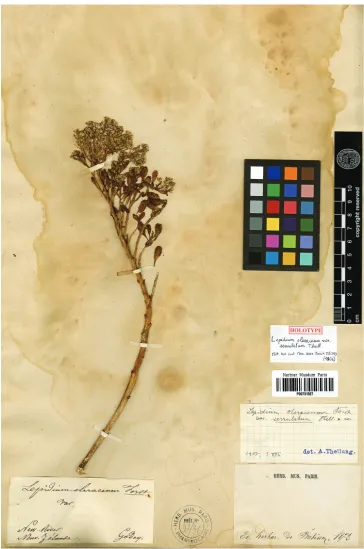
frondosum Kirk, and var. serrulatum Thell. As Allan (1961) noted, the taxonomic status of these varieties has never been particularly clear, though it would seem that the large, bushy, broad-leaved form occurring on the Three Kings Islands and the northern part of North Island is referable to Kirk’s var. frondosum, while plants with coarsely serrate and lanceolate leaves comprise his var. acutidentatum. Lepidium oleraceum var. serrulatum is known only from the type at the Paris Herbarium (P!, Fig. 1), described by Thellung (1906) from a sin-gle collection made from ‘New River, New Zealand’ a place equated by Allan (1961) with the Riverton Estuary, Southland. The type is a plant with narrow and deeply serrated leaves; comparable forms have been occasionally gathered from the North and South islands.
named varieties can be recognised, [though] there is considerable variation (possibly clinal) present within L. oleraceum. A critical investigation of the whole complex, based on genetic as well as morphological analyses, is required before any taxonomic changes within this species are formalised’.
In this paper we present a taxonomic revision of L. oleraceum s.l. (hereafter referred to as the Lepidium oleraceum group), along with the allied species L. banksii Kirk, L. flexicaule Kirk, and the extinct L. obtusatum Kirk. This revision began in 1990 (de Lange 2010) and has involved the critical study of type specimens and herbarium ma-terial, extensive field work to examine natural variation of wild populations through-out their geographic range, supplemented with the use of DNA sequence data and, where possible, cultivating plants under uniform conditions. Although the current natural distribution of L. oleraceum group and its allies comprises small, highly frag-mented populations that most probably represent only a small remnant of the original distribution, abundance, and morphological and genetic diversity of the species, suf-ficient populations remain to enable the taxonomic revision offered here.
In addition to revising the L. oleraceum group, we also treat Lepidium naufragorum. At the time of its formal naming L. naufragorum was regarded as having a relationship to L. flexicaule and the L. oleraceum group (Garnock-Jones and Norton 1995). It is now known to have no close relationship to these species (Mitchell and Heenan 2000; Heenan et al. 2007). Nevertheless we treat it here because of the recent discovery of some populations that have entire rather than pinnatifid rosette leaves, so necessitating a slight revision of the description provided by Garnock-Jones and Norton (1995).
Materials and methods
Plant collections and specimens
The taxonomic revision presented in this paper is based on the critical study of speci-mens and type material of Lepidium banksii, L. flexicaule, L. obtusatum, L. oleraceum
group, and L. naufragorum held at the following herbaria AK, BM, CANU, CHR, HO, K, MEL, MPN, NSW, OTA, P, UNITEC, WAIK, WELT, and WELTU. Herbarium acronyms follow Thiers (2012). Live specimens of the northern South Island endemic
P. J. de Lange et al. / PhytoKeys 24: 1–147 (2013) 4
Knights Islands (35°28'35.98"S, 174°44'22.27"E), Mokohinau Islands (35°54'23.93"S, 175°7'47.57"E), Ngatutura Point (Waikato) (37°31'5.31"S, 174°44'38.20"E), an un-named islet near Banks Peninsula (43°53'46.26"S, 172°52'2.54"E), coastal Otago and Otago Peninsula (45°52'47.00"S, 170°37'56.97"E), islands off the coast of Stewart Island (46°51'38.92"S, 168°13'45.79"E), and throughout the Chatham Island group (43°55'58.38"S, 176°29'18.99"W). Additional observations, live plants and specimens of L. oleraceum group were also provided by J.W. Barkla and T.C. Greene from Ma-cauley Island, Haszard Islet and Cheeseman Island in the Southern Kermadec Islands group; E.K. Cameron from West Island (part of the Three Kings Islands); by P. Sa-gar from North East Island, Snares Island group (47°59'49.23"S, 166°33'35.49"E); and J.W. Barkla and G. Loh from various sites around Otago. The late P.I. Knight-bridge provided fresh material of L. naufragorum from Taumaka, Open Bay Islands (47°59'49.23"S, 166°33'35.49"E), and S. Walls provided live plants of L. banksii
from Totaranui headland (40°48'53.32"S, 173°00'53.91"E) and Moutere Island (41°10'14.18"S, 173°2'11.28"E).
To this sampling were added further plants of L. banksii, L. flexicaule, L. oleraceum
group and L. naufragorum collected by New Zealand botanists from a wide range of sites, and held by the Auckland Botanic Gardens, University of Auckland, Oratia Na-tive Plant Nurseries, Motukarara Conservation Nursery and Landcare Research (Lin-coln campus) to meet the ex-situ objectives of the Department of Conservation Coastal Cress Recovery Plan (Norton and de Lange 1999).
Molecular phylogenetics
In conjunction with the taxonomic revision of the L. oleraceum group and allied spe-cies, phylogenetic studies were carried out to determine relationships among the taxa, as well as to gain a better understanding of the population variation in extant popula-tions of Lepidium species. For simplicity and clarity we use the new taxonomic names described here throughout the manuscript.
Total genomic DNA was extracted from 0.1–1.0 g of leaf tissue using a QIAGEN DNeasy® Plant Mini Kit or an INTRON Plant DNA kit using fresh material, fresh ma-terial stored in Silica Gel, and from herbarium specimens. DNA sequencing of nrDNA (ITS1-5.8S-ITS2 and ETS), and plastid DNA (trnL-F spacer regions) were carried out fol-lowing the methods of White et al. (1990) and Mitchell and Heenan (2000) respectively. PCR products were purified using either the Perfectprep PCR cleanup kits (Eppen-dorf), or diluted to approximately 1:4 with ultrapure water. Each sample was sequenced in the sense and antisense direction by the Centre for Gene Technology (University of Auckland), the Allan Wilson Centre Genome Service, (Massey University, Albany), or the Landcare Research Ecological Genetics Laboratory (Tamaki). Sequencing reactions were performed with the same primers as the PCR amplifications and the 3.1 ABI PrismTM
Big Dye Terminator Sequencing Kit (Applied Biosystems, Scoresby, Vic.). Sequences obtained in this study have been assigned GenBankaccession numbers (Table 1).
Matrix preparation
Sequence alignment was performed using ClustalX vers. 1.81 (Thompson et al. 1997). Multiple alignment parameters were set to 12 for gap opening penalty and 6.0 for gap extension penalty. No further alignment was required.
Maximum likelihood (ML) analyses were conducted using RaXML (Stamatakis 2006) employing the full search algorithm with Gamma Distribution and General time reversible (GTR) model. In each of the datasets support for nodes was assessed by non-parametric bootstrapping (Felsenstein 1985) using 1000 replicates. Because of the simple nature of the dataset, no further phylogenetic reconstruction was attempted. Bayesian reconstruction in Mr Bayes (Huelsenbeck and Ronquist 2001), and parsimony analysis (Swofford 2006) in Paup* were undertaken, but preliminary analyses yielded similar results (not shown).
Trees were drawn in Figtree version 1.3.1. (Rambault 2008) and labels follow those in Table 1.
results
DNA sequence data
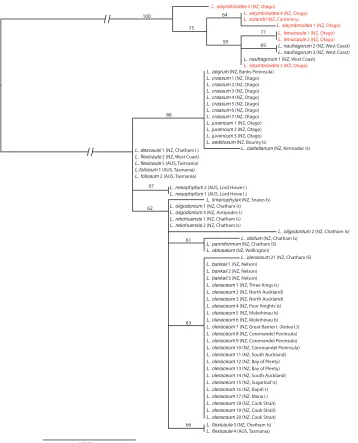
Phylogenetic analyses provided some resolution of relationships, with ETS the most informative (Fig. 2), resolving the L. oleraceum and L. sisymbrioides groups. Within the
P. J. de Lange et al. / PhytoKeys 24: 1–147 (2013) 6 tab le 1. H erbarium v
ouchers and G
enB
ank numbers of
Lepidium
study gr
oup and outgr
oup samples used in the pr
esent inv estigation. Tax on N r. Locality ETS ITS tr nL
Voucher or r
efer
ence
L. aegr
um
H
eenan & de Lange
N
ew Z
ealand, S
outh I., Canterbur
y, B anks Peninsula K C109387 K C109330 — AK 283510 L. aschersonii Thell. Australia —
AJ582426, AJ582483 AY015838, AY015926
M
ummenhoff et al.
(2004) L. banksii Kir k 1 N ew Z ealand, S
outh I., N
elson, A bel Tasman N ational P ar k, Totaranui P oint K C109388 K C109331 K C109368 AK 259119 L. banksii Kir k 2 N ew Z ealand, S
outh I., N
elson, A bel Tasman N ational Par k, T otaranui K C109389 — K C109369 CHR 515311 L. banksii Kir k 3 N ew Z ealand, S
outh I., N
elson, Ngur oa I. K C109390 K C109332 — AK 259118 L. castellanum
de Lange & H
eenan K ermadec I s., M acauley I. K C109391 — — AK 306194 L. cr assum H
eenan & de Lange
1
N
ew Z
ealand, S
outh I., O
tago, B ridge P oint, K C109394 — — CHR 609797 L. cr assum H
eenan & de Lange
2
N
ew Z
ealand, S
outh I., O
tago P eninsula, Aramoana K C109395 K C234312 K C109370 AK 234312 L. cr assum H
eenan & de Lange
3
N
ew Z
ealand, S
outh I., O
tago P eninsula, Aramoana K C109396 — — CHR 609772 L. cr assum H
eenan & de Lange
4
N
ew Z
ealand, S
outh I., O
tago P eninsula, Whar ekakahu I. K C109393 — — CHR 609801 L. cr assum H
eenan & de Lange
5
N
ew Z
ealand, S
outh I., O
tago P eninsula, E ye talus K C109392 — — no v oucher L. cr assum H
eenan & de Lange
6
N
ew Z
ealand, S
outh I., O
tago, Tair ei K C109397 — — no v oucher L. cr assum H
eenan & de Lange
7
N
ew Z
ealand, S
outh I., O
tago, N ugget P oint K C109398 — — CHR 609805 L. desv auxii Thell. 1 Chatham I s., R
ekohu (Chatham I.),
W aitangi W est K C109399 K C109334 K C109371 AK 294948 L. desv auxii Thell. 2 Australia —
AJ582429, AJ582486 AY015848, AY015935
M
ummenhoff et al.
(2004)
L. fasciculatum
Thell.
Australia
—
AJ582428, AJ582485 AJ582563, AJ582564
M
ummenhoff et al.
Tax on N r. Locality ETS ITS tr nL
Voucher or r
efer ence L. flexicaule Kir k 1 N ew Zealand, South I., Karamea, Scott ’s Beach —
AJ582430, AJ582487
AY015853
M
ummenhoff et al.
(2004) L. flexicaule Kir k 2 N ew Zealand, South I., Karamea, Scott ’s Beach K C109403 — — — L. flexicaule Kir k 3 Chatham I s., R
ekohu (Chatham I.) P
oint Somes K C109400 K C109335 K C109372 AK 289897 L. flexicaule Kir k 4 Australia, Tasmania, P or t D avy , E lliot P oint K C109401 K C109336 K C109373 HO 402077 L. flexicaule Kir k 5 Australia, Tasmania, P or t D avy , G ull R eef K C109402 K C109337 K C109374 HO 26460 L. foliosum D esv . 1 Australia, Tasmania, F
urneaux, Little D
og Island K C109404 K C109338 K C109375 HO 525314 L. foliosum D esv . 2 Australia, Tasmania, M arion B ay , V ischer Island, K C109405 K C109339 — HO 306271 L. hyssopifolium D esv . Australia —
AJ582435, AJ582492 AY015861, AY015970
M
ummenhoff et al.
(2004)
L. juv
encum
H
eenan & de Lange
1
N
ew Z
ealand, S
outh I., O
tago P eninsula, Long Beach K C109406 K C109340 — CHR 609803 L. juv encum H
eenan & de Lange
2
N
ew Z
ealand, S
outh I., O
tago P eninsula, G reen I sland K C109407 — — no v oucher L. juv encum H
eenan & de Lange
3
N
ew Z
ealand, S
outh I., O
tago P eninsula, G reen I sland K C109408 — — AK 238646 L. limenophylax de Lange,
B.D.Rance & D.A.N
or ton Snar es I s, N or th-East I. K C109409 K C109341 K C109376 AK 283482 L. muelleri-fer dinandi Thell. Australia —
AJ582427, AJ582484 AY015870, AY015956
M
ummenhoff et al.
(2004) L. naufr agor um G arn.-J ones & D.A.N or ton 1 N ew Z ealand, S outh I., W
est Coast, O
pen B ay Is., T aumaka AJ532422 DQ989386 AY015958 H eenan et al . (2007) L. naufr agor um G arn.-J ones & D.A.N or ton 2 N ew Z ealand, S outh I., W
est Coast, O
pen B ay Is., T aumaka K C109410 — K C109377 AK 317068 L. naufr agor um G arn.-J ones & D.A.N or ton 3 N ew Z ealand, S outh I., W
est Coast, O
P. J. de Lange et al. / PhytoKeys 24: 1–147 (2013) 8 Tax on N r. Locality ETS ITS tr nL
Voucher or r
efer ence L. naufr agor um G arn.-J ones & D.A.N or ton 4 N ew Z ealand, S outh I., W
est Coast, O
pen B ay Is., T aumaka — —
AY015872, AY015958
M
ummenhoff et al.
(2004) L. nesophilum H ewson 1 Lor d H ow
e I., G
ow er Track K C253769 K C109342 — NSW 253769 L. nesophilum H ewson 2 Lor d H ow
e I., Little S
lope K C109413 K C109343 K C109379 NSW 492466 L. oblitum H ouliston, H
eenan & de
Lange Chatham I s., M anger e I. K C109415 — — AK 300342 L. obtusatum Kir k N ew Z ealand, N or th I., W ellington, M iramar Peninsula, S eatoun K C109414 K C109344 K C109380 CHR 329224 L. oler aceum G.F
orst. ex S
parrm.
1
N
ew Z
ealand, Thr
ee Kings I
s., W est I. K C109435 K C109360 — AK 288471 L. oler aceum G.F
orst. ex S
parrm. 2 N ew Z ealand, N or
th I., N
or th A uckland, Te Paki, M otuopao I. K C109428 K C109354 — AK 195840 L. oler aceum G.F
orst. ex S
parrm. 3 N ew Z ealand, N or
th I., N
or th A uckland, Te O ner oa-a-T ohe (N inety M ile B each), M atapia I. K C109424 K C109350 — AK 212201 L. oler aceum G.F
orst. ex S
parrm. 4 N ew Z ealand, N or
th I., P
oor Knights I
s., Ar chway I. K C109430 — — AK 302001 L. oler aceum G.F
orst. ex S
parrm. 5 N ew Z ealand, N or
th I., M
okohinau I s, M otuharakeke I. K C109420 — — AK 226984 L. oler aceum G.F
orst. ex S
parrm. 6 N ew Z ealand, N or
th I., M
okohinau I s., M otukino (F anal I.) K C109427 K C109353 — AK 258785 L. oler aceum G.F
orst. ex S
parrm. 7 N ew Z ealand, N or
th I., G
reat B
arrier I. (A
otea I.), M ahuki I. K C109421 K C109348 — AK 255389 L. oler aceum G.F
orst. ex S
parrm. 8 N ew Z ealand, N or
th I., Cor
omandel
Peninsula, Aldermen I
s., H ongiora K C109416 K C109345 — AK 304818 L. oler aceum G.F
orst. ex S
parrm. 9 N ew Z ealand, N or
th I., Cor
omandel
Peninsula, Aldermen I
s., M iddle I s, K C109426 K C109352 — AK 293250 L. oler aceum G.F
orst. ex S
parrm. 10 N ew Z ealand, N or
th I., Cor
omandel Peninsula, M atariki I. K C109425 K C109351 — AK 231114 L. oler aceum G.F
orst. ex S
parrm. 11 N ew Z ealand, N or
th I., S
Tax on N r. Locality ETS ITS tr nL
Voucher or r
efer
ence
L. oler
aceum
G.F
orst. ex S
parrm. 12 N ew Z ealand, N or
th I., B
ay of P
lenty , Kar ewa I. K C109418 K C109347 — AK 293306 L. oler aceum G.F
orst. ex S
parrm. 13 N ew Z ealand, N or
th I., B
ay of P
lenty , Kar ewa I. K C109419 — — AK 299140 L. oler aceum G.F
orst. ex S
parrm. 14 N ew Z ealand, N or
th I., S
outh A uckland, Albatr oss P oint, W aioioi R eef K C109436 K C109361 — AK 297502 L. oler aceum G.F
orst. ex S
parrm. 15 N ew Z ealand, N or th I., Taranaki, S ugarloaf I s., M otumahanga I. K C109434 K C109359 — AK 293304 L. oler aceum G.F
orst. ex S
parrm. 16 N ew Z ealand, N or
th I., Kapiti I.
K C109417 K C109346 — AK 259125 L. oler aceum G.F
orst. ex S
parrm. 17 N ew Z ealand, N or th I., W ellington, M ana I. K C109423 K C109349 — AK 293308 L. oler aceum G.F
orst. ex S
parrm.
18
N
ew Z
ealand, S
outh I., M
arlbor ough, Cook Strait Takapour ewa (S tephens I.) K C109433 K C109358 K C109381 AK 233809 L. oler aceum G.F
orst. ex S
parrm.
19
N
ew Z
ealand, S
outh I., M
arlbor ough, Cook Strait B rothers I s., S outh B rother K C109431 K C109356 — AK 293307 L. oler aceum G.F
orst. ex S
parrm.
20
N
ew Z
ealand, S
outh I., M
arlbor ough, Cook Strait B rothers I s., N or th B rother K C109432 K C109357 — no v oucher L. oler aceum G.F
orst. ex S
parrm. 21 Chatham I s., M anger e I. K C109422 — — AK 295979 L. oligodontum
de Lange & H
eenan
1
Chatham I
s., The S
isters (Rangitatahi) K C109438 K C109363 K C109382 AK 290289 L. oligodontum
de Lange & H
eenan
2
Chatham I
s., R
ekohu (Chatham I.), P
oint Somes K C109437 K C109362 — AK 292941 L. oligodontum
de Lange & H
eenan
3
Antipodes I
s., Antipodes I.
K C109439 — K C109383 AK 293309 L. o xytrichum Sprague Australia —
AJ582424, AJ582481 AY015877, AY015963
M
ummenhoff et al.
(2004)
L. pannifor
um
de Lange & H
eenan Chatham I s., M anger e I., K C109440 K C109364 K C109384 AK 293305 L. papillosum F.M uell. Australia —
AJ582425, AJ582482 AY015878, AY015964
M
ummenhoff et al.
(2004) L. pseudohyssopifolium H ewson Australia —
AJ582431, AJ582488
—
M
ummenhoff et al.
(2004)
L. pseudopapillosum
Thell.
Australia
—
AJ582423, AJ582480 AY015886, AY015971
M
ummenhoff et al.
P. J. de Lange et al. / PhytoKeys 24: 1–147 (2013) 10 Tax on N r. Locality ETS ITS tr nL
Voucher or r
efer ence L. pseudotasmanicum Thell. Australia —
AJ582432, AJ582489 AY015887, AY015972
M
ummenhoff et al.
(2004)
L.
rekohuense
de Lange & H
eenan
1
Chatham I
s., R
ekohu (Chatham I.),
Kaiangar oa K C109441 K C109365 — AK 259130 L. r ekohuense
de Lange & H
eenan 2 Chatham I s., F or ty F ours (M otuhara), Chatham I slands K C109442 K C109366 K C109385 AK 290290 L. seditiosum
de Lange H
eenan, & J.R olfe Bounty I s., F unnel I. K C109443 K C109367 — O TA 59718 O utgr oups L. sisymbrioides H ook.f . 1 N ew Z ealand, S
outh I., O
tago, G ar ds R oad DQ989378 DQ997560 DQ997064 H eenan et al . (2007) L. sisymbrioides H ook.f . 2 N ew Z ealand, S
outh I., O
tago, O tematata DQ989376 DQ997565 DQ997054 H eenan et al . (2007) L. sisymbrioides H ook.f . 3 N ew Z ealand, S
outh I., O
tago, F alls D am DQ989381 DQ997569 DQ997061 H eenan et al . (2007) L. sisymbrioides H ook.f . 4 N ew Z ealand, S
outh I., O
tago, N evis B luff DQ989383 DQ997561 DQ997067 H eenan et al . (2007) L. solandri Kir k N ew Z ealand, S
outh I., Canterbur
y, Castle H ill DQ989389 DQ997553 DQ997060 H eenan et al . (2007) L. tenuicaule Kir k 1 N ew Z ealand, S
outh I., O
tago, S hag P oint DQ989404 AJ582421 AY015899 H eenan et al . (2007) L. tenuicaule Kir k 2 N ew Z ealand, S
outh I., O
P. J. de Lange et al. / PhytoKeys 24: 1–147 (2013) 12
and the Kermadec Islands’ L. castellanum de Lange et Heenan. Chatham Island and sub-Antarctic species included L. rekohuense de Lange & Heenan, L. oblitum Houliston, Heenan et de Lange, L. panniforme de Lange & Heenan,and L. oligodontum de Lange
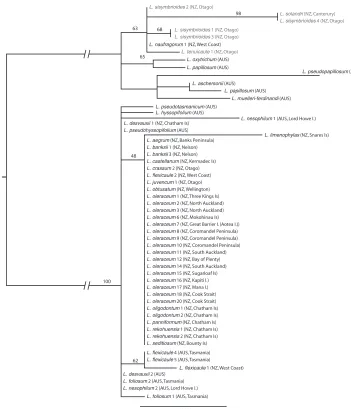
et Heenan from the Chatham Islandsand L. seditiosum de Lange, Heenan & J.Rolfe from Bounty Island. ITS also resolved the L. oleraceum and L. sisymbrioides groups, but within ITS, there was no resolution within the L. oleraceum groupincluding L. banksii
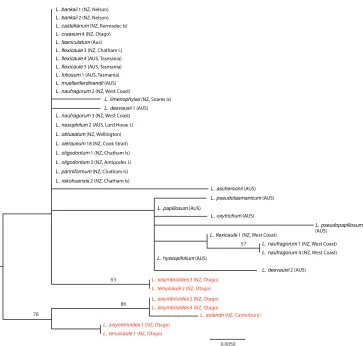
(Fig. 3). The pattern for trnL-F was more complex (Fig. 4), and is discussed below, although it again provided no resolution within the L. oleraceum groupand L. banksii.
P. J. de Lange et al. / PhytoKeys 24: 1–147 (2013) 14
ETS Sequence Characteristics and Phylogeny
Eighteen unique ETS sequences were present among the 65 Lepidium samples that were amplified for this region (58 from the L. oleraceum group and seven from the L. sisymbrioides group) (Fig. 2). Within the L. sisymbrioides group, the four samples of L. sisymbrioides all had different ETS ribotypes, and L. naufragorum, and L. tenuicaule Kirk also contained more than one ribotype. Within the L. oleraceum group, one described species, L. flexicaule, was found to contain more than one ETS ribotype, with the New Zealand and Tasmanian examples of this species differing by two base substitutions.
Two pairs of species (L. rekohuense and L. seditiosum; L. oleraceum and L. banksii)
shared the same ETS type (Fig. 2). Lepidium flexicaule (Tasmanian sample), L. folio-sum Desv.(Australian endemic) and L. desvauxii Thell. (Australia and New Zealand samples) also share identical ETS sequences, however New Zealand L. flexicaule have a different ETS type (Fig. 2). The three most southern / central South Island species,
L. crassum, L. aegrum and L. juvencum, share an identical ETS type with L. seditiosum
from the Bounty Islands, while L. castellanum from Macauley Island (Kermadec Is-lands group) is also similar, differing by only one base pair (Fig. 2).
There were three different ribotypes in L. oleraceum s.s., with a single sample from Mangere Island differing by a single base pair to the other L. oleraceum s.s. samples.
The extinct Lepidium obtusatum and morphologically rather different Chatham Is-lands endemic L. panniforme also share an ETS sequence type, which is almost identical to that of another Chatham Islands endemic, L. oblitum (Fig. 2). Notably, these three species also differ from the other Chatham Islands endemic, L. rekohuense, and the Chatham /Antipodes islands endemic, L. oligodontum (Fig. 2). Lepidium limenophylax, known from the southern Titi Island of the south-western coastline of Stewart Island, the Snares and Auckland Islands, is sister to these Chatham / Antipodes islands species (i.e., L. oblitum, L. oligodontum, L. panniforme, and L. rekohuense) (Fig. 2).
This study also confirms the taxonomic status of the Lord Howe Island endemic,
L. nesophilum Hewson, which is a species that had previously been treated as L. olera-ceum (see Green 1990).
ITS sequence characteristics and phylogeny
The 56 samples of Lepidium from which ITS data were collated (48 L. oleraceum group, 6 L. sisymbrioides group) are shown in Fig. 3.With the exception of L. limenophylax, all of the other species within the L. oleraceum group, including L. banksii and the Chatham Island sample of L. flexicaule, shared the same ITS sequence (Fig. 3).
trnL-F sequence characteristics and phylogeny
The plastid data (trnL-F spacer region, 30 L. oleraceum group, 7 L. sisymbrioides group included) is interesting for the lack of strong divergence between the oleraceum and sis-ymbrioides groups, with two species (L. sisymbrioides and L. naufragorum) being found in both clades (Fig. 4); see Heenan et al. (2007) for discussion on sequence variation in
L. naufragorum and L. sisymbrioides. This conflict could be explained by hybridisation between representatives of each of the two groups. With the exception of L. limenophy-lax (which differed by one base pair), all of the species previously described in the L. oleraceum group shared the same trnL-F sequence (Fig. 4).
Although the trnL-F spacer region showed only low sequence variation, several patterns were evident. For example, the morphologically distinctive species L.
P. J. de Lange et al. / PhytoKeys 24: 1–147 (2013) 16
fragorum (New Zealand), L. flexicaule (Australia + New Zealand), L. muelleri-ferdi-nandi Thell. (Australia),L. fasciculatum Thell. (Australia) and L. oleraceum (Kermadec Islands and New Zealand)had identical sequences (Fig. 4), a pattern that suggests a recent origin for these taxa. Further, the two New Zealand samples of L. flexicaule
(South Island (Karamea) and Chatham Islands) have distinct trnL-F sequences (Fig. 4). Morphologically, the Chatham Island race of L. flexicaule differs from the major-ity of New Zealand (North Island and South Island) L. flexicaule plants in that they lack the marginal leaf, pedicel and stem denticles that are diagnostic of the species on mainland New Zealand (see Garnock-Jones 1988). Interestingly, the Australian (Tas-manian) samples of L. flexicaule had the same trnL-F sequence as the Chatham Islands, and they too lack denticles. However, our study has found that, while denticles are usual for New Zealand (North Island, South Island) examples of this species, not all plants from western South Island have them, and, as we have not sequenced examples of these “non-denticulate” plants, further study into this pattern is warranted. The pat-tern is reversed for the ITS data set, in which the South Island (Karamea) sample of L. flexicaule clusters with Australian L. flexicaule (Fig. 3).
Phylogenetic implications
Bootstrap support for the trees was low to moderate, as would be expected for recently diverged taxa where resolution and divergence is low and where there has possibly been recent reticulation. An earlier study has indicated that hybridisation, and biocontinen-tal origin for the New Zealand / Australian Lepidium is likely, although the age of this event and whether it is related to the divergence from the rest of the Lepidium group is unclear (Mummenhoff et al. 2004). Estimates for times of divergence vary between the
L. oleraceum and L. sisymbrioides groups (0.7–1.3 Myr and 0.3–0.55 Myr respectively; Mummenhoff et al. 2004), although further hybridisation events and potential mul-tiple dispersal events make accurate inference difficult. However, as noted by Mitchell and Heenan (2000), there was good support in the rDNA data for the L. oleraceum and
L. sisymbrioides groups, though this was not found in the cpDNA dataset.
ribotypes between L. rekohuense and L. seditiosum; and L. oleraceum and L. banksii,
which also show this pattern.
In general, the L. oleraceum and L. sisymbrioides groups formed two distinct clades in both nuclear datasets, but was not strongly supported by the plastid data, as was found by Mummenhoff et al. (2004). Significantly for this study, the three DNA data sets confirm that those informally recognised morphological units within the L. olera-ceum group (see de Lange 2010; de Lange et al. 2010a) warrant formal taxonomic rec-ognition. This is especially evident when, in our study, such morphologically discrete taxa as L. banksii (Garnock-Jones 1988) proved indistinguishable from the very differ-ent L. oleraceums.s based on the rDNA and cpDNA sequences used here. That such a distinct species is not distinguished using this data also further supports the idea that much of the New Zealand Flora is in a state of rapid speciation (see above references), and that the reliance of DNA data sets, in isolation, to resolve taxonomic uncertainty is fraught with difficulty. In the case of the sequence data presented here. We conclude that the retention of a single morphologically divergent species, L. oleraceum is unac-ceptable, and that formal taxonomic segregation within the group, at species level is warranted.
Characters
Growth habit
Lepidium oleraceums.s., its allied species, and the unrelated L. naufragorum are all per-ennial herbs that can be distinguished by their growth habit. This includes plants with an upright, spreading or sprawling, shrubby growth habit (L. castellanum, L. aegrum, L. banksii, L. crassum, L. juvencum, L. oleraceum, L. panniforme and L. seditiosum) and those with a prostrate or decumbent growth habit (L. amissum, L. flexicaule, L. limenophylax,
L. oblitum, L. obtusatum, L. oligodontum, and L. rekohuense). Lepidium obtusatum is, as discussed by Cockayne (1921), further distinguished from all other members of the L. oleraceum group by its uniquely suckering habit. A further separation, based on seasonal growth patterns, is also evident, i.e., whether plants die back to the rootstock or not during winter. Of the extant species, L. castellanum, L. aegrum, L. juvencum, and L.
oleraceum have persistent stems that do not die back to a rootstock; L. oblitum and L. panniforme stems are usually long-persistent, though sometimes they die back to a basal rootstock. The remaining extant species all have stems that die back to their rootstock. Herbarium evidence indicates that the extinct L. obtusatum also died back in winter but there are insufficient herbarium specimens and no written accounts to enable us to determine whether the extinct segregate L. amissum did so as well. Unique amongst the
P. J. de Lange et al. / PhytoKeys 24: 1–147 (2013) 18
Leaf characters
The leaves of Lepidium oleraceum and allied species show a diversity of shape and de-gree of dentition that has been the basis for the recognition of a number of species and varieties (see Kirk 1899; Thellung 1906). Lamina-shape immediately distinguishes the pinnatifid Lepidium flexicaule from the other members of the L. oleraceum group but not from the pinnatifid-leaved forms of the unrelated L. naufragorum. Among the remaining members of the L. oleraceum group, lamina size, shape, and degree of denti-tion provide important differences between the species (Figs 5, 6).
Floral and fruit characters
The inflorescences, flowers and fruits of the Lepidium oleraceum group provide a number of characters enabling species recognition. The inflorescences of the species in the group are usually leaf-opposed. While in some species (L. flexicaule and L.
obtusatum) the inflorescences tend to be obscured by foliage, they are held well above the surrounding foliage in the majority of species. In most species the inflorescence rachises and pedicels are glabrous, but in L. castellanum, L. banksii, L. rekohuense, L. seditiosum, (and very rarely L. oblitum), minute, usually sparse, eglandular, clavate hairs are present. The sepals and petals show little variation with respect to size, shape, and degree of investiture. The size, shape and degree of notching of the sili-cles, and the length and shape of the stigma remnant are also critical characters (see Garnock-Jones 1988).
Stamen number of the Lepidium oleraceum group varies between species with two (L. flexicaule, L. limenophylax and L. rekohuense), those with four (L. castellanum, L. aegrum, L. amissum, L. juvencum, L. banksii, L. crassum, L. juvencum, L. naufragorum,
L. obtusatum, L. oleraceum, and L. seditiosum), to those with variable stamen numbers (L. oblitum, L. panniforme, and L. oligodontum). In these three species, stamen num-bers may vary from two to four (L. oblitum, L. panniforme) to a maximum of six in
L. oligodontum, often within the same inflorescence, or on different individuals of the same species.
Figure 5. Cauline leaves of (A) L. aegrum, (B) L. banksii, (C) L. castellanum, (D) L. crassum, (E) L. ju-vencum, (F) L. oblitum, (G) L. obtusatum, (H) L. oleraceum. Scale bars = 20 mm.
a single immature fruiting specimen, the few immature silicles present indicate that, as with all the other members of the L. oleraceum group, the two valves are dehiscent (see
P. J. de Lange et al. / PhytoKeys 24: 1–147 (2013) 20
The presence or absence of an apical notch to the silicle in the New Zealand species was an important character emphasised by Kirk (1899), Cheeseman (1906, 1925), Al-lan (1961), and Garnock-Jones (1988). In all these treatments the lack of a notch in Le-pidiumoleraceum is noted, and a silicle of that species showing this is clearly illustrated by Garnock-Jones (1988). This is a significant observation, because, of the new species segregated here from L. oleraceum s.s. a shallow apical notch is present in eight species (though minute and so scarcely evident in L. aegrum, L. limenophylax, L. juvencum and
L. rekohuense), absent in two (L. castellanum and L. oleraceum), and unknown for L. seditiosum (see above comments). We also stress that care is needed to observe the pres-ence or abspres-ence of a notch. It is best seen in freshly matured silicles because, in older, over mature silicles, the apically initiated disarticulation of the valves can be misleading as it gives the false impression of a notch. Notching was noted by past workers (Kirk 1899; Cheeseman 1906, 1925; Allan 1961; Garnock-Jones 1988) as being especially prominent in L. banksii and L. obtusatum, as it also is in the new species L. amissum
(which is segregated here from L. obtusatum) and L. oblitum. It is odd, therefore, that despite the prominence of the notch in L. banksii, Kirk (1899) in his dichotomous key emphasised the cordate silicle base rather than apical notch as diagnostic of L. banksii
and he did not mention it in his key for L. obtusatum. In fact cordate silicle bases are not
Figure 7.Silicles of (A) L. aegrum, (B) L. amissum, (C) L. banksii, (D) L. castellanum, (E) L. crassum, (F) L. flexicaule, (G) L. juvencum, (H) L. limenophylax. Scale bars = 1mm.
unique to L. banksii as they are also present in L. oligodontum. Silicle wings that occur around the margin of the silicle are also important. Of the 16 species for which mature silicles are available, ten have slightly winged silicles and six species (L. castellanum, L.
P. J. de Lange et al. / PhytoKeys 24: 1–147 (2013) 22
Figure 8.Silicles of (A) L. oblitum, (B) L. obtusatum, (C) L. oleraceum, (D) L. oligodontum, (E) L. pan-niforme, (F) L. rekohuense. Scale bars = 1 mm.
systematics
Lepidium aegrum Heenan & de Lange, sp. nov.
urn:lsid:ipni.org:names:77129253-1
http://species-id.net/wiki/Lepidium_aegrum
A L. oleraceo caulibus gracilibus flexilibus, foliis pallide viridibus membranaceis, lanceolatis elliptico-lanceolatis vel anguste ellipticis, apice prominente acuto vel subacuto, marginibus serratis dentibus prominentibus profundis, et sequentia nucleotidorum DNA distinguenda.
P. J. de Lange et al. / PhytoKeys 24: 1–147 (2013) 24
Etymology. The specific epithet ‘aegrum’ is derived from Latin, meaning ‘diseased and/or sick body’ and refers to the condition of the plants in the single known extant wild population on the unnamed rock stack near Island Bay, many of which are infec-ted with turnip mosiac virus (Fletcher et al. 2009).
Description(Figs 10–14). Tap-rooted, strongly pungent smelling, perennial herb. Growth habit open, up to 50 cm tall, stems arising from basal woody stems. Stems upright, slender, flexible; mature stems woody, 100–500 × 10–12 mm, often devoid of foliage on middle and lower parts of stems; new stems 80–200 × 3–4 mm, leafy, glabrous. Leaves glabrous, membranous, light green, planar, pellucid glands sometimes scattered on abaxial surface, rosette and stem leaves usually withering, variable in size and shape. Leaves of young and vigorous plants and stems: lamina 35–80 × 10–20 mm, lanceolate, elliptic-lanceolate, narrowly elliptic; apex subacute, with a single pro-minent tooth; margin singly serrate, with 8–12 pairs of teeth; teeth up to 3.5 mm deep, not overlapping; base attenuate, tapering to distinct petiole. Leaves of mature plants and cauline stems: lamina 30–65 × 4–11 mm, narrowly lanceolate, elliptic-lanceolate, narrowly elliptic; apex acute to subacute, with a single prominent tooth; margin singly serrate in upper and/or lower half, with 2–10 pairs of teeth; teeth up to 1.2 mm deep, not overlapping; base attenuate, tapering to petiole. Inflorescence terminal and lateral, racemose, often branched, up to 95 mm long, rachis up to 2.1 mm diam., glabrous;
P. J. de Lange et al. / PhytoKeys 24: 1–147 (2013) 26
Figure 12.Lepidium aegrum leafy stems showing mid-stem and apical foliage. Scale bar = 20 mm.
pedicels 4–10 mm long, erecto-patent, glabrous. Flowers 4.0–4.5 mm diam. Sepals 4, 1.0–1.5 mm long, saccate, green, apex obtuse, margin white, shape dimorphic; lateral sepals broad, 1.0–1.1 mm diam., orbicular, abaxial surface often hairy, hairs entirely eglandular or with glandular tip, 0.2–0.3 mm long; median sepals narrow, 0.8–0.9 mm diam., broadly elliptic, glabrous. Petals white, 2.3–2.5 × 1.2–1.4 mm, spreading, claw 0.7–0.9 mm long; limb broadly elliptic to orbicular, apex obtuse to rounded. Sta-mens 4; filaments 1.7–2.0 mm long, base 0.3–0.4 mm diam., equal; anthers 0.4–0.5 mm long. Ovary 0.9–1.0 × 0.9–1.0 mm, broadly ovate to broadly elliptic, green, apex usually with shoulders; style 0.3–0.4 mm long, cylindrical; stigma 0.3–0.4 mm diam. Nectaries 4, 0.2–0.3 × c. 0.1 mm, oblong, green. Silicles cartilaginous when fresh, co-riaceous when dry, 4.0–4.7 × 3.2–3.5 mm, elliptic-rhomboid to orbicular-rhomboid, apex shallowly notched, valves pale brown,glabrous, not winged; style 0.3–0.4 mm long, exserted. Seeds 1.6–1.7 × 0.9–1.0 mm, narrowly ovoid, brown to orange-brown, not winged. FL Mar. FR Mar.
Heenan s.n., (CHR 609821); Landcare Research experimental nursery, Lincoln, ex Is-land Bay, Banks Peninsula, 1 April 2009, P. B. Heenan s.n., (CHR 609804); Landcare Research experimental nursery, Lincoln, ex Island Bay, Banks Peninsula, 11 August 2009, P. B. Heenan s.n., (CHR 609792).
Distribution(Fig. 15). Endemic. New Zealand, South Island, Canterbury, Banks Peninsula, Island Bay, unnamed rock stack.
Figure 13.Lepidium aegrum (from left to right) basal- to mid-stem foliage. Scale bar = 20 mm.
P. J. de Lange et al. / PhytoKeys 24: 1–147 (2013) 28
Figure 15. Distribution of Lepidium aegrum, L. amissum, L. castellanum (Kermadec Islands only), L. banksii, and L. crassum.
Motunau Island (Pegasus Bay), Quail Island (Lyttleton Harbour), and at Stony Bay (Banks Peninsula).
Recognition.Lepidium aegrum is distinguished by its slender flexible stems (Figs 11, 12), light green membranous leaves that are lanceolate, elliptic-lanceolate or nar-rowly elliptic with a prominent acute to subacute apex, and margins that are serrate with prominent and deep teeth (Fig. 13).
Conservation Status. Lepidium aegrum is known from a single wild population and three additional populations that have been established with nursery-raised plants. The single wild population and unknown recruitment patterns means that this species is especially vulnerable to stochastic events. Furthermore, turnip mosiac virus, which deforms and retards growth, is common in plants at the wild population, and this will likely reduce reproductive success (Fletcher et al. 2009). Using the New Zealand Threat Classification System (Townsend et al. 2008), L. aegrum qualifies as Threatened/Na-tionally Critical. We recommend appending the qualifiers ‘CD’ (Conservation Depend-ent – as it has been established and is being managed at Motunau and Quail islands, and at Stony Bay), ‘DP’ (Data Poor – to reflect uncertainty over plant numbers and popu-lation trends), ‘OL’ (One location – since it is known from a single wild popupopu-lation).
Lepidium amissum de Lange & Heenan, sp. nov.
urn:lsid:ipni.org:names:77129254-1
http://species-id.net/wiki/Lepidium_amissum
A L. obtusato habitu suberecto parce ramoso et sine rhizome, caulibus arcutis potius quam flexuosis, foliis rosulae et caulis inferi profunde denticutis persistente oblanceolato-spathu-latis ad obovato-spathuoblanceolato-spathu-latis, foliis caulis superi sparsis lanceooblanceolato-spathu-latis ad anguste oblanceooblanceolato-spathu-latis vel obdetoideis truncatis et profunde dentatis (raro integris) paribus dentorum usque ad 6 profunde incises et sparsim foliaceis, racemis longioribus quibus non obscuris caulibus veg-etativis siliclisque parvioribus et angustioribus differt.
Holotype. New Zealand (Fig. 16): Cliffs between Karekare and Manukau Heads, Jan-uary 1917, T. F. Cheeseman s.n., AK 4474! Isotypes: AK 206570!, WELT SP030095!
Etymology. The epithet ‘amissum’ is derived from the Latin ‘amissus’ meaning ‘lost’ and is used here to refer to the loss though extinction, of this plant from the New Zealand flora.
obovate-P. J. de Lange et al. / PhytoKeys 24: 1–147 (2013) 30
Figure 17. Basal stem leaves of Lepidium amissum. AK 4473
P. J. de Lange et al. / PhytoKeys 24: 1–147 (2013) 32
obdeltoid, apex truncate, with 3–4 prominent teeth, margins prominently toothed in upper ⅓ of lamina with 4–6 deeply incised pairs of teeth (rarely entire except for apex), base cuneate to broadly cuneate; petiole distinct or indistinct, up to 6 mm long when present, channelled. Inflorescence racemose, terminal and lateral, conspicuous, sparingly leafy and unfettered by associated vegetative leafy stems; racemes 22–68 mm long, rachis 0.9–1.6 mm diam., glabrous; pedicels 2.8–3.2 mm long at flowering, erec-to-patent, elongating somewhat after anthesis, glabrous. Flowers 4.3–4.6 mm diam. Sepals 4, saccate, overlapping at base, green, apex obtuse, margin white, shape and size dimorphic; lateral sepals 2.2–2.9 × 2.1–3.0 mm, suborbicular, mostly glabrous, some-times sparsely hairy, hairs 0.2–0.4 mm long, caducous; median sepals 1.9–2.9 × 1.5– 1.7 mm, broadly elliptic to obovate, abaxial surface glabrescent, sparsely hairy, hairs 0.2–0.4 mm long, caducous. Petals white, 1.3–1.8 × 1.3–1.8 mm, erect, claw minute, 0.2–0.3 mm; limb orbicular, apex obtuse. Stamens 4, ± equal lengths, 1.2–1.8 mm long, base 0.6–1.0 mm wide; anthers 0.6–0.8 mm long, yellow, pollen yellow. Ovary 1.3–1.8 × 1.3–1.7 mm, broadly ovate to suborbicular green, apex distinctly notched; style 0.3–0.5 mm long, cylindrical below, spreading at apex; stigma 0.5–0.6 mm diam. Nectaries 4, green, 0.12–0.14 × c. 0.09 mm, narrow oblong, apex obtuse. Silicles 3.4– 4.5 × 2.9–3.9 mm, broadly ovate, oval to obovate, apex prominently notched, valves yellow-green (in dried specimens), glabrous, slightly winged; style 0.2–0.5 mm long, not or only slightly exserted. Seeds 2.0–2.7 × 1.8–2.0 mm, obovate, broadly obovate, brown to orange-brown, not winged. FL: Dec–Jan. FR: Dec–Jan.
Representative Specimen. New Zealand (North Island): North Auckland, Cliffs north of the Manukau heads, December 1870, T. F. Cheeseman s.n., (AK 4473).
Distribution (Fig. 15). Endemic. New Zealand, North Island, where it was re-corded from ‘between Manukau Heads and Karekare’ (Cheeseman 1906, 1925), not
Figure 19. Upper-stem leaves and inflorescences of Lepidium amissum. AK 4473.
the ‘Titirangi’ noted by Kirk (1899). Lepidium amissum was last collected from the west Auckland coastline in 1917 and is presumed to be extinct.
P. J. de Lange et al. / PhytoKeys 24: 1–147 (2013) 34
Ecology. Little is known about the habitat preferences and ecology of L. amissum, beyond that it grew on sea cliffs (Cheeseman 1906, 1925).
Conservation Status.Lepidium amissum is considered to be extinct. There have been repeated unsuccessful surveys for this species over the last fifty years by various botanists. Aside from the type the species is known from only one collection made in 1917. This collection and the type came from an ill defined area of coastline stretching for some 6 km from the Manukau Heads to Karekare. Today this coastline is protected within the Centennial Park, Waitakere Ranges. However, during the period when this species was gathered, all of the coastline was being modified as a result of kauri ( Aga-this australis (D.Don) Lindl.) logging (see Harvey 2001, 2006; MacDonald and Kerr 2009), and this may have contributed to its eventual extirpation. It does seem that L. amissum was already uncommon at the time of its discovery and it is possible that the gatherings made by Thomas Cheeseman where sufficient to cause its extinction as they are copious and comprise many stems.
Lepidium banksii Kirk, Stud. Fl. N. Z., 35 (1899)
http://species-id.net/wiki/Lepidium_banksii
Type Collection: “SOUTH Island: Queen Charlotte Sound and Astrolabe Habrour, A. Richard, l.c.”
Lectotype(Fig. 21, designated here): Herbarium Richard, Paris!
Etymology. Although Kirk (1899) did not explain his choice of epithet, ‘banksii’ commemorates Sir Joseph Banks FLS, FRS (1743–1820) who together with Dr Daniel Solander made the first gatherings of New Zealand plants to be described by European botanists during the Endeavour voyage of discovery (1768–1771).
= Lepidium banksii var. ovatum Kirk, Stud. Fl. N. Z., 35 (1899)
Lectotype (fide Allan 1961): Northwest Bay, Pelorus Sound, J. Rutland s.n., n.d., WELT SP079012!
Etymology. Although Kirk (1899) did not explain his choice of epithet, the pro-tologue makes it clear that “ovatum” was chosen to refer to the shape of the mature silicles.
Note: The key provided by Kirk (1899, p. 34) used the name “L. forsteri” instead of L. banksii. This is considered to be a nomen nudum.
Description (Figs 22–25). Tap-rooted, strongly pungent smelling, perennial herb. Growth habit dense, stems closely placed, 20–50 cm tall. Stems upright to spreading, stout, barely flexuous; mature stems woody, 100–500 × 3–8 mm, often devoid of foli-age on middle and lower parts of stems. Leaves glabrous, coriaceous, green, planar, rosette and stem leaves usually withering, variable in size and shape. Leaves of young and vigorous plants and stems: lamina 20–40 × 6–15 mm, oblanceolate-spathulate, obovate; apex obtuse, often with up to 3 or 4 teeth; margin coarsely serrate, with 15–21 pairs of teeth; teeth up to 2.0 mm deep, irregular in size, protruding beyond leaf outline; base attenuate to cuneate, petiole distinct; petiole up to 35.0 × 1.3–2.8 mm, channelled. Leaves of mature plants and cauline stems: lamina 8–25 × 3–6 mm, linear-oblanceolate, obovate; apex obtuse to truncate, often with up to 3 or 4 teeth; margin serrate in upper half, up to 7 pairs of teeth; not overlapping, up to 1.5 mm deep, often protruding beyond leaf outline; base attenuate to cuneate, usually tapering to ± dis-tinct petiole, sometimes appearing sessile; petiole up to 8.0 × 1.0–1.8 mm, channelled. Inflorescences terminal and lateral, racemose, 20–80 mm long, rachis 0.6–1.4 mm diam., glabrous or sometimes with pale clavate hairs; pedicels 5–8 mm long, erecto-patent, with pale clavate hairs on adaxial surface, hairs 0.1–0.15 mm long. Flowers 4.0–4.5 mm diam. Sepals 4, saccate, overlapping at base, green, apex obtuse, margin white, shape and size dimorphic; lateral sepals 1.6–2.1 × 1.1–1.5 mm, orbicular, gla-brous; median sepals 1.5–1.9 × 0.9–1.1 mm, broadly elliptic, abaxial surface glabrous or sparsely hairy, hairs 0.2–0.4 mm long. Petals white, 1.8–2.0 × 0.1–0.9 mm, erect, claw indistinct; limb narrrowly obovate, elliptic or filiform, often irregular in shape, apex obtuse to subacute. Stamens 4, ± equal lengths, 1.2–1.7 mm long, base 0.6–0.9 mm wide; anthers 0.4–0.7 mm long, yellow or sometimes violet. Ovary 1.4–1.6 × 1.0–1.6 mm, broadly ovate, green, apex round or sometimes weakly shouldered; style 0.2–0.3 mm long, cylindrical below, spreading at apex; stigma 0.45–0.5 mm diam. Nectaries 4, 0.2–0.4 × c. 0.1 mm, oblong, green. Silicles cartilaginous when fresh, co-riaceous when dry, 4.5–5.5 × 4.0–5.0 mm, broadly ovate, apex notched, base cordate, valves green maturing yellow-green, glabrous, slightly winged; style 0.2–0.3 mm long, exserted. Seeds 1.8–2.3 × 1.0–1.2 mm, obovate or obovate-elliptic, brown to orange-brown, not winged. FL Nov–Jan. FR Nov–Jan.
P. J. de Lange et al. / PhytoKeys 24: 1–147 (2013) 36
Figure 22. Young wild plant of Lepidium banksii (image: S. Walls).
P. J. de Lange et al. / PhytoKeys 24: 1–147 (2013) 38
Tasman National Park, Totaranui Headland, December 1961, A. E. Esler s.n., (AK 218197); Abel Tasman National Park, Totaranui Headland, 27 January 1963, A. E. Esler s.n., (CHR 181143); Abel Tasman National Park, Totaranui Point, 12 January 1984, D. R. Given 13871 & A. D. Given, (CHR 509034); Abel Tasman National Park, Totaranui, 12 January 1986, D. R. Given 14106, (CHR 420352); Abel Tasman National Park, Totaranui Trig, 9 January 1984, D. R. Given 13505 & B. A. Duncan, (CHR 416178); Abel Tasman National Park, Separation Point, 28 January 1997, P. J. de Lange 3249 & G. M. Crowcroft, (AK 231008); Karamea, 28 January 1985, P. Wardle s.n., (CHR 446772); Bird Island, Waimea Estuary, 1946, C. Baas s.n., (CHR 278958). Cultivated (New Zealand). Landcare Research experimental nursery, Lin-coln, ex Totaranui, Nelson, 17 November 2005, P. B. Heenan s.n., (CHR 504666); Landcare Research experimental nursery, Lincoln, ex Abel Tasman National Park, 6 August 2006, P. B. Heenan s.n., (CHR 609830).
Distribution (Fig. 15). Endemic. New Zealand, South Island, Marlborough Sounds (Queen Charlotte, Kenepuru and Pelorus Sounds), Nelson (Waimea Estuary, Totaranui, Separation Point, Wainui Inlet), north-west Nelson (Karamea).
Recognition.Lepidium banksii is recognised by the clavate hairs on the pedicels (Fig. 24A), mostly filiform petals, styles that spread at the apex into a broad plate (Fig. 24B), and silicles that have a prominent apical notch (Fig. 25). In comparison, the styles of the other Lepidium species except for L. seditiosum, are cylindrical for their whole length.
Ecology. Lepidium banksii is a strictly coastal species favouring rubble slopes, boulder beaches, exposed rocky headlands (Fig. 22), and sparsely vegetated cliff faces
usually near penguin colonies or low lying, estuarine shell banks and sand and shell barrier islands used as high tide roosts by wading birds.
Conservation Status.Lepidium banksii is currently listed as ‘Threatened/Nation-ally Critical CD, EF’ by de Lange et al. (2009). Both de Lange (2006) and Courtney (2009) describe the conservation management of this species, noting that there are probably no naturally occurring plants of L. banksii left in the wild, with all those known the result of deliberate plantings and sowing of seed. As such, the qualifier ‘EW’ (Extinct in Wild) should be added to the current threat listing. The most recent census of the numbers of L. banksii present in the ‘wild’ records 113 plants (Courtney 2009). Survival of this species is now completely dependent on direct hands-on man-agement (de Lange 2006; Courtney 2009).
Lepidium castellanum de Lange & Heenan, sp. nov.
urn:lsid:ipni.org:names:77129255-1
http://species-id.net/wiki/Lepidium_castellanum
A Lepidio oleraceo sympatrico sed foliis in caule medio ad supero anguste lanceolatis ad linearo-lanceolatis dentibus acicularibus, apicibus foliorum decresento-acuminatis, et pedi-cellis minutis et sparsim puberuli differt, et sequentia nucleotidorum DNA distinguenda.
Holotype. Kermadec Islands (Fig. 26): Macauley Island, north-east coast, 3 July 2006, J. W. Barkla M29 & T. C. Greene, AK 297694! Isotype: CHR 552474!
Etymology. The epithet ‘castellanum’ from the Latin ‘associated with a fort, for-tress or castle’ refers to the remote, craggy, castle-like habitats of this species in the southern Kermadec Islands group on which islands it is endemic.
P. J. de Lange et al. / PhytoKeys 24: 1–147 (2013) 40
deeply and ± evenly incised, teeth in 6–14 widely and evenly spaced ± pairs, 1.5–7.2 mm long, protruding beyond leaf line, narrowly deltoid, tapering, acerose, ± acicular to acicular-falcate; lamina apex acute (rarely truncate-praemorse), acuminate, acu-men 5.8–11.0 mm long, margins of acuacu-men toothed, teeth often bidentate, 8–10 mm long, acerose, often acicular, or acicular-falcate, leaf base attenuate extending into a narrow petiole wing; petiole distinct, 2.9–8.2 × 1.2–3.3 mm, decurrent, chan-nelled, often with a broadly sheathing base. Inflorescences racemose, 50–100 mm long at fruiting; rachis 0.5–2.25 mm diam., terminal and lateral, leaf-opposed, often long-persistent, sparsely to densely covered in pale, patent, ± clavate hairs or rarely glabrous, hairs 0.1–0.14 mm long; pedicels 5.6–7.2 mm long at fruiting, erecto-patent, with sparse, pale, erecto-patent, clavate hairs on adaxial surface, hairs 0.1–0.12 mm long. Flowers 3.0–4.5 mm diam., fragrant. Sepals 4, saccate, ± overlapping at base, lateral sepals broad, 0.5–1.5 mm diam., orbicular, pale to dark green with a broad white, ± undulose margin, apex rounded to obtuse, abaxial surface often hairy, hairs 0.2–0.4 mm long, eglandular or with glandular tip, mostly shedding at anthesis ex-cept near base, median sepals 0.5–0.9 mm diam., broadly elliptic, pale to dark green with a broad white, ± undulose margin, apex rounded to obtuse, abaxial surface glabrous. Petals white, 1.1–2.0 × 1.0–1.6 mm, spreading, claw 0.4–0.8 mm long; limb obovate, obovate-spathulate to orbicular, apex obtuse to rounded often slight-ly emarginate, margins smooth, sometimes weakslight-ly undulose. Stamens 4, filaments 1.2–2.0 mm long, white; anthers 0.3–0.5 mm long, yellow. Ovary 1.1–1.8 × 0.6–1.3 mm, ovate, broadly ovate to elliptic, green-brown, apex subacute; style 0.11–0.4 mm long, cylindrical; stigma 0.2–0.5 mm diam. Nectaries 4, 0.2–0.3 × 0.1–0.15 mm, narrow-oblong to deltoid, pale translucent green. Silicles cartilaginous when fresh, coriaceous when dry, 2.4–3.6 × 1.8–2.5 mm, elliptic to rhomboid, apex acute and
P. J. de Lange et al. / PhytoKeys 24: 1–147 (2013) 42
Figure 27. (A) Wild plant of Lepidium castellanum on cliff top of Macauley Island showing growth habit (plant growing with Scaevola gracilis, Tetragonia tetragonioides and Disphyma australe subsp. stricticaule) (image: J.W. Barkla).
tapering, valves green maturing grey-white, glabrous, scarcely separating at apex at maturity, not winged; style 0.3–0.7 mm long, exserted. Seeds 2, 1.3–1.9 × 0.8–1.6 mm, narrowly to broadly ovoid, brown to orange-brown, not winged. FL Jul–Jun. FR Sep–Jul.
Figure 28.Young inflorescences and upper-stem leaves of Lepidium castellanum (image: J.W. Barkla).
P. J. de Lange et al. / PhytoKeys 24: 1–147 (2013) 44
Figure 30. Close up of basal-stem leaf of Lepidium castellanum on Cheeseman Island (image: W. Chinn).
Distribution (Fig. 15). Endemic. Kermadec Islands (Macauley Island, Curtis Is-land, Haszard Islet and Cheeseman Island).
Recognition. Lepidium castellanum is distinguished by its very robust, shrubby growth habit (Fig. 27), sometimes up to 1.8 × 2.0 m, erect, often closely packed, usually leafy stems, narrowly lanceolate to linear-lanceolate upper stem leaves, and by the very long, needle-shaped teeth of the leaves which reach well beyond the leaf margin (Figs 28–30). In this species, the pedicels (and often the inflorescence rachises) are minutely hairy (Fig. 31), whilst those of L. oleraceum are glabrous. Lepidium castellanum is sym-patric with Lepidium oleraceum on Curtis Island. Elsewhere, in northern New Zealand, especially on the Poor Knights and Hen (Taranga) islands, narrow-leaved forms of L. ol-eraceum are also common. However, these plants have a much smaller growth habit, their leaves lack the distinctive long needle-shaped teeth and long-acuminate leaf apices of L. castellanum, and, as with L. oleraceum populations elsewhere, their pedicels are glabrous.
in association with Myoporum rapense subsp. kermadecense (Sykes) Chinnock, Cyperus insularis Heenan et de Lange, Tetragonia tetragonioides (Pall.) Kuntze, and Parietaria debilis G.Forst. On Cheeseman Island, numerous seedlings and a few adults were seen in 2011 growing on heavily petrel-burrowed soil covered ledges amongst Disphyma aus-trale subsp. stricticaule, and also as a few sub-adults within an active petrel colony in a narrow gully, growing in association with Cyperus insularis, Tetragonia tetragonioides, and Parietaria debilis.
Conservation Status.Lepidium castellanum is confined to the Southern Kermadec Island group (see de Lange et al. 2004), part of the Kermadec Islands Nature Reserve. Within the southern Kermadec Islands group it has been recorded from Macauley Island, Cheeseman Island, Curtis Island, and from Haszard Islet. On Macauley Island it was recorded twice, in 2002 and 2006 (Barkla et al. (2008); T. C. Greene pers. comm.), at that time numbering at best five or fewer individuals. However, it was not seen on Macauley Island in 2011 (de Lange 2012; de Lange in press). In 2002 and 2006, the summit of Haszard Islet (6 ha, of which c.2.1 ha is vegetated) was thor-oughly explored during helicopter-assisted landings by ornithologists. During those visits, it was noted that Lepidium castellanum was one of the major shrub-forming species on the richly manured and petrel-turbated soils of that islet’s summit slopes (T. C. Greene and K. Baird pers. comm.). While accurate counts of the number of plants present on Haszard Islet were not made, it would seem that on both visits the islet summit supported approximately 20–50 individuals (T. C. Greene and K. Baird pers. comm.). Further south, its status on Curtis Island remains unknown, as there have been no gatherings of Lepidium from there since 1969, and several visits during the 1980s and in 2002 did not see it there (G.A. Taylor and T. C. Greene pers. comm.). However, on nearby Cheeseman Island, a 7-ha island (of which c.5.6 ha is vegetated)
P. J. de Lange et al. / PhytoKeys 24: 1–147 (2013) 46
two plants were recorded in 2002 during a brief helicopter assisted 40 minute visit (T. C. Greene pers. comm.). Later, in 2011, nine adults and an estimated 1000 seedlings were noted on Cheeseman Island during a thorough botanical investigation of that island (de Lange 2012). Therefore, to the best of our knowledge there are between 20 and 50 adults on Hazard Islet and nine mature plants on Cheeseman Island, while the status of this species on Curtis Island and Macauley Island is uncertain. Therefore
Lepidium castellanum qualifies as ‘Threatened/Nationally Critical’ either because the total number of plants in the wild is < 250 (criterion A(1) of Townsend et al. (2008)) or because the combined area of occupancy is < 1 ha (criterion A(3) of Townsend et al. 2008). To that assessment we add the qualifiers ‘DP’ (Data Poor) and ‘IE’ (Island Endemic). Data Poor (‘DP’) is recommended because of the lack of accurate counts of wild plants from Haszard Islet, absence of any recent survey for the species on Curtis Island, and lack of any trend data.
Lepidium crassumHeenan & de Lange, sp. nov.
urn:lsid:ipni.org:names:77129256-1
http://species-id.net/wiki/Lepidium_crassum
A L. oleraceo habitu temporali, caulibus ad caudicem lignosum emorientibus, foliis crasse coriaceis, distincte petiolatis, late ellipticis, ellipticis vel obovatis, apicibus obtusis vel trun-catis, marginibus saepe duplicato-serratis, siliculis orbiculatis vel orbiculato-rhomboideis, et sequentia nucleotidorum DNA distinguenda.
Holotype. New Zealand (Fig. 33): Otago Land District, Otago Peninsula, Aramoana, Mole, open sites among stones and rocks at the edge of the road down mole and in car park, 26 November 2009, P. B. Heenan s.n., CHR 609777A! Isotype: CHR 609777B!
Etymology. The specific epithet ‘crassum’ from the Latin for ‘thick’ refers to the distinctly thick and fleshy leaves of this species.
Description (Figs 34–37). Tap-rooted, strongly pungent smelling, perennial herb. Growth habit dense, stems closely placed, up to 50 cm tall, arising from underground woody stems. Stems upright to spreading, stout, short, rigid; mature stems woody, 100–400 × 10–12 mm, often devoid of foliage on middle and lower parts of stems, new stems 50–200 × 4–5 mm, leafy, glabrous. Leaves glabrous, coriaceous, green, un-dulate, rosette and stem leaves usually withering, variable in size and shape. Leaves of young and vigorous plants and stems: lamina 50–90 × 17–35 mm, broadly elliptic, elliptic to obovate; apex obtuse to truncate, often with up to 3 or 4 teeth; margin singly or doubly crenate, with 15–32 pairs of teeth; teeth up to 3.5 mm deep, some-times overlapping, often protruding beyond leaf outline; base cuneate, petiole usually distinct; petiole up to 35.0 × 3.0–6.0 mm, channelled. Leaves of mature plants and cauline stems: lamina 15–45 × 6–15 mm, broadly elliptic, elliptic-obovate to obovate-oblong; apex obtuse to truncate, often with up to 3 or 4 teeth; margin singly crenate in upper half, teeth often protruding from leaf outline, with 5–10 pairs of teeth; teeth up to 1.2 mm deep, not overlapping, often protruding beyond leaf outline; base cuneate, sometimes narrowly so, usually tapering to ± distinct petiole; petiole 5–12 × 1.6–2.3 mm, channelled. Inflorescence terminal and lateral, racemose, 15–60 mm long, rachis 0.7–1.2 mm diam., glabrous; pedicels 4–7 mm long, erecto-patent, glabrous. Flowers 4.0–5.0 mm diam. Sepals 4, 1.3–1.6 mm long, saccate, overlapping at base, green, apex obtuse, margin white, shape dimorphic; lateral sepals broad, 1.4–1.5 mm diam., orbicular, abaxial surface often hairy, hairs 0.2–0.5 mm long; median sepals narrow, 1.0–1.3 mm diam., broadly elliptic, glabrous. Petals white, 1.8–2.0 × 1.0–1.1 mm, spreading, claw 0.6–0.8 mm long; limb broadly elliptic to orbicular, apex obtuse to rounded. Stamens 4; filaments 1.2–1.6 mm long, base 0.4–0.5 mm diam., equal; an-thers 0.4–0.6 mm long. Ovary 1.0–1.6 × 0.9–1.1 mm, broadly ovate to broadly ellip-tic, green to green-brown, apex round or sometimes weakly shouldered; style 0.15–0.3 mm long, cylindrical; stigma 0.2–0.4 mm diam. Nectaries 4, 0.2–0.3 × 0.1–0.15 mm, oblong to oblong-triangular, green. Silicles cartilaginous when fresh, coriaceous when dry, 3.0–3.7 × 2.6–3.1 mm, orbicular to orbicular-rhomboid, apex obtuse to shallowly notched, valves pale brown,glabrous, not winged; style 0.2–0.3 mm long, exserted. Seeds 1.6–1.7 × 0.9–1.1 mm, narrowly ovoid, brown to orange-brown, not winged. FL Dec–Mar. FR Jan–Jul.
P. J. de Lange et al. / PhytoKeys 24: 1–147 (2013) 48