SYNTHESIS AND CRYSTAL STRUCTURE OF BRIDGED
peri-AROYLNAPHTHALENE DERIVATIVES
Sayaka Yoshiwaka,
[a]Shinji Ohisa,
[a]Noriyuki Yonezawa
[a]and Akiko
Okamoto
[a]Keywords: Non-coplanarly aromatic ring accumulation, Bridged structure, Non-dilution synthesis, Syn-conformer, Crystal structure
Bridged peri-aroylnaphthalene compounds are satisfactorily synthesized by the reaction of bis(fluorobenzoyl)naphthalene derivatives and catechol without high dilution conditions. The preferential bond formation between the p-positioned carbon atoms of the terminal aromatic rings of peri-aroyl groups by 1,2-dioxybenzene unit shows that the starting molecules take syn-orientation of the aroyl groups along with anti-form. By comparison of the spatial organization of the bridged compound with the corresponding non-bridged homologues, the factors leading to syn-oriented conformation for peri-aroylnaphthalene derivatives in crystal packing are elucidated.
* Corresponding Authors Fax: +81–42–388–7601 E-Mail: [email protected]
[a] Department of Organic and Polymer Materials Chemistry, Tokyo University of Agriculture and Technology, 2–24–16 Naka-machi, Koganei, Tokyo 184–8588, Japan
Introduction
Coplanarly -conjugated aromatic aggregate compounds have engaged material chemists’ and organic ones’ heart and mind because of their excellent conductivity.1,2
Naturally, aromatic aggregate compounds having unique -conjugated structure have been in the limelight as promising framework in nanoelectronics, e.g., fullerene analogues including bucky bowl,3 coannulene4 and sumanene,5 and
carbon nanotube analogues including cyclacene6 and
cycloparaphenylene.7 The synthetic strategies and the
minute structure analyses have been challenging task.8,9
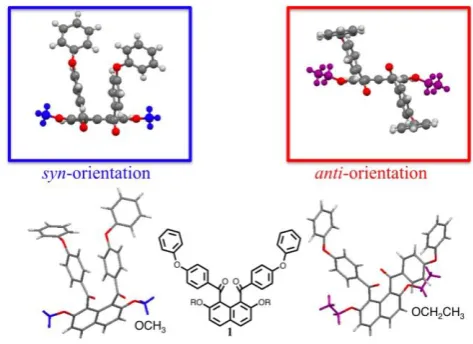
Figure 1 exhibits crystal structure of peri-aroylnaphthalene bearing phenoxy groups in the aroyl groups.10,11 The authors
have been studying on the synthetic procedures12,13 and the
X-ray crystal structure analysis of the peri-aroylnaphthalene compounds in which aromatic rings accumulate non-coplanarly giving highly congested intramolecular circumstance. As one of the categories of the -conjugated aromatic ring accumulated compounds,
peri-aroylnaphthalene compounds have some distinguishable structure characteristics: peri-Aroylnaphthalene compounds are poly(aromatic ring) compounds where aromatic rings are linked by ketonic carbonyl groups. The aroyl groups are connected with naphthalene ring at the most inner position, and they are situated in the neighbourhood. Accordingly,
peri-aroylnaphthalene compounds have too congested molecular circumstance to make the coplanar form of aromatic rings in a molecule. Besides, diaryl ketone structure is supposed to make somewhat congested spatial organization around ketonic carbonyl groups. However, the restriction is certainly estimated less than π-conjugated aromatic molecules. So expected small flexibility of aromatic ketone compound probably shows the variety of molecular and packing structure in crystal. It means opportunity to reveal the interactions determining the structure hitherto unknown.
In crystal of peri-aroylnaphthalene compound, the naphthalene ring core and the benzene rings of the aroyl groups of are situated in an almost perpendicular fashion. The non-coplanar features of peri-aroylnaphthalene compounds are plausibly caused from avoidance of internal steric repulsion. In addition, there are possible two types of metastable conformation of molecules satisfying perpendicular molecular organization, i.e., syn type and anti
type. The syn-oriented peri-aroylnaphthalene molecule has two aroyl groups aligned in a same direction; meanwhile the two aroyl groups of the anti-oriented molecule are situated in an opposite orientation. According to the authors’ study of X-ray crystal analysis, the anti-oriented fashion is the majority as single molecular crystal structures of
peri-aroylnaphthalene compounds.11,14-16 Recently, several
examples of syn-oriented molecular organization in crystal have been found, i. e., 1,8-bis(4-phenoxybenzoyl)-2,7-dimethoxynaphthalene (1a),10
{2,7-dimethoxy-8-[4-(propan- 2-yloxy)benzoyl]naphthalen-1-yl}[4-(propan-2-yloxy)phen-yl]methanone,17 and
1,8-bis(4-chlorobenzoyl)-7-meth-oxynaphthalen-2-ol ethanol monosolvate.18 The authors
have regarded 4-phenoxybenzoyl group as the most effective inducing moieties for syn-oriented conformation.
Consequently, a series of 2,7-dialkoxy-1,8-bis(4-phenoxybenzoyl)naphthalene homologues, i.e., 2,7-diethoxy-1,8-bis(4-phenoxybenzoyl)naphthalene (1b)11 and
2,7-diisopropoxy-1,8-bis(4-phenoxybenzoyl)naphthalene (1c) are designed.19 However, these homologues (1b and 1c) showed anti-orientation in their crystals (Figure 1).
Under these circumstances, the authors aimed to realize compelled syn-oriented molecules and designed the intramolecularly bridged homologous molecule, which shares terminal benzene ring connected to the benzoyl groups at 1- and 8-positions of the naphthalene ring [Figure 2, compound 2].
Figure 2. Design of compelled syn-oriented molecule 2
The structure analysis of such compelled syn-oriented molecules was expected to indicate the factors for stabilization of the molecular organization in crystal. This article reports the synthesis and crystal structure of bridged
peri-aroylnaphthalene compounds 2, and discusses comparatively the crystal structure with the non-bridged homologues 1a and 1b to elucidate the determining factors for molecular spatial organization.
Results and discussion
Nucleophilic aromatic substitution reaction of compound
3a (R=Me) and catechol gave bridged compound 2a
(R=Me) with the benzoyl groups being connected by catechol hinge unit intramolecularly (Table 1). The formation of intramolecular connection proceeded satisfactorily in rather concentrated reaction solution than conventional conditions (entry 1).
Table 1. Synthesis of bridged compound 2
R c,
10-2 M
Ti-me, h
T,˚C Product distribution, %a
3 2 4
by-prod.c
a Me 4 24 150 9 87
(62)b
4 0
a Me 4 48 150 0 19 48 33
a Me 6 24 150 1 18 29 52
a Me 12 24 150 2 29 13 56
a Me 4 24 120 51 49 0 0
a Me 1 24 150 50 12 0 38d
b Et 4 24 150 25 75 0 0
b Et 4 48 150 3 77 20 0
a) Calculated on the basis of 1H NMR spectra (3.6–3.9 ppm). b)
Isolated yield. c) Distribution of by-product was determined on the basis of 1H NMR spectra on condition that the by-product has two
methyl groups. d) 1-Aroyl-2,7-dimethoxynaphthalene was included.
The concentration was almost one-tenth value for those of typical polycondensation synthesis of polyketones.20
Furthermore, the amount of the by-product 4 increased at the prolonged reaction interval, i.e., 33 % for 48 h (entry 2). Further concentrated conditions also yielded significant amounts of by-products (52 % and 56 %, entry 3 and entry 4, respectively).
At 120 ˚C, the conversion was far lower than that obtained under the optimized conditions (entry 5 vs. entry 1).
Ordinary high-dilution cyclization reaction is undertaken at about one-hundredth concentration compared to those for the polycondensation reaction. When compound 2 were allowed to react with catechol at fortieth concentration against typical polycondensation conditions, the reaction moderately proceeded with a 50 % conversion (entry 6 vs. entry 1).
Reaction under the non-high dilution conditions gave the bridged compound (2a)quantitatively, is meaning that there were enough opportunities for the precursor molecules took
syn orientation against more stable anti-orientation in crystal, i.e., orientations of aroyl groups were converted easily between same and opposite directed conformations in solution.
As preparation of crystal of compound 2a suitable for X-ray crystal structural analysis was unsuccessful unfortunately, the authors intended to analyze a homologous compound having intimately related molecular structure for bridged compound 2a.
Consequently, 2,7-diethoxy homologue 2b bearing two terminal benzoyl moieties connected intramolecularly by catechol residue at 4,4’-positions was designed and synthesized successfully according to essentially same synthetic method for bridged compound 2a. For this compound 2b, preparation of satisfactorily qualified crystal was achieved and the X-ray crystal structure analysis was performed (Figure 3).21
In crystal, the molecule of compound 2b shows
syn-oriented single molecular structure. Two planes of the internal benzene rings are parallel [dihedral angle between internal benzene rings and naphthalene ring; 3.83(8)˚] and are inclined in conrotatory directions [dihedral angles between internal benzene ring and naphthalene ring; 71.63(6)˚ and 72.58(6)˚]. The plane of the catechol hinge moiety situates almost in exo site and parallel to the naphthalene ring [dihedral angle between naphthalene (C1– 10) and catechol (C25–C30); 17.03(7)˚].
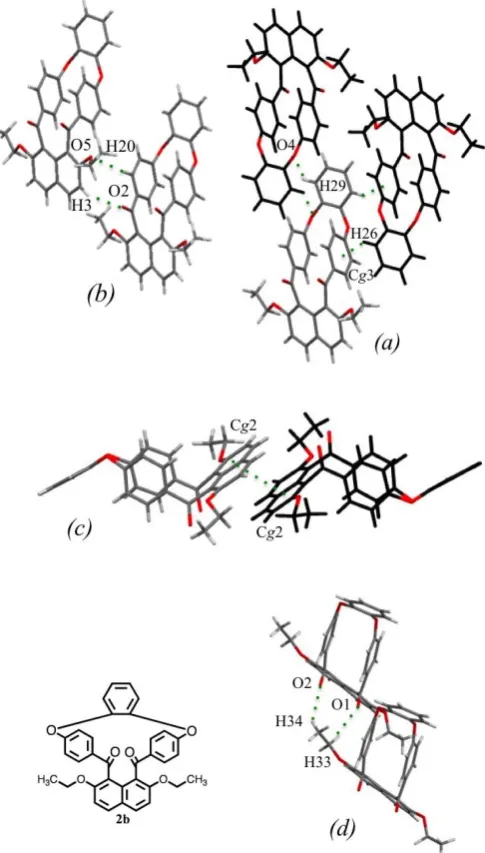
Figure 4. Intermolecular interactions of compound 2b. Dashed lines indicate the intermolecular C–H…π and C–H…O–catechol moiety interactions in part (a), benzoyl C–H…O–ethoxy interaction in part (b), π…π stacking between naphthalene rings in part (c), and ethylene C–H…O=C interactions in part (d).
Table 2 Intermolecular interactions and molecular packing density of compounds 1a, 1b, and 2b (Å, g cm-3)
Symmetry codes: i) –x+1, –y+1, –z+1; ii) x, y+1, z; iii) x–1, y, z; iv) x, y–1, z; v) –x, –y+2, –z+1; vi) –x+1, –y+1, –z; vii) –x+2, – y+1, –z+2; viii) –x+3/2, y+1/2, –z+3/2; ix) x–1/2, –y+1/2, z–1/2; x) –x+1/2, –y+1/2, z+1/2; xi) x, –y+1, z+1/2.
a)Interplanar distance between naphthalane ring and naphthalane ring of neighboring molecule.
The molecules are aligned as dimeric units in crystal packing. One molecule of compound 2b interacts with the neighbouring five molecules at seven points including three kinds of strong intermolecular interactions (Figure 4): 1) C– H…π interaction (non-covalent bonding) between a H atom at the 3-position of the catechol hinge moiety and the benzene ring of the internal benzoyl moiety of the adjacent counterpart molecule of dimeric aggregate [C26– H26…Cg3; 3.00 Å, Table 2, Cg3; internal benzene ring (C12–C17)], 2) intermolecular C–H…O=C interaction between a H atom at the 3-position of the naphthalene ring and the carbonyl group of the adjacent molecule (C3– H3…O2=C18; 2.49 Å, Table 2; entry 4), and 3) intermolecular C–H…O–C2H5 interaction between a H atom
of the internal benzene ring and the O atom of the alkoxy moiety at 2-position of the naphthalene ring of the adjacent molecule(C20–H20…O5(ethoxy); 2.60 Å, Table 2; entry 9).
The intermolecular C–H…O interactions concerning ethoxy group at 7-position of naphthalene ring can be regarded to contribute to increase of density of crystal packing cooperatively with above three kinds of interactions against the steric repulsion by tightening of contact of molecules [O6–C33–H33…O1=C11; 2.67 Å, Table 2; entry 7: O6–CH3–C34–H34…O2=C18; 2.69 Å, Table 2;entry 8]. The other interactions are likely to function rather subsidiary for stabilization of crystal packing [π…π stacking; 3.27 Å (interplaner distance between the naphthalene ring and the naphthalene ring of the neighboring molecule), Table 2; entry 11: C29–H29…O4; 2.68 Å, Table 2; entry 10].
Interactions 2b 1a 1b
D–H…A
hingeC26–H26…interCg3 3.00i
termC35–H35…interCg3 2.78vii
termC18–H18…interCg3 3.17x
NaphC3–H3…O2=C 2.49ii
NaphC3–H3…O1=C 2.44viii NaphC6–H6…O6–Ph 2.56ix
O6–C33–H33…O1=C 2.67iii
O6–CH2–C34–H34…O2=C 2.69iii
interC20–H20…O5–CH2CH3 2.60iv
termC29–H29…O4–catechol 2.68v
NaphCg2…NaphCg2 3.59vi
(3.27a)
interC12–H12…O1=C 2.64xi
termC19–H19…O1=C 2.68x
termC18–H18…O1=C 2.66x
To elucidate the governing interactions in determining the crystal packing and the single molecular structure, the authors planned comparison of crystal data of compound 2b
with those of other related compounds. For this purpose, the authors chose the analogous compound 1b in addition to compound 1a, of which crystal structure has been already determined. Compound 1b, 2,7-diethoxy-1,8-bis(4-phenoxybenzoyl)naphthalene (1b),11 has phenoxybenzoyl
groups at the 1- and 8-positions of the naphthalene ring without bridged moiety. The structural difference between the homologue 1b and compound 1a is only whether the 2,7-dialkoxy groups of the molecule are ethoxy or methoxy.
According to the crystal structure analysis, spatial organization of homologue 1b essentially differs from the bridged compound 2b in orientation of phenoxybenzoyl groups. The two 4-phenoxybenzoyl groups of homologue
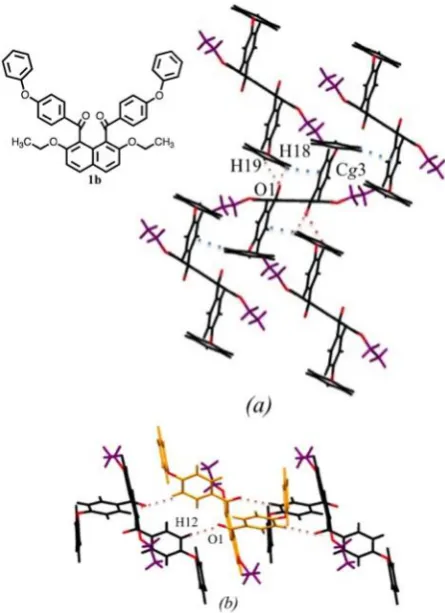
1b are oriented in an anti-orientation despite of the 2,7-diethoxy groups version of compound 1a. For crystal packing structure, homologue 1b apparently has no effective intermolecular interactions. C–H…π interaction between a H atom at the 3-position of the terminal benzene ring and the benzene ring of the internal benzoyl moiety of the adjacent molecule for compound 1b [Figure 5, C18– H18…Cg3; 3.17 Å, Cg3; internal benzene ring (C10–C15)] seems to be resemble fashion to that of bridged compound
2b. From the viewpoint of effective interactions in crystal, the intermolecular C–H…π interaction has a distance longer than 3 Å. Therefore, the contribution of the intermolecular C–H…π interaction to the molecular packing in compound
1b is smaller than that observed in crystal structure of bridged compound 2b.
Figure 5. Intermolecular interactions of non-bridged compound 1b. Dashed lines indicate the intermolecular C–H…π and terminal C– H…O=C interactions in part (a), internal benzene C–H…O=C interactions in part (b). As described in the text, all contact distances are longer than the sum of van der Waals radii.
Figure 6. Intermolecular interactions of homologue 1a. Dashed lines indicate the intermolecular C–H…π and C–H…O=C in part (a), and C–H…O–phenyl interactions in part (b).
Besides, three types of C–H···O=C hydrogen bonds are observed in the crystal of compound 1b (C19–H19···O1; 2.68 Å, C18–H18···O1; 2.66 Å, and C12–H12···O1; 2.64 Å). However, they have almost same distances. So, their significance as structure-directing interactions is doubtful. On the other hand, the spatial organization of the
syn-oriented molecular structure shown in the crystal of bridged compound 2b is essentially in the same style with that of homologue 1a (Figure 6). In crystal of compound 1a,10 the
H atom at 3-position of terminal benzene ring of 4-phenoxybenzoyl moiety interacts with the π-system of internal benzene ring of 4-phenoxybenzoyl moiety of the adjacent molecule [C35–H35…Cg3; 2.78 Å, Table 2, Cg3; internal benzene ring (C12–C17)]. Two sets of strong C– H···π interactions force the two molecules of the homologue (1a) to form a dimeric aggregate with centrosymmetry. Furthermore, intermolecular C–H…O=C interaction between a H atom of naphthalene ring and the O atom of the carbonyl group is observed (C3–H3…O1=C11; 2.44 Å). Another intermolecular C–H…O interaction is observed between the H atom of the naphthalene ring and the O atom of the terminal benzeneoxy moiety (C6–H6…O6–Ph; 2.56 Å). The distance of intermolecular C–H···π interaction becomes shorter in the order of homologue 1b, bridged compound 2b and homologue 1a [3.17 Å for homologue 1b; 3.00 Å for bridged homologue 2b; 2.44 Å for homologue 1a]. Dimeric fashion means that the C–H…π interaction is one of the important factors for appearance of
syn-orientation of 4-phenoxybenzoyl moieties. The C–H…O=C interactions seem to be formed effectively between the dimeric aggregates as shown in the crystal packing of compounds 2b and 1a. Another weak van der Waals interactions between the dimeric pairs might contribute cooperatively to stabilize the molecular packing.
formation of other non-bridged peri-aroylnaphthalene derivatives. Based on this crystal structure similarity in compounds 1a and 2b, the intermolecular C–H…π interaction is supposed as the most effective directing factor for the crystal packing of these syn-oriented compounds. The intermolecular interactions involving the H atoms of naphthalene ring are considered to contribute to arrange the molecules as dimeric formulae in the crystal structures of the syn-oriented molecules. Furthermore, the intermolecular C–H…O=C interaction, together with the C–H···π interaction, observed in crystal packing of both bridged compound 2b and 2,7-dimethoxy non-bridged homologue
1a is interpreted to assist formation of the molecular pairs.
Conclusion
Bridged peri-aroylnaphthtalene compounds 2 having intramolecular connection between the benzene rings of the 1,8-diaroyl groups have successfully synthesized by base-mediated reaction of 1,8-bis(4-fluorobenzoyl)naphthalene derivatives 3 with catechol in a rather non-dilution solution compared to ordinary high-dilution solution synthesis. In crystal of one of the bridged homologues, 2,7-diethoxy derivative 2b, the intramolecularly connected aroyl groups are situated as syn-orientation. Furthermore, two molecules of the bridged compound (2b) form a dimeric aggregate with centrosymmetry having a set of strong C–H···π interactions between a H atom of the catechol hinge moiety and the phenylene ring of the oxybenzoyl group of the other molecule, essentially the same with the 2,7-dimethoxy non-bridged homologue (1a). The ready formation of bridged derivatives from non-bridged homologues in non-dilution conditions manifests the smooth interconversion between
anti and syn forms of the substrate molecule in solution.
This susceptibility is surely caused from lack of conjugation of aromatic rings, which makes the molecule to take anti conformer and syn one. Both semi-stable structures have satisfactorily high energy making the conversion easy. Then, in solution there is enough opportunity the molecule stays in syn structure to convert bridged-derivatives. By the same governing factors, the selection of anti or syn conformer in crystal is interpreted. These semi-stable conformers are still in rather high energy conditions, so the small perturbation of substituent sums up to exchange the level of conformers resulting in drastic alteration of single molecular conformation in crystal.
Experimental
All reagents were of commercial quality and were used as received. Solvents were dried and purified using standard techniques.22 2,7-dimethoxynaphthalene23 and
2,7-dieth-oxynaphthalene,24 non-bridged
1,8-bis(4-phenoxybenzoyl)-2,7-dialkoxynaphthalene (1a and 1b) were prepared according to literatures.10,11
Measurements
1H NMR spectra were recorded on a JEOL JNM-AL300
spectrometer (300 MHz) and a JEOL ECX400 spectrometer (400 MHz). Chemical shifts are expressed in ppm relative
to internal standard of Me4Si ( 0.00). 13C NMR spectra
were recorded on a JEOL JNM-AL300 spectrometer (75 MHz). Chemical shifts are expressed in ppm relative to internal standard of CDCl3 ( 77.0). IR spectra were
recorded on a JASCO FT/IR-4100 spectrometer. Elemental analyses were performed on a Yanaco CHN CORDER MT-5 analyzer. High-resolution FAB mass spectra were recorded on a JEOL MStation (MS700) ion trap mass spectrometer in positive ion mode.
X-ray Crystallography
For the crystal structure determination, the single-crystal of the compound 2b was used for data collection on a fourcircle Rigaku RAXIS RAPID diffractometer (equipped with a two-dimensional area IP detector). The graphite-monochromated CuK radiation ( = 1.54187 Å) was used for data collection. The lattice parameters were determined by the least-squares methods on the basis of all reflections with F2 > 2(F2). The data collection and cell refinement
were performed using PROCESS-AUTO software. The data reduction was performed using CrystalStructure. The structures were solved by direct methods using SIR2004 and refined by a full-matrix least-squares procedure using the program SHELXL97. All H atoms were found in a difference map and were subsequently refined as riding atoms, with the aromatic C–H = 0.95 Å, methyl C–H = 0.98 Å and methylene C–H = 0.99 Å, and with Uiso(H) =
1.2Ueq(C).
Synthesis of bridged peri-aroylnaphthalene 2 without high dilution conditions
To a solution of 1,8-bis(4-fluorobenzoyl)-2,7-dimethoxy- naphthalene (3a, 0.3 mmol, 130.7 mg) in dimethylacetamide (7.5 mL), K2CO3 (1.5 mmol, 208.3 mg) and catechol (0.3
mmol, 34 mg) were added and the resulting solution was stirred at 423 K for 24 h. The reaction mixture was poured into aqueous 2 M HCl (75 mL) at r.t. resulting in formation of pale yellow precipitates. The precipitates were collected by filtration and dried in vacuo. giving crude product (141 mg). The crude material was purified by column chromatography (silica gel, toluene : acetone = 5 : 1) and recrystallization from AcOEt to give the target compound (2a) (m.p. 440.3–441.5 K).
Compound 2b was prepared according to essentially the same way to synthesize compound 2a. The crude material was purified by column chromatography (silica gel, CHCl3 :
acetone = 20 : 1) and recrystallization from AcOEt. Single crystal of compound 2b suitable for X-ray diffraction was obtained by crystallization from AcOEt (m.p. 402.5–404.4 K).
Bridged compound 2a: 1H NMR (300 MHz, CDCl3):
7.91 (2H, d, J = 9.0 Hz), 7.80 (2H, dd, J = 8.7 Hz), 7.22– 7.38 (4H, m), 7.20 (2H, d, J = 9.0 Hz), 6.84 (2H, dd, J = 8.7 Hz), 6.54–6.74 (2H, br), 6.20–6.40 (2H, br), 3.74 (6H, s) ppm; 13C NMR (125 MHz, CDCl
3): 56.80, 111.19, 121.63,
125.46, 126.08, 126.83, 128.86, 131.05, 132.23, 132.80, 134.60, 147.77, 156.37, 161.54, 193.85 ppm; IR (KBr): 1670 (C=O), 1597, 1512, 1485 (Ar, naphthalene), 1501 (Ar, benzene), 1259 (C–O–C) cm–1; HRMS (m/z): [M+Na]+
Bridged compound 2b: 1H NMR (300 MHz, CDCl 3):
7.87 (2H, d, J = 9.0 Hz), 7.80 (2H, dd, J = 8.7 Hz), 7.25– 7.40 (4H, m), 7.18 (2H, d, J = 9.0 Hz), 6.85 (2H, dd, J = 8.7 Hz), 6.60–6.75 (2H, br), 6.25–6.40 (2H, br), 3.95–4.16 (4H, m), 1.12 (6H, t, J = 6.6 Hz) ppm; 13C NMR (75 MHz,
CDCl3): 14.64, 65.37, 112.42, 122.20, 125.37, 125.92,
126.66, 128.89, 130.86, 131.88, 132.84, 134.35, 147.68, 155.57, 161.27, 193.68 ppm; IR (KBr): 1676 (C=O), 1597, 1510, 1484 (Ar, naphthalene), 1500 (Ar, benzene), 1258 (C– O–C) cm–1; HRMS (m/z): [M+H]+ Calcd. for C
34H27O6,
637.2590. Found, 531.1842.
References
1Lu, B., Yan, J., Xu, J., Zhou, S., Hu, X., Macromolecules, 2010,
43(10), 4599–4608.
2Fraind, A. M., Tavor, J. D., J. Phys. Chem. B, 2010, 114(9), 3104–
3116.
3Schmidt, B. M., Topolinski, B., Higashibayashi, S., Kojima, T.,
Kawano, M., Lentz, D., Sakurai, H., Chem. Eur. J., 2013, 19(10), 3282-3286.
4Yoshimoto, S., Kobayashi, N., Structure and Bonding (Berlin,
Germany), 2010, 135, 137-168.
5Shrestha, B. B., Higashibayashi, S., Sakurai, H., Beil. J. Org.
Chem., 2014, 10, 841-847.
6Choi, H. S., Kim, K. S., Angew. Chem. Int. Ed., 1999, 38(15),
2256–2258.
7Bunz, U. H. F., Menning, S., Martin, N., Angew. Chem., Int. Ed., 2012, 51, 7094–7101.
8Kayahara, E.; Patel, V. K.; Yamago, S.,J. Am. Chem. 2014, 136,
2284–2287.
9Segawa, Y., Fukazawa, A., Matsuura, S., Omachi, H., Yamaguchi,
S., Irle, S., Itami, K., Org. Biomol. Chem., 2012, 10, 5979– 5984.
10Hijikata, D., Takada, T., Nagasawa, A., Okamoto, A., Yonezawa,
N., Acta Cryst., 2010,E66, o2902–o2903.
11Yoshiwaka, S., Sasagawa, K., Noguchi, K., Okamoto, A.,
Yonezawa, N. Acta Cryst., 2014, C70, 1096–1100.
12Okamoto, A.; Yonezawa, N.; Chem. Lett.,2009, 38, 914.
13Okamoto, A; Mitsui, R.; Yonezawa, N.; Chem. Lett., 2011, 40,
1283.
14Nakaema, K.; Noguchi, K.; Okamoto, A.; Yonezawa, N.; Acta
Cryst.,2008, E64, o2497.
15Mohri, S.; Ohisa, S.; Noguchi, K.; Yonezawa, N.; Okamoto, A.;
Acta Cryst.,2014, E70, 138-141.
16Nishijima, T.; Kataoka, K.; Nagasawa, A.; Okamoto, A.;
Yonezawa, N.; Acta Cryst.,2010, E66, o2904–o2905.
17Sasagawa, K., Takeuchi, R., Kusakabe, T., Yonezawa, N.,
Okamoto, A., Acta Cryst., 2013, E69, o444–o445.
18Mitsui, R., Nagasawa, A., Noguchi, K., Okamoto, A., Yonezawa,
N., Acta Cryst., 2010, E66, o1790.
19Yoshiwaka, S., Hijikata, D., Sasagawa, K., Okamoto, A.,
Yonezawa, N., Acta Cryst., 2013, E69, o242.
20Okamoto, A., Hijikata, D., Sakai, N., Yonezawa, N., Polymer J., 2013, 45, 277–280.
21CCDC-1039291 contains the supplementary crystallographic data
for this paper. These data can be obtained free of charge from The Cambridge Crystallographic Data Centre via www.ccdc.cam.ac.uk/data_request/cif.
22Armarego, W.L. F.; Perrin, D. D.; “Purification of Laboratory
Chemicals”, Fourth edition, Reed Educational and Professional Publishing Ltd, Oxford, 1996.
23Domasevitch, K. V.; Solnsev, P. V.; Krautscheid, H.; Zhylenko, I.
S.; Rusanov, E. B.; Chernega, A. N. Chem. Commun., 2012, 48, 5847.
24Kuwano, R.; Morioka, R.; Kashiwabara, M.; Kameyama, N.
Angew. Chem., Int. Ed., 2012, 51, 4136.
![Figure 3. Crystal structure of 2,7-diethoxy homologue 2b; displaying single structure [front view (a) and top view (b)] and unit cell (c)](https://thumb-us.123doks.com/thumbv2/123dok_us/7830889.2089156/2.595.304.541.422.735/figure-crystal-structure-diethoxy-homologue-displaying-single-structure.webp)