OXIDATION OF ORGANIC SULFIDES BY QUINOLINIUM
CHLOROCHROMATE: A KINETIC AND MECHANISTIC
APPROACH
G. Sharma,
[a]R. Rathi,
[a]A. Sharma,
[a]J. Banerji
[a]and Pradeep K. Sharma
[a]*Keywords: Correlation analysis, halochromate, kinetics, mechanism, sulfide, oxidation.
The oxidation of organic sulfides by quinolinium chlorochromate (QCC) resulted the formation of the corresponding organic sulfoxides. These reactions are first order ones with respect to QCC. A Michaelis-Menten type kinetics was observed with respect to the reactants. The reaction is catalyzed by p-toluene sulfonic acid (TsOH). The oxidation was studied in nineteen different organic solvents. An analysis of the solvent effect on Swain's equation showed that the both cation- and anion-solvating powers of the solvents play important roles. The correlation analyses of the rate of oxidation of thirty-four sulfides were done in terms of various single and multiparametric equations. In the reactions of aryl methyl sulfides, the best correlation could be obtained with Charton's LDR and LDRS equations. The oxidation reactions of alkyl phenyl sulfides exhibited an excellent correlation in terms of Pavelich-Taft equation. The negative values of polar reaction constants indicate an electron-deficient sulfur center in the rate- determining step. The proposed reaction mechanism involves the formation of a sulphenium cation intermediate in a slow step
* Corresponding Authors Phone: +91 94144-10900 E-Mail: [email protected]
[a] Department of Chemistry, J.N.V. University, Jodhpur 342 005, India
INTRODUCTION
Various halochromates have been used as mild and selective oxidizing reagents in synthetic organic chemistry.1
Oxidation of sulfides has been tested with various oxidants.2
There are several papers published from our laboratory about the kinetic and mechanistic aspects of the oxidation by complex cation containing anionic Cr(VI) species.1--7
Quinolinium chlorochromate (QCC) is one of the oxidants belong to our interesting field.2 It is well known that mode
of oxidation depends upon the nature of counter-ion attached to the chromium-containing anion. Karunakaran et. al.8 have reported a mechanism for the oxidation of diphenyl
sulfide by various anionic Cr(VI) reagents in acetic acid. In the present article, we report the kinetics of oxidation of thirty-four organic sulfides by QCC in dimethylformamide (DMF) as the solvent. Attempts have been made to correlate rate and structure in these reactions. A probable mechanism of these reactions has been proposed.
EXPERIMENTAL
Materials
The sulfides were either commercial products or prepared by known methods9 and were purified by distillation under
reduced pressure or crystallization. Their purity was checked by comparing their boiling or melting points with the literature values. QCC was prepared by the reported method.1 p-Toluene-sulfonic acid (TsOH) was used as a
proton source. Other solvents were purified by their usual methods.10
Product analysis
MeSPh or Me2S (0.1 mol) and QCC (0.01 mol) was
dissolved in the appropriate solvent (50 ml), and the mixture was allowed to stand for 20 h. The solvent was removed in vacuum, the residue was diluted with water and extracted with chloroform (3x50 mL). The organic layer was dried over anhydrous MgSO4, the solvent was removed by
evaporation. The IR and 1H NMR spectra of the residue were identical with those of the corresponding sulfoxides. IR bands characteristic of the sulfides and sulfones could not be detected, but strong and broad absorption bands characteristics for sulfoxide11 appeared at 1050 cm-1. The
peak of methyl protons in the NMR spectrum of Me2S was
shifted from 2.1 ppm to 2.6 ppm in the oxidation product. In the corresponding sulfone, the peak should have appeared at 3.0 ppm.12 Similar experiments were performed with the
other sulfides also. In all cases, the products were the corresponding sulfoxides. The oxidation state of chromium in completely reduced reaction mixtures, determined by an iodometric method, was 3.90 0.10.
Kinetic measurements
The reactions were studied under pseudo-first-order conditions by keeping an excess (15 or greater) of the sulfide over QCC. The solvent was DMSO unless mentioned otherwise. The reactions were studied at constant temperature (0.1 K) and were followed by monitoring the decrease in the concentration of QCC at 352 nm for up to 80 % reaction extent. Pseudo-first-order rate constants, kobs,
were evaluated from linear plots (r2 > 0.995) of log [QCC]
against time. Duplicate kinetic runs unambiguously showed that the rate constants are reproducible to within 3 %. All kinetic runs, except those for studying the effect of acidity, were studied in the absence of TsOH. The values of the second order rate constants were calculated from the known relation k2 = kobs/ [sulfide]. Simple and multivariate
RESULTS AND DISCUSSION
The oxidation of organic sulfides by QCC resulted in the formation of the corresponding sulfoxides. The overall reaction may be represented by Eqn. (1).
RSR' + O2CrClOQH RSOR' + OCrClOQH (1)
QCC undergoes two-electron redox transformation. This result is in accordance with the earlier observations about structurally similar other halochromates also. It has already been shown that both PFC13 and PCC14 reacted as two
electron oxidants and are reduced to chromium (IV) species. The oxidation state of chromium was determined by magnetic susceptibility, ESR and IR studies.
Rate law
The reactions are of first order with respect to QCC. Figure 1 depicts a typical kinetic run. The pseudo-first order rate constant, kobs was found to be independent of the initial
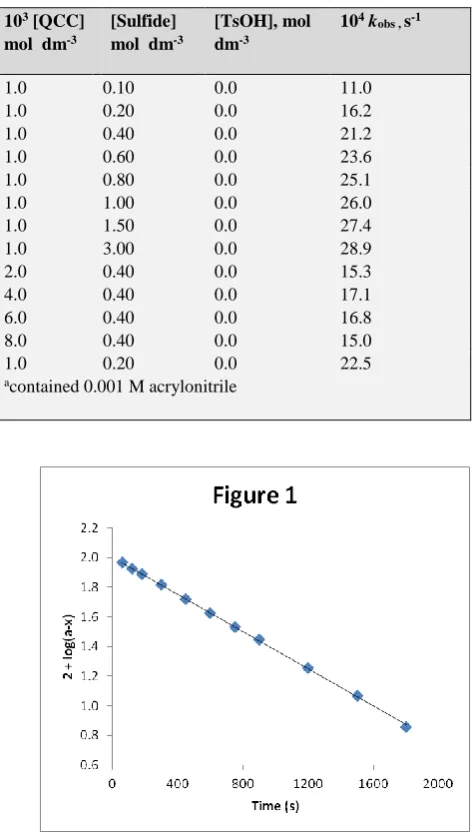
concentration of QCC. The reaction rate increases with increase in the concentration of the sulfide but not linearly (Table 1). A plot of 1/kobs against 1/[sulfide] is linear (r >
0.995) with an intercept on the rate-ordinate (Figure 2). Thus, Michaelis-Menten type kinetics are observed with respect to the sulfide. This leads to the postulation of following overall mechanism (2) and (3) and rate law (4).
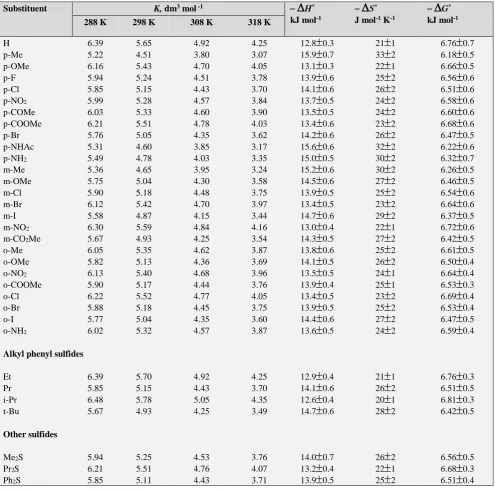
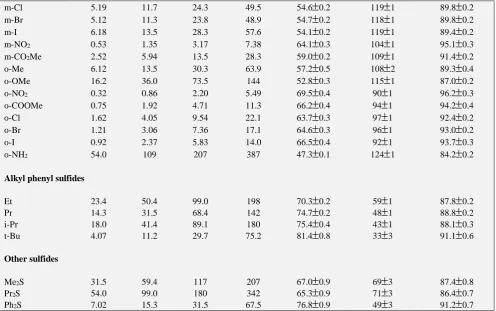
The dependence of reaction rate on the reductant concentration was studied at various temperatures, and the values of K and k2 were evaluated as usual from the double
reciprocal plots. The thermodynamic parameters of the complex formation and activation parameters of the decomposition of the complexes were calculated from the individual values of K and k2 respectively at different
temperatures (Tables 2 and 3). Figure 2 depict a typical kinetic run.
Test reaction for free radicals
The oxidation of methyl phenyl sulfide, in an inert atmosphere (N2), failed to induce the polymerization
reaction of acrylonitrile. The addition of acrylonitrile had no any effect on the rate of oxidation (Table 1). To confirm the absence/role of free radicals in the reaction pathway, the reaction was carried out in the presence of 0.05 mol dm3 of
2,6-di-t-butyl-4-methylphenol (butylated hydroxytoluene or BHT). It was observed that BHT was proved to be unchanged and could be recovered almost quantitatively.
Table 1. Rate constants for the oxidation of MeSPh by QCC at 298 K
103 [QCC] mol dm-3
[Sulfide] mol dm-3
[TsOH], mol dm-3
104 kobs , s-1
1.0 0.10 0.0 11.0
1.0 0.20 0.0 16.2
1.0 0.40 0.0 21.2
1.0 0.60 0.0 23.6
1.0 0.80 0.0 25.1
1.0 1.00 0.0 26.0
1.0 1.50 0.0 27.4
1.0 3.00 0.0 28.9
2.0 0.40 0.0 15.3
4.0 0.40 0.0 17.1
6.0 0.40 0.0 16.8
8.0 0.40 0.0 15.0
1.0 0.20 0.0 22.5
acontained 0.001 M acrylonitrile
Figure 1. Oxidation of methyl phenyl sulfide by QCC: A typical kinetic run.
Figure 2. A double reciprocal plot: 1/kobs versus 1/[Sulfide]
Sulfide + QCC [Intermediate] (2)
K
[Intermediate] Products (3)
k2
Table 2. Formation constants of QCCsulfide complexes and thermodynamic parameters
Substituent K, dm3 mol -1
H* kJ mol-1
S* J mol-1 K-1
G* kJ mol-1 288 K 298 K 308 K 318 KH 6.39 5.65 4.92 4.25 12.8
0.3 21
1 6.76
0.7p-Me 5.22 4.51 3.80 3.07 15.9
0.7 33
2 6.18
0.5p-OMe 6.16 5.43 4.70 4.05 13.1
0.3 22
1 6.66
0.5p-F 5.94 5.24 4.51 3.78 13.9
0.6 25
2 6.56
0.6p-Cl 5.85 5.15 4.43 3.70 14.1
0.6 26
2 6.51
0.6p-NO2 5.99 5.28 4.57 3.84 13.7
0.5 24
2 6.58
0.6p-COMe 6.03 5.33 4.60 3.90 13.5
0.5 24
2 6.60
0.6 p-COOMe 6.21 5.51 4.78 4.03 13.4
0.6 23
2 6.68
0.6p-Br 5.76 5.05 4.35 3.62 14.2
0.6 26
2 6.47
0.5p-NHAc 5.31 4.60 3.85 3.17 15.6
0.6 32
2 6.22
0.6p-NH2 5.49 4.78 4.03 3.35 15.0
0.5 30
2 6.32
0.7m-Me 5.36 4.65 3.95 3.24 15.2
0.6 30
2 6.26
0.5m-OMe 5.75 5.04 4.30 3.58 14.5
0.6 27
2 6.46
0.5m-Cl 5.90 5.18 4.48 3.75 13.9
0.5 25
2 6.54
0.6m-Br 6.12 5.42 4.70 3.97 13.4
0.5 23
2 6.64
0.6m-I 5.58 4.87 4.15 3.44 14.7
0.6 29
2 6.37
0.5m-NO2 6.30 5.59 4.84 4.16 13.0
0.4 22
1 6.72
0.6m-CO2Me 5.67 4.93 4.25 3.54 14.3
0.5 27
2 6.42
0.5o-Me 6.05 5.35 4.62 3.87 13.8
0.6 25
2 6.61
0.5o-OMe 5.82 5.13 4.36 3.69 14.1
0.5 26
2 6.50
0.4o-NO2 6.13 5.40 4.68 3.96 13.5
0.5 24
1 6.64
0.4o-COOMe 5.90 5.17 4.44 3.76 13.9
0.4 25
1 6.53
0.3o-Cl 6.22 5.52 4.77 4.05 13.4
0.5 23
2 6.69
0.4o-Br 5.88 5.18 4.45 3.75 13.9
0.5 25
2 6.53
0.4o-I 5.77 5.04 4.35 3.60 14.4
0.6 27
2 6.47
0.5o-NH2 6.02 5.32 4.57 3.87 13.6
0.5 24
2 6.59
0.4Alkyl phenyl sulfides
Et 6.39 5.70 4.92 4.25 12.9
0.4 21
1 6.76
0.3Pr 5.85 5.15 4.43 3.70 14.1
0.6 26
2 6.51
0.5i-Pr 6.48 5.78 5.05 4.35 12.6
0.4 20
1 6.81
0.3t-Bu 5.67 4.93 4.25 3.49 14.7
0.6 28
2 6.42
0.5Other sulfides
Me2S 5.94 5.25 4.53 3.76 14.0
0.7 26
2 6.56
0.5Pr2S 6.21 5.51 4.76 4.07 13.2
0.4 22
1 6.68
0.3Ph2S 5.85 5.11 4.43 3.71 13.9
0.5 25
2 6.51
0.4Table 3. Rate constants and activation parameters of the decomposition of QCC-sulfide complex.
Substituent 104 k2 dm3 mol-1 s-1 H* kJ mol-1
S* J mol-1 K-1
G* kJ mol-1 288 K 298 K 308 K 318 K
H 14.4 30.6 62.1 123 51.8
0.1 120
1 87.3
0.2p-Me 32.4 65.7 126 246 48.7
0.5 124
1 85.5
0.4p-OMe 75.6 153 288 522 46.4
0.2 125
1 83.4
0.2p-F 14.4 31.5 65.7 135 54.2
0.3 112
1 87.3
0.2p-Cl 9.36 20.7 43.5 89.1 54.6
0.1 114
1 88.3
0.1 p-NO2 0.72 1.80 4.23 9.90 63.8
0.4 103
1 94.4
0.3p-COMe 1.89 4.50 10.1 22.0 59.7
0.3 109
1 92.1
0.2 p-COOMe 2.82 6.57 14.4 31.5 58.6
0.4 110
1 91.2
0.3 p-Br 9.21 20.3 42.8 88.2 54.7
0.2 113
1 88.4
0.2 p-NHAc 36.0 74.7 144 279 49.2
0.3 121
1 85.2
0.2p-NH2 288 540 963 1660 41.9
0.1 129
1 80.3
0.1m-Me 27.0 55.8 108 207 49.0
0.2 124
2 85.9
0.4m-Cl 5.19 11.7 24.3 49.5 54.6
0.2 119
1 89.8
0.2 m-Br 5.12 11.3 23.8 48.9 54.7
0.2 118
1 89.8
0.2m-I 6.18 13.5 28.3 57.6 54.1
0.2 119
1 89.4
0.2m-NO2 0.53 1.35 3.17 7.38 64.1
0.3 104
1 95.1
0.3m-CO2Me 2.52 5.94 13.5 28.3 59.0
0.2 109
1 91.4
0.2o-Me 6.12 13.5 30.3 63.9 57.2
0.5 108
2 89.3
0.4 o-OMe 16.2 36.0 73.5 144 52.8
0.3 115
1 87.0
0.2 o-NO2 0.32 0.86 2.20 5.49 69.5
0.4 90
1 96.2
0.3o-COOMe 0.75 1.92 4.71 11.3 66.2
0.4 94
1 94.2
0.4o-Cl 1.62 4.05 9.54 22.1 63.7
0.3 97
1 92.4
0.2o-Br 1.21 3.06 7.36 17.1 64.6
0.3 96
1 93.0
0.2o-I 0.92 2.37 5.83 14.0 66.5
0.4 92
1 93.7
0.3o-NH2 54.0 109 207 387 47.3
0.1 124
1 84.2
0.2Alkyl phenyl sulfides
Et 23.4 50.4 99.0 198 70.3
0.2 59
1 87.8
0.2Pr 14.3 31.5 68.4 142 74.7
0.2 48
1 88.8
0.2i-Pr 18.0 41.4 89.1 180 75.4
0.4 43
1 88.1
0.3t-Bu 4.07 11.2 29.7 75.2 81.4
0.8 33
3 91.1
0.6Other sulfides
Me2S 31.5 59.4 117 207 67.0
0.9 69
3 87.4
0.8Pr2S 54.0 99.0 180 342 65.3
0.9 71
3 86.4
0.7Ph2S 7.02 15.3 31.5 67.5 76.8
0.9 49
3 91.2
0.7Effect of acidity
The reaction is catalysed by TsOH (Table 4). The TsOH-dependence has the form kobs = a + b [TsOH]. The values of
a and b for methyl phenyl sulfide are 10.40.57104 s-1 and
18.80.95104 mol-1dm3 s-1 respectively (r2 = 0.9980).
Therefore, the experimental rate law can be given in the following form:
Rate = k2 [QCC] [sulfide] + k3 [QCC] [sulfide] [TsOH] (5)
Table 4. Dependence of the reaction rate on hydrogenion concentration
[H+] mol dm3 0.10 0.20 0.40 0.60 0.80 1.00
104k
obs s-1 12.3 14.4 16.4 21.0 25.2 29.3
[sulfide] 0.10 mol dm-3, [QCC] 0.001 mol dm-3, T 298 K
Effect of Solvent
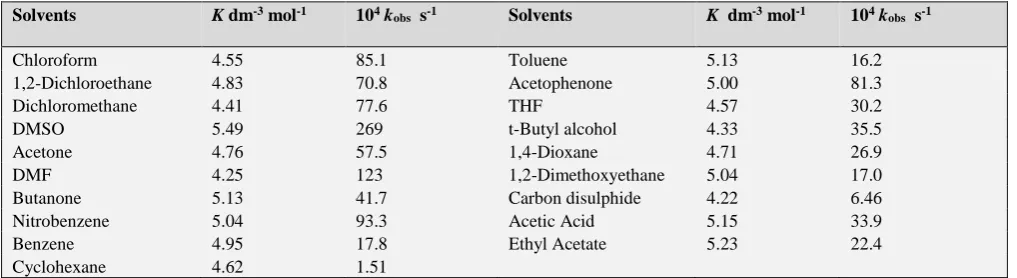
The oxidation of methyl phenyl sulfide was studied in nineteen different organic solvents. The choice of solvent was limited by the solubility of QCC and its reaction with primary and secondary alcohols. There was no reaction with the solvents chosen. The kinetics were similar in all the solvents. The values of k2 and K are recorded in Table 5.
There is a linear correlation between the activation enthalpies and entropies of the oxidation of the thirty-four sulfides (r = 0.9693), indicating the operation of a compensation effect.15 The value of the isokinetic
temperature is 60731 K. However, according to Exner16 an
isokinetic relationship between the calculated values of enthalpies and entropies is often vitiated by the random experimental errors associated with them. Exner suggested an alternative method for establishing the isokinetic relationship. An Exner’s plot between log k2 at
288 K and at 318 K was linear (r2 = 0.9962, slope = 0.8302
± 0.0090). The value of isokinetic temperature evaluated as usual from the Exner's plot is 656±65 K. The linear isokinetic correlation implies that all the sulfides studied are oxidized by the same mechanism, and the change in the rate of oxidation is governed by changes in both the enthalpy and entropy of the activation.
Solvent effect
The rate constants for oxidation, k2, in eighteen solvents
(CS2 was not considered, as the complete range of solvent
parameters was not available) were correlated in terms of the linear solvation energy relationship (6) of Kamlet et al.17
log k2 = A0 + p* + b + a (6)
In this equation, * represents the solvent polarity, the
hydrogen bond acceptor basicities and is the hydrogen bond donor acidity. A0 is the intercept term. It may be
mentioned that out of the 18 solvents, 13 have a value of zero for . The results of correlation analysis in terms of equation (6), a biparametric equation involving * and ,
and separately with * and are given below in eqns. (7-10).
We have used the standard deviation (sd), the coefficient of multiple determination (R2), and Exner's18 parameter,
, asTable 5. Solvent effect on the oxidation of Me-S-Ph by QCC at 318 K
Solvents K dm-3 mol-1 104 kobs s-1 Solvents K dm-3 mol-1 104 kobs s-1
Chloroform 4.55 85.1 Toluene 5.13 16.2
1,2-Dichloroethane 4.83 70.8 Acetophenone 5.00 81.3
Dichloromethane 4.41 77.6 THF 4.57 30.2
DMSO 5.49 269 t-Butyl alcohol 4.33 35.5
Acetone 4.76 57.5 1,4-Dioxane 4.71 26.9
DMF 4.25 123 1,2-Dimethoxyethane 5.04 17.0
Butanone 5.13 41.7 Carbon disulphide 4.22 6.46
Nitrobenzene 5.04 93.3 Acetic Acid 5.15 33.9
Benzene 4.95 17.8 Ethyl Acetate 5.23 22.4
Cyclohexane 4.62 1.51
log k2 = 4.26 + 1.88(0.19) * + 0.16(0.16) +
0.3(0.15) (7) R2 = 0.8869; sd = 0.18; n = 18; = 0.37
log k2 = 4.34 + 1.77(0.20) * + 0.27(0.17) (8)
R2 = 0.8528; sd = 0.20; n =18; = 0.41
log k2 = 4.39 + 1.84 (0.21) * (9)
r2 = 0.8273; sd = 0.21; n = 18; = 0.39
log k2 = 2.63 + 0.59(0.39) (10)
r2 = 0.1255; sd = 0.47; n = 18; = 0.96
Kamlet's17 triparametric equation explains ca. 88 % of the
effect of solvent on the oxidation. However, by Exner's criterion the correlation is not even satisfactory (cf. eqn. 7). The major contribution is of solvent polarity. It alone accounted for ca. 83 % of the data. Both and play relatively minor roles.
The data on the solvent effect obtained were analyzed in terms of Swain's equation19 of cation- and anion-solvating
concept of the solvents as well.
log k2 = aA + bB + C (11)
Here A represents the anion-solvating power of the solvent and B the cation- solvating power. C is the intercept term. The rates in different solvents were analyzed in terms of Eqn. (11), separately with A and B and with (A + B).
log k2 = 1.38(0.04) A + 1.76(0.03) B 3.97 (12)
R2 = 0.9965; sd = 0.03; n = 19; = 0.06
log k2 = 1.13(0.58) A 2.76 (13)
r2 = 0.1827; sd = 0.47; n = 19; = 0.93
log k2 = 1.65(0.24) B 3.52 (14)
r2 = 0.7271; sd = 0.27; n = 19; = 0.54
log k2 = 1.630.05 (A + B) 3.96 (15)
r2 = 0.9820; sd = 0.07; n = 19; = 0.14
The rates of oxidation of methyl phenyl sulfide in the different solvents show an excellent correlation with Swain's equation with both the cation- and anion- solvating powers
playing significant roles, though the contribution of the cation- solvation is slightly more than that of the anion-solvation. However, the correlations individually with A and B were poor. In view of the fact that solvent polarity is able to account for ca. 98 % of the data, an attempt was made to correlate the rate with the relative permittivities of the solvents. However, a plot of log k2
against the inverse of the relative permittivity is not linear (r2 = 0.5044; sd = 0.36; = 0.72).
Correlation analysis of reactivity
The data in Table II show that the oxidation of different sulfides follows the order of their nucleophilicity: Pr2S >
Me2S > MeSPh > Ph2S.
Aryl methyl sulfides
The correlation of the effect of substituents on the reactivity has been widely attempted in terms of the Hammett equation20 or with dual substituent-parameter
equations.21,22 In the late 1980s, Charton23 introduced a
triparametric LDR equation for the quantitative description of structural effects on chemical reactivities. This triparametric equation results from the fact that substituent types differ in their mode of electron delocalization. This difference is reflected in a different sensitivity to the electronic demand for the phenomenon being studied. It has the most important advantage of not requiring a choice of parameters as the same three substituent constants are reported to cover the entire range of electrical effects of substituents. We have, therefore, begun a study of structural effects on reactivity using the LDR equation. In our present work, we have applied the LDR equation (16) to the rate constants, k2.
log k2 = L
l + D
d + R
e + h (16)Here,
l is a localized (field and/or inductive) effectparameter, and
d is the intrinsic delocalized (resonance)electrical effect parameter when active site electronic demand is minimal and
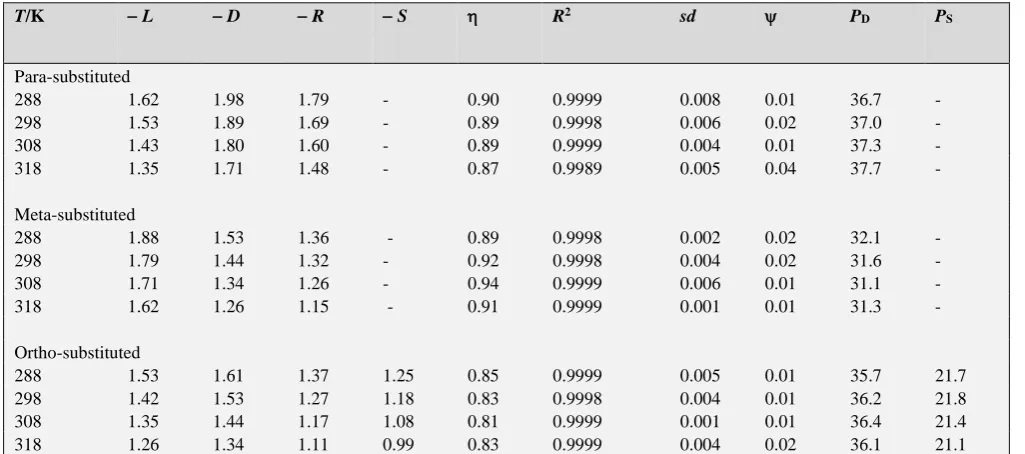
e represents the sensitivity of theTable 6. Temperature dependence of the reaction constants for the oxidation of organic sulfides by QCC
T/K L D R S R2 sd PD PS
Para-substituted
288 1.62 1.98 1.79 - 0.90 0.9999 0.008 0.01 36.7 -
298 1.53 1.89 1.69 - 0.89 0.9998 0.006 0.02 37.0 -
308 1.43 1.80 1.60 - 0.89 0.9999 0.004 0.01 37.3 -
318 1.35 1.71 1.48 - 0.87 0.9989 0.005 0.04 37.7 -
Meta-substituted
288 1.88 1.53 1.36 - 0.89 0.9998 0.002 0.02 32.1 -
298 1.79 1.44 1.32 - 0.92 0.9998 0.004 0.02 31.6 -
308 1.71 1.34 1.26 - 0.94 0.9999 0.006 0.01 31.1 -
318 1.62 1.26 1.15 - 0.91 0.9999 0.001 0.01 31.3 -
Ortho-substituted
288 1.53 1.61 1.37 1.25 0.85 0.9999 0.005 0.01 35.7 21.7 298 1.42 1.53 1.27 1.18 0.83 0.9998 0.004 0.01 36.2 21.8 308 1.35 1.44 1.17 1.08 0.81 0.9999 0.001 0.01 36.4 21.4 318 1.26 1.34 1.11 0.99 0.83 0.9999 0.004 0.02 36.1 21.1
D =
e +
d (17)Here
represents the electronic demand of the reaction site and represents the ratio of the regression coefficient of the sensitivity parameter,
e, and that of resonanceparameter,
d i.e.
= R/D.
D represents the delocalizedelectrical parameter of the diparametric LD equation.
For ortho-substituted compounds, it is necessary to account for the possibility of steric effects and Charton23
therefore, modified the LDR equation to generate the LDRS equation (18).
log k2 = L
l + D
d + R
e + S + h (18)where is the known Charton's steric parameter based on Van der Waals radii24.
The rates of oxidation of ortho-, meta-, and para-substituted sulfides show excellent correlations in terms of the LDR/LDRS equations (Table 6). The values of the independent variables,
l,
d,
e and , were obtainedfrom the work of Charton and Charton.19 Though the
number of data points is less than the optimum number, the correlations are excellent as per Exner's16 criterion also.
Exner’s
parameter takes into account the number of data-point also.All three regression coefficients, L, D, and R, are negative indicating an electron-deficient sulfur center in the transition state of the rate-determining step. The positive value of
adds a negative increment to
d as in equation (18),reflecting the electron- donating power of the substituent and its capacity to stabilize a cationic species.
The negative value of S indicates that the reaction is subjected to steric hindrance by the ortho-substituent. This may be due to steric hindrance of the ortho--substituent to the approach of the oxidizing species.
To test the significance of localized, delocalized and steric effects in the ortho-substituted sulfides, multiple linear regression analyses were carried out with (i)
l,
dand
e, (ii)
d,
e and , and (iii)
l,
e and . The absenceof significant correlations [eqns. (19-21)] showed that all the four substituent constants are significant.
log k2 = 1.99(
0.48)
l 1.33(
0.39)
d1.99(
2.76)
e 2.87 (19)R2= 0.8926; sd = 0.29; n = 10;
= 0.40log k2 = 1.89(
0.44)
d + 0.51(
3.51)
e 1.84(
0.54) 2.64 (20)
R2 = 0.8528; sd = 0.34; n = 10;
= 0.47log k2 = 2.12(
0.88)
l 5.39(
4.41)
e 0.71(
0.88) 2.42 (21)
R2 = 0.6823; sd = 0.50; n = 10;
= 0.69Similarly in the cases of the oxidation of para- and meta-substituted sulfides, multiple regression analyses indicated that both localization and delocalization effects are significant. There is no significant collinearity between the various substituent constants for the three series.
The percent contribution24 of the delocalized effect, P D is
given by the following equation (22).
PD = (D
100)/ (L + D + R) (22)Similarly, the percent contribution of the steric parameter24 to the total effect of the substituent, P
S, was
determined by using equation (23).
The values of PD and PS are also recorded in Table 6. The
value of PD for the oxidation of para-substituted sulfides is
ca. 52 % whereas the corresponding values for the meta- and ortho-sobstituted aldehydes are ca. 39 and 49 % respectively. The less pronounced resonance effect from the ortho- position than from the para-position may be due to the twisting away of the methyl-thio group from the plane of the benzene ring.
In earlier studies on the oxidations of organic sulfides, involving a direct oxygen transfer via an electrophilic attack on the sulfide-sulfur, the reaction constants were negative but of relatively small magnitude, e.g. by hydrogen peroxide (1.13),25 periodate (1.40),26 permanganate (1.52),27 and
peroxydisulfate (0.56).28 Large negative reaction constants
were exhibited by oxidations involving the formation of halogeno-sulfonium cations e.g. by chloramine-T(4.25),29
bromine (3.2)30 and N-bromoacetamide (3.75).31 In the
oxidation by N-chloroacetamide (NCA)32 the values of the
field (I) and resonance ( +R), at 298 K are 1.3 and 1.7
respectively.
Alkyl phenyl sulfides
The rates of oxidation of alkyl phenyl sulfides did not yield any significant correlation separately with Taft's * or E
s values. The rates were therefore analyzed in terms
of Pavelich--Taft's33 dual substituent-parameter (DSP)
equation (24).
log k2 = ** + Es + log k0 (24)
The correlations are excellent (Table 7). Though the number of compounds is small (five) for any analysis by a DSP equation, the results can be used qualitatively. The negative polar reaction constant confirms that the electron-donating power of the alkyl group enhances the reaction rate. The steric effect plays a minor inhibitory role.
Table 7. Correlation of rate of oxidation of alkyl phenyl sulfides with Pavelich-Taft equation
T, K * R2 sd
288 2.790.04 0.880.01 0.9999 0.003 0.01 298 2.710.06 0.810.01 0.9998 0.006 0.02 308 2.560.04 0.710.01 0.9998 0.004 0.02 318 2.390.09 0.610.02 0.9989 0.007 0.04
a No. of data points = 5
Mechanism
The observed dependence on TsOH suggests that the reaction follows two mechanistic pathways, one TsOH-catalysed and the other unTsOH-catalysed. The catalytic effect of TsOH can be attributed to a protonation of QCC to give a stronger oxidant and electrophile (25).
O2CrClOQH + TsOH [OCr (OH)ClOQH]+[TsO]- (25)
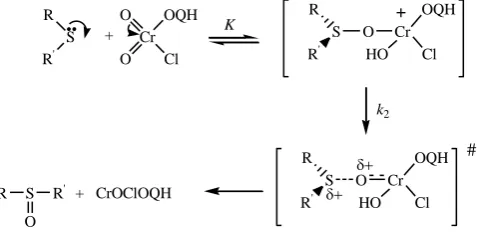
In view of the absence of any effect of the radical scavenger, acrylonitrile, on the reaction rate, it is unlikely that a one-electron reaction giving rise to free radicals is operative in this oxidation. The observed Michaelis-Menten kinetics with respect to sulfides led us to suggest the formation of an intermediate in a rapid pre-equilibrium. With present set of data, it is difficult to state the definite nature of the intermediate complex. The most logical mode of interaction between sulfides and QCC would, therefore, be the nucleophilic attack at the metal. Donation of a unshared pair of electrons to an empty d-orbital on the metal would result in the formation of a coordinate covalent bond. The initially formed intermediate is likely to undergo a further rapid reaction in which the incipient oxide and sulfonium ions bond to form a highly structured intermediate that would rearrange to give a sulfoxide (Scheme 1).
The oxidation of sulfides by QCC may involve a cyclic intermediate as has been suggested in many reactions of Cr(VI). The cyclic transition state will be highly strained in view of the apical position of a lone pair of electrons or an alkyl group. The steric requirements of the reaction will be higher as compared to those of reaction, and the observed small magnitudes of steric reaction constants are thus consistent with the proposed acyclic mechanism. The formation of a cyclic transition state entails a more exacting specificity of orientation and should result in much larger negative entropy of activation than that observed.
Scheme 1. Mechanism of the oxidation of sulfides by QCC.
ACKNOWLEDGEMENTS
Thanks are due to Department of Science and Technology, New Delhi, for financial support in the form INSPIRE fellowship to GS.
References
1Corey, E. J., Suggs, W. J., Tetrahedron Lett., 1975, 2647;
https://doi.org/10.1016/S0040-4039(00)75204-X; Guziec, F. S., Luzio, F. A., Synthesis, 1980, 691;
https://doi.org/10.1055/s-1980-29172; Bhattacharjee, M. N., Choudhuri , M. K., Dasgupta, H. S., Roy, N., Khathing, D. T.
Synthesis, 1982, 588; https://doi.org/10.1055/s-1982-29872; Balasubramanian, K., Prathiba, V., Indian J. Chem., 1986,
25B, 326; Pandurangan, A., Murugesan, V., Palamichamy, P.
J. Indian Chem. Soc., 1995, 72, 479; Singh J., Kalsi P. S., Jawanda J. S. Chhabra B. R., Chem. Ind,, 1986, 751; Panchariya, P., Vadera, K., Malani, N., Prasadrao, P., Kotai,
+
CrOClOQH +
S R
R'
•• O Cr
O OQH
Cl K
k2 R
S R'
O Cr OQH
HO Cl
R S R'
O Cr OQH
HO Cl
#
R S R'
L., Sharma, P. K., J. Chem. Asia, 2011, 2(4), 225-229; Barthora, S., Baghmar, D., Gilla, M., Choudhary, A., Kotai, L., V. Sharma, J. Chem. Biol. Phys. Sci., 2011, 1(1), 7-20; Gilla, M., Meena, A., Choudhary, A., Baghmar, M., Sharma, I. K., Kotai, L., Sharma, V., J. Chem. Biol. Phys. Sci., 2011,
1(1), 30-38; D. Sharma, P. Pancharia, S. Vyas, L. Kotai, P. K. Sharma, Int. J. Chem. (Mumbai),2012, 1, 29-37; Panchariya, P.; Purohit, T.; Swami, P.; Malani, N.; Kotai, L.; Prakash, O; Sharma, P. K., Int. J. Chem. Sci., 2012, 10, 557-567; Daiya, A., Purohit, P., Kumbhat, R., Kotai, L., Sharma, V., Int. J. Chem., 2012, 1(2), 230-240.
2Sharma, P. K., Eur. Chem. Bull.,2013, 2(12), 1019-1026., DOI:
10.17628/ecb.2013.2.1019-1026; Meena, A. K., Daiya, A., Sharma, A., Banerji, J., Sajó, I. E., Kotai, L., Sharma, V. Int. J. Chem. (Mumbai), 2012, 1, 55-65; Banerji, J., Banerji, K. K., Kotai, L., Sharma, D., Sharma, P. K., J. Ind. Chem. Soc.,
2011, 88, 1879-1886; Kótai, L., Gács, I., Sajó, I. E., Sharma, P. K., Banerji, K. K., Trends Inorg. Chem.,2009, 11, 25-104; Panchariya, P., Purohit, T., Sharma, D., Malani, N., Kotai, L., Sharma, P. K., J. Indian Chem. Soc. 2012, 89(9), 1203-1207.
3Malani, N., Baghmar, M., Sharma, P. K., Int. J. Chem. Kinet,,
2009, 41, 65. https://doi.org/10.1002/kin.20372
4Sharma, D., Panchariya, P., Vadera K., Sharma P.K., J. Sulfur
Chem., 2011, 32(4) 315.
https://doi.org/10.1080/17415993.2011.587519
5Sharma, D., Panchariya, P., Purohit P., Sharma P.K., Oxid.
Commun., 2011, 32(4) 315.
6Panwar S., Pohani S., Swami P., Vyas S., Sharma P.K., Eur.
Chem. Bull., 2013, 2(11) 904-909 DOI: 10.17628/ecb.2013.2.904-909;
7Rao A., Purohit T., Swami P., Purohit P., Sharma P.K. Eur.Chem.
Bull., 2016, 5(5) 189-192; DOI: 10.17628/ecb.2016.5.189-192;
8Karunakaran, C, Chidambarnathan, V. Oxid. Commun., 1998, 21,
381.
9Zincke, T., Swartz, H., Chem. Ber., 1913, 46, 775;
https://doi.org/10.1002/cber.191304601103; Zincke, T., Siebert, G., Chem. Ber., 1915, 48, 1242;
https://doi.org/10.1002/cber.19150480204; Hofmann, A. W.,
Chem. Ber., 1887, 20, 2251-2265; DOI: 10.1002/cber.18870200231; Gilman, H., Gainer, G. C. J. Am. Chem. Soc., 1949, 71, 1747;
https://doi.org/10.1021/ja01173a059; Saggiomo, A. L., Craig, P. N., Gordon, M. J. J. Org. Chem., 1958, 23, 1906;
https://doi.org/10.1021/jo01106a022; Nodiff, E. A., Lipschutz, S., Craig, P. N., Gordon, M. J. J. Org. Chem.,
1960, 25, 60. https://doi.org/10.1021/jo01071a018.
10Perrin, D. D. Armarego, W. L. and Perrin, D. R. Purification of
organic Compounds, Pergamon Press, Oxford, 1966.
11Pouchart, C. J., 1981, The Aldrich Library of IR Spectra, 3rd
edition.
12Pouchart, C. J., 1983, The Aldrich Library of NMR Spectra, 1st
and 2nd edition.
13Brown, H. C., Rao, G. C., Kulkarni, S. U., J. Org. Chem., 1979,
44, 2809. https://doi.org/10.1021/jo01317a042
14Bhattacharjee, M. N., Choudhuri, M. K., Purakayastha, S.,
Tetrahedron, 1987, 43, 5389. https://doi.org/10.1016/S0040-4020(01)87719-X
15Liu, L., Guo, Q-X., Chem. Rev., 2001, 101, 673.
https://doi.org/10.1021/cr990416z
16Exner, O., Collect Chem Czech Commun,, 1964, 29, 1094.
https://doi.org/10.1135/cccc19641337
17Kamlet, M. J., Abboud, J. L. M., Abraham, M. H., Taft, R. W., J.
Org. Chem., 1983, 48, 2877.
https://doi.org/10.1021/jo00165a018
18Exner, O., Collect. Chem. Czech. Commun., 1966, 31, 3222.
https://doi.org/10.1135/cccc19663985
19Swain, C. G., Swain, M. S., Powel, A. L., Alunni, S., J. Am.
Chem. Soc., 1983, 105, 502.
https://doi.org/10.1021/ja00341a032
20Johnson, C. D., The Hammett equation, University Press,
Cambridge, 1973, 78.
21Dayal, S. K., Ehrenson, S., Taft, R. W., J. Am.. Chem. Soc., 1974,
94, 9113. https://doi.org/10.1021/ja00781a021
22Swain, C. G., Unger, S. H., Rosenquest, N. R., Swain, M. S., J.
Am. Chem. Soc.,1983, 105, 492.
https://doi.org/10.1021/ja00341a032
23Charton, M., Charton, B. Bull. Soc. Chim. Fr., 1988, 199 and
references cited therein.
24Charton, M., J. Org. Chem., 1975, 40, 407.
https://doi.org/10.1021/jo00892a003
25Modena, G., Maioli, L., Gazz. Chim. Ital., 1957, 87, 1306. 26Ruff, F., Kucsman, A., J. Chem. Soc. Perkin Trans 2, 1985, 683.
https://doi.org/10.1039/p29850000683
27Banerji, K. K., Tetrahedron, 1988, 44, 2969.
https://doi.org/10.1016/s0040-4020(88)90035-x
28Srinivasan, C., Kuthalingam, P., Arumugam, N., Can. J. Chem.,
1978, 56, 3043. https://doi.org/10.1139/v78-497
29Ruff, F., Kucsman, A., J. Chem. Soc. Perkin Trans 2, 1975, 509.
https://doi.org/10.1039/p29750000509
30Miotti, U., Modena, G., Sadea, L., J. Chem. Soc., 1975, B, 802.
https://doi.org/10.1039/j29700000802
31Perumal, S., Alagumalai, S., Selvaraj, S., Arumugam, N.
Tetrahedron, 1986, 42, 4867. https://doi.org/10.1016/s0040-4020(01)82068-8
32Agarwal, A., Bhatt, P., Banerji, K. K., J. Phys. Org. Chem., 1990,
3, 174. https://doi.org/10.1002/poc.610030306
33Pavelich, W. H., Taft, R. W., J. Am. Chem. Soc., 1956, 79, 4935.
https://doi.org/10.1021/ja01575a029