THERMODYNAMICS OF ALLOXAN SOLUBILITY IN VARIOUS
SOLVENTS AT DIFFERENT TEMPERATURES
S. Baluja,
[a]*Divyata Lava,
[a]Asmita Hirpara
[a]and K. Bhesaniya
[a]Keywords: alloxan; solubility; thermodynamic parameters; Apelblat and Buchowski-Ksiazczak models.
The solubility of Alloxan in methanol, ethanol, ethane-1, 2-diol, water, acetone, and tetrahydrofuran was measured by gravimetric method over a temperature range (293.15 to 323.15) K at atmospheric pressure. The solubility increases non-linearly with temperature in all the studied solvents. Further, in protic solvents, solubility is maximum in methanol and minimum in ethane-1, 2 diol whereas in the selected nonprotic solvents, solubility is greater in tetrahydrofuran than in acetone. The experimental data were correlated with modified Apelblat and Buchowski-Ksiazczak equations. The calculated results show good agreement with the experimental data. Some thermodynamic parameters such as dissolution enthalpy, Gibb’s free energy, and entropy of mixing have also been calculated. The evaluated thermodynamic parameters are found to be positive. The positive enthalpy and Gibb’s free energy indicate endothermic and spontaneous dissolution of compounds. The positive entropy suggests entropy-driving dissolution process.
*Corresponding Authors
E-Mail: [email protected]
[a] Physical Chemistry Laboratory, Department of Chemistry, Saurashtra University, Rajkot-360005 (Gujarat), India.
Introduction
Diabetes mellitus has been considered as one of the major health concerns all around the world today.1,2 One of the
most potent methods to induce experimental diabetes mellitus is chemical induction by alloxan which is a well known diabetogenic agent.3-6
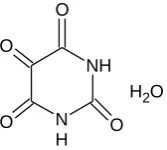
Alloxan is an oxygenated pyrimidine derivative, and its IUPAC name is 2,4,5,6-pyrimidinetetrone. Figure 1 shows the structure of alloxan.
Figure 1. The structure of alloxan
It causes selective necrosis of the β-cells of pancreatic islets. In pharmaceutical industries, the crystallization process is a critical method for both drug intermediates and final drugs. The solubility data is essential for the selection of the proper solvent for the crystallization process and in pre-formulation studies.7 Further, phenomenological
treatment of drug delivery, transport and distribution are dependent on knowledge of solubility.8 The transportation
through membranes and the topical activity of drugs can also be predicted by solubility data.9
Various workers have reported solubility of drugs and other compounds in different solvents.10-12 Thus, in the
present work, the solubilities of alloxan have been
determined in various solvents; methanol, ethanol, ethane-1,2-diol, water, tetrahydrofuran and acetone over a temperature range 293.15 K to 323.15 K by a gravimetric method. The experimental solubility data were correlated with modified Apelblat and Buchowski-Ksiazczak models. Further, some thermodynamic parameters such as enthalpy of dissolution, Gibb׳s energy, and entropy of solutions have been evaluated.
Experimental
Materials
Alloxan was purchased from Loba Chemie Pvt. Ltd. The polymorph used in this study was monohydrate. The melting point of alloxan was determined measured by Differential Scanning Calorimeter (Shimadzu-DSC-60) and was found to be 254 0C. All of the solvents used for the present study
were of analytical grade and supplied by Loba Chemie Pvt. Ltd. These solvents were purified by drying over anhydrous sodium sulfate and were fractionally distilled. The solvents were stored over molecular sieves. The purities of the solvents were confirmed by GC-MS (SHIMADZU-Model No.-QP-2010) equipped with column (DB-5MS, 25 m in length, 0.20 mm internal diameter and 0.33μm film) and were found be greater than 99.8 %.
Solubility measurement
The solubility of alloxan was determined by the gravimetric method. For each measurement, an excess mass of drug was added to a known mass of solvent. The equilibrium cell was heated to a constant temperature with continuous stirring for about 5 hours (the temperature of the water bath approached the constant value, and then the actual value of the temperature was recorded). After 5 hours, stirring was stopped, and the solution was kept for 2 hours to approach equilibrium. The equilibrium time of 2 hours is optimized by checking the concentration of solution at
NH
N H O
O O
O
different intervals of time. After 2 hours, the change in concentration was less than 1 %, so the saturated solution was assumed to be equilibrium. The upper portion of this clear solution was filtered through a membrane (0.22 μm) and was kept in a weighed vial. The vial with the solution was quickly weighed to determine the mass of the sample. When the mass of the residue reached constant value, the final mass was recorded. All of the masses were taken using an electronic balance (Mettler Toledo AB204-S, Switzerland) with an uncertainty of ±0.0001 g. At each temperature, the measurement was conducted three times, and an average value was used to determine the mole fraction solubility. The saturated mole fraction solubility (xi)
of the drug in each solvent can be calculated by using equation (1).
(1)
where
M1 is the molar mass of solvent and
M2 is the molar mass of alloxan.
m1and m2 are the mass of the solvent and solute
(alloxan), respectively.
At each temperature, the measurement was conducted three times. By using the average value, mole fraction solubility of alloxan in selected solvents was calculated.
Results and discussion
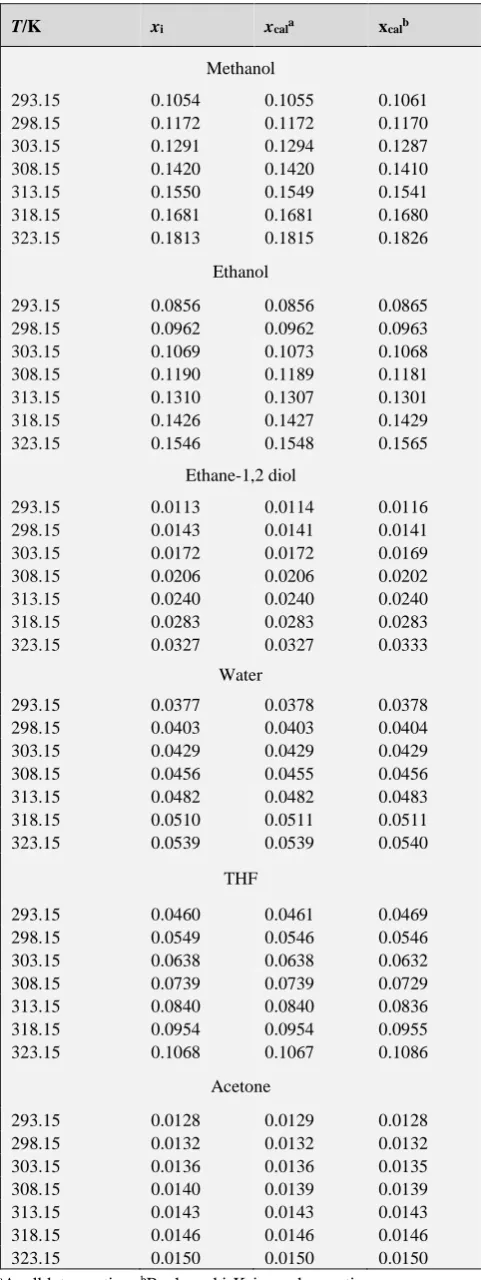
The mole fraction solubilities xi of alloxan in the selected
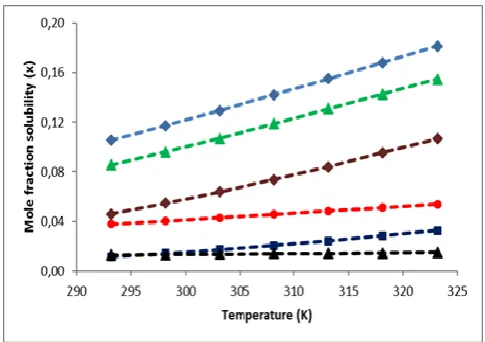
solvents are presented in Table 1 at different temperatures (293.15 to 323.15 K) with an uncertainty of ±0.1 K and more visually given in Fig. 2. It is observed that the solubility of alloxan increases nonlinearly with temperature. Further, in protic solvents, solubility is maximum in methanol and minimum in ethane-1,2-diol. The order of solubility is: methanol > water > ethanol > ethane-1,2 diol. In the selected nonprotic solvents, solubility is greater in tetrahydrofuran than in acetone. The results are compared with dielectric constants and dipole moments of the solvents, which was given in Table 2. For protic solvents, solubility was maximum in methanol and minimum in ethane-1,2-diol which is of reverse order of dipole moment. The dipole moment of ethane-1,2-diol is highest among studied protic solvents whereas that of methanol is lowest. In nonprotic solvents, solubility was found to be in higher in tetrahydrofuran (THF) than in acetone. The dipole moment of acetone is higher than that of THF. So, the solubility of alloxan was increasing with decreasing of dipole moment.
The temperature dependence of alloxan solubility in pure solvents was described by the modified Apelblat model.13
(2)
Table 1. Experimental and calculated mole fraction solubilities (xi) of alloxan in different studied solvents at different temperatures.
T/K xi xcala xcalb
Methanol
293.15 0.1054 0.1055 0.1061
298.15 0.1172 0.1172 0.1170
303.15 0.1291 0.1294 0.1287
308.15 0.1420 0.1420 0.1410
313.15 0.1550 0.1549 0.1541
318.15 0.1681 0.1681 0.1680
323.15 0.1813 0.1815 0.1826
Ethanol
293.15 0.0856 0.0856 0.0865
298.15 0.0962 0.0962 0.0963
303.15 0.1069 0.1073 0.1068
308.15 0.1190 0.1189 0.1181
313.15 0.1310 0.1307 0.1301
318.15 0.1426 0.1427 0.1429
323.15 0.1546 0.1548 0.1565
Ethane-1,2 diol
293.15 0.0113 0.0114 0.0116
298.15 0.0143 0.0141 0.0141
303.15 0.0172 0.0172 0.0169
308.15 0.0206 0.0206 0.0202
313.15 0.0240 0.0240 0.0240
318.15 0.0283 0.0283 0.0283
323.15 0.0327 0.0327 0.0333
Water
293.15 0.0377 0.0378 0.0378
298.15 0.0403 0.0403 0.0404
303.15 0.0429 0.0429 0.0429
308.15 0.0456 0.0455 0.0456
313.15 0.0482 0.0482 0.0483
318.15 0.0510 0.0511 0.0511
323.15 0.0539 0.0539 0.0540
THF
293.15 0.0460 0.0461 0.0469
298.15 0.0549 0.0546 0.0546
303.15 0.0638 0.0638 0.0632
308.15 0.0739 0.0739 0.0729
313.15 0.0840 0.0840 0.0836
318.15 0.0954 0.0954 0.0955
323.15 0.1068 0.1067 0.1086
Acetone
293.15 0.0128 0.0129 0.0128
298.15 0.0132 0.0132 0.0132
303.15 0.0136 0.0136 0.0135
308.15 0.0140 0.0139 0.0139
313.15 0.0143 0.0143 0.0143
318.15 0.0146 0.0146 0.0146
323.15 0.0150 0.0150 0.0150
aApelblat equation, bBuchowski-Ksiazczak equation.
The values of parameters A, B and C were evaluated by nonregression method and are given in Table 3.
2
2 i
1 2
2 2
m
M
x
m
m
M
M
ln
aln
ci
B
x
A
C
T
T
Figure 2. Variation of mole fraction solubilities (xi) with temperature (T) for alloxan in different studied solvents. Methanol (♦), ethanol (▲), water (●), ethane-1,2-diol (■), THF (♦), acetone (▲). Dashed lines represent calculated mole fraction solubility by Apelblat equation
Using these parameters, mole fraction solubility (xa ci) was
evaluated. These calculated solubilities (xa
ci) are also plotted
against temperature along with experimental mole fraction solubility (xi) as shown in Figure 2. It is observed that these
are good agreement between the experimental and calculated solubility values.
The Buchowski-Ksiazczak (λh) equation was first introduced by Buchowski et al. to describe solid-liquid equilibrium. In the present study, solubility data was also correlated with temperature by the following Buchowski-Ksiazczak(λh) model.14
(3)
where
T and Tm are the experimental and melting temperature
of alloxan
λ and h are two adjustable parameters.
Table 2. Dipole moments and Dielectric constants of the studied solvents
Solvent Dipole moment Dielectric constant
Methanol 1.70 32.70
Ethanol 1.69 24.55
Ethane-1,2 diol 2.28 38.66
Water 1.80 80.00
THF 1.55 5.61
Acetone 2.88 20.70
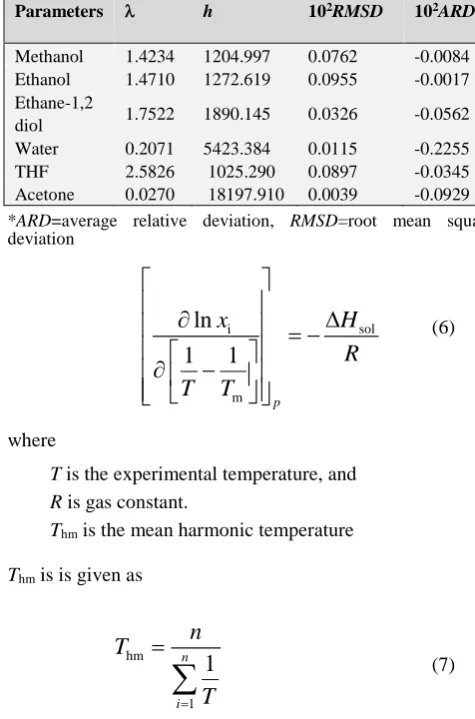
The values of λ and h are evaluated using experimental solubility data and are reported in Table 4. Using these values of adjustable parameters, solubility (xb
ci) is calculated
using equation (3).These values are also plotted against temperature
along with experimental mole
fraction solubility (xi) as shown in Figure3. I
t is observed that thecalculated solubilities by Buchowski-Ksiazczak (λh) model are in good agreement with experimental solubility in all the solvents.
The root-mean-square deviations (RMSD) and average relative deviations (ARD) are also calculated for both Apelblat and Buchowski–Ksiazczak models using following equations:
(4)
(5)
where N is the number of experimental points.
Figure 3. Variation of mole fraction solubilities (xi) with temperature (T) for alloxan in different studied solvents. Methanol (♦), ethanol (▲), water (●), ethane-1, 2-diol (■), THF (♦), acetone (▲). Dashed lines represent calculated mole fraction solubilities by Buchowski-Ksiazczak equation
These values are listed in Tables 3 and 4 for Apelblat and Buchowski–Ksiazczak models respectively.
From these solubility data, some thermodynamic parameters such as enthalpies of solution (Hsol), Gibb’s
energy of dissolution (ΔGsol) and entropy of solutions (Ssol)
have also been evaluated. The enthalpies of solution (Hsol)
was calculated by modified van't Hoff equation, i.e., from the slope of the plot of lnx versus (1/T - 1/Thm).
b
ci
b
ci m
1
1
1
ln 1
x
h
x
T
T
1/ 2 2 i
i 1
N i
i i
(
)
1
1
Nx
x
RMSD
N
x
x
ARD
N
x
a/b ci
Table 3. Parameters A, B and C of Apelblat model in studied solvents
*ARD=average relative deviation, RMSD=root mean square deviation
Table 4. Parameters of Buchowski-Ksiazczak h equation in the studied solvents
Parameters h 102RMSD 102ARD
Methanol 1.4234 1204.997 0.0762 -0.0084 Ethanol 1.4710 1272.619 0.0955 -0.0017 Ethane-1,2
diol 1.7522 1890.145 0.0326 -0.0562 Water 0.2071 5423.384 0.0115 -0.2255 THF 2.5826 1025.290 0.0897 -0.0345 Acetone 0.0270 18197.910 0.0039 -0.0929 *ARD=average relative deviation, RMSD=root mean square deviation
(6)
where
T is the experimental temperature, and
R is gas constant.
Thm is the mean harmonic temperature
Thm is is given as
(7)
where n is the number of experimental temperatures. In the present case, the Thm value obtained is only 307.83 K.
From the intercepts of these plots, Gibbs energy change (ΔGsol) for the solubility process was evaluated by the
following relation:
(8)
Using these evaluated Hsol and Gsol values, the
entropies of solutions (Ssol) were obtained from the
following equation:
(9)
Table 5 summarizes these thermodynamic parameters. It is found that enthalpy of dissolution (Hsol) is positive for
all the solvents indicating the thereby endothermic behavior of dissolution.
Table 5. Thermodynamic parameters: Enthalpy of dissolution (ΔHsol), Gibbs’s Energy (ΔGsol) and Entropy (ΔSsol) of dissolution of alloxan in different studied solvents
Solvent Hsol kJ mol-1
ΔGsol kJ mol-1
ΔSsol J mol-1 K-1
Methanol 14.2502 5.0260 29.9640
Ethanol 15.5638 9.8789 47.3505
Ethane-1,2 diol 27.5526 10.0150 56.9030
Water 9.3283 7.9160 4.5880
THF 22.0155 6.7260 49.6690
Acetone 4.0431 10.9410 22.4080
This suggests that there may be strong interactions between drug and solvent molecules that those between the solvent molecules and the newly formed bond energy between drug and solvent molecule is not powerful enough to compensate the energy needed for breaking the original association bond in various solvents.15 The Gibbs energy of
dissolution (Gsol) is positive for the studied solvents
suggesting that the dissolution process is spontaneous. Further, the order of Gsol values is the reverse of solubility
data. The Gibb's energy of dissolution is minimum for methanol and maximum for acetone whereas solubility is maximum for methanol and minimum for acetone. Further, the entropy of dissolution (Ssol) is found to be positive in
all the solvents. The positive entropy change indicates that the entropy of solubilization is unfavorable for the solute in solution.14 The entropy depends on the functional groups
present in the drug as well as in the solvent. Owing to the Alloxan molecule containing groups of different nature like –NH-, -C=O, there may exist various forces such as electrostatic force, hydrogen bond, hydrophobic interaction and stereoscopic effect in the dissolving process.
Parameters A B C 102 RMSD 102ARD
Methanol 76.1403 -5030.5957 -10.7785 0.0146 -0.0533
Ethanol 106.5523 -6563.97 -15.2482 0.0233 -0.0003
Ethane-1,2-diol 241.2325 -14029.2250 -34.8287 0.0085 0.0734
Water -2.2895 -992.8372 0.4225 0.0065 -0.0346
THF 180.4289 -10624.1830 -25.9236 0.0125 0.0604
Acetone -3.4772 -450.6254 0.1161 0.0053 -0.0096
sol i
m
ln
1
1
p
H
x
R
T
T
hm
1
1
ni
n
T
T
sol hm
intercept
G
RT
sol sol
sol
hm
H
G
S
T
Conclusion
In protic solvents, solubility is maximum in methanol and minimum in ethane-1,2-diol. The order of solubility is: methanol > ethanol >water > ethane-1,2-diol. In the selected nonprotic solvents, solubility is greater in THF than in acetone. The positive Gibb's energy and enthalpy of dissolution suggest dissolution process be endothermic and spontaneous.
References
1Abdel-Barry, J. L., Abdel-Hassan, I. A., Al-Hakiem, M. H.: Hypoglycemic and anti-hyperglycemic effects of Trigonella foenumgraecum leaf in normal and alloxan induced diabetic rats. J. Ethnopharmacol., 1997, 58, 149-155. https://doi.org/10.1016/S0378-8741(97)00101-3
2Beach, E. F., Turner, J. J., An enzymatic method for glucose determination in body fluids. Clin. Chem. 1958, 4, 462-465. 3El-Mekkawy, S., Meselhy, M.,Nakamura, N., Tezuka, Y., Hattori,
M., Kakiuchi, N., Shimotohno, K., Kawahata, T., Otake, T., Anti-HIV-1 and anti-HIV-1-protease substances from Garnoderma lucidum. Phytochemistry. 1998, 49, 1651-1657 (1998). https://doi.org/10.1016/S0031-9422(98)00254-4
4Obiudu, I. K., Okolie, A. C., Agbafor, N. K., Obiudu, C. V., Anti-Diabetic Property and Phytochemical Composition of Aqueous and Methanol Extracts of Buchholzia coriacea Seeds in Alloxan-Induced Diabetic Rats, J. Med. Sci., 2015,
15, 241-245. https://doi.org/10.3923/jms.2015.241.245 5Eo, S. K., Kim, Y. S., Lee, C. K., Han, S. S., Possible mode of
antiviral activity of acidic protein bound polysaccharide isolated from Ganoderma lucidumon herpes simplex viruses,
J. Ethnopharmacol., 2000, 72, 475-481. https://doi.org/10.1016/S0378-8741(00)00266-X
6Lenzen, S., The mechanisms of alloxan- and streptozotocin-induced diabetes, Diabetologia, 2008, 51, 216–226. https://doi.org/10.1007/s00125-007-0886-7
7Lipinski, A. C., Lombardo, F., Dominy, B.W., Feeney, J. P., Experimental and computational approaches to estimate solubility and permeability in drug discovery and development settings. Adv. Drug Delivery Rev.,2012, 64, 4-17. https://doi.org/10.1016/j.addr.2012.09.019
8Bodor, N., Harget, A., Huang, M.: Neural network studies: I Estimation of the Aqueous solubility of organic compounds.
J. Am. Chem. Soc., 1991, 113, 9480-9483. https://doi.org/10.1021/ja00025a009
9Pico, Y., Andreu, V., Anal. Bioanal. Chem., 2007, 387, 1287-1299. https://doi.org/10.1007/s00216-006-0843-1
10Baluja, S., Bhalodia, R., Gajera, R., Vekariya, N., Bhatt, M., Solubility of difloxacin in acetone, methanol, and ethanol from (293.15 to 313.15) K. J. Chem. Eng. Data., 2009, 54,
1091-1093. https://doi.org/10.1021/je800742d
11Zhao, Y., Wang, Y., Measurement and correlation of solubility of tetracycline hydrochloride in six organic solvents. J. Chem. Thermodyn., 2013, 57, 9-13. https://doi.org/10.1016/j.jct.2012.08.007
12Bhesaniya, K. D., Chavda, K. V., Sadhu, C. H., Baluja, S., Thermodynamic characteristics of solutions of ornidazole in different organic solvents at different temperatures. J. Mol. Liq., 2014, 191, 124–127. https://doi.org/10.1016/j.molliq.2013.12.001
13Apelblat, A., Manzurola, E., Solubility of oxalic, malonic, succinic, adipic, maleic, malic, citric, and tartaric acids in water from 278.15 to 338.15 K. J. Chem. Thermodyn., 1987,
19, 317-320. https://doi.org/10.1016/0021-9614(87)90139-X 14Buchowski, H., Ksiazczak, A., Pietrzyk, S.: Solvent activity
along a saturation line and solubility of hydrogen-bonding solids. J. Phys. Chem., 1980, 84, 975-979. https://doi.org/10.1021/j100446a008
15Panteli, E. K., Voutsas, E. K., Solubilities of cinnamic acid esters in ionic liquids. J. Chem. Eng. Data, 2009, 54, 812-818. https://doi.org/10.1021/je800596c