ISSN: 2347-7474
International Journal Advances in Social Science and Humanities
Available Online at: www.ijassh.com
RESEARCH ARTICLE
Cross-Cultural Management Strategies of McDonald’s in
France-Based on a Multimodal Discourse Analysis of Three Print
Advertisements
Hongmiao Gao
1School of English for International Business, Guangdong University of Foreign Studies, Guangzhou
510420, China.
Abstract
Intercultural advertising can not only market products and expand markets via culture, but also can spread enterprise culture and promote cultural exchange and economic trade via products. This study is based on a series of print advertisements of McDonald’s which were designed to celebrate Hallowmas in France, with Visual Grammar (VG) functioning as the research theory and Multimodal Discourse Analysis (MDA) as the research method. In this way, the underlying intercultural adaption mode of McDonald’s in France is dredged through an examining of those three ads with AIDA mode analysis. It can be concluded that marketing and advertising localisation strategy is used in its brand spreading and culture adaption in France. Hopefully, this study can spur more researches on intercultural advertising strategies for transnational enterprises.
Keywords: Multimodal Discourse Analysis, Visual Grammar, McDonald’s, intercultural management, print advertisement.
Introduction
Recently, the heatedly discussed news of McDonald’s planning to sell its business in China has provoked thoughts widely. McDonald’s has opened more than 400 sub branches in China since its first entering in Shenzhen in 1990, more than 3,000 branches in the world until now. As a large-scale transnational chain restaurant, McDonald’s has attracted a considerable number of researchers to probe into its transnational management and marketing modes.
McDonald’s has various management systems and marketing modes in different countries. The classic and representational golden yellow of the trademark “M” is widely used. However, to adapt to the local culture and surrounding environment, it is chameleon-like to change its colour to like sky
blue (the only blue one in the world, situated in Sedona to be environmentally harmonious) and red in China, and green in Germany and France. In addition, the slogan “come as you are” is used in France instead of “I’m lovin’ it” in most places. Analysis on the differences and localization is of guiding significance not only for McDonald’s its intercultural adaption and management in different countries, but for other cross-national enterprises’ acculturation and localisation.
there.
France is the most profitable market for McDonald’s outside the United States. It is known for its pursuit of romance and proud nobles, which is totally different from the casual culture of America. This study chooses a series of advertisements (including three of them) of McDonald’s in France to analyse its advertising strategies with multimodal discourse analysis approach.
This study strives to answer the following questions:
How do visual and verbal elements interact together in those advertisements to make meaning?
Which intercultural advertising strategies are employed for McDonald’s in France?
Literature Review
An overview of Cross-cultural
Management
The influencing factors in cross-cultural management are cultural differences and cultural conflict. Therefore, how to eliminate cultural differences is of paramount importance for the development and business extending of cross-national enterprises in their cross-cultural management and marketing. Studies on cross-cultural management can be classified into two categories--transnational management of foreign companies in China and the internalisation of Chinese enterprises overseas.
In terms of the former category, has researched on the cross-cultural management issues of European and American companies in China, mentioning that the management model of “harmonious culture” should be adopted to overcome cross-cultural management; took foreign enterprises in China as the research object, probing their cross-cultural management characteristics, development modes as well as how to form suitable intercultural management approaches. As for the second category,
discussed cultural adaption modes of Chinese enterprises in foreign countries: cultural contradiction--cultural adaption--cultural communication and cooperation; summarize domestic and external researches on cross-cultural management, pointing out that there is huge room to improve.
From the perspective of intercultural marketing, most contemporary researches are embarking on intercultural advertisements translating, like emphasized on advertisement translating guided by cross-cultural communication and Western translation theories.
He suggested that appropriate expressions should be chosen according to the advertisement characteristics so that it can be accepted by the target culture. But those studies lack of the in-depth analyses with theories and applicable strategies have not been figured out to instruct the specific advertisement designing, which has provided room and possibilities for future researches,
The ocharous [1] identify iced cultural preferences in advertising style in the UK and Greece through the comparison of advertisements for food products of local brands, which has inspired this study on the advertising marketing strategies of McDonald’s in France.
An Overview of Multimodal Discourse Analysis (MDA)
Discourse analysis [2] focusing on language has inspired many diversified theories and
approaches since 1950s. Other
meaning-carrying semiotic modes like image, sound, colour also encouraged people to discuss more about the interaction between different modes, specifically, multimodal discourse analysis. O’Toole [3] studied visual arts like painting, sculpture, architecture, and so on in The Language of Displayed Arts
children books, math, film analysis and webpage illustration [4-5-6-7] etc. Multimodal discourse analysis has become an emerging research method to analyse multimodal text, and it’s also a useful way to reveal the underlying meaning behind the images of different culture backgrounds.
Interdisciplinary studies are also practiced. Lan [8] carried out a multimodal metaphor research on 21 pieces of shampoo advertisements. The multimodal analysing tool, especially Visual Grammar is increasing applied in advertisements research. This study uses Visual Grammar as the theoretical basis, Multimodal Discourse Analysis as a research method to interpret the meaning implied and the localisation strategy of McDonald’s in France.
Theoretical Framework
Visual Grammar
According to Functional Grammar by
Halliday[9] language has three
meta-functions: the first one is the ideational function--expressing conceptual meaning; the second one is the interpersonal function--displaying the relationship between speakers and listeners as well as the attitude of speakers towards what is talked about; the last one is the textual function--explaining the meaning of the text or discourse.
Based on this theory, many social theorists have raised many different theories in terms of the diversity of different fields, which has further extended functions of language to a larger scale, namely, multiple subjects.
Visual Grammar proposed by Kress & van Leeuwen [4] was theorized on Halliday’s Functional Grammar, claiming that the communicative system of human beings should not be limited to the single mode language, instead, other modes like image, sound, music, colour, etc., should also be employed with their own functions. Those meta-functions of language were applied to studies about visual grammar of images in the book, and specific terms were also found
to match the functions of image. In the research of Kress & van Leeuwen, grammar was extended to modes including visual mode. Therefore, corresponding to meta-functions of language in Systemic Functional Linguistics-- ideational function, interpersonal function and textual function, images possess their own representational meaning, interactive meaning and compositional meaning in Visual Grammar.
Representational meaning is that images can show us the actions of participants within, the internal relationship between them and their surrounding environment and what the participants are doing in a narrative or conceptual form. In the light of the characteristics of the image, the process of representation can be divided into narrative process and conceptual process.
Narrative process displays the actions of participants and the events described with a focus on the development and change of the actions and the event as well as the placement of the elements in dimensional position within a short time; conceptual process is more stable and concise compared with the narrative process, with less consideration of the time and more consideration of the class, status, role, inner qualities of the participants.
Interactive meaning explains that the nature of the image aims at arousing the interaction between the viewer and the designer or the interaction between the viewer and the participants depicted in the image. Three factors including distance, contact and attitude are crucial to realize the interaction, from which it can be reflected what kind of attitude the viewer should hold towards the represented things expected by the designers or what fact they want to display to the audience.
elements in the whole, and to be placed in the left or the right, in the centre or the edge signifies different informational structures of different elements. Framing is determined by whether there is a split line in the picture. Salience shows the attention-attracting degree of the elements, which can be realized
by the difference of position--the elements are placed in the foreground or the background, the relative size, colour contrast, saturation, etc.
A multimodal Discourse Analysis:
McDonald’s in France
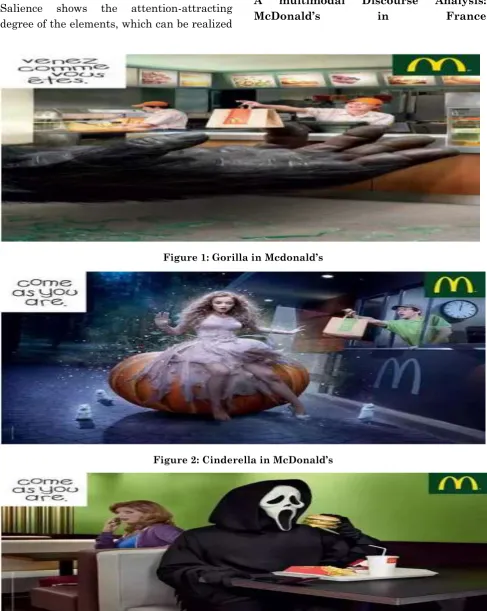
Figure 1: Gorilla in Mcdonald’s
Figure 2: Cinderella in McDonald’s
Figure 3: The Death in McDonald’s Those three pieces of print ad of McDonald’s
in France 1 are designed to celebrate
Representational Meaning Narrative Representation Process
Three factors including participants, action processes and circumstances functions when analysing the narrative representation process. In Figure 1, the male staff, the female staff as well as the gorilla serve as represented participants, and the male one in green, the Cinderella on the big pumpkin in Figure 2, and the female customer as well as the Death in Figure 3.
For the action process, actors, goals and the vector are elements that matter. In Figure 1, two transactional action processes (the male staffs are keeping doing his job and the female one is passing on the packed food to the gorilla) can be figured out. Those two actions are released by the two actors (the female staff and the male staff) and received by the two goals (the food made by the male, and the packed food in the hand of the female), with the hands of the male and the right hand of the female being the vectors respectively. The gorilla serves as the recipient here. Besides, another action process of breaking down the window delivered by the gorilla is hidden but obvious. In Figure 2, the Cinderella is sitting on the pumpkin and the man in green is trying to give the food to her (the man and the Cinderella are the two actors, the pumpkin and the packed food are the corresponding goals, with the right hand of him and the body of her as the vectors separately). In Figure 3, those two represented participants have no interactions—the woman is making a call and the Death is eating his hamburger in an enjoyable way. However, those two divided actions present a harmonious atmosphere together.
When the vector is formed by an eye line, reactional processes should be taken into consideration. The female who is a reactor in Figure 1 is smiling at the phenomenon gorilla, the direction of the glance of the staff being the vector. In Figure 2, the transactional reactional process is the behaviour of looking
at the girl by the man. The non-transactional reactional process in Figure 3 is the female customer who is phoning looking at somewhere.
The common point of those three pieces of ad is that all of those situations are set in the inner part of McDonald’s, which gives customers or viewers a sense of being personally involved.
Conceptual Representation Process
Analytical processes relate participants in terms of part-whole structure [4] Two kinds of participants (Carrier as the whole and Possessive Participants as the part) are involved within. In Figure 1, the big brown hairy hand represents the image of a gorilla, the glass fragments on the ground refers to the unbroken one before, what the staffs have done here represents the whole image of McDonald’s.
Symbolic processes are about what a participant means or is. Carrier is the participant whose meaning or identity is established in the relation, and Symbolic Attribute is the one representing the meaning or identity itself. The gorilla symbolises outrageous customers, smile on the face of the female staff is a symbol of the overall attitude of McDonald’s towards customers. The clock is pointing at 12 p.m. when Cinderella comes in a rush, showing that McDonald’s opens all hours. The wide popularity of the food is displayed by the Death enjoying the tasty.
The concepts of “customer first”, “good service and quality” are well uncovered by the action processes between staffs and customers, as well as by the compatibility between customers.
Interactive Meaning
There are two kinds of participants: represented participants (people, places and things described in images) and interactive participants (the image-producer and the viewers of the image). Through analysing contact, social distance, perspective and modality, the relations between the represented participants, that between represented participants and viewers and between interactive participants can be figured out.
Contact
When there is direct eye contact between the represented participants and viewers, it is called “demand” image, otherwise, it is an “offer” image. All the participants in those three images have no direct eye contact with each other. Only an imaginary level of contact with the interactive participants is established, aiming at offering some information or service to the audience.
Social Distance
The second dimension to the interactive meanings of the image is relative to the size of the frame as well as the choice of close-up, medium shot or long shot, etc. The social relation between people depends on the distance they keep. A very close shot of the big hand of the gorilla and a medium close shot of those two staffs bind a close and personal tie between the viewer and represented participants. A similar relationship is also displayed in Figure 3. However, in Figure 2, a close social relationship is established by the full presentation of the Cinderella.
Perspective
Perspective is another way to imply the relations between the viewer and the participants. From the horizontal angle, the difference between the oblique and the frontal angle is the difference between detachment and involvement. [4] In figure 1, an oblique point of view is adopted by the photographer.
It seems that this photo is taken from the perspective of the gorilla. Being a potential customer, the viewer is subtly involved with the represented participants. Nevertheless, both Figure 2 and Figure 3 are taken from a parallel angel so that the viewers are involved with the participants.
From the vertical angle, through the direction of the eye line by the women looking up to the gorilla in Figure 1, the power is transferred to the potential customers. It is similar in Figure 2 that the power is passed to the Cinderella. An eye level in Figure 3 shows no symbolic power to anyone at all, delivering a feeling of equity.
Modality
Modality markers like colour saturation, colour differentiation and colour modulation, representation, and so on are employed to reflect the truth value or credibility of what are talked about in the image. The pieces of ad selected are all highly saturated with colour of orange (typical colour of McDonald’s), brown, green, red, black etc. Those rich and diversified colours give viewers a good appetite and desire for food. Figures 1, 2, 3 all have detailed representation of pictorial details. Through the depiction of the fragmentized glass, clearly visible fur of the animal, smiling face of the woman, and the hasty look of Cinderella, high modality is fully revealed. Highly saturated and unmodulated colours are there to be experienced sensually and emotively, attractive to both children and customers. Sensory coding orientations are used here to deliver pleasure, as well.
Textual Meaning
Information Value
attention of customers.
Salience
Through the observation of the three pieces of ad, it can be figured out that be it the gorilla, Cinderella, or the Death, has taken up most part of the whole frame, which can easily catch the eyes of viewers. Hence, the priority is given to the customers, no matter whom or what he or she is.
Framing
Framing is realized by whether there is an obvious dividing line in visuals. In the former two pictures, the dividing line is formed by the counter desk of the restaurant, separating the staffs and customers as well as connecting them with the packed food simultaneously. In Figure 3, the back of the green bench serves as the dividing line to separate the woman and the Death. However, those two symbolise two different groups of customers and also constitute a harmonious atmosphere in the restaurant. The theme of “come as you are” is brought out again to show its inclusivity and non-discrimination.
Findings and Discussion
When it comes to advertising, AIDA model is extensively employed to define whether it is a successful one or not. AIDA is an acronym developed in 1898 by advertising pioneer E. St. Elmo Lewis. It describes the steps that a prospective customer goes through before deciding to buy. The acronym AIDA stands for Attention, Interest, Desire, Action, and it is one of the founding principles of most modern-day marketing and advertising. 2 An
attractive ad should fulfil the four steps in order to appeal to customers—getting Attention, holding Interest, arousing Desire and obtaining Action.
The most crucial step is to get attention or awareness from customers at first. By informing the readers of the information of products promoted, viewers are unconsciously turned into potential customers. Only when the first step is achieved can the process of
advertising fulfilled. In those advertisements to be analysed in this study, it adopts unique slogan “come as you are” instead of “I’m lovin’ it” in other countries like China and America. The green “M” also makes it unconventional and unorthodox. The French slogan “venez comme vous êtes” in Figure 1 adapts well to the local culture on the one hand, and also catches customers’ attention at first sight on the other hand.
Once the ad has got customers’ attention, the following step is to keep it as their interest. Customers are eager to know what is involved and conveyed by the ad and what benefits they can get from the product or service. This series of advertisements attracts customers to know what are exactly expressed behind those pictures by depicting the gorilla, Cinderella and the Death as customers. In this way, the theme to celebrate Hallowmas is clearly displayed. Meanwhile, the aim to captivate the interests of customers is attained.
Had the first two steps been achieved, the desire of customers should have to be satisfied. From Figure 1 to Figure 3, it can be concluded that customers are given the priority and put in the first place. The rich fusion of colours, alluring food and cosy dining environment bring prospective customers a sense of desire for having a taste and purchasing the food. When the prospective decides to take actions to buy, they turn themselves into customers. Whether they will buy or not depends on what the desire means to them— it’s a “want” or a “need”. What the advertisers need to do at this step is to close the sale by thinking and doing innovatively and practically to turn their wants into needs.
Therefore, only when the problems derived from cultural conflict be solved can cross-cultural corporations be highly effective in intercultural management and realize the goal of the company. There are many strategies that can be taken to eliminate cultural differences and market the products successfully—through localisation, common values, cross-cultural training and so on and so force. To balance which strategy to apply into the local market is part of the responsibilities born by transnational managers.
The first strategy is acculturation. It is the most fundamental one in cross-cultural management. Under the guidance of intercultural adaption, managers should fully take the cultural traits of the target market into consideration in marketing strategies defining and decision-making processes.
They should take the local traditions, customs and taboos as the pattern to comply with the needs there and maximize the localisation of products, salesmen, marketing channels and so on. This strategy is suitable for the home country with low variability and weak awareness to be open and when managers find it hard to be synergetic with the local culture.
The second strategy is cultural fusion, which is also called cultural complementarity. Subsidiaries of transnational enterprises do not regard the culture of the mother country or company as the dominant culture. Although there are many cultural differences existent, they complementary to each other rather than exclude themselves so that the advantages of cross-cultural communication are exerted. KFC in China has set a good example of successfully realizing cross-cultural management by making use of cross-cultural superiorities.
The third one is cultural differences avoiding. When there is a huge disparity between the mother country and the target country, the mother culture takes a dominant position in the overall operation of the subsidiary and
the target culture cannot be overlooked, the huge contradiction of “sensitive zone” should be attached great attention to and be avoided. Especially for those countries with a powerful religion, the local believes should be given priority to.
The fourth one is cultural innovation, which is similar to the second one. It refers to the mutual understanding, adaption and effective integration of the mother culture and the target culture via various channels. In this way, an emerging cross-cultural corporate culture is established as the fundamental managing principles on the basis of the fusion of the mother culture and target culture.
Put in the melting pot of the global culture, the merits and demerits of one country or area are hard to define. Only when the two cultures are fused together organically can the corporate culture connotations of the mother country be maintained, the foreign culture be adapted and the competitive advantages be embodied.
The last one is cultural change. It focuses on utilizing the powerful cultural superiority of the mother culture and seizing the opportunity of cultural changes in target culture. Cultural change aims to adjust the target culture according to the development trend, shape a new marketing environment and create new consuming needs. From a glimpse of the impact of the fast food markets (McDonald’s, Pizza hut, KFC, Coca-Cola) on China, the power of cultural change is demonstrated. This strategy can be applied between countries with strong awareness to open, strong culture correspondence and a large number of sub-cultures.
Cross-national corporations should analyse its own culture and the target culture carefully, and employ the most appropriate strategy in intercultural marketing management.
Conclusion
fully apprehend the underlying information advertisers want to deliver to customers through advertisements. The AIDA model is also applied to figure out whether it is a successful international advertisement or not so that the successful intercultural adaption strategies can be used for reference in other transnational activities, and the failed aspects can be figured out to be drawn lessons from and avoided.
Based on this study about French print advertisements of McDonald’s, it can be concluded that several strategies can be used in intercultural adaption—marketing localisation, product localisation, and so on. The target country’s national conditions, traditions, consumption level, customs and
taboos, and other cultural differences should be fully taken into consideration so as to satisfy customers’ needs and to exceed customers’ expectation.
For lack of time and capacity, there are many limitations in this study. Hopefully, the strategies concluded and the intercultural adaption code can be applied to other transnational marketing activities. Other theories can also be used to analyse different types of advertisements like that in magazines and journals, TV and websites, etc. If combined with other culture or country’s advertisements in the same kind of the same brand, it will be more convincing and more information can be excavated.
References
1.
Theocharous A (2015) Food Advertising
as a Mirror of Intercultural Differences:
the Case of the UK and Greece. British
Food Journal, 117(4):1256-1272.
2.
Harris Z (1952) Discourse Analysis.
Language: 1-30.
3.
O’ Tool M (1994) the Language of
Displayed Art. London: Leicester
University Press.
4.
Kress G, Van Leeuwen T (1996/2006)
Reading Images: The Grammar of
Visual Design (2nd Ed.). London:
Routledge.
5.
O’ Halloran K.L, Tan S, Marissa KLE
(2013) ‘Above All’: The Myth of ‘Dreams’
as Advertising Tool. The Multimodal
Analysis of Television Commercials:
329-30.
6.
Bateman JA, Schmidt KH (2012)
Multimodal Film Analysis: How Films
Mean. New York, London: Routledge.
7.
O’ Halloran KL, Tan S, Wignell P (2017)
SFL and Multimodal Discourse Analysis.
Cambridge:
Cambridge
University
Press.
8.
Lee WN (1993) Acculturation and
Advertising Communication Strategies:
a Cross-cultural Study of Chinese and
Americans. Psychology
&
Marketing, 10(5):381–397.
9.
Halliday
MAK.
(1985/1994)
An
Introduction to Functional Grammar.
London: Arnold Publishers.
10.
Gauthier
C,
Fornerino
M
(2016) Acculturation and Advertising:
Evidence from South Korea. Looking
Forward, Looking Back: Drawing on the
Past to Shape the Future of Marketing.
Springer International Publishing.
11.