© 2020 by the Serbian Biological Society How to cite this article: Çelik M, Bağcı Y, Martin E, Eroğlu HE. Karyotype analysis 203 and karyological relationships of Turkish Bunium species (Apiaceae). Arch Biol Sci. 2020;72(2):203-9.
Karyotype analysis and karyological relationships of Turkish
Bunium
species (Apiaceae)
Mustafa Çelik1, Yavuz Bağcı2, Esra Martin3 and Halil E. Eroğlu4,*
1Selçuk University Advanced Technology Research & Application Center, Selçuklu, Konya, Turkey
2Selçuk University, Faculty of Pharmacy, Department of Pharmaceutical Botany, Konya, Turkey
3Necmettin Erbakan University, Faculty of Science, Department of Biotechnology, Konya, Turkey
4Yozgat Bozok University, Faculty of Science and Art, Department of Biology, Yozgat, Turkey
*Corresponding author: [email protected]
Received: January 22, 2020; Revised: March 7, 2020; Accepted: April 7, 2020; Published online: April 21, 2020
Abstract: Chromosomal data and karyological relationships provide valuable information about karyotype evolution and
speciation. For the genus Bunium, the chromosomal data are limited. In the present study, the chromosomal data of 10
taxa are provided, 6 of which are given for the first time, 2 present new chromosome numbers, and 2 agree with previous
reports. Four different chromosome numbers (2n=18, 20, 22 and 40) were detected, and 2n=40 is a new number in the
genus Bunium. B. brachyactis is the first polyploid species of the genus with a ploidy level of 4x. The most asymmetric
karyotypes are those of B. pinnatifolium and B. sayae. Regarding karyological relationships, B. pinnatifolium forms a
mono-phyletic group by quite different karyological features such as large chromosomes, more submedian chromosomes and
the most asymmetric karyotypes. In addition, the other 5 taxa form a strong monophyletic group. B. verruculosum and B.
ferulaceum are cytotaxonomically very close species, as are B. sayae and B. elegans var. elegans. The chromosome numbers
of 2 Turkish species, B. nudum and B. sivasicum, remain unknown. The presented results provide important contributions
to the cytotaxonomy of Bunium.
Keywords: Bunium;chromosome; karyotype asymmetry; Mediterranean Basin; polyploidy
INTRODUCTION
Metric and meristic characters in some cases are inad-equate in the classification of species, subspecies and isolated groups that are similar and morphologically indistinguishable in systematic studies. Systematic stud-ies are supported by cytogenetic and molecular studstud-ies in order to overcome these deficiencies. Therefore, chromosomal data remain important parameters that support morphological data. The major chromosomal data are the basic number (x), the diploid number (2n) and the total chromosome length. These data can be alterable numerically with aneuploidy or polyploidy, but also structurally with deletion, inversion and trans-location. All these mechanisms generate karyotypic variations by affecting the centromere position, which changes the intra- and interchromosomal asymmetry [1-4]. Speciation and diversification could be the result of karyotypic variations. The families and genera of
higher plants are important systems for determining speciation and diversification.
Apiaceae is a cosmopolitan family represented by approximately 434 genera and 3780 species. Although a cosmopolitan family, it has a more intensive distri-bution in the subtropical climate zone and northern temperate regions [5]. Bunium L. is placed in the subfamily Apioideae in the family Apiaceae. The genus consists of about 30 species worldwide and spreads in Europe, West, South and South-East Asia, North and North-West Africa, which are temperate zones of the northern hemisphere. In addition, B. bulbocastanum
(from 6 to 11), and pseudomonocotyly in seedlings and embryos [6-8]. From this perspective, Bunium is an important model to examine chromosomal and karyotypic variations.
A cytotaxonomic study reported the somatic chro-mosome numbers and chromosomal properties of 23
Bunium species [9], with some species belonging to the genus Elwendia Boiss. The chromosome numbers of Turkish Bunium are 2n=17, 18 in B. elegans (Fenzl) Freyn; 2n=18 in B. simplex (С. Koch) Kljuykov; 2n=20 in B. paucifolium DC, B. cylindricum Drude, B. ferula-ceum Sibt. & Sm. and B. microcarpum (Boiss.) Freyn & Bornm. ex Freyn; and 2n=22 in Elwendia caroides
Boiss. (=B. caroides Hausskn. ex Bornm.) and B. pin-natifolium Kljuykov [9-14].
The karyological data of most Turkish Bunium
have not yet been described in detail. In the present study, we provide a contribution to the cytotaxonomy and interspecific relationships of the genus Bunium.
MATERIALS AND METHODS
Plant material
The distribution map of Bunium taxa is given in Sup-plementary Fig. S1. Collection details are as follows:
Buniumallioides B. Bani, Pimenov & Adıgüzel. Adana: Tufanbeyli, Güzelim village, Kumlupınar location, 1432 m a.s.l., 14.08.2016, [M. Çelik 478]; Bunium brachyac-tis (Post) H.Wolff. Kahramanmaraş: Ahır Mountain, Çallıbalma location, 1908 m a.s.l., 10.07.2015, [M. Çelik 423 et al.]; Bunium elegans var. elegans. Kayseri: Sarız, 3 km west of Yeşilkent, 1529 m a.s.l., 10.07.2015, [M. Çelik 434 et al.]; Bunium elegans var. brevipes Freyn & Sint. Van: Başkale, Çaldıran village, Muz Tepesi location, 2045 m a.s.l., 29.06.2015, [M. Çelik 364 et al.]; Bunium ferulaceum. Denizli: Honaz, 2 km from Karateke to Honaz, 502 m a.s.l., 13.06.2015, [M. Çe-lik 278 et al.]; Bunium microcarpum subsp. bourgaei
(Boiss.) Hedge & Lamond. Rize: İkizdere, Cimil, be-tween Ortaköy and Başköy, 1960 m a.s.l., 12.08.2015, [M. Çelik 480]; Bunium pestalozzae Boiss. Kayseri: Yahyalı, from Çubukharmanı village to mountain road, 1746 m a.s.l., 09.07.2015, [M. Çelik 401 et al.]; Bunium pinnatifolium Mersin: Silifke, 2 km from Paslı castle, 474 m a.s.l., 12.07.2015, [M. Çelik 407 et al.]; Bunium
sayae Yıld. Hakkari: between Depin and Çimenli, Zap valley, 1165 m a.s.l., 28.06.2015, [M. Çelik 312 et al.];
Bunium verruculosum C.C. Towns. Malatya: between Erkenek and Doğanşehir, 1492 m a.s.l., 19.06.2017, [M. Çelik 501 & Ö.Çetin]. The specimens were deposited in Selçuk University Konya Herbarium (KNYA).
Cytogenetic procedure
Chromosome spreads were made from root tips pre-treated with α-mono-bromonaphthalene at 4°C for 16 h, fixed in fixative solution containing absolute alcohol:glacial acetic acid (3:1, v:v) for 24 h, and stored in ethanol (70%) at 4°C until use. The roots were hydrolyzed in 1 N HCl at 60°C for 10-12 min and stained in 2% aceto-orcein. Preparations were made by the squash method [15-16].
Karyotype analysis
At least 10 metaphase plates were analyzed by Software Image Analyses (Bs200ProP). The following abbre-viations and formulae were evaluated to characterize the chromosomes: LA – long arm, SA – short arm, LA+SA – total length, LA/SA – arm ratio, [(SA)/ (LA+SA)×100] –the centromeric index, THL – total haploid length, RL=[(LA+SA)×100/THL] – relative length, and MCL – mean chromosome length. The karyotype formulae were determined by chromosome morphology based on centromere position according to the Levan classification [17]. The ideograms were drawn based on chromosome lengths.
Karyological relationships and karyotype asymmetry
M (median chromosome number), SM (submedian chromosome number), ST (subtelocentric chromosome number), and T (telocentric chromosome number). A scatter diagram was drawn between MCA and CVCL. A dendrogram showing karyological relationships was drawn using bootstrap values (BV) with UPGMA software. The dendrogram contains 6 Bunium taxa with detailed chromosomal data and Carum carvi L. as a sister outgroup.
RESULTS
Chromosomal data
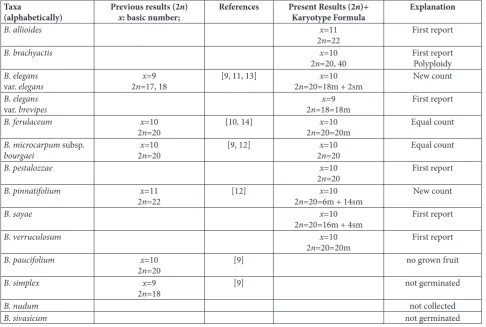
The chromosomal data of 10 taxa are provided (Fig. 1), 6 of which are given for the first time, 2 present new chromosome numbers, and 2 agree with previ-ous reports (B. ferulaceum and B. microcarpum subsp.
bourgaei). Table 1 presents the chromosome numbers of present and previous studies. Four different chromo-some numbers (2n=18, 20, 22 and 40) were detected
Fig. 1. Somatic metaphase chromosomes of the genus Bunium.
Table 1. Chromosome counts of the investigated species in this and previous studies. Taxa
(alphabetically) Previous results (2x: basic number;n) References Present Results (2Karyotype Formulan)+ Explanation
B. allioides x=11
2n=22 First report
B. brachyactis x=10
2n=20, 40 First reportPolyploidy
B. elegans
var. elegans 2n=17, 18x=9 [9, 11, 13] 2n=20=18m + 2smx=10 New count
B. elegans
var. brevipes 2n=18=18mx=9 First report
B. ferulaceum x=10
2n=20 [10, 14] 2n=20=20mx=10 Equal count
B. microcarpum subsp.
bourgaei 2xn=10 =20 [9, 12] 2xn=10=20 Equal count
B. pestalozzae x=10
2n=20 First report
B. pinnatifolium x=11
2n=22 [12] 2n=20=6m + 14smx=10 New count
B. sayae x=10
2n=20=16m + 4sm First report
B. verruculosum x=10
2n=20=20m First report
B. paucifolium x=10
2n=20 [9] no grown fruit
B. simplex x=9
2n=18 [9] not germinated
B. nudum not collected
and 2n=40 is a new number in the genus Bunium. Six taxa have only median and submedian chromosomes (Table 2). The smallest chromosome is 1.80 µm in B. sayae. The largest chromosome is 10.30 µm in B. pin-natifolium. The smallest total haploid length is 25.18 µm in B. elegans var. brevipes, and the highest value is 71.73 µm in B. pinnatifolium (Table 3).
Basic numbers, ploidy levels and polyploidy
In the genus Bunium, common basic numbers are x=9, 10 and 11. In the present study, the basic numbers are
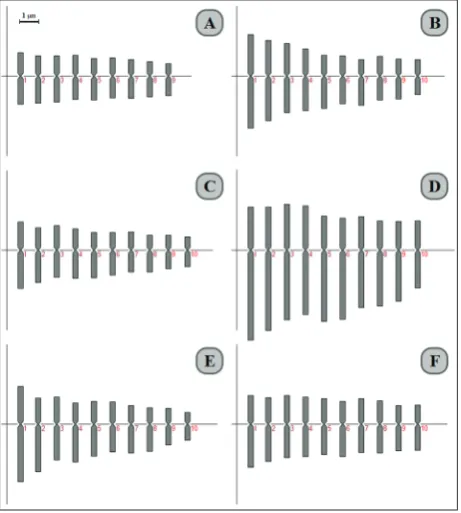
x=9 in B. elegans var. brevipes, ploidy level 2x; x=10 in 8 taxa, ploidy levels 2x and 4x; x=11 in B. allioides, ploidy level 2x. The monoploid ideograms are generated by x=9 and 10 (Fig. 2). Polyploidy is demonstrated by
the prevalence of cells with 2n=4x=40 (tetraploid) in
B. brachyactis (Fig. 1).
Karyotype asymmetry and karyological relationships
The MCA value, which refers to intrachromosomal asymmetry, ranges from 12.39 (B. verruculosum) to 28.41 (B. pinnatifolium). The CVCL value, which refers to interchromosomal asymmetry, ranges from 15.12 (B. verruculosum) to 36.89 (B. sayae). B. pinnatifolium
and B. sayae have the most asymmetric karyotypes, while B. verruculosum has the most symmetric karyo-type (Table 3).
Fig. 3. presents a dendrogram including chromo-somal data of 6 Bunium taxa. The dendrogram consists
Taxa Pair L + S L S L / S RL % CI % Type
B. e lega ns va r. ele gan s
1 6.53 3.62 2.91 1.24 16.69 44.56 median
2 5.61 3.10 2.50 1.24 14.34 44.64 median
3 4.79 2.53 2.26 1.12 12.25 47.18 median
4 4.25 2.38 1.87 1.28 10.87 44.00 median
5 3.61 2.21 1.41 1.57 9.24 38.95 median
6 3.27 1.89 1.38 1.36 8.35 42.20 median
7 3.10 1.98 1.12 1.78 7.93 36.13 submedian
8 2.95 1.60 1.35 1.19 7.55 45.76 median
9 2.67 1.53 1.14 1.35 6.83 42.70 median
10 2.33 1.22 1.11 1.10 5.95 47.64 median
B. e lega ns va r. br ev ip es
1 3.49 1.91 1.58 1.21 13.86 45.27 median
2 3.22 1.84 1.38 1.33 12.79 42.86 median
3 3.10 1.73 1.37 1.26 12.31 44.19 median
4 2.95 1.55 1.40 1.11 11.72 47.46 median
5 2.76 1.60 1.16 1.38 10.96 42.03 median
6 2.67 1.46 1.21 1.20 10.60 45.32 median
7 2.58 1.48 1.10 1.34 10.24 42.64 median
8 2.32 1.38 0.94 1.47 9.22 40.52 median
9 2.09 1.28 0.81 1.58 8.30 38.76 median
B. f er ul ac eu m
1 4.55 2.62 1.93 1.35 15.05 42.42 median
2 3.73 2.21 1.52 1.46 12.35 40.75 median
3 3.49 1.82 1.67 1.09 11.55 47.85 median
4 3.35 1.91 1.45 1.32 11.09 43.15 median
5 3.05 1.87 1.19 1.57 10.09 38.89 median
6 2.85 1.66 1.19 1.39 9.42 41.75 median
7 2.66 1.45 1.21 1.20 8.78 45.49 median
8 2.43 1.46 0.97 1.51 8.04 39.92 median
9 2.19 1.21 0.98 1.23 7.23 44.75 median
10 1.93 1.07 0.87 1.23 6.40 44.85 median
B. p in na tif olium
1 10.30 7.27 3.03 2.40 14.36 29.42 submedian
2sat 8.69 5.66 3.03 1.87 12.11 34.87 submedian
3 8.11 4.90 3.21 1.53 11.31 39.58 median
4 7.60 4.51 3.09 1.46 10.60 40.66 median
5 7.40 5.04 2.36 2.14 10.32 31.89 submedian
6 7.08 4.87 2.21 2.20 9.87 31.21 submedian
7 6.38 4.03 2.35 1.71 8.89 36.83 submedian
8 5.97 3.93 2.04 1.93 8.32 34.17 submedian
9 5.56 3.57 1.99 1.79 7.75 35.79 submedian
10 5.04 2.62 2.02 1.27 6.47 43.53 median
B.
say
ae
1 6.72 4.05 2.67 1.52 17.73 39.73 median
2 5.10 3.30 1.80 1.84 13.47 35.29 submedian
3 4.35 2.45 1.90 1.29 11.48 43.68 median
4 4.07 2.62 1.46 1.80 10.75 35.78 submedian
5 3.80 2.21 1.58 1.40 10.03 41.69 median
6 3.42 1.88 1.54 1.23 9.02 45.03 median
7 3.24 1.96 1.28 1.53 8.54 39.51 median
8 2.94 1.84 1.10 1.67 7.75 37.41 median
9 2.46 1.39 1.07 1.30 6.49 43.50 median
10 1.80 1.03 0.77 1.35 4.75 42.78 median
B. ve rr uc ulo su m
1 4.92 2.95 1.97 1.50 12.85 40.04 median
2 4.38 2.55 1.82 1.40 11.44 41.65 median
3 4.24 2.27 1.97 1.15 11.07 46.46 median
4 4.06 2.20 1.86 1.18 10.61 45.81 median
5 3.80 2.06 1.73 1.19 9.93 45.65 median
6 3.75 2.19 1.57 1.40 9.82 41.76 median
7 3.66 1.92 1.73 1.11 9.56 47.40 median
8 3.52 1.93 1.59 1.21 9.21 45.17 median
9 3.06 1.79 1.27 1.41 7.99 41.50 median
10 2.88 1.75 1.30 1.55 7.53 42.62 median
Table 2. The detailed chromosome measurements of Bunium taxa.
of 2 main clades. In clade I, B. pinnatifolium forms a monophyletic group with quite different karyological features such as large chromosomes, more submedian chromosomes and the most asymmetric karyotype. Clade II consists of 2 subclades with a strong mono-phyletic group (BV=82). Subclade 1 contains different basic number (x=9) and relatively more symmetrical karyotypes. Subclade 2 contains the most asymmetric karyotypes of interchromosomal asymmetry.
DISCUSSION
The chromosome numbers of 6 taxa are reported for the first time in B. elegans var. brevipes (2n=18), B. brachyactis, B. pestalozzae, B. sayae, B. verruculosum
(2n=20), and B. allioides (2n=22). The chromosome numbers of 2 taxa are the same as in previous records. The chromosome number of B. ferulaceum is 2n=20 in Greece and Syria. The chromosome number of
B. microcarpum is 2n=20 in Crimea and Turkey [9-10,12,14]. However, subspecies may be different from
B. microcarpum subsp. bourgaei.
The chromosome numbers of B. elegans var. el-egans and B. pinnatifolium represent new cytotypes (2n=20). In the literature, the chromosome numbers are 2n=17, 18 in B. elegans and 2n=22 in B. pinnatifolium
[9,11-13]. The metaphase microphotographs of some
Bunium species are shown in [9] while B. elegans is not included, and an image of metaphase chromosomes of
B. elegans is presented in [13], however, cell borders are not shown. In the present study, the chromosome number is 2n=20 in cells with clear cell boundaries.
Fig. 2. Monoploid ideograms of A – B. elegans var. brevipes, x=9;
B – B. elegans var. elegans; C – B. ferulaceum; D –B. pinnatifolium;
E – B. sayae; F – B. verruculosum, x=10.
Table 3. The total haploid length (THL), mean chromosome length
(MCL) and asymmetry index values of Bunium taxa.
Taxa THL MCL CVCL MCA
B. elegans var. elegans 39.11 3.91 34.85 13.25
B. elegans var. brevipes 25.18 2.80 15.82 13.55
B. ferulaceum 30.26 3.03 25.94 14.04
B. pinnatifolium 71.73 7.17 22.90 28.41
B. sayae 37.90 3.79 36.89 19.12
B. verruculosum 38.42 3.84 15.12 12.39
In addition to the new cytotypes, satellites are found in the second chromosome pairs of B. pinnatifolium. It was reported that B. persicum (Boiss.) B. Fedtsch had a single satellite [21].
Chromosomal data could not be obtained in B. paucifolium, which does not have ripe fruits and B. nudum (Post) H. Wolff, which could not be collected. In addition, B. sivasicum M. Çelik & Y. Bağcı sp. nov. and
B. simplex could not be germinated. The chromosome numbers of B. simplex and B. paucifolium are 2n=18 and 2n=20, respectively [9]. There is no information about the chromosome numbers of B. nudum and B. sivasicum. A basic number of x=10 dominates in Turkish
Bunium taxa, but the basic numbers of x=9 and 11 characterize several taxa. In addition, the basic num-bers of x=6, 7 and 8 have been reported in other re-gions. For example, the basic number is x=6 in B. afghanicum Beauverd, B. intermedium Korovin, B. kuhitangi Nevski, and B. latilobum Korovin; x=7 in B. hissaricum Korovin, B. persicum (Boiss.) B. Fedtsch., and B. seravschanicum Korovin; and x=8 in B. capusii
(Franch.) Korovin [9,22-23].
B. brachyactis is the first polyploid species of the genus with a ploidy level of 4x. The polyploidy or ge-nome duplication, originating from autopolyploidy and allopolyploidy, is one of the most effective mechanisms in speciation and karyotype evolution [24]. Polyploidy levels increase at high altitudes, although this is not the only reason. For example, B. brachyactis spreads between 1700 and 3150 m a.s.l. In addition, the adja-cent cells of B. brachyactis present different patterns
in terms of chromosome set, which is referred to as mixoploidy (2n=2x =20 and 2n=4x=40).
There is no detailed study showing karyological relationships and karyotype evolution among Bunium
species. The karyological studies consist of basic chro-mosome numbers, diploid chrochro-mosome numbers and several karyotype analyses. B. pinnatifolium forms a monophyletic group (clade I) by quite different kar-yological features such as large chromosomes, more submedian chromosomes and a mostly asymmetric karyotype. In addition, the other 5 taxa form a strong monophyletic group (clade II). B. elegans var. brevipes
shapes the subclade 1 by some variations, which have a different basic number, different diploid number and small chromosomes. B. verruculosum and B. ferulaceum
are cytotaxonomically very close species, as are B. sayae
and B. elegans var. elegans. Two varieties of B. elegans
are cytotaxonomically distant taxa located in different subclades. Comparative karyotype analysis can be used to describe the chromosomal evolution patterns in a group. In particular, karyological variations can produce postzygotic-crossover barriers for diversification and speciation. The data will provide important contributions to understanding the karyotype evolution of Bunium, however, it must be supported by molecular data.
In intrachromosomal asymmetry, all karyotypes are symmetrical except the karyotype of B. pinnatifolium. The most symmetrical karyotypes are the karyotypes of
B. verruculosum, B. elegans var. elegans, and B. elegans
var. brevipes, with 0<MCA≤15.00. In interchromosomal asymmetry, all karyotypes are symmetrical except the karyotypes of B. sayae and B. elegans var. elegans. The most symmetrical karyotypes are karyotypes of
B. verruculosum and B. brevipes, with 0<CVCL≤20.00.
Bunium taxa have different karyotypes in terms of asymmetry degrees: B. elegans var. brevipes and B. verruculosum possess relatively low intrachromo-somal and interchromointrachromo-somal asymmetry; B. elegans
var. elegans, B. ferulaceum and B. sayae have a higher interchromosomal asymmetry, and B. pinnatifolium
has higher intrachromosomal asymmetry.
In the genus Bunium, the asymmetry data are limited to several reports. Karyotype asymmetry of 23 species is highly variable [9]. B. elegans has a sym-metrical karyotype in both [9] and the present study.
B. microcarpum also has a symmetrical karyotype,
however, karyotype asymmetry could not be deter-mined in the present study. Karyotype asymmetry of 3 species, B. persicum, B. cylindricum and B. chaero-phylloides Drude, was shown [22].
CONCLUSIONS
New chromosomal data are reported for the genus
Bunium as follows: (i) new chromosome numbers and polyploidy for the genus, (ii) in 6 taxa, the first report of chromosome numbers, (iii) in 2 taxa, dif-ferent numbers from previous reports, (iv) in 6 taxa, detailed chromosomal data, (v) karyotype asymmetry and generally symmetric karyotypes, (vi) interspecific relationships and karyological variations. The chromo-some numbers of 2 Turkish species, B. nudum and B. sivasicum, are still unknown. The results provide an important contribution to the cytotaxonomy of Bunium.
Funding: This study was supported by Selçuk University, Scien-tific Research Projects Coordination Unit, Project No. 15101015. Author contributions: MÇ and YB collected and examined the plant material; MÇ and EM designed and applied the cytogenetics experiments and measured the chromosomes. HEE performed the data analysis, asymmetry index calculations, drawings of the ideogram and dendrogram, and drafted the manuscript. All authors read and approved the final manuscript.
Conflict of interest disclosure: The authors declare that there is no conflict of interest.
REFERENCES
1. Schubert I. Chromosome evolution. Curr Opin Plant Biol. 2007;10(2):109-15.
2. Guerra M. Chromosome numbers in plant cytotaxon-omy: concepts and implications. Cytogenet Genome Res. 2008;120(3-4):339-50.
3. Schubert I, Lysak MA. Interpretation of karyotype evolution should consider chromosome structural constraints. Trends Genet. 2011;27(6):207-16.
4. Guerra M. Cytotaxonomy: The end of childhood. Plant Bio-syst. 2012;146(3):703-10.
5. Plunkett GM, Chandler GT, Lowry PP, Pinney SM, Sprenkle TS. Recent advances in understanding Apiales and a revised classification. S Afr J Bot. 2004;70(3):371-81.
6. Bani B, Degtjareva GV, Pimenov MG, Kljuykov EV, Adıgüzel
N. Bunium allioides (Apiaceae), a new species from Turkey.
Ann Bot Fenn. 2012;49(5-6):412-6.
7. Çelik M. Türkiye Bunium L. (Apiaceae) cinsinin taksonomik revizyonu [dissertation]. [Konya]: Institute of Science, Uni-versity of Selçuk; 2019. 294 p.
8. Çelik M, Bağcı Y. A new species of Bunium (Apiaceae: Api-oideae) from Central Anatolia in Turkey: Bunium sivasicum. Phytotaxa. 2019;416(4):263-77.
9. Vasil’eva MG, Kljujkov EV, Pimenov MG. Karyotaxonomic analysis of the genus Bunium (Umbelliferae). Plant Syst Evol. 1985;149:71-88.
10. Engstrand L. Generic delimitation of Bunium, Conopodium
and Geocaryum (Umbelliferae). Bot Not.
1973;126(2):146-54.
11. Pimenov MG, Dauschkevich JV, Vasil’eva MG, Kljuykov EV. Mediterranean chromosome number reports 6 (716-748). Flora Mediterr. 1996;6:288-307.
12. Pimenov MG, Alexeeva TV, Kljuykov EV. Mediterranean chromosome number reports 8 (905-935). Flora Mediterr. 1998;8:221-45.
13. Shner JV, Pimenov MG, Kljuykov EV, Alexeeva TV, Ghahre-mani-nejad F, Mozaffarian V. Chromosome numbers in the Iranian Umbelliferae. Chromosome Sci. 2004;8(1):1-9. 14. Shner JV, Ostroumova TA. Mediterranean chromosome
number reports 14. Flora Mediterr. 2004;14:433-4. 15. Altay D, Eroğlu HE, Hamzaoğlu E, Koç M. Karyotype
analy-sis of some taxa of Dianthus section Verruculosi (Caryophyl-laceae, Sileneae). Turk J Bot. 2017;41(4):367-74.
16. Martin E, İçyer Doğan G, Karaman Erkul S, Eroğlu HE. Karyotype analyses of 25 Turkish taxa of Astragalus from the sections Macrophyllium, Hymenostegis, Hymenocoleus,
and Anthylloidei (Fabaceae). Turk J Bot. 2019;43(2):232-42.
17. Levan AK, Fredga K, Sandberg AA. Nomenclature for centromeric position on chromosomes. Hereditas. 1964;52(2):201-20.
18. Peruzzi L, Eroğlu HE. Karyotype asymmetry: again, how to measure and what to measure? Comp Cytogenet. 2013;7(1):1-9.
19. Paszko B. A critical review and a new proposal of karyotype asymmetry indices. Plant Syst Evol. 2006;258:39-48. 20. Eroğlu HE. Which chromosomes are subtelocentric or
acrocentric? A new karyotype symmetry/asymmetry index. Caryologia. 2015;68(3):239-45.
21. Chahota RK, Mukai Y, Chaudhary HK, Kishore N, Sharma TR. Karyotyping and in situ chromosomal localization of
rDNA sites in black cumin Bunium persicum (Boiss) B.
Fedtsch,1915 (Apiaceae). Comp Cytogenet. 2011;5(4):345-53.
22. Sheidai M, Ahmadian P, Poorseyedy S. Cytological studies in Iran Zira from three genera: Bunium, Carum and Cuminum. Cytologia. 1996;61(1):19-25.
23. Nagari S, Wakhlu AK, Sharma RK. Cytological analysis of embryogenic callus and regenerated plants of Bunium
per-sicum Boiss. Chromosome Sci. 1997;1:69-71.
24. Demirci Kayıran S, Özhatay FN. A karyomorphological study on the genus Muscari Mill. growing in Kahramanmaraş (Tur-key). Turk J Bot. 2017;41(3):289-98.
Supplementary Material