Volume 40 (2011)
Proceedings of the
4th International Workshop on Petri Nets and Graph
Transformation
(PNGT 2010)
Formal Relationship between Petri Net and Graph Transformation
Systems based on Functors between
M
-adhesive Categories
Maria Maximova, Hartmut Ehrig and Claudia Ermel
18 pages
Guest Editors: Claudia Ermel, Kathrin Hoffmann
Managing Editors: Tiziana Margaria, Julia Padberg, Gabriele Taentzer
Formal Relationship between Petri Net and Graph Transformation
Systems based on Functors between
M
-adhesive Categories
Maria Maximova, Hartmut Ehrig and Claudia Ermel
Institut f¨ur Softwaretechnik und Theoretische Informatik Technische Universit¨at Berlin, Germany
[email protected], [email protected], [email protected]
Abstract:Various kinds of graph transformations and Petri net transformation sys-tems are examples of M-adhesive transformation systems based onM-adhesive categories, generalizing weak adhesive HLR categories. For typed attributed graph transformation systems, the tool environment AGG allows the modeling, the simu-lation and the analysis of graph transformations. A corresponding tool for Petri net transformation systems, the RON-Environment, has recently been developed which implements and simulates Petri net transformations based on corresponding graph transformations using AGG. Up to now, the correspondence between Petri net and graph transformations is handled on an informal level. The purpose of this paper is to establish a formal relationship between the correspondingM-adhesive transfor-mation systems, which allow the translation of Petri net transfortransfor-mations into graph transformations with equivalent behavior, and, vice versa, the creation of Petri net transformations from graph transformations. Since this is supposed to work for dif-ferent kinds of Petri nets, we propose to define suitable functors, calledM-functors, between differentM-adhesive categories and to investigate properties allowing us the translation and creation of transformations of the corresponding M-adhesive transformation systems.
Keywords:M-adhesive transformation system, equivalence, graph transformation, Petri net transformation,M-adhesive category
1
Introduction
Modeling the adaptation of a dynamic system to a changing environment gets more and more im-portant. Application areas cover e.g. computer supported cooperative work, multi agent systems or mobile networks. One approach to combine formal modeling of dynamic systems and con-trolled model adaption are reconfigurable Petri nets. The main idea is the stepwise development of place/transition nets by applying net transformation rules [EHP+08,PEHP08]. This approach increases the expressiveness of Petri nets and allows in addition to the well known token game a formal description and analysis of structural changes.
exe-cutes and analyzes Petri net transformations based on corresponding graph transformations us-ing AGG. As a matter of fact, the correspondence between Petri net and graph transformations is handled on an informal level up to now. Since both graph and net transformation systems are formally defined, the aim of this paper is to propose formal criteria ensuring a semantical correspondence of reconfigurable Petri nets and their corresponding representations as graph transformation systems.
An M-adhesive transformation system is a general categorical transformation framework based onM-adhesive categories, which rely on a class M of monomorphisms, generalizing weak adhesive HLR categories. The double-pushout approach, based on categorical construc-tions, is a suitable description of transformations leading to results like the Local Church-Rosser, Parallelism, Concurrency, Embedding, Extension, and Local Confluence Theorems [EEPT06].
A set of rules over anM-adhesive category according to the double-pushout approach consti-tutes anM-adhesive transformation system [EGH10].
Aiming for a more general approach to ensure a semantical correspondence of different trans-formation systems, we establish a formal relationship between two correspondingM-adhesive transformation systems. This correspondence allows us especially the translation of Petri net transformations into graph transformations and, vice versa, the creation of Petri net transforma-tions from graph transformatransforma-tions in order to analyze the behavior of Petri net transformation systems by analyzing their translation in terms of typed attributed graph transformation sys-tems using the tool AGG [AGG09]. We propose to define suitable functors, calledM-functors, between differentM-adhesive categories and to investigate properties, which allow us the trans-lation and creation of transformations of the correspondingM-adhesive transformation systems. The paper is structured as follows:Section 3introduces the formal notionsM-adhesive trans-formation systems andM-functors. The first main result given inSection 4states that anM -functor translates rules in a way that applicablility and transformation results are translated as well. Vice versa, the second main result states that anM-functor also creates applicability of rules in the other direction.Section 5applies these new main result to the translation and creation of Petri net transformations by constructing and analyzing anM-functor from the category of place/transition nets to the category of typed attributed graphs with corresponding type graph1. InSection 6, we conclude and propose interesting future research directions.
2
Related Work
In [MM90], Meseguer and Montanari represented Petri nets as graphs equipped with operations for composition of transitions. They introduced categories for Petri nets with and without initial markings and functors expressing duality and invariants. Their constructions provide a formal basis for expressing concurrency in terms of algebraic structures over graphs and categories. Based on categorical Petri nets, in [DS02], Petri nets are related to automata with concurrency relations by establishing a correspondence as coreflection between the associated categories. A first approach to relate Petri nets and graph transformation systems has been proposed by Kre-owski in [Kre81], where Petri net firing behavior is expressed by graph transformation rules. In our approach, we want to consider Petri net transformations in addition. Moreover, we aim for a
more general approach that establishes a semantical correspondence not only between Petri net and graph transformation systems but between any kind of formally defined rule-based transfor-mation systems that can be generalized asM-adhesive transformation systems.
In order to transform not only graphs, but also high-level structures as Petri nets and alge-braic specifications, high-level replacement (HLR) categories were established in [EHKP91a,
EHKP91b], which require a list of so-called HLR properties to hold. They were based on a morphism classM used for the rule morphisms. This framework allowed a rich theory of trans-formations for all HLR categories, but the HLR properties were difficult and lengthy to verify for each category. Combining adhesive categories [LS04] and HLR categories lead to (weak) adhesive HLR categories in [EHPP06] and toM-adhesive categories in [EGH10], where a sub-classM of monomorphisms is considered and only pushouts overM-morphisms have to fulfill thevan Kampen property (a certain compatibility of pushouts and pullbacks). Not only many kinds of graphs, but also different kinds of place/transition nets and algebraic high-level nets are M-adhesive and also weak adhesive HLR categories which allows the application of the theory to all these kinds of structures [EEPT06,PE07,MGE+09]. In fact, all results in [EEPT06] for weak adhesive HLR categories are also valid forM-adhesive categories [EGH10].
3
M
-Adhesive Categories, Transformation Systems and
M
-Functors
AnM-adhesive category [EGH10], consists of a categoryCtogether with a classM of monomor-phisms as defined inDefinition 1below. The concept ofM-adhesive categories generalises that of weak adhesive, adhesive HLR and adhesive categories [LS04]. The category of typed at-tributes graphs and several categories of Petri nets are weak adhesive HLR (see [EEPT06]) and hence alsoM-adhesive.
Definition 1(M-Adhesive Category)
AnM-adhesive category(C,M)is a categoryCtogether with a classM of monomorphisms satisfying
• Chas pushouts (POs) and pullbacks (PBs) alongM-morphisms,
• M is closed under composition, decomposition, POs and PBs,
• POs alongM-morphisms areM-VK-squares, i.e.
the VK-property holds for all commutative cubes, where the given PO withm∈M is in the bottom, the back faces are PBs and all vertical morphismsa,b,candd are inM. The VK-property means that the top face is a PO iff the front faces are PBs.
A
B
C
D A0
B0 C0
D0 m
f
g
n
m0 f0
g0 n0
a
b
c
d
Definition 2(M-Adhesive Transformation System and Independence) Given anM-adhesive category(C,M).
A direct transformation G=ρ⇒,m H via production ρ and matchmconsists of two POs(1)and(2)as shown in the diagram to the right, wheren:R→His called comatch of m. A productionρ is applicable viamtoG, if we have a PO complementDin(1), such that(1)becomes a PO.
L K R
G D H
(1) (2)
l r
m n
• Two (direct) transformationsGρ=1,m⇒1H1andG
ρ2,m2
=⇒H2are called parallel independent, if
there are morphismsd12:L1→D2,d21:L2→D1such thatl∗1◦d21=m2andl∗2◦d12=
m1. Dually G
ρ1,m1
=⇒ H1 and H1
ρ2,m2
=⇒ H2 are sequentially independent ifH1
ρ1−1,n1
=⇒ G and
H1
ρ2,m2
=⇒H2are parallel independent, whereρ1−1= (R1 r1
←−K1 l1
−→L1)andn1is the comatch
ofm1.
R1 K1 L1 L2 K2 R2
H1 D1 G D2 H2
m1 d12
m2
d21 l1
l∗1
l2
l∗2
In order to study translation and creation of transformations between different M-adhesive transformation systems we introduce the notion of anM-functor. AnM-functor establishes a semantical correspondence between differentM-adhesive transformation systems.
Definition 3(M-Functor)
A functorF :(C1,M1)→(C2,M2) betweenM-adhesive categories is calledM-functor, if
F(M1)⊆M2andF preserves pushouts alongM-morphisms.
On purpose we don’t require that an M-functor preserves pullbacks alongM-morphisms, VK-squares, or other properties, but later additional properties ofF will be required in order to achieve specific results.
Remark1
If we want to consider only (direct) transformations with injective matches, as in the case of
Petri net transformations in the next section, then it is sufficient to define the functor F on
injective morphisms only. Moreover, this restriction is necessary, ifF is not well-defined for
non-injective morphisms.
For this case we need to define a special kind of anM-functor: arestrictedM-functor.
Definition 4(RestrictedM-Functor)
A functorF :C1|M1 →C2|M2 betweenM-adhesive categories(C1,M1) and(C2,M2)with Ci|Mi the restriction of Ci to Mi-morphisms for i=1,2 is called a restricted M-functor, if
F(M1)⊆M2 andF translates POs along M1-morphisms in (C1,M1) into POs along M2
4
Translation and Creation of Transformations
To obtain a semantical correspondence between any two transformation systems we need to en-sure that the respective transformation systems together with their relevant properties are trans-lated and reflected properly.
Given an M-adhesive transformation system AS1= (C1,M1,P1) with an M-adhesive
cat-egory(C1,M1) and productionsP1. We want to translate transformations fromAS1 to AS2=
(C2,M2,P2)withM-adhesive category(C2,M2)and suitable productionsP2. This can be done
using anM-functorF :(C1,M1)→(C2,M2)forP2=F(P1).
Theorem 1(Translation of Transformations)
AnM-functorF :(C1,M1)→(C2,M2)translates applicability of productions, construction
of (direct) transformations , as well as parallel and sequential independence of transformations.
Proof.
AS2= (C2,M2,F(P1))is a well-definedM-adhesive transformation system, becauseF
trans-lates M1-morphisms into M2-morphisms for the productions and each direct transformation
G=ρ⇒,m HinAS1given by pushouts(1)and(2)leads to a direct transformationF(G)F
(ρ),F(m)
=⇒
F(H)inAS2given by pushouts(3)and(4), becauseFpreserves pushouts alongM-morphisms.
L K R
G D H
(1) (2)
l r
m
⇒
F(L) F(K) F(R)
F(G) F(D) F(H)
(3) (4)
F(l) F(r)
F(m)
Moreover, the functor property ofF implies thatF translates parallel and sequential indepen-dence of transformations.
As shown above, we need for translation of transformations fromAS1 toAS2 only the basic properties of anM-functor. This is no longer true for creation of transformations inAS1 from
transformations inAS2withP2=F(P1)as above.
Definition 5(Creation of Applicability and Direct Transformations)
1. AnM-functorF:(C1,M1)→(C2,M2)creates applicability of a productionρ= (L←−l
K−→r R) to objectG, if applicability of F(ρ) toF(G)with match m0:F(L)→F(G)
implies applicability ofρtoGwith some matchm:L→GandF(m) =m0.
2. Fcreates direct transformations, if for each direct transformationF(G)F(ρ),m 0
=⇒ H0inAS2 there is a direct transformationG=ρ⇒,m HinAS1withF(m) =m0andF(H)∼=H0leading
F(L) F(K) F(R)
F(G) D0 H0
(1) (2)
F(l) F(r)
m0
⇒
L K R
G D H
(3) (4)
l r
m
3. F creates parallel (and similarly sequential) independence, if parallel independence of F(H1)
F(ρ1),F(m1)
⇐= F(G)F(ρ=2)⇒,F(m2)F(H2)inAS2implies parallel independence ofH1
ρ1,m1
⇐=
Gρ=2,m⇒2H2inAS1.
Remark2
IfF creates parallel (sequential) independence, thenF characterises parallel (sequential)
in-dependence, i.e., parallel (sequential) independence inAS1 is equivalent to parallel (sequential)
independence inAS2, becauseF already preserves parallel (sequential) independence by
Theo-rem 1.
In the following we formulate the properties for an M-functorF, such that we have cre-ation of applicability, direct transformcre-ations and parallel (sequential) independence. But first we review the notion of initial pushouts motivated byRemark 3below.
Definition 6(Initial Pushout)
Given a morphism f : G → G0 in an M-adhesive category
(C,M). (1) is an initial pushout (IPO) over f with boundary B, contextCandb,c∈M, if
(1)is PO∧ ∀POs(2)over f(defined by the outer diagram) with h,h0∈M =⇒
∃!b∗:B→B0,c∗:C→C0.h◦b∗=b ∧ h0◦c∗=c∧(3)is a PO.
B G
B0
(2)
C G0
C0
(1) (3)
= = b b∗ k h c c∗ k0 h0 f Remark3
For each matchm:L→Gwith initial pushout(4)andb∈M1, a
productionρ= (L←−l K→−r R)is applicable with matchm:L→G,
iff the following “gluing condition” is satisfied:
there isb0:B→KinM1withl◦b0=b. In this case the pushout
complementDin(5)can be constructed as pushout ofb0 ∈M1
andaleading toh:C→D,k:K→Dand an induced morphism
d:D→G, s.t.,(5)is pushout and(7)commutes (see [EEPT06]).
B L K
C G D
(4) (5)
(6)
(7)
b l a b0 h k d m
Definition 7(Properties ofM-Functors)
1. AnM-functorF:(C1,M1)→(C2,M2)creates morphisms, if for allm0:F(L)→F(G)
in(C2,M2)there is exactly one morphismm:L→GwithF(m) =m0.
2. F preserves initial pushouts, if for each initial pushout (IPO)(1)overm:L→G, also(2)
B
(1)
L
C G
b
m
⇒
IPO in(C1,M1) IPO in(C2,M2)
F(B)
(2)
F(L)
F(C) F(G)
F(b)
F(m)
This leads to the following theorem on creation of transformations byM-functors:
Theorem 2(Creation of Transformations)
Given anM-functorF:(C1,M1)→(C2,M2)with initial pushouts in(C1,M1), which creates
morphisms and preserves initial pushouts, thenF creates applicability of productions, direct transformations, as well as parallel and sequential independence of transformations.
Proof.
1.F creates applicability of productions
Givenρ= (L←−l K→−r R)and matchm0:F(L)→F(G), s.t.,F(ρ)is applicable tom0. SinceF
creates morphisms we have a uniquem:L→GwithF(m) =m0. Let(1)be an initial pushout over m in the diagram below. By assumption on F, (2) is initial pushout over F(m) and
(4),(5)are POs. This means, thatF(ρ)is applicable tom0=F(m). According toRemark 3, this implies the existence ofb00:F(B)→F(K)inM2withF(l)◦b00=F(b).
L K R
B
C G D H
(3) (6)
(1)
l r
m b0
a b
⇐
F(L) F(K) F(R)
F(B)
F(C) F(G) D0 H0
(4) (5)
(2)
F(l) F(r)
m0 b00
F(b)
F(a)
SinceF creates morphisms there is a unique morphismb0:B→KwithF(b0) =b00. More-over, uniqueness of creation of morphisms impliesl◦b0=band henceb0∈M1by decomposition
property ofM1. Hence the gluing condition is satisfied and we have applicability ofρtoGwith
matchm:L→GandF(m) =m0with pushout complementDin(3).
2.F creates direct transformations
Given the direct transformation F(G)F(ρ),m 0
=⇒ H0 inAS2 by pushouts(4) and(5) in(C2,M2).
We have already constructed pushout (3) in (C1,M1) and can construct pushout (6) along
r∈M1 leading to a direct transformation G=ρ⇒,m H. SinceF preserves pushouts along M -morphisms and pushout complements in(C2,M2)and they are unique up to isomorphism. We
haveF(D)∼=D0,F(H)∼=H0and hence alsoF(G)F(ρ=)⇒,F(m)F(H)inAS2.
3.F creates parallel (sequential) independence
By parallel independence ofF(H1)F
(ρ1),F(m1)
mor-phisms d012:F(L1) →F(D2) with F(l∗2)◦d120 =F(m1) and d210 :F(L2)→F(D1) with
F(l∗1)◦d210 =F(m2) leading to corresponding morphismsd12 :L1 →D2 andd21:L2→D1 withl∗2◦d12=m1 andl∗1◦d21=m2, becauseF creates morphisms uniquely and preserves
composition.
Remark4 For the case described in theRemark 1 we have to show forTheorem 1thatF
translates pushouts ofM1-morphisms in(C1,M1)into pushouts ofM2-morphisms in(C2,M2).
ForTheorem 2we need in addition, thatF createsM-morphisms, i.e., for each(m0:F(L)→
F(G))∈M2 there is exactly one morphism(m:L→G)∈M1withF(m) =m0 andF
pre-serves initial pushouts overM1-morphisms. Note, that we cannot replace theM-adhesive
cate-gories(Ci,Mi)fori=1,2by(Ci|Mi,Mi), because(Ci|Mi,Mi)are in general notM-adhesive.
5
Translation and Creation of Petri Net Transformations
According to our overall aim inSection 1we want to construct a functor from Petri nets to typed attributed graphs and show how to apply the main results ofTheorem 1andTheorem 2in order to translate and create Petri net transformations using graph transformations. For this purpose we review on one hand theM-adhesive categories(PTINet,M1)of Petri nets with individual
tokens and classM1of all injective morphisms, which is defined and shown to beM-adhesive
in [MGE+09]. On the other hand we review typed attributed graphs(AGraphsATG,M2), which
are shown to beM-adhesive in [EEPT06] and we define a suitable attributed Petri net type graph AT G=PNT G. Moreover we construct a functorF between both categories, which, however, is only defined on injective morphismsM1.
Note, that we do not use Petri nets with “classical initial markings”, known as Petri net systems [Rei85], because the correspondingM-adhesive category requires a classM leading to Petri net rules which are marking preserving. Marking preserving rules are not adequate to model firing steps as direct transformations since tokens must not be created or deleted. Other choices for
(C1,M1)would be Petri nets without initial marking or algebraic high-level nets (see [EEPT06,
Rei85,MGE+09]).
In fact, we can construct a functor F :PTINet|M1 →AGraphsPNTG|M2 between the cate-gories restricted toM-morphisms, but not anM-functorF:(PTINet,M1)→(AGraphsPNTG,
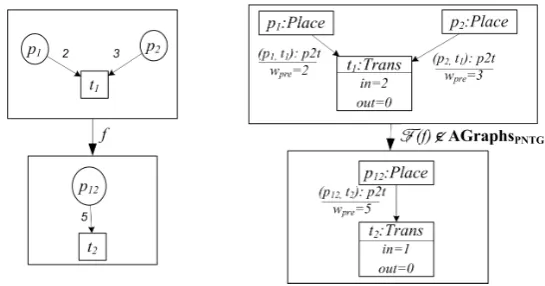
M2), becauseFis not well-defined on non-injective morphisms (see counterexample inFigure 1
below, whereF(f)does not preserve attributes inandwpre). This means, we proceed as
dis-cussed inRemark 4, which allows the application ofTheorem 1andTheorem 2in order to obtain translation and creation of Petri net transformations with injective morphisms. For application ofTheorem 1we need steps 1.-5., and forTheorem 2in addition steps 6. and 7.
1. Definition of Petri nets with individual Tokens:PTINet.
2. Definition of typed attributed graphs over Petri net type graphPNT G:AGraphsPNTG.
3. Translation of PTI nets into PNT G-typed attributed graphs (definition of functor F on objects).
4. Translation of restrictedPTINet-morphisms into restrictedAGraphsPNTG-morphisms
5. Ftranslates pushouts ofM1-morphisms in(PTINet,M1)into pushouts ofM2-morphisms
in(AGraphsPNTG,M2).
6. F createsM1-morphisms.
7. F preserves initial pushouts overM1-morphisms.
Figure 1: Counterexample for general (non-injective) morphisms
5.1 Petri Nets with Individual Tokens: PTINet
For classical place / transition (P/T) netsNwe adopt the approach of Meseguer and Montanari [MM90] using free commutative monoidsP⊕overP, whereN= (P,T,pre,post)with placesP, transitionsT, functions pre,post:T→P⊕ and markingsM∈P⊕.
Petri netsNI= (P,T,pre,post,I,m)with individual tokens are place/transition netsN= (P,T,pre,
post)together with a setIof individual tokens and a marking functionm:I→Passigning a place m(x)∈Pto eachx∈I. Therefore two (or more) different individual tokensx,y∈I may be on the same place, i.e.m(x) =m(y), while in the standard “collective token approach” the marking M∈P⊕tells us only how many tokens we have on each place, but we are not able to distinguish between two tokens on the same place.
A formal definition of a Petri net with individual tokens is as follows ([MGE+09]).
Definition 8(Petri Net with Individual Tokens)
A Petri net with individual tokens NI = (P,T,pre,post,I,m) is given by a classical P/T net N= (P,T,pre:T →P⊕,post:T →P⊕), whereP⊕ is the free commutative monoid overP, a (possibly infinite) set of individual tokensI, and the marking functionm:I →P, assigning to each individual tokenx∈Ithe corresponding placem(x)∈P.
PTINet-morphisms now define not only a mapping between two P/T nets but also between their individual tokens:
Definition 9(PTINet-Morphism)
APTINet-morphism f:NI1→NI2is given by a triple of functions f= (fP:P1→P2,fT:T1→
T1
=
P1⊕
T2 P2⊕
pre1
post1
fT fP⊕
pre2
post2
I1
=
P1
I2 P2
m1
fI fP
m2
It is also shown in [MGE+09], that(PTINet,M1)with the classM1of all injective morphisms
is anM-adhesive category, where pushouts and pullbacks are constructed componentwise (see
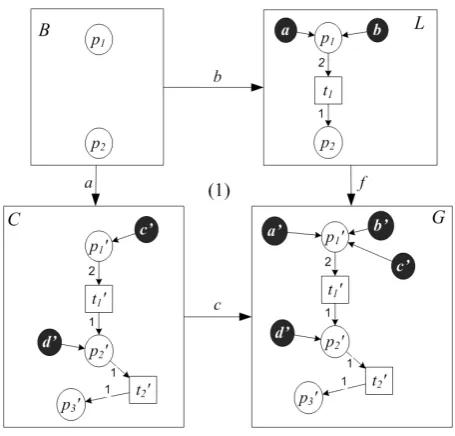
Figure 2, where(1)is an example for a pushout in(PTINet,M1), with individual tokens colored
in black).
Figure 2: PO inPTINet
In the following we only consider the restriction ofPTINettoM1-morphisms,PTINet|M1, in order to define the functorF inSubsection 5.4, becauseF is not well-defined on general mor-phisms. But we use theM-adhesive category(PTINet,M1)in order to define pushouts, because
(PTINet|M1,M1)is notM1-adhesive due to the well-known fact, that the induced morphism of
M1-morphisms is in general not anM1-morphism.
5.2 Typed Atributed Graphs over Petri Net Type Graph PNTG
According to [EEPT06] the category (AGraphsATG,M2)of typed attributed graphs with class
M2 of all injective morphisms with isomorphism on the data type part isM-adhesive, where
Place Token
Trans nat
token2place
place2trans trans2place weight
post weightpre in out Place Token Trans in:nat out:nat
place2trans weightpre:nat
trans2place weightpost:nat
token2place
Σ−nat sorts: nat opns: z:→nat
succ:nat→nat
NAT NATnat=N
znat=0∈N
succnat:N→N x7→x+1
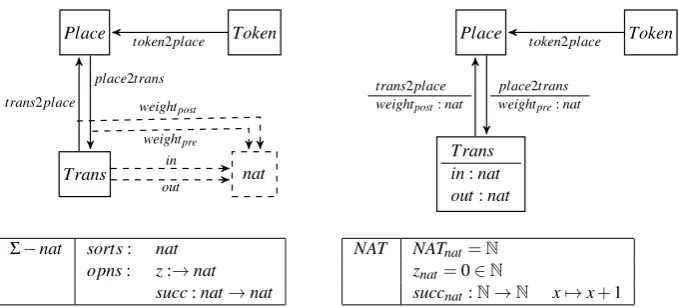
Figure 3: Type graph PNTG with data type signatureΣ−natand algebraNAT
Objects inAGraphsare pairs(G,D)of an E-GraphGwith sig-natureE (shown to the right), andΣ−natdata typeD, where in
the following we only use D=TΣ−nat ∼=NAT. This means, G
is given byG= (VGG,VDG=N,EGG,E G NA,E
G EA,(s
G
j,tGj )j∈{G,NA,EA}),
whereVGGresp.VDGare the graph resp.-data nodes ofG,EGG,ENAG ,
EG VG
ENA VD EEA sG tG sNA tNA sEA tEA
resp. EEAG are the graph edges resp. node attribute and edge attribute edges ofGandsGj,tGj are corresponding source and target functions for the edges.
In our case, the type graph ATG is the Petri net type graph PNTG shown inFigure 3with data type signatureΣ−natand algebraTΣ−nat∼=NAT for rules and graphs, where the E-Graph
of PNTG is shown on the left and its attribute notation on the right of Figure 3. Objects in AGraphsPNTG are pairs (AN,type) with attributed graphAN = (G,D) with D=NAT and
AGraphs-morphismtype:(G,D)→(PNTG,Dfin)with finalΣ−natdata typeDfin. Morphisms in
AGraphsPNTGare defined componentwise and are type compatible with morphisms inAGraphs.
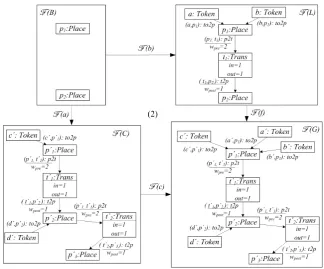
Four sample morphisms inAGraphsPNTGare shown inFigure 4, where a pushout is constructed.
5.3 Translation of PTI Nets into PNTG-typed Attributed Graphs
A formal definition of the functorFon objects is given as follows.
Definition 10(Translation ofPTINet-Objects)
Given a PTI netNI = (P,T,pre,post,I,m). We define the objectF(NI) = ((G,NAT),type)in AGraphsPNTGwithtype:(G,NAT)→(PNT G,Df in)andG= (VGG,V
G D =N,E
G G,E
G NA,E
G EA, (sG
j,tGj )j∈{G,NA,EA})as follows, where we use the following abbreviations:token2place,to2p,
Figure 4: PO inAGraphsPNTG
VGG=P]T]I
EGG=EtoG2p]EpG2t]EtG2pwith
EtoG2p={(x,p)∈I×P|m(x) =p},EGp2t={(p,t)∈P×T |pre(t)(p)>0} and EtG2p={(t,p)∈T×P|post(t)(p)>0}
ENAG =EinG]EoutG with
EinG={(t,n,in)|(t,n)∈T×N∧ | •t|=n},
EoutG ={(t,n,out)|(t,n)∈T×N∧ |t• |=n},
where•tandt•are the pre- and post-domains oft∈Twith cardinalities| •t|and|t• |. EEAG =EwG
pre]E
G wpost with
EwGpre=
(p,t,n)∈EpG2t×N|pre(t)(p) =n
EwG
post =
(t,p,n)∈EtG2p×N|post(t)(p) =n
sGG,tGG:EGG→VGG defined by sGG(a,b) =a resp. tGG(a,b) =b
sGNA:ENAG →VGG,tNAG :ENAG →N defined by sGNA(t,n,x) =t resp. tNAG (t,n,x) =n sGEA:EEAG →EGG defined by sGEA(p,t,n) = (p,t) and sGEA(t,p,n) = (t,p)
tEAG :EEAG →N defined by tEAG (p,t,n) =n and t G
The correspondingtype-morphism is given inDefinition 11below.
An example for using the functor F on objects is shown inFigure 4, where the four typed attributed graphs are translations of the corresponding four PTI nets inFigure 2.
Definition 11(AGraphsPNTG-Morphismtype)
TheAGraphsPNTG-morphismtype:(G,NAT)→(PNT G,Df in)is given by final morphism of
data types andtypeG:G→PNT Ggiven by E-graph morphismtypeG= (typeVG,typeVD,typeEG,
typeENA,typeEEA)where
typeVG:V
G
G →V
PNT G
G with x7→Place(x∈P), x7→Trans(x∈T),x7→Token(x∈I)
typeVD:N→Df innat with x7→nat(x∈N)
typeEG:E
G
G →E
PNT G
G with x7→y for x∈E
G
y and y∈ {to2p,p2t,t2p}
typeENA:E
G
NA→E
PNT G
NA with x7→y for x∈E
G
y and y∈ {in,out}
typeEEA:E
G
EA→E
PNT G
EA with x7→y for x∈E
G
y and y∈ {wpre,wpost}
5.4 Translation of Restricted PTINet-Morphisms into Restricted AGraphsPNTG-Morphisms
We now define the functor F :PTINet|M1 →AGraphsPNTG|M2 on injective morphisms. A counterexample for the translation of non-injective morphisms is given inFigure 1, examples for injective morphisms inFigure 2and corresponding translated morphisms inFigure 4.
Definition 12(Translation ofPTINet-Morphisms)
For eachPTINet-morphism f :NI1→NI2with f = (fP,fT,fI)∈M1, i.e. fP,fT,fI injective,
we defineF(f):F(NI1)→F(NI2)where
F(NIi) = (ViG,N,EiG,EiNA,EiEA,(si j,ti j)j∈{G,NA,EA})withi=1,2
byF(f) = f0= (fV0
G,f
0
VD,f
0
EG,f
0
ENA,f
0
EEA)with
fV0
G:V1G→V2G with ViG=Pi]Ti]Ii for i=1,2 by f
0
VG = fP]fT]fI
fV0
D:N→N by f
0
VD =idN
fE0G:E1G→E2G with EiG=Eito2p]Ei p2t]Eit2p by
fE0
G(x,p) = (fI(x),fP(p)) for (x,p)∈E1to2p
fE0
G(p,t) = (fP(p),fT(t)) for (p,t)∈E1p2t
fE0
G(t,p) = (fT(t),fP(p)) for (t,p)∈E1t2p
fE0
NA:E1NA→E2NA with EiNA=Eiin]Eiout by
fE0
NA(t,n,i) = (fT(t),n,i) for (t,n,i)∈E1in]E1out∧i∈ {in,out}
fE0
EA:E1EA→E2EA with EiEA=Eiwpre]Eiwpost by
fE0
EA(p,t,n) = (fP(p),fT(t),n) for (p,t,n)∈E1wpre
fE0
Lemma 1(Well-Definedness of Morphism Translation)
For each f :NI1→NI2inPTINetwith f ∈M1isF(f):F(NI1)→F(NI2)inAGraphsPNTG
well-defined withF(f)∈M2. MoreoverF preserves inclusions.
Proof.
A detailed proof is given in [MEE11] showing the following steps:
1. fV0
G,f
0
VD,f
0
EG,f
0
ENA,f
0
EEAare well-defined w.r.t. codomain.
2. The components ofF(f)are compatible with sources and targets.
3. The components ofF(f)are compatible with typing morphisms.
4. f ∈M1(inclusion) impliesF(f)∈M2(inclusion).
5.5 Translation of Pushouts
We have to show, that if(1)is a PO inPTINetwith fi∈M1, then we have that(2) is a PO in
AGraphsPNTGwithF(fi)∈M2.
NI0
(1)
NI1
NI2 NI3
f1
f2 f4
f3
F(NI0)
(2)
F(NI1)
F(NI2) F(NI3)
F(f1)
F(f2) F(f4)
F(f3)
Since POs inPTINetare constructed componentwise, we know that theP-,T- andI-components of(1)are POs inSets. Since also POs inAGraphsATGandAGraphsPNTGare constructed
com-ponentwise we have to show that theVG-,VD-,EG-,ENA- andEEA-components of(2)are POs in
Sets. This is clear for theVG-components fiVG =fiP]fiT]fiI, because POs are compatible with coproducts and for fiD, because all components are identities. For theEG-component we have
to show, that(3)is PO inSets, which follows if(4)and similar(4a)resp. (4b)with “to2p” and “fiI×fiP” replaced by “p2t” and “fiP×fiT” resp. “t2p” and “fiT×fiP” are POs.
E0G
(3)
E1G
E2G E3G
F(f1)G
F(f2)G F(f4)G
F(f3)G
E0to2p
(4)
E1to2p
E2to2p E3to2p
f1I×f1P
f2I×f2P f4I×f4P
f3I×f3P
For theENA- andEEA components, it is sufficient to show POs(5) and(6)and similar(5a)
with “in” replaced by “out” and(6a)with “pre” replaced by “post”.
E0in
(5)
E1in
E2in E3in
f1T×idN
f2T×idN f4T×idN
f3T×idN
E0wpre
(6)
E1wpre
E2wpre E3wpre
f1P×f1T
f2P×f2T f4P×f4T
All these diagrams commute, because each product component commutes by assumption. But it is more difficult to show explicitly, that they are POs (see for exampleLemma 2below), because products of POs are in general not POs. An example is the translation of the PO in PTINetshown inFigure 2to the PO inAGraphsPNTGshown inFigure 4.
Lemma 2(Translation of Pushouts) Diagrams(4)and(4a)are pushouts. Proof. See [MEE11].
5.6 Creation of Injective Morphisms
GivenF(NI1),F(NI2)and f0:F(NI1)→F(NI2)∈M2with type compatible morphisms
fV0
G:V1G→V2G with ViG=Pi]Ti]Ii for i=1,2
fV0
D:N→N with f
0
VD=idN
fE0
G:E1G→E2G with EiG=Eito2p]Ei p2t]Eit2p
fE0
NA:E1NA→E2NA with EiNA=Eiin]Eiout
fE0
EA:E1EA→E2EA with EiEA=Eiwpre]Eiwpost
Define f :NI1→NI2withNIj= (Pj,Tj,prej,postj,Ij,mj) for j=1,2 by
f = (fP:P1→P2,fT:T1→T2,fI:I1→I2)with
fT(t) = fV0G(t) for t∈T1⊆V1G
fP(p) = fV0G(p) for p∈P1⊆V1G
fI(x) = fV0G(x) for x∈I1⊆V1G
Well-definedness of f :NI1→NI2∈M1 follows fromLemma 3below, where the proof of
part 2 is based onLemma 4. The proofs of both Lemma are given in [MEE11].
Lemma 3 (Well-Definedness of Creation of Injective Morphisms)
Given the construction above for f :NI1→NI2. The
following holds:
1. fV0
G(t)∈T2, f
0
VG(p)∈P2, f
0
VG(x)∈I2, and
2. squares(1),(2)to the right commute with injec-tive fP,fT,fI.
T1
(1)
P1⊕
T2 P2⊕
pre1
post1
fT fP⊕
pre2
post2
I1
(2)
P1
I2 P2
m1
fI fP
m2
Lemma 4(PTI-Morphism-Lemma)
f :NI1→NI2is an injectivePTINet-morphism⇔
f = (fP,fT,fI)is injective with1−4, where
1. ∀t∈T1.p∈ •t⇔ fP(p)∈ •fT(t) and ∀t∈T1.p∈t• ⇔ fP(p)∈ fT(t)•
2. ∀(p,t)∈P1⊗T1=E1p2t.(p,t,n)∈E1wpre⇔(fP(p),fT(t),n)∈E2wpre and
3. ∀t∈T1.
card(•t) =n⇔card(•fT(t)) =n and card(t•) =n⇔card(fT(t)•) =n with •t={p∈P1|pre1(t)(p)>0} and t•={p∈P1|post1(t)(p)>0}
4. ∀x∈I1.(x,p)∈E1to2p⇔(fI(x),fP(p))∈E2to2p
5.7 Preservation of Initial Pushouts
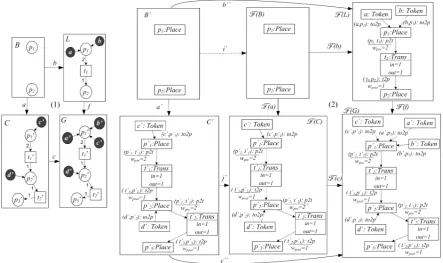
The proof of this property is based on the initial PO constructions for PTINetin [MGE+09] and forAGraphsATG in [EEPT06]. Details of the proof are given in [MEE11]. An example
is given in Figure 5, where (1) is an initial PO over f in PTINet, (2) the induced PO over F(f), and the initial PO overF(f)inAGraphsPNTGis given by the outer diagram with corners
B0,C0,F(L),F(G). Since i0 and j0 are isomorphisms, diagram (2) is already initial PO over F(f).
Figure 5: Preservation of Initial Pushouts
6
Conclusion and Future Work
This allows byTheorem 1andTheorem 2the translation and creation of transformations between the correspondingM-adhesive transformation systems, including parallel and sequential inde-pendence of transformations. Moreover, we have discussed the restriction to injective matches viaM1-morphisms, which requires only a functor forM1-morphisms.
InSection 5we have discussed a corresponding functor from Petri nets with individual tokens to typed attributed graphs. We have verified that this functor translates pushouts ofM1-morphisms,
createsM1-morphisms and preserves initial pushouts overM1-morphisms, which allows the
ap-plication ofTheorem 1andTheorem 2in connection withRemark 4.
In future work, we will provide sufficient conditions in order to ensure that theM−functor preserves initial pushouts2. In the long run, this should allow the analysis of interesting prop-erties of Petri net transformation systems, like termination and local confluence in addition to parallel and sequential independence, using corresponding results and analysis tools like AGG for graph transformation systems. Moreover, it is interesting to study the relationship between otherM-adhesive transformation systems using this approach, e.g. high-level Petri nets and typed attributed graphs as well as triple graphs and flattening of triple graphs.
Acknowledgements: Some of the authors are partly supported by the German Research Coun-cil projectBehaviour Simulation and Equivalence of Systems Modelled by Graph Transformation (Behaviour-GT).
References
[AGG09] TFS-Group, TU Berlin. AGG. 2009.http://tfs.cs.tu-berlin.de/agg.
[BEHM07] E. Biermann, C. Ermel, F. Hermann, T. Modica. A Visual Editor for Reconfigurable Object Nets based on the ECLIPSE Graphical Editor Framework. In Proc. Work-shop on Algorithms and Tools for Petri Nets (AWPN’07). 2007.
http://tfs.cs.tu-berlin.de/publikationen/Papers07/BEHM07.pdf
[DS02] M. Droste, R. M. Shortt. From Petri Nets to Automata with Concurrency.Applied Categorical Structures10:173–191, 2002. 10.1023/A:1014305610452.
http://dx.doi.org/10.1023/A:1014305610452
[EEPT06] H. Ehrig, K. Ehrig, U. Prange, G. Taentzer. Fundamentals of Algebraic Graph Transformation. EATCS Monographs in Theor. Comp. Science. Springer, 2006.
[EGH10] H. Ehrig, U. Golas, F. Hermann. Categorical Frameworks for Graph Transformation and HLR Systems based on the DPO Approach.Bulletin of the EATCS 102:111– 121, 2010.
http://tfs.cs.tu-berlin.de/publikationen/Papers10/EGH10.pdf
[EHKP91a] H. Ehrig, A. Habel, H.-J. Kreowski, F. Parisi-Presicce. From Graph Grammars to high level replacement systems. In4th Int. Workshop on Graph Grammars and their Application to Computer Science. LNCS 532, pp. 269–291. Springer, 1991.
[EHKP91b] H. Ehrig, A. Habel, H.-J. Kreowski, F. Parisi-Presicce. Parallelism and Concurrency in High-Level Replacement Systems.Math. Struct. in Comp. Science1:361–404, 1991.
[EHP+08] H. Ehrig, K. Hoffmann, J. Padberg, C. Ermel, U. Prange, E. Biermann, T. Modica. Petri Net Transformations. InPetri Net Theory and Applications. Pp. 1–16. I-Tech Education and Publication, 2008.
[EHPP06] H. Ehrig, A. Habel, J. Padberg, U. Prange. Adhesive High-Level Replacement Sys-tems: A New Categorical Framework for Graph Transformation.Fundamenta In-formaticae74(1):1–29, 2006.
[Kre81] H.-J. Kreowski. A Comparison between Petri Nets and Graph Grammars. In 5th International Workshop on Graph-Theoretic Concepts in Computer Science. LNCS 100, pp. 1–19. Springer, 1981.
[LS04] S. Lack, P. Soboci´nski. Adhesive Categories. InProc. FOSSACS 2004. LNCS 2987, pp. 273–288. Springer, 2004.
[MEE11] M. Maximova, H. Ehrig, C. Ermel. Functors betweenM-adhesive Categories Ap-plied to Petri Net and Graph Transformation Systems. Technical report 2011/04, TU Berlin, 2011.
http://www.eecs.tu-berlin.de/menue/forschung/forschungsberichte/2011
[MGE+09] T. Modica, K. Gabriel, H. Ehrig, K. Hoffmann, S. Shareef, C. Ermel, U. Golas, F. Hermann, E. Biermann. Low- and High-Level Petri Nets with Individual Tokens. Technical report 2009/13, Technische Universit¨at Berlin, 2009. http://www.eecs. tu-berlin.de/menue/forschung/forschungsberichte/2009.
[MM90] J. Meseguer, U. Montanari. Petri Nets are Monoids.Information and Computation 88(2):105–155, 1990.
[PE07] U. Prange, H. Ehrig. From Algebraic Graph Transformation to Adhesive HLR Categories and Systems. In Algebraic Informatics. Proceedings of CAI 2007. LNCS 4728, pp. 122–146. Springer, 2007.
[PEHP08] U. Prange, H. Ehrig, K. Hoffman, J. Padberg. Transformations in Reconfigurable Place/Transition Systems. InConcurrency, Graphs and Models: Essays Dedicated to Ugo Montanari on the Occasion of His 65th Birthday. LNCS 5065, pp. 96–113. Springer, 2008.
[Rei85] W. Reisig.Petri Nets: An Introduction. EATCS Monographs on Theoretical Com-puter Science 4. Springer, 1985.