109
The Curriculum Of Practice: A Conceptual Framework For
Speech-Language Therapy and Audiology Practice With A Black
African First Language Clientele
Mershen Pillay
1, Harsha Kathard
1& Michael A. Samuel
2 department of Speech & Hearing Therapydepartment of Applied Curriculum Studies University of Durban- Westville
ABSTRACT
This paper discusses the use of a conceptual framework (i.e., the curriculum of practice) to guide the transformation of professional practice toward equitable service provision, rooted in a research finding that South African Speech-Language
Therapy & Audiology has a favourable service bias toward White English I Afrikaans first language speakers (Pillay, 1997b). Three perspectives of practice are discussed, i.e., the official, espoused and actual perspectives. Also, the various elements of practice are reviewed, and include clinical practice activities, resources and their utilization, professional education cur-ricular and professional policies. It is asserted that re-constructing the profession's knowledge base in a presently (1996-) transforming South Africa, mostly requires the use of a critical (versus, for e.g., a scientific) paradigm.
OPSOMMING
Inhierfdie artikel word die gebruik van 'n konseptuele raamwerk(d.i. diepraktykskurrikulum) bespreek om die transformasie van die professionele praktyk in werking te stel ten opsigte van regverdige dienslewering gegrond op navorsingsbevindinge dat die vakgebied van Spraak-Taalterapie en Oudiologie in die Suid-Afrikaanse konteks gekenmerk word deur 'n gunstige beroepsinslagjeens Blanke Engels- /Afrikaans-eerstetaalaprekers(Pillay, 1997). Driepraktyksperspektiewe word bespreek, naamlik die offisiele, bepleite en aktuele perspektiewe. Die verskillende praktykelemente word ook bespreek en sluit kliniese praktykaktiwiteite, hulpbronne en aanwending daarvan, professionele opleidingskurrikulums en professionele beleid in. Daar word aangevoer dat die belangrikste vereiste vir die rekonstruering van die beroep se kennisbasis in Suid-Afrika wat tans( 1996-) in 'n transformasie proses is,die gebruik van 'n kritiese ( versus bv. 'n wetenskaplike) paradigma is. KEYWORDS: speech-language therapy and audiology practice; knowledge construction, critical paradigm, Black African first language speakers, curriculum of practice.
1. INTRODUCTION
The conceptual framework described in this paper is based on research conducted in 1996 (Pillay, 1997a & 1997b), which focused on developing an understanding of the profession's practice with a Black African first lan-guage speaking clientele. The use of this framework re-vealed that Speech-Language Therapy and Audiology is biased toward providing a better quality service to a White, English and Afrikaans first language speaking population, while concurrently providing a poorer service to a Black African first language speaking clientele (Pillay, 1996). Given the apartheid/racist context of its development, Speech-Language Therapy and Audiology services may hardly be understood otherwise. Arriving at an under-standing of how the profession, or rather the people within it, have actually delivered their services within a racist/ apartheid framework; involved the use of a critical con-ceptual framework, which is promoted in this paper.
Why is it important to present such a framework? Pri-marily, this framework is intended to present a view on Professional practice and to develop a common
understand-ing of concepts associated with terms used within this framework. Many may find research results like that which claim that the profession's use of science has contributed towards its service bias, a ludicrous comment (Pillay, 1997). How could something like the impressive, rigourous and objective scientific method ever contribute toward main-taining a racist service? It is hoped that professionals use the curriculum of practice to position themselves in rela-tion to concepts, such as that in the above example.
Speech-Language Therapy and Audiology has to pro-vide an equitable service for Black African first language speaking clients given national political imperatives. Firstly, however, the focal term Black African first lan-guage speakers requires clarification: Black African first language speaker is a reference to the primary use of an indigenous language i.e., a country's native language (Lan-guage Plan Action Group, 1996) by Black South Africans who are themselves indigenous to this country, and whose ancestors'birthplace is pre-colonial Africa (Mesthrie, 1995). In other words, this refers to the Nguni class (i.e, isiZulu, isiXhosa, isiNdbele and SiSwati) and the Sotho class (i.e, Sepedi, Sesotho, and Setswana) of African languages
Die Suid-Afrikaanse Tydskrif vir Kommunikasieafwykings, Vol. 44, 1997
by
S
ab
in
et
G
at
ew
ay
u
nd
er
li
ce
nc
e
gr
an
te
d
by
th
e
Pu
bl
is
he
r (
da
te
d
20
12
which, according to the South African Constitution (1996) are considered as official languages. In South Africa peo-ple who speak an African first language are usually mem-bers of the apartheid racial classification referred to as Black, viz., the term Black African first language speak-ers.
For the profession of Speech-language Therapy and Audiology, language embedded within the broad frame-work of communication, is the critical focus of its frame-work. It is therefore an important construct to consider given that language and culture (for example, the African language and the African culture) are closely intertwined, and that the nature and management of communication disorders must be viewed via a cultural perspective (Taylor & Clark, 1994). If we view practice within generic concepts of fac-tors like culture and language as opposed to specific con-cepts, for example, Black African and Zulu, we can then apply this framework of practice to any context. The ap-plication of the framework may, however, highlight differ-ent factors across specific contexts, for example, the is-sues related to Turkish first language speakers in London would be different from that of Afrikaans first language speakers in Durban.
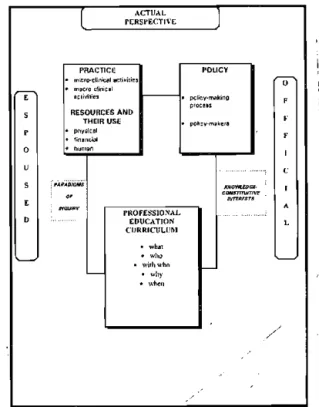
The framework provided below is referred to as the 'cur-riculum of practice' and is a term that is catalytically de-fined within the next section. Figure 1 is a schematic rep-resentation of this framework which will now be discussed in detail.
2. THE CURRICULUM OF PRACTICE: A CONCEP-TUAL FRAMEWORK.
Could practice possibly be conceptualized in various ways? In other words, is there not only one way of looking at practice? The curriculum of practice has been gener-ated in response to such questions. It is a term (coined for use by the author) that refers to the way in which we may view practice and its elements may be viewed. What is meant by this?
2.1. PERSPECTIVES OF PRACTICE: AN ORGANI-SATIONAL FRAMEWORK.
In order to review the perspectives of practice, let us assume a Speech-Language Therapist and Audiologist from another country visited South Africa, and that she/ he wished to know about how her/his South African coun-terparts provided a service to their clients, more especially their Black African first language clients. In order to in-vestigate her/his interest regarding this clientele, she/he may obtain documents, for example official policies; and read them. This would provide her/him with an official understanding of the issue. Alternatives to finding out answers to her/his questions may be via direct, personal communication with the South African professionals them-selves. Depending on where and with whom she/he is vis-iting she/he may ask the head professional practitioner of an institution, a university academic or practitioners them-selves. These people would tell her/him about how they practice (or facilitate practice) with a Black African first language clientele, providing her/him with their espoused perspectives of what they do. One of these people might even invite her/him to visit their place of work, for a while, to see what actually happens. By observing such practice, she/he would gain an understanding of actual practice.
The So
At the end of these various investigations the visitor should have some insight into Speech-Language Therapy and Audiology practice.
From the above illustration (which is, simplistically, similar to the qualitative research methodology used by Pillay, 1997a), we can see that the factors to consider within the curriculum of practice may be viewed from three per-spectives (schematically placed on the border of Figure 1). These include the (2.1.1.) the official perspective, (2.1.2.) the espoused perspective, and (2.1.3.) the actual perspec-tive. These perspectives provide a framework within which we may organise the various elements of practice, dis-cussed below:
2.1.1. The Official Perspective
The official perspective refers to that perspective of practice which is documented in writing, and sanctioned by an authoritative body. Official perspectives (for exam-ple, those presented via policies) are produced via a rigor-ous process of being discussed and referred to as official. The Interim Medical and Dental Council of South Africa (INMDCSA) is a government-sanctioned organisation and its documents legally bind all registered practitioners to their policy statements, while the South African Speech-Language-Hearing Association's (SASLHA) policies (or guidelines) do not enjoy similar statutory status. In con-text of this paper, policies will be regarded as official by virtue of their origin from authoritative professional or-ganisations. The issue of whether or not they are known to exist, i.e., effectively communicated (Hewton, 1988) to practitioners may also be important to consider within the official perspective.
2.1.2. The Espoused Perspective
The espoused perspective consists of statements, medi-ated in the verbal or written mode, which refer to practice
ACTUAL PERSPECTIVE
Figure 1: The curriculum of practice: A schematic diagram of the conceptual framework.
African Journal of Communication Disorders, Vol. 44, 1997
by
S
ab
in
et
G
at
ew
ay
u
nd
er
li
ce
nc
e
gr
an
te
d
by
th
e
Pu
bl
is
he
r (
da
te
d
20
12
The Curriculum of Practice: A Conceptual Framework for Speech-language Therapy and
Audiology Practice with a Black African First Language Clientele 111
a s it happens. Such statements do not have official status
due to the lack of the process involved in making official the concepts associated with practice. In other words, it is
what practitioners/professional educators claim that they
actually do. Examples of the written espoused perspec-tive may be the sophisticated form of conference papers, journal articles; or the informal statements contained within various documents, for example, memos, client records, etc. This perspective may be understood within the professional education sector (i.e., from professional educators) and within the service sector (i.e., which in-clude practitioners and professional managers).
2.1.3. The Actual Perspective
What actually happens then, is viewed as another per-spective via which the curriculum of practice may be in-terpreted. Therefore, practice as it actually occurs in the work place (or reality site) is investigated as an actual perspective. Statements regarding this perspective may be generated via observations of the actual act of practice within the practice site. The practice site refers to the physical context in which practice (as performed by a prac-titioner) occurs. It includes the people involved in the proc-ess of practice, the resources (or equipment) utilised, etc.
With these perspectives in mind, what are the specific aspects that we may consider when viewing practice? The following discussion reviews the elements of practice to consider within the general organisational format provided above.
2.2. THE ELEMENTS OF PRACTICE.
In considering the elements of practice, (2.2.1.) prac-tice activities, (2.2.2.) resources and their utilisation, (2.2.3.) professional education curriculum, and (2.2.4.) professional policy are reviewed as part of the curriculum of practice:
I
1
2.2.1. Practice Activities j
One may refer to practice activities within individual or group work, and (with reference to Figure 1) refer to two broad types: J
2.2.1.1. Micro activities which are specific and distinc-tive to performing a professional function, com-parable to what may be referred to within the con-cept of a core curriculum. In Speech-Language Therapy and Audiology one may consider the vari-ous clinical activities, i.e., the diagnostic and therapeutic aspects within the entire clinical man-agement process, as collectively constituting these micro-activities.
2.2.1.2. Furthermore, one may consider the aspect of macro-activities, i.e., the activities linked to and impacting on the performance of the micro/core activities. Macro-activities for professional prac-tice refers to macro-clinical activities which may include any activity directly related to the clini-cal management of the Black African first lan-guage client, for example clinical administration. Importantly, the policy making process and ele-ments thereof, may' be an aspect within this cat-egory of macro-clinical activities. However, this
element is given specific consideration within the curriculum of practice, as may be noted below. An obvious element to consider within the curriculum of practice is the client's language and culture which should be a factor in determining the nature of the changes (if any) which is made to one's practice with such a clientele (Vaughn-Cooke, 1986). Furthermore, any reference to prac-tice activities should account for the inherent status of the types of resources and their use. For purposes of this framework, this latter element of practice is highlighted:
2.2.2. Resources And Their Use
As may be noted in Figure 1, in order to achieve the above practice activities the practitioner may refer to three categories, including (2.2.2.1.) physical or material re-sources, for example the actual equipment used in the clini-cal and macro-cliniclini-cal activities; (2.2.2.2.) human resources which refer to people involved in the clinical and macro clinical process, for example, the client's parents; and (2.2.2.3.) financial resources, i.e., finances that may be utilised for and/or during practice by the practitioners.
Ballantine, Ballantine & Morgan (1982, in Bortz, 1992: 26) have correctly noted - in discussing the availability of assessment materials for the Black African first language speaking population - that "...we have limited tools avail-able to perform the identification of speech and language problems, and those that do exist are inadequate".
This comment regarding clinical resources, in the form of tests and various therapeutic materials for use with the Black African first language client during clinical activi-ties; is essential to consider within a framework intended to explain such practice. Also, it is known that the public sector services for Black African first language speakers are extremely under-resourced (Owen, 1995). Practition-ers working in these contexts have high client case loads, and generally work under stressful conditions (Swindler & Ross, 1993). While this situation was designed and sup-ported by the previous racist government's national budget scheme (Sinclair & Place, 1991), the public practitioner is still faced with the present poor stock of all types of re-sources, and is an important factor to consider.
The above elements of practice activities and resource utilisation may be viewed from the point of what actually occurs, i.e., the actual perspective. Such professional prac-tice may be perceived as constituting a set of actions or activities and may be defined as that which actually hap-pens (Jansen, 1995). The notion of practice as that which actually happens must be considered (or re-considered) as consisting of more than just action. Practice is related to knowledge/theory, i.e., what one does is related to what one knows:
A practice... is not some kind of thoughtless behaviour which exists separately from theory and to which theory can be applied. Furthermore, all practices, like all ob-servations, have theory embedded in them and this is just as true for the practice of theoretical pursuits as it is for those of practical pursuits like teaching [or speech-language therapy & audiology], [my insertion] (Carr & Kemmis, 1986: 113)
The notion of practice as being a simple set of activi-ties/actions is extended, to be contextualised within the
Die Suid-Afrikaanse Tydskrif vir Kommunikasieafwykings, Vol. 44, 1997
by
S
ab
in
et
G
at
ew
ay
u
nd
er
li
ce
nc
e
gr
an
te
d
by
th
e
Pu
bl
is
he
r (
da
te
d
20
12
theory in which such actions are always grounded. These aspects are schematically represented in Figure 1, and are the focus of the next section:
2.2.3. The Concept Of Knowledge
Habermas (according to Grundy, 1987; and Pusey, 1987) has stated that all human knowledge has fundamental cognitive interests. Grundy (1987) provides an understand-ing of what Habermas has meant by interests and then what he has meant by cognitive interests. She has ex-plained Habermas' definition of interests as:
...the basic orientation of the human species is towards pleasure and that fundamentally what gives us pleas-ure is the creation of the conditions which will enable the species to reproduce itself. (Grundy, 1987: 8) People's interests, which are usually self-satisfying, nec-essarily coincide with their values and beliefs (Grundy, 1987) and are rooted in a form of reasoning or rationality (Grundy, 1987), i.e., there is an addition of the cognitive dimension to Habermas' concept of human interests, i.e, knowledge-constitutive interests (Habermas, in Pusey, 1987). This ba-sic interest in self-preservation (guided by one's value ori-entation) has led people to compose knowledge in various ways. Grundy (1987) has asserted that knowledge-tutive interests "...both shape what we consider to consti-tute knowledge and determine the categories by which we organise knowledge" (Grundy, 1987: 10).
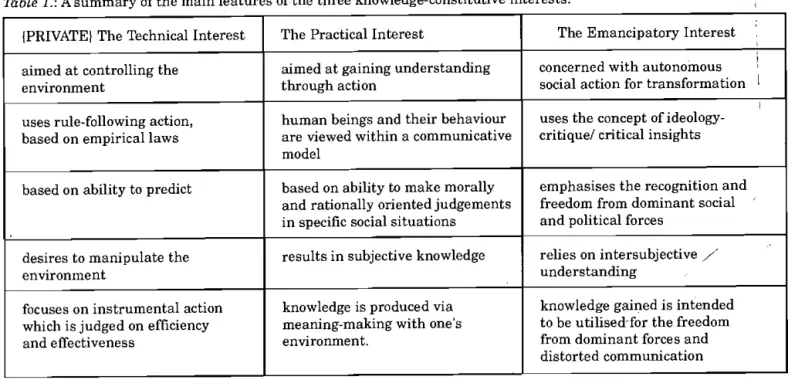
Habermas (in Grundy, 1987) has proposed three knowl-edge-constitutive interests: the technical interest, the prac-tical interest, and the emancipatory interest, summarised in notational form in Table 1. Firstly, the technical in-terest has a "...fundamental inin-terest in controlling the environment through rule-following action based upon empirically grounded laws" (Grundy, 1987: 12). This in-terest is concerned with the ability to predict and there-fore manipulate the environment giving rise to instrumen-tal action which is judged in terms of its efficiency and effectiveness (Luckett, 1995).
Secondly, the practical interest is concerned with un-derstanding through action. This interest has its roots in Habermas' (1972, cited in Pusey, 1987) theories of human speech and communication - based on assumptions of theo-rists like Freud (the well known psychoanalyst) and Hegel who, like Habermas, was a German philosopher (Pusey,
1987). The practical interest refers to the human being as a "language-using being... using a form of knowledge to com-municate with their fellows through the employment of mutually-understood symbols" (Kinchelhoe, 1991). Further-more, it is concerned with the ability to make judgements about how to act morally and rationally within a specific social situation (Schubert, 1987). It results in subjective knowledge (as opposed to rule-following knowledge) which is usually produced through meaning-making interaction with one's environment (Grundy, 1987).
Thirdly, the emancipatory interest:
... goes beyond the technical interest of controlling ob-jects in the environment and the practical interest of fostering intersubjective understanding. The emanci-patory interest is concerned with a form of knowledge which leads to freedom from dominant forces and dis-torted communication.(Kinchelhoe, 1991: 70). The emancipatory interest is concerned with autono-mous social action as a result of "authentic, critical insights into the social construction of human society" (Grundy, 1987:19). Emancipation (or freedom) and self-knowledge are restricted by often unrecognised social and political conditions (Kinchelhoe, 1991)
Regarding, the notions of science, it is significant to note that Habermas (in Pusey, 1987) has viewed all the knowledge-constitutive interests as motivated by rational inquiry: A concept which is closely linked with what is com-monly referred to as science. In fact, as Pusey (1987) has noted, Habermas promotes rational inquiry and is for sci-ence. However, Habermas promotes a different science, that which he refers to as scientism. Habermas (1972, in Pusey, 1987) has used the term scientism to promote "... sci-ence's belief in itself: that is, the conviction that we can no
Table J.: A summary of the main features of the three knowledge-constitutive interests.
(PRIVATE) The Technical Interest The Practical Interest The Emancipatory Interest ι aimed at controlling the
environment
aimed at gaining understanding through action
concerned with autonomous j social action for transformation | uses rule-following action,
based on empirical laws
human beings and their behaviour are viewed within a communicative model
uses the concept of ideology-critique/ critical insights
based on ability to predict based on ability to make morally and rationally oriented judgements in specific social situations
emphasises the recognition and freedom from dominant social and political forces
desires to manipulate the environment
results in subjective knowledge relies on intersubjective understanding
focuses on instrumental action which is judged on efficiency and effectiveness
knowledge is produced via meaning-making with one's environment.
knowledge gained is intended to be utilised for the freedom from dominant forces and distorted communication
The South African Journal of Communication Disorders, Vol. 44, 1997
by
S
ab
in
et
G
at
ew
ay
u
nd
er
li
ce
nc
e
gr
an
te
d
by
th
e
Pu
bl
is
he
r (
da
te
d
20
12
The Curriculum of Practice: A Conceptual Framework for Speech-language Therapy and Audiology Practice with a Black African First Language Clientele
longer understand science as one form of possible knowl-edge, but rather must identify knowledge with science" (Pusey, 1987: 20). In addition, he has claimed that "...sci-ence can only be comprehended epistemologically, which means as one category of possible knowledge, as long as knowledge is not equated with....scientistic self-under-standing of the actual business of [scientific] research" (Pusey, 1987: 20).
Habermas' reference to science as only being understood epistemologically is significant. This assumption is based on the nature of the three knowledge-constitutive inter-ests given that they are different from each other. It may be concluded that what one considers as basic knowledge/ truth is dependent on one's value orientation, i.e., there is more than one version of truth (Guba & Lincoln, 1994). Put another way: there is more than one story to be told, i.e., we construct knowledge according to the way we see the world. In this process of knowledge construction, the way we see the world is not only personally constructed, but related to paradigms of inquiry which is the focus of the next section:
2.2.3.1. Paradigms and the construction of knowl-edge
Guba & Lincoln (1994) have defined a paradigm as: a set of basic beliefs (or metaphysics) that deal with ultimates or first principles. It represents a worldview that defines for its holder, the nature of the "world", the individual's place in it, and the range of possible relationships to that world and its parts, as for exam-ple, cosmologies and theologies do. (Guba & Lincoln, 1994: 107).
These paradigms are each governed by Habermas' theory of knowledge-constitutive interests. Historically, knowledge (for professional practice) has been guided by
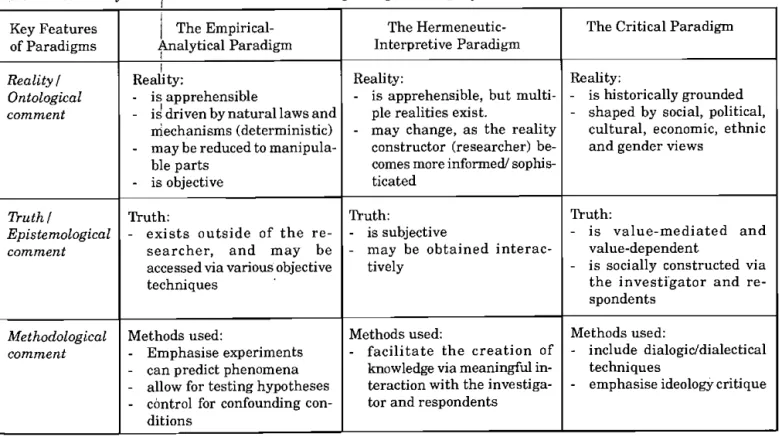
Table 2: A summary of the main features of the three paradigms of inquiry Key Features
of Paradigms
1
J The Empirical-Analytical Paradigm
The Hermeneutic-interpretive Paradigm
The Critical Paradigm
Reality / Ontological comment
1 Reality:
- is apprehensible
- is driven by natural laws and mechanisms (deterministic) - may be reduced to
manipula-t e parmanipula-ts - is objective
Reality:
- is apprehensible, but multi-ple realities exist.
- may change, as the reality constructor (researcher) be-comes more informed/ sophis-ticated
Reality:
- is historically grounded - shaped by social, political,
cultural, economic, ethnic and gender views
Truth 1 Epistemological comment
Truth:
- exists outside of the re-searcher, and may be accessed via various objective techniques
Truth:
- is subjective
- may be obtained interac-tively
Truth:
- is value-mediated and value-dependent
- is socially constructed via the investigator and re-spondents
Methodological comment
Methods used:
- Emphasise experiments - can predict phenomena - allow for testing hypotheses - control for confounding
con-ditions
Methods used:
- facilitate the creation of knowledge via meaningful in-teraction with the investiga-tor and respondents
Methods used:
- include dialogic/dialectical techniques
- emphasise ideology critique three paradigms (Hartman & Warren, 1994). These three paradigms include the empirical-analytical paradigm, the hermeneutic-interpretive paradigm, and the criti-cal paradigm. Carson's (1990) overview (quoted below) of the relationship between Habermas' knowledge-consti-tutive interests and these paradigms provides a basic defi-nition of each paradigm. Furthermore, it sufficiently ex-plains the relationship between knowledge-constitutive interests and paradigms of inquiry for purposes of this discussion.
... [Habermas'] three basic orientations...[are] governed by a particular interest. One is an orientation to mate-rial well-being, governed by a technical interest in acting on the world. This produces an empirical know-ing in the form of facts and generalisations. A second orientation, towards communication, is governed by a practical interest in understanding others. The form of knowing that this produces is situational and inter-pretive, rather than generalisable and empirical. The
third orientation is toward freedom and it is governed by an emancipatory interest in liberating persons from oppressive situations. This produces a critically reflective knowledge [my insertions and emphases] (Carson, 1990: 168).
While Habermas' theory of knowledge-constitutive knowledge relates to three types of paradigms, "... it is not at all clear what sort of and how many distinct and mono-lithic social scientific paradigms do really exist" (Smaling, 1992: 5). However, for this article the popular types of paradigms are discussed.
2.2.3.1.1. The types of paradigms.
As has been noted in Carson's (1990) quote above, the three main paradigms are the empirical-analytical, the
Die Suid-Afrikaanse Tydskrif vir Kommunikasieafwykings, Vol. 44, 1997
by
S
ab
in
et
G
at
ew
ay
u
nd
er
li
ce
nc
e
gr
an
te
d
by
th
e
Pu
bl
is
he
r (
da
te
d
20
12
hermeneutic-interpretive, and the critical paradigm, which relate to the technical, practical and emancipatory inter-ests, respectively. Guba and Lincoln's (1994) interrogative framework which highlights'each paradigm's ontological, epistemological, and methodological orientation, may be used to explain each paradigm: The question relating to ontology is: "What is the form and nature of reality and, therefore, what is there that can be known about it?" (Guba & Lincoln, 1994: 108). This question focuses on the para-digm's claims made about reality, while the epistemologi-cal question focuses on knowledge or truth. The epistemo-logical question is: "What is the nature of the relationship between the knower or would-be knower and what can be known?" (Guba & Lincoln, 1994: 108).
Finally, the manner in which research is performed, i.e., the methodology or the paradigm's mode of inquiry is evaluated via the question: "How can the inquirer (would-be knower) go about finding out whatever he or she (would- be-lieves can be known?" (Guba & Lincoln, 1994: 108). Method I mode of inquiry is the key concept that this ques-tion seeks to address. These key quesques-tions/features of the paradigms of inquiry are summarised in Table 2 in order to enable greater clarity of the text in this section.
2.2.3.1.1.1. Choosing the outfit to suit the occasion.
Selecting which paradigm to rely on - possibly not ex-clusively so - during the profession's development is re-lated to the issue of making a paradigmatic-pragmatic choice. Simply put, one needs to choose the outfit to suit the occasion. It is asserted that effecting critical change in the South African profession necessarily involves hav-ing to identify the fundamental paradigmatic values and beliefs underlying Speech-Language Therapy and Audiol-ogy. In order to achieve such a thing, the use of the critical paradigm of inquiry is best suited to this purpose. A brief discussion on the range of the commonly used research paradigms ensues in order to better contextualise the criti-cal paradigm's features. However, the focus on this theo-retical review will be on the critical paradigm itself.
Most attempts at gaining knowledge, seek to achieve an answer to the question: 'what is truth' ? In doing so, it must be acknowledged that paradigms couch the way re-ality is viewed, i.e., they provide views of the world via different lenses. If this is the case then what story may one tell with a critical lens? What does this paradigm en-courage?
"A critical perspective requires a historical perspective. We can forgive, but we should not forget" (Villanueva, 1993: 12). The critical paradigm may be described as encourag-ing a view on reality (via research) as beencourag-ing historically grounded. Reality is promoted as being shaped by social, political, cultural, economic, ethnic, and gender views, amongst others (Guba & Lincoln, 1994). Therefore, if these factors shape reality then it follows that truth is medi-ated by the values which such things as constructs of gen-der or political views inculcate: Within the critical para-digm, truth is seen as value-dependent and value-medi-ated. More importantly truth is seen as being dually con-structed by the investigator and the respondents and as such is socially contestable.
At this point it may be useful to digress slightly toward an understanding of the nature of paradigms, in order to better situate the critical paradigm. Generally, paradigms are founded on basic beliefs to be accepted "...simply on faith
(however well argued). There is no way to establish their ultimate truthfulness" Guba & Lincoln (1994:107), as they are constructed by people with their personal beliefs.
Paradigms - even when ontologically, epistemologically and methodologically dissimilar - should not compete with each other (Guba & Lincoln, 1994: 116), but ought to rely on persuasiveness and utility rather than proof in arguing their position (Guba & Lincoln, 1994: 108). Therefore, while an empirical-analytical approach is useful for the speech-language therapist and audiologist to understand the anatomy of the middle-ear; auditory processing may be better investigated via the use of the hermeneutic-in-terpretive paradigm's methods. Importantly, an excessive use of one paradigm to understand all aspects of a profes-sion/field's scope, maybe inappropriate (Kinchelhoe, 1991). This singular use of a paradigm may be because it is per-vasive (either explicitly/implicitly) in the process of knowl-edge construction by being all owed to dominate a par-ticular profession, for e.g., like that of Speech-Language Therapy and Audiology and how it researches/re-looks at its focal field of inquiry.
The implicit domination of a paradigm refers to a form of hegemony or ideological domination (Villanueva, 1993). Importantly, the empirical -analytical paradigm has, since its origins, dominated the production of knowledge in hegemonic form. Hegemony is an important factor to note, not only for understanding ideological domination with regard to paradigms of inquiry, but also in understanding how prejudice, relative to class, gender and/or race are hegemonically maintained. The tenets of the empirical-analytic paradigm (refer to Table 2) have promoted the type of research that for example, has fuelled racism (Villanueva, 1993) by proffering racist research as neu-tral and objective. The most myth-destroying comment that can be made about the concept of knowledge is that: knowledge is never neutral - it is socially constructed, value-laden, subjective and provisional (Luckett, 1995).
The myth that knowledge can be objective, neutral, and value-free has been promoted primarily by the empirical-analytic paradigm, and must be recognised as being only one way of looking at the world. A point worth noting is that the use of the empirical-analytical and hermeneutic paradigms are not suitable to transform a profession (Carr & Kemmis, 1986). Presently, Speech-Language Therapy and Audiology is guided by the political imperative to transform its service and professional education to better serve a Black African first language clientele. Therefore, if transformation is on the profession's agenda thenj the critical paradigm seems most appropriate for this func-tion. An understanding of what paradigm has influenced the practice of a profession, will reveal information about what such practice values/views as important. It may, for e.g., indicate whose values these are or whose values are being served via particular practice, as one may discover, that South African White English/Afrikaans first language speakers enjoy the benefits of Speech-Language Therapy and Audiology's practice.
A profession's hegemonic promotion of a paradigm , for e.g., the empirical-analytical paradigm; and promotion of social values, for e.g., White (race) and English (language-culture) predominantly relies on the use of various struc-tures and mechanisms. These may include, for e.g., the process of student selection, professional educational courses and syllabi, the profession's standards of practices, and its research and publications (Pillay, 1997a).
The South African Journal of Communication Disorders, Vol. 44, 1997
by
S
ab
in
et
G
at
ew
ay
u
nd
er
li
ce
nc
e
gr
an
te
d
by
th
e
Pu
bl
is
he
r (
da
te
d
20
12
115 The Curriculum of Practice: A Conceptual Framework for Speech-language Therapy and
Audiology Practice with a Black African First Language Clientele
tion between theory and practice. Upon examining the nature of the relationship between theory and practice, one may discover myths associated with the
theory-prac-Such values and beliefs are not only promoted via
ac-tual practice. One may also understand practice with
re-gard to how it is promoted or facilitated via the
profes-sional policies (via written 'policy statements') for
prac-tice or via the professional education curriculum. Regard-ing the latter two viewpoints, there are additional elements
related to each that require further consideration. Let us
turn to the aspects associated with professional education
curriculum for an overview of further elements to consider
within this element of the curriculum of practice.
2.2.4. Professional education
curriculum-la. considering the professional education curriculum development aspects of practice, the practice activities and resource utilisation elements of practice - as facilitated via the professional education curriculum, requires con-sideration. In Figure 1, this aspect is linked with practice given that the professional education curriculum facili-tates such practice. Aron (1991), Schneider (1992), McKenzie (1992), Kathard & Pillay (1993), Uys (1993), Jager (1994), Kathard (1994), Pillay (1994) and Pillay & Kathard (1994) and Kathard (1996a & 1996b) have high-lighted both the need to investigate, and aspects to con-sider in the academic preparation of professionals for prac-tice with a Black African first language clientele.
The previous discussion focused on how the construc-tion of knowledge may occur within the practice dimension of a profession, like Speech-Language Therapy and Audiol-ogy. Similar paradigmatic processes have permeated the construction of professional education curricula (Schubert, 1987; Grundy, 1987; Luckett, 1995) so that professions, like Speech-Language Therapy and Audiology may promote their professional knowledge base. The term curriculum or professional education curriculum shall be understood by its broadest definition as the "...interlinked complex of who is taught, what is taught, how it is taught, who teaches, and within what context we teach" (Gerwel, 1991: 10). Therefore, what is taught (the syllabi), who teaches (the professional educators), how'^ it is taught (the teaching and learning process),to whom teaching occurs (the learners), and the context (for example, the reality site of a commu-nity setting or the lecture theatre) of teaching are factors which are regarded as basic Jto the concept of curriculum.
Given that professional practice (e.g., of teaching, law, medicine or speech-language therapy and audiology) is be-ing facilitated, the relationship between theory and prac-tice has been differently promoted within each of these paradigms. It is the intention of this discussion to suggest that the empirical-analytical paradigm offers a rather lim-ited and framed-in conception of the relationship between knowledge and action, theory and practice. Since its para-digmatic assumptions force it to dichotomise the relation-ship between the two constructs, it often leaves the prac-titioner in the field to mystify theory (Carr & Kemmis, 1986). This also results in practitioners being unable to critique the underlying values and assumptions of this paradigm (Grundy, 1987). Practitioners often become un-able to critique their own practice since they naturalise the axiomatic beliefs of the paradigm. Lincoln & Guba (1985) argue that it is difficult for fish to understand what water is because they have lived all their lives in it.
The radical critique necessary to transform professional education curricula is offered within the critical paradigm which celebrates the reflexive and constructive
interac-tice relationship. Significantly, there are three myths worth considering with such a discussion on practice. These three myths, generated by the influence of the empirical-ana-lytical paradigm, are that (a) theory is non-practical and practice is non-theoretical; that (b) theorists and practi-tioners are totally separate; and that (c) the relationship between theory and practice is linear and hierarchical. A critical examination of these assumptions/myths of the theory-practice relationship may reveal that (a) knowledge and action are located within the same realm, i.e., theory is a statement of practice and practice is a statement of theory; (b) theorists and practitioners are functionally the same, working with the same problem, using methods which are similar, and which are essentially derived from shared beliefs and values; and (c) knowledge and practice are not linearly or hierarchically related, but refiexively and constructively interlinked (Grundy, 1987; Carr & Kemmis, 1986).
The critical paradigm's perspective of the theory-prac-tice relationship is deemed suitable as it incorporates and develops the dialectic/dialogic view of this complex relation-ship (Grundy, 1987) . Furthermore, it acknowledges the professional education's political milieu and its intention to transform; which are critical factors to account for in any attempt at understanding the profession's practice. In addition, it promotes the curriculum as a dynamic entity for facilitating practice during a dynamic period - such as that associated with the dynamism of social transforma-tion. Therefore, the critical paradigm is selected as the pre-ferred mode of inquiry from which to view practice.
A broad summary of what has been stated regarding the theory associated with practice so far is that, when one considers practice, one has to consider more than just the action or the set of activities. The resources and how they are utilised to achieve these activities are as impor-tant. Furthermore, the knowledge base of such practice as defined by the professional education curriculum that facilitates and reflects practice is also important to con-sider. This knowledge base has been explained with refer-ence to knowledge-constitutive interests that govern para-digms of inquiry, as manifested in the curricula models used for professional education. With this in mind, let us now turn to the other significant aspect of practice, i.e., the policies relative to practice.
2.2.5. Professional Policy
This element is related to the perspective ofpractice as policy and is intended to add to the previous discussion on practice. Policy, like the professional education curricu-lum, may also be influenced by the three paradigms. In light of this factor, aspects of how the policy-making proc-ess occurs for profproc-essional practice, who the policy mak-ers are, and (of course) what the policies reflect; deserve consideration. A definition of what is meant by policy is a necessary, yet difficult task to achieve, as numerous dif-fering definitions exist. However, Hewton's (1988) defini-tion of policy may be used to guide one's conceptual un-derstanding of it. He has defined policy as:
a set of interrelated decisions relating to a particular activity concerning the selection of goals and means of achieving them over a period of time (Hewton, 1988: 78)
Die Suid-Afrikaanse Tydskrif vir Kommunikasieafwykings, Vol. 44, 1997
by
S
ab
in
et
G
at
ew
ay
u
nd
er
li
ce
nc
e
gr
an
te
d
by
th
e
Pu
bl
is
he
r (
da
te
d
20
12
A policy, which may exist without being written, serves as a focusing device for the core task at hand; provides a form of organisational analysis (requiring the assessment and ordering of needs); is a direction finder (requiring a statement of aims), a co-ordinating mechanism (for bring-ing together disparate - yet related - activities); indicates the policy-maker's commitments; and is an instrument of communication for all the above. Also, it may serve as a framework of coping with change (Hewton, 1988). Further-more, elements of policy as consisting of aims (including the assessment of needs), a rationale, a programme (in-cluding activities, costs and timing) and an evaluation, may be considered in a discussion of the concept of policy (Hewton, 1988).
While Hewton's definition of policy is useful for a gen-eral understanding of the concept, it may be regarded as not being different to technicist curriculum models. There-fore, Jansen's (1994) presentation of the conceptions of policy specific to curriculum (of education practice) are noteworthy. Jansen has reviewed four concepts of policy. The first concept of such policy refers to that which actu-ally happens, where practice (activities) are taken as a starting point for policy reflections. This concept highlights the role of the practitioner in the policy-making process. A second concept relates curriculum policy as political sym-bolism, where attention is drawn to the political motivations which often drive particular policies. Thirdly, policy may also be conceived of as the specification of offi-cial intentions. This is when policies contain specific guide-lines from the official policy makers, which the practitioner may follow. Finally, another concept of policy regards policy as containing broad guidelines for practice, providing prac-titioners with a general (as opposed to a specific) set of guidelines to utilise. Within each conception of practice, the role of the policy-maker is highlighted. Relative to this is the role of the practitioner, who may be perceived as a recipient of the policy or as an active contributor to the policy-making process.
These hermeneutic-interpretive oriented notions may be critiqued for their overemphasis on the process of who and how policies are developed, risking the actual trans-formation of policies in the process. The emphasis on the
policy process itself may result in minimal attention be-ing paid to what is actually done (Samoff, 1996), i.e., the extent of which practice has transformed via the policy process is a concern of the critically-oriented model. Nev-ertheless, the power of policies should never be underesti-mated (Jansen, 1995) and their role in the practice of any profession, for example Speech-Language Therapy and Audiology, should be given due consideration.
Therefore, the process of policy-making is important to consider when focusing of the practice of the profession where the intention is to transform practice. As such, one needs to consider more than the content/policy statements contained within these official documents. Present-day pro-fessional practice has highlighted the political importance - noted for consideration - (a) the identification and role of the policy-makers; and (b) the process of policy-making.
2.2.5.1. The policy-making process
This refers to the way in which policies for professional practice are devised, within the element of professional policy presented in the curriculum of practice. It is not peculiar to official policy statements regarding the
proc-ess. It may include that which actually occurs in the prac-tice site, and what is facilitated via the professional edu-cation curriculum.
2.2.5.2. The identification and role ofpolicy-makers
Similarly, who generates policy must be considered with reference to how this actually occurs and how it is facili-tated via the professional education curriculum in addi-tion to what is stated in the policy documents regarding this issue.
3. CONCLUSION
If you're white/ you's alright/ if you're brown/
mmmm... stick aroun'/ if you's black/ git back, git back! (Anon, in Brindley, 1972). This popular poem has been quoted to present, what may be seen as, the prevalent perspective on race (and associated factors) within the various sectors of South Af-rican health care, education, etc. As practitioners within the profession of Speech-Language Therapy and Audiol-ogy, we have to be able to critically reflect on how much of this perspective is promoted (implicitly or otherwise) by what we think about race (and what comes with being a colour in South Africa) and how we may translate such thoughts into all aspects of our lives - more especially in the way we work.
The belief that the critical paradigm is better suited for use by the profession during South Africa's great era of political transformation is promoted along with the sug-gestion to use appropriate, perhaps more qualitative meth-ods of inquiry. In this regard, the interested reader is re-ferred to an action plan which has provided recommenda-tions to focus on the use of action research in the profes-sion's pursuit to develop its practice (Pillay, 1997a & 1997b). The curriculum of practice may aid Speech-Lan-guage Therapy and Audiology to reflect on where we have come from by critically de-constructing racist, apartheid values that underlie the profession's curriculum of prac-tice. Significantly, this framework should also assist us to consciously define where we intend to go, so that we can re-construct ourselves and actually do respond to thejcriti-cal health care needs of South Africans within the present
(1997-) moment of history-making. ,
ι
i
ACKNOWLEDGEMENTS j
Ruth Beecham, friend and ex-colleague at UD-W, whose Toffler-like mind provided the inspiration for this stiidy. Melanie Adams (Speech-language Therapist, Camden & Islington Community Health Trust, London,UK) for re-viewing initial drafts of this paper.
REFERENCE LIST
Aron, M.L. (1991). Perspectives. South African Journal of Communication Disorders. 38, 3-11. ^ ^
Anon, in D.J. Brindley (1972). The turning world. Johannesburg:
Juta & Co. Ltd.
Ballantine, J., Ballantine, P.R.. & Morgan, R. (1982). Auditory perceptual skills in Zulu school children: A preliminary normative investigation. In MA. Bortz,(1992). Language abilities of 18-month old Zulu speakers. South African Journal of Communication Disorders. 39, 25-35.
The South African Journal of Communication Disorders, Vol. 44, 1997
by
S
ab
in
et
G
at
ew
ay
u
nd
er
li
ce
nc
e
gr
an
te
d
by
th
e
Pu
bl
is
he
r (
da
te
d
20
12
Audiology Practice with a Black African First Language Clientele
_ " Mesthrie, R. (Ed.) (1995). Language and social history: Studies
in South African Linguistics. Cape Town, David Philip.
C u r r i c u l u m of Practice: A Conceptual Framework for Speech-language Therapy and
117 W & Kemmis, S. (1986). Becoming critical: Education,
^"knowledge and action research. London: The Falmer Press,
son T. (1990). What kind of knowing is critical action research? Theory Into Practice, 3, 167-173.
ρ rwel, J· (1991)· Intellectuals in a changing South Africa. David
Webster Memorial Speech, University of the Witwatersrand,
Johannesburg.
Grundy, S. (1987). Curriculum: Product or Praxis?. London: The
Falmer Press.
Guba, Y.S. & Lincoln, G.E. (1994). In E.G. Guba & N.K. Denzin.
Handbook of qualitative research. New York: McGraw-Hill.
Habermas, J. (1972 cited in M. Pusey (1987). Jurgen Habermas.
England: Tavistock Publications Ltd.
Hartman, N. & Warren, D. (1994). Perspectives on a framework for curriculum development created for use in the faculty of social science and humanities at the University of Cape Town.
Proceeding of the South African Association for Academic Development Conference, University of Natal-Durban, Durban, KwaZulu-Natal.
Hewton, E. (1988). School focused staff development: Guidelines for policy makers. London: Falmer Press.
Jager, G.W. (1994). Community based education in speech pathology and audiology at the University of Durban-Westville in an under-served community. South African Journal of Communication Disorders, 41, 93-99.
Jansen, J. (1994). Standards and other myths. The transformation
of universities in South Africa. Paper presented at the Academic Freedom Lecture, University of Natal-Pietermaritz-burg, KwaZulu-Natal. '
Jansen (1995). Pedagogy as policy. Keynote address to the South
African Association of Research in Mathematics and Science Education Conference, University of Cape Town, Cape Town. Kathard, H. (1994). Audiology and speech-language therapy:
Developing practice and education. Paper presented at the
South African Speech-Language-Hearing Association Conference, Durban, KwaZulu-Natal.
Kathard, H. (1996a). Curriculum transformation issues: Context and paradigms. Unpublished article.
Kathard, H. (1996b). The curriculum: Critical questions and practical outcomes: Department of Speech & Hearing Therapy,
University of Durban-Westville. Unpublished article.
Kathard, H. & Pillay, M. (1993). Educational development and professional transformation: A case discussion. Paper
presented at the South African Association of Academic Development Conference, University of the Western Cape, Cape Town.
Kinchelhoe, J.L. (1991). Teachers as researchers: Qualitative inquiry as a path to empowerment. London: The Falmer Press.
Language Plan Action Group j(LANGTAG) (1996). Towards a national Language Plan for^South Africa. Final Report of the
Language Plan Action Group (LANGTAG), Ministry of arts, culture, science and technology, South Africa.
Lincoln, Y.S. & Guba, E.G. (1985). Naturalistic inquiry. London:
Sage. |
Luckett, K. (1995). Towards a model of development for the University of Natal's curriculum reform programme. Academic Development, 1, (2), 125-141.
McCarthy, (1978). In S. Grundy (1987). Curriculum: Product or Praxis?. London: The Falmer Press.
McKenzie, J.A. (1992). The provision of speech and hearing services in a rural district of South Africa. South African Journal of Communication Disorders, 39, 50-54.
Owen, C.P. (1995). (Ed.) A policy for the development of a district health system for South Africa. Pretoria: Department of
Health.
Pillay, M. (1994). Mentoring: A form of continuing education for Speech-Language Therapists & Audiologists in South Africa.
Paper presented at the Speech-Language-Hearing-Association, KwaZulu-Natal, Durban.
Pillay, M. (1997a). SASHLA bashing?!, Communiphon, South
African Speech-Language-Hearing Association: University of Witwatersrand, Johannesburg.
Pillay, M. (1997b). Speech-Language Therapy & Audiology: Practice with a Black African First Language Clientele.
Unpublished Master's dissertation, University of Durban-Westville, Durban.
Pillay, M. & Kathard, H. (1994). Student assessment: Issues of policy and practice in the health sciences. Paper presented at
the conference of the South African Association for Academic Development, University of Natal-Durban, Durban, KwaZulu-Natal.
Pusey, M. (1987). Jurgen Habermas. England: Tavistock
Publications Ltd.
Rajah, D.S (1992). Paradigms in teacher education curriculum.
Unpublished doctoral dissertation, University of Durban-Westville, Durban.
Samoff, R. (1996). Frameworks: An analysis of educational policy document (1995-1996). Paper presented at seminar of the
Macro-Education Policy Unit, University of Durban-Westville, Durban, KwaZulu-Natal.
Schneider, M. (1992). Nature and management of speech and hearing problems in a rural area: The role of the community speech and hearing workers. South African Journal of Communication Disorders, 39, 55-61.
Schubert, W.H. (1987). Perspectives, paradigms and possibilities.
New York: MacMillan Publishing Co.
Sinclair, M.R. & Place, J.L. (1991). Changing health in South Africa: Towards new perspective in research. CA, USA: H.J.
Kaiser Family Foundation.
Smaling, A. (1992). The pragmatic dimension: Paradigmatic and pragmatic aspects of choosing a qualitative or quantitative method. Research report, University for Humanist Studies,
Utrecht, The Netherlands.
Swindler, M. & Ross, E. (1993). Burnout: A smouldering problem among South African speech language pathologists and audiologists? South African Journal of Communication Disorders, 40, 71-84.
Taylor, O.L. & Clarke, M.A. (1994). Culture and communication disorders: A theoretical framework. Seminars in Speech and Language, 15 ,(2), 103-114.
Uys, I.C. (1993). Kommunikasiepatologie: Onderrig vir die toekoms. South African Journal of Communication Disorders, 40, 3-10.
Van Rensburg, P. (1992). In Committee on Human Resources for Health (1994). Report of the Committee on Human Resources for Health. Ministry of Health, South Africa.
Vaughn-Cooke, F. (1986). The challenge of assessing the language of non-mainstream speakers. In O.L. Taylor. (Ed.). Nature of communication disorders in culturally and linguistically diverse populations. San Diego: College-Hill.
Villanueva, V. (1993). Bootstraps: From an American academic of colour. USA: NCTE.
Die Suid-Afrikaanse Tydskrif vir Kommunikasieafwykings, Vol. 44, 1997
by
S
ab
in
et
G
at
ew
ay
u
nd
er
li
ce
nc
e
gr
an
te
d
by
th
e
Pu
bl
is
he
r (
da
te
d
20
12
INFORMATION FOR CONTRIBUTORS
The South African Journal of Communication Disorders publishes
reports and papers concerned with research, and critically evalu-ative theoretical and philosophical conceptual issues dealing with aspects of human communication and its disorders, service pro-vision, training and policy.
The South African Journal of Communication Disorders will not
accept material which has been published elsewhere or that is currently under review by other publications
MANUSCRIPT STYLE AND REQUIREMENTS
Manuscripts should be accompanied by a covering letter provid-ing the author's address and telephone numbers. All contribu-tions are required to follow strictly, the style specified in the Pub-lication Manual of the American Psychological Assoc. (3rd ed.,
1983) (ΑΡΑ Pub. Man.), with complete internal consistency. Four copies of triple-spaced high quality type-written manuscripts with numbered pages, and wide margins should be submitted. They should be accompanied by ONE identical disc copy of the paper. Filenames should include the first author's initials and a clearly identifiable keyword or abbreviation thereof and should be type-written on the last line of the last page of the Reference List (for retrieval purposes only).
As a rule, contributions should not exceed much more than 30 pages, although longer papers will be accepted if the additional length is warranted. The first page of TWO copies should con-tain the title of article, name of author(s), and institutional af-filiation (or address). In accordance with the ΑΡΑ Pub. Man. style (1983, p.23) authors are NOT required to provide qualifications. In the remaining two copies, the first page should contain only the title. The second page of all copies, should contain only an abstract (100 words), written in English and Afrikaans. Afrikaans abstracts will be provided for overseas contributors. Major head-ings where applicable should be in the order of METHOD, RE-SULTS, DISCUSSION, CONCLUSION, ACKNOWLEDGE-MENTS, REFERENCES. All paragraphs should be indented. TABLES AND FIGURES which should be prepared on separate sheets (one per page), should be copied for review purposes and only the copies sent initially. Figures, graphs, and line drawings that are used for publication, however, must be originals, in black ink on good quality white paper, but these will not be required until after the author has been notified of the acceptance of the article. Lettering appearing on these should be uniform and pro-fessionally done, allowing for a 50% reduction in printing. On no account should lettering be typewritten on the illustration. Any explanation or legend should appear below it and should not be included in the illustration. The titles of tables, which appear above, the figures, which appear below, should be concise but explanatory. Both should be numbered in Arabic numerals in or-der of appearance. The number of illustrative materials allowed, will be at the discretion of the Editor (usually about 6).
REFERENCES
References should be cited in the text by surname of the author and the date, e.g., Van Riper (1971). Where there are more than two authors, after the first occurrence, et al. after the first
au-thor will suffice, except for six or more when et al. may be used
from the start. The names of all authors should appear in the Reference List, which should be listed in strict alphabetical or-der in triple spacing at the end of the article. All references should be included in the List, including secondary sources, (ΑΡΑ Pub. Man. 1983, p. 13). Only acceptable abbreviations of journals may be used, (see DSH ABSTRACTS, October; or The World List of Scientific Periodicals). The number of references should not
ex-ceed much more than 30, unless specifically warranted.
EXAMPLES
Locke, J.L. (1983). Clinical Psychology: The explanation and treatment of speech sound disorders. J. Speech Hear. Disord.,
48 339-341.
Penrod, J.P. (1985). Speech discrimination testing. In J. Katz (Ed.), Handbook of clinical audiology (3rd ed.). Baltimore:
Williams & Wilkins.
Davis, G.A. & Wilcox, M.J. (1985). Adult aphasia rehabilita-tion: Applied pragmatics. San Diego, CA: College-Hill.
EDITING
Acceptable manuscripts may be returned to the author for revi-sion. Additional minor changes may also be made at this stage, but a note on the manuscript acknowledging each alteration made by the author is required. The paper is then returned to the edi-torial committee for final editing for style, clarity and consist-ency.
REVIEWING SYSTEM
The peer review of refereeing system is employed as a method of quality control of this publication. Peer reviewers are selected by the editor based on their expertise in the field and each article is sent to two independent reviewers to assess the quality of the manuscript's scientific and technical content. The blind peer re-view system is employed during which the name of the author/ authors are not disclosed to the reviewers. The editor retains the final responsibility for decisions regarding revision, acceptance
or rejection of the manuscript. : 1
REPRINTS: 10 reprints without covers will be provided free of charge. ' j DEADLINE FOR CONTRIBUTIONS: the preferred date is the 31st May each year, but papers will be accepted until 30th June by arrangement.
QUERIES, CORRESPONDENCE & MANUSCRIPTS: should be addressed to The Editor, South African Journal of Communi-cation Disorders, South African Speech-Language-Hearing
Asso-ciation, P.O. Box 600, Wits, 2050, South Africa.
y
The South African Journal of Communication Disorders, Vol. 44, 1997