Jillian B. Harper. Cultural Authenticity in Native American Children‟s Books: An Examination of Cumberland, Robeson, and Swain Counties‟ Elementary School
Collections as Accessed Through Their Online Catalogs. A Master‟s Paper for the M.S. in L.S degree. April, 2010. 130 pages. Advisor: Sandra Hughes-Hassell.
Abstract:
The purpose of this study was to critically examine the cultural authenticity of materials held by the elementary school library collections in three North Carolina counties. Specifically, I looked at Cumberland and Robeson Counties in the southeastern part of the state and Swain County in the western part of the state. These counties are home to some of the largest Native student populations in North Carolina; by searching the elementary school online catalogs for each county, using a list of titles that are recommended as being culturally authentic, as well as a list of titles that are problematic in terms of cultural authenticity, I looked at whether or not the collections contained a balance of materials, or if they tended towards holdings that perpetuate misrepresentation and stereotypes. Further analysis of the results enabled a discussion about the role of the school media specialist as an advocate for students, addressed the importance of cultural authenticity, and suggested strategies for working with collections that may not be particularly culturally authentic.
Headings:
School libraries – Native American materials
School libraries – North Carolina
School libraries – Collection Development
Children‟s literature – Native American
CULTURAL AUTHENTICITY IN NATIVE AMERICAN CHILDREN‟S BOOKS: AN EXAMINATION OF CUMBERLAND, ROBESON, AND SWAIN COUNTIES‟ ELEMENTARY SCHOOL COLLECTIONS AS ACCESSED THROUGH THEIR
ONLINE CATALOGS
by Jillian B. Harper
A Master‟s paper submitted to the faculty of the School of Information and Library Science of the University of North Carolina at Chapel Hill
in partial fulfillment of the requirements for the degree of Master of Science in
Library Science.
Chapel Hill, North Carolina April 2010
Approved by
Acknowledgments
Table of Contents
Acknowledgments ... 1
List of Tables and Figures ... 4
Liz‟s Story ... 5
Raven‟s Story ... 6
Introduction ... 7
Literature Review ... 11
Multicultural Children‟s Literature ... 11
History of Multicultural Children‟s Literature ... 12
Evaluation of Multicultural Children‟s Literature ... 14
Native American Children‟s Literature ... 17
History and Development of Native American Children‟s Literature ... 18
Evaluating Native American Children‟s Literature ... 19
Cultural Authenticity ... 22
Methodology ... 27
Choosing the North Carolina Counties to Examine ... 27
Compiling a List of Recommended and Not-Recommended Resources to Check Against Library Holdings ... 29
Searching the Catalogs ... 30
Drawbacks/limits of methodology ... 34
Results ... 35
Titles that Were Not Recommended ... 35
Recommended Titles ... 38
Analysis and Discussion ... 45
Titles that Appeared on Both Lists ... 46
Recommended Titles Held by All Three Systems ... 49
Titles That Are Not Recommended ... 53
Conclusion ... 57
Appendices ... 61
Appendix # B: Evaluating Multicultural Children‟s Literature ... 62
Appendix # C: Gilton‟s Multicultural Evaluation Criteria ... 63
Appendix # D: Russell‟s Evaluative Guidelines for Cultural Consciousness ... 64
Appendix # E: Slapin and Seale‟s Evaluative Criteria and Focus ... 65
Appendix # F: Guides to Selecting Books and Sources of Current Reviews ... 68
Appendix # G: List of North Carolina Counties Participating in Title VII Program ... 71
Appendix # H: Recommended Children‟s Literature ... 72
Appendix # I: Titles That Are Not Recommended, Per A Broken Flute ... 101
Appendix # J: Questions to Ask When Selecting American Indian Books for Classrooms ... 120
List of Tables and Figures
Tables
Table 1: Non-Recommended Titles Held ... 35
Table 2: Circulating totals for Each County System ... 36
Table 3: Cumberland County Top Five Circulating Non-Recommended Titles ... 36
Table 4: Robeson County Top Five Non-Recommended Circulating Titles ... 36
Table 5: Swain County Top Five Circulating Non-Recommended Titles ... 37
Table 6: Non-Recommended Titles Held by All Systems ... 37
Table 7: Recommended Titles Held... 38
Table 8: Circulating Totals for Each County System ... 39
Table 9: Cumberland County Top Five Recommended Circulating Titles ... 39
Table 10: Robeson County Top Five Recommended Circulating Titles ... 40
Table 11: Swain County Top Five Circulating Titles ... 40
Table 12: Recommended Titles Held by All Systems ... 41
Table 13: Titles On Both the Recommended and Not-Recommended Lists ... 44
Table 14: Commonly Held Titles With Significant Numbers of Circulating Copies ... 49
Table 15: Titles With Significant Circulating Copies that are Not-Recommended Held in All Systems ... 53
Figures Figure 2: Author Search ... 31
Figure 1: Title Search... 31
Figure 3: Limiting Search to Books ... 32
Figure 4: Viewing Results by Type ... 32
Figure 5: Search Results ... 33
Figure 6: Record 1 - 3 Circulating Copies ... 34
Figure 7: Record 2 - 4 Circulating Copies ... 34
Figure 8: Record 3 - 14 Circulating Copies ... 34
Liz’s Story
This happened when I was in the third grade. In my reading group there was this Newbery book called Caddie Woodlawn. I don‟t think the teacher had read this book, but she picked it because we were studying pioneers and someone told her it was about pioneers. And my friend at the time, pretty much my best friend Emma, was in the reading group with me. She had read Caddie Woodlawn when she was like six and she didn‟t know that it was offensive to Native Americans. And so we were reading it and when we got to the second chapter, it said, I‟m not sure exactly what it said, that the Native Americans were sneaking around like dogs, and they picked up Caddie Woodlawn by her hair, and they were acting like dogs sniffing a bone. In another part it said that the Native Americans were massacring, murdering and scalping the pioneers and made belts out of their hair and skin. They made the pioneers seem like angels and the Native Americans seem like inhuman monsters. I felt hurt inside, my eyes were watering and I felt like I wanted to cry. But then I thought, there‟s something I can do about this.
This was the first time I ever thought about doing something about this, besides my mom coming to school and talking about us being Native American. Usually it was like a tradition, my mom would come in every year. But nothing really happened until third grade.
When I got to this part in Caddie Woodlawn, I was home and I showed it to my mom and we both got uncomfortable, upset, angry. So the next day I went to school and I told my teacher, I told her I found something that‟s really offensive to Native Americans in this book and I would really like for us to stop reading it. So she said we would have a meeting about it that day.
I said I would prefer we stopped reading this book and pretty much everybody agreed we should stop reading it. So we stopped reading the book and my friend Emma said that she didn‟t want anything offensive to white people either. So me and my mom agreed to find another book and that was Birchbark House. So we read that book and we liked it so much that I did a play about it. The people in my reading group and another of my friends helped me with this play by being my actors. So that‟s basically what happened with me and Caddie Woodlawn when I was in third grade.
Raven’s Story
My name is Raven. When I was in the third grade, our class read The Courage of Sarah Noble. In this book they said Indian people were savages and murderers, they chop your head off and eat you alive and that we were not really people. When the class put on the play for the whole school, the kids started taunting me, calling me “stinky” and asking me how many people I‟ve eaten. Nobody would play with me or even sit next to me in class. I felt so ashamed. Finally, I told my mother I didn‟t want to go back to school.
Introduction
Since the first Europeans ventured onto North American soil, Indigenous peoples
have been battling against cultural oppression, assimilation, and even annihilation. From
lost lands and languages, to disappeared identities, Native Americans have been fighting
to preserve their cultural identity and carve a place of normalcy in modern society.
Because Native Americans are frequently portrayed in literature as bloodthirsty, scantily
clad savages, or noble forbearers to environmentalists, many present-day Native
American students struggle to relate to literature (fiction and nonfiction) due to a lack of
cultural authenticity and persistent misrepresentation, and, in some cases, are
significantly offended and hurt, as illustrated by Liz and Raven‟s stories. Not every
student is going to be as self-assured and proactive as Liz; many will have the sad
circumstances of Raven. No child should be faced with literature in school that
invalidates or trivializes who they are.
In recent years much work has been done to determine how complete or
meaningful collections are in regards to holdings about African Americans, and, as more
and more Latino peoples immigrate to the United States, this population as well. Less
mainstream focus has been given to examining library collections from the Native
American, Indigenous perspective, although this is beginning to change as activists and
demand cultural authenticity in children‟s books and develop resources that help
advocate for critical change.
The American Association of School Librarians (AASL) articulates a two-fold
mission for school library media specialists (SLMS): one, “to instill a love of learning in
all students,” and two, to “ensure equitable access to information” (Empowering Learners
7). This mission is accomplished when the SLMS “empowers students to be critical
thinkers, enthusiastic readers, skillful researchers, and ethical users of information” (5).
In order to achieve these goals, a SLMS is charged with the task of providing students
with access to a variety of literature that will “develop and strengthen a love of reading”
(8).
Thus, libraries, especially public school libraries, have a responsibility to acquire
and make available literature that ALL students can learn from and appreciate. As the
AASL guidelines explain, a school library media specialist “must work to create an
environment where everyone is a teacher, learner, producer and contributor” in hopes of
creating “a participatory culture where every individual has a voice to contribute” (10).
When school library collections contain materials that misrepresent Native Americans or
reinforce debilitating stereotypes, Native students are more likely to disengage from their
educational experience (“Why This Blog Matters, and My Visit to Penn State” 2010).
The voices of the disengaged are less likely to be heard, and are in danger of being
disappeared. Again.
Additionally, collections that contain more circulating copies of materials with
negative and stereotypical representations do a disservice to non-native students, in that
incorrect ideologies and perceptions about Native people and culture. In modern
America, stereotypes and misrepresentations about Native Americans abound. Across
America, school curriculums pay homage to traditions that may not be historically
accurate, much less culturally authentic. For example, Thanksgiving programs often
include biases and prejudices that Anglo-American participants may not even realize are
offensive to Native classmates (Dorris 13-16). Many teachers frequently read aloud or
require students to read “classics” such as Little House on the Prairie and The Courage of
Sarah Noble, which present dated, one-sided, biased representations of Native people, as noted by numerous reviews throughout A Broken Flute.
Unless teachers and students are made aware of materials that offer another
perspective, Native people will continue to be misunderstood and disappeared through
uninformed ignorance. Caddie Woodlawn. Little House on the Prairie. The Courage of
Sarah Noble -- Beloved classics or offensive misrepresentations? The answer depends upon whom you ask. Regardless, these should not be the only representations of Native
Americans encountered in children‟s literature.
Per the American Library Association‟s publication entitled “Diversity in
Collection Development: An Interpretation of the Library Bill of Rights,” it is the
responsibility of the librarian to “select and support access to materials and resources on
all subjects that meet, as closely as possible, the needs, interests, and abilities of all
persons in the community the library serves.” In so doing, “Libraries should provide
materials and information presenting all points of view on current and historical issues”
met when collections favor culturally inauthentic materials that do not represent minority
populations with accuracy or respect
(http://www.ala.org/ala/issuesadvocacy/intfreedom/librarybill/interpretations/diversitycol
lection.cfm).
North Carolina is home to many Native Americans; school library collections in
the state must reflect this diversity. In following, it is particularly important for counties
with significant Native American student populations to provide access to culturally
authentic materials in order to help Native and non-native students alike identify with
realistic characters, and learn to value diversity.
Cultural authenticity is complex, nuanced. Often, there is disagreement between
members of a culture and outsiders as to the validity of a particular source. What criteria
mark children‟s books as being culturally authentic, thereby affirming or alienating
students whose backgrounds are referenced in the works? How does multicultural
children‟s literature position children from Native American backgrounds? Do the
elementary school library collections in Cumberland, Robeson, and Swain Counties,
North Carolina – three counties with large numbers of Native American children --
contain resources that are culturally aware, or are the collections predominantly
comprised of misinformed materials? What are the implications of the elementary school
holdings? I attempt to help answer these questions and shed more light upon WHY it is
important for school libraries in North Carolina to have well-developed collections that
meaningfully include and speak to ALL students without marginalizing or trivializing
Literature Review
The literature review addresses the following questions: What is multicultural
literature? How is multicultural children‟s literature evaluated effectively? What is
cultural authenticity and why is it important? What is Native American children‟s
literature and what are the significant issues and concerns in the field of Native American
children‟s literature? Why is cultural authenticity relevant to Native American children‟s
literature?
As the purpose of this study was to examine cultural authenticity, the literature I
have reviewed concerning Native American children‟s literature and cultural authenticity
was written primarily by Native American authors and scholars. It may be argued that a
people, a culture, are most accurately and meaningfully discussed and examined by
members of the culture. As many scholars and authors point out, one of the gross
injustices Native cultures in the United States have faced since Europeans arrived is the
mass-lumping together of very disseparate cultures and identities. Specificity is stressed
by the majority of authors and scholars who discuss Native American children‟s
literature; indeed, the cultural authenticity of a work is often denoted by attention (or lack
therof) to what may be termed “insider” details.
Multicultural Children’s Literature
Essentials of Children’s Literature, compiled and edited by Carol Lynch-Brown and Carl M. Tomlinson, defines multicultural literature as “trade books, regardless of
genre, that have as the main character a person who is a member of a racial, religious, or
language microculture other than the Euro-American one” (2005 185). Citing
conscience books, melting pot books, and culturally conscious books (186). They
explain that social conscience books “help all readers know the condition of their fellow
humans,” while melting pot books “are written for all young readers on the assumption
that everyone needs to be informed that children of all microcultures are exactly alike,
except for the color of their skins, their language, or their religious preference” (186).
Culturally conscious books are identified as being “written primarily…by microcultural
authors other than Euro-American for readers belonging to that culture” (186).
Author Donna L. Gilton‟s Multicultural and Ethnic Children’s Literature in the United States (2007) presents a similar definition. Gilton discusses the use of the word “multicultural,” explaining she “believe[s] that the term multiculturalism can encompass
people from all ethnic groups and nationalities” (3). According to Gilton, literature is a
means for transmitting cultural information; she notes “People from all ethnic groups
pass on their cultures to their children, in a number of ways, including…the publication
of literature specifically for children and young people” (4). She holds that
“Multiculturalism emphasizes the value and worth of all cultures, particularly minority
ones” (19). Because of the influence children‟s literature has on young readers, it is very
important to evaluate materials critically and provide books that are culturally authentic.
History of Multicultural Children’s Literature
Gilton (2007) discusses the changing social and literary landscape in relation to
multicultural children‟s literature, detailing that the Civil Rights movement had a
significant impact on organizations battling cultural stereotypes. In 1965, “the Council
on Interracial Books for Children (CIBC) was organized” (50). The CIBC urged
Additionally, they created filmstrips, including Unlearning Indian Stereotypes, and provided direction on evaluating materials through their publication “10 Quick Ways to
Analyze Children‟s Books for Racism and Sexism” (51). Prior to this time, as Mendoza
and Reese (2000-2001) note, non-Euro-American peoples were sorely underrepresented,
to the extent that they were invisible (3).
The relatively recent development of multicultural literature is a theme noted by
many scholars, including Russell (2001), who observes “the appearance of heroes from
minority cultural groups has been a belated one in children‟s literature” (Literature for
Children 36). Gilton writes “The status of multicultural and ethnic children‟s literature started to improve in the mid-1980s for several reasons,” noting that during that time the
population of people of color in the United States grew, which led to an increase in the
publication of like books (59). According to Gilton, “Two contradictory trends have also
been observed since 1985” – an increase in “socially conscious and melting-pot”
publications by white authors by mainstream publishers, and alternative presses issuing
“very culturally specific books by writers of color” (60). She states “The last twenty
years have marked the establishment of new ethnic and multicultural publishers,
periodicals, prizes, and institutions…” (60). Gilton explains that “When people of color
and their supporters complain of stereotypes in children‟s literature or textbooks, they are
reacting to current literature, to what they have experienced in their own pasts, and to the
history” of multicultural representation (41).
Despite increased recognition of the need for multicultural literature, the number
of books published by and about people of color still represents a small percentage of the
Book Center, 2009). Clearly, there is a long way to go before multicultural, or ethnic,
literature is even remotely as accurately or equally represented as Anglo/Euro-centric
literature. Several organizations are working to help make this a reality, including the
Ethnic and Multicultural Information Exchange Round Table (EMIERT) of the American
Library Association (ALA), the National Association for Multicultural Education
(NAME), and the Center for Multicultural Literature for Children and Young Adults at
the University of San Francisco. To help promote such literature, many organizations
have been developing prizes and awards, such as the Coretta Scott King Award, the Pura
Belpre Award, and the Native American Youth Services Award, to help raise awareness
of quality materials. In part, these awards are designed to combat the predominance of
stereotypes and misinformation that abounds. This is especially true for literature about
Native American peoples. (For more information regarding the chronology of
multicultural children‟s literature, please refer to Appendix # A detailing information
from page 191 of Essentials of Children’s Literature).
Evaluation of Multicultural Children’s Literature
Informed evaluation and selection is an important part of combating stereotypes.
Gilton (2007) identifies three useful criteria: “traditional literary criteria, criteria related
to cultural authenticity, and evolving ethnic criteria” (87). Russell (2001) stresses the
necessity of avoiding materials with negative or biased stereotypes, exaggeration or
oversimplification. He also notes that materials that are honest and specific are of higher
quality (37). Lynch-Brown and Tomlinson (2005) too maintain that quality multicultural
literature should avoid stereotyping and feature well-rounded characters, and accurately
publishers who produce quality multicultural materials. (For more in-depth information
about the aforementioned evaluation ideologies, please see Appendix # B, C and D,
which detail the specifics of each set of guidelines.)
Cultural authenticity is critical in multicultural literature. Stories Matter: The Complexity of Cultural Authenticity in Children’s Literature (2003) features twenty-two chapters penned by a variety of authors, divided into five sections on topics ranging from
“The Sociopolitical Contexts of Cultural Authenticity” to “Connecting Cultural
Authenticity to the Classroom.” Editors Dana L. Fox and Kathy G. Short explain that the
book‟s main focus is to address the fact that children need stories “in their lives that
authentically convey their own and others‟ cultures” (v). They continue, „Stories do
matter to children. They influence the ways in which children think about themselves
and their place in the world as well as the ways in which they think about other cultural
perspectives and people” (v).
The first section of the compilation contains two chapters: “The Complexity of
Cultural Authenticity in Children‟s Literature: Why the Debates Really Matter” wherein
Fox and Short identify some of the most common components of debates about cultural
authenticity, and Rudine Sims Bishop‟s “Reframing the Debate about Cultural
Authenticity.” Sims Bishop‟s work delves into the complex debates about cultural
authenticity. Fox and Short note that many times such debates center around “insider/
outsider distinctions, specifically whether whites should write books about people of
color” (3). The two also discuss a working definition of cultural authenticity, drawing
upon E.F. Howard‟s 1991 work, concurring with Bishop‟s belief that “you know it
definition of cultural authenticity speaks to the complicated opinions and beliefs that the
ensuing chapters examine.
Rudine Sims Bishop focuses her treatment on African American literature, as that
is where she feels her particular experience lies. She reveals that
in my own early work…I implicitly defined authenticity in relation to two dimensions. The first had to do with which aspects of the cultural, physical, or social environment the authors chose to emphasize” while the “second dimension was the accuracy of what I called „authenticating details‟ (27-28).
According to Bishop, authenticity is strongly impacted by details such as “dialect, and
taken-for-granted information possessed by members of a cultural group” (28). She goes
on to advocate for parallel culture group studies to “devote serious and informed critical
attention to the literature produced” that could better inform discussion about cultural
authenticity (29). She also examines the impact having real experiences as opposed to
reading and researching can have upon the authenticity of a work. Bishop concludes by
calling attention to the role that history plays in current publishing practices, stating that
it is important to consider such questions as “Whose perspectives are privileged in the
publishing of so-called multicultural children‟s literature? What does it signify that just
over half the books about African Americans in 2001 were written by non-African
Americans?” (35). Bishop explains that cultural authenticity debate hinges upon the idea
that “the messages – the underlying values, images, and themes – in books by outsiders
Native American Children’s Literature
Literature about Native American children‟s literature ranges from bibliographies
to criticisms about specific works to discussions of the implications of books that do not
portray Native peoples in a culturally authentic manner. Significant and oft-cited
materials written by Native American scholars include Through Indian Eyes - The Native
Experience in Books for Children, edited by Beverly Slapin and Doris Seale; “„I‟ Is For Inclusion: The Portrayal of Native Americans in Books for Young People,” compiled by
Naomi Caldwell, Gabriella Kaye, and Lisa A. Mitten; “Indigenizing Children‟s
Literature” by Debbie Reese; “Native American Literature for Children and Young
Adults” by Arlene B. Hirschfelder; “Native Americans in Children‟s Books of the
Twentieth Century” by Debbie A. Reese; and A Broken Flute, also edited by Beverly Slapin and Doris Seale.
Increasingly, blogs and personal websites are contributing to the discussion
about Native American children‟s literature. In particular, Debbie Reese‟s blog,
“American Indians in Children‟s Literature: Critical Perspectives of Indigenous Peoples
in Children‟s Books, The School Curriculum, Popular Culture, and Society-At-Large”
(http://www.american indiansinchildrensliterature.blogspot.com/), Cynthia Leitech
Smith‟s website (http://www.cynthialeitichsmith.com/), and the Oyate website
(http://www.oyate.org/), provide solid information about Native American children‟s
literature and thoughtful analysis of specific works.
Debbie Reese maintains that Native American children‟s literature is a field rife
with debate and controversy, noting that most books contain inaccuracies, stereotypes
in literature about Native Americans: the fact that many authors writing children‟s books
began writing materials for adults; that many Native American authors are writing about
modern-day Native America; and, finally, that the photo essay is emerging as a format
used by many Native authors to tell their stories (146).
History and Development of Native American Children’s Literature
In “ Native Americans in Children‟s Books of the Twentieth Century,” Reese
(2004) presents a history of the development of Native American children‟s literature,
identifying early Native American authors, including Charles Alexander Eastman (Santee
Sioux) and Zitkala Sa (Yankton Sioux). Reese notes that both authors worked to combat
negative and prevailing stereotypes about Native Americans (140). Subsequent
influenctial Native authors Luther Standing Bear (Lakota) and E-Yeh-Sure (Isleta
Pueblo) furthered the development of children‟s books about Native Americans and their
culture (140). According to Reese, much of the material about or by Native Americans
was autobiographical (140).
In the 1940s, the United States Bureau of Indian Affairs promoted series books
about the Navajo, Sioux, and Pueblo. Although most of the books in the series were
written by a non-Native, Ann Nolan Clark, they were illustrated by Natives (142). The
1950s and early 1960s saw a particular dearth in books written by Native Americans; in
the 1970s, the American Indian Historical Society distributed The Wee Wish Tree, a magazine featuring short stories, poems, and essays written by Native Americans (143).
Also in the 1970s, the Council on Interracial Books for Children (CIBC) promoted
Much of Native American children‟s literature, written by Natives and
non-Natives alike, deals with the Native educational experience. Gilton (2007) notes that
although some Native students did have extreme difficulties, and Native cultures were
grossly impacted by forced assimilation and processes that worked to strip Native
children of their indigenous identities, some mission school graduates, such as “Charles
Eastman, Francis La Flesche, Luther Standing Bear, Arthur Caswell Parker, and D‟Arcy
McNickle” were among the first to create materials specifically for children, with
authentic representations of Native Americans (42). She writes, “A number of Native
American authors wrote directly for young people…All of these people lived in two
worlds and wrote to pass on their cultures to their own children, as well as to explain their
cultures to a more general audience” (42).
Literature that accurately portrays Native American peoples and practices helps
provide respect for Native Americans and is important, as Mary Gloyne Byler (1973)
notes. She writes, “American Indians want respect, not pity – it is demeaning and denies
human dignity” (10). Byler futher explains that Native Americans seem to be portrayed
“either as noble superhumans, or as depraved, barbarous subhumans,” which results in
characters who are never allowed “to behave like mere human beings” (10). Byler urges
stakeholders in children‟s literature to reevaluate materials depicting Native people.
Evaluating Native American Children’s Literature
Evaluative criteria for Native American children‟s literature can be traced back to
determine bias against African Americans in literature (“Native Americans in Children‟s
Books” 148). Reese identifies Mary Gloyne Byler‟s 1973 compilation, American Indian
Authors for Young Readers: A Selected Bibliography, as one of the very first texts to deal solely with the evaluation of Native American children‟s literature (149). Byler, a
member of the Eastern Band of Cherokee Indians, also served as the editor of the
Association on American Indian Affairs‟ newsletter, Indian Affairs. In creating
American Indian Authors, Byler engaged in rigorous analysis:
Well over six-hundred children‟s books were examined during a four-year period in the preparation of this bibliography. Roughly two out of three were rejected out-of-hand because the contents or illustrations were conspicuously offensive. A closer look at the remaining two-hundred-or-so books proved discouraging. The prevalence of more subtle stereotypes, misconceptions and clichés led to further rejections. Finally, it was decided to limit selection to American Indian authors (3).
Byler (1973) contends that non-Natives “lack the feelings and insights essential to a valid
representation of what it means to be an American Indian” and that “While non-Indian
authors may produce well-written and entertaining children‟s books featuring American
Indians, there is little in their stories that tells us much about American Indians. We do
learn what non-Indians imagine Indians to be, or think they should be” (3). Byler‟s work
is only 26 pages long, a fact she acknowledges is due in part to the dearth of quality
materials. Publishers, she notes, “had had little interest in developing American Indian
authors” (3).
Few books are perfect. When looking at books about Native peoples, then, perhaps the most important questions to ask are: Is this book truthful? Is this book respectful? Is there anything in this book that would embarrass or hurt a Native child? Is there anything in this book that would foster stereotypic thinking in a non-Indian child? (179).
Slapin and Seale enumerate 12 specific areas of evaluative focus: looking at picture
books, looking for stereotypes, loaded words, tokenism, distortion of history, lifestyles,
dialog, standards of success, the roles of women and elders, effects on a child‟s
self-image, and, finally, looking at the background of the author and illustrator (180-203).
(Please see Appendix # E for in-depth guidelines).
Slapin and Seale‟s evaluative criteria are included in Naomi Caldwell-Wood and
Lisa A. Mitten‟s (1991) compilation, “„I‟ is Not For Indian: The Portrayal of Native
Americans in Books for Young People.” Caldwell-Wood and Mitten also provide a list
of sources to consult when evaluating and selecting Native American children‟s
literature. (Please see Appendix # F for list).
In “„I‟ Is For Inclusion: The Portrayal of Native Americans in Books for Young
People” compilers Caldwell, Kaye, and Mitten note that in the years since “„I‟ Is Not For
Indian” came out, there are more Native authors publishing works for children” (2). This
updated work presents recommendations and reviews focusing on books for young
people by Native authors, as well as non-Native authors. Additionally, they highlight
information about Jamestown and Pocahontas, in conjunction with Jamestown‟s 400th
anniversary (2). Caldwell, Kaye and Mitten provide “references to guidelines to assist
librarians and teachers in evaluating portrayals of Indians in children‟s books” (2). Titles
that they “feel should be recommended with caveats,” due to “their portrayals of Native
Providing the title and then pulling out specific portions of the text/story that are
offensive is a strategy used not only in “„I‟ is For Inclusion,” but by Slapin and Seale
(both works), Reese, and by Oyate as well. In fact, Oyate wants to encourage critical
review and analysis to the point that they have removed their list of books that are not
recommended in hopes that people will engage texts critically in order to make informed
evaluative decisions (http://www.oyate.org). A Broken Flute contains topical reviews of
titles, as well as an alphabetical authorial review. Titles are recommended or
not-recommended based upon authenticity. Reviewers hold titles accountable for accurate
and unbiased presentations of Native peoples, and stress attention to tribal diversity.
Cultural Authenticity
All people, regardless of age, ethnicity or gender, want to feel validated.
Culturally inauthentic children‟s literature does not validate children whose cultures are
maligned, misrepresented or misconstrued. Several Native American authors, critics and
scholars express anger and frustration about the inauthentic manner by which a great deal
of Native American children‟s literature portrays Native peoples. Stereotypes, the use of
offensive terms, and the failure to acknowledge or address integral components of Native
culture are primary issues of cultural authenticity. A lack of specificity, and the tendency
to lump together Native American peoples and experiences, also contribute to culturally
inauthentic literature.
Byler (1973) addresses many of the most pervasive stereotypes and challenges
present in children‟s literature about Native Americans. She writes,
books in which whites benevolence is the only thing that saves the day for the incompetent, childlike Indian; too many stories setting forth what is “best” for American Indians (5).
She continues, “There are too many stories for very young children about little boys
running around in feathers and headbands, wearing fringed buckskin clothing, moccasins,
and (especially) carrying little bows and arrows” (5). One of Byler‟s main criticisms is
that many such works deal in complete generalities, failing to give specific, individual
names and tribal affiliations – beyond the stereotype. Byler illustrates the point using
Good Hunting Little Indian, which features “Little Indian, Mama Indian and Papa Indian” and Granny and the Indians, in which the (white) granny is named, while the other
(Indian) characters are not. According to Byler, “The device of repeatedly referring to
people in this impersonal and anonymous way, and then reinforcing the anonymity with
illustrations that are nondescript, creates the impression that one is not dealing with
full-fledged human beings” (5).
In addition to depersonalizing peoples, Byler expresses frustration that “Many
books parody Indian life and customs, holding them up to ridicule and derision”
providing examples of texts that make a mockery of the importance of names and
name-giving practices (5). Further misrepresentation often deals with physical appearance and
apparel. Byler explains that some books feature characters wearing clothing that does
match their stated location, participating in behaviors with items and objects (e.g. peace
pipes) in situations that are grossly out of context according to Native history and custom
(6). Such misrepresentation, Byler maintains, “put Indians in the same category with
witches, ogres, giants, fairies, and baby animals,” none of which are perceived by
Depersonalizing peoples, misrepresenting them, taking stories and altering
important details to present a story that fails to accurately represent the culture from
whence it came is, Byler states, “cultural vandalism” (6). Byler notes that often, such
stories are “all the more insidious because it is well meant and not obviously bad. It is
the impressions the words convey that are objectionable” (7). Byler contends that
“humanness is not an arguable point” and examines history books and their portrayal of
American Indians, explaining that many times, the content portrays Native people in
inauthentic ways, bordering on sheer fantasy (8). Consequently, such presentations
sustain “the illusion that the original inhabitants deserved to lose their land because they
were so barbaric and uncivilized” (8).
One of the most prolific barbaric symbols promoted through children‟s literature
and textbooks is, notes Byler, scalping. Byler writes,
The history books and story books seldom make it clear that Native Americans in fighting back, were defending their homes and families and were not just being malicious…It is rarely, if ever, mentioned that non-Indians scalped people, but scalping as an Indian practice is emphasized in most of the books about American Indians (8).
She goes on to provide historical information contextualizing scalping, pointing out that
it was not a widespread practice among Native American tribes (9). She notes that “In all
fairness, a more balanced approach is needed” (9).
As Byler points out, humanity is denied Native Americans when stories make use
of “key words and phrases which trigger negative and derogatory images…savage, buck,
squaw, and papoose do not bring to mind the same images as do the words man, boy,
hideously painted creatures brandishing tomahawks or scalping knives, yelping, howling,
grunting, jabbering, or snarling are hardly conducive to a sympathetic reaction to the
people so described…Broad generalizations are made, obliterating individuality” (10).
These generalizations, Byler points out, “serve to foster and sustain stereotypic
misconceptions” (10). By juxtaposing Native Americans with animals, children‟s stories
“instill and reinforce the image of American Indians as being not only subhuman but also
inhuman beings” (11). Byler expresses concern and outrage at the effect such works can
have (do have) upon children, noting “It has been well established by sociologists and
psychologists that the effect on children of negative stereotypes and derogatory images is
to engender and perpetuate undemocratic and unhealthy ideals that will plague our
society” (11).
In “Why I‟m Not Thankful for Thanksgiving” author Michael A. Dorris (1998)
writes “From the „One little, two little…‟ messages of nursery school, to the ersatz
pageantry of boy scout/campfire girl mumbo jumbo, precious, ridiculous and irritating
„Indians‟ are forever popping up” (14). Often, Native Americans are portrayed in
one-dimensional ways, as noble or bloodthirsty. In “„I‟ is Not For Indian,” Dorris continues,
“Frozen in a kind of pejorative past tense, these make-believe Indians are not allowed to
change or in any way be like real people. They are denied the dignity and dynamism of
their history, the validity of their myriad and major contributions to modern society, the
distinctiveness of their multiple ethnicities” (19).
Of white authors and their oft-erronous and biased represenations of Native
peoples and stories, Keeschig-Tobias (1998) writes “This issue is cultural theft, the theft
cultural metaphor, cultural symbols, hidden subtext – give a book or film the ring of
truth” (71). Cultural authenticity within children‟s literature hinges upon the reflection of
truth through nuanced details, many of which are not something cultural outsiders even
recognize.
Debbie Reese‟s “Authenticity and Sensitivity: Goals for Writing and Reviewing
Books With Native American Themes” reveals that there is incredible diversity in Native
America, which is not reflected in children‟s literature (1). She states “Despite the
diversity of tribe and lifestyle, most books that children read about Native Americans are
not about a specific tribe” (1). Native religions are also misrepresented, which results in
a loss of spiritual significance (1). Hirschfelder notes that many times the written
versions of Native stories (which were originally oral), were often “incomplete or
inaccurately recorded” (2). Reese also points out that cultural authenticity is not only
impacted by authors and storytellers, but illustrators as well: “Rather than creating
culturally specific artwork, illustrators have tended to mix elements from different
tribes…in the same scene” (1).
In the foreward of Jon C. Stott‟s Native Americans in Children’s Literature, author Joseph Bruchac writes, “We need to take a close and honest look at the ways in
which Native stories, Native life, and Native people are presented to our children in the
classrooms. We need to examine and understand how important children‟s literature can
be. It can reinforce the worst in us and in our children or it can encourage true
intellectual growth” (xii). He continues, “The great preponderance of books written for
written with the best and noblest intentions but deeply flawed from a lack of real
understanding about the Native cultures they portray” (xii).
Children‟s books that are well-researched, specific, and acknowledge the great
diversity within Native America, contribute to collections that are culturally authentic.
Works that misappropriate, generalize, trivialize, or disrespect Native American ideas,
experiences, and diversity, fail to provide culturally authentic literary experiences for
children.
Methodology
Choosing the North Carolina Counties to Examine
Because a culturally authentic collection is critical for helping students find and
develop their own voices, particularly for students within minority cultures, I selected
counties in North Carolina with significant Native American student populations. By
limiting the school library collections in each county to elementary schools, I was able to
focus my analysis. I opted to focus on elementary schools for two reasons. One, it is
particularly vital for young/beginning readers and students to form a connection with
literature and feel welcome and comfortable in a school media center. If the collection is
not culturally aware, Native students may not become engaged in that aspect of their
education. Two, many of the books discussed by cultural critics are children‟s books that
are frequently used in elementary classrooms (Little House on the Prairie, The Courage
of Sarah Noble, Caddie Woodlawn). Therefore, examining elementary school collections in terms of cultural authenticity is particularly meaningful as elementary school libraries
and children‟s books are often the first introduction students have to cultures (and
Schools were chosen consulting materials provided by the North Carolina
Department of Public Instruction in the State Advisory Council on Indian Education
“2009 REPORT TO THE NORTH CAROLINA STATE BOARD OF EDUCATION.”
Per the report, in 2008-2009, 17 counties participated in the Title VII program in North
Carolina, serving Native American students (123). Please see Appendix # G for a list of
the participating counties and the number of Native students in each county. After
consulting the list of counties, I limited my analysis to the largest three counties in order
to have a more manageable data set, and to evaluate collections that have the potential to
impact the greatest number of elementary school students. In order to examine the
collections, I also limited the analysis by choosing the largest three counties that had
online access to their library catalogs. Cumberland County, Robeson County, and Swain
County all served significant Native American student populations and all had online
catalogs using the Destiny system. The demographics of each county are described
below.
Cumberland County has the fourth largest school district in North Carolina, and
serves 1,077 Native American students or 2% of the total student population.
Cumberland County has 51 elementary schools, with an average of 477 students at
each school; in total, there are 24,967 elementary school students (NC REPORT
CARD 2008-2009).
Robeson County is geographically the largest county in North Carolina, and has one
of the biggest school districts as well. The population is essentially tri-racial, with a
fairly even break-down between African Americans, Caucasians, and Native
Native Americans making up 44% of the student body, Robeson County serves
11,333 Native students. There are 23 elementary schools in the county, with
approximately 472 students at each school (NC REPORT CARD 2008-2009).
Located in the western part of the state, Swain County is a much smaller school
district than Robeson or Cumberland. Swain County has two elementary schools,
with approximately 405 students at each school. Native American students make up
24% of the student body (NC REPORT CARD 2008-2009).
Compiling a List of Recommended and Not-Recommended Resources to Check Against Library Holdings
After examining a variety of resources concerning culturally authentic Native
American literature, I was able to develop a list of titles, recommended either by
members of the Native American community or by reviewing sources utilizing reviewing
criteria established by Indigenous critics. My list of recommended titles was based upon
titles recommended in the following sources:
The Native American Youth Services Literature Award
Materials garnering positive reviews and recommendations from scholars and
members of the Native community, as denoted in A Broken Flute.
A list of recommended resources from Debbie Reese‟s blog, “American Indians
in Children‟s Literature: Critical Perspectives of Indigenous Peoples in
Children‟s Books, the School Curriculum, Popular Culture, and
Society-At-Large.”
The First Nations Communities Read Program‟s award winning titles
Titles from the aforementioned sources were searched within the catalogs of
Cumberland, Robeson, and Swain Counties. Please see Appendix # H for a full list of the
270 recommended titles.
In addition to titles that were recommended, a list of titles that are not recommended
was compiled, drawing upon the reviews articulated in A Broken Flute. The books were
not recommended by the authors of A Broken Flute for a variety of reasons, including those articulated by Deborah A. Miranda in a letter prefacing the work. She writes,
The books I‟ve managed to review for you fall into, roughly, two categories – Invisible Indians and Construction material. Indians are either completely denied as ever having existed, or we are used like building materials, to construct the façade of conquest, a place to house the Doctrine of discovery. But we are never human beings, never wronged human beings with our own honor, pride, integrity and existence who are capable of great deeds, and surviving with joy. The books I‟ve read for these reviews deny our autonomy, our history, the simple fact that we were here first…What we see of ourselves – and what others see of us – is fragmented by false images and sorrow… (pages 1-3).
The 296 titles that were not recommended were searched in each county‟s Destiny
system using the procedure described below. Please see Appendix # I for a full list of the
titles that were not recommended.
Searching the Catalogs
To help ensure that results were similar between searches, all searches within a
county were done through the same school portal (Gallberry Farm Elementary in
Cumberland County, Deep Branch Elementary in Robeson, and Swain County East
Elementary School in Swain County). Although specific elementary school websites
were used to access the catalog, results were directed to pull from “All Elementary
mode. Searches were first conducted based on title, but in the event that did not yield
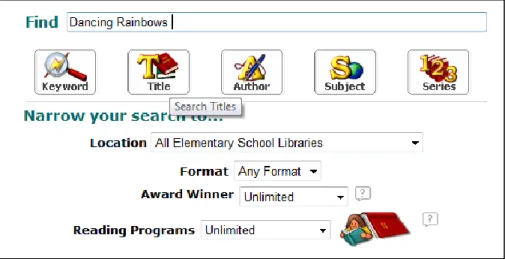
results a second search using the author‟s name was conducted (see Figures 1 and 2
below):
Figure 2: Author Search
When comparing the items that appeared within both lists in each county, I further
limited analysis to focus upon materials identified as books, rather than include materials
were not included in analysis. As the online catalogs are set up, it is not possible to limit
the initial search to books; however search results can be organized according to type and
thus limit the analysis, as illustrated by Figures 3 and 4.
Figure 3: Limiting Search to Books
I collected data regarding the total number of circulating copies for each title.
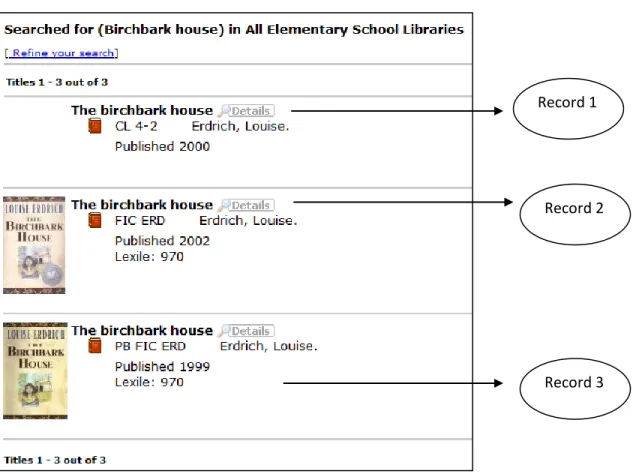
After searching by title and/or author, if the county held the item, search results would
frequently appear as denoted in Figure 5.
Figure 5: Search Results
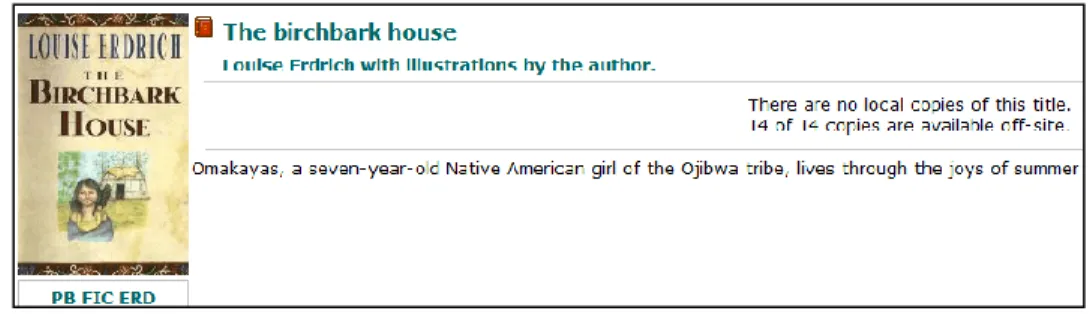
In order to gather totals for circulating copies, I would then click on each of the
search results, totaling the number of circulating titles held under each record (Figures
6,7, and 8).
Record 1
Record 2
Figure 6: Record 1 - 3 Circulating Copies
Figure 7: Record 2 - 4 Circulating Copies
Figure 8: Record 3 - 14 Circulating Copies
I followed this process in each county, for each title/author search with multiple records
returned. Circulating copies were added from each record.
Drawbacks/limits of methodology
The analysis sampling was limited by school districts with online access to their
catalogs. Secondly, it is difficult to impossible to know how materials are presented or
used in the media program, save for examining their call numbers and catalog data, such
as key words, and pop-up informational texts, such as reviews. Additionally, because the
programs‟ Native American holdings (from an informal observational standpoint,
probably not). Finally, research error is quite possible. There is also no way to know the
total number of resources within a collection, which would be helpful for determining the
percentage of recommended/not recommended resources in relation to the overall
collection, a figure which would be quite telling. Finally, at times, when working
through A Broken Flute, it was difficult to decide if a resource that received positive and
negative analysis should be considered recommended or not – at times the reviews
explicitly stated that the item was or was not recommended, but this did not occur in
every evaluation. I based my decision on the overall tone of the review.
Results
Titles that Were Not Recommended
After consulting A Broken Flute, I totaled 296 titles that were not recommended,
for a variety of reasons, many of which involve a lack of cultural authenticity related to
characterization, plot, illustration, and historical truth. As Tables 1 and 2 show,
Cumberland County held 36.8 percent of the titles that were not recommended,
circulating 1,384 copies. Of the 296 titles, Robeson County held 19.6 percent with 606
circulating copies. Swain County, with 14.5 percent of the non-recommended titles,
circulated 94 titles.
Table 1: Non-Recommended Titles Held
County Non-Recommended Titles Held N=296
Table 2: Circulating totals for Each County System
County Circulating Copies
Cumberland 1,384
Robeson 606
Swain 94
Cumberland County‟s top five titles with the most copies in circulation made up
40.6% of the total circulation for non-recommended titles (see Table 3).
Table 3: Cumberland County Top Five Circulating Non-Recommended Titles
Rank Title # of
copies
1 Wilder, Laura Ingalls, Little House on the Prairie. 261 2 Creech, Sharon, Walk Two Moons. 1994 195 3 Martin, Rafe, The Rough-Face Girl. 1992 105 4 Osborne, Mary Pope, Buffalo Before Breakfast.
1999
94
5 O‟Dell, Scott, Sing Down the Moon. 89
The five titles that comprised 45.0% of Robeson‟s total circulating
non-recommended titles are shown below in Table 4.
Table 4: Robeson County Top Five Non-Recommended Circulating Titles
Rank Title
# of copies
1 Wilder, Laura Ingalls, Little House on the Prairie 99 2 Martin, Rafe, The Rough-Face Girl. 1992 62 3 Osborne, Mary Pope, Buffalo Before Breakfast.
1999
43
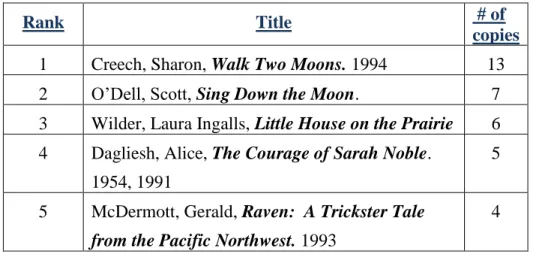
As shown in Table 5, Swain County‟s five titles with the most number of
circulating copies made up 37.2% of the county‟s total number of non-recommended
circulating titles.
Table 5: Swain County Top Five Circulating Non-Recommended Titles
Rank Title # of
copies
1 Creech, Sharon, Walk Two Moons. 1994 13 2 O‟Dell, Scott, Sing Down the Moon. 7 3 Wilder, Laura Ingalls, Little House on the Prairie 6 4 Dagliesh, Alice, The Courage of Sarah Noble.
1954, 1991
5
5 McDermott, Gerald, Raven: A Trickster Tale from the Pacific Northwest. 1993
4
Four percent (12) of the 296 titles were held in common by the three systems, as
illustrated in Table 6.
Table 6: Non-Recommended Titles Held by All Systems
Title Cumberland
# of copies
Robeson # of copies
Swain # of copies
Bunting, Eve, Cheyenne Again. 1995 6 5 1
Creech, Sharon, Walk Two Moons. 1994
195 31 13
Dagliesh, Alice, The Courage of Sarah Noble. 1954, 1991
26 19 5
Edmunds, Walter, The Matchlock Gun. 1941, 1989
58 17 5
London, Jonathan, Fire Race: A Kauk Coyote Tale. 1993
Martin, Rafe, The Rough-Face Girl. 1992
105 62 1
O‟Dell, Scott, Sing Down the Moon. 89 35 7 Osborne, Mary Pope. Buffalo Before
Breakfast. 1999
94 43 5
Rinaldi, Ann, My Heart is on the Ground: The Diary of Nannie Little Rose, A Sioux Girl, Carlisle Indian School, Pennsylvania 1880.
31 5 3
Schneider, Antoine, The Birthday Bear. 1996
13 12 1
Van Laan, Nancy, Rainbow Crow. 1989
18 4 1
Wilder, Laura Ingalls, Little House on the Prairie.
261 99 6
Recommended Titles
After consulting A Broken Flute, Debbie Reese‟s blog, “I is For Inclusion,” the Native American Youth Services Literature Award (AYSL) list, and the First Nation
Communities Read list, I compiled a list of 270 recommended titles. The recommending
source, title, and circulating number of copies held by each county are all detailed in the
appendix, and summarized below in Tables 7 and 8:
Table 7: Recommended Titles Held
County Recommended Titles Held N=270
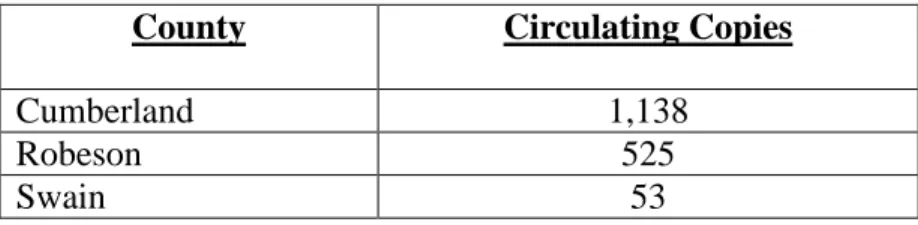
Table 8: Circulating Totals for Each County System
County Circulating Copies
Cumberland 1,138
Robeson 525
Swain 53
Cumberland County‟s five titles with the most circulating copies totaled 316
circulating copies, and comprised 27.8% of total recommended titles in circulation (see
Table 9). The five recommended titles with the most circulating copies for Robeson
County comprised 43.2% of Robeson‟s total circulating recommended titles, as illustrated
below in Table 10.
Unlike Cumberland and Robeson Counties, which had five clearly delineated
titles with the most number of copies in circulation, Swain County had several titles with
the same number of copies in circulation. Including all of the titles that had two copies in
circulation, Swain County‟s five titles with the most copies in circulation comprised
58.5% of Swain‟s total number of circulating recommended titles (see Table 11).
Table 9: Cumberland County Top Five Recommended Circulating Titles
Rank Recommending
Source
Title
# of copies
1 BF Bruchac, Joseph, Skeleton Man. 2001 71 1 BF Steptoe, John. The Story of Jumping
Mouse: A Native American Legend 1984
71
3 DR Dorris, Michael. (1996). Sees Behind Trees.
60
4 BF; DR Scott, Ann Herbert On Mother’s Lap 1972 and 1992
Rank Recommending
Source
Title
# of copies
5 DR Munsch, Robert. (1989). A Promise Is a Promise.
56
316 total
Table 10: Robeson County Top Five Recommended Circulating Titles
Rank Recommending
Source
Title # of copies
1 BF; I Dennis, Yvonne Wakim and Arlene Hirschfelder, Children of Native America Today. 2003
71
2 BF Bruchac, Joseph, Skeleton Man. 2001 49 3 DR Munsch, Robert. A Promise Is a Promise.
1989
47
4 BF; DR Scott, Ann Herbert On Mother’s Lap. 1972 and 1992
35
5 BF Steptoe, John. The Story of Jumping Mouse: A Native American Legend. 1984
25
227 total
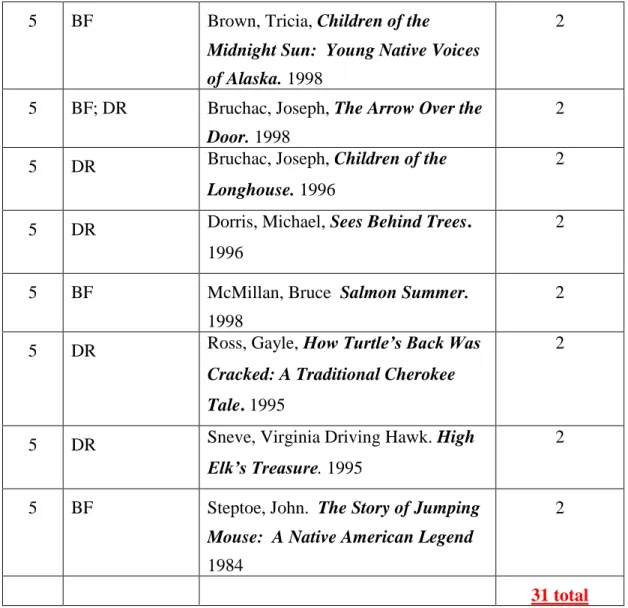
Table 11: Swain County Top Five Circulating Titles
Rank Recommending
Source
Title
Swain # of copies
1 DR Bruchac, Joseph, The Story of the Milky Way. 1995
4
1 DR; I Dorris, Michael, Guest. 1994 4
1 DR Dorris, Michael, Morning Girl. 1992 4 4 DR Munsch, Robert, A Promise Is a
Promise. 1989
5 BF Brown, Tricia, Children of the Midnight Sun: Young Native Voices of Alaska. 1998
2
5 BF; DR Bruchac, Joseph, The Arrow Over the Door. 1998
2
5 DR Bruchac, Joseph, Children of the Longhouse. 1996
2
5 DR Dorris, Michael, Sees Behind Trees. 1996
2
5 BF McMillan, Bruce Salmon Summer. 1998
2
5 DR Ross, Gayle, How Turtle’s Back Was Cracked: A Traditional Cherokee Tale. 1995
2
5 DR Sneve, Virginia Driving Hawk. High Elk’s Treasure. 1995
2
5 BF Steptoe, John. The Story of Jumping Mouse: A Native American Legend 1984
2
31 total
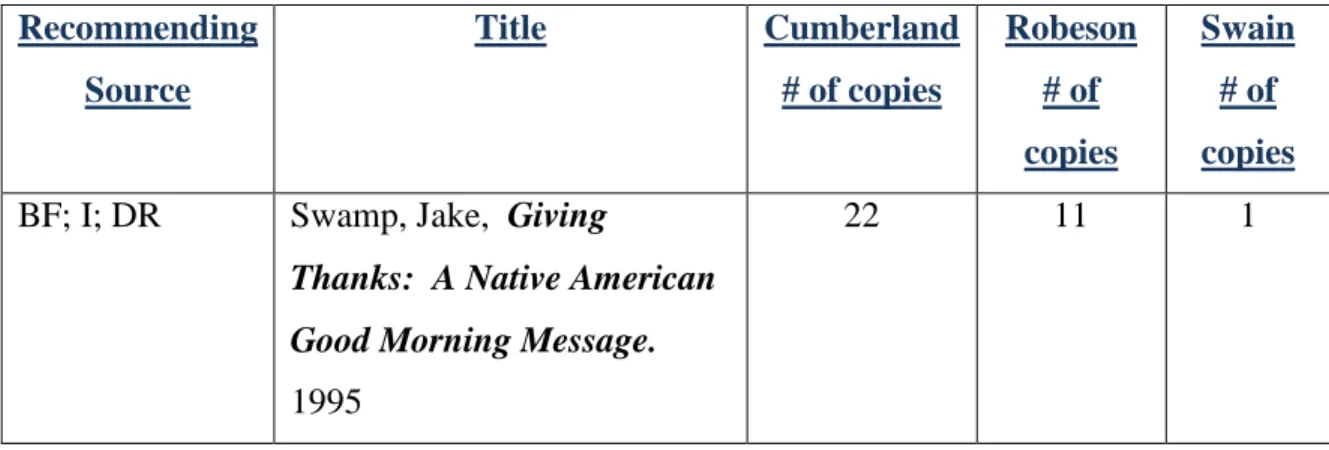
8.5% (23) of recommended titles were held by all three counties (23 titles), as
shown in Table 12.
Table 12: Recommended Titles Held by All Systems
Recommending
Source
Title Cumberland
# of copies
Robeson
# of
copies
Swain
# of
copies
DR Ancona, George, Powwow. 1993
Recommending
Source
Title Cumberland
# of copies
Robeson # of copies Swain # of copies
DR Andrews, Jan, Very Last First Time. 1988
19 11 1
BF; DR Bruchac, Joseph, The Arrow Over the Door. 1998
25 8 2
DR Bruchac, Joseph, Children of the Longhouse. 1996
20 9 2
DR Bruchac, Joseph. The Story of the Milky Way. 1995
33 12 4
BF Bruchac, Joseph, Crazy Horse’s Vision. 2000
13 5 1
BF Bruchac, Joseph, Skeleton Man. 2001
71 49 1
BF Bruchac, Joseph and James Bruchac, How Chipmunk Got His Stripes. 2001
27 5 1
BF Caduto, Michael J. and Joseph Bruchac, Keepers of the Animals: Native American Stories and Wildlife Activities for Children. 1991
5 3 1+
teacher‟s guide
DR; I Dorris, Michael, Guest. 1994 21 6 4
DR Dorris, Michael Morning Girl. 1992
28 11 4
DR Dorris, Michael. Sees Behind Trees. 1996
60 3 2
BF; ALA; DR Erdrich, Louise, The Birchbark House. 1999
Recommending
Source
Title Cumberland
# of copies
Robeson
# of
copies
Swain
# of
copies
BF; I; DR Grace, Catherine O‟Neill and Margaret Bruchac, 1621 A New Look at Thanksgiving. 2001
20 5 1
DR Harjo, Joy, The Good Luck Cat. 2000
3 4 1
DR Munsch, Robert, A Promise Is a Promise. 1989
56 47 3
BF; DR Peters, Russell M.
Clambake: A Wampanoag Tradition. 1992
9 1 1
DR Ross, Gayle, How Turtle’s Back Was Cracked: A Traditional Cherokee Tale. 1995
37 14 2
BF; DR Scott, Ann Herbert, On Mother’s Lap. 1972 and 1992
58 35 1
BF; I; DR Smith, Cynthia Leitich, Jingle Dancer. 2000
11 8 1
DR Sneve, Virginia Driving Hawk The Cherokees: A First Americans Book. 1996
19 2 1
BF Steptoe, John, The Story of Jumping Mouse: A Native American Legend. 1984
Recommending
Source
Title Cumberland
# of copies
Robeson
# of
copies
Swain
# of
copies
BF; I; DR Swamp, Jake, Giving
Thanks: A Native American Good Morning Message. 1995
22 11 1
Interestingly, and illustrative of the complexity of cultural authenticity in
children‟s literature, there were five titles that appeared on BOTH the recommended and
not-recommended list. Two titles from “„I‟ Is For Inclusion” (I)were not recommended
by A Broken Flute, as was one title from the First Nations Community Reads program (FN), and one title from the list from Debbie Reese‟s blog (DR). The recommending
source, title, and number of circulating copies in each county are detailed in Table 13.
Table 13: Titles On Both the Recommended and Not-Recommended Lists
Recommending
Source Title
Cumberland # of copies
Robeson # of copies
Swain # of copies
I Secakuku, Susan, Meet Mindy: A Native Girl from the Southwest. 2003
1 1 0
FN Spalding, Andrea Solomon’s Tree. 2002
0 1 0
I Tapahonso, Luci and Eleanor Schick, Navajo ABC: A Dine Alphabet Book. 1995
8 0 0
I Tayac, Gabrielle, Meet Naiche: A Native Boy from the Chesapeake Bay