We have complied with the requirements of the Honor code in all aspects of this submitted work.
NC DELTA 2011-2012 Capstone Summary Report, page 2
Table of Contents
Acronym Guide ... 4
Acknowledgements ... 5
Abstract ... 6
Deliverables: ... 7
Introduction ... 8
Work Plan Deliverables Rationale ... 10
Background ... 12
Information Gaps ... 12
DV Prevention ... 13
Utilization-Focused Evaluation ... 14
Community Assessment ... 15
Methods ... 16
Logic Model ... 16
Description of Deliverables ... 20
Community assessment deliverables. ... 20
Evaluation deliverables. ... 20
Sustainability ... 21
Engagement ... 22
Intended beneficiaries. ... 23
Engagement activities. ... 23
Community assessment deliverables. ... 23
Evaluation deliverables. ... 24
Results ... 25
Sustainability Findings... 25
Factors within the organizational setting ... 25
Project design and implementation factors... 27
Factors within the broader community. ... 28
NC DELTA 2011-2012 Capstone Summary Report, page 3
Deliverables Findings ... 31
Discussion... 34
Strengths and Limitations of Engagement & Assessment Activities ... 34
Potential Impact & Benefits ... 35
Community partners. ... 36
Lessons Learned & Challenges ... 37
Considerations for Sustainability ... 39
Conclusion & Recommended Next Steps ... 41
References ... 42
Appendices ... 44
NC DELTA 2011-2012 Capstone Summary Report, page 4
Acronym
Guide
CCR – Community Coordinated Response
CDC – Centers for Disease Control and Prevention CFP – Coalition for Family Peace
DELTA – Domestic Violence Prevention Enhancement and Leadership Through Alliances DV – Domestic Violence
EVOLVE! – Encouraging Values and Opportunities for Living in a Violence-free Environment FVRC – Family Violence and Rape Crisis Services of Chatham County
IPV – Intimate Partner Violence
NC DELTA 2011-2012 Capstone Summary Report, page 5
Acknowledgements
NC DELTA 2011-2012 Capstone Summary Report, page 6
Abstract
Background: An estimated one in five North Carolina women report experiencing violence by an
NC DELTA 2011-2012 Capstone Summary Report, page 7
Deliverables
:
Community Assessment Survey of domestic violence knowledge, attitudes, and beliefs in New Hanover County
Presentation of findings on domestic violence knowledge, attitudes, and beliefs in New Hanover County
One-page fact sheet of findings on domestic violence knowledge, attitudes, and beliefs in New Hanover County
Process and outcome evaluation toolkits for New Hanover’s Civil Workplace Summit domestic violence prevention program
Process and outcome evaluation toolkits for New Hanover’s Faith Leaders Training domestic violence prevention program
NC DELTA 2011-2012 Capstone Summary Report, page 8
Introduction
The Capstone project is a key component of the curriculum for the Masters of Public Health in Health Behavior and Health Education at the UNC Gillings School of Global Public Health. The Capstone project consists of a yearlong mentored field project in which a team of students partner with a community organization in order to work toward shared public health goals. This is the third year that a Capstone team has worked with North Carolina Coalition Against Domestic Violence (NCCADV) on work related to evaluation of the North Carolina Domestic Violence Prevention Enhancement and Leadership Through Alliances (DELTA) project. Leah Perkinson, the Prevention Coordinator at NCCADV, has served as each team’s primary community partner for all three DELTA Capstone teams. In the Capstone’s first year, 2009-2010, the Capstone team focused on increasing capacity at the state-level to support domestic violence (DV)1 prevention activities (Casey et al., 2011). In the second year, 2010-2011, the Capstone team focused on developing local-level evaluation initiatives for the Coalition for Family Peace (CFP), Chatham County’s Coordinated Community Response Team (CCR). Evaluation tools were developed in close collaboration with CFP and with Family Violence and Rape Crisis Services (FVRC) in Chatham County, NC, CFP’s local fiscal agent. The 2011-2012 team continued the local-level evaluation initiatives started in 2010-2011, partnering with Reverend Rick Houston, a local Reverend and the Prevention Specialist of Encouraging Values and Opportunities for Living in a Violence-free Environment! (EVOLVE! Wilmington) in New Hanover County. Reverend Houston, and the members of EVOLVE! Wilmington, served as the secondary community partner for the 2012-2011 Capstone team.
The current and previous Capstone groups have all worked with NCCADV on projects related to the DELTA initiative, which was created by the Centers for Disease Control and Prevention in an effort to
1
NC DELTA 2011-2012 Capstone Summary Report, page 9 support and engage in efforts that prevent first time perpetration of DV and promote healthy relationships (CDC) in 2002. The DELTA initiative was designed to reduce the incidence of DV through funding community level efforts (Centers for Disease Control and Prevention, 2011). Funding is passed down from the federal level to state domestic violence coalitions, who then disperse funds to the CCRs for primary prevention efforts at the community level (Centers for Disease Control and Prevention, 2011). As part of the DELTA initiative, evaluators are working with individuals at the state and local level to evaluate the impacts that DELTA funded programming has had on the prevention of DV (Centers for Disease Control and Prevention, 2011).
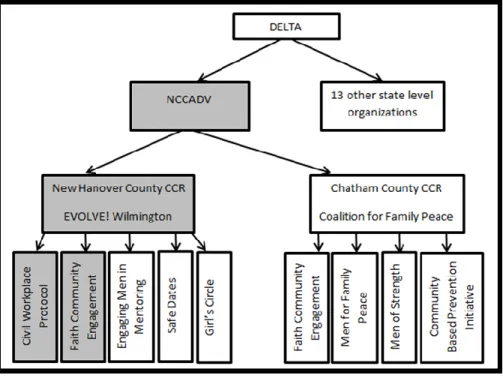
The DELTA initiative currently funds 14 statewide domestic violence coalitions to support state and local prevention efforts (Centers for Disease Control and Prevention, 2011). Since the creation of DELTA, North Carolina has been a recipient of DELTA funding with NCCADV serving as the state-level coalition. NCCADV uses DELTA funds to support the prevention efforts of two local CCRs, Coalition for Family Peace in Chatham County in Chatham County and EVOLVE! Wilmington in New Hanover County (NCCADV, 2011).
NC DELTA 2011-2012 Capstone Summary Report, page 10 The Business Community Action team focuses on knowledge, attitudes and norms around DV as they relate to the workplace. The team’s primary program is the annual Civil Workplace Summit, a free two-day summit designed for human resource personnel and business managers focusing on the impact of domestic violence in the workplace. The Faith Community Action Team focuses on knowledge, attitudes and norms around DV as they relate to faith communities. Throughout the year, at the request of various religious organizations, the Faith Community Action Team provides workshops on DV to faith community members, lay leaders, and pastors.
Work Plan Deliverables Rationale
The aim of both the DELTA initiative and EVOLVE! Wilmington is to decrease the incidence of DV. Our Capstone team contributed to this work through the overall goal of building EVOLVE! Wilmington’s capacity to improve their DV prevention programming. We worked to achieve this goal through two distinct groups of deliverables: (1) the community assessment deliverables and (2) the process and outcome evaluation deliverables. The deliverables for the community assessment
NC DELTA 2011-2012 Capstone Summary Report, page 11 component of our work plan included: (1a) the Community Assessment Survey, (1b) a PowerPoint presentation of the community assessment findings, and (1c) a fact sheet of community assessment findings. The deliverables for the evaluation component of our work plan included: (2a) process and outcome evaluation toolkits for both the Civil Workplace Summit and Faith Leader Trainings, and (2b) a 5-hour evaluation training workshop. Both the community assessment and evaluation components of our work serve to refine New Hanover County’s current prevention efforts based on process and outcome evaluation data and data from the community assessment, as depicted in Figure 2. The diagram visually illustrates the synergy between these two distinct components and how they work towards our collective purpose.
Figure 2. Integration of the 2011-2012 DELTA Capstone Team’s community assessment deliverables and evaluation deliverables.
This report outlines the details of our experience partnering with NCCADV and EVOLVE! Wilmington. It includes a background on our methods, the rationale for our Capstone project, our plan for sustainability, our work plan approach and logic model, community engagement and assessment process, key deliverables, potential impacts of our project, key findings, and lessons learned.
Ongoing Domestic Violence Prevention Efforts in New Hanover County
Community Assessment Deliverables
NC DELTA 2011-2012 Capstone Summary Report, page 12
Background
In addition to being a fundamental denial of human rights, domestic violence (DV) is linked with a vast array of health outcomes that damage social structures and contribute to the global burden of disease (General Assembly, 1993). In this paper, we use female pronouns and refer to victims of DV as women. This is because the vast majority of victims of DV are women and they bear the greatest burden of this public health issue (Centers for Disease Control and Prevention, 2011). DV is defined as physical, emotional, sexual or economic abuse by a current or former spouse or partner and can range from a single act of violence to more frequent acts of violence where one partner works to gain control over the other partner (Centers for Disease Control and Prevention, 2009). Chronic pain, depression,
reproductive disorders, and post-traumatic stress are among the negative health outcomes attributed to DV (Mikton, 2010). In the United States alone, costs associated with DV exceed $8.3 billion dollars annually (Centers for Disease Control and Prevention, 2011). These costs include medical care, mental health services, lost productivity and wages.
In addition to the outcomes listed above, many public health researchers and practitioners consider the experience of DV itself as a health outcome of interest. The CDC identified violence as a leading public health problem in the mid-1980s, followed by the World Health Assembly in 1996 (Rosenberg et al., 2006). This has led to an increased focus on using a scientific, evidence-based public health approach to understanding and intervening on many types of violence (Rosenberg et al., 2006). The CDC’s DELTA initiative aims to prevent first-time perpetration of DV and first-time victimization (Centers for Disease Control and Prevention, 2011)
Information Gaps
NC DELTA 2011-2012 Capstone Summary Report, page 13 because many victims and survivors, for a variety of reasons, choose not to report DV. Therefore, the data that do exist tend to under-represent the true magnitude of the problem (Smith, 1994). Varied ways of classifying the frequency of DV in a woman’s life also contribute to challenges with data. For example, some studies only measure violence occurring in the past 12 months; whereas other studies might measure lifetime experiences of domestic violence (Smith, 1994).
In addition to measurement issues, DV research to date has focused on the individual-level experiences of victims and survivors of DV, which has had a limited impact on rates of DV (Jewkes, 2002). For example, these individual-level interventions might include providing shelter services and restraining orders to women escaping violence. While these responses are crucial for victims and survivors in crisis, additional research and interventions are needed to more effectively prevent DV from occurring in the first place.
There is a lack of evidence demonstrating the effectiveness of most DV primary prevention programming (Mitchell-Clark & Autry, 2004). The body of DV prevention research is scant and funding dedicated to the development, implementation, and evaluation of DV prevention programs is limited (Martin et al., 2009). As a result, there is little evidence base upon which to inform best practices for DV prevention (Hickman, Jaycox, & Aronoff, 2004; Mitchell-Clark & Autry, 2004; Whitaker et al., 2006).
DV Prevention
NC DELTA 2011-2012 Capstone Summary Report, page 14 identified through cross-sectional studies, an underlying causal model for first time perpetration of DV has not been identified (Guterman, 2004). Supporting evaluation efforts is a first step to understanding the causes of DV and ways to prevent it.
Efforts to prevent DV should influence individuals, interpersonal relationships, and the community as a whole. Intervening on the individual level might include a program designed to improve/change psychosocial characteristics such as attitudes towards women and beliefs about equitable gender norms. A community intervention might include a social media campaign encouraging community members to speak up when they overhear a sexist remark. Researchers and practitioners believe these types of efforts will be effective because research in multiple settings has shown how inequitable and rigid gender norms, as well as power imbalances between women and men, lead to DV (Ricardo & Barker, 2008). Also, findings indicate that adult and adolescent men who adhere to more rigid views about masculinity are more likely to report use of violence against a partner (Promundo and ICRW, 2011). These findings suggest that inequitable gender norms play a major role in DV and efforts to prevent DV should be multifaceted in order to address these societal-level concerns (McLeroy, Bibeau, Steckler, & Glanz, 1988).
Utilization-Focused Evaluation
A Utilization-Focused Evaluation framework guided the process and outcome evaluation
NC DELTA 2011-2012 Capstone Summary Report, page 15 refine the tools, make them more user-friendly, and support CCRs with technical assistance from
NCCADVin order to increase the chances that evaluation practice would be adopted. To refine the evaluation tools for the New Hanover context and encourage institutionalization, the 2011-2012 DELTA Capstone team chose to employ Utilization-Focused Evaluation (UFE). UFE is a framework for evaluation asserting that evaluations should be judged by their utility and actual use by the intended users (Patton, 2002). The goal of this evaluation framework is to work closely with the intended users so they will be able to implement changes based on the evaluation findings (Patton, 2002).
The literature suggests that employing a UFE framework will encourage intended users to begin to use the tools to evaluate their programs (Patton, 2002). Sustained evaluation efforts will provide intended users information about their interventions that will help the organization make changes to future programming and this information will add to the overall evidence base for DV prevention. The UFE framework also encourages a commitment to ongoing evaluation and continuous programming improvement, thus improving an organization’s chances for continued grant funding.
Community Assessment
The literature on the uses and benefits of community assessments guided the community assessment deliverables of our work plan. The purpose of a community assessment is to recognize factors that affect the health of a community or population and to use this information to improve health (Healthy Carolinians, 2012). A community assessment shows us that determinants of good health can include behavioral, social, and cultural components (Israel, 2005; Krieger, 2003). Also, the
assessment helps communities understand their strengths and needs, and can help a community to identify where they are in relation to a particular health outcome, where they want to be, the resources they have to get there, and the resources they need (Israel, 2005).
NC DELTA 2011-2012 Capstone Summary Report, page 16 all of these components. By understanding how the community perceives DV, why it occurs, who is responsible, how to address and prevent it, EVOLVE! Wilmington’s programming can more effectively target the attitudes and norms identified in the assessment that may contribute to, support, or otherwise help to sustain the perpetration of DV.
Methods
Logic Model
As previously mentioned, the overall goal of the CDC’s DELTA initiative is to prevent first time perpetration of DV (CDC, 2011). Our Capstone team’s efforts aim to contribute to DELTA’s overarching goal by providing EVOLVE! Wilmington members with the tools and training to increase their capacity to refine and improve their prevention programming. The following section describes how our Capstone team accomplished the immediate outcomes and how change is expected to occur within New Hanover County.
In order to show a logical relationship between the collective goals presented above, the resources invested, and the activities that took place, we developed a logic model. A logic model is a basic tool or blueprint that outlines how a program or process arrives at the end goal. Logic models can be a visual or verbal representation of how inputs or resources, such as staff and funding, are utilized through activities to produce outputs, such as the project deliverables. The outputs then lead to outcomes, intended short term changes in the target population, which will eventually lead to changes in a long-term goal. In addition to facilitating the understanding of a program, logic models are an important component of process and outcome evaluations because they clearly indicate the major steps that lead to changes in outcomes (Kellogg, 2004).
NC DELTA 2011-2012 Capstone Summary Report, page 17 evaluation tools are the main inputs into this Capstone experience. Human capital includes the Capstone team, community partners at NCCADV and EVOLVE! Wilmington, as well as our faculty advisor. By pooling these resources and collaborating with our community partners, a Community Assessment Survey of New Hanover County residents’ attitudes, knowledge, and beliefs about domestic and sexual violence (SV) was created by refining the Chatham County community assessment survey, developed by the 2010-2011 Capstone team. The CCR members were responsible for distributing both the paper and electronic copies of the Community Assessment Survey to New Hanover County residents. These data were entered into a statistical package and analyzed for results and trends. After this analysis, the PowerPoint presentation and fact sheet of community assessment findings were produced.
Additionally, we developed the process and outcome evaluation toolkits for two current prevention efforts in New Hanover County: an annual Civil Workplace Protocol Summit and an ongoing Faith Leaders Training. We designed an appropriate evaluation-training workshop for New Hanover and Chatham County CCR members.
The main outputs for this project are (1a) a Community Assessment Survey, (1b) a PowerPoint presentation of the community assessment findings and (1c) a fact sheet of community assessment findings, (2a) process and outcome evaluation, and (2b) an evaluation training workshop. With ongoing technical assistance and support from NCCADV and DELTA, the community-informed tools and
NC DELTA 2011-2012 Capstone Summary Report, page 19 Figure 2. Logic model for the 2011-2012 NC DELTA Capstone team. New Hanover County is abbreviated as (NHC) for this figure.
Inputs
NC DELTA Grant
Capstone Team NCCADV Staff
• Leah Perkinson • Kris Macomber
EVOLVE! Wilmington
• Rick Houston
Faculty Advisor
• Dr. Beth Moracco
Teaching Team Technical Consultants
• Dr. Mike Bowling
SAS Staitistical Package
Qualtrics Survey Software
Knowledge of evaluation techniques and tools
Knowledge of community assessment tools
2010-2011 Chatham County DELTA community assessment tools 2010-2011 Chatham County DELTA evaluation tools
Activities
Refine Community Survey from Chatham County
Critique NHC Community Survey with EVOLVE! Wilmington via teleconference and inperson meetings Incorporate sexual violence community assessment tool into the NHC Community Survey
Create online NHC Community Survey tool
Enter NHC Community Survey data from paper surveys
Conduct a discriptive analysis on the NHC Community Survey results Create summary report and PowerPoint presentation highlighting NHC's Community Survey results Teleconference with community partners to determine specific community prevention efforts Refine Faith Leader Training Evalution Tools from Chatham County Refine Civile Workplace Protocol Evaluation Tools
Meet with EVOLVE! Wilmington and other community partners to solicit feedback on Evaluation Tools Learning assessment of training workshop participants Develop 45 minute Evaluation 101 workshop
Help facilitate workshop on real world evaluation methods and procedures with loval DV lagencies including EVOLVE! Wilmington
Submit Evaluation Tools to CDC
Outputs
Community Assessment Survey of domestic violence knowledge, attitudes, and beliefs in New Hanover County PowerPoint Presentation of the Community Assessment Findings Fact Sheet of Community Assessment findings
Process and outcome evaluation toolkits for New Hanover’s Civil Workplace Summit domestic violence prevention program
Process and outcome evaluation toolkits for New Hanover’s Faith Leaders Training domestic violence prevention program
Evaluation Training Workshop on use of process and outcome evaluation toolkits for New Hanover and Chatham County domestic violence prevention staff
Outcomes
Increase in understanding of NHC residents' attitudes, knowledge, and beliefs about DV
Increase in tailoring of NHC DV prevention programs according to NHC resident's needs
Increase in evaluation of DV prevention efforts in NHC
Increase in user friendly DV evaluation tools at the national level
Increase in funding for NHC prevention programs due to an increase in evaluated programs
Institutionalization of evalution of DV programs in NHC
Impact
NC DELTA 2011-2012 Capstone Summary Report, page 20
Description of Deliverables
Community assessment deliverables. In 2010, NCCADV, EVOLVE! Wilmington and Chatham County’s CCR, the Coalition for Family Peace, determined that a community assessment of knowledge, attitudes and beliefs about domestic violence would be helpful at informing programming in New Hanover and Chatham counties. Our Capstone team built on the existing work in Chatham County, editing Chatham County’s survey in collaboration with EVOLVE! Wilmington members to reflect the needs and specific concerns of New Hanover County.
The CCR members performed all the data collection, receiving a total of 513 respondents. We analyzed the findings with guidance from EVOLVE! Wilmington members on which questions,
demographics, and variables they were most interested in. We then created a PowerPoint and one-page fact sheet to present the results in a way that is both easy to disseminate and will meet NCCADV
reporting needs. Using the PowerPoint and fact-sheets, our Capstone team presented the results of the community assessment after the evaluation training workshop in New Hanover, with the purpose of disseminating the information to our key stakeholders. The presentation of results and the discussion increased the awareness and knowledge about community attitudes and beliefs related DV and SV in New Hanover County. The PowerPoint and fact-sheets also provide our community partners with a valuable tool for funding applications and communicating with their stakeholders. The various deliverables within the community assessment component therefore work as an integrated whole to build EVOLVE! Wilmington’s capacity to improve their ongoing programming.
Evaluation deliverables. Since evaluating local prevention programming is a stipulation for funding through the CDC’s DELTA initiative, developing user-friendly evaluation tools as well as local evaluation capacity was a priority for NCCADV and EVOLVE! Wilmington.
NC DELTA 2011-2012 Capstone Summary Report, page 21 without the assistance of outside evaluators or intensive technical support. The toolkits are a package of pre-, post-, 6-month follow-up, and process surveys with instructions on who should fill them out, when, and how the information should be analyzed. Our Capstone team developed these toolkits by adapting existing Chatham County tools through discussions with EVOLVE! Wilmington members. Together, we conducted an evaluability assessment, a systematic process intended to determine if program
evaluation is feasible, justifiable and likely to provide results (Moracco, 2012). We also determined the appropriate evaluation design and analysis procedures. The tools were refined in an iterative, hands-on meeting in New Hanover County where members of EVOLVE! Wilmington reviewed each tool,
commenting on the appropriateness of overall evaluation questions and specific items. After incorporating this feedback, the final tools were inputted into SurveyMonkeyTM by NCCADV so that EVOLVE! Wilmington will have a platform to collect and analyze evaluation data in the future.
A UFE framework also includes training intended users through simulations of data collection, input, analysis, and interpretation with hypothetical data. To increase capacity of the local CCRs in New Hanover County and Chatham County to evaluate their programming, we designed an interactive workshop on basic evaluation concepts and how to use the tools created by the 2010-2011 NC DELTA Capstone team for Chatham County and by the 2011-2012 Capstone team for New Hanover County. At the workshop, our Capstone team presented the 45 minute Evaluation 101 portion of the workshop and assisted with the facilitation of activities on how to use the existing tools with the SurveyMonkeyTM platform. The various deliverables within the evaluation component therefore also serve to build EVOLVE! Wilmington’s capacity to improve ongoing DV programming.
Sustainability
NC DELTA 2011-2012 Capstone Summary Report, page 22 over an extended period of time after external support from the donor agency is terminated. Some ways to measure sustainability include: the maintenance of health benefits through the development of monitoring and tracking systems; the institutionalization or integration of a program into the overall organization; and building capacity through strengthening community competency and ownership of the program (Shediac-Rizkallah & Bone, 1998). Sustainability is a key feature of most public health programs and should be outlined early in a program’s development. Without a sustainability plan the limited time, effort, and funding resources of the community may not be efficiently used to advance or sustain long-term programming.
Achieving sustainability varies considerably across programs and depends upon the overall programmatic goals and long-term vision of a particular project. Using the Shediac-Rizkallah & Bone framework to conceptualize sustainability for the purposes of this Capstone, we defined sustainability of the project as: (1) the institutionalization of evaluation protocols among EVOLVE! Wilmington members, (2) strengthened community competency in evaluation methods (collecting, analyzing, interpreting data), and (3) increased assessment and evaluation activities among EVOLVE! Wilmington members. In order to increase the likelihood that these indicators would be met, we first considered the variety of components that influence sustainability, including project design and implementation factors, organizational factors, and factors within the broader community. Our analysis of these factors is included in the results section.
Engagement
Both achieving sustainability and successfully completing the activities, outputs, and outcomes laid out in our logic model required a meaningful engagement plan with our intended beneficiaries, the EVOLVE! Wilmington members. The CDC (1997) defines community engagement as “working
NC DELTA 2011-2012 Capstone Summary Report, page 23 similar situations to address issues affecting the wellbeing of those people.” As such, the process of community engagement is a vital step in program development in communities.
Intended beneficiaries. The collective goal of our work plan is to build the capacity of EVOLVE! Wilmington to improve their DV prevention programming. Thus, the stakeholders and intended
beneficiaries of our deliverables were Reverend Houston and other EVOLVE! Wilmington members. As a Capstone team, we worked directly with members of EVOLVE! Wilmington on both the community assessment and evaluation components of our work plan; however, the level and type of stakeholder engagement differed by deliverable.
Engagement activities. Developing a working relationship and engaging with EVOLVE!
Wilmington was a continuously evolving process that took different forms throughout our work. Initially, we worked primarily with Reverend Houston. At the start of the academic year, we had several
telephone conferences with Reverend Houston regarding information for both the community assessment and process and outcome evaluation components. These meetings provided us valuable insight into Reverend Houston’s role within the CCR, the structure, and general activities of EVOLVE! Wilmington. Yet, discussions over the telephone and information through Reverend Houston did not provide us with the direct, insider perspective that we needed in order to move forward with our projects and truly engage with the EVOLVE! Wilmington community. Therefore, our Capstone team sought additional engagement opportunities.
NC DELTA 2011-2012 Capstone Summary Report, page 24 community were mediated through Reverend Houston, who served as the liaison between our Capstone team and the members of the CCR. To that end, Reverend Houston sent an email out to the members of EVOLVE! Wilmington asking them to provide input and insight on the community assessment; however, we received little feedback. Thus, our first attempt at reaching out to the EVOLVE! Wilmington
community was largely unsuccessful.
At this point, we revised our community engagement approach. In October 2011, we hosted a meeting in Wilmington for the CCR members where we introduced ourselves, the project, and explained the importance of their input in our Capstone activities. This meeting was a huge success. Face-to-face, the CCR members were excited and engaged, providing valuable insight into the New Hanover
community, the programs currently being implemented, and how our work could best fit their needs. Our Capstone team continued to fully engage with EVOLVE! Wilmington as we began the analysis of the Community Assessment Survey. The analysis process was directed by the information needs articulated by Coastal Horizons and EVOLVE! Wilmington members. Our Capstone team kept an open dialogue with members, discussing emerging results and receiving guidance on which variables were most relevant to ongoing DV programming in New Hanover. We also worked with Coastal Horizons and EVOLVE!
Wilmington members on the PowerPoint and fact sheet in order to determine a format for the dissemination of findings that would be most useful for their purposes and most easily understood by their audiences.
NC DELTA 2011-2012 Capstone Summary Report, page 25 component by eliciting feedback from EVOLVE! Wilmington members during a meeting hosted in
Wilmington in January 2012.
Complementing the development of the process and outcome evaluation toolkits, the team collaborated on a 5-hour workshop in April 2012 in order to increase EVOLVE! Wilmington’s ability to conduct evaluation. The training as a whole covered evaluation basics, an introduction to
SurveyMonkeyTM, the use of the toolkits, and a simulation of data collection, input, analysis and
interpretation using hypothetical data. Overall, our sustainability and engagement efforts were designed to ensure the successful completion of the activities, outputs, and outcomes laid out in our logic model.
Results
Sustainability Findings
Factors within the organizational setting. Our Capstone team had a unique opportunity to work on a nationwide initiative while also interacting with a state coalition, county-level DV service providers, and EVOLVE! Wilmington. The established partnership between NCCADV and EVOLVE! Wilmington and their collective goal of using evaluation data to inform programming will increase the likelihood that EVOLVE! Wilmington will institutionalize evaluation protocols and tools into existing prevention efforts.
NC DELTA 2011-2012 Capstone Summary Report, page 26 for sustainability, this project is also well integrated within existing programs and services across
multiple sectors (Shediac-Rizkallah & Bone, 1998), thus providing an excellent organizational base for the project.
Using ongoing community assessment and evaluation data to inform continual quality improvement and sustainability of programming is viewed by the CDC, NCCADV, and EVOLVE! Wilmington as crucial to program success. Assessment and evaluation were viewed not only as an effective way to plan future interventions, but also an important method to build an evidence-base for EVOLVE! Wilmington’s programming. NCCADV has applied for and received federal funds dedicated to prevention efforts from the CDC since 2002 and is currently reapplying for further funding that will continue to support primary prevention efforts for another five-year cycle (CDC, 2011). The recognition among local, county, and state-level stakeholders of the need for data that improves the relevance, appropriateness, acceptability, and accessibility of prevention efforts will likely contribute to the sustainability of the EVOLVE! Wilmington’s efforts, and position NCCADV well to apply for additional CDC prevention dollars.
NC DELTA 2011-2012 Capstone Summary Report, page 27 capacity to perform evaluation and assessment. The established relationship between NCCADV and EVOLVE! Wilmington laid the groundwork for a productive work environment for our Capstone team and increased the potential for the sustainability of our Capstone work considerably.
Project design and implementation factors. According to Shediac-Rizkallah & Bone (1998), sustainability is a multi-dimensional concept; a diverse process that must include involvement from various levels in order to increase the likelihood of success. Because the tools, resources, and training workshop our Capstone team developed were produced in collaboration with agencies and stakeholders on multiple levels (individual, community, county, and state) the team anticipates that the uptake and institutionalization of these tools is quite likely. This adds considerably to the project’s overall
sustainability.
Additionally, the driving force behind the deliverables came from both the top-down and the ground-up. From the top down, the CDC and NCCADV requires that the CCRs within the DELTA network develop process, outcome, sustainability plans with accompanying tools. In addition to providing support to EVOLVE! Wilmington around evaluation plan and tool development, from the ground up, the team also met a need articulated by EVOLVE! Wilmington members: to develop, disseminate, and analyze the results of a community assessment in order to provide baseline data of community norms, attitudes and beliefs as they relate to DV.
NC DELTA 2011-2012 Capstone Summary Report, page 28 Wilmington staff members to administer refresher evaluation courses in the future. In addition, there are plans to post the evaluation tools and community assessment onto the NCCADV website. They will be downloadable tools that are a part of webinars on DV primary prevention program planning,
evaluation, and sustainability. Each deliverable was designed to build EVOLVE! Wilmington’s capacity to improve their ongoing DV prevention programming. With attention paid to the generalizability and transferability of the tools our Capstone team adapted, EVOLVE! Wilmington will likely be able to carry out community assessment and evaluation activities in the future with initial support and technical assistance from NCCADV.
Factors within the broader community. There were also factors within the broader community that potentially impacted the sustainability of this Capstone project. EVOLVE! Wilmington and NCCADV’s work on the state and local level are often affected by national-level legislation and federal funding. Because NCCADV is a CDC-funded initiative, support for the work of EVOLVE! Wilmington is not
guaranteed since funding for DV prevention activities is vulnerable to national-level budget cuts. In the current political climate, Congress is placing a large emphasis on deficit reduction and cutting the federal budget. However, there is also a larger national push by Democrats to prioritize women’s issues, such as birth control access and renewing the federal Violence Against Women Act, in an effort to court the vote of this important demographic leading up to the 2012 presidential election. Funding allocation to
EVOLVE! Wilmington could be affected by either of these national political trends.
Engagement & Assessment Findings
NC DELTA 2011-2012 Capstone Summary Report, page 29 flowed back and forth freely as momentum from the October 2011 meeting continued through email. The members provided valuable insight into how the tools could be adjusted based on their knowledge of on-the-ground implementation of the programs. Once this line of communication had been
established, it was easier to continue to work collaboratively with the CCR to adapt the process and outcome evaluation tools to the community context.
Another key finding was how to take advantage of unanticipated opportunities to increase community ownership of the process. During our discussions around the Community Assessment Survey, it became clear that Coastal Horizons had reservations about the deliverable since the organization was also planning a grant-required community assessment in the upcoming year. One of the members expressed concerns that volunteer resources available to implement such a community survey might be “tapped out” after our assessment and that the substantial overlap between our tools would make their efforts partially redundant. We were then able to collaborate with Coastal Horizons to merge our community assessment with theirs, serving to maximize our efforts and create more buy-in for our deliverables among the CCR members. The insights from both Reverend Houston and Katie Bennet, Coastal Horizon’s Rape Prevention Education Coordinator, ensured that the final version of the Community Assessment Survey, which underwent many iterations, fit the needs of both EVOLVE! Wilmington and Coastal Horizons.
Our Capstone team also found how to best utilize a key strength of our community partners: EVOLVE! Wilmington’s experience and connections in New Hanover. EVOLVE! Wilmington’s involvement in the assessment process dramatically changed the community assessment’s implementation plan. We originally based the community assessment’s implementation plan off the 2010-2011 Capstone team’s work in Chatham County, wherein volunteers tabled at local supermarkets, community colleges, and other community events. However, the EVOLVE! Wilmington members’ extensive experience
NC DELTA 2011-2012 Capstone Summary Report, page 30 many of the challenges in data collection faced by the 2010-2011 Capstone team. Including online surveys and links on prominent county websites maximized available community resources and increased the assessment’s coverage of hard-to-reach segments of the population. The CCR had complete ownership of the assessment implementation, including the timeline for distribution, networking with different organizations within the community for distribution, and the promotional campaign that accompanied the community assessment. Our role during the data collection process was minimal and EVOLVE! Wilmington truly took control of the process, resulting in exceeding the original goal of 500 completed surveys.
We also used the results of our engagement process to narrow the scope of our evaluation plan. Initially, we had planned on developing toolkits for all five DV prevention programs in New Hanover. However, from our early meetings and discussions with Reverend Houston, the results of the
NC DELTA 2011-2012 Capstone Summary Report, page 31
Deliverables Findings
The following table details each deliverable, its purpose, timeline, methods for completion, as well as key findings:
Community Assessment Survey
Purpose: To develop a tool for EVOLVE! Wilmington and Coastal Horizons to assess New Hanover County residents’ current knowledge, attitudes, and beliefs about DV and SV.
Timeline: September 2011 – January 2012
Methods Key Findings
Reviewed the 2010-2011 Community Assessment Survey for Chatham County
Secured IRB approval
Solicited feedback from EVOLVE! Wilmington members on potential changes
In-person feedback session with EVOLVE! Wilmington members
Collaboratively adapted content and implementation plan to address the challenges the 2010-2011 team faced
Incorporated questions from Coastal Horizons
Revised survey based on feedback from community partners and faculty advisor
Developed online version of the survey
Submitted final tools in paper and online form to community partners for data collection
Review of 2010-2011 survey
Survey was too long and implementation plan presented challenges to achieving a large and diverse sample size
In-person feedback session
Community Assessment Survey can be combined with Coastal Horizons assessment to pool community resources
EVOLVE! Wilmington has greater interest in DV in the workplace and SV issues than Chatham
Long data collection periods are not feasible for community partners
Online assessment surveys are an effective way to increase sample size and decrease the demand on staff resources
Process and Outcome Evaluation Toolkits
Purpose: To ensure that evaluation plans allow EVOLVE! Wilmington to measure both the process of implementing activities designed to prevent DV and the outcomes of the activities. Outcomes of interest include changes in participants’ norms, attitudes, beliefs and behaviors surrounding DV and healthy relationships.
Timeline: September 2011 – February 2012
Methods Key Findings
Reviewed tools created be 2010-2011 Capstone team for Chatham County and assessed which evaluations we could adapt
Revised logic models of EVOLVE! Wilmington DV prevention programming with community partner to reflect current activities
Conducted informal evaluability assessment
Evaluability assessment
Safe Dates, Men of Strength, and Girls Circle do not have consistent implementation and clear logic models, and therefore do not have the capacity to begin evaluation
NC DELTA 2011-2012 Capstone Summary Report, page 32 to determine feasibility of instituting
evaluation activities for each program
Adapted pre/post Faith-based Chatham outcome evaluation tool for New Hanover Faith Leader Trainings
Developed process and 6-month follow-up outcome evaluation tools for New Hanover Faith Leader Trainings
Reviewed literature on workplace DV evaluation tools that assess healthy relationship norms and gender norms
Developed pre/post, 6-month follow-up, and process evaluation tools for Civil Workplace Summit
In-person feedback session with EVOLVE! Wilmington members
Revised tools based on feedback from community partners and faculty advisor
Submitted final tools to EVOLVE! Wilmington
outcome evaluation
Review of tools created by 2010-2011 Capstone
Current tools are long, overly complicated and cumbersome to fill out; tools should be simplified and pared down for intended users
Faith-based programming in Chatham is similar to Faith Leaders Trainings in New Hanover and pre/post tools can be adapted for EVOLVE! Wilmington
Process and 6-month follow-up tools should be developed based on curriculum
Review of literature on workplace DV evaluation
Currently existing tools are not appropriate for the Civil Workplace Summit
Pre/post, process, and 6-month follow-up tools should be developed based on curriculum and the gold standard of workplace DV policies
PowerPoint Presentation of Community Assessment Findings & Fact Sheet of Community Assessment Findings
Purpose: To describe the results and implications of the data collected from the Community Assessment Survey and to present the findings in a meaningful and useful way to NCCADV, EVOLVE! Wilmington, and Coastal Horizons.
Timeline: February 2012 – March 2012
Methods Key Findings
Review descriptive analysis of 2010-2011 Capstone team
Identify key variables of interest in collaboration with community partners
Input data from paper surveys
Clean data from online surveys
Conduct data analysis
Produce PowerPoint presentation of
community assessment findings for EVOLVE! Wilmington and Coastal Horizons
Produce fact sheet of community assessment findings for EVOLVE! Wilmington and Coastal Horizons
Review of 2010-2011 descriptive analysis
2010-2011 descriptive analysis is long and very detailed, however not written for use by a lay audience
Presenting the results in a shorter, more easily understood format will increase utilization of the deliverable by community partners
Identification of key variables
Capstone partners were most interested in seeing a breakdown of DV and SV myths by gender and education, bystander efficacy by age, and awareness of services by zip code Data analysis
NC DELTA 2011-2012 Capstone Summary Report, page 33 but not within the workplace or among close friends.
o 93% of respondents agree or strongly agree that domestic violence is an issue that impacts the whole community, even those who are not directly experiencing it
o 87% of respondents agree or strongly agree that sexual violence is a problem in New Hanover County
o 54% of respondents agree or strongly agree that domestic violence is affecting or has affected their closest friends
o 35% of respondents agree or strongly agree that that domestic violence has negatively affected their workplace
There was almost no variation between the percent of men and women who agreed with DV and SV myths; there was a large variation in who agreed with DV and SV myths
between education levels.
Younger and older age groups had the lowest bystander efficacy.
Over 95% of people believe that services should be funded to both support victims and their children and to prevent domestic violence and sexual violence.
Zip code 28412 had the lowest awareness of DV and SV services.
Evaluation Training Workshop Findings
Purpose: To build CCR members capacity to conduct process and outcome evaluations of their programs using the toolkits developed by the Capstone team. Training will include Evaluation 101 (led by Capstone team), interactive demonstrations on how fill out evaluation tools and input information into online database management system, as well as data analysis (led by NCCADV).
Timeline: February 2012 – April 2012
Methods Key Findings
Identify training methods
Conduct evaluation training workshop
Conduct participant evaluation of training workshop
Identification of training methods
Based on UFE framework, the Capstone team compiled hypothetical data and led participants through a simulation of data input, analysis, interpretation, and recommendations for the program Participant evaluation of training workshop
NC DELTA 2011-2012 Capstone Summary Report, page 34
Participants’ confidence in creating logic models and using SurveyMonkeyTM increased
Most participants indicated that they would use the information from the training to implement changes in their organization
Discussion
Strengths and Limitations of Engagement & Assessment Activities
Originally, we envisioned our role in the Capstone project as that of advisors. Our interactions with EVOLVE! Wilmington would consist of providing drafts of the completed tools and receiving feedback through email. This level of engagement, which is primarily comprised of one-way communications, is classified within the CDC’s (2011b) Community Engagement Continuum as
consultation. However, through our work and the iterative feedback process in which we engaged, we were able to increase community ownership, trust, and information flow and move toward
collaboration, characterized by greater community involvement, bi-directional communication flow, and extensive partnership on all aspects of the project (CDC, 2011b). For the assessment component of our work plan, EVOLVE! Wilmington and Coastal Horizons had extensive experience with community
assessments and felt confident developing the Community Assessment Survey and implementation plan. This sense of ownership is evidenced by the fact that our community partners were wholly responsible for the data collection process. While there is currently no plan to sustain the use of the Community Assessment Survey, Coastal Horizons is required to perform an assessment every three years. Our engagement activities effectively shifted our role from just consulting for EVOLVE! Wilmington to a more collaborative relationship. Both the Community Assessment Survey and the implementation plan we developed together with our partners can serve as a model for future data collection.
NC DELTA 2011-2012 Capstone Summary Report, page 35 from the intended users to develop the process and outcome tools, our community partners served more as advisors on this component rather than full partners. We attempted to reinforce the sense of ownership of evaluation tools through a capacity building workshop.
With New Hanover County located nearly three hours from Chapel Hill, distance hindered many of our activities, including fostering a more collaborative relationship. To strengthen ties with our New Hanover County collaborators despite the geographic distance, our Capstone team developed a system of regular communication in which we periodically met with CCR members in person while
corresponding via email between visits. Nevertheless, there are many instances when in-person interaction would have been preferred to facilitate work on the deliverables.
Furthermore, while our Capstone team was able to successfully work with EVOLVE! Wilmington, we would have liked to volunteer with EVOLVE! Wilmington projects in order to get a more insider perspective on the organization, demonstrate our commitment to their programming, and to get to know the individual members of EVOLVE! Wilmington better. Had we been closer, our Capstone team members could have helped with community assessment data collection as well as attended the Civil Workplace Summit and several Faith Leader Trainings. However, because of the distance and the cost of travel, we were unable to engage on this level. While we were able to successfully collaborate with EVOLVE! Wilmington, perhaps our relationship could have been stronger if we were physically closer. Overall, our engagement process emphasized the importance of community involvement at each step, face-to-face interaction, and honoring the community’s expertise.
Potential Impact & Benefits
NC DELTA 2011-2012 Capstone Summary Report, page 36 Community partners. Prior to the Capstone project there were few tools to evaluate process and outcome of DV programs at the local level and the ability to tailor programs to address local norms was limited. From the beginning of the Capstone experience, the team paid close attention to
addressing these gaps by working with EVOLVE! Wilmington members to increase their capacity to improve their ongoing DV prevention programming. Each deliverable has contributed to this collective goal in the following ways:
Impacts and Benefits of Capstone Deliverables
Deliverable Impact/Benefit
Process and Outcome Evaluation Toolkits for Faith Leader Training and Civil Workplace Summit
As a result of the development of the evaluation tool, EVOLVE!
Wilmington will be able to utilize evaluation tools in order to document the process and measure the effects of primary prevention activities. They can then use this information to inform and improve future
programming, and well as apply for future funding. These tools may also be adapted for other communities in North Carolina and other states. Community Assessment
Survey
As a result of the assessment, our community partners now have the ability to assess norms pertaining to DV and healthy relationships. This assessment will fill the information gap about DV at the county level and may be used as baseline data for future community assessments by EVOLVE! Wilmington.
The Community Assessment may be distributed to other domestic violence or rape crisis agencies in North Carolina and other DELTA States PowerPoint Presentation and
Executive Summary of the Descriptive Analysis
As a result of the presentation and executive summary, EVOLVE!
Wilmington will be able to easily communicate the assessment results to a variety of audiences, including community members and funders. The findings will guide the development of future prevention activities and materials.
Evaluation Training Workshop for CCRs in Chatham and New Hanover Counties
The evaluation training workshop deliverable provides both the New Hanover and Chatham County CCRs with a background in evaluation basics, hands-on experience collecting process and outcome data, inputting information in an online data management system, and conducting analysis.
NC DELTA 2011-2012 Capstone Summary Report, page 37 prevention activities. Their increased capacity to collect, analyze and interpret data and use evaluation results to improve and sustain programming will position them well to apply for future funding. At the state level, NCCADV can use this workshop as a model for evaluation trainings for local domestic violence service providers throughout North Carolina.
In the long term, we hope that EVOLVE! Wilmington’s increased capacity to improve their ongoing DV programming will result in decrease incidence and prevalence of DV in New Hanover County, thus benefitting the entire New Hanover community. Currently, there are no known additional or unintended consequences resulting from capstone activities at this time.
Capstone Students: Through collaboration with NCCADV and EVOLVE! Wilmington, we were able to gain skills and direct experience with community assessments, data analysis, process and outcome evaluation tool development, and training workshop development. Also, we gained knowledge of DV and the complexities of prevention work. We benefited immensely from observing and partnering with a collaborative network of practice-based agencies working to prevent DV.
Lessons Learned & Challenges
Overall, we were incredibly fortunate to have a very productive working relationship with our partner organizations, faculty advisor, teaching team, and each other. We faced challenges, but were able to overcome them with flexibility, patience and a positive attitude. In fact, each challenge turned into a lesson from which we all benefited.
NC DELTA 2011-2012 Capstone Summary Report, page 38 more involved in their activities and developed closer relationships with our partners. This situation built our communication skills, tested our patience and allowed us to gain experience working with a
community who we could not see on a day-to-day basis. While it was a difficult adjustment, it proved to be a great lesson in the power of good communication skills and flexibility. We learned that fostering this collaborative relationship takes time and extra effort at a distance. Furthermore, we came to appreciate the importance of an involved community. Their guidance on how to conduct the community assessment, develop process and outcome evaluation tools and necessary content for the training truly shaped our approach. Our project would not have been possible without their expert knowledge in primary prevention and familiarity with existing resources within the New Hanover community.
Another challenge we faced near the end of the first semester was when CDC funding for EVOLVE! Wilmington was put into jeopardy. We learned first-hand how funding cuts and delays can threaten the sustainability of local CCR programming. During the course of the 2011-2012 Capstone experience, CDC gaps in the disbursement of DELTA funds due to Congressional budgetary delays threatened 100% of EVOLVE! Wilmington’s funding. Thankfully, the CDC released a one-year cost extension application that the 14 CDC DELTA grantees were eligible to apply for. NCCADV applied, was awarded the extension, and funding was secured for the year. This illustrated for us that while funding for the longstanding DELTA initiative seems relatively secure given its documented success, the current economic and political climate in which social programs are being cut can significantly affect the sustainability of project efforts.
This was a challenge completely out of our control. However, this challenge turned into a lesson learned. At our first meeting with the EVOLVE! team, when we were obtaining feedback on the
NC DELTA 2011-2012 Capstone Summary Report, page 39 week, when the CDC funding was uncertain, we were very glad to have not turned down the offer to collaborate with another partner organization who would have been able to step in and help with the logistics of data collection had EVOLVE! Wilmington members been unable to do so. We were forced to be resourceful and to think seriously about the sustainability of our efforts given that the funding was put into question. This experience reinforced for us the importance of a committed staff and strong partnerships between stakeholders in order to overcome threats to sustainability due to factors within the broader community.
We also found it difficult to define our “community” in the beginning of the year because we worked closely with a local organization instead of the broader population of New Hanover County residents. There were degrees of separation between our Capstone work and the DV prevention work on the ground that affected the very distal outcome of DV in New Hanover County. As we worked through our deliverables and reports, we found it hard to describe the intended beneficiaries of our work and how that was directly related to DV prevention efforts. In order to overcome this challenge, we conceptualized our community as EVOLVE! Wilmington members, the direct beneficiaries of our Capstone deliverables.
The lessons learned and challenges faced helped us grow personally and professionally. The opportunity to work through some of these challenges provided important lessons in flexibility, sustainability and community-focused work.
Considerations for Sustainability
NC DELTA 2011-2012 Capstone Summary Report, page 40 Wilmington members. Data-driven program improvement will increase the likelihood that evaluation will be institutionalized into EVOLVE! Wilmington’s organizational climate and primary prevention programming.
There are several key factors that NCCADV should consider when planning for the long-term sustainability of local evaluation by CCR teams. The first is that program champions within the CCR play an integral role in sustainability. Through our close partnership with Reverend Houston, he was able to galvanize CCR members to participate in tool development and attend the evaluation workshop. Since these CCR members are the staff that will eventually be institutionalizing the use of the evaluation tools within the organization, Reverend Houston’s ability to create buy-in was and will continue to be an important component of sustainability.
Additionally, continued collaboration with CCR members conducting evaluation will be
important. Although the evaluation toolkits were developed with agencies and stakeholders on multiple levels, these tools should be seen as living documents in order to increase sustainability. As the CCR begins to use the evaluation toolkits in real world settings, it will be important for NCCADV to work closely with CCR members to understand what components of the process and outcome surveys are effective and what components are challenging or confusing for respondents. The CCR will initially require ongoing technical assistance from NCCADV in order to address these issues by revising the toolkits.
NC DELTA 2011-2012 Capstone Summary Report, page 41
Conclusion & Recommended Next Steps
Through this Capstone experience, we felt that our activities enhanced the capacity of our community partners to improve their ongoing work in New Hanover County. Each deliverable significantly contributed to this collective goal through well-defined benefits for our community partners. We reinforced the impact of our deliverables through successfully planning for sustainability and community engagement.
The next step in the process of empowering local providers to effectively evaluate prevention programs is to continue to train local DV prevention staff. While current staff have been trained in process and outcome evaluation, turnover may undermine the effectiveness of our Capstone work. In the future, it would be most beneficial to create webinars and online tutorials on assessment and evaluation that can be disseminated to future staff in New Hanover County, but that can also be
disseminated to other organizations with similar programs and capacities. Additionally, our county level community partners would benefit from trainings on how to tailor community programs based on the community assessment and feedback from their ongoing evaluations. NCCADV has made these next steps a priority for the DELTA Project Prevention Coordinator in the future. We are immensely grateful for the support of our community partners and for the time and dedication of all those who contributed to our project, and we enthusiastically anticipate the successful use of these items by EVOLVE!
NC DELTA 2011-2012 Capstone Summary Report, page 42
References
American Psychological Association. (2012). Glossary of Psychological Terms. Retrieved 2/2/2012, from http://www.apa.org/research/action/glossary.aspx.
Casey, J., Carlin, M., Reilly, K., & Wilkes, N. (2011). Capstone summary report: Team DELTA 2010-2011. Centers for Disease Control and Prevention. (2009). The DELTA program: At a glance. Atlanta: Centers
for Disease Control and Prevention. Retrieved from
http://www.cdc.gov/ViolencePrevention/pdf/DELTA_AAG-a.pdf
Centers for Disease Control and Prevention. (2011). CDC fact sheet: Understanding intimate partner violence. Atlanta: Centers for Disease Control and Prevention: Division of Violence Prevention. Retrieved from http://www.cdc.gov/ViolencePrevention/pdf/IPV_factsheet-a.pdf
Centers for Disease Control and Prevention. (2011). Domestic violence prevention enhancement and leadership through alliances (DELTA). Retrieved 11/1/2011, from
http://www.cdc.gov.libproxy.lib.unc.edu/violenceprevention/DELTA/
Centers for Disease Control and Prevention. (2011b). Principals of community engagement: Second edition. Retrieved November, 13, 2011, from
http://www.atsdr.cdc.gov.libproxy.lib.unc.edu/communityengagement/
Centers for Disease Control and Prevention. (1997). Principles of community engagement. Retrieved November, 9, 2011, from http://www.cdc.gov.libproxy.lib.unc.edu/phppo/pce/part1.htm Crooks, C. V., Goodall, G. R., Hughes, R., Jaffe, P. G., & Baker, L. L. (2007). Engaging men and boys in
preventing violence against women. Violence Against Women, 13(3), 217-239.
Foshee, V. A., Bauman, K.E., Arriaga, X.B., Helms, R.W., Koch, G.G., & Linder, G.F. (1998). An evaluation of Safe Dates, an adolescent dating violence prevention program. American Journal of Public Health, 88(1), 45-50.
General Assembly. (1993). Declaration on the elimination of violence against women.104(48)
Guterman, N. B. (2004). Advancing Prevention Research on Child Abuse, Youth Violence, and Domestic Violence: Emerging Strategies and Issues. Journal of Interpersonal Violence, 19(3), 299-321. Hawkins, J. D., Catalano, R.F., & Arthur, M.W. (2002). Promoting science-based prevention in
communities. Addictive Behaviors, 27(27), 951-976.
Healthy Carolinians. (2012). Community health assessment. Retrieved February 25, 2012, from http://www.healthycarolinians.org/assessment/guidebook.aspx
Hickman, L. J., Jaycox, L. H., & Aronoff, J. (2004). Dating Violence among Adolescents: Prevalence, Gender Distribution, and Prevention Program Effectiveness. Trauma, Violence, & Abuse, 5(2), 123-142.
Israel, B. A. (2005). Methods in community-based participatory research for health Jossey-Bass Inc Pub. Jewkes, R. (2002). Intimate partner violence: Causes and prevention. The Lancet, 359(9315), 1423-1429. Krieger, N. (2003). Does racism harm health? did child abuse exist before 1962? on explicit questions,
critical science, and current controversies: An ecosocial perspective. American Journal of Public Health, 93(2), 194.
Krug, E. G., Mercy, J. A., Dahlberg, L. L., & Zwi, A. B. (2002). The world report on violence and health. The Lancet, 360(9339), 1083-1088.
Martin, S. L., Coyne-Beasley, T., Hoehn, M., Mathew, M., Runyan, C.W., Orton, S., et al. (2009). Primary Prevention of Violence Against Women: Training Needs of Violence Practitioners. Violence Against Women, 15(1), 44-56.
NC DELTA 2011-2012 Capstone Summary Report, page 43 Mikton, C. (2010). Preventing intimate partner and sexual violence against women: Taking action and
generating evidence. Injury Prevention, 16(5), 359.
Mitchell-Clark, K., & Autry, A. (2004). Preventing Family Violence: Lessons from the community engagement initiative.
Moracco, K, B. (2012). Evaluability assessments and logic models. Powerpoint presentation presented in HBHE741, Chapel Hill, NC.
NCCADV. (2011). The DELTA project. Retrieved November 1, 2011, from http://nccadv.org/delta_project.htm.
Patton, M. (2002). Utilization-focused evaluation. Evaluation Models, 425-438.
Promundo and ICRW. (2011). Evolving men - international men and gender equality survey (IMAGES). Rabin, B., Brownson, R., Haire-Joshu, D., Kreuter, M., Weaver, N. (2008). A Glossary for Dissemination
and Implementation Research in Health. Journal of Public Health Management & Practice 14(2), 117-123
Ricardo, C., & Barker, G. (2008). Men, masculinities, sexual exploitation and sexual violence: A literature review and call for action. Rio De Janeiro: Promundo/MenEngage Alliance,
Rosenberg, M., Butchart, A., Mercy, J., Narasimhan, V., Waters, H., Marshall, M., . . . Alleyne, G. (2006). Disease control priorities in developing countries. Disease Control Priorities in Developing Countries,
Shediak-Rizkallah, M. & Bone, L. (1998). Planning for the sustainability of community-based health programs: conceptual frameworks and future directions for research, practice and policy. Health Education Research 13(1), 87-109.
Smith, M. D. (1994). Enhancing the quality of survey data on violence against women. Gender & Society, 8(1), 109.
Wegs, C., Turner, K., & Randall-David, B. (2003). Effective training in reproductive health: Course design and delivery. Reference manual. Chapel Hill, NC, Ipas.
Whitaker, D. J., Morrison, S., Lindquist, C., Hawkins, S. R., O'Neil, J. A., Nesius, A. M., et al. (2006). A critical review of interventions for the primary prevention of perpetration of partner violence. Aggression and Violent Behavior, 11(2), 151-166.
NC DELTA 2011-2012 Capstone Summary Report, page 44
Appendices
Appendix A. NC DELTA: Capstone Work Plan
A. Capstone Team Members
Leah Perkinson, MPH Community Partner
Prevention Coordinator – DELTA Project Coordinator North Carolina Coalition Against Domestic Violence 123 W. Main St, Suite 700
Durham, NC 27701
Web site: www.nccadv.org Phone: 919-956-9124 ext 302 Fax: 919-682-1449
Kris Macomber, MS Community Partner
Evaluation Specialist
NC Coalition Against Domestic Violence 123 W. Main St, Suite 700
Durham, NC 27701
Email: [email protected] Phone: (919) 956-9124, ext 209 (Fax:919) 682-1449
Beth Moracco, PhD Faculty Adviser
Research Associate Professor
UNC Gillings School of Global Public Health Health Behavior & Health Education CB# 7440
Chapel Hill, NC 27599-7440 Phone: 919-966-5542 Fax: (919) 966-2921
E-mail: [email protected]
Leah Gordon Student
Phone: 214-668-9526
E-mail: [email protected] Suzannah Ellis Johnston
Student
Phone: 919-324-2102 E-mail: [email protected] Molly McFatrich
Student
Phone: 214-507-3677
E-mail: [email protected] Jill Simmerman
Student
Phone: 910-619-7711
E-mail: [email protected] Sarah Weller
Student
Phone: 443-867-0975