How cocaine impairs flexible behavior: A neuroscience perspective
By Heather Ortega
Senior Honors Thesis Psychology and Neuroscience University of North Carolina at Chapel Hill
May 2018
Approved:
___________________
Abstract
Acknowledgements I would like to thank the following people,
Dr. Regina Carelli, for her support and guidance over the past two years. She welcomed me into her lab when I had little research experience and no knowledge about working with animals. I worked with her as part of a research-intensive course, then as a McNair Scholar, and finally as an honors thesis student. She also provided wonderful resources for me to grow as a scientist. Without her I would not be a scholar ready for graduate school.
Dr. Elizabeth West, for her advice and mentorship. She taught me about animal research,
scientific writing, presentation skills, and statistics. Liz was always available when I needed help and facilitated my transition from a research assistant to a researcher.
The Carelli Lab, for their welcoming atmosphere and constant help. I have only spent two short years with them but I have learned more about science and myself than all of the previous years combined.
My friends and family, for their unconditional love and support. I would not have made it through my four years as an undergraduate without them.
The Ronald. E. McNair Scholars Program, for the guidance and community they provided. Within the McNair program, I found a supportive family that drove me to become the scholar I am today.
Introduction
Incessant drug-seeking behavior despite negative consequences (e.g., loss of job, family, etc.) characterizes drug addiction. During the early stages of substance use disorder, addicts seek drugs using goal-directed behavior (i.e., the individual takes the drugs in order to feel good). Once substance use becomes compulsive it is increasingly difficult to stop taking the drug because the behavior has transitioned to habitual. Habitual behavior is characterized as being routine, automatic, and not subject to executive control. It is also subject to much less top-down neural processing than goal-directed and, as such, it is more difficult to change. The inability to change habitual behavior represents a loss of behavioral flexibility. Behavioral flexibility is a vital skill that allows animals to shift behavior in response to the ever-changing environment. Following extended cocaine use, there is a shift in behavior from goal-directed to habitual which most likely results from alterations to the learning circuits in the brain (Everitt & Wolf, 2002).
A history of cocaine use makes rats unable to modify their behavior based on the devaluation of the reward. In other words, the behavior is inflexible and habitual (Schoenbaum & Setlow, 2004). This demonstrates long-term impairment in behavioral flexibility in cocaine-treated rats compared to control rats as all testing takes place after several weeks of abstinence. This was not due to a deficit in the ability of the rats to learn the original conditioned response to receive the reward, as history of cocaine did not impair the ability of the rats to preferentially approach the reward predictive cue. Instead, it impaired the ability of the rats to integrate the conditioned response with the new value of the reward, impairing their ability to flexibly change their behavior post-devaluation.
While both sexes readily self-administer cocaine (Becker, 2016), learn reward-associated cues (Ostlund & Balleine, 2005, Tran-Tu-Yen et al., 2009), and successfully devalue rewards (Sengstake, 1991); females self-administer higher doses of cocaine (Becker, 2016, Sanchis-Segura & Becker, 2016), learn faster and respond more strongly in reward-related tasks (Dalla & Shors, 2009), and return to baseline behavior following conditioned taste aversion induced-devaluation more rapidly (Sengstake, 1991). Because of these known differences, it is important to consider potential sex differences in behavioral flexibility.
Methods
Subjects
Long-Evans rats (Charles River), 90-120 days old were used. The males (n=28) and females (n=17) weighed 300-350 g and 200-250 g at start, respectively. They were individually housed in reverse 12-hour light/dark cycle with lights off at 7:00 am. After arrival, they were given
Procedure
Surgery. The rats were anesthetized with a ketamine hydrochloride (100 mg/kg) and xylazine hydrochloride (10 mg/kg) cocktail intramuscularly. Eight microwire electrodes (50 micometer diameter) were placed into the prelimbic cortex (AP: +2.6, ML: +/- 0.6, DV: -4.0 from skull) and a catheter was placed into the jugular vein as previously described (West et al., 2014).
Self-administration. After 7 days of recovery from surgery, behavioral training began in standard operant chambers (Med Associates, Inc). Rats were mildly water deprived (20-30 ml/day) and then trained to nosepoke to self-administer cocaine (0.33 mg/press) or saline during 2 hour daily sessions for 14 consecutive days as previously described (Saddoris & Carelli, 2014). Following each nosepoke, a tone–houselight conditioned stimulus turned on for 30 s (additional nosepokes were unrewarded during this period). Water was paired with saline-infusions to ensure similar operant nosepoke experience in the control group.
Devaluation Procedure (LiCl). During the last 2 days of Pavlovian training, rats were habituated in a standard cage. Following habituation, rats were allowed to consume sucrose pellets
ad libitum for 30 minutes followed by an injection of lithium chloride (LiCl, 0.3 M, 10 ml/kg). On the following day, they were allowed to consume food pellets followed by an injection with saline (0.9% solution, 10 ml/kg). Forty-eight hours later (including a rest day), the 2-day procedure was repeated.
Post-Devaluation Testing. At least 48 hours after completion of the devaluation procedure, rats experienced the same Pavlovian paradigm as during training but under extinction (i.e. no rewards were given).
Devaluation Food Choice Test. In the same cage and using the same food/sugar as during the devaluation procedure, each rat was allowed to freely consume sugar and food pellets for 30 minutes. The amount of food and sugar pellets consumed was recorded.
Measures
voltage boxes provided by the neurophysiological software system. Cell recognition and sorting was finalized after the experiment using the Offline Sorter program (Plexon, Inc). This allowed neuronal data to be further assessed based on the principle component analysis of the waveforms, cell firing characteristics such as autocorrelograms and interspike interval distribution. It also ensured that putative cells showed biologically appropriate firing refractory periods, and cross-correlograms to ensure that multiple cells recorded on the same wires showed firing independently of each other. Finally, an additional computer processed operant chamber input and output (Med Associates, Inc) and sent digital outputs corresponding to each event into system to be time stamped along with the neural data.
Data Analysis
Behavioral
predictive cues for the nondevalued (food) and devalued (sugar) rewards. 𝐷𝐼 =
𝑁𝑜𝑛𝐷𝑒𝑣𝑎𝑙𝑢𝑒𝑑−𝐷𝑒𝑣𝑎𝑙𝑢𝑒𝑑
𝑁𝑜𝑛𝐷𝑒𝑣𝑎𝑙𝑢𝑒𝑑+𝐷𝑒𝑣𝑎𝑙𝑢𝑒𝑑 =
𝑁𝐷−𝐷
𝑁𝐷+𝐷 This allowed us to compare the degree and direction of each rat’s
response to the cues (CS+1 and CS+2). A devaluation index of 1 indicates that all of the time spent in the food cup were under the NonDevalued condition (flexible behavior), 0 represents equal amount of time in the food cup to the CS+ that is paired with the NonDevalued reward (i.e., food) and CS+ paired with the Devalued reward (i.e., sugar). Devaluation indices were analyzed with a two-way ANOVA comparing devaluation indices with factors (cocaine vs control) and sex (male vs female). Devaluation indices were also analyzed for each group (male-control, male-cocaine, female-control, female-cocaine) using a one-sample t-test (West et al., 2012) in order to determine if the devaluation index for each group was different from the theoretical value of 0 (i.e., numerical representation of equal responding to both cues). Thus, scores that are significantly higher than zero indicated that the group showed a devaluation effect. To confirm successful devaluation, a two-way ANOVA was used to compare amount of food consumed through pairing (first or second) and food choice (food or sucrose). Behavioral data analyses were performed using GraphPad Prism (Graphpad Software, Inc. La Jolla, CA) or SPSS.
Electrophysiology
Histology
Upon completion of the experiment, rats were deeply anesthetized with an intraperitoneal injection of a ketamine and xylazine mixture (100 and 10 mg/kg, respectively). A 15-μA current was passed through each microwire electrode for 5 seconds to mark the placement of electrode tips. Transcardial perfusions were then performed using physiological saline and 3% potassium ferricyanide in 10% formalin, and brains were removed. After post-fixing and freezing, 40-μm coronal brain sections were mounted. The addition of potassium ferricyanide allowed for a blue reaction corresponding to the location of the electrode tip which was viewed under a 1X microscope lens. Placement of an electrode tip within the PrL was determined by examining the relative position of observable reaction product to visual landmarks and anatomical organization of the NAc and PrL represented in a stereotaxic atlas.
Results
Self-Administration
Pavlovian Conditioning
Controls
After 10 days of conditioning, controls rats (female n=7, male n=9) spent more time in the food cup for cues that predicted rewards (CS+1 and CS+2) than cues that did not predict rewards (CS-1 and CS-2). CS+1 predicts the food reward while CS+2 predicts the sugar reward. Two-way repeated measures ANOVAs with day (Day 1 vs Day 10) and cue presentation (CS+1, CS+2, CS-1, CS-2) as factors were performed for each sex (male and female, see details below). Comparing Day 1 to Day 10, the control rats (both male and female) responded preferentially to the different types of cues (CS+ v. CS-) on Day 10 (Figure 2, A and C).
Male Rats. Analysis of the male control group revealed a significant main effect of day (F1,8 =33.83, p<0.05), a significant main effect of cue presentation (F3,24 = 16.77, p<0.05), and a significant interaction (F3, 24=16.47, p<0.05). Post-hoc analysis revealed no difference in the percent of time spent in the food cup to any of the cues before learning on Day 1 (p >0.10). After learning (on Day 10), post-hoc analysis of male-control rats showed that they spent significantly more time in the food cup during CS+1 compared to both CS-1 (t=6.376, p<0.05) and CS-2 (t=5.971, p<0.05) and more time in CS+2 compared to both CS-1 (t=7.884, p<0.05) and CS-2 (t=7.478, p<0.05). There was no significant difference between CS+1 and CS+2 (t=0.1028, p>0.1) and for CS-1 and CS-2 (t=0.4058, p>0.1). Analysis shows that the male control group preferentially responds to reward predictive cues on day 10.
post-hoc analysis revealed no difference in the percent of time spent in the food cup to any of the cues before learning on Day 1 (p >0.10). After learning (on Day 10), post-hoc analysis of female-control rats showed that they spent significantly more time in the food cup during CS+1 compared to both CS-1 (t=3.46, p<0.05) and CS-2 (t=3.101, p<0.05) and more time in CS+2 compared to CS-1 (t=3.049, p<0.05). Females showed a trend towards differentiating between CS+2 and CS-2 (t=2.69, p=0.0899). There was no significant difference between CS+1 and CS+2 (t=0.4111, p>0.1) and for CS-1 and CS-2 (t=0.3597, p>0.1). Analysis shows that the female control group preferentially responds to reward predictive cues on day 10.
Cocaine
After 10 days of conditioning, cocaine (female n=7, male n=6) exposed rats spent more time in the food cup for cues that predicted rewards (CS+1 and CS+2) than cues that did not predict any rewards (CS-1 and CS-2). Two-way repeated measures ANOVAs with day (Day 1 vs Day 10) and cue presentation (CS+1, CS+2, CS-1, CS-2) as factors were performed for each sex (male and female, see details below). For cocaine-exposed rats (male and female), post-hoc analysis revealed no difference in the percent of time spent in the food cup to any of the cues before learning on Day 1 (p >0.10). The rats (both male and female) responded preferentially to the different types of cues (CS+ and CS-) by spending more time in the food cup when cues are predictive of a reward (both sugar and food) (Figure 2, B and D).
in CS+2 compared to both CS-1 (t=6.948, p<0.0001) and CS-2 (t=5.236, p<0.01). There was no significant difference between CS+1 and CS+2 (t=1.057 p>0.1) or CS-1 and CS-2 (t=1.712, p>0.1). Analysis shows that the male cocaine group preferentially responds to reward predictive cues on day 10.
Female Rats. Analysis of the female cocaine group revealed a significant main effect of day (F1,6 = 39.44, p<0.05), a significant main effect of cue presentation (F3,18 = 8.299, p<0.05) and a significant interaction effect (F3,18 = 4.542, p<0.05). After learning (on Day 10), post-hoc analysis of cocaine-exposed female rats showed that rats spent significantly more time in the food cup during CS+1 compared to both CS-1 (t=5.1, p<0.05) and CS-2 (t=3.14, p<0.05) and more time in CS+2 compared to the CS-1 (t=4.62, p<0.05). There was a trend towards differentiating between CS+2 and CS-2 in the females (t=2.66, p=0.0957). The trend shows a preference for CS+2 over CS-2. There was no significant difference between CS+1 and CS+2 (t=0.48, p>0.1) or CS-1 and CS-2 (t=1.96, p>0.1). Analysis shows that the female cocaine group preferentially responds to reward predictive cues on day 10.
Comparing Learning Across Groups
Post-Devaluation Food Choice Test
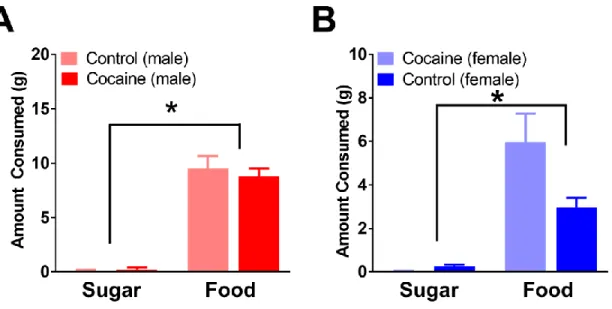
Both the control and cocaine groups demonstrated successful devaluation of the sugar by not consuming it and consuming the nondevalued food instead, during the free choice test (Figure 3, A and B). Using group (cocaine vs control) and devaluation status (devalued vs nondevalued) as factors, two-way repeated measures ANOVAs were performed for each sex (male and female). Analysis of male rats (control n=6, cocaine n=5) revealed no significant main effect of group (F1,6 =1.722, p>0.1), a significant main effect of devaluation status (F1,6 = 233.6, p<0.05) and no significant interaction (F1,6=2.042, p>0.1). Post-hoc analysis showed rats ate significantly more nondevalued food than devalued sugar in both control (t=9.748, p<0.0001) and cocaine (t=8.131, p<0.0001) groups. Similarly, analysis of female rats (control n=8, cocaine n=7) revealed no significant main effect of group (F1,13 = 4.305, p=0.0584), a significant main effect of devaluation status (F1,13 = 43.93, p<0.0001) and a significant interaction (F1,13 = 6.021, p<0.05). Post-hoc analysis showed rats ate significantly more nondevalued food than devalued sugar in both control (t=3.055, p<0.05) and cocaine (t=6.218, p<0.0001) groups.
Post-Devaluation Extinction Test
p>0.1; female, t=0.4178, p>0.1). The cocaine-exposed rats responded equally to both cues. The control groups (male n=6, female n=6) showed a mean devaluation index that was positive and significantly different from zero (male, M=0.3329, +/- 0.2987; female, M=0.1977, +/- 0.1533) as one sample t-tests (male, t=4.246, p<0.01; female, t=3.158, p<0.05). This result indicates that the control rats responded preferentially to the food predictive cues over the sugar predictive cues.
There were no sex-differences in the devaluation indices. Using group (cocaine vs control) and sex (male vs female) as factors, a two-way repeated measures ANOVA revealed a trend towards a main effect of group (F1,20 =4.289, p=0.0512), no significant main effect of sex (F1,20 = 0.3487, p>0.1) and no significant interaction (F1,20=0.0001282, p>0.1).
Electrophysiology
Discussion
Based on the results from Pavlovian conditioning (Figure 2), both groups (cocaine and control) and sexes (male and female) preferentially responded to the CS+ cues that predicted rewards more than the CS- cues that do not predict rewards. One day 1 the rats spent the same amount of time in the food cup for all cues. On day 10 they differentiated between the cues and spent significantly more time in the food cup following CS+ compared to CS- cues. A history of cocaine use does not impair the ability of the rats to determine which cues predict rewards and which do not across sexes. There were fewer female rats in the group, so more rats will be needed to explore potential sex differences during learning.
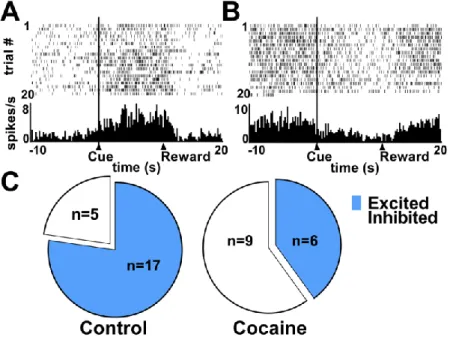
males and females) continues to respond in this way despite the cue representing the delivery of the sugar pellets that made them sick previously. Alternatively, the control group is able to employ goal-directed behavior and successfully avoid the cue that predicts the pellets that made them sick. Electrophysiology recordings in the PrL show that in male-control animals, neurons that are phasic to the cue are predominantly excitatory (77%) (Figure 5C). In the male-cocaine group, about half (60%) of the phasic neurons are excitatory while the others are inhibitory (Figure 5D). This hypoactivity in the PrL is consistent with findings in over trained rats. When animals are over trained and thus displaying habit-like behavior they show impaired behavioral flexibility and hypoactivity in the PrL (Smith et al., 2014). These animals will continue responding to cues predictive of the devalued reward, similar to the cocaine animals. Those with a history of cocaine use display behavior similar to the over trained animals even though they have the same amount of training as control animals that are not responding habitually. It appears that cocaine use predisposes the rat to habit formation. Thus, the history of cocaine leads to habit-like behavior sooner (with less training) than in control animals. In humans, those who recreationally use cocaine may be predisposed to become compulsive (habitual) users.
References
Becker, J.B. (2016). Sex differences in addiction. Dialogues Clin Neurosci.18(4), 395-402.
Bonson, K. R., Grant, S. J., Contoreggi, C. S., Links, J. M., Metcalfe, J., H, L. W., London, E. D. (2002). Neural systems and cue-induced cocaine craving. Neuropsychopharmacology, 26(3), 376-86.
Dalla, C., Shors., T.J. (2009). Sex differences in learning processes of classical and operant conditioning. Physiol Behav. 97(2), 229-238.
Everitt, B., & Wolf, M. (2002). Psychomotor stimulant addiction: A neural systems perspective. J Neurosci, 22(16), 3312.
Gawin, F. (1991). Cocaine Addiction: Psychology and Neurophysiology. Science, 251(5001), 1580-1586.
Goldstein, R., & Volkow N. (2011). Dysfunction of the prefrontal cortex in addiction: neuroimaging findings and clinical implications. Nat Rev Neurosci,12(11), 652-669. Koob, G. F., & Volkow, N. D. (2010). Neurocircuitry of addiction. Neuropsychopharmacology,
35(1), 217-38.
Lucantonio F., Stalnaker, T., Shaham, Y., Niv, Y., & Scheonbaum. G. (2012) The impact of orbitofrontal dysfunction on cocaine addiction. Nat Neurosci, 15, 358-366.
Ostlund, S.B. & Balleine, B.W. (2009). Lesions of the medial prefrontal cortex disrupt the acquisition but not the expression of goal-directed learning. J Neurosci, 25(34), 7763-7770.
encoding in the nucleus accumbens necessary for higher-order learning. Biol Psychiatry,
75(2), 156-64.
Sanchis-Segura, C., & Becker, J. B. (2016) Why we should consider sex (and study sex
differences) in addiction research. Addiction Biology, 21: 995–1006.
Smith, K.S. & Graybiel, A.M. (2013). A dual operator view of habitual behavior reflecting cortical and striatal dynamics. Neuron, 79(2), 361-74.
Schoenbaum, G. & Setlow, B. (2005). Cocaine makes actions insensitive to outcomes but not extinction: Implications for altered orbitofrontal-amygdalar function. Cerebral Cortex, 15(8), 1162-1169.
Sendstake, C.B., Chambers, K.C. (1991). Sensitivity of male, female, and androgenized female rats to testosterone during extinction of a conditioned taste aversion. Behav Neurosci, 105(1), 120-125.
Stalnaker, T. A., Roesch, M. R., Franz, T. M., Calu, D. J., Singh, T., & Schoenbaum, G. (2007). Cocaine-induced decision-making deficits are mediated by miscoding in basolateral amygdala. Nature Neuroscience, 10(8), 949-51.
Tran-Tu-Yen, D.A., Marchand, A.R., Pape, J.R., Di Scala, G., & Coutureau, E. (2009). Transient role of the rat prelimbic cortex in goal-directed behaviour. Eur J Neurosci, 30(3), 464-471.
West, E.A., Saddoris, M.P., Kerfoot, E.C., & Carelli, R.M. (2014). Prelimbic and infralimbic cortical regions differentially encode cocaine-associated stimuli and cocaine-seeking before and following abstinence. Eur J Neurosci, 39(11), 1891-1902.
Appendix
D a y 1 D a y 1 0 0 1 0 2 0 3 0 4 0 % t im e s p e n t in f o o d c u p
C S - 1
C S - 2
C S + 1 ( F o o d )
C S + 2 ( S u g a r )
*
D a y 1 D a y 1 0
0 1 0 2 0 3 0 4 0 % t im e s p e n t in f o o d c u p
C S - 1
C S - 2
C S + 1 ( F o o d )
C S + 2 ( S u g a r )
*
D a y 1 D a y 1 0
0 1 0 2 0 3 0 4 0 % t im e s p e n t in f o o d c u p
C S - 1
C S - 2
C S + 1 ( F o o d )
C S + 2 ( S u g a r )
*
D a y 1 D a y 1 0
0 1 0 2 0 3 0 4 0 % t im e s p e n t in f o o d c u p
C S + 1 ( F o o d ) C S - 1
C S - 2
C S + 2 ( S u g a r ) * M a le F e m a le
C o n t r o l C o c a in e
A
B
C
D
Figure 3: Effect of sugar devaluation on free food choice. Both groups consumed little to no sugar when presented with the option of consuming food or sugar, demonstrating successful devaluation of the sugar. This remains true for both sexes (males left, females right).