Communicating, Improving and Evaluating BCBSNC Member Advisory Group: A Member Engagement Approach
By Jennifer Luttrell
A Master’s Paper submitted to the faculty of the University of North Carolina at Chapel Hill
in partial fulfillment of the requirements for the degree of Master of Public Health in
the Public Health Leadership Program
Chapel Hill Spring 2017
Date
ii TABLE OF CONTENTS
Page
Keywords iii.
List of Abbreviations iv.
Abstract 1
Introduction 2
Methods 3
Case: BCBSNC MAG 10
Communication Plan 13
Evaluation Plan 16
Recommendations 18
References 20
iii KEYWORDS
Advisory Group
Communication
Evaluation
Patient Engagement
iv LIST OF ABBREVIATIONS
AHRQ Agency for Healthcare and Research Quality BCBSNC Blue Cross and Blue Shield of North Carolina CDC Centers for Disease Control and Prevention
MAG Member Advisory Group
NC North Carolina
1 ABSTRACT
The importance of patient-centered care has become more evident in public health practice, and a patient-centered organization is important to improve and encourage public health. Best practices have identified key inputs through Member Advisory Councils as critical components to developing patient-centered care and, while once limited to hospitals, health plans are discovering their role as they look to improve health and control costs. Blue Cross Blue Shield of North Carolina (BCBSNC) developed the Member Advisory Group (MAG) in 2015, a program designed to address this concern and ensure/increase patient-centered organizational efforts. The program implementation was considered a success and the first year saw valuable member participation, but the program faced a challenge, and there was a need for additional employee engagement and communication of the work MAG was doing across the BCBSNC Enterprise. To improve the quality and make a case for future funding of the program, it was necessary to develop a communication plan with elements of a social marketing campaign as well as an evaluation plan that would elevate and communicate the success of MAG. The communication plan and evaluation plan will help BCBSNC ensure member input reaches internal employees who can affect change and ultimately improve BCBSNC as a
2 INTRODUCTION
Blue Cross and Blue Shield of North Carolina (BCBSNC) is the largest health insurance company in North Carolina (NC) with more than 3.8 million members and currently, the only participating health insurance company in the marketplace across the 100 counties of NC. In 2015, the healthcare division recognized that current best practices in healthcare require a more patient-centered organization with one step including a focus on improving patient and family engagement (Carmen et al., 2013). Beyond improvement of customer satisfaction, Carman et al. (2013) write evidence suggests “patient engagement can lead to better health outcomes,
contribute to improvements in quality and patient safety, and help control health care costs.” (Carman et al., 2013, p. 2).
3 process throughout the first year of implementation with interviews with other identified key stakeholders determined what teams/employees played critical roles in the success of MAG. Standards and formal communication plans were identified and put into place to ensure
appropriate sharing of future findings of MAG and encourage patient engagement by engaging the broader enterprise audience.
METHODS
For additional background information on patient and family engagement, engaging members at other organizational levels, organizational adoption of such programs and
communications strategies as well as information on program implementation and evaluation, a literature search was conducted in PubMed and Google Scholar databases, as well as textbook resources. A search was conducted using a combination of the terms “patient and family engagement,” “organizational adoption,” “internal communication strategies,” to find peer-reviewed articles on patient and family engagement, how to best adopt these programs within organizations, and develop internal communications to support these adoptions. General web searches and scholarly textbooks uncovered additional information related to program
4 Patient and Family Engagement in Health Care and Health Insurance:
Consumers continue to find the healthcare system stressful to navigate. Patients/members and their families are key drivers in the learning process of organizations to develop care and health insurance programs that respond to their needs. When they are fully involved as active participants in the process, the experience of care can be improved substantially (Smith et al., 2012). As cited in Smith et al., 2013, The National Quality Forum’s National Priorities
Partnership (NPP) characterizes patient-centered care as healthcare that “honors each individual patient and family, offering voice, control, choice, skills in self-care, and total transparency” (Smith et al., 2013, p. 193). To improve health and health care, patient and family engagement should involve patients and health professionals working in active partnerships across the health care system at various levels including direct care, organizational design and governance, and policy making (Carman et al., 2013). An emphasis has been placed on patient engagement so that shared decision making encourages and shifts the role of the patient or member to become more “active, informed, and influential (Carman et al., 2013, p. 1).” By becoming active and informed, patients, as key users, can help to identify barriers and enablers for navigating health care
systems. As health insurance companies continue to help members navigate the healthcare
system in the ever-changing healthcare environment, it is important to encourage the reduction of healthcare costs for their members as stated by the Committee on Learning Health System, “meaningful engagement of patients in their own care has the potential to reduce costs.” (Smith et al., 2013, p. 196).
5 and has been shown to improve disease-related outcomes and quality of life, according to
(Epstein, Fiscella, Lesser & Stange, 2010). If patients can understand their care, actively participate in treatment, and are given the opportunity to self-manage their care these activities are documented as “result[ing] in better adherence to medications and improved chronic disease control, without incurring higher costs” (Epstein et al., 2010, p.1491). In addition to improving care, patient-centered care also improves a patient’s well-being by building trust and social support. Lastly, patient-centered care leads to reduced healthcare costs by increasing the value of care to reflect what patients want and need. Decision making should be a shared responsibility between the patient/member and clinician, and studies show that not all patients will want to be engaged in care, but some will be interested in playing a larger role in the decision-making progress, especially at the organizational design level (Epstein et al., 2010). Decision-making in healthcare should be a shared responsibility between the patient/member and clinician. Although studies show that not all patients will want to be engaged in care, some will be interested in a playing a larger role in the decision-making process (Smith et al., 2013).
Multi-Level Approach to Engaging Patients/Members:
Public health strategies should take a multi-level approach to engagement. As seen in Figure 1, The Patient and Family Engagement Framework outlines engagement at multiple levels including direct care, organizational design and policy making. The framework provides guide posts for each organizational level to integrate patient engagement into practice. As most public health strategies should be implemented utilizing a multi-level approach, the framework outlines best practices for individuals, doctors, hospitals, insurance companies and policy makers. Like the social ecological model, the individual, or patient, is at the center of the engagement
6 Figure 1: A Multidimensional Framework For
Patient And Family Engagement In Health And Health Care (Carman, 2013, p. 225).
address the multiple levels of the framework at varying points in a patient’s healthcare journey (Stone, 2012). At the direct care level, engagement is shifting from the consultative role for doctors to more of a shared partnership between the doctors and patients. The framework suggests this can be accomplished
by doctors involving patients in decision making proactively
involved patients in their health. At the organizational design level, “engagement integrates patients’ values, experiences, and
perspectives into the design and governance of health care
organizations” (Carman, 2013, p. 225). At the policy-making level, engagement focuses on the
development, implementation, and evaluation of local state and national health care policies and
7 MAG program. By including members in the Advisory Council, BCBSNC can encourage
member engagement. Through this engagement, BCBSNC can learn what the member’s value, what they would like to change, and what they would like to implement moving forward to improve overall customer satisfaction and member/patient experience as a BCBSNC member. With continued development and engagement of these best practices and the MAG program, eventually, BCBSNC should look to move to a partnership and shared leadership organization. Organizational Adoption and Communication Strategies:
According to the Guide for Patient and Family Engagement developed by the Agency for Healthcare and Research Quality (AHRQ), there are several steps organizations can take that can provide advisors an opportunity to integrate into the organization. It is important to provide resources that highlight the benefits of an advisory group to the organization’s staff as well as create positive experiences for the staff that help them understand the value of the experiences and perspectives of the advisors. Several opportunities include advisors sharing stories,
acknowledgment of advisor contribution to new materials or redesigned processes and provide information on projects that have involved advisors input (AHRQ, 2013). To encourage and increase advisor engagement across the enterprise, it is critical to continually communicate about the work and accomplishments of the advisors. With this knowledge, tracking involvement and collecting examples to share with the enterprise will be beneficial. A system should be set up that would track involvement and outcomes of projects that are achieved and integrate these into existing process and monitoring efforts of the program.
8 patient focus, which was most consistently mentioned throughout the study, and listening to patient stories were influential in overcoming this barrier (Luxford, Safran & Delbanco, 2011). Another barrier that was recognized was that culture change does not happen rapidly, and change to a patient-centered focus would take three to five years with organizational leaders remaining influential throughout this process to transform care (Luxford et al., 2011). One key
organizational factor that would help support the implementation of a patient-centered focus was that employees received regular measurement and feedback reporting. “All eight organizations reported that providing front line staff, management and governance with regular reports of
patient care experience data with high specificity (‘from the Board to the Ward’) was an enabling
factor” (Luxford et al., 2011, p. 3). They conclude “that organizations that have succeeded in
fostering patient-centered care have gone beyond mainstream frameworks for quality
improvement based on clinical measurement and audit and have adopted a strategic
organizational approach to patient focus” (Luxford et al., 2011, p.5).
When developing communications at the organizational level, various techniques should
be considered to reach more of your target audience. The message should be tailored to the
specific audience you want to target, this includes targeting to audience segments like operations
or the entire enterprise, utilize narratives and convey a story, and frame the message so one
message may have multiple viewpoints (Agency for Healthcare Research and Quality, 2012). In
addition, communications should “simultaneously influence” the multiple levels of the patient
engagement framework to lead to “greater and longer-lasting behavioral changes” (Lee & Kotler,
2016, p. 219). To impact the upstream audience of the BCBSNC employees, and inform and
9 should have clear objectives and goals, audience research should be conducted, and monitoring
and evaluation efforts should be put into place (Lee & Kotler, 2016).
Program Implementation and Evaluation:
After a program has been developed and approved, resources are allocated to implement the program, to achieve the established goals and objectives. Implementation parameters include delivering the program as planned and marketing or communicating the program to the target audience. Another critical component of program implementation is a process evaluation to help provide key feedback that can lead to revisions in the originally planned program delivery and can demonstrate the need for future programs. The evaluation of a program can be an outcome evaluation or impact evaluation. An outcome evaluation is the evaluation of immediate
programmatic effects, and an impact evaluation is an evaluation of the temporary programmatic effects (Issel, 2014). One stakeholder group that is important to consider when developing an evaluation plan is the program directors or managers. These individuals will use the findings to approve future funding as well as implement future improvements to the program (Issel, 2014).
10 CASE: BCBSNC MAG
The MAG was created and implemented in September 2015 based on the patient and family engagement research to help drive customer satisfaction, improve quality and reduce costs to help improve the work BCBSNC did at an organizational level. After several months of program participation, the program developer understood the need for continued communication and transparency at the organizational level into what MAG was doing for the enterprise. There are various stages of program implementation and with MAG a program since 2015, it is
recognized that the program is in the organizationally institutionalized stage of maturity. The program has become an ongoing service with goals and BCBSNC support to have wide acceptance across the enterprise as a program that is considered a standard practice and can multiply (Issel, 2014).
The MAG program was developed with a clear direction, and the current program developer and program director are encouraged to make the future growth of the program
successful. A specific evaluation plan was not put into place at the start of the program, but some informal process evaluations took place. The need for a formal evaluation was recognized to continue to “revise or improve the program” (Issel, 2014, p. 20).This evaluation approach will need to be introduced to analyze needs assessment data (what the business needs), process evaluation data, effect evaluation data and cost evaluation data (future state).
Currently, MAG receives limited funding pay for an external facilitator and neutral meeting space for the ten advisory group members. A healthcare program developer manages the program which includes tasks such as identifying topics and presenters for the monthly meetings, meeting with those presenters to discuss agenda topics, coordinating meeting logistics,
11 meeting, formal minutes are distributed to meeting attendees, but there were barriers to
distributing to the broader BCBSNC enterprise. Many of the past topics were generated by the advisory group’s interest or perceived need by the program developer. For instance, the program developer identified a gap that a communication strategy was needed to help engage the
employees of BCBSNC with MAG to share the experiences and improvements noted from the meeting discussions. The perception was that not many employees knew what the MAG was or that it existed, so increased awareness was essential.
It was important to understand the current BCBSNC employee engagement, measured by
the number of employees that have or are currently involved in the MAG process, and
knowledge of MAG, as measured by the number of employees that are aware of MAG and its
objectives across the enterprise. These were assessed by conducting informal meetings with
various employees in the healthcare, sales and marketing and operations division of BCBSNC.
Questions asked in the informal meetings aimed to determine different stakeholder’s needs for
future communications, including frequency and modality, as well as current involvement in
MAG as measured by the amount of times they have participated in providing content for a
meeting or utilizing content after a meeting to improve programs. To ensure the program focused
the right communications on the correct audience, an initial stakeholder analysis was conducted
as a form of qualitative research. These stakeholder groups were interviewed through informal
conversations to determine current knowledge of MAG and their current level of involvement.
The initial three stakeholders were identified: Consumer Experience Team, Corporate
Communications, and the Customer Service & Support Advisory Board. The Consumer
12 interactions with the business to identify pain points. MAG was identified as a program that would help improve the member’s journey, as measured by the satisfaction rating the consumer
experience team at BCBSNC collects, as well as a forum through which ‘pain points’ in the customer’s journey could be identified. Corporate Communications helps develop and distribute
internal communications across the enterprise. They identified various channels MAG could
utilize for communication and relayed best practices throughout the planning process to ensure
communications tied into the external and internal front-runners impacting the work that
BCBSNC did throughout the year. For example, the Customer Service & Support Advisory
Board is an employee group based out of Operations and is comprised of a group of employees
that work on the front line with BCBSNC members. This was a group that had not been
previously identified as a stakeholder but would provide a good benchmark as to how well
known MAG was. The group was not familiar with MAG, so the program better understood the
need to target audiences across the enterprise.
Additional informal, conversational interviews were held to discuss the MAG process to
understand how to communicate best, utilize MAG input, and identify partners that could
provide additional information in support of any communications developed. One interview was
with a healthcare program manager who had previously presented a topic on BCBSNC’s
Preventive Care Benefits webpage and had made improvements to the webpage based on the
MAG input. Another interview was with an employee who led the team that conducts customer
input sessions and produces surveys of BCBSNC members to collect data and helps improve
current programs/products that BCBSNC offers.
With these interviews and additional resources, a communication and an evaluation plan
13 employees and encourage participation with the MAG in the future. The communication and
evaluation plans took into consideration the recommendations and research developed that focus on patient and family engagement within healthcare as well as communication strategies aimed to increase adoption of this program across the organization.
COMMUNICATION PLAN
Communication is an integral part of implementing any program, and BCBSNC
understands the value of communication and offers several internal avenues to help communicate
to a broad audience (the entire enterprise) or specific departments at no additional cost to the
program. Based on best practices outlined by Luxford et al. (2011) the goals of the
communication plan were to engage employees regarding experience with the MAG, increase
reporting of efforts, and provide various levels of engagement for employees to get involved in
the MAG (Luxford et al., 2011).
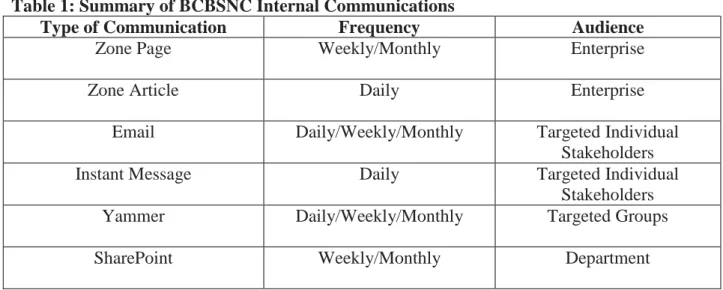
The enterprise has various channels of internal communication pathways, as seen in
Table 1, including, but not limited to: Zone pages, Zone articles, email, IM, Yammer,
SharePoint, and BLOOM.
Table 1: Summary of BCBSNC Internal Communications
Type of Communication Frequency Audience
Zone Page Weekly/Monthly Enterprise
Zone Article Daily Enterprise
Email Daily/Weekly/Monthly Targeted Individual
Stakeholders
Instant Message Daily Targeted Individual
Stakeholders
Yammer Daily/Weekly/Monthly Targeted Groups
14
BLOOM Weekly/Monthly Enterprise
Zone pages are utilized as a repository of information for specific programs, much like an
external webpage, and can be a central source for an employee in the enterprise to learn more
information about a specific program or obtain contact information as to how to get involved.
Zone Articles are communications that are highlighted on BCBSNC’s internal homepage and are
geared towards reaching a larger audience and have been successful in promoting past programs
and providing updates to the organization promptly. Yammer is a newer social media tool that
has been introduced to BCBSNC and allows employees to create groups and share relevant information where employees can ‘like’ and ‘comment’ on the topic shared. There are many
challenges associated with the number of communications available at BCBSNC and, at times,
too much information can be presented and BCBSNC employees are not engaged in the
conversation. To increase awareness of patient engagement work of the MAG the
communication plan aimed to reposition the MAG to create more excitement through strategic,
internal communications.
As outlined in the work by Lee and Kotler, Social Marketing: Changing Behaviors for
Good, it was imperative that we reposition MAG to highlight the three focus areas from social
marketing theory stated below, since there was a lack of enterprise communication throughout
the first year of the program. Lee and Kotler suggest:
Fun in this context means to provide your audience with perceived benefits they
care about.
Easy means to remove all possible barriers to action and make the behavior as
15 Popular means to help the audience feel that this is something that others are
doing, particularly others the audience believes are important to them (Lee &
Kotler, 2016, p. 251).
The MAG program had an introductory presentation built to share with stakeholders
involved at implementation (advisors, program director and project manager). A Zone Page was
developed to highlight MAG within BCBSNC and provide more information on how to obtain
MAG inputs and stay connected with MAG. Both of these efforts were undertaken to create,
initial opportunities to increase communications and target the MAG and BCBSNC employees
with those communications in a fun, easy, and popular way. Based on the analysis of the current
communication outlets and methods, there was an opportunity to increase communications and
target more of the enterprise on a consistent basis to more effectively promote patient
engagement. Communication would need to incorporate MAG education, align with strategic
goals, and relate to the business and current programs that were occurring to reflect Lee & Kotler’s recommendations (Lee & Kotler, 2016). The message to be conveyed was that MAG
input was improving work at BCBSNC that resulted in improved member’s experience, as well
as welcomed all employees to participate in MAG. Employee engagement was encouraged
through raising agenda topics for the MAG meetings and welcoming updates from the group. Based on Luxford’s study on promoting patient-centered care, the creation of
opportunities for the sharing of member stories was key to engage BCBSNC employees with the
MAG as well as increase reporting of improvement efforts and provide various levels of
engagement for employees to get involved (Luxford, 2011). An initial introductory Zone Article
was developed (see Appendix B), in partnership with Corporate Communications, to help launch
16 to improve the Preventive Care Benefits webpage, how BCBSNC helped to provide clarity of
benefits to their members, how previous topic owners perceived MAG, and how to contact and
present to MAG in the future. The article was viewed over 310 times with 242 unique visitors
and an average time of 2 minutes and 27 seconds was spent on the article (as of December 13,
2016, per BCBSNC website analytics). In conjunction with the article, the MAG Yammer page
was created to highlight further the article as well as set up the platform for future Yammer
conversations. As Lee & Kotler cite the Centers for Disease Control and Prevention (CDC),
internal social media has the potential to “leverage the networks of audiences”, expand a program’s reach, “personalize and reinforce messages”, and “influence desired behaviors” (Lee
& Kotler, 2016, p.391).
After initial communication, the communication plan (see Appendix C) was designed to
provide a roadmap for regular communications including: suggested frequency of
communication; suggested methods of communications; different audiences; and specific timing.
Communications will be developed by the program manager in partnership with respective
stakeholders. The communications are frequent, but not too frequent, to keep BCBSNC
employees aware of the MAG and they aligned with the MAG meetings and impacts to the
business.
EVALUATION PLAN
Member engagement requires the assessment of what works, how it works, and how
those engagement efforts are improving outcomes (Carman, 2013). An evaluation plan was
needed to help improve MAG and identify gaps in outreach. Through data collection efforts that
17 Figure 2: MAG Engagement Logic Model
engagement and informal interviews, an evaluation plan was developed to assess the
communication plan. The purpose of the evaluation plan was to evaluate the engagement of
MAG across BCBSNC enterprise and the MAG’s ability to architect the health experience
around the consumer. The MAG program’s logic model (Appendix A) details the overall
program goals and outcomes, so an engagement logic model was designed to specify the goals
and outcomes of the further development of patient engagement.
The engagement model aimed to answer four main areas through the process:
1. How can MAG be improved?
2. How many new BCBSNC employees were engaged each month through
communications? How many new BCBSNC employees were engaged in monthly
meetings?
3. How was the MAG experience for BCBSNC employees? Was it easy to engage with
18 4. What improvements were made to BCBSNC programs? Were programs
started/stopped/continued because of MAG input?
The evaluation plan is being proposed so that the findings can be used to provide evidence for
the continuation and growth of MAG (if warranted), as well as provide recommendations for future improvements regarding the advisory group’s roles and responsibilities.
RECOMMENDATIONS
Over a period of five months, meetings were held with MAG stakeholders, needs were
defined, an introductory communication was developed to increase awareness among employees,
and a communication and evaluation plan were developed for 2017. The objectives of these
plans were to continue to build employee engagement, introduce the members of the advisory
group, and also highlight the improvements the group was able to make to programs throughout
BCBSNC. Through continued communication and evaluation of MAG, the goal is to encourage
continued funding of MAG as well as ensure the advisory group is consulted when developing
and implementing programs that will impact the members of BCBSNC.
Through the deployment of both the communication and evaluation plans, as outlined in
the logic model, it is important to display a level of leadership that encourages participation and
advocacy for a patient/member-centered organization. Leadership is a requirement to put public
health programs into practice effectively, and leaders need the necessary skills to continue to
interact with many stakeholders and understand what continues to motivate and encourage
patient engagement in each stakeholder and how to find common ground. The communication
and evaluations plans provide short-term sustainability for the program, but leaders must be
19 communication and evaluation plan are implemented the following are recommendations for
future improvements:
1. Hire a communication coordinator
and
2. Develop similar advisory groups in other regions of NC.
A communication coordinator is essential to ensure the communication plan is followed
and reaches its full potential and can also implement and report out on evaluations in a timely
manner. Consequently, an immediate recommendation is to create a role, similar to a project
coordinator, to manage the MAG and communications moving forward. Another
recommendation is for the development of similar advisory groups in other regions of the state to
20 REFERENCES
Agency for Healthcare Research and Quality. (2012). Communication and Dissemination Strategies To Facilitate the Use of Health-Related Evidence. Retrieved from http://effectivehealthcare.ahrq.gov/index.cfm/search-for-guides-reviews-and-reports/?pageaction=displayproduct&productid=1208.
Agency for Healthcare Research and Quality. (2013). Working with Patient and Families as Advisors Implementation Handbook. Retrieved from
https://www.ahrq.gov/sites/default/files/wysiwyg/professionals/systems/hospital/engagin gfamilies/strategy1/Strat1_Implement_Hndbook_508_v2.pdf.
Carman, L. K., Dardess, P., Mauerer, M., Sofaer, S., Adams, K., Bechtel, C., Sweeney, J. (2013). Patient and Family Engagement: A Framework For Understanding The Elements And Developing Interventions and Policies. Health Affairs, 32, no.2:223-231. doi:
10.1377/hlthaff.2012.1133.
Epstein, R., Fiscella, K., Lesser, C., Stange, K. (2010). Why The Nation Needs A Policy Push on Patient-Centered Health Care. Health Affairs, 29, no.8: 1489-1495. doi:
10.1377/hlthaff.2009.0888
Issel, L. Michelle. (2014). Health Program Planning and Evaluation: A Practical, Systematic Approach for Community Health. 3rd Edition. Jones & Bartlett Learning. Kaplan, SA., & Garrett, K.E. (2005). The use of logic models by community-based initiatives.
Evaluation and Program Planning, 28, 167-172.
Koh, H. (2015). Educating Future Public Health Leaders. American Journal of Public Health 105(Suppl 1), S11-S13. doi: 10.2105/AJPH.2014.302385
Lee, N. & Kotler, P. (2016). Social Marketing: Changing Behaviors for Good. 5th Edition. Thousand Oaks, CA: SAGE Publications, Inc.
Luxford, K., Safran, D., Delbanco, T. (2011). Promoting patient-centered care: a qualitative study of facilitators and barriers in healthcare organizations with a reputation for improving the patient experience. Int J Qual Health Care, 65 (5), 510-515. doi: 10.1093/intqhc/mzr024.
Smith, M., Robert, S., Stuckhardt, L., McGinnis, J., Editors, Committee on the Learning Health Care System in America, Institute of Medicine. (2012). Engaging Patients, Families and Communities. Best Care at Lower Cost: The Path to Continuously Learning Health Care in America. (pp.189-217). Washington, DC. National Academies Press (US).
21 APPENDIX
Appendix A: MAG Program Logic Model
Inputs Outputs Outcomes Impact
Funding for Program Staff Time Advisors of
Member Advisory Groups
Topic Owners
MAG Meetings Development of
communications Presentation of
topics at meetings Advisor input
Communication plan
Evaluation Plan Increased
awareness of MAG
Future funding Expansion of
Advisory Groups across NC Improving the
22 Appendix B: Introductory Communication to Enterprise – Zone Article
Title: Improving our services one discussion at a time. Published December 5, 2016
Learn how member input influences the work we do
Consumer feedback is priceless. It helps us improve our products and services and helps us identify how to create a better consumer experience. One of the ways we gather feedback from consumers is through our Member Advisory Group (MAG).
Each month since September 2015, about 10 of our commercial members from the Triangle area have come together to discuss hot topics with employees across the company. These members, called advisors, provide suggestions to improve services, give feedback to new projects and solutions, and discuss any hassles of doing business with us.
One of MAG’s biggest achievements this year has been improving the readability and usability of our Preventive Care webpage. Through Language Simplification strategies, Healthcare identified room for improvement on the webpage and decided to bring it to the Membership Advisory Group for feedback in October 2015.
A member’s perspective
At the meeting, Healthcare introduced the advisors to the Affordable Care Act (ACA)
provisions that require preventive care coverage, and she explained the complexities of the law. She then showed the advisors the old version of the webpage and examples of other preventive care webpages to get ideas flowing.
The advisors had many suggestions to improve clarity, including:
Supplemental materials available on the webpage did not reflect what advisors understood about the ACA law regarding preventive care benefits
Advisors wanted a more interactive webpage that allowed them to see some info, and info headers that would allow them to click to get more information if they chose – rather than opening up an 8-page PDF file
The font was way too small
At the end of the process, Healthcare brought the new and improved Preventive Care webpage back to MAG in September 2016 to highlight the changes, many of which came directly from MAG! The reading level of the Preventive Care webpage went from a college reading level to a ninth grade reading level. MAG advisors were particularly excited about the new “Know Before You Go” section, calling it a “nice little snapshot of info.”
23 BEFORE AFTER
How can the Member Advisory Group help you?
The Member Advisory Group has received great feedback from both members and employees. It is just one of the many ways we are trying to make it easier for consumers to do business with us. Manager of Product Development said, “Hearing the group’s views has impacted the way I think about future work.”
24 Appendix C: Communication Plan
Member Advisory Group (MAG) Communication Plan - 2017
Goal: Regular communications to increase awareness of MAG and encourage BCBSNC employees to interact with MAG. The plan will include various channels and engagement methods to keep the message fresh and motivating.
Date Target Audience
Messaging/Channel Key
Stakeholders
Desired action(s) Monthly All
Employees
Zone Page: Update with upcoming topics, monthly meeting notes. Suggested date: by the 1st of the following month
Healthcare Maintain MAG Updates. Communicati on current and upcoming discussion. Engage BCBSNC employees. Monthly Consumer
Experience
Email: Send to Consumer
Experience regarding pain points that were discussed/brought up at monthly MAG meeting.
To include:
1. Key Topics of Discussion 2. Pain points
3. Improvements 4. Feedback from Topic
Owners
5. Quotes from Members Suggested date: by the 1st of the following month Consumer Experience Encourage partnership and transparency with Consumer Experience team
Monthly Topic Owners
SurveyMonkey Survey: Send survey to most recent topic owner for feedback.
Suggested date: Day after MAG Meeting TBD (Specific Topic Owners) Gather feedback on topic owner’s experience and evaluate success of MAG. Quarterly All
Employees
Zone Article: Meet the Member Series
Corp
Communicati
25 Date Target
Audience
Messaging/Channel Key
Stakeholders
Desired action(s) 1.Interview selected member at
meetings (Jan, April, August, November)
2.Compile article to be posted on Zone at the end of each quarter Questions to include:
1. Name and number of months you have served on MAG
2. Why did you want to get involved with MAG? 3. What has been your most
memorable experience working with MAG?
4. What are your hobbies? Tell us something about you that you would like to share. Suggested dates: End of Jan, April, August, and November
ons employees to specific Members of MAG to connect and add value to the work we do
Bi-Weekly
All
Employees
Yammer Page Updates: Come up with new/recurring topics bi-weekly.
Ideas include:
1. Asking our Advisors to select a “question of the month” for our employees and posting this question 2. Huge pain point for our
advisors at the last meeting: Open up a discussion to allow employees to discuss how we can improve this experience/project/work etc. 3. Post blogs/articles about the
effectiveness of member advisory boards (share any articles you may have used to create group) ex.
http://www.pearsoned.com/
education-blog/advisory-TBD Keep the
26 Date Target
Audience
Messaging/Channel Key
Stakeholders
Desired action(s)
groups-a-new-model-for-more-effective-results/ 4. Ask our employees to
suggest upcoming topics for the following month’s MAG meeting
Suggested dates: 1st and 3rd Monday of each month? (what days have most hits on Yammer)
Ad Hoc All
Employees
Zone Article/Yammer/Etc.:
1. Follow-up on improvements made to behavioral
health/care management messaging
2. Have topic owner write about experience with MAG.
Corp Comm Enhance communicatio n moving forward that showcases improvements made by MAG and highlights the continued need for MAG. Annually Healthcare Email/Survey:
1. Annual Review of MAG 2. Survey of Advisor’s
Experience
Suggested dates: Mid-December
27 Appendix D: Evaluation Plan
Member Advisory Group (MAG) Evaluation Plan - 2017
Purpose: Evaluate the engagement of the Member Advisory Group (MAG) across BCBSNC enterprise and its ability to architect the health experience around the consumer. Findings will be used to ensure continuation and growth of MAG as well as provide recommendations for future improvements, and enhancements regard the advisory group’s roles and responsibilities. Evaluation Questions:
1. How can MAG be improved?
2. How many new BCBSNC employees were engaged each month through communications/meetings?
3. How was the MAG experience? Was it was to engage with MAG?
4. What improvements were made to programs? Were programs started/stopped/continued because of MAG?
Evaluation Question Date Messaging/Channel 1.How can MAG be
improved?
Quarterly Interview/Survey with MAG Members Suggested dates: April, July, October of 2017 1.How can MAG be
improved?
Monthly SurveyMonkey Survey: Send survey to most recent topic owner for feedback.
Suggested date: Day after MAG Meeting 2.How many new
employees were engaged each month?
Monthly/ Quarterly
Zone Page: Utilize Adobe Analytics software to analyze visits to MAG Zone Page each month (can be accessed through Corp Comm or Heather Ferrell)
Yammer: Record # of ‘likes’/comments on Yammer posts to measure interaction and engagement each month 2.How many new
employees were engaged each month?
Quarterly Zone Articles: On quarterly articles, utilize corp comm analytics to measure the number of views the article received.
3.How was the MAG Experience? Was it easy to engage with MAG?
Monthly Survey Monkey: Send survey to most recent topic owner for feedback
Suggested date: Day after MAG Meeting 4.What improvements
were made to programs?
Monthly Survey Monkey: Send survey to most recent topic owner for feedback*