2 Abstract
The early childhood education system in France is often looked to as a model for creating more equitable and accessible child care and public pre-primary education in other countries. However, little is known about how the uniformity of public early childhood centers and how
well these centers meet the needs of “diverse” populations (e.g. immigrant students, children with disabilities, etc.). To address these gaps, this research explores the following questions: 1)
What are the qualities or attributes of a high quality maternelle in different areas of France? How do they align with French early childhood development quality standards, particularly with regard to emotional and ethical development? 2) To what extent are immigrant and minority
populations engaged within maternelles across France? 3) Do maternelles engage with family members? If so, how? 4) What is the demographic make-up of children in maternelles across
France?
Using a grounded theory approach, this research analyzes interviews and focus groups composed of parents whose children attend maternelle and teachers in 17 different maternelles
from six different regions across France to explore these questions. This study concludes with an analysis of themes highlighted in interview responses, including the need for the development of teacher-student ratio standards in French maternelle and reconsidering the recent shift to a four
and a half day per week schedule. I highlight the need for more research regarding the experiences of minority children in maternelles and parent supports and child outcomes in
3 Acknowledgements
I am overwhelmed with gratitude for my advisor, Dr. Cassandra Davis, without whose constant support, expertise, and advice this work would simply not be possible, and to my second reader, Dr. Candis Watts-Smith, who inspires me to be a better and more critical researcher every
day. Thank you to Paul Smith for accompanying me on this journey and for your constant support. Thank you to my dear community and home for your patience, love, and celebration.
I am deeply indebted to those whose stories these pages only begin to enlighten for trusting me with their experiences. Thank you for welcoming me into your lives and work, even if for just a moment, and giving what you could.
This project was supported by the Tom and Elizabeth Long Excellence Fund for Honors administered by Honors Carolina, the Frances L. Phillips Travel Scholarship administered by
4 Table of Contents
Chapter 1: Significance and Specific Aims ……… 6
Chapter 2: Background and Conceptual Framework ………. 16
Chapter 3: Methods ……… 27
Chapter 4: Results ……….. 34
Chapter 5: Conclusions and Recommendations ………. 58
Appendix A: Protocol Questions ……… 60
Appendix B: Research Questions & Protocol Questions…… 63
5 Table of Figures
Table 1. Interviews and Focus Groups ………...…………. 28
Table 2. Maternelle Quality Priorities (According to Parents) ………...…. 36
Table 3. Maternelle Quality Priorities (According to Teachers) ………. 38
Table 4. Emotional, Social, and Ethical Development Practices (Highlighted by Teachers) …. 40 Table 5. Teacher Practices Used to Engage All Students ………45
Table 6. Presence of Teacher Trauma Training in Maternelles ……….. 47
Table 7. Parent Understanding of Maternelle Curriculum ……….. 48
Table 8. Parent Involvement in the Classroom (According to Parents) ………... 49
Table 9. Parent Involvement in the Classroom (According to Teachers) ………... 51
Table 10. Parent Reflections on Diversity in the Classroom ……….. 54
6 Significance and Specific Aims
1. Overview
In the United States, proponents of accessible child care and pre-primary education consider France a successful model when advocating for policy changes. However, as will be
further outlined in this paper, more research is necessary to understand if the French education system as it currently functions is able to realize the full benefits of public pre-primary
education. Indeed, high quality, accessible public pre-primary education has the opportunity to advance equity in society, particularly for marginalized populations. Yet, there are many gaps in the literature regarding variation in quality, engagement of diverse and marginalized populations,
and family engagement in public pre-primary education centers across France. This paper seeks to address these gaps, through a qualitative study. First, I will contextualize the issue and further
explain the aims of this study. Then, I will provide a review of literature and conceptual framework for my analysis. Next, I will present my methods and results, and finally, I will present my conclusions and recommendations.
2. Background
Advocates for more expansive child care in the United States often praise the French child care system as a model for accessible quality child care and early learning. Studies have shown that since France expanded resources for maternelle care in the 1960s and 1970s, the
proportion of French three and four year old children in maternelles (voluntary pre-schools funded by the French government) more than doubled (Dumas and Lefranc, 2010). At the same
7 While some literature explores the impact of France’s fairly recent decentralization—from 1980s
reforms to most recent constitutional changes in 2005—it does not identify on a basic level how school resources vary from site to site in different regions across the country. Indeed, while the national government funds the majority of maternelle costs across France, some funding can
vary across the country, with municipalities funding facilities and maintenance, and the federal government subsidizing the great majority of costs—staff (Directorate for Education; OECD,
2004; Adamson and Litjens, 2016). At the same time, the national maternelle curriculum has been reformed to allow for more flexibility in its implementation in regions across France, meaning that teachers can implement the curriculum in a variety of different ways (Directorate
for Education).
The Organization for Economic Cooperation and Development and the French
government have attempted some oversight regarding curricula, equipment, resources, and equality of education to some degree, but these have not been the focuses of their reports. Further, there is a gap in the literature discussing how this variation presents itself on a more
specific, basic level—whether there is any difference in toys, facility quality, books etc.—in regions across France.
Recent literature regarding French early childhood education emphasized the importance with the French government places on early childhood education for equality of opportunity for children across the country. (Ministry of Education, 2002; Directorate for Education; OECD,
2004; OECD, 2006; Ministry of Education, 2010) Indeed, the maternelle system in France is heralded as the foundation for education in France. It is thus important to understand how
8 Further, because equality of opportunity is highlighted as a priority, it is important to
explore how children’s diverse perspectives are engaged in maternelle classrooms. As recent statistics from The National Institute of Statistics and Economic Studies (INSEE) show, many immigrants and descendants of immigrants experience educational inequality and feelings of
discrimination in the classroom in France. (Brinbaum and Primon, 2014) Therefore, a better understanding of how maternelle level education varies across the country regarding engagement
with diverse communities, particularly minority and immigrant communities, is certainly important to explore.
Additionally, research to understand whether demographics of children in maternelle
classrooms are similar to the surrounding communities in which they live is also important. Because maternelle care is voluntary, it is important to understand whether there are any specific
communities who are less likely to send their children to maternelles. If this is the case, further research could explore potential reasons for any gaps. Additionally, it is important to understand what the process of enrollment is like, whether there are waitlists in different regions, and how
long the process generally takes.
Finally, France stresses the importance of access to diversified care for children; the
country emphasizes that parents should be able to choose the care and early learning that best fits their needs and standards. (Sabatinelli, 2007) Thus, it is important to explore the parents of maternelle age children’s agency over the care their children receive, how maternelles engage
children’s families, if at all, and whether this varies across the country.
Therefore, to gain this basic, grassroots level of understanding of curricula, engagement
9 spending two months in different regions of France. This research uses grounded theory and was
conducted by interviewing parents of children in maternelles, teachers, and individuals associated with child care focused organizations.
My research is guided by the following four research questions:
1) What are the qualities or attributes of a high quality maternelle in different areas of France? How do they align with French early childhood development quality
standards, particularly with regard to emotional and ethical development?
2) To what extent are immigrant and minority populations engaged within maternelles across France?
3) Do maternelles engage with family members? If so, how?
4) What is the demographic make-up of children in maternelles across France?
3. Contribution to the Literature
This study fills necessary gaps in early childhood education research in France by
examining how the quality and attributes of maternelles vary in France on an intimate level from region to region. As opposed to aggregate data often collected by the state, this information is
specific to each parent and teacher interviewed. Additionally, this study interviews parents as opposed to simply surveying them (as French evaluations traditionally do) and interviews
teachers from the lens of a researcher and not a program evaluator, potentially allowing for more
flexibility and freedom in expression than past research (OECD, 2016). Further, this study explores family engagement and involvement within French maternelles, something that is not
10 to racial and ethnic minority children’s experiences in French education, as the French
government does not collect any data on these specific identities, and few studies on the topic exist. (OECD, 2016)
4. Perspective of the Researcher
It is important here to note my relevant social location and identities. I am a United States
citizen and have lived in the United States my entire life. It is thus important to acknowledge that, while I of course did as much research as possible to inform myself before conducting this study, I did approach each interview and observation with the eyes, ears, and mind of an
American. My conceptions of child care are primarily framed by my experiences with child care advocacy in the United States. The standards for child care and early childhood education are set
by the National Association for the Education of Young Children, for example, and are thus my primary experience with child care and early childhood education quality recommendations. The culture in the United States also differs from other cultures in that talk about racial, among other,
identities is considered normal and is thus part of the lens through which I view research. Because I have been primed with American ideas, it was thus necessary for me to seek out
literature from other cultures to inform my research—particularly my interview protocol. I am a White, native-English speaker, middle class, college-educated non-immigrant woman. I therefore have not experienced firsthand the circumstances of a racial minority or
immigrant in a country and hold a perhaps more privileged social location than people who have. I also hold the privilege of being middle-class and being college-educated and am thus less likely
11 I should also note that I am conversational in French and that French is my second language.
Finally, I am an advocate for gender equity and thus view much of my work through that lens. I also identify as politically liberal in the context of United States politics. For the purpose
of this study, I attempted to be aware my ideological and political preconceptions and to present my findings with as much nuance as possible, holding this in mind.
Throughout my research, it is clear that my social location allowed me easier access to parents and teachers in many cases, as it is likely that teachers were more comfortable with me entering their classrooms and parents were more comfortable with me approaching them as a
petite White woman than if I held another social location. It is also likely that parents and teachers were more comfortable with divulging more information to me if we held similar
identities (White, seemingly middle-class, French speaking, etc.). However, if I held different social locations from the parents and teachers with whom I interacted, it seemed as though they were less comfortable with speaking with me and divulging their full experiences to me.
5. Anticipations
Differences in Adherence to Maternelle Curricula
Based on my perspective and review of literature, I expected that maternelle curricula across France would vary according to each region’s culture and economy. I anticipated this
particularly because of the country’s model of decentralized oversight and funding. (As noted above, communes contribute some funds to maternelles.) Thus, in richer communes, I expected
12 imagination, creativity, and emotional and ethical development, as the overall national
curriculum from 2015 suggests these are priorities for the French pre-primary education system (Ministry of Education, 2017).
Differences in Maternelle Quality
I also expected that upper-class, White, native children would have access to better schools due to the variation in funding from commune to commune, as France has a history of
racial and ethnic housing segregation (Huttman, Blauw, & Saltman, 1991). I also expected that minority racial, ethnic, and migrant populations would not find maternelles as accessible as other populations, as France has a history of racism and discrimination on the basis of ethnicity
(Schneider, 1982; Keaton 2006). I also anticipated a less welcoming environment for these populations because race and difference are not often discussed in Europe (“Ethnic-based
Statistics”, 2016).
Differences in Family Engagement
I expected that some maternelles would provide family supports and creative ways to
encourage and support families to be involved according to priorities outlined in the 2015 national curriculum (Ministry of Education, 2017).
Demographic Make-Up of Maternelles
I anticipated that maternelles would be predominately majority children who were not immigrants or descendants of immigrants. I also expected that most children would be White. If
13 expected that because maternelle is voluntary, perhaps less immigrant or descendent of
immigrant families would be familiar with the practice of enrollment, and thus be less likely to enroll children in maternelles.
6. Results
This study finds that teacher-student ratios are important attributes in a high quality
maternelle for the teachers interviewed in each region of France, and many teachers express the need for less children per classroom. Because France does not impose a teacher-student ratio standard, this study recommends policy development regarding these ratios.
This study highlights two minority experiences, those of a disabled student and a parent of immigrant children, in particular that warrant further research regarding minority children’s experiences in France. I also find that the majority of parents and teachers comment that all
children are treated the same, with no differences in support or engagement, in maternelles across France.
For the most part, parents were engaged in maternelles sampled in this study via volunteering or parent-initiated actions. However, a few schools did have more supportive parental engagement, particularly for immigrant and non-French speaking parents, that suggest
further research may be necessary regarding the benefits or costs of parent outreach and population-specific support programs in France.
Finally, this study finds that, as the literature suggests, the demographics of children in maternelles in each region reflected the surrounding community. Parents had trouble finding places for their children in only a few schools in the sample, and all of these were in large,
14 or intentionally sending children to maternelles in other neighborhoods in densely-populated
cities may be necessary to ensure equal access to maternelle education in France.
7. Inspiration for the Work
I should note that this work is deeply personal for me. I approach this research as someone who is concerned about gender equity and understands that there are many
complexities surrounding the need and/or desire to work and the need to provide quality care for one’s children. In many places across the globe, the task of caring for a family’s children
generally falls on the mother. This is especially difficult for low-income mothers in the United
States who have to work to provide for their families and have difficulty providing their children with safe, affordable, quality care during the most important years for their development.
I also simply love children. I have worked as a tutor in elementary school classrooms, as a nanny, and as a Teacher Assistant in a day care in Western Massachusetts. Children hold infinite possibilities within them, and with the right mentorship and care, they provide hope for
progress in each generation. I believe children hold the solutions to problems such as interpersonal violence and sexual assault, simply because we can teach them so much about
inclusiveness, bodily autonomy, and consent from an incredibly early age. Child care also provides the opportunity to identify and provide resources for childhood trauma. All of this fuels my passion for child care as an economic and social issue.
Because of this, I spent time doing research and writing about child care in my home state with Women AdvaNCe, a non-profit focused on women’s interests in North Carolina. I
later spent time as a Child Care Policy intern at the National Women’s Law Center. As I
15 models that inspire child care and early childhood education policy advocates for change in the
United States. During my time with Child Care policy advocates at the National Women’s Law Center, I often heard France and Sweden heralded as countries with the best child care and early childhood education policies.
While the numbers of children receiving care in these countries was extremely high and government funding for child care and early childhood education was much higher than in the
United States, I began to wonder about the faults and strengths of this policy on a human level. I wanted to know whether it truly served all French citizens equally, about the satisfaction and involvement of parents, how the curriculum as a whole was implemented across the country. I
wanted to explore facilities from the independent, outside perspective of a United States citizen and to more deeply understand parents’ and teachers’ perspectives of the policy. At its core, I
16 Background and Conceptual Framework
1. Early Childhood Education
Research suggests early childhood education significantly benefits children’s development (Jalongo et al., 2004; Burger, 2009; OECD, 2016; Miller, Cameron, Dalli, &
Barbour, 2018). Further evidence shows that early childhood education and child care can be successful tools for reducing inequality among disadvantaged children (Dumas & Lefranc, 2010;
Heckman, 2011; OECD, 2016; Miller et al., 2018).
The literature places an emphasis on not just the presence of early childhood education and care, but the quality of early childhood education and care to ensure positive and equitable
outcomes for children (OECD, 2016; Heckman, 2011;Miller et al., 2018). In fact, low quality early childhood education and care has been shown to have negative effects on children. For
example, a recent study in Quebec found poor child developmental and health results after the implementation of universal child care policies in Quebec (Kottelenberg & Lehrer, 2013). Analyses show this was likely because only 5% of the child care centers in this model provided
high quality child care—and the rest did not. Therefore, the quality of early childhood education and care is an important consideration in assessing programs.
While research helps shape notions of excellence, defining universal high quality early
childhood education and care standards poses challenges. As standards such as teacher-student ratios, methods of conflict resolution, and multiculturalism vary around the world, it is important
to recognize quality as a “value- and cultural- based concept” (OECD, 2016, p. 5; Tobin 2005).
For this study, questions of quality will be considered within the framework of the
17 which France is a member organization, and the French National curriculum itself. The OECD
conducts regular early childhood education monitoring for member countries who are willing to participate, including France.
The OECD defines quality as “all the features of children’s environments and
experiences that are assumed to benefit their well-being and development” (OECD, 2016, p. 7). Such features that factor into this, according to the OECD, are a school or child care provider’s
curriculum, teacher qualifications and qualities, the physical facility itself, and numbers of children served. According to the OECD, “Quality in France is, as in most countries, implicitly defined through minimum standards, a curriculum, and a competency framework for staff”
(OECD, 2016, p. 7).
2. French Early Childhood Education
Children from ages two to six years old can be enrolled in French pre-primary school, or maternelle (Ministry of Education 2017). The Ministry of Education sets maternelle curriculum
and teacher requirements on a national level. All maternelle teachers must pass a concours, or a public service competition to become a teacher. To prepare for this exam, teachers attend higher
education for teaching and education. The maternelle curriculum, recently updated in 2015, outlines five domains of early learning: “1) Mobilize language in all its dimensions, 2) Act, express yourself, understand through physical activity, 3) Act, express yourself, understand
through artistic activities, 4) Build the first tools to structure your thinking, and 5) Explore the world” (Robine, 2015). This new curriculum signifies a further move toward a maternelle
18 model. It is important to understand how schools are implementing this change, according to the
OECD (2016), as such reform poses a challenge for France.
At the end of maternelle, students are expected to possess a number of skills. However, the curriculum does not present a strict timeline for when these skills should be achieved. Each
maternelle simply receives national guidelines and are monitored by nationally regulated regional offices, located according to province. The curriculum stresses the importance of
recognizing and adapting to the differences in each child and creating a place of community and care in maternelle. It also highlights early on in the curriculum the importance of family
participation in school life, particularly in recognizing family “diversity” and engaging with it
(Robine, 2015).
In 2014, almost all children ages three to six years and 11.8% of children ages 2 to 3
years attend maternelle. According to the Minister of Education (2017), children ages 2 to 3 can enroll in maternelles primarily in “disadvantaged social environments”, (p.1), maternelle is considered the “foundation” of the education system in France, as noted by the name of the
curriculum, “L'école maternelle: un cycle unique, fundamental pour la réussite de tous”, or “Kindergarten: a single cycle, fundamental to the success of all” (Directorate of Education, 2004,
p. 16; OECD, 2016). It is regarded as an equalizer, with the curriculum going so far as to state, “The kindergarten builds the conditions for equality, especially between girls and boys” (Robine, p. 5 2015).
France has no set national teacher-student ratios. However, on average, there is one teacher for every 25 students in maternelle. This may be lower if schools are located in priority
19 additional funding to hire more teachers (OECD, 2006). The national government hires and pays
teachers, while municipalities hire and pay teaching assistants, or Atsems, provide funding for supplies, and provide and maintain school buildings (Directorate of Education, 2004).
3. “Fundamental for the Success of All”
Since studies have shown that high quality early childhood education can have particularly positive outcomes for “disadvantaged” children and the French government has
affirmed a commitment to maternelle as a tool for equality, it is important to explore the state of equity in French pre-primary education. According to the literature, policies to ensure equality in maternelles seem focused on gender and income. While the national curriculum states that
teachers should adapt their lessons to each child’s ability (OECD 2006). French maternelles have been less successful in ensuring students with disabilities are included. Further, the OECD
mentioned that data on this topic were particularly difficult to find (OECD, 2006).
According to municipal leaders and funding, there is potential for inequality of resources from region to region given that municipalities share the responsibility of funding maternelles,
and community demographics (incomes, population density, rate of immigration, etc.) vary widely from region to region. While there is some public data on regional inequality in France, it
is not specific and does not provide any geographic or material understanding of how resources may vary across the nation (OECD, 2016).
As the National Institute of Statistics and Economic Studies (INSEE) notes, France does
not collect data on race, ethnicity, or religion whatsoever; therefore, discussions of these are absent from evaluations of equity in French administration (“Ethnic-based Statistics”, 2016).
20 different origins (North Africa in particular) experienced inequality or felt discriminated against
in the French education system, citing their country of origin and skin color as perceived reasons (Brinbaum & Primon, 2014). Further, studies have shown that in France, immigrant children have low academic performance and feelings of belonging (OECD, 2015). Further research
should thus explore how inequality or feelings of discrimination may present themselves in maternelle, particularly because the French system sees this as a tool of equal opportunity.
Pre-primary education has been considered one of the best ways to help immigrant children integrate into society and learn their host country’s language (OECD, 2015). French maternelles stress teaching French language and culture and promote an assimilationist
integrative model of society. For example, one study showed that multilingualism was not common in French maternelles, and that some teachers would encourage parents to speak the French language at home with their children (Thomauske, 2011). The OECD has criticized
French maternelles for lacking adequate attention to difference and multiculturalism (Directorate of Education, 2004). However, some studies suggest that there are benefits to France’s model of
assimilationist integration, particularly one study that compares this model to the Netherlands’ multiculturalist integration model (Kaptein, 2016). Yet, while, immigrants in France who are fluent in French are more likely to participate in society, and less likely to be unemployed than
Dutch speaking Dutch immigrants, immigrants in France were likely to have a lower level of education than immigrants in the Netherlands, lower rate of naturalization, and were less likely
to marry within their own communities (Kaptein, 2016). Indeed, none of the ways in which France’s assimilationist culture and government structure appears to have positive outcomes for immigrants outweighs the benefits of the Netherland’s multiculturalist culture and government
21 France’s assimilationist model. Thus, literature is limited in fully understanding best integrative
models for immigrants in France, particularly immigrant children in pre-primary education.
Policy recommendations to assist immigrant children at school include 1) preparing all teachers for diverse classrooms, 2) distributing immigrant children among a mix of schools—not
just “disadvantaged” schools, 3) engaging with immigrant students’ parents (OECD, 2015). Indeed, research shows that engaging with “high need” students’ parents can improve families’
experiences (Join-Lambert, 2016, p.). According to OECD surveys, moderately fewer principles in advantaged schools in France (1.5%) saw ethnic diversity in schools as a hindrance to learning than the OECD average (3.5%). But in disadvantaged schools, the percentage of principles in
France who saw ethnic diversity in schools as a hindrance to learning was an outlier in the dataset—17% as compared to the OECD average of 7% (OECD, 2015). Further research should thus assess what actions may or may not be taken to ensure all students are provided with an
equitable experience in maternelle.
Further, after accounting for socio-economic status, immigrant children in France are not
more likely to attend pre-primary schools than immigrant children in OECD countries (OECD, 2015), even though France has the highest enrollment rate of children overall in pre-primary
education of all OECD countries, well above the average (OECD, 2016). This raises questions of how accessible maternelle is for all French immigrant children.
4. Race & Ethnicity in France
Literature also shows that racism and discrimination based on ethnicity and immigration
22 particularly in urban areas, also shows associations with increased rates of poverty and inequity
in education, mimicking patterns in other colonizer countries throughout the Western World (Huttman, Blauw, and Saltman, 1991; Schneider, 1982; Keaton, 2006). Yet, France is unique in that 1) the government has purposefully avoided constructing any form of race policy, and 2)
little research exists, particularly within government records, to document the depth of such inequality (Bleich, 2001; “Ethnic-based Statistics”, 2016). Further, in most French cities, many
immigrant communities are based in subsidized housing constructed on the margins of society, away from accessible transportation and employment (Huttman, Blauw, and Saltman, 1991). This policy decision is indicative of a society that in which systems are constructed unjustly for
racial, ethnic, and immigrant minorities. Indeed, such circumstances cannot be overlooked when considering the context of racial and ethnic educational equity in France.
5. Monitoring Pre-Primary Education in France
Research shows that monitoring and evaluations of early childhood education contribute
to quality improvements (Litjens, 2013). The French government monitors service quality, staff quality, and child developmentin maternelles on a national level via regional offices. To achieve
this, researchers and inspectors utilize inspections, surveys, observations, checklists, and other tools. Notably, child development is monitored using narrative assessments, such as portfolios, and observations (OECD, 2016). However, the OECD has criticized France for lacking a child
perspective on service and staff quality assessments (OECD, 2016). Additionally, parent perspectives are monitored using surveys, and mostly on a local level, to gather parental
23 The OECD did note that a potential area of improvement for France in the wake of
reforms like the most recent curriculum change was monitoring of adjustment to changes in policies. As France’s maternelle curriculum has evolved over time from an academic to child development focus, these changes may materialize differently in different parts of the country,
with some regions still maintaining a more academic focus and others transitioning more quickly to a child development focus (perhaps due to resource allocation or location). Further, the French
government generally chooses not to publish outcomes from service quality evaluations (which includes curriculum implementation) and staff quality evaluations (OECD, 2016).
As noted earlier, France does not collect information on race and ethnicity, leaving this
information absent from monitoring data. Such information could benefit the country in assessing the differences in maternelle quality and experiences for people of racial and ethnic minorities.
6. Contribution to the Literature
In the following section, I will illustrate how my work will contribute to the literature by explaining the gaps in literature addressed by each research question and my methodology.
RQ 1) What are the qualities or attributes of a high quality maternelle in different areas of
France? How do they align with French early childhood development quality standards, particularly with regard to emotional and ethical development?
Since the French government stresses maternelle as the foundation of the education system and “fundamental for the success of all” (Directorate of Education, 2004, p. 16), it is
24 important to engage with teachers’ understandings of the definition of quality in maternelle and
how they implement this, especially with regard to the recent change in curriculum and teachers’ flexibility in its implementation. It is also important to explore how the evolution from a more academic focused model to child development model has been implemented. Using qualitative
methods to interview teachers and parents, my first research question will address this gap in the literature.
RQ 2) To what extent are immigrant and minority populations engaged within maternelles
across France?
Given that the French model tends to emphasize sameness and minimize difference, there
is little literature regarding how minority populations are engaged within maternelles. To fully assess maternelles as a foundation for the education of all children in France, I will use this study
to explore how teachers and parents believe children of different identities and backgrounds are treated in the classroom. This is an especially significant area of research considering the literature around the importance of pre-primary education for immigrant populations and
immigrants’ and descendants of immigrants’ reported interactions with the French education system.
RQ 3) Do maternelles engage with family members? If so, how?
This study will explore family engagement within maternelles, as the French curriculum directly states the importance of family members to maternelles and studies have shown that
25 government evaluations, regarding this question. Through interviews and focus groups with
teachers and parents, this research allows for deep inquiry to address this gap.
RQ 4) What is the demographic make-up of children in maternelles across France?
It is very difficult to understand some aspects of the demographic make-up of maternelles
across France and whether these are accessible to people of all population, as there is little to no data regarding race, ethnicity, religion, or whether children are descendants of immigrants in
school systems. This is an especially significant question considering the above data that many immigrant children experience discrimination or inequality in the French education system. Thus, this study addresses this gap in the literature.
Comparing Methodologies
The methodology employed in this study also addresses gaps in the literature. While the French government tends to employ surveys on a local level to assess parents’ opinions of
maternelle quality, this study will use qualitative methods to explore parents’ input into all of the above research questions on a more intimate and comprehensive level. Additionally, while the
French government does interview teachers when assessing quality, this study will provide the perspective of interviews with an outside researcher not interested in assessing their
performance, but interested in assessing policy as a whole. While other studies have attempted to
provide similar outside perspectives, these have often employed observations and checklists to do so. This study will attempt to gather a more robust understanding of teacher’s experiences and
26 evaluations, giving parents more flexibility to fully comment on their own and their children’s
27 Methods
Data Collection Method
1. Strategy of Inquiry
This study uses grounded theory to deduce information about the French early childhood
education system. I collected data for this study by interviewing and conducting focus groups of teachers and parents of children in maternelles almost entirely in French. During my in-person
teacher interviews, I collected observation data and took photographs to supplement my findings.
2. Target population and Sample
The target population for this study was 1) teachers in maternelles across France and 2)
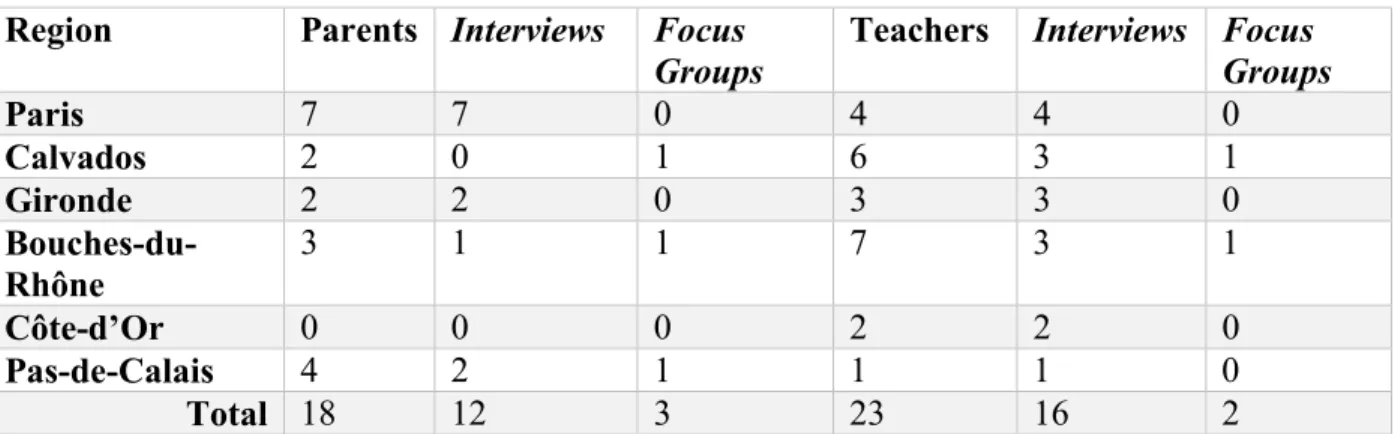
parents of children ages two to six who attend maternelles across France. Overall, I spoke with 22 teachers and 18 parents over the time period of 5/31/17 to 11/21/17.
I spoke with the 22 teachers from 17 different maternelles via 15 individual interviews and 2 focus groups. Of the individual interviews, I conducted ten in person and five over the phone. Of all the teachers I interviewed individually, all but one were both administrators and
teachers. Of the two focus groups, one included one maternelle director/teacher1 and three
teachers with no administrative duties, and the other included one director/teacher and two
teachers with no administrative duties.
I spoke with the 18 parents via three focus groups (each with two parents in the
interview) and 12 individual interviews. While the focus of this paper is public maternelles, three
28 of these parents’ children attended private maternelles and the rest attended public maternelles.
The three parents whose children attended private maternelles were all located in Paris.
Table 1. Interviews and Focus Groups
Region Parents Interviews Focus
Groups Teachers Interviews Focus Groups
Paris 7 7 0 4 4 0
Calvados 2 0 1 6 3 1
Gironde 2 2 0 3 3 0
Bouches-du-Rhône
3 1 1 7 3 1
Côte-d’Or 0 0 0 2 2 0
Pas-de-Calais 4 2 1 1 1 0
Total 18 12 3 23 16 2
I did not directly ask teachers and administrators about their racial or ethnic identities
because it is not customary to do so in France. This is, unfortunately, a limitation of my data, and the racial descriptions within this paper must be noted with my social location as a White, middle-class woman who has lived in the United States for her entire life.
The sample of teachers was overwhelmingly European, native French, White and female. There were seven male teachers/directors and two teachers whom I have identified as teachers of
visible racial minorities represented in my data. One male director in the Bouches-du-Rhône region self-identified as a person of North African descent. One woman in the Gironde region did not directly state her racial or ethnic identity. Most male teachers whom I interviewed held
director positions.
The sample of parents included four men and eleven women. Half (nine) were native
29 To more specifically describe my sample of parents, within the Paris Department, I spoke
with two Black men, one Asian woman, one Greek immigrant woman, two Black women, one Black Muslim woman, and one White, native French man. In the Calvados Department, I spoke with a White couple composed of one man and one woman. In Gironde, I spoke with one White
unemployed woman who had just returned from more than five years as an expatriate in England and one Black man. I spoke with two White women and one woman of a visible racial minority
who did not identify her race in Bouches-du-Rhône. Finally, in Pas-de-Calais, I spoke with three White women and one Black Muslim immigrant woman from Sudan who spoke little French.
3. Sampling Procedures
To preserve the confidentiality of my interviewees, I did not include participants’ names
nor did I include their particular locale, instead naming the department, or region, in which their child attended maternelle. I used purposive sampling to choose where to conduct interviews and visit maternelles in France. I started by clustering France’s provinces to make six main
geographic regions of France. I then purposefully ensured that the two cities with the highest immigrant populations in France were the cities chosen from their cluster regions, and thus
included as part of the sample. I did this to ensure that my study appropriately examined access to early childhood education for immigrant and racially diverse populations. For the four remaining clusters, I randomly sampled provinces within the purposefully chosen clusters, then
randomly choose cities containing accessible train stations (for budget purposes) within these provinces to visit as my base for ten days each. During the ten days, I interviewed teachers and
30 or foot. The cities and municipalities visited for my study were within the following French
Departments: Pas-de-Calais, Côte-d’Or, Gironde, Bouches-du-Rhône, Calvados, and Paris.
This sampling method ensured that towns from different regions all across France were represented in my sample. It is important to note, however, that because the cities I chose were
close to train stations for budgetary reasons and ease of transportation, even if the provinces in which towns were located were rural, I still examined fairly urban towns within these regions.
Within these towns, the schools were sampled randomly on the whole, by assigning numbers to schools and using a random number generator to decide who to call. The exception to this is one city which was too large to assign a number to each school in a database and sample.
Therefore, for this city I chose to randomly sample schools from all the schools in a middle class to upper middle class neighborhood and a poorer neighborhood to get a robust representation of
socioeconomic status in my sample.
Parents were sampled using convenience sampling. I interviewed any parents of children in maternelles interested in participating in the study. I coordinated interviews through the school
by talking to parents before and after school. I also recruited parents from public child friendly places (i.e. parks) and asked friends and acquaintances in France about people who may be
interested in being interviewed for my study.
4. Obstacles and limitations
31 The sample is limited by my language abilities, as I only speak French and English. I was
unable to communicate with parents who only or mostly spoke Arabic or Spanish, and thus the sample like underrepresents immigrants or decedents of immigrants.
Political Restrictions
It is important to note the limitations of my methods of data collection. I would first like to note that some of my initial observation plans changed after getting to France. Though I had
done research and spoken to French lawyers about legalities surrounding research in French classrooms, French teachers, particularly in one city, were quite averse to any observation of classroom activities without a note from l’Academie, or their regional Board of Education. After
making contact with the Board of Education, I was unable to get a clear response of what I needed to do for weeks. Eventually, I was told that without mailing a handwritten letter to the
Board of Education in each district and receiving one in return, the observation I initially planned to combine with teacher and parent interviews would be quite difficult, so I cut observation down to just observing the general layout and resources in each school. This eventually turned out to
be better for teachers and time managementand allowed me to better focus my observations and goals for the study. However, because I was waiting on a response from the Board of Education,
my in person contact with teachers in that region for this study was quite limited.
Limited Time
I was only able to spend ten days in each location. I was harassed and followed as a
32 time would of course lend itself to me not appearing as a visitor and given me the opportunity to
collection more information and have a more robust sample.
5. Data Collection
After randomly sampling schools for interviews and observations in each region, I called each school during business hours and requested interviews with teachers and/or directors at the
school. At some schools, I was only able to interview the director. Other schools did not have any teachers with time or interest in being involved in my study. During my visits to schools, I also asked the directors for a tour. On this tour, I took photographs of the school from which to
make notes for my observation protocol.
As noted above, because my first attempts at coordinating parent interviews in advance were not effective, I mostly interviewed parents by approaching them when they seemed to have
a free moment in the park or during another leisurely activity. These interviews only took about ten minutes and were the most effective way to ensure parent follow-through and efficiency of
resources. I did also make contacts with parents through my Airbnb hosts and asked friends about any parents of children in maternelles who might be willing to talk to me; however, parents are busy, and the follow-through was extremely low.
My Teacher Interview Protocol, School Observation Guide, and Parent Interview Protocol are included in Appendix A.
Data Analysis Methods
33 I conducted my analysis in English. Because the vast majority of my interviews were in
French, I hired native French speaking students to translate and transcribe the interviews for efficiency.
2. Coding
I assigned each question from my interview protocol to the research question it sought to
answer. I then coded interview responses by hand according to themes that appeared most often in my interviews, according to interview question. I kept a record of the number of interview and focus group responses that included each theme in response to each question. I then grouped
these according to the research question to which each interview question was assigned. The tables including my protocol and assigned research questions are in Appendix B. These records
are displayed in Chapter 4: Analysis.
3. Analysis
In my analysis, I searched for similarities and differences of responses in France as a whole, across regions, and within regions. I grouped responses according to teacher/director
responses and parent responses to best understand these populations’ different perspectives. For this analysis, I used quotes from interviews paired with the tables displaying common interview themes to understand both individual interviewee experiences as well as the most common
34 Results
Research Question 1.What are the qualities or attributes of a high quality maternelle in different areas of France? How do they align with French early childhood development quality standards, particularly with regard to emotional and ethical development?
For parents within this sample, a high-quality maternelle is one that focuses on their children’s well-being and teaches them to live in community with others. For teachers, a
high-quality maternelle also focuses on the child’s well-being and care; it is defined as having low teacher-student ratios, meeting children’s individual needs, providing games in the classroom, and positively measuring children’s success and development. With the exception of the quality
standard of a low teacher-student ratio, these align well with the national curriculum’s focus on developing the spirit and individuality of each child. Teachers also highlighted practices of
encouraging children to express themselves orally and through the arts, which align with the national maternelle curriculum as well (Ministry of Education 2017).
1.1 Parents
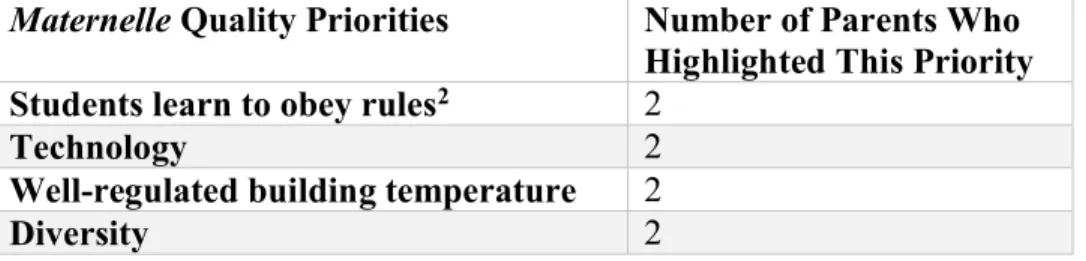
Parents highlighted a number of characteristics they consider critical elements of a high
quality maternelle. These characteristics are outlined in Table 1. As displayed in this table, most of the concerns parents brought up focused on their children’s well-being—whether the children were well taken care of at school, if the maternelle provided them with activities, and if the
children learned to live in community with others. While education and language skills are certainly priorities highlighted in the table below, these are out-numbered by a list of more
35 that are generally representative of the wide variety of parents’ responses to the question, “Please
describe your ideal maternelle.”
Pas-de-Calais (White woman): “[An ideal maternelle is] where the children can correct
themselves, where they can be free during the activities.”
Gironde (Black man): “They are well received, they eat there, they have a siesta there,
they have a lot of games, it’s not necessarily focused on the education, the staff plays with the children, they don’t overwhelm them, they sing, they eat, they rest and in the
evening we come and pick them up...”
Bouches-du-Rhône (White woman): “I think there is no ideal kindergarten. The
kindergarten of my children is good because there are not many children per class...It’s near my home. And this allows parents to work…”
Calvados (Two-parent interview, White woman and man):
Parent 1: “It must prepare the child for school, it should not too hard at the beginning. It is hard for the children to leave their family so it must help them into doing that.”
Parent 2: “It’s the same, the preschool must help my child to improve, and prepare him for the future.”
Paris (White man): “It’s important that the children eat well, that they are well
supervised, and also that they do manual activities and a nap!”
While there were only two parents who highlighted diversity as priorities of an ideal maternelle, both were parents of students who would in some way be considered a minority,
either because of their race or ability status, and both were parents who lived in big cities with high immigrant populations. For example, one parent, a White, unemployed woman in the
36 everyone can, regardless of their physical ability or intellectual ability, whether if their fully
potty trained or not.” Another parent, a Black man in the department of Paris, stated that the ideal maternelle would be, “[p]ublic after all so that everybody is mixed with everybody and it allows all the children to have the same education. But this is not always the case because it depends
where you will: in rich neighborhood the school are usually richer, even if it is not always the case.”
Additionally, while many parents were concerned with their children’s well-being, parents were also concerned with a recent change in the early childhood education schedule, as evidenced in Table 1. Currently, maternelles are in session four and one-half days out of the
week, as opposed to the traditional four days per week schedule. Many parents stated some dissatisfaction with this new added class day, noting either that their children were tired from the added school day or that this was a day during which they would like to spend more time with
their children.
Table 2. Maternelle Quality Priorities (According to Parents)
Maternelle Quality Priorities Number of Parents Who Highlighted This Priority
Activities 8
Children well cared for 5
Living in community 5
Relationships with friends 4
Education 4
4 days/week schedule 4
Happy 3
Eat well 3
Low teacher-student ratio 3
Nap 3
Less shy 2
Children evolve/grow 2
37 Maternelle Quality Priorities Number of Parents Who
Highlighted This Priority Students learn to obey rules2 2
Technology 2
Well-regulated building temperature 2
Diversity 2
1.2 Teachers
Teachers’ thoughts regarding a high quality maternelle are organized into Tables 2 and 3.
Table 2 details more general maternelle components, while Table 3 contains priorities and practices related to emotional and social development. Like parents, teachers also seem
concerned with children’s well-being—focusing on teacher-student ratios, ensuring they adapt to children’s individual needs, games in the classroom, and positively measuring children’s success and development. This suggests that France is in fact moving from a more academic approach to
maternelle to a more comprehensive approach to development. One teacher, a White woman director in a suburban school close to a major city in Calvados, summarized this quite well:
The program has recently changed. Before this change, the program required that at the end of the maternelle the pupils had to know some basis of reading and writing, for example how to hold a pen. But this program has been slimmed. More time is let to the children to grow at their own pace. This change was necessary because the children of today are not the same as the children of yesterday. They changed a lot, for example nowadays, as they are surrounded by screens, they are not able to stay focused. Also I think there has been a change in the parental education at home. So the school needed to adapt to those changes. Moreover, the school helps parents to become parents. Some of them are totally submerged so we give them advice, we try to show them the path. The mistress [teacher] has a different view of the children, as they see them in community, a view that can be very useful to the parents. So we discuss a lot with the parents, which is not the case of all schools. It’s more difficult in the city center, or when the parents are disadvantaged or when the parents don’t speak French for instance. Also the curricula are now more focused of the progress and success of the children, while they were more repressive before, with sanctions. For example, in elementary schools, the grades have been suppressed. It’s good I think, it’s necessary to give time to the children to learn and progress. This is especially true when the children are young, since there is a huge difference between the children born at the beginning of the year and the end of the year.
38 When you are 4 years old, 10 months are very important in terms of knowledge and skills. So the logic has changed: today we care more about the children’s full development. But of course there are still educational requirements, because the maternelle is not a nursery.
As shown in Table 2, teacher-student ratios was the characteristic of a high-quality maternelle teachers highlighted most often, even though there are no regulations regarding teacher-student ratios in France. Many teachers stated that there were too many students in their
classrooms, and that an ideal maternelle would contain fewer students per teacher. While this was a less pronounced concern in the parent analysis, three parents did mention low
teacher-student ratios as important components of a high quality maternelle as well.
While at least one teacher in every region expressed concern about teacher-student ratios, in Calvados, a more rural region, a teacher in only one of the four schools brought this up,
perhaps suggesting that teacher-student ratios are smaller or pose less of a problem in villages or more rural regions. Additionally, a White, male director at a village school in Calvados was one
of few teachers to make any mentions of the curriculum being quite “full”, suggesting that perhaps in smaller villages the curriculum is a bit more overwhelming than in other regions or that perhaps in smaller villages the definition of a high quality maternelle curriculum would
differ from other regions. However, because so few villages were represented in this sample, more research is necessary to draw any conclusions from this outlier.
Table 3. Maternelle Quality Priorities (According to Teachers)
Maternelle Quality Priorities Number of Teachers/Directors Who Highlighted This Priority
Low teacher-student ratio 9
Adapt to individual child 8
Games/play 8
Charting progress over time (positive success) 6
Less school hours per week 5
39
Learning to live together 4
4 school days/per week (versus the current 4.5) 3
Focus on child development 3
Manipulations 3
More space 2
Time for children to move 2
Notebook charting progress for parents 2
As outlined in Table 3, most teachers highlighted language, art, and theater as media
through which high quality maternelles encourage children’s emotional, social, and ethical development. In almost every interview, teachers emphasized the importance of language in early childhood education in France. Encouraging expression through various media appeared to
be synonymous with encouraging emotional, social, and ethical development for most teachers. As one White, male teacher and director in a village in Calvados stated, “We encourage them to
express by themselves their needs. The preschool is a lot about oral, and learning through play. So for instance after we read a story, we ask children to summarize it in their own words.” Another teacher, a man of North African descent, in Bouches-du-Rhônes spoke on the
importance of theater in the maternelle classroom, “We have workshops like the live show, express emotions, we do dance, mime, which allow children to be spectators, actors. This year
they made a show on the theme of the circus for example, an imaginary circus, with imaginary animals, clowns. So they learn to communicate through live performance, but that's part of the kindergarten program.”
In three of the four schools where teachers were interviewed in Bouches-du-Rhônes, when asked about techniques for social and emotional development in the classroom, teachers
40 response, these teachers gave no responses regarding techniques for social and emotional
development in the classroom. This leaves implications regarding the ethics of discontinuing such programs with no clear resources or action steps for teachers to continue similar projects or implement similar techniques in the future.
Table 4. Emotional, Social, and Ethical Development Practices (Highlighted by Teachers)
Maternelle Emotional, Social, & Ethical Development Practices
Number of Teachers/Directors Who Highlighted This Practice
Helping children find words for feelings/express themselves orally
7
Encouraging students to express opinions 6
Arts & theater 5
Work in teams 4
Being available to listen 3
Literature 3
Exposure to differences 3
Adapt to children’s differences 2
Research Question 2. To what extent are immigrant and minority populations engaged within
maternelles across France?
On average, both parents and teachers in this study tended to view immigrant and
minority engagement as no different as engaging other children, unless there was a tangible difference like a language barrier that would require extra care. Even then, most teachers stated
that there were no extra supports for non-French speaking children and that they can learn by playing with others. Additionally, overall, most teachers are not trained to recognize and deal with the signs of childhood trauma in the classroom, which children of immigrant and minority
populations are more likely to face (OECD 2015). Some teachers do, however, mention organizing students with difficulties in school into small groups based on learning ability and language skill to facilitate learning, and stories of parents whose children experienced different
41 2.1 Parents
One limitation of this study that particularly impacts my ability to fully explore this question is my ability to speak only English and French. As noted in Chapter Three, I was
unsuccessful in interviewing many immigrants, as French was their second language; indeed, only one person who spoke little French is included in this study. This study is thus
unrepresentative of the experiences of immigrant parents, as the language barrier prevented me from gaining access to these interviews. Therefore, I cannot speak to the experiences of
immigrant parents, and this is a limitation of the data. I can, however, summarize the findings of
the parents included within the sample, most of whom spoke French well and were of European descent. I must stress here again that these findings should not be generalized to minority
populations.
In general, parents either 1) tended to believe that teachers engaged all students well, regardless of identity or background or 2) were not completely sure of the details regarding their
children’s engagement at school. One parent, a Black man, from the Gironde region stated,
Children are not pressured. Every child learns at its pace. Every child is different and learns in his own way. Sometimes, children don’t want to play too much, so teachers leave the child alone, in peace. The teachers exchange with parents regularly, so we know everything, it’s very well. It is not because a child can read and another can’t that the child has to learn how to read. Everybody learns at his own pace.
Each parent mentioned something different regarding their child’s engagement in the
42 they fulfill national curriculum goals and 2) all parents and children hold different identities,
background, and ways of living in this world.
Only two responses highlighted the experiences of immigrant and minority populations in France. The first was the experience of a Muslim immigrant mother from Sudan living in
Pas-de-Calais. Her first language was Arabic, so we could not communicate very well. However, we were able to have the following exchange,
“At the beginning, did the teachers help the children if they do not speak French so well?”
“One of the teachers asked me to speak more French in the house.”
She did not share if her child’s teacher attempted to support them in any other ways in the classroom or home; I am not sure if that was because of the communication barrier or because
there were no other ways in which her daughter’s teacher had attempted to reach out. Further research is certainly required to better understand immigrant students’ experiences in early
childhood education settings in France.
The second example experience of a child within a minority population was highlighted when a White divorced, unemployed teacher with four children in Gironde shared her experience
as the parent of a child with chronic medical concerns. Her daughter’s experience supports the OECD literature (Referenced in Chapter 2) that suggests a gap in the French early childhood
education system in meeting disabled children’s needs. She shared:
43 thing. So if you’re not like everybody else, if you’re a bit different, that’s the problem here. That’s the problem here. They don’t like differences. They like everyone to be the same. Yeah, because they don’t know how to deal with disabled children! Even just conditions like—her main problem is a breathing condition—they don’t know what to do!
Her concerns not only bolster the OECD literature’s suggested gap, but highlights a need
for further French government research—and perhaps policy reform—regarding maternelle policies for students with disabilities and chronic medical conditions.
2.2 Teachers
Most teachers did not differentiate student engagement by population. Rather, as
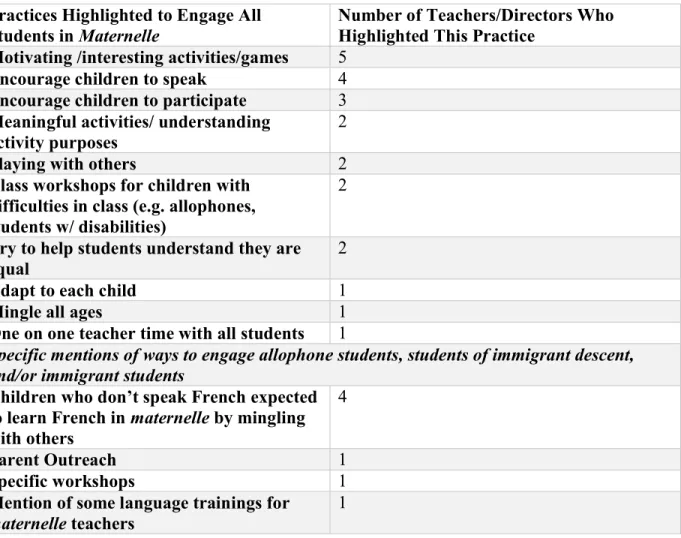
demonstrated in Table 4, it was most teachers’ goal to encourage each student to speak and ensure that all students were interested in class. As one teacher in Paris, a White woman, stated,
“We use the Montessori methods: each pupil, once he completed the activity, shows it to the mistress who validates it. The mistress is always available for them; she is here to encourage and support them in the activities.” I asked her a follow-up question, “How do the teachers encourage
immigrant children to participate?” She responded, “It is the same thing for everybody, we do not differentiate children of foreign origin.” Certainly teaching methods varied from interview to
interview given the flexibility allowed in the French national curriculum; however, the focus on adapting to each individual students’ needs and encouraging all students equally was generally present throughout most interviews.
44 become fluent with months or a year. As one teacher, a White woman in the Paris Department,
said, “But in maternelle the children learn very fast, within a few months they are able to say basic things and understand the mistress. It is said that children are like sponges because they have a great ability to learn.”
However, as shown in Table 4, some teachers did mention efforts to specifically engage students with learning difficulties and allophone students, students of immigrant descent, and/or
first-generation immigrant students. One teacher, a White woman in a large city in the Bouches-du-Rhône region, highlighted a variety of measures teachers carried out in and outside the classroom to engage their immigrant/allophone students:
Our primary goal in kindergarten is that children learn to speak French as best as possible. So our priority is teaching French to all children. But here we have children whose mother tongue is not French, who do not speak French at home. So the teachers organize specific workshops for these students. In this school we also give free French lessons for parents who do not speak French with teachers who come from an association called EPFF, Training Space Training France, that does training for adults. So this
teacher gives courses to about 18 parents who do not speak French well and who have trouble reading and writing it. And that's very important because it's so that after the parents can help the children in their schooling. In the classroom, there are also actions that are put in place. For example, this year we had a training course on listening pedagogy, which is a training that encourages children to speak by giving them several speaking sessions one after the other. And even if a child has the right answer, we still give the floor to other children to allow everyone to express themselves. We also try to work so that the children understand the meaning of the school: after each activity, we return to what has been done so that the children realize what they have learned. The goal is to return to the activity so that the children understand the meaning of the activity, the real meaning of the activity. We also do a lot of outings: in museums, in the city, in parks, on the farm. We have a lot of cultural projects. These are concrete activities so that they can learn more easily.
Another teacher, a White man, in a village near a large city in the Gironde region spoke
45 them. We are taking them in small group of 4 or 5 children. While the others are doing
something else, and we, the teachers, we are taking the students and we are coming back to what was not good.”
There is, therefore, a wide variation in approaches to engaging students with learning
difficulties, allophone students, students of immigrant descent, and/or first-generation immigrant students in French maternelles. More research is required to understand better understand this
variation, which approaches are more beneficial and why these approaches vary so greatly from school to school (culture, resources, etc.).
Table 5. Teacher Practices Used to Engage All Students
Practices Highlighted to Engage All Students in Maternelle
Number of Teachers/Directors Who Highlighted This Practice
Motivating /interesting activities/games 5 Encourage children to speak 4 Encourage children to participate 3 Meaningful activities/ understanding
activity purposes
2
Playing with others 2
Class workshops for children with difficulties in class (e.g. allophones, students w/ disabilities)
2
Try to help students understand they are equal
2
Adapt to each child 1
Mingle all ages 1
One on one teacher time with all students 1
Specific mentions of ways to engage allophone students, students of immigrant descent, and/or immigrant students
Children who don’t speak French expected to learn French in maternelle by mingling with others
4
Parent Outreach 1
Specific workshops 1
Mention of some language trainings for maternelle teachers