Anna D. Sandelli. Practices and Perceptions of Academic Library Instruction: A Survey of Composition & Rhetoric Instructors. A Master’s Paper for the M.S. in L.S degree. April, 2014. 63 pages. Advisor: Barbara B. Moran
Instructional services play a central and growing role in academic libraries’ offerings. As these services continue to evolve, librarians are increasingly called upon to not only plan and deliver instruction, but also to assess their efforts. This study sought to evaluate library instruction through an electronic survey of English 105 and English 105i course instructors within the University of North Carolina at Chapel Hill’s Writing Program. Survey questions were designed to examine both the attitudes and behaviors of
respondents, with the goal of gaining an understanding of factors involved in instructors’ decisions to include library-led instruction sessions in their courses, their expectations of this instruction, and their motivation for future use. Individual responses are highlighted, as are potential associations observed among length of teaching experience, course objectives, assignment development practices and perceptions of library instructors. Implementations for both practice and further research are also discussed.
Headings:
Academic Libraries – Use Studies
Information Literacy
Librarian-Teacher Cooperation
PRACTICES AND PERCEPTIONS OF ACADEMIC LIBRARY INSTRUCTION: A SURVEY OF COMPOSITION & RHETORIC INSTRUCTORS
by
Anna D. Sandelli
A Master’s paper submitted to the faculty of the School of Information and Library Science of the University of North Carolina at Chapel Hill
in partial fulfillment of the requirements for the degree of Master of Science in
LibraryScience.
Chapel Hill, North Carolina April 2014
Approved by
Table of Contents
List of Tables ...2
Acknowledgements ...3
Introduction ...4
Purpose of Study ...6
Study Environment ...7
Literature Review ... 9
Background ...9
Calls for Collaboration ...12
Use of Assessment ...15
Methodology ... 21
Results ... 24
Responses to Individual Questions ...24
Associations Among Responses ...31
Limitations and Opportunities ...39
Discussion ... 42
Practices of Instruction ...42
Perceptions of Library Instruction ...46
Conclusion ... 49
References ... 51
Appendix A: Survey Instrument ... 56
Appendix B: Survey Invitation ... 60
List of Tables
Table 1 ... 24
Table 2 ... 26
Table 3 ... 29
Table 4 ... 34
Table 5 ... 35
Table 6 ... 37
Table 7 ... 37
Acknowledgements
Introduction
Since their start, academic libraries have been synonymous with learning.
Depictions of early academic libraries frequently include imagery of a lone scholar
immersed in the text before him. Today, representations of these libraries, both in popular
culture and in college and university publications, often continue to feature scenes of
students engrossed in reading or writing, a book or laptop their sole companion. Learning
in today’s academic libraries, however, is increasingly seen not as a solitary pursuit but as
a shared experience. On campuses of all sizes, libraries have, and continue to, evolve
from places to find information to active partners in working with information, from its
gathering and evaluation to its attribution and distribution.
As academic libraries’ roles have evolved, librarians’ responsibilities have also
changed. Rather than serving primarily as gatekeepers to materials, librarians today stand
as guides to both faculty and students as they navigate a complex information landscape.
Often, their guidance takes the form of teaching all or part of class sessions. In recent
years, this teaching has itself undergone growth and transformation, due in large part to
increased attention on information literacy in higher education.
Introduced by Information Industry Association president Paul Zurkowski in
1974, the concept of being “information literate” has been interpreted in varied ways
(Behrens, 1994). Perhaps the most basic way to define it is with a description put forth by
the American Library Association (ALA): “Ultimately, information literate people are
to paraphrase a common aphorism, is not about giving a man a fish but about teaching
him how to fish, so that he will not simply have food for a day but instead develop a skill
to use the next time that he is hungry. In an academic library setting, a parallel could be a
librarian helping a student develop keywords to find articles for a research paper, rather
than the librarian conducting his or her own search and jotting down the titles of a few
promising results. By experiencing the former method, the student not only leaves with
materials to use for this assignment but with knowledge to apply in future coursework.
Teaching library instruction in general, and information literacy in particular, is
not a one-size-fits-all endeavor. Instead, librarians must collaborate with faculty and
campus partners to deliver instruction that targets specific research needs and skill levels.
The fact that much library-led instruction involves a single session within a professor’s
semester-long course further demonstrates this need for collaboration with faculty to
maximize student learning within a short time frame (Meulemans & Carr, 2013, p. 80).
Meanwhile, the work that the Association of College & Research Libraries (ACRL)
embarked on in 2011 to review and revise the information literacy competency standards
that it adopted in 2000 (Bell, 2013, para. 1-2) stands as just one distinct example of the
fact that discussions about information literacy remain an ever-changing dialogue.
As part of this ongoing dialogue, librarians involved with developing and
maintaining information literacy instruction must not only plan, teach and promote it;
they must also assess their efforts. Assessment can provide insights into what libraries
and librarians are doing effectively and should continue, as well as identifying areas in
which they could improve. Assessment can also play a key role in supporting and
same language as faculty and campus partners, in terms of both information literacy skills
and these partners’ instructional needs. Oakleaf and Kaske (2009) note that, in addition to
augmenting student learning and enhancing instruction, data from information literacy
assessment can serve as a response to “calls for accountability,” enabling libraries to
collect and share tangible evidence of their activities with stakeholders (p. 273).
Purpose of Study
As the focus of academic library instruction continues to shift from telling patrons
about the physical library to helping them learn how to learn, librarians not only need to
foster this evolution but to evaluate their efforts. One insightful way of conducting such
evaluation is by examining the practices and perceptions of faculty. While library-led
information literacy instruction is delivered to, and primarily impacts, students, it is their
professors who often have the power to decide whether to incorporate such instruction
into their courses. Consequently, if librarians want to bolster their contributions to
undergraduate education, they must connect with faculty (Hardesty, 2001, p. 128).
Before librarians reach out to forge connections with faculty, however, they first
need to gain awareness of faculty behavior and attitudes. Such an undertaking can
provide a valuable window into whether these faculty see library instruction in the same
way that the librarians with whom they work do. For instance, for faculty, is library instruction about teaching information literacy and cultivating students’ understanding of
learning as a process? Or, is it instead focused on presenting particular tools, such as the
library’s online catalog and its database offerings? Uncovering answers to such questions
has potential to kindle outreach efforts that could fuel more effective conversations with
To gain a deeper awareness of faculty practices and attitudes, this study undertook
a survey of instructors in the University of North Carolina at Chapel Hill’s Writing
Program. Instructors who had taught at least one section of ENGL 105: Composition and Rhetoric or ENGL 105i: Writing in the Disciplines during the Fall 2013 semester were eligible to participate. A survey instrument was chosen as the method of evaluation, with
the aim of gathering participant feedback in a way that was accessible and anonymous.
The study’s purpose was three-fold: first, to gain an understanding of factors
involved in instructors’ decisions to include or exclude library-led instruction sessions in
their courses; second, to learn of their expectations of, and experiences with, this
instruction; and third, to investigate their motivation for its future use. Also of interest
was examining possible associations among responses. For instance, were instructors
who had taught ENGL 105 or 105i for multiple semesters more or less likely to utilize library instruction than those newer to teaching it? Did instructors who wrote their own
assignments tend to seek library instruction more or less frequently than those who took a
collaborative approach to assignment creation? It was hoped that both responses to
individual questions and associations among responses would provide insights that could
be used to enhance instructional services at libraries with established information literacy
instruction programs, as well as those in the early stages of implementing one.
Study Environment
Instructional services in the form of classroom teaching have long been a
hallmark of UNC’s University Libraries. During the 2012-2013 academic year, the R.B.
House Undergraduate Library, which oversees logistics for a majority of instructional
services involving undergraduates, hosted 380 classroom instruction sessions for 7,081
also brought the appointment of an Undergraduate Engagement Librarian, a new role that
involves delivering instruction, leading assessment projects and examining “new ways of
engaging with undergraduate students” (UNC Library News and Events, 2012). This
librarian also serves as UNC Libraries’ primary liaison to the UNC Writing Program.
Overseen by the Department of English and Comparative Literature, the UNC
Writing Program is a self-described “model both for teacher training and for composition
instruction” (n.d., About). The program’s ENGL 105 and 105i courses, which were added to the curriculum in Fall 2012, were selected for this study because they form a large
portion of library-led instruction sessions at the University. ENGL 105 focuses on writing across Natural Sciences, Social Sciences and Humanities units, while ENGL 105i enables students with an interest in a particular discipline, such as medicine or business, to focus
on that discipline in greater depth (UNC Writing Program, n.d., Courses and placement). In addition to being courses that frequently incorporate library-led instruction,
ENGL 105 and 105i serve as foundational courses. According to the University of North Carolina at Chapel Hill Office of Undergraduate Curricula, students must complete one
of the courses to graduate (n.d., Foundations requirements). Moreover, a majority of students in these courses are first-year undergraduates with little previous exposure to
college research and writing. Consequently, it was thought that exploring the practices
and perceptions of the courses’ instructors could provide insights for other institutions
that offer similar first-year writing requirements, whereas focusing on subject-specific,
upper-level courses could limit the study’s generalizability. Due to the fact that many
Literature Review
A review of literature related to this topic proceeded in three stages. In the first,
the focus lay in examining literature about information literacy’s development and
growth in higher education, as well as its connections to library instruction. The second
focused on librarian and faculty collaboration, while the third reviewed the literature of
library instruction assessment.
Background
Dialogues about how to define information literacy emerged in the 1970s,
alongside discussions about why it was an important concept. In his 1974 proposal to the
National Commission on Libraries and Information Science, Paul Zurkowski described
the information services environment as being in a state of transition. The Information
Industry Association (IIA) president observed that, “People trained in the application of
information resources to their work can be called information literates,” and noted that
being able to use information effectively involved learning both skills and techniques (as
cited in Behrens, 1994, p. 310). By decade’s end, further discussions of the concept had
led to the sentiment that information literacy involved acquiring new skills in both
locating and using information; that it could help foster an active civic culture; and that it
was not simply about information use in the workplace (Behrens, 1994, p. 310).
Interestingly, these early discussions of information literacy arose soon after what
that academic librarians in the United States had engaged in teaching activities during the
19th century, while German library literature suggests even earlier origins, which likely
influenced American practices. By the 1930s, however, library instruction in the U.S.
seemed to have stagnated, and it remained in this state for close to three decades before
blossoming again. By the early 1970s, its resurgence could be seen in initiatives such as
the inaugural Library Orientation Exchange (LOEX) Conference (Lorenzen, 2001, p.
8-11). During this decade, Thompson (2002) posits, there was also a growing awareness
among librarians of the need to change traditional instruction practices to better meet students’ needs (p. 223). Links between library instruction and information literacy to
facilitate this change, however, were not strongly established during the 1970s. Overall,
the decade focused on defining information literacy, rather than demarcating the skills
and knowledge needed to manage information (Behrens, 1994, p. 311).
Discussion about information literacy in the 1980s and early 1990s expanded its
definitions while also beginning to delineate academic libraries’ involvement. In 1985,
Martin Tessmer of the University of Colorado Denver’s Auraria Library described the concept as “the ability to effectively access and evaluate information for a given need”
(as cited in Behrens, 1994, p. 312). Writing nine years later, Behrens (1994), notes that
Tessmer’s definition was both more detailed and more impactful than many before it.
“The definition can also be seen as an important milestone in the information literacy movement, since it marks the point at which information literacy and library user education appear to meld, and information literacy becomes a dominant issue in librarianship” (p. 312).
The decade’s end saw information literacy become even more of a dominant issue in
definition of information literacy still widely used today; it also emphasized the concept’s
importance, calling it a “survival skill in the Information Age” (1989, Opportunities to
Develop Information Literacy section,para. 1). Simultaneously, the report encouraged
librarians to take a leading role in championing information literacy. New mandates from
regional accreditation agencies during the 1990s further fueled this call to action, both for
institutions of higher education and for libraries (Thompson, 2002).
For libraries, taking a leading role in championing information literacy during the
end of the 20th century and early years of the 21st century involved much discussion of
what constituted information literacy instruction. While some saw it as a new direction,
others saw it as building upon an established foundation of “bibliographic instruction,”
which was based on what a library physically owned and the mechanics of using these
materials. Although some viewed the two concepts as divergent, others saw information
literacy instruction as an outgrowth of bibliographic instruction, with the former a way of
incorporating the best of the latter and of “helping people learn to help themselves by
becoming powerful, critical-thinking information users” (Grassian, 2004, p. 53) who
were poised to succeed not only throughout college but in future careers.
Other recent discussions about information literacy have focused on its
relationship to technology. Badke (2010) notes that having technological skills does not
necessarily make an individual information literate and that a number of studies
demonstrate that technologically savvy students continue to perform poorly on tasks that
require information handling more complex than Google searches (p. 135-136). The
Association of College & Research Libraries’ (ACRL’s) Information Literacy
literacy, while important, is a subset of information literacy, rather than a synonym for it.
As the competencies state:
“‘Fluency’ with information technology may require more intellectual abilities than the rote learning of software and hardware associated with ‘computer
literacy’, but the focus is still on the technology itself. Information literacy, on the other hand, is an intellectual framework for understanding, finding, evaluating, and using information--activities which may be accomplished in part by fluency with information technology, in part by sound investigative methods, but most important, through critical discernment and reasoning” (2000, Information Literacy and Information Technology section, para. 3).
Calls for Collaboration
As the 21st century has continued, conversations about information literacy have
progressed from what it is to how to best foster and encourage it. Regional accreditation
standards such as those referenced by Thompson (2002), have continued to be in place,
while the ALA and ACRL have developed and disseminated guidelines, proficiencies for
library instructors and characteristics of best practices for instruction programs
(Muelemans & Carr, 2013). In addition to presenting recommendations, these documents
also highlight the importance of libraries and librarians collaborating with faculty and
other campus partners to deliver information literacy instruction (Mounce, 2010, p. 306).
An exploration of the literature on librarian-faculty collaboration reveals the
contrasting themes of possibility and challenge. Raspa and Ward (2000) offer enthusiastic
perspectives on the first theme as they describe both how their own partnership began and
share case studies of other librarians and faculty working together. The humanities
professor and coordinator of library instructional services describe collaboration as an act
of listening that “has the power to bring the enterprise of learning to life” (Raspa &
Ward, 2000, p. 3). Such a relationship, the authors note, enables both parties to see
partnerships an imperative in an information age that is increasingly interdisciplinary and
in which one individual cannot know everything. Interestingly, they also posit that
librarian-faculty partnerships may provide personal fulfillment in what they envision as
an era where people desire more than monetary rewards from their work (2000, p. 15-16).
While a number of case studies describing instruction-based collaboration exist, of more interest to this study’s focus was literature that highlights faculty perspectives on
such collaboration. In many instances, this literature also delves into how faculty perceive
information literacy. Although the general consensus seems to echo ALA, ACRL and accreditation standards’ stance that information literacy skills are important, and even
essential, to acquire, there is less agreement about how this acquisition should occur.
The idea that students will obtain information literacy skills via osmosis is a
recurrent theme. McGuinness’ (2006) cross-disciplinary study of Irish faculty found an
implicit assumption of “learning by doing,” or of developing information literacy skills
simply by completing research-based assignments (p. 577). Moreover, a number of the
faculty whom she surveyed indicated that successfully developing information literacy
skills depended on students’ “personal interest, individual motivation and innate ability,
rather than on the quality and format of the available instructional opportunities” (2006,
p. 577). DaCosta’s (2010) surveys of faculty in the United Kingdom and United States
similarly echo the idea of learning by osmosis while also suggesting a gap between
respondents’ rankings of the information literacy skills students that need and the actions
that they as faculty take to teach these skills.
Tied to the idea of a lack of consensus about how students acquire information
Gullikson’s (2006) survey of Canadian faculty included written complaints about the
language she used and verbal feedback expressing confusion with her wording and
comments about vagueness. One respondent even circled every instance of the phrase “information literacy” on the survey and added the comment “a horrible term!” (p. 591).
Saunders (2012) echoes the idea of confusion over information literacy, as well as noting
that the concept is frequently linked too closely with library skills. Such an association,
she adds, could lead faculty to view cultivating information literacy skills as something
that is outside of their realm of responsibility. This attitude, she notes, could “encourage
faculty to focus on discipline content and assume that information literacy will be
addressed in other ways,” (2012, p. 227), an observation that echoes McGuinness’ (2006)
premise that information literacy is often seen as acquired through osmosis.
An additional challenge to collaboration involving information literacy is
uncertainty about what librarians can do to foster it. Rather than asking how a librarian
may best support their class’ needs, faculty often come to the librarian with requests
based on their own perceptions and which remain grounded in bibliographic instruction,
or a focus on specific materials rather than broader concepts of learning how to learn.
Muelemans and Carr (2013) highlight such thinking by citing faculty requests such as
“Take the student[s] on a tour of the library so they can learn how to do research” and
“Tell them to not use the Internet and use scholarly sources,” (p. 81). Saunders (2012),
found that, despite expressing appreciation for librarians’ skills, few faculty respondents
to her survey signaled that they saw librarians as instructional partners. Such a finding,
she notes, demonstrates that “library instruction seems to be regarded as an add-on, and
Encouraging faculty to see the value of giving up class time for library instruction
involves fostering dialogue. Throughout the literature reviewed for this study, an idea that
appears frequently is that faculty do not appear unwilling to participate in such dialogue.
Instead, they seem unsure of how to best initiate it. As Saunders (2012) posits, what may
seem faculty reticence to partner with librarians has less to do “with a lack of respect for
the position, and more to do with a lack of understanding of how librarians can contribute
to and support their instruction” (p. 232). Responses to Shellie Jeffries’ surveys to faculty
echo this perspective, particularly through one respondent’s observation that new and
part-time faculty often neither know what librarians are able to do nor that they would
like to partner (as cited in Raspa & Ward, 2000, p. 126). Such observations bring up
another theme found throughout the literature: the idea that the onus is on librarians to
proactively kindle dialogue with faculty (Meulemans & Carr, 2013, p. 82). It may, as the
saying goes, take two to tango, but, as Raspa and Ward (2000) note, “If we wait for others to invite us, we may be waiting a long time to enter the dance” (p.11).
Use of Assessment
If librarians are to take the lead in fostering dialogue, assessment can serve as a
valuable tool in making this dialogue effective. Like information literacy instruction,
assessment is neither a one-size-fits-all endeavor nor one with a universally accepted
definition. Often, “assessment” and “evaluation” are used interchangeably, although the
terms are not quite synonymous. Houlihan and Click (2012) reference several definitions
of assessment that highlight its focus on measuring outcomes, which they contrast with Rabine and Cardwell’s (2000) description of evaluation as concerned with apprising
services, initiatives or individuals (p. 36). Although the terms are not identical, the
and weaknesses, for instance, may lead to the development of training, and a librarian
could then assess this training to measure whether it has impacted instructors’ skills.
The demarcation between assessment and evaluation is not widely discussed in
the literature (Houlihan and Click, 2012, p. 37) and even those who note the difference
may choose to use the terms interchangeably, as Tancheva, Andrews and Steinhart (2007)
do (p. 31). Because “assessment” is used more frequently throughout the literature, it is
the term referenced throughout this section for the sake of consistency. Nonetheless, the
distinction is discussed here, both as a consideration that emerged when planning this
study and as a factor that others may wish to consider as they develop projects.
Planning an assessment project begins with consideration of the project’s
logistics, goals and implications. Radcliff, Jensen, Salem, Burhanna and Gedeon, (2007)
note that those planning assessment have the option to undertake it at an individual
classroom level, at a program level or at an institutional level. Time and money involved,
access to participants and the amount of faculty collaboration and outside expertise
needed are among the additional considerations that Radcliff et al. (2007) suggest
librarians consider when exploring assessment options. Oakleaf and Kaske (2009) expand
upon these considerations by proposing key questions to guide projects, including
determining why the project is being conducted, which stakeholders are involved and
whether the project will tell those administering it what they seek to know (p. 274).
Understanding the distinction between “formative” and summative” assessment is
also referenced throughout the literature as a criterion to keep in mind. Formative
assessment is administered as a program is taking place, with the goal of improving it
concerned with measuring outcomes and generally occurs at the end of a set point, such
as after a semester of library instruction sessions. The two forms of assessment can be
used together effectively, although there may be times when the nature of an initiative
guides the decision to use one or the other. For instance, as Schilling and Applegate
(2012) note, a library instruction program that consists of single, one-hour classes is a
difficult initiative for which to use iterative formative assessment (p. 260).
The techniques available for conducting assessment include affective, behavioral
and cognitive methods and can involve direct contact or indirect observation (Radcliff et
al., 2007). This literature review will focus specifically on survey instruments, in keeping
with the technique employed by the study. As with every assessment technique, surveys
present both benefits and drawbacks. Among their positive attributes are their ability to
efficiently gather data from a large group in a short amount of time while preserving
anonymity (Radcliff et al., 2007, p. 47-48). Surveys can also enable those administering
them to efficiently ask about a range of topics and gain insights into respondents’
opinions and attitudes (Schilling and Applegate, 2012, p. 264). Although surveys are
frequently used for stand-alone assessment projects, they can also be used in longitudinal
studies, enabling librarians to track changes over time. Those who use surveys for
longitudinal studies also have opportunities to alter questions or add questions, based on
findings and the needs of the particular survey period (Gaspar & Wetzel, 2009, p. 580).
Alongside their advantages, surveys also present challenges, and often what may
be seen as a benefit in some instances can become a limitation in others. While surveys
lend themselves well to anonymity, there may be situations where identification is
respondents’ comfort level in answering questions (Houlihan & Click, 2012, p. 45).
Making surveys easy to follow can result in short responses that provide limited detail
and no opportunity for elaboration or clarification (Radcliff et al., 2007), as one might
have in a direct contact setting, such as a focus group. As a measure of indirect
assessment, surveys also open the possibility of a gap between beliefs and actions. How
respondents view their skills, for instance, may be different than how someone
administering or analyzing a survey would (Schilling & Applegate, 2012, p. 262).
The likelihood of low responses rates, which could limit the generalizability of
takeaways, is another potential pitfall echoed throughout the literature. Gonzales (2001),
for instance, received a 23.4% response from her Web-based survey to faculty, and she
cites earlier surveys that suggest a similar rate is not uncommon (p. 193). Hrycaj’s and
Russo’s (2007a) survey sent to 1,340 Louisiana State University faculty yielded a
response rate of just 14% (p. 16). Other surveys, however, have had more success. Anita Cannon’s (1994) survey, on which both of the above were based, yielded a 41% response
rate. In addition, even those whose surveys had lower response rates than desired
uncovered findings that they pinpointed as interesting opportunities for further study. In
Gonzales’ case, for instance, she found that faculty with the least teaching experience
were proportionally more likely to have received library instruction when learning to
research, but that this relationship did not correlate to their decision to request library
instruction for their own students (2001, p. 201). Such a finding led to her to propose
additional research to explore what motivates faculty to seek library instruction.
A review of the literature also unveiled reflections on how survey design may
discussion of how both their findings and those of two widely-cited earlier surveys from
which they drew inspiration included a notable gap between the library instruction that
faculty respondents actually used and what they said that they would use (p. 692). They
suggest that this gap can be attributed to “social desirability bias,” or the idea of
participants positively responding to something that they believe society will also view
positively. The authors further note that asking faculty about the actions they would take does not bear the weight of a formal commitment to actually undertake an action (p. 694).
Findings such as the above illustrate the value of designing surveys that focus
more specifically on behavior, rather than attitudes, or that include a combination of
questions focused on both behavior and attitudes. For instance, Gaspar and Wetzel
(2009), in their survey of The George Washington University faculty, asked respondents
to share their learning goals for library instruction sessions. This question not only
provided an open-ended opportunity to identify the key principles valued by faculty; it
also offered a chance to see how – and if – these principles synced with those that the
library had previously defined (p. 580-581). The authors also strove to avoid questions
that could be construed as vague or overly broad by breaking them into smaller, more
specific categories. When asking about the effectiveness of library sessions, for instance,
the authors requested that respondents rate effectiveness in three separate categories: students’ information needs, faculty expectations and support of the course (p. 582).
Guided by learnings from the literature, this study sought to build and expand
upon earlier information literacy assessment projects. It strove to take such projects in a
new direction with a survey instrument designed to gain insights into both attitudes and
both of respondents’ use of library instruction and of their own teaching practices. The
aim of such a survey arrangement was to fuel the study’s goals of understanding what
drives faculty to include library-led instruction, their expectations of, and experiences
with, this instruction and their motivation for its future use. This survey could be best
described as a formative evaluation project, as it seeks to apprise services and identify
areas of improvement. As the literature suggests, evaluation can lead to assessment
(Houlihan & Click, 2012) and formative projects to summative endeavors (Schilling &
Applegate, 2012). Consequently, what is notable about this survey is not only that it
builds upon previous research and strives to take it in a new direction, but also that it may
Methodology
This study sought to develop an assessment instrument that would go beyond
affective measurement and provide behavioral insights while also examining potential
relationships among attitudes and behavior. Following discussions with University
Libraries’ Undergraduate Engagement Librarian, Fall 2013 was selected as the time
frame around which survey questions would be centered. This semester marked the
beginning of the second full year of ENGL 105 and ENGL 105i as course requirements, meaning that survey respondents could include both those who had taught the course
before and those new to it. To facilitate ease of responding, an online tool, Qualtrics, was
selected as the instrument for survey design.
To further assist ease of responding, the survey was designed to employ branch
logic, so that respondents who had not utilized library instruction would not answer
inapplicable questions and vice versa. Both closed and open-ended questions were
included, with the hope of mitigating the lack of detail described as a potential drawback
to this assessment technique. No question required a response, other than the question of
whether a participant had used library instruction during the Fall 2013 semester, as an
answer was needed here to employ branch logic. Although both full-time librarians and graduate student assistants from UNC’s School of Information and Library Science,
following observation and training activities, teach library instruction sessions, survey
questions did not differentiate among or ask respondents to identify whether their library
facilitate ease of responding by keeping survey questions brief, it was thought that ENGL 105 and ENGL 105i might not know if their instructor was a librarian or a graduate student, as stating this status is not a requirement when speaking with instructors.
Three librarians, each of whom had taught library instruction for at least two
years, pretested the survey, as did a School of Information & Library Science faculty
member and a current ENGL 105 instructor. Their insights led to rewording and
combining several questions, helping employ more concrete language while streamlining
the survey. They also confirmed that the survey was accessible on mobile devices and
tablets. The final survey instrument can be viewed in Appendix A, beginning on page 56.
A link to the survey was sent to ENGL 105 and ENGL 105i instructors via two UNC Writing Program departmental listservs on February 3, 2014. These electronic
mailing lists are open to all affiliated with the Writing Program, rather than solely shared
with ENGL 105 and ENGL 105i instructors, so the invitation e-mail was worded to reference criteria for eligibility in its opening lines. The listservs seemed to offer an
appropriate balance between sending a targeted message and retaining anonymity, as
neither the study author nor the Undergraduate Experience Librarian with whom she
collaborated to draft and send these messages had access to the individual e-mail
addresses of listserv subscribers.
Based on the amount of e-mail that UNC affiliates receive, it was initially
determined that sending an invitation e-mail from the Undergraduate Experience
Librarian, with whom many ENGL 105 and ENGL 105i instructors had worked, might lead to increased name recognition and higher response rates than sending it from the
served as an administrator for these listservs, however, the invitation instead needed to be
sent from the e-mail account of the Writing Program Assistant. This e-mail invitation
strove to emphasize that the survey was not solely a student project; but instead an
endeavor designed to garner insights that could enhance library services. The complete
text of the invitation can be seen in Appendix B, found on page 60.
Although the survey had been scheduled to remain open for two full weeks, North
Carolina experienced an unexpectedly harsh bout of winter weather that closed the
campus for two and a half days during this planned period. Given the potential this
weather caused for loss of Internet access, as well as instructors’ regular routines, the
survey was extended an additional week and closed on Sunday, February 23. During this
three week period, three brief reminder messages were sent to the Writing Program
listservs, again via the e-mail of the Program Assistant. Text of a reminder message can
be seen as Appendix C, found on page 61. Several modifications were made to the
reminder messages. Following observations that respondents were generally taking
approximately five minutes to complete the survey, references to the estimated time
needed to take the survey were changed from ten minutes to five, in the hopes that the
more accurate measure would encourage responses. Reminder messages also emphasized
the fact that instructors did not need to have utilized library instruction during the Fall
Results
Thirty-four Writing Program instructors responded to this survey. Of these, one
response was discarded because the participant indicated in an open-ended answer that
the courses he or she taught during Fall 2013 did not include either ENGL 105 or 105i. The University of North Carolina at Chapel Hill Office of the University Registrar (2013)
lists 87 total ENGL 105 and 105i instructors for the Fall 2013 semester. Thus, excluding the ineligible respondent, the survey yielded a 38% overall response rate. It also yielded a
100% completion rate: all who started the survey also finished it.
Responses to Individual Questions
Responses to individual questions provided information about participants’
backgrounds, their use of library instruction, their expectations and experiences of this
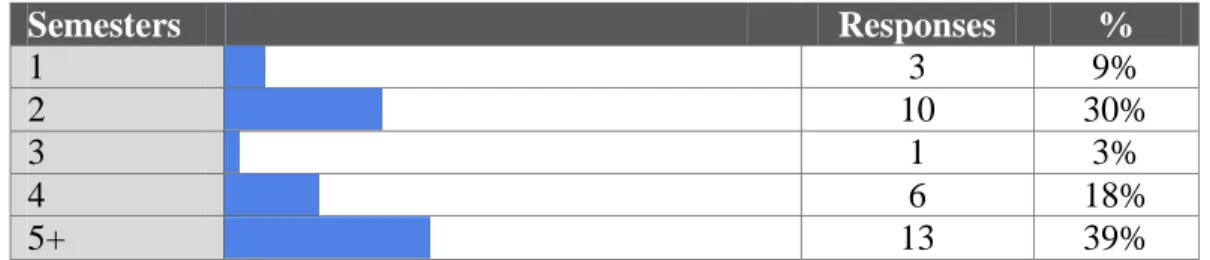
instruction and their motivation to request it in the future. Of the 33 eligible respondents,
a slight majority had taught a first-year composition course for four or more semesters,
and those who had taught such a course for more than five semesters comprised the
highest percentage of respondents. Table 1, below, lists a full breakdown of responses.
Table 1: Semesters of teaching ENGL 105/105i (or equivalent first-year writing course)
Semesters Responses %
1 3 9%
2 10 30%
3 1 3%
4 6 18%
In terms of their own teaching practices, 76% of instructors utilized more than one
assignment-planning process during the Fall 2013 semester, and 74% incorporated a
practice that involved either another person’s input or their materials. Using existing
assignments that the instructor had developed without outside assistance and modifying
existing assignments developed by other instructors were listed as the most frequently
used processes, at 64% each, followed by updating assignments that the instructor had
developed by himself or herself, at 55%. The least frequently selected responses all
involved the process of developing new assignments, either on one’s own (27%), through
collaboration with a colleague (24%) or through collaboration with a librarian (18%).
One of the first questions in the survey asked participants to rank up to three
research-related course objectives for teaching ENGL 105 or 105i by order of importance. All 33 respondents ranked at least three objectives from a list of seven options, which
included an “Other” option. Although the survey requested that respondents rank three or
fewer objectives, its setup did not impose any limits on the number that they actually
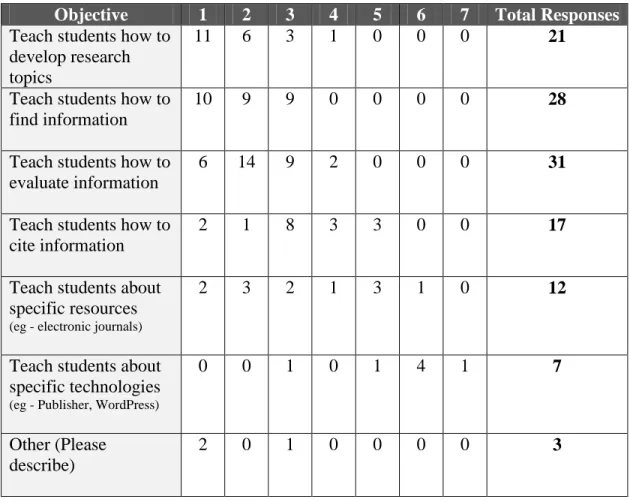
could select, and nearly a quarter ranked a fourth and fifth objective as well. Teach students how to evaluate information was ranked as an important objective by 32 of 33 respondents, followed closely by teach students how to find information. Teach students how to develop research topics came in third among overall responses, with 22 of 33 respondents ranking it at some place along their list. As illustrated in Table 2, on page 26,
students how to synthesize info and come up with an argument, use research to refine their own ideas about a topic and Zotero as their objectives.
Table 2: Research-Related Course Objectives, In Order of Importance (#1 as highest)
Objective 1 2 3 4 5 6 7 Total Responses
Teach students how to develop research topics
11 6 3 1 0 0 0 21
Teach students how to find information
10 9 9 0 0 0 0 28
Teach students how to evaluate information
6 14 9 2 0 0 0 31
Teach students how to cite information
2 1 8 3 3 0 0 17
Teach students about specific resources (eg - electronic journals)
2 3 2 1 3 1 0 12
Teach students about specific technologies (eg - Publisher, WordPress)
0 0 1 0 1 4 1 7
Other (Please describe)
2 0 1 0 0 0 0 3
Thirty-one of the 33 eligible respondents indicated that they had used library
instruction for their ENGL 105 or 105i courses during Fall 2013. A schedule of Fall 2013 library instruction sessions, maintained by the Undergraduate Experience Librarian,
of 33 respondents indicated that they had not used library-led instruction, representing a
9% response rate for this population. The low response rate and small number of
respondents in this category limit its utility in analysis. Consequently, much of the
analysis and discussion of results presented in the pages that follow will focus on those
who did use library-led instruction.
More than three-quarters of respondents indicated including a library instruction
session for their Natural Sciences unit. For ENGL 105 courses, Natural Sciences is generally the first unit introduced during a semester, so it is perhaps unsurprising that
81% of those who had used library instruction included a session during this unit, in
comparison to 16% for Social Sciences, which is generally taught as the second unit of
the semester, and 35% for Humanities, which is typically last. Nineteen percent of those
who had used library instruction indicated using it for a unit other than the three
referenced above. Because the number of Writing Program instructors who teach ENGL 105i and focus on other units is much smaller than the number who teach ENGL 105, this question did not ask respondents to name the specific other unit for which they had used
library instruction , as their answers may have impacted anonymity.
Respondents were more likely to have included multiple library instruction
sessions throughout the semester (55%) than just a single session (45%). Just five
respondents, or 16%, indicated that they signed up for more sessions than they had
originally anticipated. In response to an open-ended follow-up question that asked why
they had requested additional sessions, the three themes that emerged were: the need to
explore additional, subject-specific resources, referenced by four respondents; a desire to
helpfulness of librarians, also referenced by two respondents. One respondent noted that
the suggestion of the library instructor with whom he or she had worked played a part in
the decision to schedule a subsequent session, alongside a realization of students’ needs
to better understand online databases used to locate scholarly and reliable sources.
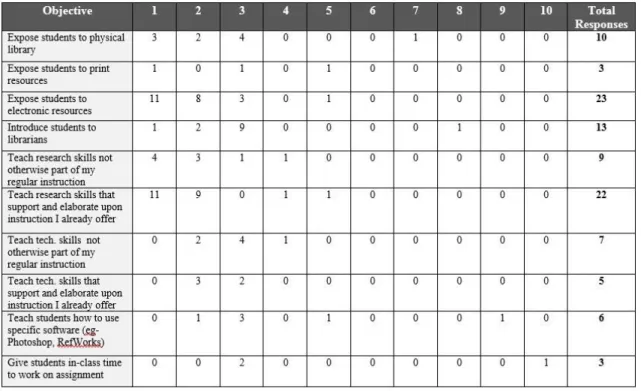
A large majority of ENGL 105 and 105i instructors came to their most recent library instruction session with multiple goals. Expose students to electronic resources was selected most often, with 11 instructors ranking it as their most important objective
and an additional 12 selecting it elsewhere in their ratings. Teach research skills that support and elaborate on the instruction I already offer was listed as the most important objective by 11 respondents, with an additional 11 selecting it elsewhere in their ratings.
Introduce students to librarians stood as the third most frequently referenced, with one respondent listing it as his or her most important objective and an additional 12
respondents including it elsewhere in their rankings. As in the question about course
objectives, participants were asked to rank up to three objectives but the survey
instrument did not prevent them from ranking more, and several respondents included
additional objectives. A full list of responses can be seen as Table 3, found on page 29.
All 31 respondents indicated that their library session either met most (32%) or all
(64%) of their objectives. A greater percentage rated their library instructor as highly
proficient in subject knowledge (62%) than in presentation and delivery or engagement
with students (42% each). Online tutorials that could be assigned as homework and
collaborating with a librarian to develop assignments were selected most frequently as
Table 3: Ranking of Objectives for Library Instruction Session (#1 as Highest)
Among those who had utilized library instruction during Fall 2013, all 31 stated
that they would sign up for such instruction again. Twenty-three responded to an
open-ended question asking them to share their reasons for being willing to sign up for future
instruction. Themes that emerged were: the benefits of this instruction to students, its
benefits to Writing Program instructors and the nature of librarians, each illustrated in the
selected responses below:
“It is helpful to get students into the library and to help them realize that they have other resources to tap into when they are having trouble with an assignment.” “The library instructors tend to have a good strategy for helping students navigate the different tools available on the site. It's also helpful because it would take me a long time to find the perfect examples for everything that I would want to cover. It takes a lot of the burden off of me as an instructor.”
Although, as noted previously, the two respondents who had not utilized library
instruction represented a small percentage both of participants and of this population of
ENGL 105 and 105i instructors, their answers will be referenced briefly. Both indicated that their decision stemmed from feeling able to teach necessary skills and concepts
themselves. One respondent also cited a negative past experience with library instruction,
while the other indicated that he or she did not consider it a productive use of time. In a
question about what would make library instruction of use, one respondent listed
additional communication about what library instruction is, an opportunity for shorter
sessions and an opportunity to collaborate with a librarian to develop and test
assignments. A second respondent selected Nothing; do not see a use for it in my class. The survey’s last question, which was open-ended, asked respondents to share
any additional comments that they had about library instruction. Nine participants
responded. Several included praise for individual librarians and library instruction as a whole, echoing the comments found in the survey’s earlier question about why
instructors would or would not sign up for library-led instruction in the future. Other
responses either noted recent progress or offered recommendations for improvement.
Two respondents specifically referenced their experiences with graduate student
assistants leading their instruction sessions, one with a positive perspective; the other
with suggestions based on an off-putting experience:
“I’ve noticed a big improvement in the librarians’ teaching skills over the past couple of years. Old sessions could be VERY boring and not engage the students at all; it seems that SILS [the School of Information and Library Science] is being attentive to pedagogy in its instruction these days, because the ‘teaching’ element is definitely getting better.”
easier and after so many years of doing library visits. maybe you need to develop expertise in specific use of lib resources and make that available to 105 classes?”
Interestingly, although this respondent expressed dissatisfaction, he or she also referenced
currently working with librarians in two of UNC’s other subject-specific libraries as part
of ENGL 105 or ENGL 105i instruction.
Other comments from this final open-ended question included a suggestion to
make library-led sessions more engaging by having students complete certain tasks,
rather than listening to a lecture. One respondent shared experiences of librarians being
“well-meaning” but trying to engage in dialogue to a larger degree than he or she desired:
“I have sometimes decided against having a library session because I knew that the librarian would try to impose on me more services than I was seeking and turn the email exchange into a long dialogue, always with requests for more
material….When this happens, I feel like it is the librarian’s needs that are being serviced instead of my own needs.”
Associations Among Responses
While responses to individual questions shed light on ENGL 105 and 105i instructors’ experiences with and attitudes toward library instruction, it was thought that
examining possible associations among quantitative responses could provide additional
illumination. Knowing that there are many approaches to analyzing data, and that this
survey contained varied categories of data, the goal was not an exhaustive analysis of
every set of responses’ relationship to each other set. Rather, the investigation focused on
exploring potential connections that could be of use in both planning library instruction
and in identifying and developing further research opportunities in this field.
The first part of this investigation involved examining whether evidence of
ranking of library instruction’s value to his or her teaching (Question #9) or the instructor’s ranking of how well his or her most recent library session met objectives
(Question #11). Following a commonly accepted practice in the social sciences, a p-value of 0.05 or below was deemed statistically significant. STATA 13 data analysis and
statistical software was used to calculate three ordered logistic regression models, using
length of teaching experience as the independent, or causal, variable in each case. All of
the resulting models yielded a p-value of greater than 0.05. The model for Question #6 had the lowest p-value, at 0.156. Nonetheless, in each case, the models suggested that
length of teaching experience had no statistically significant impact on any of the three
practices or perceptions described above.
The second part of this investigation turned to survey questions that involved
categorical variables and began by exploring whether associations existed among their
answers and respondents’ length of teaching experience. In addition to not having an
intrinsic order, questions that involved categorical variables often enabled respondents to
select more than one answer. For instance, comparing respondents’ rankings of their
research-related course objectives (Question #2) seemed an area of interest. However, respondents were told that they could rank up to three objectives in this question. All
respondents ranked at least three, and several ranked more than three, initially making it
difficult to use responses as a point of comparison.
To rectify this issue, data was imported in Excel and recoded. Recoding began
with removing the three objectives ranked by fewer than half of participants, leaving
had listed each of these objectives as either their most important or second-most
important received a “1” in their column, and all other respondents, including both those
who had ranked the objective lower on their list and those who had avoided ranking it, received a “2.” STATA was then used to conduct Fisher’s exact tests, a method of
calculating associations among small samples for which Pearson chi-square tests are not
appropriate. A p-value of 0.05 or lower was again considered statistically significant.
Using this method to compare length of teaching experience with course
objectives resulted in no statistically significance evidence of association, as shown in
Table 4, found on page 34. Data was then recoded to place a “1” in the columns of those
who had ranked each objective as their most important objective and a “2” for those who
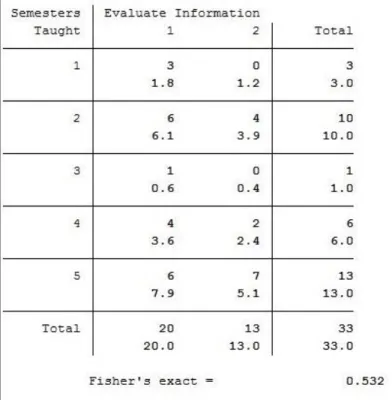
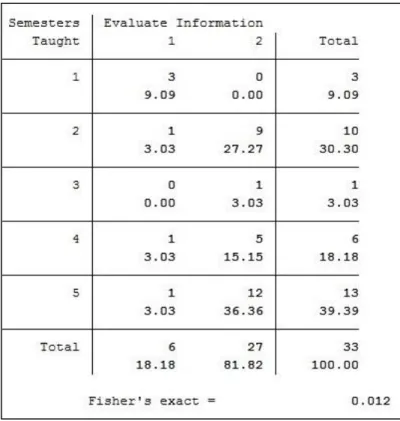
had ranked it lower. Returning to STATA to calculate Fisher’s exact tests yielded p-values of lower than 0.1 but higher than 0.05 for developing topics,finding information and citing information. For evaluating information, however, the test yielded a p-value of 0.012. As Table 5, on page 35, shows, all three instructors with one semester of ENGL 105 or 105i teaching experience ranked this as their most important objective, while only one of 13 instructors with five or more semesters’ experience did. Interestingly, just one
of 10 instructors with two semesters’ of experience teaching such a course ranked
evaluating information as his or her most important objective, demonstrating more similarity to those with five or more semesters’ experience. Comparing Table 4 to Table
5, however, shows 60% of respondents listed evaluating information as one of their top two objectives, although less than a quarter saw it as their number one objective.
This same process of recoding date to explore potential associations with length
library session objectives (Question #10) and which other library instructional offerings participants would use (Question #15), recoding again proceeded in two stages. In the first, any objective or offering that the respondent had ranked as his or her top or second choice was coded with a “1” and anything ranked lower was coded with a “2.” In the
second stage, to narrow the focus, only the objective or offering that the respondent had ranked as his or her top choice was coded with a “1.” This process revealed no
statistically significant associations among respondents’ objectives for their most recent
library instruction session and their length of first-year composition teaching experience.
Table 4: Association Between Teaching Experience and Top Two Course Objectives
Table 5: Association Between Teaching Experience and Top Course Objective
*Note: Actual values are displayed without decimal points, with expected frequencies listed immediately below, calculated to two decimal points.
For association between length of teaching experience and rankings of additional
library instruction offerings, a different story emerged. Again running Fisher’s exact tests
to measure association, no evidence of statistically significance differences among groups
emerged for the first two offerings listed in the question (online tutorials in place of in-person library instruction and online tutorials that could be assigned as homework).
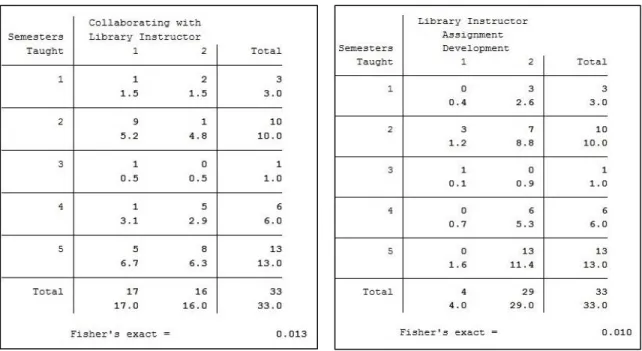
For the next two offerings, collaborating with a library instructor to develop an assignment or library instructor development of a class assignment, however,
suggestions of statistical significance did emerge. With the first round of recoding, or using a “1” to indicate the offerings ranked as respondents’ first or second-highest choice,
recoding, or using a “1” to only indicate the offering ranked as respondents’ first-highest
choice, p-values rose to 0.051 and 0.036, respectively. Although, at 0.051, the p-value for
association between length of teaching experience and selection of collaborating with a library instructor to develop an assignment is slightly above the level deemed statistically significant, overall these four Fisher’s exact tests suggest that respondents with two or three semesters’ teaching experience selected these two offerings at a higher rate than
those with other lengths of teaching experience, as shown in Tables 6 and 7, on page 37.
A similar recoding process was next undertaken to explore whether associations
existed between length of first-year composition teaching experience and instructors’ Fall
2013 assignment planning processes (Question #3), with a particular focus on
collaborative versus individual planning processes. An equitable recoding process was
also undertaken to investigate length of teaching experience and perceptions of library
instructors’ (Question #12). In both cases, no evidence of statistical significance emerged.
After exploring possible associations among length of teaching experience and
other variables, the next step lay in examining these other variables’ associations with one another. Performing Fisher’s exact tests to compare respondents’ rankings of the
value of library instruction to their teaching (Question #9) with their ratings of library instructors’ subject knowledge, presentation and delivery and engagement with students
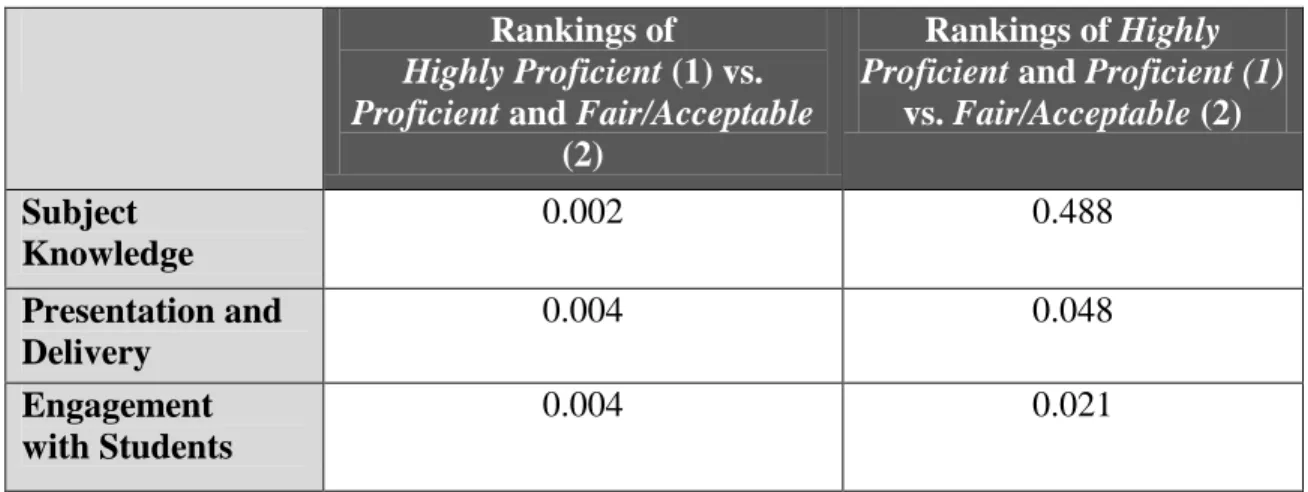
(Question #12) yielded p-values below 0.05. As demonstrated in Table 8, on page 38, these statistically significant p-values occurred for all categories when data was coded to group ratings of “highly proficient” as “1” and ratings of “proficient” or “fair/acceptable”
together as “2.” They also occurred for every category except “subject knowledge” when
Table 6: Association Between Teaching Experience and Top-Two Ranked Library Offerings
*Note: For both Tables 6 and 7 actual values are displayed without decimal points, with expected frequencies listed immediately below, calculated to two decimal points.
Table 7: Association Between Teaching Experience and Top Ranked Library Offering
Table 8: P-Values of Comparisons Between Library Instruction’s Value and Library Instructor Rankings
Rankings of
Highly Proficient (1) vs.
Proficient and Fair/Acceptable
(2)
Rankings of Highly Proficient and Proficient (1)
vs. Fair/Acceptable (2)
Subject Knowledge
0.002 0.488
Presentation and Delivery
0.004 0.048
Engagement with Students
0.004 0.021
Fueled by these findings, subsequent Fisher’s exact tests sought to explore other
potential associations involving ratings of library instruction’s value to respondents’
teaching. Tests were run between instruction’s value and respondents’ ENGL 105 or 105i course objectives, their library session objectives, the number of library sessions that they
used and how well their most recent library session met the objectives that they had for it
(Question #11). In each of these cases, no p-values of 0.05 or below occurred, indicating that there was no statistically significant association among respondents’ rating of library
instruction’s value and any of the other four variables. Thus, the statistically significant
associations that emerged in analyzing survey responses remained:
Length of first-year composition teaching experience and listing of evaluating information as a top course objective
Length of teaching experience and ratings of collaborating with library instructor to develop an assignment or library instructor development of a class assignment as the top additional instruction opportunities respondents would use if available Rating of library instruction’s value to respondents’ teaching and rankings of
Limitations and Opportunities
Before further discussing the survey’s responses and their implications, it is
helpful to consider the study’s limitations. As noted in the literature review, surveys tend
to suffer from low response rates. While this survey’s 38% response rate is higher than
several others referenced in the literature review, the fact remains that fewer than half of
the population eligible to take this survey completed it. Moreover, with 33 respondents,
the survey has a small sample size, and respondents represent a rather homogenous
population, both of which could limit the generalizability of results. This is especially
important when considering associations among responses. Given the small and
exploratory nature of this study, these potential associations should be seen as areas of
interest for replicating or expanding upon this research, rather than as associations to
attribute to other populations, or even to extend to all of UNC’s ENGL 105 and 105i instructors. It could be particularly enlightening to conduct a similar survey with a larger population of faculty instructors, culled from either other departments’ introductory,
first-year coursework or from other colleges and universities with comparable first-first-year
composition courses that likewise have an opportunity to utilize library-led instruction. It
could also be insightful to focus on other groups of faculty. As noted in the description of
this study’s environment, a majority of ENGL 105 and 105i instructors are doctoral
candidates. Exploring the practices and perceptions of full-fledged and veteran faculty
could yield different insights or deepen those gleaned from this study.
Social desirability bias stands as another potential caveat to keep in mind. This
survey strove to incorporate questions about both behavior and attitudes to lessen the risk
of respondents answering questions a particular way because it seemed politically correct.
respondents knew that the survey was being conducted with involvement from the
Undergraduate Experience Librarian. The fact that 100% of respondents indicated that
they would sign up for library-led instruction again stands as one potential example of
this bias. Although a unanimously positive response may seem encouraging, indicating a
willingness to sign up for instruction does not carry the same weight as actually doing so.
An open-ended follow-up question asking participants why they would choose to sign up
again provided some specific insights into respondents’ reasoning. Again, however,
describing why one would do something is not equivalent to actually doing it. In addition,
eight respondents, or approximately 26%, chose not to answer this follow-up question.
Survey timing and question wording stand as two final limitations to consider.
Initially, it was thought that launching the survey early in the Spring 2014 semester
would encourage responses because faculty would not be consumed by end-of-semester
deadlines that may have weighed upon them if the survey were administered in
December. Nonetheless, it is worth considering whether launching the survey at the end
of the Fall 2013 semester, or in early January of the Spring 2014 term, would have made experiences fresher in respondents’ minds or increased response rates.
Survey wording stands as a related consideration. Several questions asked
respondents to think about their “most recent library instruction session.” This wording
was purposefully selected with the thought that this session would be clearest in
respondents’ minds and prevent the potential for skewed respondents that could occur if
the phrasing “most memorable” Fall 2013 session were used instead. However, for
respondents whose classes received more than one library instruction session in Fall
sessions. In addition, since the survey launched during Spring 2014, it is also possible
that instructors may have taken “most recent session” to include any that they had already
had during this new semester. To mitigate these potential issues, the survey could have
instead asked respondents whose classes received more than one library instruction
session to discuss each of these sessions separately, although this could have led to
convoluted processes in both completing the survey and analyzing and coding data.
Issues with wording stand as an overall drawback of surveys as a methodology.
As Radcliff et al.(2007) note, surveys generally do not allow for follow-up on, or
clarification of, questions. In this survey, several results emerged that led the principal
investigator to consider further research questions she would have liked to ask, which are
addressed further in the Discussion section that follows. Because of the survey’s design and the desire for collecting anonymous responses, however, there was no way to reach
out to ask these questions of participants, as there may have been in a focus group or
Discussion
Despite the limitations described above, both individual study findings and
associations among findings present considerations for practice, as well as opportunities
for further research. Moreover, the introduction of certain practices, based on study
findings, could itself pave the way for additional research. In terms of both applications
to librarianship and further research, findings could be grouped into two broad categories:
respondents’ practices, both in terms of their own teaching and in their use of library
instruction, and their perceptions of instruction and library instructors.
Practices of Instruction
Survey respondents’ listings of their course objectives suggest one interesting area
of exploration. As illustrated in Table 2, ENGL 105 and 105i instructors had a range of objectives for their teaching. Such a finding reinforces the idea of personalization in
conversations with faculty, rather than assuming that one objective fits all for library
instruction, or that a library instructor’s objectives parallel those of the faculty instructor.
It is also worth noting that some of the objectives that respondents selected focused on
particular tools and resources, rather than broader concepts of learning, such as