Sharif University of Technology
Scientia IranicaTransactions E: Industrial Engineering http://scientiairanica.sharif.edu
Solving a multi-objective model toward home care sta
planning considering cross-training and sta
preferences by NSGA-II and NRGA
H. Habibnejad-Ledari
a, M. Rabbani
a;, and N. Ghorbani-Kutenaie
b a. School of Industrial Engineering, College of Engineering, University of Tehran, Tehran, Iran.b. Department of Industrial Engineering, School of Engineering, Alzahra University, Tehran, Iran. Received 4 June 2017; received in revised form 9 April 2018; accepted 4 August 2018
KEYWORDS Home care; Sta assignment; Cross-training; Optimization; NSGA-II; NRGA.
Abstract. Home Care (HC) sta assignment problem is dened as deciding which sta to assign to each patient. In this study, a multi-objective non-linear mathematical programming model is presented to address sta assignment problem considering cross-training of caregivers for HC services. The rst objective of the model is to minimize the cost of workload balancing, cross-training, and maintenance. The second objective minimizes the number of employees for each service, while the third objective function maximizes the satisfaction level of caregivers. Several constraints including skill matching, sta preferences, regularity, synchronization, sta absenteeism, and multi-functionality are considered to build a service plan. Due to NP-hardness of the problem, a Non-dominated Sorting Genetic Algorithm (NSGA-II) with a proposed who-rule heuristic initialization procedure is applied. Due to the absence of benchmark available in the literature, a Non-dominated Ranking Genetic Algorithm (NRGA) is employed to validate the obtained results. The data required to run the model are gathered from a real-world HC provider. The results indicate that the proposed NSGA-II is superior to the NRGA with regard to comparison indexes. Based on the results obtained, it is now possible to determine which sta to cross-train for each service and how to assign sta to services.
© 2019 Sharif University of Technology. All rights reserved.
1. Introduction
Home Care (HC) service dened as visiting, assist-ing, nursassist-ing, and delivering medical, nonmedical, and paramedical services to patients, the elderly, and dis-abled people at their homes was oered as an alterna-tive to traditional hospitalization as well as to provid-ing an opportunity for citizens to stay in their homes [1-4]. HC services consist of nonmedical services (such as
*. Corresponding author. Tel.: +98 21 88021067; Fax: +98 21 88350642
E-mail address: [email protected] (M. Rabbani) doi: 10.24200/sci.2018.20800
cleaning, preparing meals, doing housework, bathing, dressing, and shopping) and medical services (such as nursing, physiotherapy, and occupational therapy, taking care of children, elderly, people with disabilities, and conditions treated (e.g., patients suering from AIDS, cancer, and neurological disorders)). The main advantages of HC include a considerable reduction in hospitalization rate, improving the quality of life, and signicant cost saving [5,6].
Increasing health care costs and change in the age distribution of population have led to an increase in the number of HC clients, and HC providers, therefore, face a large number of patients [7,8]. At the same time, these providers have to reduce their resources to mitigate costs and, at the same time, increase their
competitiveness. Moreover, demand is unpredictable and service duration is very volatile. Thus, they strive to achieve ecient workforce management that is necessary to increase service quality and reduce opera-tional costs. However, in reality, designing an ecient workforce management policy is hard to attain [7]. In the literature, this problem is referred to as HC sta assignment problem, which is concerned with deciding which sta to assign to each admitted patient [1]. HC service involves dealing with a large number of patients with rapid changes in clinical and social conditions. To deal with this issue, the number of caregivers should increase. It increases service quality and leads to high patients' satisfaction and time saving [7]. However, an increase in the number of caregivers will lead to an increase in operating and human resources costs as well as idle time of caregivers, which is not economically justiable. On the other hand, reducing the number of caregivers leads to service quality deterioration [9,10]. Therefore, it is recommended that their skills and abilities be risen instead of increasing the number of caregivers so that they can operate more services. This description refers to a concept called \cross-training" in the literature.
Cross-training the sta is one of the rst steps in HC sta assignment [11]. Increasing cross-trained sta leads to production exibility and is a signicant goal for today's organizations [12,13]. Achieving this goal at organizations or department level leads to the creation of individual training goals [14]. Cross-trained sta are capable of performing multiple services. Creating cross-trained sta includes three main steps [11]: (1) hiring sta with appropriate basic skills, (2) giving them necessary o-the-job training, and (3) assigning services to them so that the required experience can be acquired and maintained. Cross-training enjoys numerous advantages such as positively aecting op-erational performance indicators (e.g., the throughput time), dealing with uctuation in the supply of human resources more eectively, increasing the possibility of workload sharing, creating opportunities for job rotation, and minimizing idle time [15,16].
Most of the above-mentioned advantages can be achieved without having to perform full cross-training. A full cross-trained system is advantageous only when the relative exibility costs are low [17]. Achieving a full cross-trained system is, however, very costly and may lead to signicant productivity loss due to the shift of sta between services. In addition, there are some social reasons for limiting cross-training and labor exibility in rms. A fully cross-trained workforce makes jobs more similar, which may, in turn, impair social identity and lead to motivational decits. It may also cause social loang (i.e., a situation in which no one feels exclusively responsible to do the dirty work) [18,19]. Referring to the foregoing discussion,
cross-training can be potentially motivating or demoti-vating based on the selected policy, which suggests that it is often better not to attempt full cross-training. This raises the following question: \who should be cross-trained for each service?".
This study addresses sta assignment problem considering cross-training of caregivers in healthcare systems to determine which sta should be cross-trained for each service and how they should be assigned to services. A multi-objective non-linear mathematical programming model is proposed, where the rst objective function aims to minimize workload balancing, cross-training, and maintenance costs. The second objective function attempts to minimize the number of employees for each service, while the third objective function is concerned with maximization of caregivers' satisfaction level. The behavior of the various elements and features of the model is evaluated in a real-world HC provider as our case study. Several constraints with respect to Skill Matching (SM), sta preferences (PRE), regularity (REG), synchronization (SYN), sta absenteeism, time capacity, and multi-functionality level are taken into account to build a service plan. In addition, the chaining concept is used to balance workloads of caregivers and allow shifting jobs among caregivers. Finally, due to the cultural conditions prevailing in Iran, it is supposed that ser-vices for men and women are separately performed. For the problem being NP-hard, a Non-dominated Sorting Genetic Algorithm (NSGA-II) with a proposed heuristic initialization procedure is applied, and the proposed model is solved based on a dataset collected from our case. In the proposed initialization heuristic, a who-rule is applied to determine which sta should be assigned to services. The parameters are tuned by Taguchi method. Due to the absence of benchmark available in the literature, a Non-dominated Ranking Genetic Algorithm (NRGA) is employed to validate the obtained results. Three comparison indexes are considered, and the results show the superiority of the proposed NSGA-II to the NRGA with respect to comparison indexes.
The remainder of this study is organized as follows. Section 2 provides a brief review of the related literature. Section 3 presents problem denition as well as the assumptions in more detail. In Section 4, the parameters and decision variables are introduced, and the mathematical model is presented. Section 5 details the solution methodology and designs the NSGA-II to solve the proposed model. In addition, the implementation of Taguchi method and other details proposed for parameter tuning are described in this Section. The proposed real-world case study and the relevant computational results are given in Section 6. Finally, Section 7 is dedicated to concluding remarks and directions for future research.
2. Literature review
2.1. HC sta assignment problem
Sta assignment problem in health care systems is an interesting topic for researchers in dierent elds. In the literature, optimization of dierent nancial measures, such as personnel cost, overtime cost, out-source cost, waiting cost, and travel cost, has been considered as an objective function. Borsani et al. [3] presented an Integer Linear Programming (ILP) model for scheduling human resource as an HC sta planning problem and applied it to a real dataset collected from Italian HC providers. Akjiratikarl et al. [20] addressed scheduling of homecare workers in an attempt to minimize the distance traveled by workers. They used a Particle Swarm Optimization (PSO) algorithm to deal with this problem. Hertz and Lahrichi [21] presented a Mixed Integer Programming (MIP) model with the aim of balancing the workload of the nurses and minimizing the traveled distances. They applied a Tabu Search (TS) algorithm to handle the proposed model. Rabeh et al. [22] proposed a mixed ILP model with the objective of minimizing both the traveled and waiting times and took advantage of Lingo to solve the problem. Rasmussen et al. [1] studied Vehicle Routing Problem (VRP) with time windows in the healthcare system. They formulated it as a set partitioning problem and presented a branch-and-price solution algorithm based on the soft preference constraints to solve it.
Gamst and Jensen [23] addressed the long-term homecare scheduling problem and designed a branch-and-price algorithm to solve the proposed model in an attempt to minimize the overall cost and maximize the service level. Liu et al. [24] proposed two MIP models to address VRP in home health care logistics. They considered delivery, pickup, and time windows and applied genetic algorithm and TS method to solve the presented model. Allaoua et al. [2] presented an ILP model with the aim of establishing the optimal routes and rosters for the HC sta and applied a metaheuristic based on decomposition to deal with this problem. A mathematical model was developed by Mankowska et al. [25] in an attempt to optimize performance measures concerning economic and service levels. They applied a heuristic based on a sophisticated solution represen-tation to solve the problem. Duque et al. [26] proposed a bi-objective programming model with the aim of minimizing the distance traveled by the caregiver and maximizing the service level and designed a two-stage solution strategy to deal with it.
There are a few papers considering continuity of care and demand or uncertainty in sta assignment problem in healthcare environment. Lanzarone and Matta [5] studied the robust HC sta assignment problem under the continuity of care and proposed an
analytical structural policy to solve this problem. They believed that robust sta planning is crucial for oper-ations in homecare companies to increase the quality of their services. Mutingi and Mbohwa [10] designed a fuzzy simulated algorithm to address caregivers scheduling problem in homecare companies. Based on the obtained results, their algorithm has the capability to solve this problem. Carello and Lanzarone [27] proposed a cardinality-constrained robust assignment problem and analyze it on a real home care company as a case study. The results show the capability of the model to reduce nurse's overtime costs. Mutingi and Mbohwa [28] presented a fuzzy particle swarm optimization approach to sta assignment problem in healthcare environment with the aim of maximizing workload balance and minimizing violation of patients' time window. Mutingi and Mbohwa [29] addressed the caregiver planning problem and designed a fuzzy genetic algorithm to solve the problem. Their model included multiple conicting objectives and preference constraints.
2.2. Cross-training
Recently, cross-training has become very important for the global business to deal with variations in product mix and uctuations in the supply of human resources. Both in the literature and in practice, implementa-tion of cross-training policies has been recognized to play a signicant role in organizations. Bokhorst et al. [30] investigated the need for incorporating the who-rule in simulation studies. They explored the ow time impact of dierent who-rules on dual resource-constrained systems where workers dier from each other in terms of workload, number of skills, and task prociencies. In another paper, Bokhorst et al. [31] presented an integer goal programming model to evaluate cross-training policies where the objective was to minimize ow time mean and standard deviation from the operation management and human resource management viewpoints. Slomp et al. [15] proposed an integer programming model for minimizing workload and cross-training costs. They attempted to answer the following question: \which worker should be cross-trained for each machine?" Yang [32] evaluated and compared a set of cross-training policies with dierent numbers of cross-trained workers, additional machines, and additional skills per cross-trained worker in job shops.
Yue et al. [33] studied cross-training policies in a parallel job-shop environment. They considered learning and forgetting phenomena, and assumed that new part types were frequently introduced into the system. Li et al. [34] proposed a bi-objective inte-ger programming model in an attempt to minimize the average salary and maximize satisfaction degree. They employed a NSGA-II algorithm and compared
its results with those of Multiple Objective Particle Swarm Optimization (MOPSO). Liu et al. [35] pro-posed a multi-objective model aimed at balancing total processing times and minimizing total training cost in seru production systems. They also developed a three-stage heuristic algorithm to tackle the proposed model. By taking into account cross-training, the eect of worker learning and forgetting, and the heterogeneity within worker pool, Feng and Fan [36] simulated a production line in car engine parts plant and com-pared Work In Process (WIP), adaption time, and productivity under dierent cross-training policies with each other. Habibnejad et al. [37] presented a
bi-objective non-linear programming model with the aim of minimizing workload balancing, cross-training, and maintenance and transportation costs and maximizing caregivers' satisfaction level. They considered several constraints such as maximum allowable distance for transportation, maximum allowable consecutive shifts, and budget capacity and solved the proposed problem with an exact algorithm.
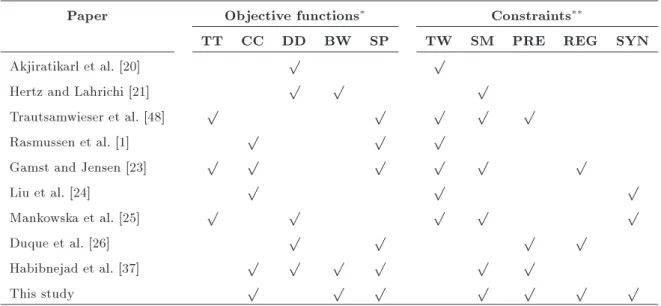
Table 1 provides a summary of the researches reported on homecare systems according to the most common constraints and objective functions taken into account for homecare services planning in chronological order. In addition, Table 2 presents the cross-training
Table 1. Overview of the literature regarding home care.
Paper Objective functions Constraints
TT CC DD BW SP TW SM PRE REG SYN
Akjiratikarl et al. [20] p p
Hertz and Lahrichi [21] p p p
Trautsamwieser et al. [48] p p p p p
Rasmussen et al. [1] p p p
Gamst and Jensen [23] p p p p p p
Liu et al. [24] p p p
Mankowska et al. [25] p p p p p
Duque et al. [26] p p p p
Habibnejad et al. [37] p p p p p p
This study p p p p p p p
TT: Time (travel, waiting, etc.); CC: Costs (assignment, scheduling, etc.); DD: Travelled distances;
BW: Balance of the workload; SP: Sta preferences.
TW: Time windows; SM: Skill matching; PRE: Sta preferences; REG: Regularity; SYN: Synchronization.
Table 2. Overview of the literature regarding cross-training and labor assignment.
Paper Feature
1 2 3 4 5 6 7 8
Stewart et al. [49] p p
Bokhorst et al. [30] p
Slomp et al. [15] p p p p
Easton [50] p p p p
Kim and Nembhard [51] p p
Gnanlet and Gilland [52] p p
Paul and MacDonald [53] p p
Sammarco et al. [54] p p p p
Habibnejad et al. [37] p p p p
This study p p p p p p
1: Cross-training; 2: Labor assignment; 3: Absenteeism; 4: Multi period;
and labor assignment features and summarizes those features addressed in the literature review. For the rst time, this paper incorporates the cross-training concept in homecare sta assignment problem based on a real-world HC provider. In addition, cross-training and labor allocation using who-rule are studied simultane-ously, and the most common constraints are taken into account for cross-training and labor allocation problem, concurrently.
3. Problem denition
Dam homecare medical center is a non-governmental organization founded in Iranian Academic Center for Education, Culture, and Research (ACECR) in 1999. It is a 24-hour medical center that provides its 11000 patients in Tehran, Iran with HC services. The process commences when a citizen applies for HC services, and a preadmission is initiated. Each visit commonly takes between 1 to 5 hours. The manager decides which caregiver should be assigned to each patient by taking into account a set of factors such as the patients' medical statue, caregivers' skills and training level, and the patients and caregivers' preferences.
The objectives of the organization are two-fold: (a) minimization of the number of employees for each service and costs associated with workload balancing, training, and maintenance and (b) maximization of sta preferences so that the patients' needs are met. Some constraints are required to build a service plan in Dam organization, as presented in the following:
1. Skill Matching (SM): A service requires stas with specic skills or training;
2. Sta preferences (PRE): Sta preferences respect-ing time and sta assignment;
3. Regularity (REG): The number of employees for each service;
4. Synchronization (SYN): A service requires more than one sta member.
Moreover, each caregiver can be cross-trained for the maximum number of services called multi-functionality level. A caregiver's multi-multi-functionality represents the number of services that one is able to deliver. The maximum number of working hours per day is another constraint that the organization has to take into account. Since there are enough regular working hours to cover all requirements, overtime and non-regular shifts are not involved. In this paper, the chaining concept is used to reallocate jobs among caregivers, leading to a more balanced workload that is desired from social and economic perspectives. Finally, it is supposed here that services for men and women be separately provided due to the cultural conditions prevailing in Iran.
4. Proposed model
In this section, the proposed multi-objective math-ematical model is presented whose rst objective is to balance workload and minimize cross-training and maintenance costs. In the second objective function, the number of employees for each service is minimized, while the third one attempts to maximize caregivers' preferences.
The indices and parameters used in the presented model are dened as follows:
Indices
i Index of service type (i = 1; :::; I) j Index of caregiver (j = 1; :::; J) d Index of day (d = 1; :::; D) t Index of time slot (t = 1; :::; T ) Parameters
I Number of services J Number of caregivers D Number of days T Set of time slots JM Set of male caregivers JF Set of female caregivers
MS Set of services requiring male caregivers F S Set of services requiring female
caregivers
Adt Set of absent caregivers on day d at
time slot t
NCi Number of caregivers required for
service i
Mj Maximum multi-functionality for
caregiver j
Eij Eciency factor for service i when
provided by caregiver j
Timei Normalized visit time of service i
Cjt Costs associated with caregiver j's
workload deviation from the average value at time slot t
T Cij Costs of training caregiver j for service
i
MCij Maintenance costs of caregiver j for
service i
Didt Demand of service i on day d at time
slot t
CPij 1, if caregiver j prefers service i; 0
otherwise
Kj Maximum working time of caregiver j
in each day 1; 2 Weight factors
Decision variables
Sj Satisfaction level of caregiver j
Ri Number of caregivers assigned to
service i
Yij 1, if caregiver j is cross-trained for
service i; 0 otherwise
Zijdt 1, if caregiver j is assigned to service i
on day d at time slot t; 0 otherwise Xijdt Number of times caregiver j is assigned
to service i on day d at time slot t
It is assumed here that training should lead to workload balance among caregivers in various circum-stances; as a result, there is always the possibility of chaining. Equally loaded caregivers can be achieved by minimizing the caregivers' workload deviation from the average workload in dierent periods. Some of the services in the organization need special care due to the cultural conditions prevailing in Iran, i.e., requiring either male or female caregivers. The sets of JM, JF , MS, and F S are dened for this purpose. NCi is dened due to the synchronization constraint,
indicating that some services could possibly call for more than one caregiver. The cost of training caregiver j for service i is denoted by T Cij and is zero for
a caregiver who is already qualied for a particular service. Eij is determined by the operational team.
The smaller the value of Eijis from 1, the more ecient
caregiver j will be for performing service i. On the other hand, as Eij goes higher than 1, caregiver j
is assumed to become more inecient in performing service i.
4.1. Mathematical model
min z1=1 D X d=1 J X j=1 X t2T
Cjt:
I X i
Timei:Xijdt X~dt
+ 2 I X i=1 J X j=1
Yij[T Cij+ MCij];
(1)
min z2= I
X
i=1
Ri; max z3= J
X
j=1
Sj; (2)
subject to:
~ Xdt=
I
P
i=1 J
P
j=1Timei:Xijdt
J 8d; t 2 T; (3)
J
X
j=1
Yij Ri 8i; (4)
Zijdt R:Yij 8j; d; t 2 T; (5)
Xijdt R:Zijdt 8i; j; d; t 2 T; (6) J
X
j=1
Xijdt= NCi:Didt 8i =2 MS; F S; d; t 2 T;
(7) X
j2JM
Xijdt = NCi:Didt 8i 2 MS; d; t 2 T; (8)
X
j2JF
Xijdt= NCi:Didt 8i 2 F S; d; t 2 T; (9)
I
X
i=1
Timei:Eij:Xijdt Kj 8j; d; t 2 T; (10)
I
X
i=1
Yij Mj 8j; (11)
Sj= I P i=1 D P d=1 P
t2TCPij:Zijdt I P i=1 D P d=1 P
t2TZijdt
8j; (12)
Zijdt= 0 8i; j 2 Adt; d; t 2 T;
(13) Sj; devjdt 0 8j; d; t 2 T; (14)
Xijdt; Ri 0; Integer 8i; j; d; t 2 T; (15)
Yij; Zijdt2 f0; 1g 8i; j; d; t 2 T: (16)
The rst objective function aims to minimize two terms as follows. The rst term represents costs associated with caregivers' workload deviation from the average value. It balances workload among care-givers that in turn results in economic and behavioral benets. The second term concerns training and maintenance costs. These two terms establish a trade-o between the balancing ctrade-ost (as trade-operating ctrade-ost) and cross-training cost. Factors 1 and 2 are weight
factors, and setting them dierently leads to dierent arguments. A higher value of 1 indicates that the
organization emphasizes workload balancing. On the other hand, cross-training costs may lead to higher settings for factor 2. The second objective function
attempts to minimize the number of employees for each service. Finally, the last objective function is aimed at maximizing caregiver satisfaction.
Eq. (3) calculate caregiver's workload deviation from the mean workload. Constraints (4) are related to regularity constraint. Constraints (5) guarantee that a caregiver is assigned to a given service only if he is trained for it. Constraints (6) force caregivers
to be assigned to the services they have to perform. Eqs. (7)-(9) guarantee that the demand for dierent services (whether general, special, or synchronization constraint) is assigned to the caregivers. Constraints (10) prevent working hours per day from exceeding the maximum working time of each caregiver in each day. The maximum desired multi-functionality of each caregiver is represented by Constraints (11). The caregivers' satisfaction level is calculated through Con-straints (12). ConCon-straints (13) ensure that no service is assigned to absent caregivers. Finally, the domain of each decision variable is denoted by Constraints (14)-(16).
The presented model can be simplied by lineariz-ing the absolute term in the objective function. The nonlinear term:
I
X
i
Timei:Xijdt X~dt
;
in the 1st objective function can be linearized by Eqs. (17) and Constraints (18). In addition, this nonlinear term is replaced by term (1
jdt+ 2jdt):
1
jdt jdt2 = I
X
i
Timei:Xijdt X~dt 8j; d; t 2 T;
(17) 1
jdt; jdt2 0 8j; d; t 2 T:
(18)
5. Solution methodology
NSGA-II, which was rst proposed by Deb et al. [38], is one of the most famous and applicable multi-objective evolutionary algorithms. This fame arises from its capability to cope with constraint as well as to promote diversity of solutions. The eciency and convergence of the GA have been veried in the literature. In this algorithm, a non-dominance technique and a crowding
distance are used to nd a set of solutions ordered by fronts and select the population fronts. The pseudo-code of the proposed NSGA-II is shown in Algorithm 1. The main components of applied NSGA-II are discussed in detail in the following subsections. 5.1. Chromosome representation
The rst step in NSAG-II and many other meta-heuristic algorithms is designing a suitable chromosome to present solutions and maintain the feasibility of the generated chromosomes. Each chromosome consists of a sequence of real, binary, or integer numbers (genes) and is represented by two approaches: direct and indirect encoding. In this study, the direct approach is used, meaning that a chromosome totally represents a solution. The designed chromosome is shown in Figure 1. In this representation, each gene stands for a service, and the chromosome shows which service is assigned to which caregiver at which time slot. Figure 1 indicates that service 3 is assigned to caregiver 2 at time slot 2 on day 1.
5.2. Initialization
A random population for initialization leads to the production of some infeasible solutions. To deal with this issue, a heuristic approach is proposed to generate feasible initial solutions. Who-rule is used to determine which caregiver to assign to services. In this rule, service is assigned to a caregiver according to the workloads of caregivers so that the workloads of
Figure 1. The chromosome representation for NSGA-II.
Algorithm 2. Heuristic procedure for initialization.
caregivers are balanced [39]. The pseudo-code of this approach is summarized in Algorithm 2.
5.3. Non-dominated sorting
The non-dominated sorting algorithm assigns a rank to each individual in the population based on non-dominance before the selection strategy as well as after applying crossover and mutation operators [40]. To rank and select the fronts, a non-dominance technique and a crowding distance are applied. In a multi-objective model, solution x dominates solution y if:
1. OFV(x) OFV(y) for all objectives;
2. OFV(x) < OFV(y) for at least one objective. If a solution is not dominated by any other solu-tion, it belongs to the front one. In addisolu-tion, solutions in the front row are dominated only by solutions in the front one.
After classifying the solutions in dierent fronts, a crowding distance is used to estimate the density of solutions and rank the solutions in the same front. The
crowding distance is computed as follows:
di = B
X
j=1
fi+1
j fji 1
fmax
j fjmin;
(19)
where B is the number of objective functions, fi+1 j is
the jth objective function of the (i+1)th solution, fi 1 j
is the jth objective function of the (i 1)th solution, and fmax
j and fjminare maximum and minimum values
of the objective functions, respectively. 5.4. Genetic operators
The binary tournament selection procedure is adopted as the selection strategy in this paper. This strategy is based on the tness value and selects two solutions of the population size based on the non-dominance technique and crowding distance.
5.4.1. Crossover
Crossover operator that combines two individuals from a population to produce new ospring is the main
Figure 2. An example of employed mutation.
GA operator. In this study, two-point crossover is applied to produce new chromosomes. In two-point crossover, two crossing sections are selected randomly, and everything is swapped between the parents. 5.4.2. Mutation
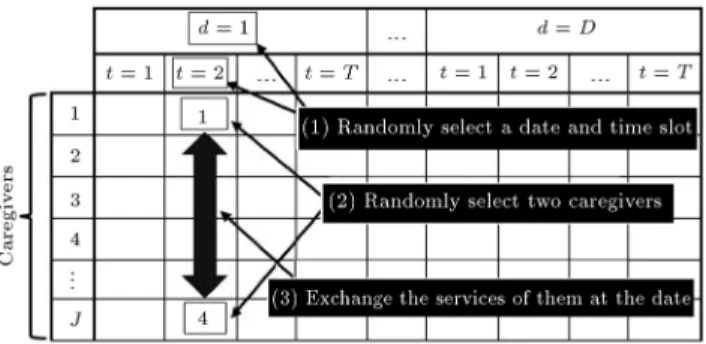
Mutation is another GA operator that produces small random changes in chromosome to maintain the di-versity of the population. Due to random changes in mutation, the solution becomes infeasible. Therefore, the mutation operator should keep the feasibility of the solutions. The basic operation of employed mutation is presented in the following. First, a day and time slot is selected randomly. Second, two caregivers are selected randomly. Finally, the services of these two positions are exchanged. Figure 2 represents an example of the employed mutation.
Some infeasible solutions may be produced by implementing crossover and mutation due to maxi-mum working time and multi-functionality constraints. Here, to deal with this issue, the penalty function strategy is used and the values of constraint violations (Eqs. (20) and (21)) with proper penalty factors are added to the rst objective function.
constraint violation 1 =
I
X
i=1
Timei:Eij:Xijdt K;
(20)
constraint violation 2 =
I
X
i=1
Yij Mj: (21)
5.5. Parameter tuning
Due to the signicant eect of parameter values on the eectiveness of the algorithm, choosing appropriate parameters is necessary to preclude being trapped in local optimum and increase the search around interest-ing regions [41]. In this study, Taguchi Method (TM) is applied to obtain proper results and determine the best level of the parameters. TM is a robust approach of the factorial design of experiments, introduced by Genichi Taguchi. The aim of TM is to reduce the number of experiments and select a small set from all possible experiments. The NSGA-II parameters of
Table 3. NSGA-II parameters and their level values. Level
Parameter 1 2 3 4
Iteration (IT) 100 200 300 400 Population size (npop) 100 150 200 250 Tournament Size (TS) 5 15 25 35 Probability of crossover (pc) 0.7 0.75 0.8 0.85 Probability of mutation (pm) 0.2 0.25 0.3 0.35
iteration, population size, tournament size, crossover probability, and mutation probability are considered in the Taguchi's plan. These parameters and their level are shown in Table 3.
6. Computational results
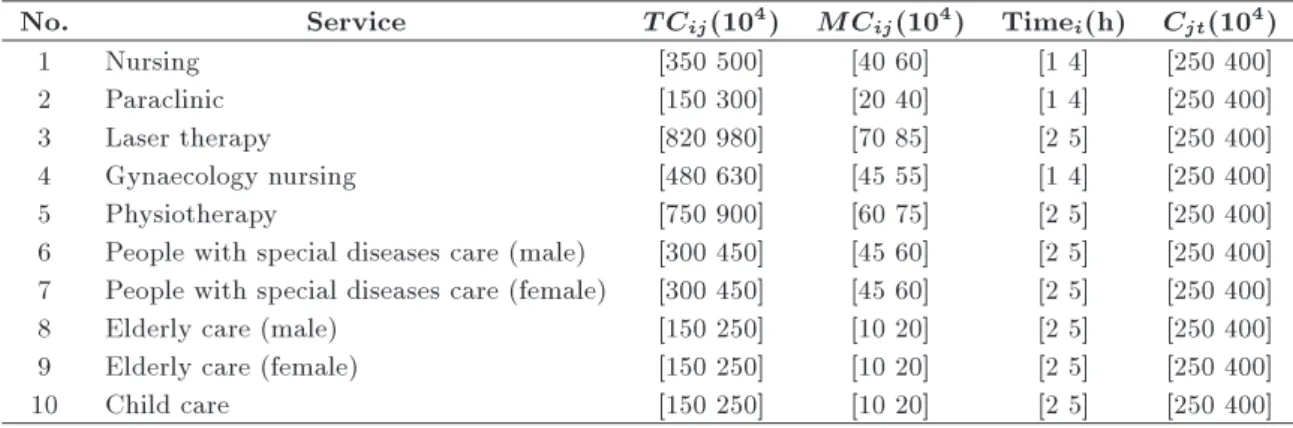
The behavior of the dierent elements and features of the proposed model is evaluated on a real-world HC provider called Dam organization, from which all required data are collected. This information relates to three adjacent districts of Tehran with the largest caregivers, and all the obtained results are solely concerned with this area. The planning horizon is a week (7 days), and about 1100 patients with 55 caregivers are assessed in this period. Table 4 presents the list of considered services in detail and also the demand for these services in the selected period. The information regarding demands is taken from the real historical data of the organization. M and F indicate male and female, respectively.
Table 5 provides information about the param-eters of the model including training costs involved in learning how to perform a task. As mentioned before, these costs are zero for caregivers who are already qualied for a particular service. Moreover, the costs imposed by maintaining skills are considered to keep qualications at a certain level. Table 5 also provides information about normalized visit time of services, indicating average visit time in a certain period as well as deviation from the average costs for workload balancing. All these parameters follow uniform distribution parameterized by specic a's and b's (e.g., x U(a; b)).
6.1. Taguchi execution
In the proposed TM method, 16 experiments with 4 replications are conducted, and the algorithm is run under these designs. Figure 3 presents a graphical representation of the behavior of selected parameters according to their levels.
According to Figure 3, pc and npop have the most and the least ranges (the dierence between the minimum and the maximum S=N ratios) and, thus, have the most and the least inuence on objective
Table 4. List of the services and corresponding demand for them.
No. Service Caregiver Demand
1 Nursing M/F 336
2 Paraclinic M/F 121
3 Laser therapy F 12
4 Gynaecology nursing F 67
5 Physiotherapy M/F 95
6 People with special diseases care (male) M 43 7 People with special diseases care (female) F 39
8 Elderly care (male) M 120
9 Elderly care (female) F 111
10 Child care M/F 156
Table 5. Parameters of the proposed model.
No. Service T Cij(104) MCij(104) Timei(h) Cjt(104)
1 Nursing [350 500] [40 60] [1 4] [250 400]
2 Paraclinic [150 300] [20 40] [1 4] [250 400]
3 Laser therapy [820 980] [70 85] [2 5] [250 400]
4 Gynaecology nursing [480 630] [45 55] [1 4] [250 400]
5 Physiotherapy [750 900] [60 75] [2 5] [250 400]
6 People with special diseases care (male) [300 450] [45 60] [2 5] [250 400] 7 People with special diseases care (female) [300 450] [45 60] [2 5] [250 400]
8 Elderly care (male) [150 250] [10 20] [2 5] [250 400]
9 Elderly care (female) [150 250] [10 20] [2 5] [250 400]
10 Child care [150 250] [10 20] [2 5] [250 400]
Figure 3. Main eects plot for S=N ratios.
function value, respectively. In addition, the highest S=N ratio is desired to achieve the minimum objective function value for each factor. The best values for parameters iteration, population size, tournament size, crossover probability, and mutation probability are 100, 200, 5, 0.80, and 0.25, respectively.
6.2. Comparative algorithm
In this study, due to the absence of benchmark available in the literature, a non-dominated ranking genetic
algorithm (NRGA) is used to validate the obtained results. The pseudo-code of NRGA is summarized in Algorithm 3.
Three comparison indexes are taken into consider-ation to validate the proposed NSGA-II. These indexes are dened as follows:
Quality Index (QI): This index computes the per-centage of the Pareto-optimal solutions for NSGA-II and NRGA. A higher value is desirable for this index [42,43];
Mean Ideal Distance Index (MIDI): The distance between the best solutions and Pareto-optimal solu-tions. A lower value is desirable for this index [44];
Spacing Index (SI): The distribution of the spread of the non-dominated set solutions. A lower value is desirable for this index [45-47].
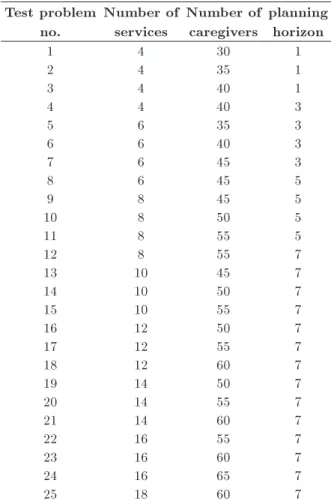
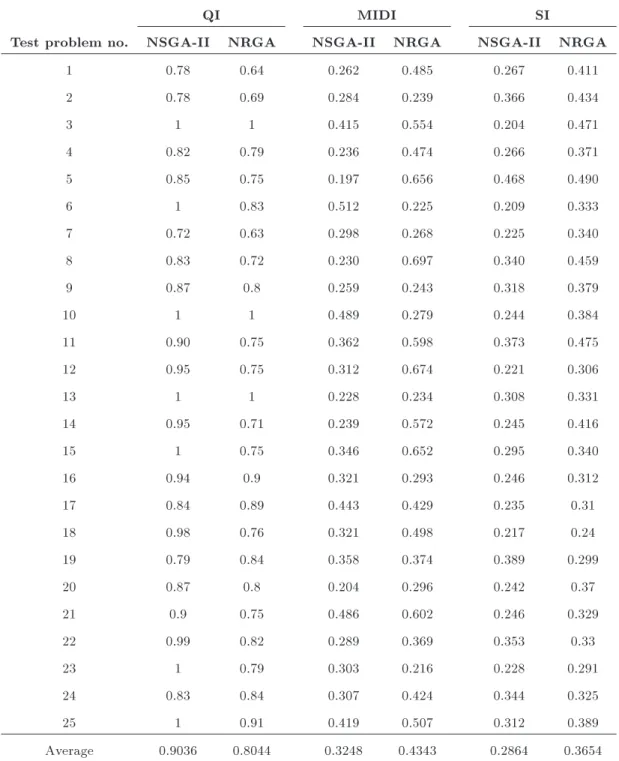
In order to compare NSGA-II and NRGA, 25 test problems with dierent sizes are designed, as shown in Table 6. It should be noted that test problem (15) represents the actual size of the main problem related to the case study.
The results of comparing NSGA-II and NRGA based on the three comparison indexes for dierent test problems are shown in Table 7. Note that each
Algorithm 3. NRGA procedure. Table 6. Data of the test problems.
Test problem no.
Number of services
Number of caregivers
planning horizon
1 4 30 1
2 4 35 1
3 4 40 1
4 4 40 3
5 6 35 3
6 6 40 3
7 6 45 3
8 6 45 5
9 8 45 5
10 8 50 5
11 8 55 5
12 8 55 7
13 10 45 7
14 10 50 7
15 10 55 7
16 12 50 7
17 12 55 7
18 12 60 7
19 14 50 7
20 14 55 7
21 14 60 7
22 16 55 7
23 16 60 7
24 16 65 7
25 18 60 7
algorithm has been run 30 times for each test problem, and the average of the obtained results is reported in Table 7. NSGA-II outperformed NRGA in terms of comparative indices QI and SI for all 25 test problems. Furthermore, paired t-test at the signicance level of = 0:05 is used to compare these two algorithms based on MIDI. The hypotheses of this test are as follows:
(
H0: NSGA II = NRGA
H1: Otherwise (22)
If the null hypothesis is not rejected, this means
that there is no signicant dierence between the means of these two algorithms, in which case the algorithm with lower average results is selected as the desired algorithm (according to MIDI). On the other hand, rejection of the null hypothesis indicates that there is a signicant dierence between the means of the two algorithms, in which case in order to select the ecient algorithm according to MIDI, the following test is used:
(
H0: NSGA II = NRGA
H1: NSGA II < NRGA (23)
If the null hypothesis of the above test is rejected, it can be concluded that NSGA-II outperforms NRGA in terms of MIDI and, thus, is selected as the supe-rior algorithm. Otherwise, the algorithm with lower average result is selected. The p-value of the paired t-test is equal to 0.006; therefore, the null hypothesis is rejected, meaning that there is no signicant dierence between NSGA-II and NRGA based on MIDI. In order to choose the superior algorithm, the second statistical hypothesis testing is used. The p-value for this test is equal to 0.003 according to which the null hypothesis is rejected; thus, NSGA-II is selected as the superior algorithm. Based on the obtained results, the proposed NSGA-II is superior to NRGA in terms of all comparison indexes (i.e., QI, MIDI, and SI) and, thus, is recommended for the proposed multi-objective homecare problem. The remainder of the analyses and results are based on the NSGA-II for the actual size of the case study.
6.3. Results and discussion
The model is run with dierent values of 1 and 2.
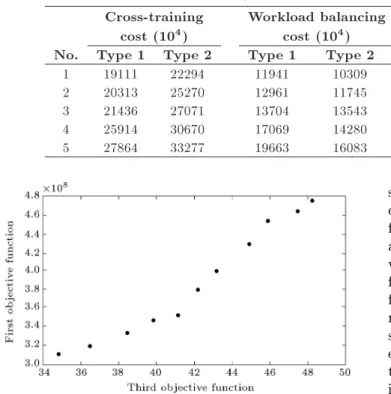
Five Pareto-optimal solutions are selected randomly and are reported for objective function terms with dierent values of 1 and 2 in Table 8. The values
of dierent terms of objective functions, including workload balancing cost, training cost, the number of employees for each service (regularity), and satisfaction level, are presented in Table 8. In addition, Figures
Table 7. Comparison results between the NSGA-II and NRGA based on to the comparison indexes.
QI MIDI SI
Test problem no. NSGA-II NRGA NSGA-II NRGA NSGA-II NRGA
1 0.78 0.64 0.262 0.485 0.267 0.411
2 0.78 0.69 0.284 0.239 0.366 0.434
3 1 1 0.415 0.554 0.204 0.471
4 0.82 0.79 0.236 0.474 0.266 0.371
5 0.85 0.75 0.197 0.656 0.468 0.490
6 1 0.83 0.512 0.225 0.209 0.333
7 0.72 0.63 0.298 0.268 0.225 0.340
8 0.83 0.72 0.230 0.697 0.340 0.459
9 0.87 0.8 0.259 0.243 0.318 0.379
10 1 1 0.489 0.279 0.244 0.384
11 0.90 0.75 0.362 0.598 0.373 0.475
12 0.95 0.75 0.312 0.674 0.221 0.306
13 1 1 0.228 0.234 0.308 0.331
14 0.95 0.71 0.239 0.572 0.245 0.416
15 1 0.75 0.346 0.652 0.295 0.340
16 0.94 0.9 0.321 0.293 0.246 0.312
17 0.84 0.89 0.443 0.429 0.235 0.31
18 0.98 0.76 0.321 0.498 0.217 0.24
19 0.79 0.84 0.358 0.374 0.389 0.299
20 0.87 0.8 0.204 0.296 0.242 0.37
21 0.9 0.75 0.486 0.602 0.246 0.329
22 0.99 0.82 0.289 0.369 0.353 0.33
23 1 0.79 0.303 0.216 0.228 0.291
24 0.83 0.84 0.307 0.424 0.344 0.325
25 1 0.91 0.419 0.507 0.312 0.389
Average 0.9036 0.8044 0.3248 0.4343 0.2864 0.3654
4 and 5 show the Pareto-optimal fronts for the rst and third objective functions with dierent values of 1 and 2. In Table 8 and Figures 4 and 5, Type 1
means 1= 1 and 2 = 1 and Type 2 means 1= 10
and 2 = 1. As mentioned before, a higher level of
1 indicates that the organizations focus on workload
balancing, while cross-training costs may lead to higher value settings for factor 2.
The results of the proposed model for selected Pareto-optimal solution (number 4) with 1 = 10 and
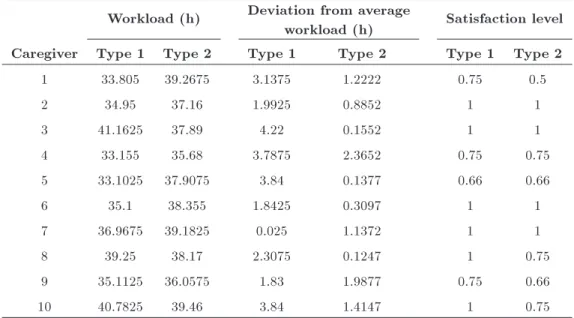
2 = 1 are given in Table 9. Furthermore, Table 10
provides the results of analyzing caregivers and their workloads only for 10 cases for dierent values of weight factors.
Table 9 shows the number of caregivers as well as the cross-training cost associated with each service. Based on the results obtained, the highest training cost is related to service nursing, which also possesses the highest number of caregivers. Several conclusions can be drawn based on the results provided in Table 10. First, the results reveal that the caregivers' workload is relatively balanced; thus, there is no bottleneck.
Table 8. Objective function values for dierent values of 1 and 2.
Cross-training cost (104)
Workload balancing
cost (104) Regularity
Satisfaction level
No. Type 1 Type 2 Type 1 Type 2 Type 1 Type 2 Type 1 Type 2
1 19111 22294 11941 10309 71 83 34.83 33.68
2 20313 25270 12961 11745 79 94 38.46 36.27
3 21436 27071 13704 13543 83 101 41.15 39.86
4 25914 30670 17069 14280 96 114 44.91 43
5 27864 33277 19663 16083 103 123 48.24 46.53
Figure 4. Pareto-optimal fronts for 1= 1 and 2= 1.
Figure 5. Pareto-optimal fronts for 1= 10 and 2= 1.
Second, in case workload balance is of considerable importance, it is possible to lay great emphasis on this issue by boosting the value of 1. This leads to an
increase in training cost. Third, when 1 = 10, the
caregivers' workload is more balanced (i.e., the care-givers' workload deviations from the average value are less) than when 1 = 1. Fourth, it is realized that the
caregivers' preferences are more satised and, except in a few cases, they were greater than 0.75. Finally, as the importance of the third objective function increases, caregivers' satisfaction level rises, too.
7. Conclusions
In this study, a multi-objective non-linear mathemat-ical programming model was presented to address
sta assignment problem considering cross-training of caregivers for HC services in healthcare systems. The rst objective function aimed to minimize the costs associated with workload balancing, cross-training as well as maintenance, while the number of employees for each service was minimized in the second objective function. In addition, caregivers' satisfaction level was maximized in the third objective function. Moreover, several constraints including skill matching, sta pref-erences, regularity, synchronization, sta absenteeism, time capacity, and multi-functionality level were taken into account in building a service plan. Chaining concept was used to balance workloads of caregivers and allow shifting jobs among caregivers. Finally, due to the cultural conditions prevailing in Iran, it was supposed that services for men and women were separately performed. Dam homecare medical center organization located in Iran was considered as the intended case study; then, required data were gathered and the behavior of varied characteristics of the model was analyzed according to this case. A service plan was also built for 7 days (1 week), and the results determined which sta had to be cross-trained for each service and how the sta was assigned to services in each shift.
For the problem being NP-hard, a non-dominated sorting genetic algorithm (NSGA-II) with a proposed heuristic initialization procedure was applied, and the proposed model was solved based on a dataset collected from the proposed case. A who-rule was applied to determine which sta should be assigned to services. An NRGA and generated dierent test problems were used to validate the obtained results with respect to three comparison indexes including QI, MIDI, and SI. Based on the results obtained from statistical hypothesis tests (paired t-test), the proposed NSGA-II was superior to NRGA in terms of all comparison indexes (i.e., QI, MIDI, and SI) and, thus, was rec-ommended for the proposed multi-objective homecare problem. Analysis of caregivers showed that most of the caregivers achieved workload balance; thus, there was no bottleneck that could positively impact operational performance. Furthermore, when 1 =
10, the caregivers' workload was more balanced than when 1 = 1. Finally, the caregivers' preferences
Table 9. Analysis of the results of each service considering the number of caregivers and training costs.
Service Caregiver Training-cost
(104) Demand
Nursing 29 9046 336
Paraclinic 13 1854 121
Laser therapy 3 1779 12
Gynaecology nursing 6 2254 67
Physiotherapy 7 4945 95
People with special diseases care (male) 6 2089 43 People with special diseases care (female) 5 2023 39
Elderly care (male) 14 2234 120
Elderly care (female) 12 2069 111
Child care 19 2377 156
Table 10. Analysis of caregivers and their workloads considering satisfaction level. Workload (h) Deviation from average
workload (h) Satisfaction level
Caregiver Type 1 Type 2 Type 1 Type 2 Type 1 Type 2
1 33.805 39.2675 3.1375 1.2222 0.75 0.5
2 34.95 37.16 1.9925 0.8852 1 1
3 41.1625 37.89 4.22 0.1552 1 1
4 33.155 35.68 3.7875 2.3652 0.75 0.75
5 33.1025 37.9075 3.84 0.1377 0.66 0.66
6 35.1 38.355 1.8425 0.3097 1 1
7 36.9675 39.1825 0.025 1.1372 1 1
8 39.25 38.17 2.3075 0.1247 1 0.75
9 35.1125 36.0575 1.83 1.9877 0.75 0.66
10 40.7825 39.46 3.84 1.4147 1 0.75
were satised and, as the importance of the third objective function increases, caregivers' satisfaction level increased, too.
The distance between patient and caregivers is a major issue, which was not covered in this study. We believe combining cross-training with this issue would help researchers and organizations achieve a more real and precise service plan. Another issue that can aect organizations and can be of interest for researchers is uncertainty stemming from high variability of sta, material resources, etc. Furthermore, presenting an ecient algorithm that can handle all these issues particularly in various lengths of planning horizon could be another interesting topic.
References
1. Rasmussen, M.S., Justesen, T., Dohn, A., and Larsen, J. \The home care crew scheduling problem: Preference-based visit clustering and temporal depen-dencies", European Journal of Operational Research, 219(3), pp. 598-610 (2012).
2. Allaoua, H., Borne, S., Letocart, L., and Calvo, R.W. \A matheuristic approach for solving a home health care problem", Electronic Notes in Discrete Mathematics, 41, pp. 471-478 (2013).
3. Borsani, V., Matta, A., Beschi, G., and Sommaruga, F. \A home care scheduling model for human resources", in Service Systems and Service Management, 2006 International Conference on IEEE (2006).
4. Benzarti, E., Sahin, E., and Dallery, Y. \Operations management applied to home care services: Analysis of the districting problem", Decision Support Systems, 55(2), pp. 587-598 (2013).
5. Lanzarone, E. and Matta, A. \Robust nurse-to-patient assignment in home care services to minimize over-times under continuity of care", Operations Research for Health Care, 3(2), pp. 48-58 (2014).
6. Lanzarone, E. and Matta, A. \A cost assignment policy for home care patients", Flexible Services and Manufacturing Journal, 24(4), pp. 465-495 (2012).
7. Koeleman, P., Bhulai, S., and Van Meersbergen, M. \Optimal patient and personnel scheduling policies for care-at-home service facilities", European Journal of Operational Research, 219(3), pp. 557-563 (2012).
8. Denton, M., Brookman, C., Zeytinoglu, I., Plen-derleith, J., and Barken, R. \Task shifting in the provision of home and social care in Ontario, Canada: implications for quality of care", Health & Social Care in the Community, 23(5), pp. 485-492 (2015).
9. Rest, K.-D., Trautsamwieser, A., and Hirsch, P. \Trends and risks in home health care", Journal of Hu-manitarian Logistics and Supply Chain Management, 2(1), pp. 34-53 (2012).
10. Mutingi, M. and Mbohwa, C. \A fuzzy simulated evo-lution algorithm for multi-objective homecare worker scheduling", In Industrial Engineering and Engineer-ing Management (IEEM), 2013 IEEE International Conference on, IEEE (2013).
11. Olivella, J., Corominas, A., and Pastor, R. \Task assignment considering cross-training goals and due dates", International Journal of Production Research, 51(3), pp. 952-962 (2013).
12. Hallgren, M. and Olhager, J. \Flexibility congura-tions: Empirical analysis of volume and product mix exibility", Omega, 37(4), pp. 746-756 (2009).
13. Power, D. and Sohal, A.S. \Human resource manage-ment strategies and practices in just-in-time environ-ments: Australian case study evidence", Technovation, 20(7), pp. 373-387 (2000).
14. Bidanda, B., Ariyawongrat, P., Needy, K.L., Norman, B.A., and Tharmmaphornphilas, W. \Human related issues in manufacturing cell design, implementation, and operation: a review and survey", Computers & Industrial Engineering, 48(3), pp. 507-523 (2005).
15. Slomp, J., Bokhorst, J.A., and Molleman, E. \Cross-training in a cellular manufacturing environment", Computers & Industrial Engineering, 48(3), pp. 609-624 (2005).
16. Slomp, J. and Molleman, E. \Cross-training policies and team performance", International Journal of Pro-duction Research, 40(5), pp. 1193-1219 (2002).
17. Marentette, K.A., Johnson, A.W., and Mills, L. \A measure of cross-training benet versus job skill specialization", Computers & Industrial Engineering, 57(3), pp. 937-940 (2009).
18. Wilke, H. and Meertens, R. \Group performance", International Series on Communication Skills (1994).
19. Bokhorst, J.A. and Slomp, J. \Design and operation of a cross-trained workforce", in Workforce Cross Training, D. Nembhard, Editor, pp. 3-63, CRC Press, Taylor & Francis Group: Boca Raton, FL (2007).
20. Akjiratikarl, C., Yenradee, P., and Drake, P.R. \PSO-based algorithm for home care worker scheduling in the UK", Computers & Industrial Engineering, 53(4), pp. 559-583 (2007).
21. Hertz, A. and Lahrichi, N. \A patient assignment algorithm for home care services", Journal of the Op-erational Research Society, 60(4), pp. 481-495 (2009).
22. Rabeh, R., Sad, K., and Eric, M. \Collaborative model for planning and scheduling caregivers' activities in homecare", In 18th IFAC World Congress (2011).
23. Gamst, M. and Jensen, T.S. \A branch-and-price algorithm for the long-term home care scheduling problem", In Operations Research Proceedings 2011, pp. 483-488, Springer (2012).
24. Liu, R., Xie, X., Augusto, V., and Rodriguez, C. \Heuristic algorithms for a vehicle routing problem with simultaneous delivery and pickup and time win-dows in home health care", European Journal of Operational Research, 230(3), pp. 475-486 (2013).
25. Mankowska, D.S., Meisel, F., and Bierwirth, C. \The home health care routing and scheduling problem with interdependent services", Health Care Management Science, 17(1), pp. 15-30 (2014).
26. Duque, P.M., Castro, M., Sorensen, K., and Goos, P. \Home care service planning. The case of Lan-delijke Thuiszorg", European Journal of Operational Research, 243(1), pp. 292-301 (2015).
27. Carello, G. and Lanzarone, E. \A cardinality-constrained robust model for the assignment problem in home care services", European Journal of Opera-tional Research, 236(2), pp. 748-762 (2014).
28. Mutingi, M. and Mbohwa, C. \A fuzzy particle swarm optimization approach for task assignment in home health care", In Industrial Engineering and Engineer-ing Management (IEEM), 2013 IEEE International Conference on, IEEE (2013).
29. Mutingi, M. and Mbohwa, C. \Healthcare sta scheduling in a fuzzy environment: A fuzzy genetic algorithm approach", International Conference on Industrial Engineering and Operations Management (2014).
30. Bokhorst, J., Slomp, J., and Gaalman, G. \On the who-rule in Dual Resource Constrained (DRC) man-ufacturing systems", International Journal of Produc-tion Research, 42(23), pp. 5049-5074 (2004a).
31. Bokhorst, J.A., Slomp, J., and Molleman, E. \Devel-opment and evaluation of cross-training policies for manufacturing teams", Iie Transactions, 36(10), pp. 969-984 (2004).
32. Yang, K.K. \A comparison of cross-training policies in dierent job shops", International Journal of Produc-tion Research, 45(6), pp. 1279-1295 (2007).
33. Yue, H., Slomp, J., Molleman, E., and Van Der Zee, D. \Worker exibility in a parallel dual resource constrained job shop", International Journal of Pro-duction Research, 46(2), pp. 451-467 (2008).
34. Li, Q., Gong, J., Fung, R.Y., and Tang, J. \Multi-objective optimal cross-training conguration models for an assembly cell using non-dominated sorting ge-netic algorithm-II", International Journal of Computer Integrated Manufacturing, 25(11), pp. 981-995 (2012).
35. Liu, C., Yang, N., Li, W., Lian, J., Evans, S., and Yin, Y. \Training and assignment of multi-skilled workers for implementing seru production systems", The International Journal of Advanced Manufacturing Technology, 69(5-8), pp. 937-959 (2013).
36. Feng, Y. and Fan, W. \A system dynamics-based simulation model of production line with cross-trained workers", Journal of Statistical Computation and Sim-ulation, 84(6), pp. 1190-1212 (2014).
37. Habibnejad, H., Rabbani, M., Javadi, B., and Ghorbani-Kutenaie, N. \A bi-objective mathemati-cal model toward sta planning considering cross-training", Journal of Industrial Engineering, 50(2), pp. 221-233 (2016).
38. Deb, K., Pratap, A., Agarwal, S., and Meyarivan, T. \A fast and elitist multiobjective genetic algorithm: NSGA-II", Evolutionary Computation, IEEE Transac-tions on, 6(2), pp. 182-197 (2002).
39. Bokhorst, J., Slomp, J., and Gaalman, G. \On the who-rule in Dual Resource Constrained (DRC) man-ufacturing systems", International Journal of Produc-tion Research, 42(23), pp. 5049-5074 (2004).
40. Bandyopadhyay, S. and Bhattacharya, R. \Solving a tri-objective supply chain problem with modied NSGA-II algorithm", Journal of Manufacturing Sys-tems, 33(1), pp. 41-50 (2014).
41. Behnamian, J., Ghomi, S.F., and Zandieh, M. \A multi-phase covering Pareto-optimal front method to multi-objective scheduling in a realistic hybrid ow-shop using a hybrid metaheuristic", Expert Systems with Applications, 36(8), pp. 11057-11069 (2009).
42. Moradi, H., Zandieh, M., and Mahdavi, I. \Non-dominated ranked genetic algorithm for a multi-objective mixed-model assembly line sequencing prob-lem", International Journal of Production Research, 49(12), pp. 3479-3499 (2011).
43. Mohammadi, M., Jolai, F., and Tavakkoli-Moghaddam, R. \Solving a new stochastic multi-mode p-hub covering location problem considering risk by a novel multi-objective algorithm", Applied Mathematical Modelling, 37(24), pp. 10053-10073 (2013).
44. Nekooghadirli, N., Tavakkoli-Moghaddam, R., Gheza-vati, V., and Javanmard, S. \Solving a new bi-objective location-routing-inventory problem in a distribution network by meta-heuristics", Computers & Industrial Engineering, 76, pp. 204-221 (2014).
45. Pasandideh, S.H.R., Niaki, S.T.A., and Asadi, K. \Bi-objective optimization of a multi-product multi-period three-echelon supply chain problem under uncertain environments: NSGA-II and NRGA", Information Sciences, 292, pp. 57-74 (2015).
46. Idoumghar, L., Cherin, N., Siarry, P., Roche, R., and Miraoui, A. \Hybrid ICA-PSO algorithm for continuous optimization", Applied Mathematics and Computation, 219(24), pp. 11149-11170 (2013).
47. Attar, S., Mohammadi, M., Tavakkoli-Moghaddam, R., and Yaghoubi, S. \Solving a new multi-objective hybrid exible owshop problem with limited waiting times and machine-sequence-dependent set-up time constraints", International Journal of Computer Inte-grated Manufacturing, 27(5), pp. 450-469 (2014).
48. Trautsamwieser, A., Gronalt, M., and Hirsch, P. \Se-curing home health care in times of natural disasters", OR Spectrum, 33(3), pp. 787-813 (2011).
49. Stewart, B., Webster, D., Ahmad, S., and Matson, J. \Mathematical models for developing a exible workforce", International Journal of Production Eco-nomics, 36(3), pp. 243-254 (1994).
50. Easton, F.F. \Cross-training performance in exi-ble labor scheduling environments", Iie Transactions, 43(8), pp. 589-603 (2011).
51. Kim, S. and Nembhard, D.A. \Rule mining for schedul-ing cross trainschedul-ing with a heterogeneous workforce", International Journal of Production Research, 51(8), pp. 2281-2300 (2013).
52. Gnanlet, A. and Gilland, W.G. \Impact of produc-tivity on cross-training congurations and optimal stang decisions in hospitals", European Journal of Operational Research, 238(1), pp. 254-269 (2014).
53. Paul, J.A. and MacDonald, L. \Modeling the benets of cross-training to address the nursing shortage",
International Journal of Production Economics, 150, pp. 83-95 (2014).
54. Sammarco, M., Fruggiero, F., Neumann, W., and Lam-biase, A. \Agent-based modelling of movement rules in DRC systems for volume exibility: human factors and technical performance", International Journal of Production Research, 52(3), pp. 633-650 (2014).
Biographies
Hamed Habibnejad-Ledari obtained his MSc cer-ticate from School of Industrial & Systems Engineer-ing, College of EngineerEngineer-ing, University of Tehran. He received his BSc degree in Industrial Engineering from Babol University of Technology. His research interests include operation research, production planning and control, healthcare engineering, soft computing tech-niques, and scheduling.
Masoud Rabbani is a Professor at the School of Industrial Engineering and the Chairman of the En-ergy Management and Planning Research Institute at the University of Tehran, Iran. He received his PhD in Industrial Engineering at Amirkabir University of Technology, Tehran, Iran. His research interests include manufacturing and production systems, soft
computing techniques, Multi-Criteria Decision-Making (MCDM), transportation, and scheduling. He has published in journals such as the International Jour-nal of Advanced Manufacturing Technology, Applied Mathematics and Computation, International Journal of Production Research, Soft Computing, Advances in Engineering Software, Applied Mathematical Mod-eling, Engineering Optimization, International Jour-nal of Manufacturing Technology and Management, Advanced Engineering Informatics, European Journal of Operational Research, Expert Systems with Ap-plications, International Journal of Computer Math-ematics, Applied Soft Computing, Computers and Operations Research, Journal of Manufacturing Sys-tems, and Journal of Applied Sciences among oth-ers.
Nastaran Ghorbani-Kutenaie obtained her MSc certicate from the Department of Industrial Engi-neering, School of EngiEngi-neering, University of Alzahra, Tehran, Iran. She received her BSc degree in Indus-trial Engineering from Babol University of Technology. Her research interests include healthcare engineering, performance assessment, customer relationship man-agement, data envelopment analysis, and articial intelligence.