Teaching and Assessing Population Health in Undergraduate Medical Education
By Hannah Yin
A Master’s Paper submitted to the faculty of the University of North Carolina at Chapel Hill
in partial fulfillment of the requirements for the degree of Master of Public Health in
the Public Health Leadership Program
Chapel Hill 2013
__________________________________ / Advisor
__________________________________ Date
__________________________________ / Second Reader
TABLE OF CONTENTS
Abstract... ii
Acknowledgements ... iii
Introduction ... 1
Theoretical Perspective ... 2
Methods ... 5
Findings ... 7
Discussion and Concluding Recommendations... 12
References ... 15
Figures ... 17
ABSTRACT
Background: Despite increased initiatives to teach population health in undergraduate medical
education, there remains a lack of consensus on both the appropriate didactic content and methods of assessment necessary to establish a unified foundation for all graduates of medical school.
Objective: To better understand the outcomes of interest for these new educational initiatives
and to explore methods for assessing medical student outcomes.
Methods: In-depth interviews with experts in medical education at national policymaking
organizations and experienced educators at United States medical schools. Findings: Experts use variable operational definitions for the terms ‘public health’ and
‘population health’; though none of the experts use them interchangeably, some indicate a difference in function while others point to a difference in scope to distinguish the terms. All national experts recommend integration of population health throughout the medical school curriculum and suggest the RMPHEC competencies as an appropriate set of standards for all medical students. However, these best practices meet significant barriers to
implementation at individual medical schools. Finally, although traditional assessment instruments still predominate, educators are beginning to suggest new approaches to measuring the effect of population health education on both medical student competency and population health outcomes.
Conclusion: National organizations such as the AAMC and CDC must take a more active role
in encouraging implementation of new educational initiatives in population health. Educators must also take a more scholarly approach to developing assessment instruments to
ACKNOWLEDGEMENTS
I would first like to express my sincerest thanks to my research advisor and first reader, Dr. Sue Tolleson-Rinehart, for her remarkable commitment to our health policy cohort. I am so grateful for her unwavering support and tremendous mentorship, without which this project could not have been completed!
Next, I would like to thank my second reader, Dr. Julie Byerley, for graciously donating her time and energy in reviewing my master’s paper. Through her many contributions to medical education, she serves as a role model for those of us who aspire to pursue a career in academic medicine.
Finally, I would like to thank all the interview respondents who generously donated their time and expertise for this project. Their enthusiasm and dedication made it such a wonderful and gratifying experience to conduct these interviews.
Malika Fair, MD, MPH
INTRODUCTION
In response to widely perceived need for changes in the way the United States prepares new physicians, the past decade has seen numerous national organizations call upon medical schools to create new initiatives to integrate public health and population sciences perspectives into the traditional allopathic medical curriculum. In 2003, the Cooperative Agreement between the Association of American Medical Colleges (AAMC) and the Centers for Disease Control and Prevention (CDC) began to fund public health curriculum development at training programs that were designated as Regional Medicine-Public Health Education Centers (RMPHECs). 1 A 2007 report from the Institute of Medicine urged both medical schools and graduate medical
education programs to include public health concepts and skills in the curriculum to better prepare physicians for the health challenges of the 21st century. 2 In 2010, the Liaison Committee on Medical Education (LCME) added public health sciences and preventive medicine to its accreditation standards for all degree-granting medical schools in the United States and Canada.3,4
THEORETICAL PERSPECTIVE
Despite sharing a common goal, public health and medicine have approached the task of health promotion from parallel paths for many years. 5 Kerr White, a physician and expert on the ecology of medicine, traces the divergence of these two disciplines to a 1916 decision by the Rockefeller Foundation to establish schools of public health apart from schools of medicine in order to give greater emphasis to the study of environmental and social causes of disease. 6 One unfortunate consequence of that choice is the loss of a readiness to understand and use population-based sciences among medical trainees. Another consequence is that medical schools have become bereft of training in the skills traditionally taught through public health education, including the ability to critically appraise the medical literature. Meanwhile, the biomedical model of medical training went on to emphasize the diagnosis and treatment of disease in individual patients. 7 By the end of the 20th century, both medical practitioners and the general public viewed medicine and public health as distinct from one another, reflecting the lasting legacy of the Rockefeller Foundation’s decision. 8,9
However, the Flexner Report, which has served as the underpinning for medical education in the United States and Canada since it was published in 1910, defined an ethical role for medicine that extends beyond the care of individual patients to the realm of social and preventive responsibility. 10 Furthermore, the modern American health care landscape,
In response to these modern challenges, the last decade has seen a considerable increase in initiatives to integrate the population health perspective into medical education. Such national authorities as the Institute of Medicine and CDC have urged a greater emphasis on this perspective in the training of physicians. 1,2 Furthermore, in June 2010, the LCME added the requirement of public health sciences training to its accreditation standards for all United States and Canadian medical schools. 3,4 For example, the “Educational Program for the M.D. Degree” (ED) standards require that curricula support mastery of “methods fundamental to acquiring and applying science to the health of individuals and populations and to the contemporary practice of medicine” (ED-11) and “prepare students to recognize wellness, determinants of health, and opportunities for health promotion” (ED-15). Furthermore, among the “Institutional Setting” (IS) requirements, standard IS-16 encourages medical schools to promote the understanding of “the importance of meeting the health care needs of medically underserved populations.” 3 In
addition, experts from the AAMC and CDC, together with the faculty leaders at each of the RMPHEC sites, released in 2010 a list of 12 competencies intended to outline a set of population health-related skills that all students should acquire by the time they graduate medical school (Figure 1). These include the ability to assess the health status of populations, apply prevention strategies that improve the health of individuals and populations, and discuss the functions of public health systems. 11 Together, the LCME standards and the RMPHEC competencies represent an unprecedented emphasis on public health sciences from national organizations that oversee medical education.
population health sciences into the curriculum, and insufficient consideration of student outcomes and how to measure them.
Medical curricula labeled as ‘public health’ or ‘population health’ actually differ
considerably from one another in content. One possible explanation for this inconsistency is that faculty at various medicals schools use different definitions for ‘population health’ as the basis for constructing curricula. Some educators may teach students to specify a population of interest in terms of a shared characteristic, such as a clinical condition, geographic area, ethnicity, or socioeconomic status, and to consider the health of this collective group. IS-16, which promotes understanding of the needs of underserved populations, seems to support this approach. 3 On the other hand, other educators may encourage students to focus on a
population perspective in contrast to the individual patient perspective, but without concentrating on a specific population. This viewpoint is also supported by LCME standards 11 and ED-15, which address a general set of skills and perspectives not specific to any group of patients. These simultaneously overlapping and contrasting definitions of ‘population health’ would understandably produce different approaches to curriculum development. Furthermore, the formats of these educational interventions vary from episodic exposures to population health, to more longitudinal experiences in several different classroom and clinical settings. Thus, the implementation of both content and structure of population health curricula differs across medical schools.
assessment in sufficient detail to ascertain whether these methods are valid or reliable for measuring student outcomes, much less change in those outcomes after changes in curricula.
Given these findings, it appears that we currently stand at the crossroads of tremendous enthusiasm for increasing medical students’ exposure to population health sciences and lack of consensus on both the specific content and ways to integrate it, as well as methods of
assessment necessary to establish a unified standard for all graduates of medical school. Therefore, I intend my in-depth interviews with experts in medical education to elucidate the outcomes of interest for these new educational initiatives and explore methods for assessing these outcomes at the medical student level.
METHODS
To generate data for this study, I triangulated a review of the literature and in-depth interviews with experts in medical education.
In order to explore what methods LCME-accredited medical schools currently use to assess students’ understanding of population health or perception of the role of public health, I performed a systematic review of descriptions of medical curricula published in the literature. The methods and results of this review are included in Appendix A.
and experienced faculty members at my home institution, the University of North Carolina School of Medicine.
Rather than attempting to recruit a national representative sample, I instead sought to speak with key stakeholders who could shed particular insight on the current status of teaching and assessing population health in medical education. Therefore, I recruited interviewees by sending a standard email invitation to 8 candidates, including representatives from national policymaking organizations and educators at both public and private medical schools. Of these, 1 was not reachable due to a change in email address, while the other 7 agreed to participate.
I conducted 6 telephone interviews and 1 in-person interview. Before beginning each interview, I read a standardized description of this research project and asked for permission to record the interview on a digital voice recorder; to identify him or her by name and position, position alone, or only as an ‘expert’ or ‘educator’; and to use direct quotations from the interview (Appendix B). I respected all requests for anonymity or abstaining from direct quotation.
FINDINGS
In May 2013, I conducted seven 15- to 45-minute interviews with experts in medical education at both national policymaking organizations and U.S. medical schools. The
respondents’ comments reflect individual opinions and do not necessarily represent the views of the organizations or institutions to which they belong.
Defining ‘public health’ and ‘population health’
To establish a foundation for the interviews, I asked each expert to define the terms ‘public health’ and ‘population health.’ None of the 7 experts use the terms interchangeably, but the ways in which the experts explained the dissimilarity separated them into two groups. Four of the experts noted a difference in function in that ‘population health’ is the health status of a group of people, whereas ‘public health’ denotes the organized activities whose goal is to improve the health of the population. The other 3 experts pointed to a difference in scope between the two terms. Though 2 of the experts initially described the terms as fitting a Venn diagram model, further questioning on what falls under one term but not the other led all 3 of these experts to assert that ‘population health’ is narrower in scope, whereas ‘public health’ includes both ‘population health’ and additional activities such as infectious disease
surveillance, restaurant inspections, and the clinical care of individual patients. One expert from each group also mentioned that they tend to use the term ‘population health’ when speaking to clinicians because these health care professionals do not tend to see themselves as belonging to the ‘public health’ system.
viewpoint is exemplified by an assignment in a Family Medicine clerkship in which students are asked to identify a group of patients with a set of shared traits and to obtain and analyze data about these patients in order to propose an intervention to improve their health. The expert with the broadest scope describes ‘population health’ as “perspectives or principles relating to care of a population rather than individual patients” without mentioning how to delineate that
population. Applied to medical education, this expert asserts that such perspectives can be integrated into a variety of problem-based learning exercises and clinical care settings. The remaining experts fell more moderately on this spectrum and sometimes appeared to adhere to both viewpoints.
Integrating population health into the curriculum
When I asked respondents to describe the ideal solution to building public health into the curriculum of a medical school, 6 of the 7 experts emphasized the importance of integrating population health into the curriculum as a whole, rather than exposing students to these concepts only in isolated experiences. A typical description of this viewpoint is as follows: “I think you have to build in those [population health] learning objectives in each course and each clerkship as people go through medical school so it becomes part of the fabric of their
Despite this near-consensus on the importance of curricular integration, 3 of the 4
educators described a lack of integration of current population health educational experiences at their own medical schools. Two of these curricula have focused course work on population health and prevention concepts in the first year, but these concepts, they said, are poorly
reinforced in subsequent course work and clinical experiences. One of these experts identified a lack of buy in among faculty as to the importance of these perspectives in clinical practice as a major barrier to genuine integration. A third expert has designed a requirement for student projects utilizing population health and quality improvement skills in one required clerkship and one optional elective course, but such assignments are not a part of of the other seven required clerkships at that medical school.
The only educator who believed his institution demonstrated more successful integration described the use of a series of cases in multiple preclinical courses, showing the use of
population health perspectives in the context of various different disease processes, as well as different clinical and community settings. Students also revisit these perspectives through assignments in the Family Medicine and Pediatrics clerkships and are evaluated on their ability to perform appropriate preventive health screening and counseling through clinical practice exams.
Crafting learning objectives
When I asked them to describe what students should gain from training in population health sciences, a majority of experts identified three types of knowledge or skills: the
recognition that physicians have broader roles and responsibilities to society than solely through their clinical practice, a basic aptitude in quantitative skills such as biostatistics and
three experts from the AAMC and CDC pointed to a list of 12 competencies recommended by the RMPHECs11 as an appropriate set of aims for all medical students (Figure 1).
Despite these prevailing views, the actual foundations upon which individual medical schools base their learning objectives appear to vary. None of the respondents at the four medical schools said the LCME content standards influenced curriculum development at their institution. Two of the 4 educators referenced the RMPHEC competencies, but the expertise of the faculty at the individual schools also heavily influenced the process. As one expert
explained, “we tried to make our faculty aware of [the RMPHEC competencies], but in reality, it’s mostly the foundational course that we teach in the first year that emphasizes those, and I think the rest kind of gets diluted or lost when faculty develop the rest of their courses and
clerkships.”
Educators also used sources not specific to medical education to guide curriculum development. One educator utilized the clinical prevention and population health curriculum framework designed by the Association for Prevention Teaching and Research. 12 Another educator cited quality improvement principles as the foundation for developing student assignments related to population health.
Assessing student competency
clinical practice examinations. Experts also suggested linking student assessment to population health outcomes, but recognized that “’it’d be very hard to figure out what the component is that the student contributed” to any given change in health outcomes. One expert also noted that it might be more appropriate to measure competencies in this domain at a later point in medical training, such as during residency.
At the medical schools represented by the respondents, the most common method of assessment was tests or quizzes attempting to gauge students’ population health related skills, used at 3 of the 4 schools. One school primarily used student projects to assess students’ ability to identify a population, gather and analyze relevant data, and suggest interventions to improve the health of that population.
DISCUSSION AND CONCLUDING RECOMMENDATIONS
My interviews with experts in medical education revealed several important findings. First, there is a lack of consensus for definitions for ‘population health’ and ‘public health’ and the relationship between these terms. This points to a compelling need for increased dialogue about definitions among all relevant stakeholders. Medical school faculty members must discuss their operative understanding of these terms in order to facilitate a cohesive process of
curriculum development. Authors of papers about medical education must stipulate the
functional definitions upon which their educational interventions are based in order to promote transparency in the literature. National organizations such as the AAMC and CDC can also help to streamline these efforts by more explicitly specifying their requirements regarding population health education.
Second, national experts concur on basic recommendations for the content and structure of population health in medical curricula. The RMPHEC’s 12 population health competencies should be regarded as baseline standards for all students to achieve by the completion of their medical school training. Furthermore, these concepts must be fully
integrated into curricula by providing educational exposures in a variety of preclinical courses and clinical settings, rather than merely in isolated modules or blocks. Given the unanimity of these best practices among national experts, educators must become familiar with these recommendations.
traditional educational paradigms to recognize that there is a pressing need for this type of training for all future physicians. In addition, given the national shift toward a greater emphasis on teaching population health, an additional incentive for faculty may be that implementation of a successful public health curriculum could make a given medical school a national leader and increase its competitiveness among prestigious schools.
Finally, student assessment remains an under-developed domain of curriculum, as most schools are still using traditional approaches such as tests and quizzes to attempt to measure students’ understanding of population health. Well-designed written examinations certainly can detect change in student knowledge or skills; however, several experts commented that these methods alone cannot measure the capacity of new curricular elements for training physicians that will bring a different perspective to both clinical practice to understanding the role of the physician in contemporary society. Therefore, because of the limitations of these traditional methods for measuring outcomes of interest, some educators are beginning to suggest other approaches, such as direct observation of student skills and measurement of real world clinical and community outcomes. The AAMC-CDC Collaborative Agreement is trying to encourage greater attention to the development of new assessment instruments at RMPHEC sites. Future research should also include the evaluation of the validity and reliability of new instruments, as well as the collection of long-term outcomes regarding the way in which population health education has affected physicians’ practices and attitudes about public health.
In conclusion, initiatives in the past decade encouraging increased training in population health are showing promising early signs at the medical school level. The AAMC-CDC
Cooperative Agreement’s funding of RMPHECs is spearheading curriculum change across the nation. However, there are still significant barriers to implementation of these initiatives,
REFERENCES
1. AAMC and CDC. Regional medicine-public health education centers (RMPHEC/RMPHEC-GME). https://www.aamc.org/initiatives/cdc/aamcbased/rmphec/. Accessed 2/25/2013. 2. IOM Committee on Training Physicians for Public Health Careers. Training physicians for public health careers: Free executive summary. Washington, DC: National Academies Press; 2007. Hernandez Lyla M. and Munthali A. Wezi, eds.
http://www.nap.edu/openbook.php?isbn=0309107601.
3. Liaison Committee on Medical Education. Standards for accreditation of medical education programs leading to the M.D. degree. http://www.lcme.org/standard.htm. Updated 2012 May. Accessed 2/25/2013.
4. AAMC. Understanding public health in medical education, a modular slide set.
https://www.aamc.org/download/277882/data/rmphecstudentpresentationslides.pptx. Updated 2011. Accessed 2/25/2013.
5. Fineberg HV. Public health and medicine: Where the twain shall meet. Am J Prev Med. 2011;41(4S3):S149-S151.
6. White KL. Healing the schism: Epidemiology, medicine, and the public's health. Ann Arbor, MI: Edwards Brothers, Inc.; 1991.
7. White KL. The task of medicine: Dialogue at Wickenburg. Menlo Park, CA: Kaiser Family Foundation; 1988.
8. Centers for Disease Control and Prevention. Public opinion about public health -- California and the United States, 1996. MMWR Morb Mortal Wkly Rep. 1998 Feb 6;47(4):69-73.
9. Centers for Disease Control and Prevention. Public opinion about public health -- United States, 1999. MMWR Morb Mortal Wkly Rep. 2000 Mar 31;49(12):258-260.
10. Flexner A. Medical education in the united States and Canada: A report to the Carnegie Foundation for the advancement of teaching. Vol Bulletin No. 4. Boston, MA: Updyke; 1910.
12. Healthy People Curriculum Task Force, APTR. Clinical prevention and population health curriculum framework.
http://c.ymcdn.com/sites/www.aptrweb.org/resource/resmgr/2011_ajpm/revised_cpph_framewor k_2009.pdf. Updated 2009 Jan. Accessed 5/3/2013.
13. Novick LF, Cibula DA, Sutphen SM, Rixey S, Epling JW, Morrow CB. Measuring orientation to population-based prevention. Am J Prev Med. 2003;24(4S):95-101.
14. Novick LF, Lazorick S, Morrow JH. RMPHEC project description.
FIGURES
Figure 1. RPMHEC population health competencies for medical students11
Appendix A: A review of methods to assess medical student competency in public health
METHODS
Focused question. What methods are used to assess student understanding of
population health or perception of the role of public health following an educational experience in public health among students who attend LCME-accredited medical schools in the U.S. or Canada?
For the purpose of this review, the terms ‘public health’ and ‘population health’ are used interchangeably to describe any training that focuses on the care of populations in contrast to or in complement with the care of individual patients. My background reading has suggested that some clinicians and educators use these terms synonymously while others interpret these terms differently, but I did not identify a single definition for either term that was used consistently throughout the literature. Therefore, although educational interventions that are designated as ‘public health’ or ‘population health’ vary widely in the literature, I intentionally utilized a broad operational definition to try to capture all training that aims to promote the health of the public, while also capturing the diversity of such curricula that are offered at different medical schools.
Study selection. I included only those articles for which the study population was medical
students who have received some education in public health during their training at an allopathic U.S. or Canadian medical school because this is the population that would be affected by the LCME accreditation standards. I excluded studies of medical school graduates (residents, fellows, and practicing physicians); students of other health professional schools; and medical students who have previously received an MPH or DrPH, who received training in a
attitudes about public health or student understanding of population health concepts, while excluding those that measured student behaviors or clinical outcomes of students’ patients. Although change in practitioner behavior and improved patient outcomes would be the ultimate desired consequence of a medical education intervention, these long-term outcomes are less feasible metrics to assess given the population of interest in this review.
Search strategy. I searched PubMED (MEDLINE) with the following terms: (“population
health” OR “public health”) AND (“medical students” OR “medical education” OR “student assessment”). I limited the search to articles with full text available in English that were published between 6/1/2010 and 2/13/2013. I selected this start date because I wanted to capture all articles published after the LCME added public health sciences and preventive medicine to its medical accreditation standards in June 2010, as this policy change represented the introduction of a universal requirement that such content be added to all U.S. and Canadian medical school curricula.1,2 The end date was the date on which the search was performed. I also hand-searched the references of the articles that met all inclusion criteria to identify any additional relevant articles.
Maeshiro et al’s “Reflections on the Flexner Report From a Public Health Perspective” 3
was considered the sentinel article for this topic because it summarized the views and
recommendations of contemporary experts on the integration of population health into medical education. Although this article was published prior to the start date of the search, I was able to identify the article by hand searching the references of the selected articles from the MEDLINE search, thus confirming that the search strategy was most likely able to capture the relevant literature.
Appraisal of assessment instruments. For each included study, I identified the study
(1) Whether the assessment was designed with consideration of competencies of the LCME, RMPHEC, or the individual medical school. This criterion is supported by the movement toward competency-based medical education in which learning activities should lead to measurable outcomes that demonstrate achievement of knowledge, skills, or attitudes necessary for practicing physicians.4,5
(2) Whether the construct validity of the instrument has been assessed. This criterion is to ensure that the instrument sufficiently measures the intended concept and is free of measurement error.6
(3) Whether the reliability of the instrument has been assessed. This criterion is to ensure that the instrument is able to replicate results on repeated testing.7 Inter-rater reliability is only applicable for those instruments that are administered, scored, or interpreted by a human agent. In the context of education, in which one is expected to demonstrate improved performance following the educational intervention, intra-rater reliability can only be appropriately assessed when the two iterations of testing are conducted with minimal time interval in between and without a relevant intervening intervention. Grading for each of these criteria were denoted as follows:
Yes = meets criteria
Possibly = addressed, but not explicitly linked to student assessment No = addressed, does not meet criteria
Unknown = not addressed
RESULTS
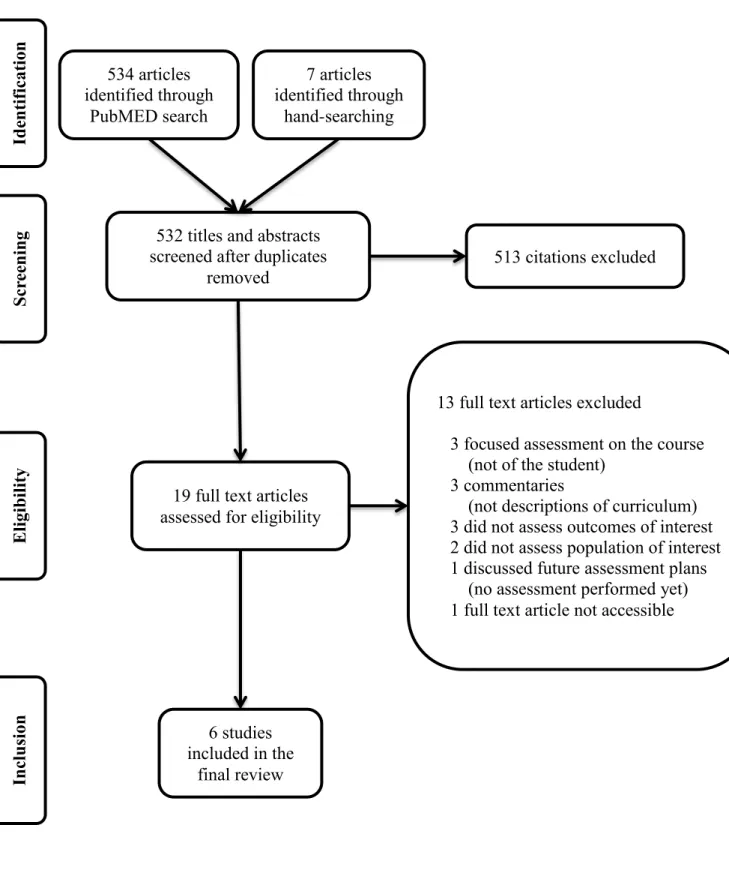
The PubMED search returned 534 articles, of which 2 were duplicates. I excluded 513 articles through title and abstract review; the most common reasons for exclusion and
approximate percentages of citations were as follows: irrelevant topic (80%), commentary on the importance of public health education rather than description of curriculum (6%), and description of curriculum at a foreign institution (4%). I excluded an additional 13 articles through full text review, leaving 5 articles that met all inclusion criteria. I hand-searched the references of these articles and applied the same inclusion and exclusion criteria as above, yielding an additional 1 relevant article (Figure A-1).
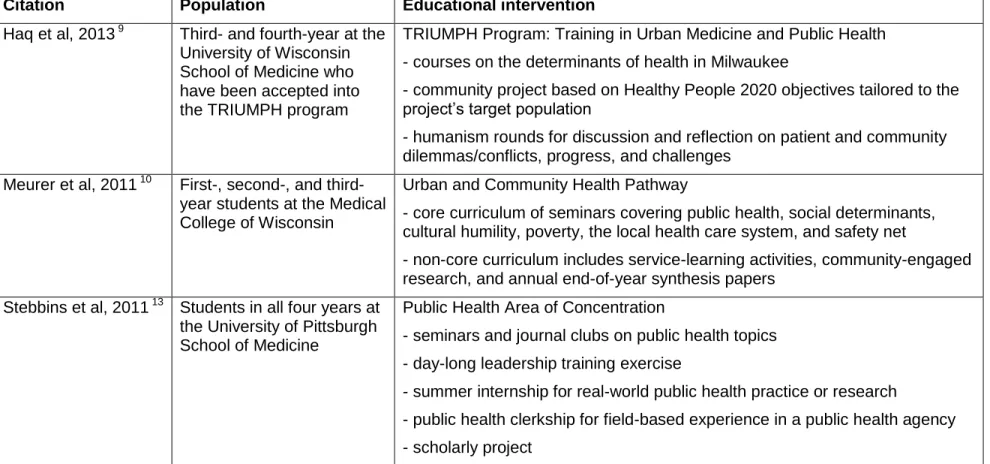
Educational interventions. The 6 articles included in the review described a varied range
of educational interventions (Table A-1) with respect to both scope of content and timing of teaching. Regarding content, the narrowest intervention was an influenza pandemic exercise designed as a response to the 2009 H1N1 pandemic and in preparation for future disasters similar to Hurricane Katrina, which would require an organized public health response. Similar versions of this exercise were carried out at several different medical schools.8 Then there are programs at two different medical schools in Wisconsin that provide in-depth training specifically focused on the care of urban populations.9,10 Finally, the Morehouse, University of New Mexico, and University of Pittsburgh Schools of Medicine all offer coursework that is not specific to a sub-population and cover a broader scope of population health disciplines, including
epidemiology, community health improvement, and public health ethics.11-13
a curricular component that is shared across several schools, but did not represent the entire public health curriculum at those schools. Nonetheless, this sampling of curricula demonstrates tremendous diversity in both the content and structure of public health education across
different U.S. medical schools.
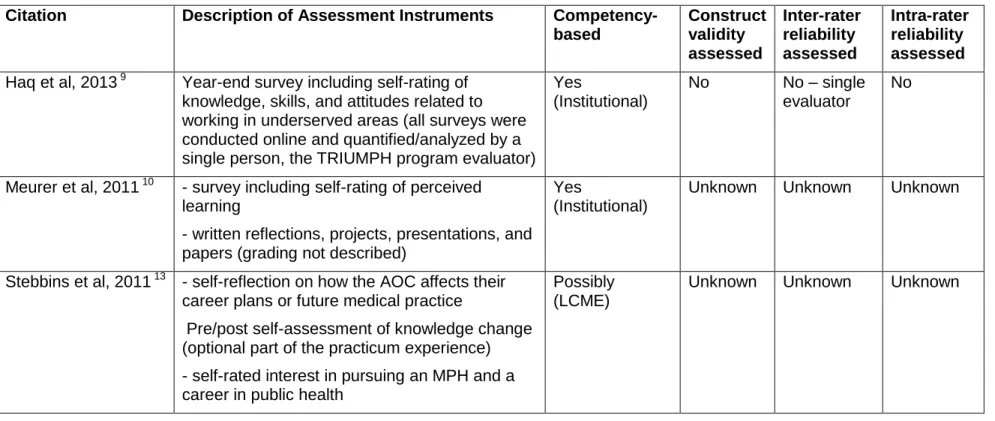
Methods of student assessment. None of the six articles included in this review had as
its primary objective the analysis of student assessment; rather, the papers provided overviews of curricular activities of which assessment is only one part. As a result, the extent of the descriptions of student assessment varied from a single brief mention to a more in-depth description of student outcome data collection (Table A-2). The most common formats of assessment included multiple-choice exams, papers and presentations (completed individually and/or in groups), reflective journals, and self-rated increase in knowledge or change in interest in pursuing a public health career as a result of experiencing the educational intervention. However, none of the authors described the process of developing the assessment tools that used relatively more objective metrics such as items for multiple-choice exams or objective structured clinical exams, nor the grading criteria for more subjective metrics such as papers or projects.
Adherence to the four criteria was highest with respect to consideration of competencies; however, although all seven articles alluded to LCME and/or institutional competencies in
not assessed inter-rater reliability of the interpretation of survey results because a single person had conducted and analyzed all the student data to date.
DISCUSSION
This systematic review revealed three key findings. The first is that curricula that are labeled as ‘public health’ or ‘population health’ actually differ considerably from one another in terms of the content that is taught. This likely reflects underlying differences in how different clinicians and educators define these terms. One definition is to specify a population of interest in terms of a shared characteristic, such as a clinical condition, geographic area, ethnicity, or socioeconomic status. This seems to be the approach of the two programs in Wisconsin, which focus on urban communities and provide intensive training to care for that specific
sub-population. Another definition would be to focus on the population perspective in contrast to the individual patient perspective, but without concentrating on a specific population. This approach is exemplified by the Community Health Course at Morehouse School of Medicine in which students learn to think of the community as the recipient unit of care.
The wording of the LCME accreditation standards specifies that curricula must support students’ mastery of “methods fundamental to acquiring and applying science to the health of individuals and populations” (ED-11) and “prepare students to recognize wellness, determinants of health, and opportunities for health promotion” (ED-15).14
The second finding is that public health perspectives are integrated to variable degrees in different curricula. On one end of the spectrum are curricula where there are episodic or encapsulated exposures to public health, such as the epidemic exercises described by Carney et al, 2011. It is unclear how well these brief exercises are assimilated into the courses in which they occur. On the other end of the spectrum would be curricula in which population health perspectives are truly woven into educational experiences throughout the four years of medical school. Based only on the descriptions of curriculum in the literature included in this review, I am unable to determine if any of the training programs achieve this highest degree of integration, but it is clear that the programs fall at different points along this spectrum.
The third key finding of this review is that although educators are designing public health curricula with consideration of pre-specified competencies, there remains a lack of meticulous development of instruments for measuring student outcomes. The majority of articles in this review did not describe the rationale or methodology for developing student assessment instruments, and investigators of the one study that did describe assessment in greater detail did not determine whether the year-end surveys were valid or reliable for measuring knowledge, skills, or attitudes.9
engagement in public health activities.9 Continued administration of such surveys throughout graduates’ medical careers will provide valuable evidence on whether population health training in medical school produces lasting influence on the trajectory physicians’ careers.
This review was also limited by the literature itself. Most of the individual articles did not state the definition of population health upon which the curriculum was built. In addition, authors neglected to describe the process and rationale for developing student assessment instruments. This may be due to the fact that the objective of these articles was to describe the entire
curriculum of which assessment is only a part; however, given the integral function of
assessment in competency-based medical education, I would assert that careful consideration of student assessment must inform the development of all related educational activities. Furthermore, increased description of assessment would fill a gap in the existing literature.
In conclusion, since the addition of population health sciences to LCME accreditation standards, several medical schools in the United States and Canada have added public health education to their curricula, but there remains a lack of standardization of definitions for
Figure A-1. Systematic review flow diagram.
532 titles and abstracts
screened after duplicates
removed
19 full text articles
assessed for eligibility
513 citations excluded
13 full text articles excluded
3 focused assessment on the course
(not of the student)
3 commentaries
(not descriptions of curriculum)
3 did not assess outcomes of interest
2 did not assess population of interest
1 discussed future assessment plans
(no assessment performed yet)
1 full text article not accessible
7 articles
identified through
hand-searching
6 studies
included in the
Table A-1. Description of study populations and educational interventions included in the review.
Citation Population Educational intervention Buckner et al, 2010 11 First-year medical students
at the Morehouse School of Medicine
Year-long Community Health Course
- instruction frames the community as the recipient unit of care, not an
individual patient; also emphasizes access and barriers to health services and disease prevention
- teams of students conduct a community health needs assessment and develop community health promotion interventions in response to the problems identified in the needs assessment
Carney et al, 2011 8 First-year students at Case Western Reserve University School of Medicine
6-hour exercise in the Population Health Block
- lectures on pandemic flu, epidemiology, and emergency response - meet with stakeholders who play a role in emergency situations - role-play in an action-planning exercise, followed by debrief First-year students at
Harvard Medical School
3-hour exercise in the Clinical Epidemiology and Population Course - preparatory lecture (not described in further detail)
- role-play in pandemic simulation exercise, followed by debrief Students in the clinical
clerkship year at the University of Vermont College of Medicine
Exercise in a required 6-week multidisciplinary longitudinal clerkship - introductory lecture (not described in further detail)
- role-play in pandemic simulation exercise facilitated by faculty mentors Geppert et al, 2011 12 Students in all phases of
training at the University of New Mexico School of Medicine
Public Health Certificate program spanning all 4 years of the curriculum - courses cover principles of public health, epidemiology and biostatistics, evidence-based practice, and public health ethics
Table A-1, continued. Description of study populations and educational interventions included in the review.
Citation Population Educational intervention Haq et al, 2013 9 Third- and fourth-year at the
University of Wisconsin School of Medicine who have been accepted into the TRIUMPH program
TRIUMPH Program: Training in Urban Medicine and Public Health - courses on the determinants of health in Milwaukee
- community project based on Healthy People 2020 objectives tailored to the project’s target population
- humanism rounds for discussion and reflection on patient and community dilemmas/conflicts, progress, and challenges
Meurer et al, 2011 10 First-, second-, and third-year students at the Medical College of Wisconsin
Urban and Community Health Pathway
- core curriculum of seminars covering public health, social determinants, cultural humility, poverty, the local health care system, and safety net
- non-core curriculum includes service-learning activities, community-engaged research, and annual end-of-year synthesis papers
Stebbins et al, 2011 13 Students in all four years at the University of Pittsburgh School of Medicine
Public Health Area of Concentration
- seminars and journal clubs on public health topics - day-long leadership training exercise
- summer internship for real-world public health practice or research
Table A-2. Description and evaluation of the assessment instruments included in the review.
Citation Description of Assessment Instruments Competency-based Construct validity assessed Inter-rater reliability assessed Intra-rater reliability assessed Buckner et al, 2010 11 - multiple-choice examinations containing
questions relevant to community health lectures - group papers and presentations (grading not described)
- reflection journal (grade of complete or incomplete, no subjective evaluation)
Possibly (LCME) Unknown N/A for multiple-choice exam, otherwise unknown Unknown
Carney et al, 2011 8 Case Western: assessment of after-action report (grading not described)
Yes (LCME and institutional)
Unknown Unknown Unknown
Harvard: 2-3 questions integrated into final course exam
Yes (LCME and institutional)
Unknown N/A Unknown
Vermont: 16-item evaluation to “assess knowledge in both clinical and public health domains”
Yes (LCME and institutional)
Unknown N/A Unknown
Geppert et al, 2011 12 - group oral and poster presentations, individual ethics paper and oral presentation (grading not described)
- OSCE with 2 stations that deal with public health issues (performance standards not described) - hands-on evidence-based practice searching skills test (grading not described)
- self-rated increase in understanding of public health concepts, how social determinants influence health, the relationships between public health and medicine, and identification of role models in community health (Likert scale)
Possibly (LCME and institutional)
Unknown N/A for self- ratings, otherwise unknown
Table A-2, continued. Description and evaluation of the assessment instruments included in the review.
Citation Description of Assessment Instruments Competency-based Construct validity assessed Inter-rater reliability assessed Intra-rater reliability assessed Haq et al, 2013 9 Year-end survey including self-rating of
knowledge, skills, and attitudes related to working in underserved areas (all surveys were conducted online and quantified/analyzed by a single person, the TRIUMPH program evaluator)
Yes
(Institutional)
No No – single
evaluator
No
Meurer et al, 2011 10 - survey including self-rating of perceived learning
- written reflections, projects, presentations, and papers (grading not described)
Yes
(Institutional)
Unknown Unknown Unknown
Stebbins et al, 2011 13 - self-reflection on how the AOC affects their career plans or future medical practice
Pre/post self-assessment of knowledge change (optional part of the practicum experience) - self-rated interest in pursuing an MPH and a career in public health
Possibly (LCME)
A-xiv References
1. Liaison Committee on Medical Education. Standards for accreditation of medical education programs leading to the M.D. degree. http://www.lcme.org/standard.htm. Updated 2012 May. Accessed 2/25/2013.
2. AAMC. Understanding public health in medical education, a modular slide set. https://www.aamc.org/download/277882/data/rmphecstudentpresentationslides.pptx. Updated 2011. Accessed 2/25/2013.
3. Maeshiro R, Johnson I, Koo D, Parboosingh J, Carney JK, Gesundheit N, Ho ET, Butler-Jones D, Donovan D, Finkelstein JA, Bennett NM, Shore B, McCurdy SA, Novick LF, Dow Velarde L, Dent MM, Banchoff A, Cohen L. Medical education for a healthier population: Reflections on the Flexner Report from a public health perspective. Acad Med. 2010; 85(2): 211-219.
4. Holmboe ES, Sherbino J, Long DM, Swing SR, Frank JR, for the International CBME
Collaborators. The role of assessment in competency-based medical education. Med Teach. 2010; 32(8): 676-682.
5. Harris P, Snell L, Talbot M, Harden RM, for the International CBME Collaborators. Competency-based medical education: Implications for undergraduate programs. Med Teach. 2010; 32(8): 646-650.
6. O’Leary-Kelly SW. Vokurka RJ. The empirical assessment of construct validity. Journal of Operations Management. 1998; 16: 387-405.
7. Trochim WMK. Reliability. Research Methods Knowledge Base website.
http://www.socialresearchmethods.net/kb/reltypes.php. Updated 2006. Accessed 4/7/2013. 8. Carney JK, Schilling LM, Frank SH, Biddinger PD, Bertsch TF, Grace CJ, Finkelstein JA. Am
J Prev Med. 2011; 41(4S3):S193-199.
9. Haq C, Stearns M, Brill J, Crouse B, Foertsch J, Knox K, Stearns J, Skochelak S, Golden RN. Training in urban medicine and public health: TRIUMPH. Acad Med. 2013; 88(3): 1-12. 10. Meurer LN, Young SA, Meurer JR, Johnson SL, Gilbert IA, Diehr S, and the Urban and
A-xv 11. Buckner AV, Ndjakani YD, Banks B, Blumenthal DS. Using service-learning to teach
community health: The Morehouse School of Medicine community health course. Acad Med. 2010 Oct; 85(10): 1645-1651.
12. Geppert CMA, Arndell CL, Clithero A, Dow-Velarde LA, Eldredge JP, Kalishman S, Kaufman A, McGrew MC, Snyder TM, Solan BG, Timm CT, Tollestrup K, Wagner LK, Wiese WH, Wiggins CL, Cosgrove EM. The University of New Mexico School of Medicine public health certificate. Am J Prev Med. 2011; 41(4S3): S214-S219.
13. Stebbins S, Sanders JL, Vukotich CJ, Mahoney JF. Public health area of concentration: A model for integration into medical school curricula. Am J Prev Med. 2011; 41(4S3): S237-241.
B-i Appendix B: Interview Fact Sheet and Protocol
Assessment of Medical Student Competency in Population Health
Hannah Yin
The University of North Carolina at Chapel Hill
Information Sheet
IRB Study # 13-1599 Consent Form Version Date: 13 March 2013
Principal Investigator: Hannah Yin
UNC-Chapel Hill Department Public Health Leadership Program
Faculty Advisor: Sue Tolleson-Rinehart, PhD Assistant Chair for Faculty Development,
Department of Pediatrics
Co-Associate Director, HC&P MPH, SPH
Advisor Phone #: (919) 843-9477
Advisor E-mail: [email protected]
Study Contact Phone #: (919) 259-5484
B-ii [Introductory script, embedding fact sheet and consent information]:
Hello, I am Hannah Yin. Thank you so much for talking with me today. I am a 4th year medical student at The University of North Carolina at Chapel Hill taking a year away from medical school to work on my master’s degree in public health. I am doing this research for my Master's paper in the Health Care & Prevention degree program.
I have asked to interview you because of your special knowledge of teaching population health in the context of medical education.
My faculty adviser is Dr. Sue Tolleson-Rinehart. She is a faculty member in the UNC Schools of Public Health and Medicine. My only purpose is to gain a better understanding of medical educational policies and curricula. My advisor and I do hope that we will be able to publish results from this study in a scholarly journal.
The interview has several open-ended questions. The interview should last about 20 minutes, depending on your time and what you want to tell me.
I would like to record this interview on a digital voice recorder to make absolutely sure that I have the most accurate record of your comments. I will not record this interview without your permission. If you do grant permission for this conversation to be recorded on cassette, you have the right to revoke recording permission and/or end the interview at any time. I will transcribe the interview, and I will give you a copy of the transcript at your request.
I will keep the digital interview files encoded on my computer and on my advisor's computer. We will delete the files after I have made transcripts of them. The digital files and my transcripts of them will be protected by passwords. Dr. Tolleson-Rinehart and I will be the only people who have the passwords.
If you have any questions about the research now, please ask. If you have questions later about the research, you may contact me by phone at 919-259-5484 or by e-mail at
B-iii Before we continue, would you please agree to any or all of the statements I’m about to read?
□ I AGREE to having this interview tape-recorded with a digital voice recorder.
□ I GIVE PERMISSION for the following information to be included in publications resulting from this study:
□ My name and title □ My title only
□ Reference to me only as an ‘expert’ or ‘educator’ □ Direct quotes from this interview
_____________________________ ______________________
Name of Participant (please print) Date
B-iv General questions for all experts
A.1. How would you define “public health”? And when you use the terms “population health” or “population sciences,” what do you mean? Do you use these terms interchangeably with “public health”?
A.2. How did you get started thinking about teaching public health in medical education? And has that changed over time?
A.3. If you could propose the ideal solution to building public health into the medical curriculum, what would that be?
Questions for educators at medical schools
B.1. What public health concepts and content have you taught at [your institution]?
B.1.a. How have you done this – that is, do you integrate it into other parts of the curriculum, or does it have its own distinct place in the curriculum?
B.2. How did faculty at your institution craft learning objectives for population health?
B.2.a. Were the learning objectives shaped by the LCME content standards? By RMPHEC competencies? By competency standards specific to [your institution]?
B-v Questions for all experts
C.1. In the ideal world, what would you want students to know? What kind of physicians would you like them to be because of their exposure to population health?
[prompt]: What are your outcomes of interest?
C.2. What might be an ‘ideal’ way to assess their population health competency?
[prompt]: Using multiple choice test, essays, projects, or some combination of these?
[prompt]: How can assessments be linked to learning objectives?
C-i Appendix C: List of Interview Respondents
Malika Fair, MD, MPH
Director, Public Health Initiatives AAMC-CDC Cooperative Agreement Washington, DC
Jonathan Finkelstein, MD, MPH Associate Professor of Pediatrics Principal Investigator, RMPHEC Project Harvard Medical School
Boston, MA
Neil Gesundheit, MD, MPH
Professor & Associate Dean for Advising, Department of Medicine Principal Investigator, RMPHEC Project
Stanford University School of Medicine Stanford, CA
Denise Koo, MD, MPH
Director, United States Public Health Service Centers for Disease Control and Prevention Atlanta, GA
Rika Maeshiro, MD, MPH
Advisor, Public Health and Prevention Association of American Medical Colleges Washington, DC
Lloyd Novick, MD, MPH
Professor & Chair, Department of Public Health Principal Investigator, RMPHEC Project
Brody School of Medicine at East Carolina University Greenville, NC
Beat Steiner, MD, MPH
Professor & Director of Medical Student Program, Department of Family Medicine University of North Carolina School of Medicine