Latex Exposure and subsequent Health Care Utilization in Health care Workers: Results from the Duke Health and Safety Surveillance System
By
Emma Archibong
A Master's Paper submitted to the faculty of the University of North Carolina at Chapel Hill
In partial fulfillment of the requirements for the degree of Master of Public Health in the Public Health Leadership Program
Latex Exposure and subsequent Health Care Utilization in Healthcare Workers: Results from the Duke Health and Safety Surveillance System
Emma Archibong B.S., Truls 0stbye M.D., Ph.D., Carol Epling M.D., M.S.P.H., John Dement, Ph.D., Division of Occupational aud Environmental Medicine
Department of Community and Family Medicine Duke University Medical Center
Short Title: Latex Allergy among Health Care Workers
Sponsor: National Instih1te for Occupational Safety aud Health; Grant Number: 5 ROI OH003979-03
KEYWORDS: latex allergy, health care workers, insurance claims, cohort study,
ABSTRACT
Background
Occupational latex exposure in health care workers (HCWs) has been linked to an array of atopic conditions, including asthma, urticaria, and conjunctivitis.
Although studies have explored sensitization rates at varying exposure levels, there has been little longitudinal research on the reported outcomes after latex exposure. We investigated the relationship between between latex exposure, as determined by years worked as a HCW, and subsequent atopic disease outcomes as determined from medical claims data. The aims of this retrospective cohort study are to match previously identified healthcare employees with potential latex exposure from the Duke Health and Safety Surveillance System (DHSSS) to subsequent health outcomes potentially related to latex allergies and symptoms; identify the risk factors associated with these outcomes, and describe the extent and type of these problems. Based on the results, suggestions for future research and possible surveillance strategies will be proposed.
Methods
Using a comprehensive integrated surveillance system for health care workers in a tertiary health care system, a cohort of2,119 HCWs were evaluated through a questionnaire for potential for latex exposure, a history of latex use and latex allergy, or symptoms likely to be latex allergy. Data was linked to medical claims for a two- year period (2002 and 2003) and de-identified individuals with less then 24 months of insurance for the two- year period were excluded from
analysis. Using the International Classification of Diseases, Ninth Revision (ICD-9, seven categories of atopic health outcomes (asthma, lungs, conjunctivitis, dermatitis, rhinitis, skin, and urticaria) were derived by grouping diseases potentially related to latex exposure according to the literature. Atopic outcome prevalence rates were calculated for strata defined by age, race, gender, years as a health care worker, years of latex glove use, and occupation. Logistic regression was used to relate these risk factors to the atopic outcomes.
Results
age, race, years worked as a HCW, and occupational group. Having worked less than 23 years as a health care worker was found to be significantly associated with lung disease. No significant associations were observed between the rhinitis, conjunctivitis, skin, or urticaria when adjusting for age, gender, race/ethnicity, duration as HCW, and occupational group.
Discussion
INTRODUCTION
The National Institute of Occupational Safety and Health (NIOSH) has identified
health care workers (HCWs) as a special population at risk of occupational
disease and injury. Hospitals are complex workplaces and job related tasks have
the potential to expose medical staff to many hazards. Natural rubber latex (NRL)
has become an important occupational health concern among HCWs, who for
protection against infectious and other noxious agents, often are required to wear
latex gloves when working.
Studies suggest that latex sensitization may be mediated by direct contact with
latex gloves and by aerolized antigens. 1'3 Latex allergies fall into either type 1
(immediate reaction) or type IV categories (the delayed reaction) and exposure
has been associated with short and long term atopic health complications such as
asthma. 4'6 Sensitized workers who continue to be exposed to latex antigens
demonstrate increased risk for related health complaints, and increased sensitivity
to other related antigens. 7'8 The only known treatment for the reduction of latex
Occupational latex allergy began to be studied in health care workers with greater
frequency soon after the implementation of the Occupational Safety and Health
Administration bloodbome pathogen standard in 1992. Epidemiological studies
have reported prevalence estimates varying from 5% to 17%. 14-19 Traditional
studies have investigated NRL sensitization via various in vitro methods or via
self reported symptoms with objective confirmation. 16 The limitations of these
previous studies are found in the lack of standardized testing methods, and
focusing on type 1 reaction outcomes resulting in inconsistent conclusions.
Although studies have explored sensitization rates at varying exposure levels,
there has been little longitudinal research on the reported outcomes to latex. 15 Our
study investigates this rarely studied area of latex exposure, as determined by
years as a HCW, and subsequent atopic disease outcomes.
The aims of this retrospective cohort study are to match previously identified
healthcare employees with potential latex exposure from the Duke Health and
Safety Surveillance System (DHSSS) to subsequent health outcomes potentially
related to latex allergies and symptoms; identify the risk factors that are
associated with these outcomes, and describe the extent and type of these
problems. Based on these findings, suggestions for future research and possible
MATERIALS AND METHODS
Duke Health and Safety Surveillance System (DHSSS)
A Duke University School of Medicine research team has developed and
implemented a comprehensive surveillance system within the Duke University
Health System (DUHS) that tracks occupational exposures and stressors, injuries
and illnesses, as well as their causes and consequences, in a large, well-defined,
population of health care workers. 20 This has been accomplished through a
combination of population-based (i.e. employment records, worker compensation
injury and illness records, work culture surveys, and occupational exposure data)
and case based data. Liukage across data sets allows for individual level data
analyses.
Latex Surveillance Program
The study cohort was assembled from data relating to Duke University Health
System employees evaluated through a questionnaire for potential for latex
exposure, a history of latex use and latex allergy, or symptoms likely to be latex
allergy (Figure I). Employees with potential for latex exposure completed a
baseline survey at the time of pre-placement evaluations or routine Purified
Protein Derivative (PPD) testing. Furthermore, a subset of these individuals,
evaluated for the development of new symptoms related to latex or worsening of
latex allergy. The latex exposure and latex allergy data was linked with human
resources data extracted from the larger Duke University Health System
comprehensive surveillance database (which has been in place for three years
[2001-2004] with surveillance of a cohort of over I 0,000 health care workers
employed by the health system) and health insurance claims data to assess health
outcomes from the questionnaire, the chart review, and health claims potentially
related to latex exposure.
Descriptive Analysis
Data management was performed using Microsoft Access. Data was linked to
medical claims for a two- year period (2002-2003) and de-identified individuals
with less then 24 months of insurance for the two- year period were excluded
from analysis. Using the International Classification of Diseases, Ninth Revision
(ICD-9, seven categories of atopic health outcomes (asthma, lungs, conjunctivitis,
dermatitis, rhinitis, skin, and urticaria) were derived by grouping diseases
potentially related to latex exposure according to the literature. 21-22 (Appendix A)
Some of these groupings are very specific while others are more general. More
than one medical claim by an individual in the same ICD-9 group was only
counted once, allowing us to estimate in a 24-month period prevalence for these
outcomes (i.e. for these analyses, an employee with 24 months of insurance could
categories in a 24 months period regardless of how many identical medical claims
where filed in the time period). The claim events were stratified by age, race,
gender, years as a healthcare worker, years oflatex glove use, and occupational
group in order to calculate stratum-specific period prevalence of the seven atopic
outcomes. The cut points for age were chosen in an effort to equally distribute the
number of employees in each group. Occupational groups were originally created
from DUBS payment categories. From these original groups, smaller subgroups
were produced from Human Resources data to make the size of each group large
enough and the occupational group variable more manageable. An 'Other'
occupational category comprised smaller occupational categories that were
identified as having little latex glove exposure through the survey.
Multivariate Analysis
Logistic regression models for each health claim category were developed to
further explore the relationship between the risk factors for and atopic outcomes
while controlling for potential confounders. Independent variables of interest
included age, gender, race, years ofDUHS employment, and job category. We
began building the models by constructing bivariate models for each of the
parameters used for stratified analysis. Reference cell coding was used to generate
appropriate internal comparisons for odds ratios. The reference cell for the
occupational variable was defined as a latex exposure low risk group of job
regression modeling, variables for inclusion in the multivariate model were
selected. The criterion for inclusion was a statistical significance (Type III
likelihood ratio p-value<0.25) for initial inclusion of parameters into the model.
This level was chosen to ensure that covariates included in the final model to
address the possibility that a collection of variables, each with a risk to related
medical claims, might be an important predictor of risk and not too highly
correlated with another variable (i.e. years as HCW and years of glove use).
For the logistic regression analysis, predictor variables found to be important were
introduced in groups (chunks). Three final models are presented for each of the
two data sets (1) demographic variables, (2) model 1 + exposure variable (number
ofyears as aHCW), and (3) model2 +occupational groups (exposure variable).
The differences in the number of subjects between models 2 and 3 are caused by
lack of claims in some occupational categories.
The data was analyzed using Stata (release# 8 software Stata Corp., College
Station, TX) to calculate risk estimates and 95% confidence intervals (Cis). The
project was approved by the Duke University Human Subject Institutional Review
RESULTS
Population Demographics
Demographic characteristics of health care workers included in these analyses are
shown in Table I. A total of2,119 workers were employed in jobs with potential
latex exposure and had uninterrupted insurance coverage in 2002 and 2003. Of
these workers, 73.6% were female and 26.4% male. The predominant race/ethnic
group was White (60.9%) followed by Black (35.4%), Asian/Pacific Islander
(3.07%), Hispanic (0.57%) and American Indian (0.09%). The mean age at the
start of follow-up was 44.8 years, and, on average, these workers had worked at
DUHS for 13.5 years. A wide range of occupations were represented with
inpatient nurses being the predominant group (19.6%), followed by office
support-medical (7.9%), administrative and ambulatory care nurses (7.4%), and
housekeeping staff/supervisors (6.5%). Table 1 also describes latex glove
exposure and previously described risk factors for latex allergy. Latex glove use
was reported by 68.5% of employees. On average employees had worn latex
gloves 14.3 years.
Latex Exposure risk and Medical Claims-Stratified Analysis
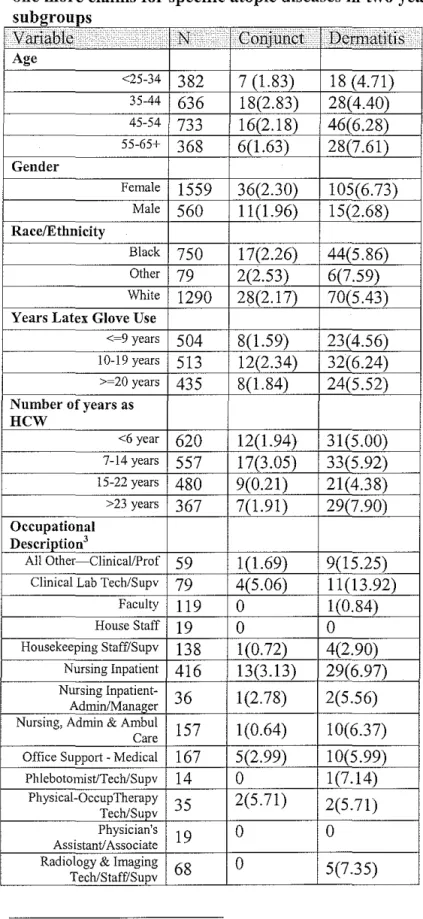
The prevalence ofHCW with one or more claims for specific disease in two- year
outcomes are stratified by gender, race/ethnicity, age, years of latex glove use,
duration as a health care worker, and job category. In all seven outcome
categories, the prevalence among female employees was significantly higher than
males. Blacks had a higher prevalence of than Whites and Other (summary
variable containing Asian/Pacific Islander/American Indian) for Asthma, Lung,
and Urticaria; however the employees in the Other race/ethnicity category had a
higher prevalence of conjunctivitis, dermatitis, rhinitis, and skin. Rhinitis, skin
and urticaria were most prevalent in employees 35 years of age or less, with
employees greater than 55 years of age having the highest prevalence of asthma,
lung, and dermatitis. Employees 35-44 years of age had the highest conjunctivitis
prevalence. Asthma was the only atopic outcome with a relationship to exposure
variable (years as a HCW). In the asthma, lung, and rhinitis categories the highest
prevalence occurred in the 15 to 22 year age range.
Stratified prevalence was calculated for job categories. Among occupation
categories with four or more cases oflatex allergy, asthma had a higher
prevalence among physician's assistants, clinical lab technicians, phlebotomists,
ambulatory nurses, and inpatient nurses. There was a high prevalence oflung
disease in physician assistants, inpatient nurses, inpatient nurses-managers,
phlebotomists, and among those in nursing care service. For conjunctivitis,
physician/occupational therapists, clinical lab technicians, nursing care service,
inpatient nurses, and medical office support personnel were observed to have the
technicians, radiology/imaging technicians, phlebotomist, and inpatient nurses recorded the highest prevalence of dermatitis. Respiratory diseases were highest in physician assistants, physical! occupational therapists, radiology/imaging technologists, medical office support personnel, and administrative nurses and ambulatory care personnel. Office support was the occupational grouping with the highest prevalence of skin diseases, followed by phlebotomists, administrative nurses and ambulatory care personnel, other clinical and professional personnel, and faculty. There was a low prevalence of urticaria across all groups, with the medical office support classification having the highest at 2.4%.
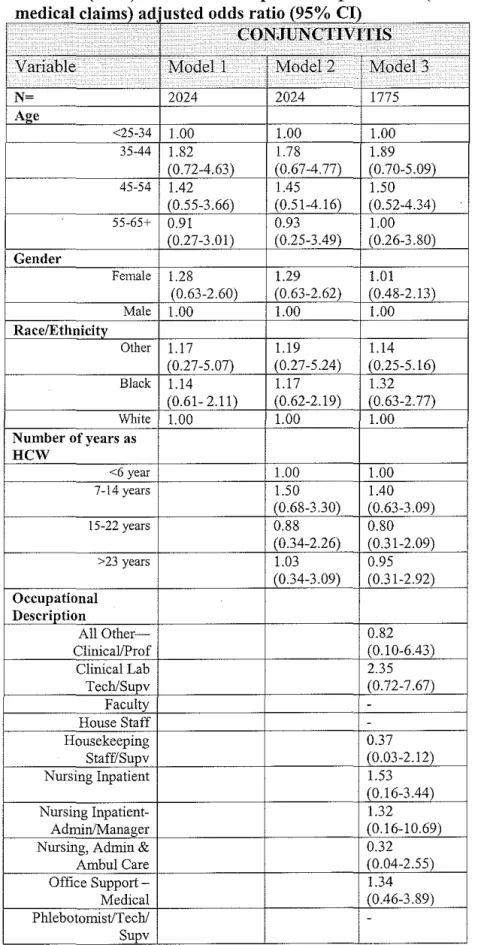
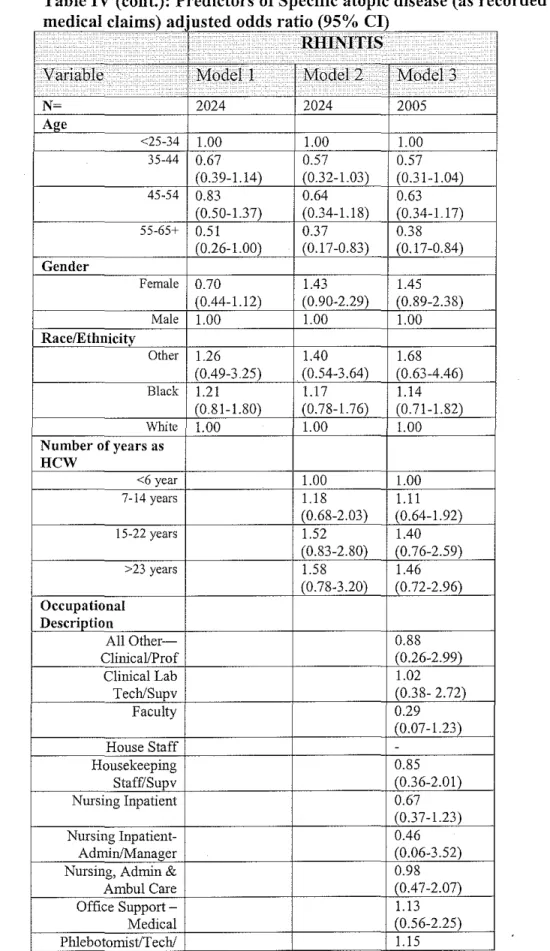
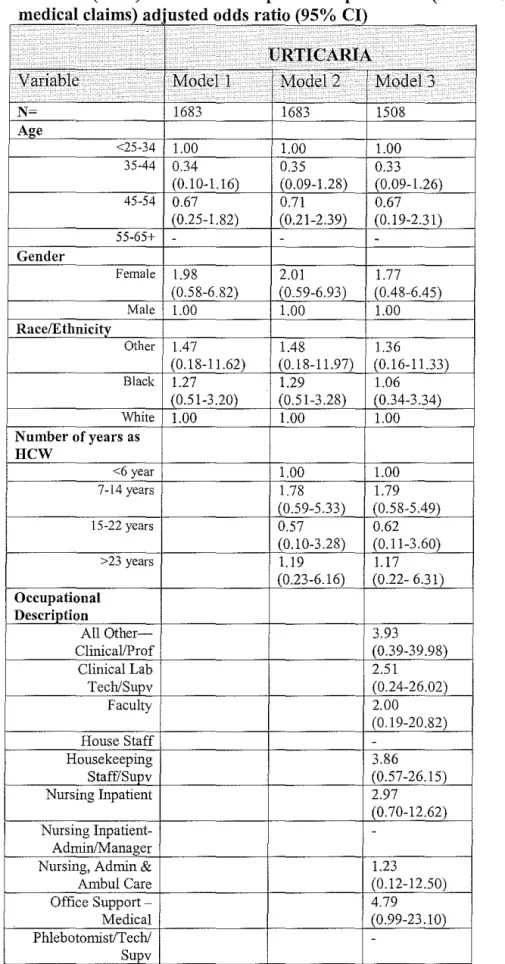
Multivariate Analyses
In bivariate models, age, gender, race/ethnicity, duration as a HCW, and occupational group were found to be predictors of atopic, latex related, health outcomes (Table III). Bivariate analysis demonstrated unadjusted statistical significance for the variables gender, years of latex glove use, and numbers of years as a HCW for the asthma outcome. The exposure variable, number of years as a HCW, was significant for the lung disease outcome. The occupational categories all other clinical/professionals and clinical lab technicians/supervision showed unadjusted significance for dermatitis.
dependent variable (Table IV). Females were found to have 3.12 (1.45-6.70)
greater adjusted odds than males of having had asthma across all models. No
significant associations were found in the fully adjusted model (Model 3, Table
IV) for age, race, duration as a HCW, and occupational group. Having worked
less than 23 years as a health care worker was found to be significantly associated
with lung disease. Employees who have worked 7-14 years as a healthcare worker
had 2.10 greater odds (1.19-3.73) of having a lung related medical claim after
adjusting for all other variables. Both female gender and the occupational
categories; all other clinical/ professional and clinical lab technician; were
significantly associated with dermatitis. No significant associations were
observed between rhinitis, conjunctivitis, skin, or urticaria when adjusting for age,
gender, race/ethnicity, duration as HCW, and occupational group.
DISCUSSION AND CONCLUSION
Summary of Results
The current study integrated human resources data and medical insurance claims
to examine the potential risk factors associated with latex related atopic outcomes.
We found that non-white race may be a risk factor for latex-related medical
outcomes, significantly in asthma. Asthma showed a dose response of increased
prevalence with the variable 'years as a HCW', but the relationship loses strength
finding between the occupational categories and seven potentially latex related atopic outcomes.
The lack of significant results in consistent with the literature. When measuring latex-specific IgE, Kibby and Aid (1997) found no significant difference in latex between reactors and non-reactors based on the length of service among hospital employees. 21 Only a few studies have evaluated association of occupation and latex-related symptoms and those that have vary in their outcomes. Liss eta! (1997) found a high prevalence oflatex sensitization among laboratory worker (16.9%) and among nurses and physicians (13.3%) in a study of 1351 hospital HCW s. 23 Both Twjanmaa and Smedley et a!. reported that operating room staff were at increased risk of sensitization compared to examination and laboratory staff or outpatient nurses. 2• 24 In contrast, Grzybowski et a!. found operating room nurses to be at the lowest risk group among all nursing specialties in their study. 25 In studies of hospital employees, Hunt (1995) and Tmjanmaa (1987) found that latex sensitivity three to five times greater among nurses and physicians than among personnel with no patient contact. 2• 26 No studies have compared the prevalence oflatex allergies among HCWs and other working populations.
Survey results from 1983-1994, and found no temporal trend of increasing
potential NRL-related conditions over time after introduction of universal
precautions (i.e. correlate for increased glove use).
Strengths and Limitations
The Duke Health and Safety Surveillance System integrates information from a
number of existing data systems, allowing for comprehensive surveillance of
adverse occupational events. For the current analysis of latex exposure and
subsequent health claims, the DHSSS extended a traditional case-based reporting
system (e.g. worker's compensation) with data from an occupational latex allergy
survey to allow for follow-up health care workers and potentially latex related
atopic outcomes. While using symptoms as a means of assessing reactivity has
been used in other studies as a viable method to estimated occupational disease,
most of these studies focus on worker's compensation claims analysis. 27-32This
study was unique in its focus on using medical claims as a more objective
measure of latex reactivity to help identify risk factors.
Study limitations stem from the use of self-report data. Using self-reported data
did result in high percentage of individuals with missing data for the variable
"years of latex gloves glove use" making it difficult to use as in analysis. Based
on current studies there is no clear relationship between the risk of sensitization
further research. Additionally, these types of data could result in the estimates of
potential latex related data being less specific than studies that involve in vivo
testing for allergic reactions. However, unlike previous research the focus of this
study was on the potential atopic reactions to latex versus the actual sensitization
of the employee. Therefore, it is hard to make a direct comparison between these
results and those of prior research.
The use of medical claims as an indicator of potential latex reactions in the
absence of specific test for latex reactivity is an additional limitation of the study.
It is possible that many of reactions indicated by the seven medical claims
categories measured among HCW s could be due to factors other than latex
exposure and the burden of disease in this population could be overestimated or
underestimated.
A fourth limitation is that those employed in medical occupations who suffered
from latex related atopic conditions may have left the medical field or entered an
occupation not requiring contact with latex. The sample was restricted to those
who had complete insurance coverage during the two years of the data analysis.
This potentially biases the study towards the healthy, and shifts estimated odds
ratios downward. The variable, "years as a health care worker" is limited to years
of employment at DUHS, and thus information about previous employment was
The cost associated with latex related medical claims should be a focus of
additional research. Some studies have looked at the medical costs associated with
latex use and switching to vinyl gloves, and a study by Phillips et a!. suggests that
when only glove costs are considered, switching to a latex -safe approach was
more expensive for medical facilities (tertiary care hospital, community hospital,
outpatient internal medicine clinic) than continued latex glove use; yet the authors
acknowledge that all costs that would favor the latex-safe conversion were not
included such as patient-related liability, or temporary disability. The costs
associated with job loss may be impossible to measure. The authors also
advocated a switch to powder-free gloves in non-surgical areas as a way to
reduced antigens in the environment.
Conclusions
Overall, the studies results show little statistical evidence that risk factors for latex
allergy result in significantly higher prevalence of atopic outcomes as indicated
by medical claims. The strengths of this study are its longitudinal nature and the
enumeration of a population of over 2,000 HCW s with potential latex exposure
using integrated human resources data. These results emphasize the need for
future investigations examining the relationship between actual reactivity rates
and latex exposure. Future research of this nature may include a longer time frame
and more objective assessment of both latex exposure and relevant more specific
The results of our study, which was done in close collaboration with the Duke Employee Occupational Health Service, will help serve as aid for enhancing and evaluating ongoing prevention efforts. Guidelines for latex allergy prevention are already in place in the Duke University Health System. Employees are
ACKNOWLEDGEMENTS
This work has been supported through a grant from the National Institute for
Occupational Safety and Health (5 ROl OH003979-03).
We express our appreciation to Clint H. Davidson, Vice President Human
Resources; George W. Jackson, M.D, Director, Duke Occupational Health
Service; Lois Ann Green, Director Human Resources Benefits Administration; Nathaniel Whitfield, Manager/Special Counsel, Workers' Compensation
Administration; and Wayne R. Thomann, Ph.D., Director, Occupational and
Environmental Safety Office for their direction and assistance in establishing the
REFERENCES
1. Weissman DN, Lewis DM. Allergic and latex specific sensitization: route, frequency, and amount of exposure that are required to initiate IgE
production. J Allergy Clin Immunol. 2002; 110(Suppl2):S57-63.
2. Tmjanmaa KA. Incidence of immediate allergy to latex gloves in hospital personnel. Contact Dermatitis.1987;17:270-275.
3. Yassin MS, Lierl MB, Fischer TJ, O'Brien K, Cross J, Steinmetz C. Latex allergy in hospital employees. Ann Allergy. 1994;72:245-249.
4. Vanderplas 0, Delwiche J-P, Evrard G, eta!. Prevalence of occupational asthma due to latex among hospital personnel. Am J Respir Crit Care Med. 1995;151: 54-60.
5. Filon F, Bosco A, Fiorito A, Negro C, Barbina P. Latex symptoms and sensitization in health care workers. Int Arch Occup Environ Health. 2001; 74:219-223.
6. Hamarm CP. Natural rubber latex protein sensitivity in review. Am J Contact Dermatitis. 1993;4:4-21.
7. Ranta PR, Ownby DR. A review of natural-rubber latex allergy in health care workers. CID. 2004; 38:252-256.
8. Fish JE. Occupational asthma and rhinoconjunctivitis induced by natural rubber latex exposure. J Allergy Clin Immunol. 2002; 11 O(Suppl2):S75-81.
9. Allmers H, Brehler R, Chen Z, eta!. Reduction of latex aeroallergens and latex -specific IgE antibodies in sensitized workers after removal of
powdered natural rubber latex gloves in a hospital. J Allergy Clin Immunol 1998; 102:841-846.
10. Hamilton RG, Brown RH. Impact of personal avoidance practices on health care workers sensitized to natural rubber latex. J Allergy Clin Immunol. 2000; 105:839-841.
12. Tarlo SM, Easty A, Eubanks K, et al. Outcomes of a natural rubber latex control program in an Ontario teaching hospital. J Allergy Clin Immunol.
2001; 108:628-633.
13. Gliniecki CM. Management oflatex reactions in the occupational setting. Am Assoc Occup Health Nurses J 1998;46:82-93.
14. Phillips VL, Goodrich MA, Sullivan TJ. Health care workers disability due to latex allergy and asthma: a cost analysis. Am J Public Health. 1999; 89: I 024-1028.
15. McCall BP, Horwitz IB, Kammeyer-Mueller JD, 2003. Have health conditions associated with latex increased since the issuance of universal precautions? AM J Public Health. 2003; 93:599-604.
16. Garabrant DH, Schweitzer S. Epidemiology oflatex sensitization and allergies in health care workers. J Allergy Clin Immunol. 2002; 11 O(Suppl 2):S82-95.
17. Ownby DR. A history oflatex allergy. J Allergy Clin Immunol. 2002; l!O(Suppl2):S27-32.
18. Ownby DR, Ownby HE, McCullough J, Shafer AW. The prevalence of anti-latex lgE antibodies in 1000 volunteer blood donors. J Allergy Clin Immunol. 1996; 97:1188-1192.
19. Tarlo SM, Sussman GL, Holness DL. Latex sensitivity in dental students and staff: a cross-sectional study. J Allergy Clin Immunol. 1997;99:396-401.
20. Dement JM, Pompeii LA, 0stbye T, Epling C, Lipscomb HJ, James T, Jacobs MJ, Jackson G, Thomann W, 2004. An integrated comprehensive occupational surveillance system for health care workers. Am J Ind Med.
2004; 45:528-538.
21. Kibby T, Akl M. Prevalence oflatex sensitization in a hospital employee population. Ann Allergy Asthma Immunol. 1997;78:41-44.
22. Trape M, Schenck P, Warren A, 2000. Latex gloves use and symptoms in health care workers I year after implementation of a policy restricting the use of powdered gloves. AJIC. 2000 28(5): 352-58.
24. Smedley J. Bendall H, Coggon D. Prevalence and risk factors for latex allergy: a cross sectional study in a United Kingdom hospital. Occup Environ Med. 1999; 56: 833-6.
25. Grzybowski M, Ownby DR, Peyser PA, Johnson CC, Schork MA. The prevalence of anti-latex IgE antibodies among registered nurses. J Clin Immunol. 1996; 98:535-544.
26. Hunt LW, Kelkar P, Reed CE. Management of occupational allergy to natural rubber latex in a medical center: the importance of quantitative latex allergen measurement and objective follow-up. J Allergy Clin Immuno.l2002; 110(Suppl2):S96-106.
27. Lagier F, Verlot D, Lhermet I, Poyen D. Prevalence oflatex allergy in operating room nurses. J Allergy Clin Immunolo. 1992; 90: 319-322.
28. Tarlo SM, Wong L, Roos J, Booth N. Occupational asthma caused by latex in a surgical glove manufacturing plant. J Allergy Clin Immunol. 1990;85 :626-631.
29. Horwitz IB, ArveyRD. Workers' compensation claims from latex glove use: a longitudinal analysis of Minnesota 1988-1997. J Occup Environ Med. 2000; 42:932-938.
30. Horwitz IB, Kammeyer-Mueller JD, Butler RJ. Workers' compensation claims as a measure ofhealthcare worker reaction to latex gloves in healthcare settings: Rhode Island 1992-1997. J Workers
Compensation.2000;10:49-59.
31. Horwitz IB, Kammeyer-Mueller JD, McCall BP. Assessing latex allergy among health care employees using workers' compensation data: results from North Dakota and a comparison with findings in Minnesota and Rhode Island. Minn Med. 2001;84:47-50.
32. Bonauto DK, Foley M, Baggs J. Workers' compensation latex claims. J
Table 1: Demographic Characteristics ofDUHS Health Care Workers Cohort with potential for latex exposure
Variable . . ·.
Mean Age at Start of Follow-up (Std. Dev) 44.8(9.7) Age, Number(%)
<25-34 382 (18.0) 35-44 636(30.0) 45-54 733(34.6) 55-65+ 368 (17.4) Gender, Number(%)
Female 1559 (73.6) Male 560 (26.4) Race/Ethnicity, Number(%)
Asian 65(3.1) Black 750(35.4) Hispanic 12(0.57) American Indian 2(0.09)
White 1290(60.9)
Mean years of latex glove use (Std. Dev) 14.31(9.2)
Years Latex Glove Use, Number(%)
<=9 years 504(34.7) 10-19 years 513(35.3)
. >=20 years 435(30.0)
Mean Years as Health Care Worker (HCW) at start 13.5(9.95) of follow-up (Std. Dev)
Number of years as HCW, Number(%)
<6 year 620(30.6) 7-14 years 557(27.5) 15-22 years 480(23.7) >23 years 367(18.1) Occupational Description', Number(%)
All Other~Clinical/Prof 59(2.8)
Clinical Lab Tech/Supv 79(3.7) Faculty 119(5.6) House Staff 19(0.90) Housekeeping Staff/Supv 138(6.5) Nursing Inpatient 416(19.6) Nursing Inpatient- Admin!Manager 36(1.7)
Physical-OccupTherapy Tech/Supv 35(1.7) Physician's Assistant/ Associate 19(0.90) Radiology & Imaging Tech/Staff/Supv 68(3.2)
Respiratory Care Tech/Supv 17(0.80) Service, Nursing Care 64(3.0)
Other 712(33.6)
.
. .
Physician Diagnosis*
Hay Fever 37 (17.5) Sinusitis 532(25.1) Chronic Bronchitis 121(5.7)
Asthma 240(11.3) Eczema 146(6.9) Latex Allergy 80(3.8) Allergies*
Medication 639(30.3) Food 200(9.4) Other 700(33.0)
Table ll: Number (Prevalence) of Health Workers (2002-2003) with one more claims for specific atopic diseases in two year follow-up period for
b
su )grou s
Variable ·· N Asthma Lungs . Rhinitis ·.
. .· .. ·.
..
.Age
<25-34 382 12(3.14) 17(4.45) 28(7.32) 35-44 636 13(2.04) 31(4.87) 31(4.87) 45-54 733 37(5.05) 50(6.82) 45(6.13) 55-65+ 368 23(6.25) 30(8.15) 14(3.80) Gender
Female 1559 76(4.87) 98(6.29) 93(5.97) Male 560 9(1.61) 30(5.36) 25(4.46) Race/Ethnicity
Black 750 31(4.13) 55(7.33) 47(6.27) Other 79 2(2.53) 5(6.33) 5(6.33) White 1290 52(4.03) 68(5.27) 66(5.12) Years Latex Glove
Use
<=9 years 504 12(2.38) 22(4.37) 30(5.95) 10-19 years 513 27(5.26) 36(7.02) 23(4.48) >=20 years 435 19(4.37) 29(6.67) 25(5.75)
Number of years as
HCW
<6 year 620 15(2.42) 22(3.55) 34(5.48) 7-14 years 557 22(3.95) 40(7.18) 29(5.21) 15-22 years 480 27(5.63) 35(7.29) 29(6.04) >23 years 367 19(5.18) 25(6.81) 22(5.99) Occupational
Description'
All Other-Clinical/Prof 59 3(5.08) 1(1.69) 3(5.08) Clinical Lab Tech/Supv 79 6(7.59) 3(3.80) 5(6.33) Faculty 119 4(3.36) 6(5.04) 2(1.68)
House Staff 19 0 0 0
Housekeeping Staf£1'Supv 138 2(1.45) 9(6.52) 8(5.80) Nursing Inpatient 416 19(4.57) 23(5.53) 18(4.33) Nursing
Inpatient-36 2(5.56) 3(8.33) 1(2.78)
Admin/Manager Nursing, Admin & Ambul
157 10(6.37) 13(8.28) 10(6.37)
Care
Office Support -Medical 167 8(4.79) 11(6.59) 12(7.19)
Phlebotomist!Tech/Supv 14 1(7.14) 1(7.14) 1(7.14) Physical-OccupTherapy
35 1(2.86) 1(2.86) 3(8.57)
Tech/Supv Physician's
19 2(10.53) 2(10.53) 3(15.79)
Assistant/ Associate
Tech/Staf£'Suov
Respiratory Care
17 0 1(5.88) 1(5.88)
Tech/Supv
Service, Nursing Care 64 1 (1.56) 5(7.81) 2(3.13)
Other 712 25(3.51) 48(6.74) 44(6.18)
I.
r-
---~..
· .. · .I
.· .. . · .·· .
.
. .Physician Diagnosis*
Hay Fever 370 36(9.73) 27(7.30) 51(13.78)
Sinusitis 532 46(8.65) 44(8.27) 71(13.34)
Chronic Bronchitis 121 24(19.20) 20(16.53) 14(11.57)
Asthma 240 70(29.17) 30(12.50) 26(10.83)
Eczema 146 8(5.48) 15(10.27) 16(10.96)
Latex Allergy 80 9(11.25) 5(6.25) 6(7.50) Allergies*
Medication 639 53(8.29) 56(8.76) 52(8.14)
Food 200 21(10.50) 9(4.50) 17(8.50)
Other 700 61(8.71) 52(7.43) 84(12.0)
Table II (cont): Number (Prevalence) of Health Workers (2002-2003) with one more claims for specific atopic diseases in two year follow-up period for subgroups
VanaJ;ne
,
...•...::::::;:
INn : ..
· <.;cni}uU:9f
I1)91'ffiaHtis ·
Age<25-34 382 7 (1.83) 18 (4.71) 35-44 636 18(2.83) 28(4.40) 45-54 733 16(2.18) 46(6.28) 55-65+ 368 6(1.63) 28(7.61) Gender
Female 1559 36(2.30) 105(6.73) Male 560 11(1.96) 15(2.68) Race/Ethnicity
Black 750 17(2.26) 44(5.86) Other 79 2(2.53) 6(7.59) White 1290 28(2.17) 70(5.43) Years Latex Glove Use
<-9 years 504 8(1.59) 23(4.56) 10-19 years 513 12(2.34) 32(6.24) >-20 years 435 8(1.84) 24(5.52)
Number of years as
HCW
<6 year 620 12(1.94) 31(5.00) 7-14 years 557 17(3.05) 33(5.92) 15-22 years 480 9(0.21) 21(4.38) >23 years 367 7(1.91) 29(7.90) Occupational
Description'
All Other-Clinical/Prof 59 1 (1.69) 9(15.25) Clinical Lab Tech/Supv 79 4(5.06) 11(13.92)
Faculty 119 0 1(0.84)
House Staff 19 0 0 Housekeeping Staffi'Supv 138 1(0.72) 4(2.90)
Nursing Inpatient 416 13(3.13) 29(6.97) Nursing
Inpatient-36 1(2.78) 2(5.56)
Admin/Manager Nursing, Admin & Ambul
157 1(0.64) 10(6.37)
Care
Office Support -Medical 167 5(2.99) 10(5.99)
Phlebotomist/Tech/Supv 14 0 1(7.14)
Physical-OccupTherapy
35 2(5.71) 2(5.71)
Tech/Supv Physician's
19 0 0
Assistant! Associate Radiology & Imaging
68 0 5(7.35)
Respiratory Care
17 0 1(5.88)
Tech/Sll]J_v
Service, Nursing Care 64 2(3.13) 1(1.56)
Other 712 17(2.39) 34(4.78)
···>> ( :>.:>:· [[;;
r•··:
.>>t:•c:·•
b•
> .·:; :;:;;.
Physician Diagnosis*
Hay Fever 370 12(3.24) 27(7.30)
Sinusitis 532 13(2.44) 43(8.08) Chronic Bronchitis 121 4(3.31) 12(9.92)
Asthma 240 8(3.33) 16(6.67)
Eczema 146 4(2.74) 26(17.81)
Latex Allergy 80 3(3.75) 9(11.25) Allergies*
Medication 639 13(2.03) 56(8.76)
Table II (cont): Number (Prevalence) of Health Workers (2002-2003) with oue more claims for specific atopic diseases in two year follow-up period for
...
ouu,;•uupo ~
:<;' .,... :;;
< :;.
r:;'>;Age
<25-34 382 21(5.50) '; (1.83) 35-44 636 25(3.93) 4(0.62) 45-54 733 30(4.09) 9(1.22) 55-65+ 368 16(4.35) ±Q.09)
Female 1559 75(4.81) 20(1.28) Male 560 17(3.04) 4(0.71) R"ee/F.: ry
Black 750 37(4.93) 1 0(1.33) Other 79 5(6.33) 1 ).27) White 1290 50(3.88) 31 '0.23) Years Latex Glove Use
<~9 years 504 22(4.37) 6(1.19) 10-19 years 513 16(3.12) 5(0.97)
>~20 years 435 22(5.06) 5(1.15)
Number u1 years as
HCW
<6 year 620 31(5.00) 7(1.13) 7-14 years 557 23(4.13) 8(1.44) 15-22 years 480 19(3.96) 2(0.42) >23 years 367 1fi(4 ifi) 3(0.82)
.4
All r 59 3(5.08) 1(1.69)
Clinical Lab - y 79 2(2.53) 1(1.27)
Faculty 119 5(4.20) 1(0.84)
House Staff 19 0 0
- y 138 3(2.17) 2(1.45)
"ursmg 416 18(4.33) 6(1.44)
N':,sing 36 0 0
"' Admin & A~~~~ 157 9(5.73) 1(0.64) Office Support -M, · 167 12(7.19) 4(2.40)
:t/Tech/Supv 14 1(7.14) 0
nccnpTherapy
35 0 0
Physician's
19 0 0
Assistant/Associate 1& [m,"inP
Respiratory Care
17 0 0
Tech/Suev
Service, Nursing Care 64 1 (1.56) 0 Other 712 36(5.06) 7(0.98) ' ,,, ,' ,,;' ::: ,">,,';, ,' '" ">:>:,.,.,, L '':': •: I ' ' \
<
'•>;;,Physician Diagnosis*
Hay Fever 370 13(3.51) 4(1.08) Sinusitis 532 26(4.89) 6(1.13) Chronic Bronchitis 121 5(4.13) 3(2.48) Asthma 240 11(4.58) 3(1.25) Eczema 146 14(9.59) 2(1.37) Latex Allergy 80 5(6.25) 3(3.75) Allergies*
Table III: Predictors of specific atopic diseases (as recorded through medical claims) bivariate odds ratio (95% CI)
Variable Asthma ·. L)lllgs Rhinitis
. .
Age
<25-34 1.00 1.00 1.00 35-44 0.81 0.89 1.03
(0.28-2.34) (0.39-2.07) (0.46-2.32)
45-54 2.58 1.04 2.10
(0.54-12.4) (0.28-3.79) (0.55-7.96) 55-65+ 4.07 1.02 2.01
(0.43-38.1) (0.16-6.52) (0.28-14.38) Gender
Female 3.14 Ll9 1.36
(1.56-6.30) (0.78-1.80) (0.863-2.13)
Male 1.00 1.00 1.00
Race/Ethnicity
Other 0.62 1.21 1.25 (0.15- 2.59) (0.48-3.10) (0.49-3.20)
Black 1.03 1.42 1.24
(0.65- 1.62) (0.98-2.05) (0.84-1.82)
White 1.00 1.00 1.00
Years Latex Glove Use
<-9 years 1.00 1.00 1.00 I 0-19 years 2.28 1.65 0.74
(L14-4.55) (0.96-2.85) (0.42-1.30) >=20 years 1.8 1.56 0.96
7(0.90-3.90) (0.89-2.77) (0.56-1.66)
Number of years as
HCW
<6 year 1.00 1.00 1.00 7-14 years 1.66 2.10 0.95
(0.85-3.23) (1.23-3.59) (0.57-1.58) 15-22 years 2.40 2.14 Ll1
(1.26-4.57) (1.24-3.70) (0.67-1.85) >23 years 2.20 1.99 LIO
(LI0-4.39) (1.10-3.58) (0.63-1.91) Physician Diagnosis
Hay Fever 4.51 1.29 4.52
(2.74 -7.39) (0.83-2.01) (3.04-6.73) Sinusitis 4.15 1.65 530
(2.63-6.54) (U2-2.42) (3.58-7 .86) Chronic Bronchitis 8.54 3.46 2.55
(5.06-14.43) (2.06-5.82) (1.41-4.62) Asthma 55.87 2.59 2.61
(30.28-103.09) (1.67-4.00) (1.64-4.16) Eczema 1.70 1.96 2.58
(0.80-3.62) (U 1-3.46) (1.47-4.54) Latex Allergy 3.81 1.06 1.54
(2.66-6.66) (1.33-2.77) (1.31-2.80)
Food 3.60 0.72 1.74
(2.14-6.07) (0.36-1.44) (1.02-2.99)
Other 6.06 1.39 6.24
(3.66-10.05) (0.96-2.01) ( 4.04-9.61)
Occupational Description
All Other- 1.47 0.24 0.81
Clinical/Prof (0.43-5.03) (0.03-1.76) (0.24-2.70)
Clinical Lab 2.26 0.55 1.03
Tech/Supv (0.90-5.69) (0.17-1.80) (0.39-2.67)
Faculty 0.96 0.73 0.26
(0.33-2.80) (0.31-1.76) (0.06-1.09)
House Staff - -
-Housekeeping 0.40 0.97 0.93
Staf£'Supv (0.09-1.73) (0.46-2.02) (0.43-2.03)
Nursing Inpatient 1.32 0.81 0.69
(0.72-2.42) (0.48-1.35) (0.39-1.20)
Nursing Inpatient- 1.62 1.26 0.43
Admin/Manager (0.37-7.11) (0.37-4.25) (0.06-3.24)
Nursing, Admin & 1.87 1.25 1.03
Ambul Care (0.88-3.98) (0.66-2.37) (0.51-2.10)
Office Support - 1.38 0.98 1.18
Medical (0.61-3.12) (0.50-1.92) (0.61-2.28)
Phlebotomist/Tech/Su 2.11 1.06 1.17
pv (0.27-16.80) (0.14-8.31) (0.15-9.13)
Physical-0.81 0.41 1.42
OccupTherapy
(0.11-6.14) (0.05-3.04) (0.42-4.83) Tech/Supv
Physician's 3.232941 1.63 2.85
Assistant! Associate (0.71-14.76) (0.37-7.25) (0.80-10.14)
Radiology & Imaging 0.41 0.21 1.20
Tech/Staf£'Supv (0.05-3.07) (0.03-1.52) (0.46-3.15)
Respiratory Care 0.86 0.95
Tech/SujlV
-
(0.11-6.66) (0.12-7.32)Service, Nursing Care 0.44 1.172316 0.49
(0.06-3.27) (0.45-3.06) (0.12-2.07)
Table III (cont.): Predictors of specific atopic diseases (as recorded through medical claims) bivariate odds ratio (9So/, CI) 0
variable.
:cc · ~-• .. C<.m}unct .•.· D~roiatitisAoe
<25-34 1.00 1.00
35-44 3.93 2.10
(1.05-14.70) (0.31-14.16)
45-54 7.59 1.58
(0.88- (0.42-5.98)
65.56)
55-65+ 14.04 1.01
(0.62- (0.43-2.36)
319.31) Gender
Female 1.17 (0.60- 2.62
2.33) (1.51-4.54)
Male 1.00 1.00 Race/Ethnicitv
Other 1.17 1.43
(0.27-5.01) (0.60-3.41) Black 1.05 1.09
(0.57-1.92) (0.74-1.60) White 1.00 1.00 Years Latex Glove Use
<-9 years 1.00 1.00
10-19 years 1.49 1.39
(0.60-3.66) (0.80-2.41) >=20 years 1.56 1.22
(0.89-2.77) (0.68-2.20)
Number of years as
HCW
<6 year 1.00 1.00 7-14 years 1.60 1.20
(0.75-3.37) (0.72-1.98)
15-22 years 0.97 0.87
(0.40-2.32) (0.49-1.53) >23 years 0.99 1.63
(0.38-2.53) (0.97-2.75) Phvsician Dia!!nosis
Hay Fever 1.66 1.43 (0.85-3.25) (0.92-2.24) Sinusitis 1.21 1.72
(0.63-2.32) (1.17-2.54) Chronic Bronchitis !.58 1.98
(0.55-4.48) (1.06-3.73) Asthma 1.62 1.28
(0.75-3.53) (0.74-2.21) Eczema 1.24 4.43
(0.44-3.51) (2.75-7.14) Latex Allergy 1.76 2.33
(0.53-5.82) (1.13-4.79) Alleroies
Food 1.25 0.85 (0.48-3.21) (0.44-1.66)
Other 1.18 1.33
(0.64-2.17) (0.91-1.94)
Occupational Description
All Other-Clinical/Prof 0.70 3.59
(0.09-5.39) (1.63-7.90)
Clinical Lab Tecb/Supv 2.18 3.23
(0.72-6.65) (1.56-6.65)
Faculty - 0.17
(0.02-1.25)
House Staff -
-Housekeeping 0.30 0.60
Staf£'Supv (0.04-2.26) (0.21-1.71)
Nursing Inpatient 1.32 1.49
(0.63-2.74) (0.90-2.49)
Nursing Inpatient- 1.17 1.17
Admin/Manager (0.15-9.03) (0.27-5.09)
Nursing. Admin & 0.26 1.36
Ambul Care (0.03-1.98) (0.66-2.81)
Office Support - 1.26 1.27
Medical (0.46-3.47) (0.61-2.63)
Phlebotomist/Tecb/Supv - (0.19-12.07) 1.53
Physical-OccupTherapy 2.48 1.21
Tecb/Supv (0.55-11.17) (0.28-5.25)
Physician's -
-Assistant/ Associate
Radiology & Imaging - 1.58
Tecb/Staff7Suov (0.60-4.19)
Respiratory Care - 1.25
Tecb/Supv (0.16-9.68)
Service, Nursing Care 1.32 0.32
(0.30-5.84) (0.04-2.35)
>=20 years
Number of years as
Other 1.10 1.65 (0.70-172) (0.73-3.70)
Occupational Description
All Other-ClinicaVProf 100 1.74
(0.30-3.37) (0.21-14.36)
Clinical Lab T ech/Supv 0.49 129
(0.12-2.07) (0.16-10.63)
Faculty 0.82 0.85
(0.32-2.14) (0.10-7.00)
House Staff -
-Housekeeping 0.42 1.48
Staffi'Supv (0.13-1.37) (0.30-7.21)
Nursing Inpatient 0.85 147
(0.48-152) (0.49-4.42)
Nursing Inpatient- -
-Admin/Manager
Nursing, Admin & 1.14 0.65
Ambul Care (0.54-2.42) (0.08-5.29)
Office Support - 1.45 2.47
Medical (0.74-2.86) (0.72-8.54)
Phlebotomist/Tech/Supv 144
-(0.18-11.35)
Physica1-0ccupTherapy -
-Teclt/Supv
Physician's -
-Assistant/ Associate
Radiology & Imaging 0.57 150
T eclt/Staff/Supv (0.13-2.42) (0.18-12.40)
Respiratory Care -
-Teclt/Supv
Service, Nursing Care 0.30
-(0.04-2.21)
Table IV: Predictors of Specific atopic disease (as recorded through medical I . ) d. t d dd f (95o/t CI)
c atms a I JUS e 0 s ra 10 0
· .
ASTHMA . . ·
·.·...
.··...
•·•
Variable ·. Modell Model2
Model3
·.· I • .
N- 2024 2024 1977
Age
<25-34 1.00 1.00 1.00
35-44 0.66 0.47 0.48
(0.30-1.46) (0.20-1.11) (0.20-1.14)
45-54 1.56 1.08 1.08
(0.80-3.05) (0.49-2.39) (0.48-2.41) 55-65+ 2.18 1.52 1.62
(1.07-4.47) (0.64-3.60) (0.68-3.90) Gender
Female 3.47 3.49 3.12 (1.66-7.26) (1.67- 7.30) (1.45-6.70)
Male 1.00 1.00 1.00
Race/Ethnicity
Other 0.76 0.86 0.84
(0.18-3.21) (0.20-3.71) (0.19-3.66)
Black 1.04 1.08 1.50
(0.65-1.65) (0.67-1.74) (0.87-2.60)
White 1.00 1.00 1.00
Number of years as
HCW
<6 year 1.00 1.00
7~14 years 1.50 1.57
(0.65-3.47) (0.76-3.26)
15-22 years 2.27 2.07
(I. 06-4. 86) (0.96-4.49) >23 years 1.50 1.33
(0.65-3.47) (0.57- 3.15) Occupational
Description
All Other- 1.40
Clinical/Prof (0.40-4.91)
Clinical Lab 2.04
Tech/Supv (0.78-5.38)
Faculty 1.49
(0.49-4.54)
House Staff
-Housekeeping 0.34
Staff!Supv (0.08-1.52)
Nursing Inpatient 1.27
(0.66-2.43)
Nursing Inpatient- 1.70
Admin/Manager (0.37-7.77)
Nursing, Admin & 1.51
Ambul Care (0.68-3.35)
Office Support- 1.06
Medical (0.46-2.47)
-Supv
Physical- 1.04
OccupTherapy (0.13-8.29)
Tecb/Supv
Physician1
S 4.74
Assistant/ Associate (0.98-22.92)
Radiology & Irnagiug 0.49
Tecb/Staff/Supv (0.06-3.77)
Respiratory Care
-Tecb/Supv
Service, Nursing Care 0.42
(0.05-3.25)
Table IV (cont.): Predictors of Specific atopic disease (as recorded through medical claims) adjusted odds ratio (95% CI)
. ·•·
. •. LUNG . ·.
. .·
..
. · . · ..Variable ·. Modell ·· Model2 . Mode13. •
N- 2024 2024 1845
Age
<25-34 1.00 1.00 1.00
35-44 1.08 0.79 1.22
(0.59-1.99) (0.41-1.52) (0.58-2.56)
45-54 1.52 1.08 1.08
(0.86-2.68) (0.56-2.09) (0.56-2.09)
55-65+ 1.73 1.23 1.22
(0.92-3.26) (0.59-2.57) (0.58-2.56) Gender
Female 1.33 1.35 1.39 (0.85-2.07) (0.86-2.11) (0.86-2.23)
Male 1.00 1.00 1.00
Race/Ethnicity
Other 1.38 1.63 1.64 (0.54-3.56) (0.62-4.26) (0.62-4.33)
Black 1.46 1.50 1.45
(1.00-2.13) (1.02-2.21) (0.91-2.30)
White 1.00 1.00 1.00
Number of years as
HCW
<6 year 1.00 1.00
7-14 years 2.15 2.10
(1.21-3.80) (1.19-3.73)
15-22 years 2.12 2.05
(1.14-3.97) (1.09-3.85) >23 years 1.61 1.56
(0.79-3.25) (0.76-3.18) Occupational
Description
All Other- 0.26
Clinical/Prof (0.03-1.93)
Clinical Lab 0.53
Tecb/Supv (0.16-1.78)
Faculty 1.01
(0.41-2.49)
House Staff
-Housekeeping 0.87
Staff/Supv (0.40-1.89)
Nursing Inpatient 0.90
(0.52-1.57)
Nursing Inpatient- 0.94
Admin!Manager (0.21-4.15)
Nursing, Admin & 1.17
Ambul Care (0.58-2.34)
Office Support- 0.93
Supv (0.13-8.19)
Physical-0.56 OccupTherapy
(0.07-4.30) Tech/Supv
Physician1
s 1.98
Assistant/ Associate (0.43-9.09)
Radiology & Imaging 0.26
Tech/StafflSupv (0.04-1.95)
Respiratory Care 1.12
Tech/Supv (0.14-8.91)
Service, Nursing Care 1.21
(0.45-3.29)
Table IV (cont.): Predictors of Specific atopic disease (as recorded through d' I I . ) d' t d dd f (95o/. CI)
me 1ca c aims a use 0 s ra 10 0
·.
...
• ••••••.·· CONJUNCTIVITIS
.·
.
. . . ·. .·Vmiable Modell Model2 · Model3
.
N- 2024 2024 1775
Age
<25-34 1.00 1.00 1.00
35-44 1.82 1.78 1.89
(0.72-4.63) (0.67-4.77) (0.70-5.09)
45-54 1.42 1.45 1.50
(0.55-3.66) (0.51-4.16) (0.52-4.34)
55-65+ 0.91 0.93 1.00
(0.27-3.01) (0.25-3.49) (0.26-3.80) Gender
Female 1.28 1.29 1.01 (0.63-2.60) (0.63-2.62) (0.48-2.13)
Male 1.00 1.00 1.00
Race/Ethnicity
Other 1.17 1.19 1.14
(0.27-5.07) (0.27-5.24) (0.25-5.16)
Black 1.14 1.17 1.32
(0.61- 2.11) (0.62-2.19) (0.63-2.77)
White 1.00 1.00 1.00
Number of years as
HCW
<6 year 1.00 1.00
7-14 years 1.50 1.40
(0.68-3.30) (0.63-3.09)
15-22 years 0.88 0.80
(0.34-2.26) (0.31-2.09) >23 years 1.03 0.95
(0.34-3.09) (0.31-2.92) Occupational
Description
All Other- 0.82
Clinical!Prof (0.10-6.43)
Clinical Lab 2.35
Tech/Supv (0.72-7.67)
Faculty
-House Staff
-Housekeeping 0.37
StafflSupv (0.03-2.12)
Nursing Inpatient 1.53
(0.16-3.44)
Nursing Inpatient- 1.32
Admin!Manager (0.16-10.69)
Nursing, Admin & 0.32
Ambul Care (0.04-2.55)
Office Support- 1.34
Medical (0.46-3.89)
Phlebotomist/Tech/
Physica!OccupTherap 2.88
vTech/Supv (0.60-13.92)
Physician1
s
-Assistant/ Associate
Radiology & Imaging
-Tech!Staf£1Supv
Respiratory Care
-Tech/Supv
Service, Nursing Care 1.25
(0.27-5.90)
Table IV (cont.): Predictors of Specific atopic disease (as recorded through medical claims) adjusted odds ratio (95% CI)
·
...
. · .. · DERMATITIS
. ·
...
..Variable ... Modell··· Model2 - . Model3
.
N- 2024 2024 1927
Age
<25-34 1.00 1.00 1.00 35-44 0.94 0.98 0.98
(0.51-1.73) (0.51-1.86) (0.51-1.88) 45-54 1.28 1.25 1.17
(0.73-2.27) (0.65-2.41) (0.60-2.26) 55-65+ 1.58 1.45 1.47
(0.84-2.95) (0.69-3.05) (0.70-3.12) Gender
Female 2.47 2.48 2.00 (1.42-4.30) (1.43-4.32) (1.12-3.57)
Male 1.00 1.00 1.00
Race/Ethnicity
Other 1.30 1.32 1.36
(0.51-3.36) (0.51-3.44) (0.51-3.62)
Black 1.02 0.97 1.33
(0.68-1.52) (0.64-1.47) (0.83-2.11)
White 1.00 1.00 1.00
Number of years as
HCW
<6 year 1.00 1.00
7-14 years 1.15 1.05
(0.67-1.98) (0.61-1.80)
15-22 years 0.79 0.69
(0.42-1.49) (0.36-1.31) >23 years 1.33 1.18
(0.69-2.55) (0.61-2.29)
Occupational
Description
All Other- 3.12
Clinical/Prof (1.33-7.31)
Clinical Lab 3.45
Tech/Supv (1.60-7.43)
Faculty 0.22
(0.03-1.61)
House Staff
-Housekeeping 0.54
Staff/Supv (0.18-1.61)
Nursing Inpatient 1.47
(0.89-2.56)
Nursing Inpatient- 1.23
Admin!Manager (0.27-5.47)
Nursing, Admin & 1.33
Ambul Care (0.62-2.85)
Office Support - 1.10
Medical (0.52-2.34)
Supv (0.17-10.76)
Physica!OccupTherap 1.55
yTech/Supv (0.34-6.95)
Physician1 s
-Assistant! Associate
Radiology & Imaging 1.83
T ech/Staf£1Supv (0.68-4.97)
Respiratory Care 2.39
Tech/Supv (0.29-19.42)
Service, Nursing Care
Table IV (cont.): Predictors of Specific atopic disease (as recorded through me d" Ica c mrns a use I I . ) d" t d dd 0 s ra f 10 (95o/. CI) 0
. · · .
..
RHINITIS. .
Variable . Mod.ell .· Model2 Model3
. .
N- 2024 2024 2005
Age
<25-34 1.00 1.00 1.00
35-44 0.67 0.57 0.57
(0.39-1.14) (0.32-1.03) (0.31-1.04) 45-54 0.83 0.64 0.63
(0.50-1.37) (0.34-1.18) (0.34-1.17) 55-65+ 0.51 0.37 0.38
(0.26-1.00) (0.17-0.83) (0.17-0.84) Gender
Female 0.70 1.43 1.45 (0.44-1.12) (0.90-2.29) (0.89-2.38)
Male 1.00 1.00 1.00
Race/Ethnicity
Other 1.26 1.40 1.68 (0.49-3.25) (0.54-3.64) (0.63-4.46)
Black 1.21 1.17 1.14
(0.81-1.80) (0.78-1.76) (0.71-1.82)
White 1.00 1.00 1.00
Number of years as
HCW
<6 year 1.00 1.00
7-14 years 1.18 Ll1
(0.68-2.03) (0.64-1.92)
15-22 years 1.52 1.40
(0.83-2.80) (0.76-2.59) >23 years !.58 1.46
(0.78-3.20) (0.72-2.96) Occupational
Description
All Other- 0.88
Clinical/Prof (0.26-2.99)
Clinical Lab 1.02
Tech/Supv (0.38- 2.72)
Faculty 0.29
(0.07-1.23)
House Staff
-Housekeeping 0.85
Staff/Supv (0.36-2.01)
Nursing Inpatient 0.67
(0.37-1.23)
Nursing Inpatient- 0.46
Admin/Manager (0.06-3.52)
Nursing, Admin & 0.98
Ambul Care (0.47-2.07)
Office Support- Ll3
Medical (0.56-2.25)
Supv (0.14-9.22)
Physical- 1.49
OccupTherapy (0.42-5.23)
Tech/Supv
Physician's 3.08
Assistant/ Associate (0.84-11.32)
Radiology & Imaging 1.24
Tech/Staff/Supv (0.47-3.30)
Respiratory Care 1.27
Tech/Supv (0.16-10.18)
Service, Nmsing Care 0.50
(0.11-2.16)
Table IV (cont.): Predictors of Specific atopic disease (as recorded through me d" . I I . 1ca c aims a use ) d" t d dd 0 s ra f 10 (95°/c CI) 0
SKIN
Variable Modell Model2 Model3
• ·. .
N- 2024 2024 1904
Age
<25-34 1.00 1.00 1.00 35-44 0.73 0.77 0.82
(0.40- 1.34) (0.40-1.48) (0.43-1.58)
45-54 0.76 0.81 0.85
(0.42-1.36) (0.41-1.61) (0.42-1.71) 55-65+ 0.82 0.88 0.89
(0.41-1.63) (0.39-2.00) (0.39- 2.02) Gender
Female 1.67 1.67 1.64 (0.96-2.89) (0.96-2.89) (0.92-2.92)
Male 1.00 1.00 1.00
Race/Ethnicity
Other 1.73 1.67 1.75
(0.66-4.49) (0.64-4.41) (0.65-4.69)
Black 1.28 1.28 1.26
(0.82-2.00) (0.82-2.01) (0.76-2.10)
White 1.00 1.00 1.00
Number of years as
HCW
<6 year 1.00 1.00
7-14 years 0.90 0.88
(0.50-1.63) (0.49-1.58)
15-22 years 0.89 0.84
(0.45-1.73) (0.43-1.66) >23 years 0.90 0.81
(0.42-1.94) (0.37-1.76)
Occupational
Description
All Other- 1.04
ClinicaVProf (0.30-3.54)
Clinical Lab 0.47
Tech/Supv (0.11-2.02)
Faculty 0.83
(0.31-2.23)
House Staff
-Housekeeping 0.38
Staff/Supv (0.11-1.29)
Nursing Inpatient 0.78
(0.42- 1.44) Nursing
Inpatient
-Admin/ManagerNursing, Admin & 0.96
Ambu1 Care (0.42-2.17)
Office Support- 1.17
Medical (0.57-2.41)
Supv (0.15-9.64)
Physical-OccupTherapy
-Tech/Supv
Physician's
-Assistant/ Associate
Radiology & Imaging 0.55
Tech/Staf£/Supv (0.13-2.35)
Respiratory Care
-Tech/Supv
Service, Nursing Care 0.26
(0.03-2.00)
Table IV (cont.): Predictors of Specific atopic disease (as recorded through me d" I I . 1ca c a1ms a use ) d" t d dd 0 s ra f 10 (95o/c CI) 0
..
..
. .. ·.· ·. . URTICARIA .
Variable . Modell Model2.·· Model3 · . . .
N~ 1683 1683 1508
Age
<25-34 1.00 1.00 1.00
35-44 0.34 0.35 0.33
(0.10-1.16) (0.09-1.28) (0.09-1.26)
45-54 0.67 0.71 0.67
(0.25-1.82) (0.21-2.39) (0.19-2.31)
55-65+ - -
-Gender
Female 1.98 2.01 1.77 (0.58-6 82) (0.59-6.93) (0.48-6.45)
Male 1.00 1.00 1.00
Race/Ethnicity
Other 1.47 1.48 1.36 (0.18-11.62) (0.18-11.97) (0.16-1 1.33)
Black 1.27 1.29 1.06
(0.51-3 .20) (0.51-3.28) (0.34-3.34)
White 1.00 1.00 1.00
Number of years as HCW
<6 year 1.00 1.00
7~14years 1.78 1.79
(0.59-5.33) (0.58-5.49)
15-22 years 0.57 0.62
(0.10-3.28) (0.11-3.60) >23 years 1.19 1.17
(0.23-6.16) (0.22- 6.31) Occupational
Description
All Other- 3.93
Clinical/Prof (0.39-39.98)
Clinical Lab 2.51
Tech/Supv (0.24-26.02)
Faculty 2.00
(0.19-20.82)
House Staff
-Housekeeping 3.86
Staff7Supv (0.57-26.15)
Nursing Inpatient 2.97
(0.70-12.62)
Nursing Inpatient-
-Adrnin/Manager
Nursing, Admin & 1.23
Ambul Care (0.12-12.50)
Office Support- 4.79
Medical (0.99-23.10)
-Physical- -OccupTherapy
Tech/Supv
Physician's
-Assistant/ Associate
Radiology & Imaging 3.06
Tech/Staff!Supv (0.30-30.81)
Respiratory Care
-Tech/Supv
Service, Nursing Care
Figure I: Identification of study participants
DUHS healthcare workers in DHSSS
N=25690
New and existing DUHS health care workers completing latex use survey in 2002 and 2003
N=4584
New=951 Existing= 3633
DUHS healthcare workers with at least two years of health insurance from in 2002 and 2003
Appendix A:
Disease outcomes potentially related to latex exposure: ICD-9 diagnostic codes
ACUTE CONJUNCTNITIS
37200 ACUTE CONJUNCTIVITIS NOS
37201 SEROUS CONJUNCTNITIS CONJUNCTNITIS
37202 AC FOLLIC CONJUNCTIVITIS CONJUNCTNITIS
37203 MUCOPUR CONJUNCTNIT NEC CONJUNCTNITIS
37204 PSEUDOMEMB CONJUNCTNIT CONJUNCTNITIS
37205 AC ATOPIC CONJUNCTIVITIS CONJUNCTIVITIS
3721 CHRONIC CONJUNCTNITIS CONJUNCTNITIS
37210 CHR CONJUNCTIVITIS NOS CONJUNCTNITIS
37211 SIMPL CHR CONJUNCTIVITIS CONJUNCTNITIS
37212 CHR FOLLIC CONJUNCTNIT CONJUNCTNITIS
37213 VERNAL CONJUNCTNITIS CONJUNCTNITIS
37214 CHR ALLRG CONJUNCTN NEC CONJUNCTNITIS
3722 BLEPHAROCONJUNCTIVITIS CONJUNCTNITIS
37220 BLEPHAROCONJUNCTIVIT NOS CONJUNCTNITIS
ANGULAR
37221 BLEPHAROCONJUNCT CONJUNCTNITIS
CONTACT
37222 BLEPHAROCONJUNCT CONJUNCTNITIS
3723 CONJUNCTNITIS NEC/NOS CONJUNCTIVITIS
37230 CONJUNCTNITIS NOS CONJUNCTNITIS
37231 ROSACEA CONJUNCTNITIS CONJUNCTNITIS
37233 MUCOCUTAN DIS CONJUNCTN CONJUNCTNITIS
37239 CONJUNCTNITIS NEC CONJUNCTNITIS
477 ALLERGIC RHINITIS RHINITIS
4771 ALLERGIC RHINITIS-FOOD RHINITIS
4770 RHINITIS DUE TO POLLEN RHINITIS
4778 ALLERGIC RHINITIS NEC RHINITIS
4779 ALLERGIC RHINITIS NOS RHINITIS
493 ASTHMA ASTHMA
4930 EXTRINSIC ASTHMA ASTHMA
49300 EXT ASTHMA W/0 STAT ASTH ASTHMA
49301 EXT ASTHMA W STATUS ASTH ASTHMA
49302 EXT ASTHMA W ACUTE EXAC ASTHMA
4931 INTRINSIC ASTHMA ASTHMA
49310 INT ASTHMA W/0 STAT ASTH ASTHMA
49311 INT ASTHMA W STATUS ASTH ASTHMA
49321 CH OB ASTHMA W STAT ASTH ASTHMA
49322 CH OBS ASTH W ACUTE EXAC ASTHMA
4939 ASTHMA NOS ASTHMA
49390 ASTHMA W/0 STATUS ASTHM ASTHMA
49391 ASTHMA W STATUS ASTHMAT ASTHMA
ASTHMA W ACUTE
49392 EXACERBTN ASTHMA
691 ATOPIC DERMATITIS DERMATITIS
6910 DIAPER OR NAPKIN RASH DERMATITIS
6918 OTHER ATOPIC DERMATITIS DERMATITIS
692 CONTACT DERMATITIS DERMATITIS
6920 DETERGENT DERMATITIS DERMATITIS
6921 OIL & GREASE DERMATITIS DERMATITIS
6922 SOLVENT DERMATITIS DERMATITIS
6923 TOPICAL MED DERMATITIS DERMATITIS
6924 CHEMICAL DERMATITIS NEC DERMATITIS
6925 TOPICAL FOOD DERMATITIS DERMATITIS
6926 DERMATITIS DUE TO PLANT DERMATITIS
6927 SOLAR RADIATION DERMAT DERMATITIS
69270 SOLAR DERMATITIS NOS DERMATITIS
69271 SUNBURN DERMATITIS
69272 ACT DRMTITIS SOLAR RDIAT DERMATITIS
69273 ACTNC RETIC ACTNC GRNLMA DERMATITIS
69274 OTH CHR DRMTIT SOLAR RAD DERMATITIS
69275 DIS SUP ACTNC POROKRTSIS DERMATITIS
69279 OTH DERMATITIS SOLAR RAD DERMATITIS
6928 OTHER DERMATITIS DERMATITIS
69281 COSMETIC DERMATITIS DERMATITIS
69282 DERMATITIS OTH RADIATION DERMATITIS
69283 DERMATITIS METALS DERMATITIS
69289 DERMATITIS NEC DERMATITIS
6929 DERMATITIS NOS DERMATITIS
693 DERMAT D/T INTERN AGENT DERMATITIS
708 URTICARIA URTICARIA
7080 ALLERGIC URTICARIA URTICARIA
7081 IDIOPATHIC URTICARIA URTICARIA
7082 URTICARIA FROM COLD/HEAT URTICARIA
DERMATOGRAPHIC
7083 URTICARIA URTICARIA
7084 VIBRATORY URTICARIA URTICARIA
7085 CHOLINERGIC URTICARIA URTICARIA
7088 URTICARIA NEC URTICARIA
7089 URTICARIA NOS URTICARIA
7820 SKIN SENSATION DISTURB SKIN
7821 NONSPECIF SKIN ERUPT NEC SKIN
7822 LOCAL SUPRFICIAL SWELLNG SKIN
78602 ORTHOPNEA LUNG
78603 APNEA LUNG
78604 CHEYNE-STOKES RESPIRATN LUNG
78605 SHORTNESS OF BREATH LUNG
78606 TACHYPNEA LUNG
78607 WHEEZING LUNG
78609 RESPIRATORY ABNORM NEC LUNG
7861 STRIDOR LUNG