Evaluation of the National Colorectal Cancer Roundtable
Tele-Town Hall on Colorectal Cancer Screenings
By
Helen Boyle Bristow
A Master’s Paper submitted to the faculty of the University of North Carolina at Chapel Hill
In partial fulfillment of the requirements for the degree of Master of Public Health in
the Public Health Leadership Program.
Chapel Hill 2011
___________________________ ___________________________
Signature Signature
___________________________ ___________________________
2
Table of Contents
Abstract 3
Background 4
Barriers to Screening 7
Reducing Barriers to Screening through Education 8
Intervention 10
Purpose of the Intervention 13
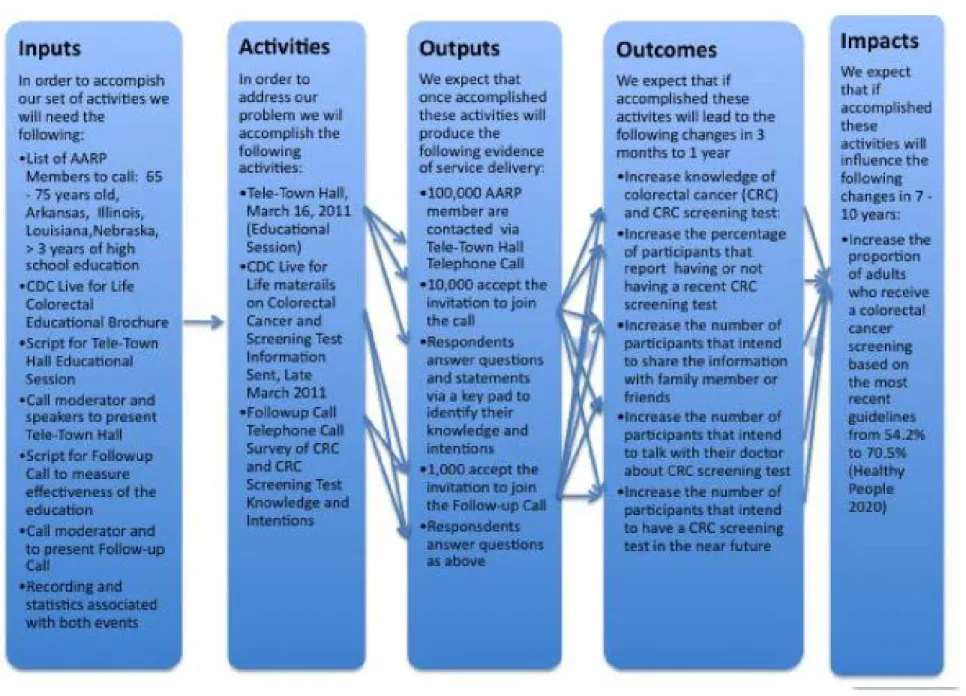
Figure 1: Logic Model 15
Questionnaire – Measuring the Intervention 16
Figure 2: Questionnaires 16
Evaluation 20
Evaluation Design 21
Types of Data Collected 22
Data Collection 23
Data Analysis 23
Reporting 24
Results 25
Abstract
Evaluation of the National Colorectal Cancer Roundtable Tele-Town Hall on Colorectal Cancer Screenings
The National Colorectal Cancer Roundtable with the American Association of Retired
People collaborated on a health intervention program to increase knowledge and intention in
colorectal cancer screening. The program included three educational communication activities
with a target population that included respondents from four states (Arkansas, Illinois, Louisiana,
and Nebraska) whom were 65 – 74 years of age and had less than a college education. This
population was specifically chosen because they have a high rate of colorectal cancer and
specifically have a higher rate of late stage colorectal cancer diagnosis.
The first component of the educational program was a Tele-Town Hall educational telephone
session with a target population of 100,000 and an expected response rate of 10%. A mailing of
educational materials from the Centers for Disease Control and American Cancer Society
followed. And then a Post-Event survey telephone call was placed to the 10,000 respondents to
the Tele-Town Hall. The expected response rate for the Post-Event survey was again 10% or
1,000 participants.
The program will evaluate the knowledge of colorectal cancer and intention for colorectal
screenings in a One-Group Pretest – Posttest Design. This document outlines the program, the
intervention and the evaluation process and does include some preliminary results. Final results
will be reported in June 2011 after all data is received and analyzed on the Tele-Town Hall
4
Evaluation of the National Colorectal Cancer Roundtable Tele-Town Hall on Colorectal Cancer Screenings
Background
Colorectal cancer is the third most common cancer and the third leading cause of death
among men and women in the United States (American Cancer Society). Colorectal cancer
affects men and women in similar proportions. Of the total number of new cancer cases,
colorectal cancer represents 9% (72,090 new cases) of the all cancer diagnosed in men and 10%
(70,040 new cases) in women and similarly 9% (26,580 deaths in males and 24,790 deaths in
females) of the estimated cancer deaths in both men and women (Jemal, Siegel, Xu, Ward,
2010).
In 2010, it was estimated that 142,570 people would be diagnosed and 51,370 people
would die from colorectal cancer (Jemal et al, 2010). Colorectal cancer incidence has declined
by 3.0 % for men and 2.2% for women during the period 1998 – 2006. Mortality has seen similar
declines during the period 2001 - 2006 at 3.9% for men and 3.4% for women (Jemal et al, 2010).
These decreases highlight the benefits that have been realized by increases in colorectal
screening.
The likelihood of being diagnosed with colorectal cancer does vary by race and ethnicity;
the incidence and mortality from colorectal cancer is highest in the African American
community. The incidence of colorectal cancer is 18% higher for African American men and
disparity is even more startling: African American men are 47% and African American women
are 44% more likely than their White counterparts to die from colorectal cancer. The disparity in
mortality rates may be the result of inequalities in access to and the quality of healthcare
treatments, and differences in co-morbid conditions between the two populations. (Jemal et al,
2010).
An objective in Healthy People 2020 is to reduce the number of colorectal death to 14.5
from 17.0 per 100,000 population. The Healthy People 2020 objective for colorectal screening is
to increase the proportion of adults who receive a colorectal cancer screening based on the most
recent guidelines from 54.2 percent to 70.5 percent of adults aged 50 to 75 years. Screening and
detecting colorectal cancer and detecting and removing precancerous colorectal polyps will
reduce the number of deaths (CDC). If colorectal cancer is diagnosed early and treated the
survival rate is 90% (CDC).
The U.S. Preventive Services Task Force recommends screening for colorectal cancer
using fecal occult blood test, flexible sigmoidoscopy or colonoscopy in adults of average risk
beginning at age 50 – 75 years of age. In 2008, the prevalence of colorectal testing in the United
States was 53.2% (Smith, Cokkinides, Brooks, Saslow, Shah, Brawley, 2011). Unfortunately,
less than 40% of the colorectal cancers are found early due to low screening rates (Smith et al,
2011).
In contrast to colorectal screening, 85% of women greater than 40 years of age have had
6
diagnosed at a localized stage with a five-year survival rate of 98% (American Cancer Society,
2010).
Early detection of colorectal cancer results in a better patient prognosis. The survival rate
for colorectal cancers detected when localized is as high as 90% but, as low as 11% if detected
late in the course of the disease (CDC). Therefore, improving the colorectal screening rate also
has the potential to increase the survival rate. By following the colorectal screening guidelines
on both age and timing of tests the number of colorectal cancers detected at an early stage can be
increased.
Screening rates vary by race and ethnicity and socioeconomic status. Among White
Non-Hispanics, 56% have had a colorectal screening test; in the Black Non-Hispanic population the
percentage is 48.9%, Asian American 47.8% and Hispanic 37.2% (CDC). For those with health
insurance the screening rate is 55.7% and for those without insurance it is 19.5%. Screening
rates rise with an increase in years of education. For example, those with less than 11 years of
education have a colorectal screening rate of 37.3%, while a high school graduate will have a
testing rate of 50.8% and those with a college degree are most likely to be tested, at 64.5%
(CDC). After adjusting for demographic characteristics the odds of having a colorectal exam
were lower among respondents who were not married or separated, had an income less than
Barriers to Screening
A recent study highlighted barriers to screening (Shike, Shattner, Ganao, Grant, Burke,
Zauber, Russo and Cuyjet, 2011). The three types of barriers are: inadequate access to
healthcare, lack of a physician recommendation for a screening test, and fear and lack of
knowledge of colorectal cancer and colorectal cancer screening.
Individuals may have inadequate access to healthcare because of the uneven distribution
of healthcare providers (Wang, Luo, 2005), a lack of transportation, and or a lack of medical
insurance. Reducing the barrier to medical care access also has the potential to increase the
colorectal testing rates. Finding resources to cover colorectal cancer screening for patients
without insurance could increase the testing among the uninsured population (Shike et al, 2011).
The colonoscopy is the costliest of the colorectal cancer screening tests. Because the
colonoscopy is so expensive, an individual without medical insurance is unlikely to get that
screening (Shike, et al, 2011).
Lack of insurance, however, does not explain the low usage of colorectal screening
among those age 65 or older that have Medicare coverage for colorectal screening.
Medicare enrollees are less likely to be screened if their physician does not recommend that they
be screened for colorectal cancer (Klabunde, Vernon, Nadel, Breen, Seef, Brown, 2005, p. 939).
Lack of a physician recommendation and not having colorectal cancer symptoms are
reasons that respondents aged 50 and above, cited as the reasons they were not screened for
8
not report ever receiving a doctor’s recommendation for CRC testing. A doctor’s
recommendation is a strong predictor of colorectal cancer testing (Nguyen, Wu, 2009, p 4).
Fear and lack of knowledge of colorectal cancer and colorectal cancer screening is a
barrier that needs focus.
Reducing the Barriers to Colorectal Cancer Screening through Education
Increasing knowledge and reducing fear of colorectal cancer and colorectal cancer
screening have been shown to increase the rate of screening. Knowledge seems to have a
positive impact upon attitudes, which then influences intentions and behavior for colorectal
cancer screening (McCaffery, Wardle, Waller, 2003).
In a 2010 review of colorectal screening trials with multiethnic groups (Marrow, Dallo,
Julka, 2010) it was noted that both mailings and telephone outreach strategies conveyed testing
choices best to participants. It was noted that patient choice was important to improve screening
adherence in studies reporting improved screen rates of intervention in comparison to a control
group. Additionally interventions in underserved communities where the direct benefit from
screening was potentially the highest also had improved screening rates after an educational
program.
In an Australian study, participants were given printed materials and a DVD that
increased the proportion of participants who made an informed choice, from 12% in the control
group to 34% in the decision aid group (Smith, Trevena, Simpson, Barratt, Nutbeam, McCaffery,
2010). In a Midwestern study, participants attended education sessions during which their
beliefs about a healthy lifestyle, colorectal cancer and cancer screening were measured before
and after the sessions. The education sessions did increase awareness among participants about
adhering to colorectal screening guidelines (Cause, Greenwald, 2010).
In a study between 2001 and 2004 in central Massachusetts and northern Connecticut,
participants were mailed an educational piece on colorectal cancer and then three months later
were called with a telephone based counseling script which varied based on the participants
responses to questions about colorectal screening readiness. (Costanza, Luckmann, Stoddard,
White, Stark, Ayrunin, Rosal, Clemow, 2007). Half of those that were counseled through the
telephone counseling session changed their intention from not planning to planning or from
non-compliant to planning to be non-compliant with American Cancer Society guidelines for colorectal
screening.
In summary, educational materials and educational programs on colorectal cancer and
colorectal cancer screening can positively influence the intention to be tested and become
10
The Intervention
The National Colorectal Roundtable (Roundtable), established by the American Cancer
Society and the Centers for Disease Control and Prevention (CDC) in 1997, is a national
coalition of public organizations, private organizations, voluntary organizations, and invited
individuals dedicated to reducing the incidence of and mortality from colorectal cancer in the
U.S., through coordinated leadership, strategic planning, and advocacy. The ultimate goal of the
Roundtable is to increase the use of proven colorectal cancer screening tests among the
population for whom screening is appropriate.
The AARP and the Roundtable co-sponsored an education program, a Tele-Town Hall on
Colorectal Cancer on March 16, 2011. The purpose of the program was to educate participants
about colorectal cancer and increase the intention of colorectal cancer screening among
participants. The program targeted primary AARP account members aged 65-74 years old, with
telephones in four states. The program included an educational mailing including materials from
the Centers for Disease Control and Prevention (CDC), the Screen for Life Basic Facts and the
American Cancer Society brochure, “Get Tested” and an automated telephone call with a public
service announcement (PSA) narrated by Morgan Freeman with an invitation to join a colorectal
cancer educational call. This educational call was followed by an automated telephone
questionnaire approximately three weeks later.
The AARP ran a similar educational program in November 2010 on vaccinations
recommended for individuals 50+ years old. In the vaccination program, they targeted African
November 2010 program, they called 100,000 individuals and of those, 11,709 participated and
stayed on the line an average of 8 minutes. This program served as a model for the colorectal
cancer educational program.
The AARP members that were targeted for the program had to have a phone number, be
between the ages of 65 and 74, have less than 4 years of college education and reside in one of
the following states: Illinois, Nebraska, Arkansas, Louisiana. The Tele-Town Hall planning
committee selected these states because the states have high rates of late-stage colorectal
diagnosis and death, coupled with low colorectal screening rates (<60%) (CDC). There were
over 100,000 AARP members in the initial target population supplied by the AARP.
The key messages for the Tele-Town Hall program were framed around the theme that
colorectal cancer is preventable, beatable and treatable. The key messages were: 1) everyone
over 50 is at risk and needs to be screened, 2) there is an association between polyps, colorectal
cancer and prevention, 3) there are myths about colorectal cancer (i.e. not at risk if no family
history; colonoscopy is painful…) 4) call to action – “Talk to your doctor!”
The education was delivered over the telephone in a format similar to a radio talk show.
Participants listened to the education program and had the ability to respond to question via a
telephone keypad and also had the opportunity to ask questions of the presenters. The
intervention was designed to address selected barriers to colorectal screening including: lack of
knowledge about the screening options and benefits of being screened, distrust, fear of pain,
12
The initial telephone call began with the pre-recorded public service announcement
(PSA) that introduced the topic of colorectal cancer and invited listeners to join the Tele-Town
Hall. The participants in the Tele-Town Hall were called via an automated calling service
beginning at the top of the hour locally and participants were placed into the call once they
accepted the invitation to join the call. Of those 100,000 members, 10,423 of the members
stayed on the phone for an average period of eight (8) minutes to hear an educational message
about colorectal cancer screening during the Tele-Town Hall. An outside vendor prioritized the
calling pattern to reach the maximum number of participants within the initial minutes of the
ongoing Tele-Town Hall.
The call was followed up by a telephone survey about the Tele-Town Hall three weeks
later on April 6, 2011. The survey included numerous questions about content of The
Tele-Town Hall , the materials mailed to respondents and the usefullness of the educational program.
These questions incorporated language from existing Behavioral Risk Factor Surveillance
System (BRFSS) questionnaires, as appropriate. The purpose was to measure the knowledge
and screening intention baseline on the Tele-Town Hall repondents and compare the initial
results to the result of the post-event questionnaire three weeks later. (See Figure 2:
Questionnaires)
The intervention targets the following outcomes: knowledge of colorectal cancer and
colorectal screening tests, the percentage that understand their personal colorectal cancer
screening status, the percentage that understand that a regular cancer screening test is important,
member, the intention to ask their physician about colorectal cancer tests, and the intention to
get a colorectal cancer screening test in the near future. The final outcome is to eventually
achieve the Healthy People 2020 goal of increasing colorectal screening rates from 54.2% to
70.0%. This outcome will require more intervention than just this program. (See Figure 1:
Figure 1: Logic Model
I
n
put
s
ln order to accomptSh our set of activ1tles we
will needttw
followtnc:
•List of AARP
MembOf"S 10 c:.ll: 65 • 75 ye.-s okl,
ArbnsiiS1 Illinois, Louisi~i,Nebraska,
> 3 \'Wil1 of hilh
schooloducotian
oCDC li . . lor lit.
Colooectal
EduClllionollrvchurw
1
- ..
•Scripllorlofo.TDMI HoiiFcfen'lonol -oCIIm 1-. -. -. -. -. -. -. -. -. -. p i _ii l
T .... ._nlllll
oSatptbf I •
Cll•• •
.,
.
.
..
...
. . 7
A
ctivitie
s
In order to
address our
problem we wll
accompl•lh the tollowlnc
ae1.'Mttes: •Tele-Town ~H.
M;m;h 16,2011
(Eduationol
Sesoian) •CDC Livofor
ur....-...
on Calutwctil
C..nco<llnd
-niniTest
lnlarrnolion Sont,loteMaldiZOU
•Fo ... pc.ll 'lilllphl• Clll
surw,afQIC IIIIIQIC
saw•w'r.t
. . I . . . . .I . . .
Outpu
ts
We e>xpect that
once accompUshed
these activities w~l
produce the
following evodence
of SOfVICO dell"""f:
•100,000 AARP member are
contacted via
Tole-Town HoH
Telephone GJII
•10,0110 acc.pt the
invUiion to join tho coli
.. . . QI.nts
·-•quwstluid
Mdatsawnb
'"""""''*'"'
bo" "'•"'*
alL
•ndI t ...,.
Ou
tco
m
es
We expect that rr
accomplished these
actiVJtes wtll Jead to the foUowtng chances in 3
months to 1 ~ar
•Increase knowl.c:tce of
colorecllll Cilnce< (CRC)
oncl CRC scrHninl test:
•tncN.a the percent11• of portlaponb thot
rwport - • or not
hiMncorwc~~ntCRC
Krweninc tftt
•lncrw . . ttw numt.r of
ponidpMts thot intend "' ... tho inl""""lion
wllhfarnlr,...•r•
...
•l n _ t h o _ o l , . . . tlltlool ...
. . . tholr ...
11:aout Clltwwetc 1111t
rb •tlle•' fll
Im
pacts
W.._ct
thot if
~complished
those
O<tivitin will influ«nce the
lollowinc
chanpsin 7 •
10ynrs:
•Increase the
ptOportlon olaclults whorKIMI a"'*»tactll
...,,
...
boselan thommt... lilt
...--
fniiiiM.aIll 'Ill !Ill (It ....
,.
•'
-Questionnaire – Measuring the Intervention
Six questions were asked of participants during the Tele-Town Hall on March 16, 2011
and a maximum of 16 questions were asked in the followup-call on April 6, 2011.
Figure 2: Questionnaires
TELE-Town Hall March 16, 2011 Event Day Questionnaire
•1. Most people should start getting regularly tested for colorectal cancer at age 50? •- True (1)
•- False (2)
•- Not Sure/Do Not Know (3)
•2. Most people should start getting regularly tested for colorectal cancer at age 50? •- True (1)
•- False (2)
•- Not Sure/Do Not Know (3)
•3. Keeping in mind that we are talking about the tests we just discussed -- either a stool test, which is when you use a special kit at home to collect a stool sample to send to a lab to be checked; or a sigmoidoscopy or a colonoscopy, in which a tube is inserted in the rectum to view the colon for signs of cancer or other health problems. Have you ever done a stool test or had the other type of test…a colonoscopy or sigmoidoscopy, where a tube is inserted in the rectum to examine the colon?
•-Yes (1) •- No (2)
•- Not Sure/ Do Not Know (3)
•4. I plan to have a colorectal cancer screening test • -Yes (1)
•- No (2)
•- Not Sure/ Do Not Know (3)
•5. I plan to talk to a family member of friend about why it is important to have a colorectal screening test.
•- Not Sure/ Do Not Know (3)
•6. This type of program cosponsored by the AARP is valuable to me? •- Strongly agree (1)
•- Agree (2) •- Disagree (3)
•- Strongly disagree (4)
END OF SURVEY
Robo-Call Follow-up on April 6, 2011 to the
Colorectal Roundtable and AARP Tele-Town Hall
Introduction:
Good morning. I am calling on behalf of AARP to ask you to take a brief survey using your telephone keypad to get your opinion on the colorectal cancer educational telephone call you participated in a few weeks back. Information collected in this survey is strictly confidential and will be used to strengthen future AARP
educational programs. No one will ever try to sell you something as a result of this survey. Your opinion is extremely important to us.
A. General Value Questions
1. This type of educational call cosponsored by the AARP is valuable to me Yes (1)
No (2)
Not Sure/Do Not Know (3)
B. Colorectal Screening Intention Questions
2. I plan to share the information I received about colorectal cancer testing with friends and family
Yes (1) No (2)
Not Sure/Do Not Know (3)
3. I plan to get regularly tested for colorectal cancer Yes (1)
No (2)
Not Sure/Do Not Know (3)
C. Colorectal Cancer Belief Questions
4. Do you believe that most people should start getting regularly tested for colorectal cancer at age 50?*
Yes (1) No (2)
18
If No on Question please proceed to F. Education Program Utility Questions
5. Do you believe that colorectal cancer can be successfully treated if detected early?
Yes (1) No (2)
Not Sure/Do Not Know (3)
If No on Question please proceed to F. Education Program Utility Questions
6. Do you believe that getting tested regularly for colorectal cancer can help prevent colorectal cancer?
Yes (1) No (2)
Not Sure/Do Not Know (3)
D. FOBT Testing Behavior and Intention
7. This is great feedback! A few more questions. A blood stool test is a test that may use a special kit at home to determine whether the stool contains blood. Have you ever taken a blood stool test at home?
Yes (1) No (2)
Not Sure/Do Not Know (3)
If No to Question 1, please proceed to Question 9,
8. How long has it been since you had your last blood stool test using a home kit? Within the past year (1)
Within the past 2 years (2) 2 or more years ago (3) Not sure/do not know (4)
If “1 – within the past year,” please proceed to F. Education Program Utility Questions
9. Do you plan to talk to your doctor about scheduling a blood stool test within a year?
Yes (1) No (2)
Not Sure/Do Not Know (3)
If Yes, please proceed to F. Education Program Utility Questions
E. Sigmoid or Colonoscopy Behavior and Intention Questions
Yes (1) No (2)
Not Sure/Do Not Know (3)
If Response is No proceed to question 12
11. How long has it been since you had either a sigmoidoscopy or colonscopy? Within the past 10 years (1)
10 or more years ago (2) Not Sure/Do Not Know (3)
If response is “within the past 10 years (1)”, please proceed to F. Educational Program Utility
12. Do you plan to talk to your doctor to schedule either a sigmoidoscopy or colonoscopy in the next year?
Yes (1) No (2)
Not Sure/Do Not Know (3)
F. Educational Program Utility
13. We’re just about done! Just a few more questions to go. Did hearing Morgan Freeman’s voice encourage you to join the colorectal cancer educational call? Yes (1)
No (2)
Not Sure/Do Not Know (3)
14. The presenters on the colorectal cancer educational call were knowledgeable Yes (1)
No (2)
Not Sure/Do Not Know (3)
15. The information provided in the colorectal cancer educational call was useful Yes (1)
No (2)
Not Sure/Do Not Know (3)
16. The colorectal cancer materials received in the mail after the call were useful Yes (1)
No (2)
Not Sure/Do Not Know (3)
Closing: Thank you for completing this telephone survey. This information will be used to strengthen future educational programs.
20
Evaluation
The purpose of the evaluation is to measure the effectiveness of the intervention. In
particular, we want to assess the change in colorectal cancer knowledge, screening intention and
effectiveness of the educational program.
The following steps were taken to develop the evaluation plan. (Please note that the
evaluation is not complete at this time, as the data from the questionnaire will not be received
and analyzed for a full evaluation until after the date that this paper is published.)
a. Developed the goal: increase respondent colorectal cancer knowledge and intention to be
screened for colorectal cancer.
b. Met with stakeholders to determine the questions to be answered:
Representatives from the AARP (Margaret Hawkins), and National Colorectal Cancer
Roundtable, American Cancer Society (Mary Doroshenk and Durado Brooks), and
University of North Carolina Gillings Global School of Public Health (Anna Schenck and
Helen Bristow)
c. Determined the necessary resources: funding, educational materials, educational script,
questionnaire script, moderator, speakers, vendor to facilitate the educational telephone
calls
d. Hired an evaluator: student from University of North Carolina Gillings Global School of
Public Health (Helen Bristow, MPH 2011)
e. Developed the evaluation design and instrument including data collection, analysis and
f. Ensure that the evaluation instruments meet the goals and objectives of the intervention:
requires final data which will be included in Results
g. Developed a timeline for evaluation: agreed to completed evaluation by June 2011.
Evaluation Design
The evaluation design is quasi-experimental, a One-Group Pretest-Posttest Design
(Shadish, Cook, Campbell, 2001). Although this is not a pure pre-test design we will receive
some initial data that will serve as a pretest, the responses received by respondents in the
Tele-Town Hall. We will assess participants knowledge and behavior through pretest questions
embedded in the intervention, offer them the educational program on colorectal cancer and
colorectal cancer screening through the Tele-Town Hall and conduct a follow-up telephone call
as the post-test. The program uses educational materials to increase knowledge and increase
intention for a colorectal screening test within a one year period. We can not control for all the
factor that may influence the validity of the results.
A confounding variable is a potential threat to the evaluation design. This would make it
hard to distinguish between a change that occurred as a result of the progam and a change tha
may have happened because of other factors unrelated to the program. The wording of the
questionnaire may be a threat to the evaluation design. We are assuming that the wording of the
questions will be understood by the target audience but most of the questions have not been
tested outside of a small sample. This could also pose a threat to the evaluation design.
Validity
22
a. Content validity: ensure that the measurement of the results represent content that is
being measured. We will base questions on the Tele-Town Hall content and include
language included in BRFSS surveys about specific colorectal screenings in the
survey to ensure content validity
b. Internal Validity: monitor threats to internal validity that may threaten the results.
We will analyze the questions asked in both the pre and post test and look for
anomalies to ensure internal validity.
c. External Validity: compare and contrast the results to other populations in the United
States and the responses to previous BRFSS surveys.
Types of Data Collected
Data collection includes structured and self- reported data. The background information
on the respondents will be structured and come from existing AARP records and will include
demographic data but will not provide respondent identification. The advantage of the structured
data is that it will come to us formatted and provide a demographic profile of the program
respondents and the cost is very reasonable. The questions as outlined in the questionnaire are
less structured but are close-ended with a specific response choice to choose from and are
self-reported by the respondents. The self-self-reported data may represent some bias as differences in
cognitive ability and understanding between respondents may affect the data. At the time of
followup we only surveyed participants in the Tele-Town Hall, therefore this will be a
Data Collection
The data must be methodically collected to ensure that the goals and objectives of the
intervention can be measured.
a. Decide how and who will collect the information.
i. AARP identified their primary members that meet the predetermined criteria,
mentioned earlier. Respondents are identified by a demographic profile.
ii. A vendor administered the Tele-Town Hall and follow-up call and all responses to
the questionnaires were recorded as the respondents answer via their telephone
keypad.
b. Reviewed initial results to refine the data collection instrument.
Initial results did require the modification of the data collection instrument to ensure that we
could measure the goals and objectives of the intervention.
c. Determined who will be included in the evaluation: all program respondents who heard
portions of the educational session.
d. Conducted the data collection: coordinated by the AARP (Margaret Hawkins).
Data Analysis
The data will be analyzed to examine changes in knowledge and intention about colorectal
24
a. Analysis tool: IBM’s SPSS to analyze the data and use the outcome to populate the
charts shown in Results.
b. Who will perform analysis: the graduate student (Helen Bristow) from the University of
North Carolina Gillings Global School of Public Health will analyze the data.
c. Data Interpretation: data analysis will be shared with the AARP, the National Colorectal
Cancer Roundtable and the University of North Carolina Gillings Global School of
Public Health to aid in interpretation.
Reporting
The reporting will be finalized in approximately June 2011 and will be evaluated and shared
with the stakeholders from analysis through reporting.
a. Who will receive the results: AARP (Margaret Hawkins), National Colorectal Cancer
Roundtable, American Cancer Society (Mary Doroshenk, Durado Brooks), University of
North Carolina Gillings Global School of Public Health (Anna Schenck).
b. Who will report the findings: University of North Carolina Gillings Global School of
Public Health (Anna Schenck and Helen Bristow).
c. Determine how and in what form the results will be reported: Cover letter and Reports
Section.
d. Determine the results relative to the program intervention, goals and objectives: Reports
Section.
Results
There were several key measures that have been and will be collected to provide results
from the educational intervention to increase knowledge of colorectal cancer and intention to
receive a colorectal cancer screening. In particular we measured the number of respondents,
demographic distribution of participants, the participation rate of the target population and the
level of participation measured by time on call and intentions of the participants.
Below are a series of documents and charts that will be used to tabulate the results and
the structure an executive summary that will summarize the evaluation report. The document
and charts will be completed after receipt of the results of the post event survey are received and
analyzed. Final results are expected in June 2011.
We will prepare an executive summary, which is not included below. The executive
summary will provide a brief but thorough overview of the program, method and results. We
will have a chart on the program participation that measures the participation of the target
population against actual participation and the participation in total time spent with the
participants for both the Tele-Town Hall and the Post Event Follow-up. Where possible we will
compare to prior similar programs.
As per the Evaluation Design, the responses to the questions asked during the Tele-Town
Hall are recorded and serve as the pre-test results. This is a measure of the knowledge and
26
during the Post-Event Follow-up, which will serve as the post-test results for this evaluation.
There will be a specific notation about previous response rates recorded in BRFSS surveys in
comparison to the answers received from respondents. The data from BRFSS is available for the
FOBT , Sigmoidoscopy and Colonoscopy knowledge and intention questions.
A demographic distribution of the participants will be compared to the current
distribution of the target population. The Tele-town Hall and Post Event Follow-up participants
will be noted and compared to the target population.
The status and intention of colorectal screening will be recorded for all Tele-Town Hall
and Post-Event Follow-Up participants. This will be specified by colorectal cancer test type.
Finally, we will measure the costs associated with the program. This will include cost
per individual reached, cost per minute and cost to influence an intended colorectal screening.
These components, listed above, will include all of the results that we will be reporting in
1. Participation
The target population is over 100,000 AARP Primary Members and of that target
population we had planned to reach approximately 10,000 of those members with the educational
session. We did reach 10,423. The chart below measures the actual participation in both the
Tele-Town Hall and relates the original target populations to the actual participants.
Tele-Town Hall Target Population Prior AARP Tele-Town Hall November 2010 Tele-Town Hall Population March 16, 2011 Post Event Follow-up Population Target Post Event Follow-up Population April 6, 2011 Targeted
Participants 100,000
100,000
100,000 10,000 10,000
Actual
Participants 10,000
11,709
10,423 1,000
Percentage of Participant Population Reached
10% 11.71% 10.23% 10%
Mean Time on
Call/Participa nt
8 mins 8 mins
Total Time Spent with Participants on Educational Call
28
2. Respondents Answers to Statements and Questions During Tele-Town Hall, March 16, 2011
The questions in the chart below were asked during the Tele-Town Hall; responses were
recorded. The responses highlight some base knowledge about colorectal screening.
Approximately 15% of respondents either did not know or were not sure that colorectal cancer
screening should begin at age 50. At least 11.3% of respondents have not been tested for
colorectal cancer. Sixty and two tenths percent (60.2%) of respondents plan to have a colorectal
cancer screening, the prevalence of colorectal cancer screening in the general population in 2008
was 53.2%. The majority of the respondents plan to tell a friend or family member about
colorectal cancer screening (72%). All respondents thought this type of educational program
from the AARP was valuable.
No Tele-Town Hall Question March 16, 2011
Live Event Respondents
Live Event Respondent
Percentage (%) 1 Most people should start getting regularly tested for
colorectal cancer at age 50.
59
True 51 86.5%
False 5 8.5%
Do Not Know 3 5.0%
2 Most people should start getting regularly tested for colorectal cancer at age 50. (Repeat of the first question, as more participants joined the call)
348
True 280 80.5%
False 21 6.0%
Do Not Know 47 13.5%
3 Keeping in mind that we are talking about the tests we just discussed -- either a stool test, which is when you use a special kit at home to collect a stool
sample to send to a lab to be checked; or a
sigmoidoscopy or a colonoscopy, in which a tube is inserted in the rectum to view the colon for signs of cancer or other health problems. Have you ever done
a stool test or had the other type of test…a colonoscopy or sigmoidoscopy, where a tube is inserted in the rectum to examine the colon?
Yes 168 82.8%
No 23 11.3%
Do Not Know 12 5.9%
4 I plan to have a colorectal cancer screening test. 118
Yes 71 60.2%
No 18 15.2%
Not Sure 29 24.6%
5 I plan to talk to a family member of friend about why it is important to have a colorectal screening test.
100
Yes 72 72%
No 7 7%
Not Sure 21 21%
6 This type of program co-sponsored by AARP is
valuable to me. 113
Strongly Agree 93 82.3%
Agree 20 17.7%
Disagree 0 0%
30
3. Respondents Answers to Statements and Questions During the Post Event Follow-up, April 6, 2011
No Post Event Follow-up April 6, 2011
Live Event Respondents Live Event Respondent Percentage (%) BRFSS Survey Respondent (%) General Value Questions
1 This type of educational call
cosponsored by the AARP is valuable to me
Yes No
Not Sure/Do Not Know Colorectal Screening Intention Questions
2 I plan to share the information I
received about colorectal cancer testing with friends and family
Yes No
Not Sure/Do Not Know 3 I plan to get a regular colorectal
screening test for colorectal cancer Yes
No
Not Sure/Do Not Know
Colorectal Cancer Belief Questions 4 Do you believe that most people should
start getting regularly tested for colorectal cancer at age 50? Yes
No
Not Sure/Do Not Know
5 Do you believe that colorectal cancer can be successfully treated if detected early?
Yes No
Not Sure/Do Not Know
6 Do you believe that getting tested regularly for colorectal cancer can help prevent colorectal cancer?
Not Sure/Do Not Know
FOBT Testing Behavior and Intention Questions
7 A blood stool test is a test that may use a special kit at home to determine whether the stool contains blood. Have you ever taken a blood stool test at home?
Yes No
Not Sure/Do Not Know
8 How long has it been since you had your last blood stool test using a home kit?
Within the past year Within the past 2 years 2 or more years ago Not Sure/ Do Not Know
9 Do you plan to talk to your doctor about scheduling a blood stool test within a year?
Yes No
Not Sure/Do Not Know
Sigmoid or Colonoscopy Behavior and Intention Questions
10 Sigmoidoscopy and colonoscopy tests examine the colon using a narrow, lighted tube that is inserted in the rectum. Have you ever had either a sigmoidoscopy or colonoscopy tests? Yes
No
Not Sure/Do Not Know
11 How long has it been since you had either a sigmoidoscopy or colonoscopy? Within the past 10 years
10 or more years ago Not Sure/Do Not Know
12 Do you plan to talk to your doctor to schedule either a sigmoidoscopy or colonoscopy in the next year? Yes
No
32
Educational Program Utility Questions 13 Did hearing Morgan Freeman
encouraged you to join the colorectal cancer educational call
Yes No
Not Sure/Do Not Know
14 The presenters on the colorectal cancer educational call were knowledgeable Yes
No
Not Sure/Do Not Know 15 The information provided in the
colorectal cancer educational call was useful
Yes No
Not Sure/Do Not Know
16 The colorectal cancer materials received in the mail after the call were useful Yes
No
4. Demographic Distribution of Participants
The participants will be AARP Primary Members in the 64 – 74 year range from four
states: Arkansas, Illinois, Nebraska and Louisiana. The chart below will measure the
demographic distribution of the participants for the Tele-Town Hall and the Post Event
Follow-up Call. Regional Population (as noted) (%) Tele-Town Hall Pop. n =10,423 Tele-Town Hall Pop. (%) Post Event Follow-up Pop. n = Post Event Follow-up Pop. (%)
Aggregate Response 10,423
Age Mean
Age group 65 – 74 yr.
State
Arkansasa 14.48%
Illinoisa 56.40%
Louisianaa 20.66%
Nebraskaa 8.45%
Sex
Malet 43.12%
Femalet 56.88%
Race/Ethnicity
White 80.2%
African American 12.8% Hispanic/Latino N/A Income
<$30,000 / yearl 10.1% >$30,000/ yearl 89.9% Education
Some High Schoolt
11.0%
High Schoolt 36.5%
Some Colleget 20.2%
Colleget 21.2%
a
data are for citizens from these four states, age 65 – 75 years old, US Census Bureau
l
Infoplease , age 65+ website site retrieved http://www.infoplease.com/ipa/A0764222.html
t
34
5. Colorectal Screening Test Question Response
The Tele-Town Hall and Post Event-Follow-up have a number of questions and the chart
below measures the participation by event subcategory.
Tele-Town Hall Participati
on
Tele-Town Hall Participatio
n%
Post Event Follow-up
Post Event Follow-up
%
Total Population Reached
Population Who Has Been Screened For CRC
FOBT
Sigmoidoscopy/Colonoscopy Unsure
Population Who Has Not Been Screened For CRC
Population That Intends to Be Screened for CRC
8. Program Costs
The charts below were designed to measure the costs of the Tele-Town Hall and the
Post-Event Follow-up. The key categories are cost per individual reached, and the cost per intended
colorectal screening.
Tele-Town Hall Live Event Post Event
Follow-up
Total Event
Event Cost ($) $ $ $
Total Population Reached 10,423
Cost/Individual Reached
($/Individual) $ $ $
Total Minutes Spent Per Individual
on the Telephone 8
Program Cost/Minute
Population That Intends to Be Screened for colorectal cancer or Intends to Ask Their Doctor About colorectal cancer Screening
(Screening Influenced)
72
36
Tele-Town Hall on Colorectal Cancer Screening with the National Colorectal Cancer Roundtable and AARP
Facilitated by Margaret Hawkins, AARP
Guest Speakers – Alan Thorson, MD, Past President American Cancer Society and Bob Brady, Colorectal cancer survivor
Wednesday, March 16th, 2011 11am – 12am Eastern Time
Margaret Hawkins, Moderator
Welcome/Overview
11:00 am
Good morning and welcome to AARP’s tele-town hall meeting on colorectal cancer screening, a joint project of the National Colorectal Cancer Roundtable and AARP.
My name is Margaret Hawkins, I am the Manager of Health Promotion at AARP, and I will be your host today. Thank you for joining us to learn more about colorectal cancer and the tests that can save your life.
We at AARP know that staying healthy is important to you, our members. In a recent national poll, of all the issues or concerns that were expressed by people 50 or older – it rated the #2 concern of our members. And it makes sense.
We are living longer and will potentially have a longer retirement - and if we are fortunate we may have more time to travel, spend time with children and
grandchildren and pursue new experiences.
And, as more of us live longer lives, the prospect of being slowed down by illness or skyrocketing healthcare costs provides an additional incentive to do everything we can to stay healthy for as long as we can. And there are steps you can take to protect your health.
Colorectal cancer -- sometimes called ‘colon cancer’ for short -- is the second leading cancer killer among Americans over 50 and it affects men and women equally. The risk for colon cancer increases with age. But after hearing from today’s speakers you will understand why experts say that colon cancer is preventable, treatable, and beatable and you’ll know what you can do to prevent colon cancer.
Today, we will talk about who is most likely to get colon cancer (including everyone who received this phone call today).
We will talk about the important tests that everyone should have that can help prevent this disease or find it early.
38
And we will hear first-hand from a colon cancer survivor about these lifesaving tests.
You will also have the chance to ask questions of our speakers.
Now let’s get started.
I am very pleased that joining me on this call is Dr. Alan Thorson, immediate past president of the American Cancer Society and, a leading expert on colorectal cancer who is based in Nebraska. Also on the call today is Bob Brady, a colon cancer survivor from Illinois who was diagnosed with colon cancer after a routine colonoscopy at aged 60.
If you have a question for our speakers, please press *3 (star 3) on your telephone keypad to be connected with an AARP staff member who will note your name and question.
Before we talk with our guests, and while more people are joining the call, I have a question for each of you and you can use your telephone keypad to respond. This question will help us with our conversation this morning.
Poll Question #1 – It’s about Colon cancer testing
We first want to know more about your understanding of colon cancer testing, so we’ll start off with a short quiz.
True or False: Most people should start getting regularly tested for colon cancer at age 50.
1 – Please press one on your telephone keypad for true.
2 – Please press two for false.
3 – Please press three if you don’t know or are not sure.
Again, True or False: Most people should start getting tested for colon cancer at age 50.
1 – Press one on your telephone keypad for true.
2 – Press two for false.
3 – Press three if you don’t know or are not sure.
If you just joined us, we are talking about colorectal cancerthis morning with Dr Alan Thorson, a leading expert on this cancer, and Bob Brady who brings his experience as a colon cancer survivor to this conversation.
Again, if you have a question for our speakers, please press *3 (star 3) on your telephone keypad to be connected with an AARP staff member.
11:05
Good morning Dr. Thorson. Thank you for joining us this morning. We have hundreds of AARP members on the line, eager to listen to you.
Dr. Thorson - what is the most important thing you’d like to share with us about colon cancer?
Dr. Thorson
The most important thing that I want to get across to everyone on the line today is that everyone who is age 50 or older should get a screening test for colorectal cancer.
And that’s because colon cancer can be PREVENTED or caught early through the use of screening tests that are available to everyone on the line right now.
Your risk for colon cancer increases, as you get older. Most colorectal cancers occur in people who are 50 or older.
Both men and women and people of all racial and ethnic groups are at risk for developing this cancer.
So it is very important that everyone who is age 50 or older gets tested. If your doctor hasn’t talked to you about getting tested, you need to tell your
doctor that you want to be tested, and talk about which screening test is right for you.
And you should know that colorectal cancer doesn’t always cause symptoms, especially early on – so don’t wait for symptoms to get checked.
Margaret
So Doctor Thorson, to be very clear – all of us, when we reach age 50, need to start getting tested for colon cancer. Men, women, - whatever ethnicity. And if our doctor hasn’t talked to us about it, we should bring it up, and find out which test to take.
Dr Thorson
That’s correct Margaret
Margaret
It’s hard to believe that a test can help prevent cancer. How is this possible?
40
This is possible because most colon cancers don’t start off as cancer. They begin as a POLYP, which is a small growth in the lining of the colon. Over a number of years, this polyp can grow and turn into cancer. Many of the tests that we use to look for colon cancer can find these polyps, and by taking the polyps out we can prevent cancer from occurring. As the number of people who have been tested for colorectal cancer has increased during the last decade, more people have had polyps removed, and as a result, we have seen the number of cases of colon cancer start to go down.
Margaret
That’s good news for our listeners that although the risk for colon cancer increases as we age, there is definitely something we can do about it.
And if you just joined us then welcome to AARP’s phone discussion on colorectal cancer screening, a joint project of the National Colorectal Cancer Roundtable and AARP. My name is Margaret Hawkins, your host today. Thank you for joining us to learn more about colorectal cancer and the tests that can save your life. We’ve been talking with Dr Alan Thorson, an expert on colorectal cancer and stay on the line because later we’ll be hearing from Bob Brady, a colon cancer survivor.
To our listeners out there: you have the opportunity at anytime to ask a question of our speakers, please press *3 (star 3) on your telephone keypad to be connected with an AARP staff member who will note your question. We’ll be taking your questions later in the call, so stay with us.
Dr THORSON, what can you tell our listeners about colon cancer screening tests?
Dr Thorson
There are different types of tests to detect the beginnings of colon cancer, and people can discuss with their doctor the right test for them.
One option is a test that checks for blood in your stool. Because many polyps or cancers bleed very slowly, blood can be detected in our stool or bowel movements, even though we don’t see it.
You are given a kit that you use at home to collect one or more stool samples from the toilet, and put them on a card that you send back to the doctor or a lab to be checked.
If you decide to be screened with that type of test – you would need to do that test every year.
Margaret:
Being able to do a test at home I’m sure appeals to many people. And the other test options?
Another testing option requires the insertion of a lighted flexible tube into your rectum and colon, with the doctor looking in and removing any polyps seen.
One of these scopes looks at the whole colon, so you need to take laxatives to purge the colon so the doctor can get a good look. It’s called a colonoscopy. The laxatives will cause you to spend a lot of time in the bathroom on the evening before the test; the good news is that you only have to do this every 10 years if no significant polyps are found.
Typically you are given IV medication to relax and you must have someone else drive you home. Most people actually sleep through the test.
If a polyp is found, it can be removed right then and there, which is how colon cancer can be prevented with this test.
If the doctor doesn’t find anything and you aren’t at high risk– you don’t need to have another Colonoscopy test for 10 years.
Margaret
I understand that taking the laxative is really important to make sure the colon is really clean so the doctor can see clearly if they’re any polyps. But again the good thing is if nothing is found you don’t need to have a colonoscopy until another 10 years.
Dr Thorson
That’s right Margaret
The other tube that can be used is called a sigmoidoscope. It doesn’t go as far into the colon, so needs to be done every 5 years, but you only need to do an enema to clean out that part of the colon.
11:12
Margaret:
It’s good that people have so many options for a colorectal cancer-screening test. If you are just joining us, welcome to AARP’s phone discussion on colorectal cancer screening. Thank you all for joining us today. As we’ve just heard from Dr Thorson, our colon cancer expert, that colon cancer is preventable, treatable and beatable. And to summarize Dr Thorson – there are a number of screening test choices for people to choose for regular colorectal cancer screening when they turn 50.
42
To our listeners out there, before we talk further with our guests, I have a question for each of you and you can use your telephone keypad to respond. This question will help us with our conversation this morning.
Poll Question #2 – we’re going to repeat a poll we had earlier since we have so many more people that have joined our call this morning. It’s about Colon cancer testing
We want to know more about you and your understanding of colon cancer testing, so here’s a short quiz.
True or False: Most people should start getting regularly tested for colon cancer at age 50.
1 – Please press one on your telephone keypad for true.
2 – Please press two for false.
3 – Please press three if you don’t know or are not sure.
Again, True or False: Most people should start getting regularly tested for colon cancer at age 50.
1 – Press one on your telephone keypad for true.
2 – Press two for false.
3 – Press three if you don’t know or are not sure.
Thanks for taking our poll.
11:13 Margaret
Dr Thorson, back to the screening tests. Are these tests expensive?
Dr. Thorson
Fortunately, for most people with Medicare, costs for colon cancer testing are less of a concern than they might have been in the past. Colorectal screening has been clearly shown to save lives, and recent changes in Medicare make it even easier for people to get tested.
This means that most of the people in the audience, who are Medicare beneficiaries, right now can get tested and not have to pay a dime of their own money.
Now, our listeners should be aware that if the doctor finds a polyp during a colonoscopy, they may have to pay a co-pay, but I hope that will not deter our audience, because this test is so important.
Margaret
That’s really good news – and I hope that encourages our listeners even more to get tested.
If you just joined us, we are talking about colon cancerthis morning with Dr
Thorson, a leading expert on colon cancer, and Bob Brady who brings his experience as a colon cancer survivor to this conversation.
Colorectal cancer – sometimes called “colon cancer” for short – is the second leading cancer killer among Americans over 50 and it affects men and women equally. The risk of colon cancer increases with age. But after hearing from today’s guests you will understand why experts say that colon cancer is preventable, treatable and beatable; and you’ll know what to do to prevent colon cancer.
We’ll be taking your questions later in the call so if you have a question for our speakers, please press *3 (star 3) on your telephone keypad to be connected with an AARP staff member.
Dr. Thorson, What if you have a test done and it turns out you already have cancer?
Dr. Thorson
I’m glad you asked that question. Many people think of cancer as an automatic death sentence. In fact, colon cancer is highly treatable, and the sooner you find it, the better it responds to treatment.
Among people who have colon cancer found in the earliest stage, over 90% of those people have excellent survival rates. And people who are screened for colon cancer regularly are more likely to be able to prevent colon cancer altogether, or have their cancer found at this earlier, more treatable stage.
Margaret
And that Dr Thorson makes a perfect introduction to our next guest, but before I introduce him let me just say:
44
If you have a question for our speakers, please press *3 (star 3) on your telephone keypad to be connected with an AARP staff member who will note your name and question and put you in the queue.
11:16
Margaret
Bob, you have a compelling story about your experience with colon cancer. Could you share with our listeners how your cancer was found?
Bob
I got my first colonoscopy in 1999 at the age of 55. I’d been reading about the test and knew I should have it done. Katie Couric impact. I chose to have a colonoscopy and it turned out that the doctor saw several polyps and those were removed.
Because the doctor found some pre-cancerous polyps, they told me to come back for regular colonoscopies.
During my 5th colonoscopy a polyp looked suspicious. The doctor biopsied it – turned out the polyp was cancerous.
Margaret
That must have been a scary experience. Before we go back to you Bob to find out what happened let me remind our listeners that if you have a question for Bob or for Dr Thorson then press star 3 on your phone pad and you’ll be connected to an AARP staff member who will note your name and question.
Bob, tell us a little more
Bob
When I found out the polyp was cancerous I found a surgeon who examined me. And then set me up for treatment including surgery in 2005. Fortunately, my cancer was still very early in the development of the disease.
I first had radiation for 10 days and then surgery – an ileostomy – for 2 months - temporary
A year after surgery I had another colonoscopy
And in December of last year – after I had been cancer free for five years -- the docs pronounced me cured
Bob, that’s very good news – congratulations. And thank you for being so open about your experience. Dr Thorson I’m sure you’d like to share a comment.
Dr Thorson
Comments – …
Margaret
Bob, what made you agree to share your story today?
Bob
I share my story because I want to encourage everyone to be tested – not just for themselves, but also for their families
I’ve been around for trips and family events and my lovely wife – I don’t think I would have been able to enjoy any of that if I had not gotten a screening test for colorectal cancer. I truly believe these tests saved my life.
I think each of us has a responsibility to our families to take care of ourselves, and a part of that is getting a screening test for colorectal cancer.
Early detection was the key for me.
There’s very good information out there about the need for these tests, and I hope people take it personally
I recently influenced a good friend to get tested – he had a precancerous polyp removed, so a cancer was prevented. I hope more people will talk to their doctors about getting screened.
Margaret
Bob, two things. First, you are a wonderful ambassador for this cancer screening – and we couldn’t ask for a better person to encourage our listeners today to get screened. As we’ve heard throughout our call - everyone should start getting regularly screened for colorectal cancer at 50. And second you said there was good information out there, so I wanted to let our listeners know that everyone on the call today will be getting a packet of material that gives more in depth information about the risks of colon cancer and the screening tests for colorectal cancer.
And this leads me to another poll of our listeners.
You can use your telephone keypad to respond.
11:20
Poll Question #3 – Have you been tested for colorectal cancer?
46
of cancer or other health problems. Have you ever done a stool test or had the other type of test…a colonoscopy or sigmoidoscopy, where a tube is inserted in the rectum to examine the colon?
1 – Please press one on your telephone keypad for yes.
2 – Please press two –for no
3 – Please press three if you are not sure.
Margaret
Summarize poll findings
Dr Thorson, can you comment on this
Dr Thorson:
First, I’d like to thank Bob for joining us and sharing his story. Bob makes the important point that while testing can prevent some cancers it won’t prevent all of them. None of our cancer tests are perfect and that is one reason that they need to be repeated at regular intervals. But even if cancer is found by testing, if it’s found early most people will do very well with treatment – like Bob, whom I congratulate at his wonderful cancer free milestone.
I think Bob’s story makes it worth repeating what I said at the start of this call:
The most important thing that I want to get across to everyone on the line today is that everyone who is age 50 or older should get a screening test for colorectal cancer.
And that’s because colon cancer can be PREVENTED or caught early through the use of screening tests that are available to everyone on the line right now.
Your risk for colon cancer increases, as you get older. Most colorectal cancers occur in people who are 50 or older.
Both men and women and people of all racial and ethnic groups are at risk for developing this cancer.
So it is very important that everyone who is age 50 or older gets screened. If your doctor hasn’t talked to you about getting tested, you need to tell your
doctor that you want to be tested, and talk about which screening test is right for you.
Margaret
If you just joined us, we are talking about colorectal cancerthis morning with Dr Alan Thorson, a leading expert on this cancer, and Bob Brady who brings his
experience as a colon cancer survivor to this conversation. I am Margaret Hawkins with AARP – your host today.
To our listeners out there: you have the opportunity at anytime to ask a question of our speakers, please press *3 (star 3) on your telephone keypad to be connected with an AARP staff member who will note your name and question and add you to the queue.
Dr. Thorson. Again, thank you for joining us this morning.
What if you believe you don’t have any risk for colon cancer? For instance, if no one in your family has had the disease do you need to be concerned?
Dr. Thorson
Most people who get colon cancer DO NOT have a family history of the disease. The biggest single risk factor for getting colon cancer is being over the age of 50, so everyone who is 50 or older should get tested regularly. If someone in your family did have colon cancer, or even if they had colon
polyps, you need to talk to your doctor to find out if you or your children need to start getting tested at an even younger age. Depending on the family history some people may start testing in their 40s or even earlier or they may need to be checked more often than other people who are considered to be at ‘average’ risk.
Margaret
I’ve heard that exercise lowers the risk of colon cancer – is that right?
Dr Thorson
Indeed, there are also some other things that can increase your chance of getting colon cancer. Smoking increases your risk, as does being overweight. Exercise lowers your risk. Race is another factor; African Americans, Native Americans and Alaska Natives have higher rates of colon cancer than other groups. Some medical conditions, like Crohn’s Disease and diabetes also increase your risk. If you have any of these apply to you, make sure to talk to your doctor.
48
11:24 Margaret
And now, let’s take some questions (3 questions).
We have _________ on the line from ________, with a question. What’s your question? (Repeat)
11:30 or later depending on # of questions from audience
Margaret
I have two questions for our audience. The first is a yes, no, or not sure response:
POLL QUESTION #4 – I plan to have a colorectal cancer-screening test
1 – Please press one on your telephone keypad for “yes”.
2 – Please two for “no”
3 – Press 3 on your telephone keypad for “not sure”
The question for you listeners is:
I plan to have a colorectal cancer screening test
Press 1 on your telephone key pad for yes Press 2 on your telephone key pad for no
And press 3 on your telephone key pad for not sure
Our second question is
Poll #5: I plan to talk to a family member or friend about why it is important to have a colorectal screening test.
1 – Please press one on your telephone keypad for “yes”.
2 – Please two for “no”
3 – Press 3 on your telephone keypad for “not sure”
Press 1 on your telephone key pad for yes Press 2 on your telephone key pad for no
And press 3 on your telephone key pad for not sure
Dr Thorson – given your years of experience and work in this field and Bob your personal experience – what can you tell our listeners who are hesitant to get a screen?
Dr Thorson
Comments
Bob Brady
Comments
Margaret
Go to more questions if time
11:55 Margaret
We’re out of time so before we close any closing thoughts Dr Thorson
Dr Thorson
Brief closing comments
Margaret
And from you Bob?
Bob
Brief closing comments
Margaret
Dr Thorson, and Bob Brady, thanks you so much for joining us today. Knowledge is power when it comes to putting this information to use so we can all live our best lives. I wish we had time to take more questions, and I apologize if we didn’t get to your question.
We have one final poll for our audience:
POLL QUESTION #6 – This type of program co-sponsored by AARP is valuable to me
50
2 – Please two for “agree”
3 – Press 3 on your telephone keypad for “disagree”
4 – Press 4 on your telephone keypad if you “strongly disagree” Repeat
Thank you to our listening audience for joining us this morning and learning about colorectal cancer testing.
We will be sending a free packet of information about colon cancer screening to you all.
This tele town hall was sponsored by the National Colorectal Cancer Roundtable and AARP.