Acute Postoperative Pain in Patients Undergoing
Video-Assisted Thoracoscopic Lobectomy
By
Jacob Wang
A Master’s Paper submitted to the faculty of
the University of North Carolina at Chapel Hill
in partial fulfillment of the requirements for
the degree of Master of Public Health in
the Public Health Leadership Program
Chapel Hill
2013
Advisor
Date
Second Reader
Table of Contents
Abstract... 2
Predictors of Acute Post-operative Pain Following Video-Assisted Thoracoscopic Surgery: A Systematic Review ... 4
Abstract ... 4
Introduction ... 6
Methods ... 7
Results ... 9
Conclusions ...11
References ...14
Tables and Figures ...19
Substantial Postoperative Pain is Common Among Patients Undergoing Video-Assisted Thoracoscopic Lobectomy ...24
Abstract ...24
Introduction ...25
Methods ...26
Results ...27
Discussion ...30
References ...33
Tables and Figures ...37
Abstract
Background: Lobectomy via video-assisted thoracoscopic surgery (VATS) is becoming more
widespread. However, to my knowledge, the postoperative pain experience of patients
undergoing VATS lobectomy has never been described using methods that retain individual
level data. In this paper, I assessed the acute postoperative pain experience of patients
undergoing VATS lobectomy.
Methods: A systematic review of the literature was conducted to describe the acute
postoperative pain experience of patients undergoing VATS lobectomy and to identify any
known clinical or demographic characteristics that may predict this pain. Following this literature
search, a retrospective chart review was performed for all adult patients who underwent VATS
lobectomy at UNC Hospitals, a large academic center from 2003 to 2012. Demographic, clinical
characteristics, and self-reported pain scores (0-10 numeric rating scale) during hospitalization
were abstracted from the medical record. Pain scores ≥4 were classified as moderate or severe,
and substantial pain was defined as ≥60% of pain ratings in the moderate or severe range
during a particular time period. Pain outcomes were summarized using descriptive statistics and
secondary analyses assessed the predictors of substantial postoperative pain.
Results: Eight studies were identified in the systematic review. These studies found that
patients experienced mild, moderate, and severe postoperative pain, but none found reliable
predictors of postoperative pain and none described pain experiences using individual level
data. The chart review found ninety-three patients who underwent VATS lobectomy during the
study period and had pain scores available for review in their medical records. One in two
patients experienced substantial postoperative pain on the day of surgery, two in five had
substantial postoperative pain the following day, and one in four had substantial postoperative
pain for the overall hospitalization. Commonly available clinical and demographic characteristics
Conclusion: These preliminary data suggest that substantial postoperative pain is common in
patients undergoing VATS lobectomy. More studies of postoperative pain outcomes in VATS
Predictors of Acute Post-operative Pain Following Video-Assisted Thoracoscopic
Surgery: A Systematic Review
ABSTRACT
Context: Video-assisted thoracoscopic surgery (VATS) lobectomy has become more common
in recent years, but the postoperative pain experience has not been characterized well.
Objective: To describe the acute postoperative pain experience of patients undergoing VATS
lobectomy and to identify any clinical or demographic characteristics that may predict this pain.
Data Sources: A systematic review of English articles using MEDLINE. Search terms included:
postoperative; pain; thoracoscopic; surgery; lobectomy. The following MeSH terms were also
included: pain, postoperative; thoracoscopy; thoracic surgery, video-assisted; pneumonectomy.
Study Selection: Only studies that included data describing acute postoperative pain following
VATS lobectomy in adult patients, published between 1/1/1990 and 12/31/2012 were included.
Results: Eight studies were identified. Four studies found that patients undergoing VATS
lobectomy experienced mild pain (<40% of the pain scale used) in the acute postoperative
period. Three studies found that patients experienced moderate pain (40-70% of the pain scale
used), and one study found that 7% of patients experienced severe pain, defined as inability to
ambulate in the early postoperative period. The presence of a chest tube, movement, sensory
level location of a chest tube incongruous with sensory level of epidural analgesia, and
displacement of epidural analgesia were qualitatively reported to be associated with increased
pain by different studies. One study reported that levels of serum interleukin-10 (IL-10) were
positively associated with pain and pulmonary function measures (FVC, VC, and FEV1) were
negatively associated with pain. IL-10 was weakly associated with pain (r =0.25, p<0.001) while
pulmonary function was moderately associated with pain (r = -0.51, p=0.02 for FEV1).
Conclusions: Patients experience only mild to moderate pain in the acute postoperative period
the pain experience using individual level data and to identify clinical and demographic
INTRODUCTION
The identification of pulmonary nodules found on imaging often requires tissue sampling for
pathologic analysis. While wedge resection may be sufficient for initial diagnosis, lobectomy
may be required to ensure disease-free margins in cases of malignancy. Traditionally,
lobectomy has been performed through an open approach via an anterior or posterolateral
thoracotomy. However, lobectomy via video-assisted thoracoscopic surgery (VATS) results in
better tolerance by elderly patients and patients with poor performance status,1,2 shorter length
of hospital stay and lower care costs,3-5 improved pulmonary function,6,7 improved tolerance of
adjuvant chemotherapy,8,9 and reduced postoperative pain.4,9 Although the majority of
lobectomies are still performed as open procedures, the VATS approach is becoming more
widespread.10
Animal and human studies examining pain in response to a variety of environmental exposures,
including relatively minor exposures, have consistently demonstrated that individual pain
experiences are highly variable.11-13 This marked individual variation in pain sensitivity is
believed to be due to genetic,14,15 sociocultural,16,17 psychologic,18 and cognitive factors.19
Although reduced postoperative pain is one of the major benefits ascribed to lobectomy via
VATS, the pain experience of patients may vary widely, and the literature shows that a large
portion of patients undergoing minimally invasive surgery still experience substantial pain in the
acute postoperative period.20 Identifying clinical and demographic characteristics that predict
substantial postoperative pain in patients undergoing VATS lobectomy may help target pain
management strategies and improve patient comfort. Therefore, the goal of this systematic
review is to examine the literature to describe acute postoperative pain following VATS and to
METHODS
Eligibility Criteria
All studies that included measurement of pain in the examination of outcomes in the immediate
post-operative period following VATS lobectomy were eligible for inclusion. Only
English-language studies were included. The publication date was restricted to 1/1/1990 to 12/31/2012
because the first reported use of VATS was published in 1991.21(VATS special methods paper)
Only studies examining adult participants of at least 19 years old were included. Studies
examining outcomes beyond the immediate postoperative period were excluded unless they
also collected data on pain in the immediate postoperative period. The immediate postoperative
period was defined as the time between surgery and discharge from the hospital. The primary
outcome of interest was patient pain, and only studies that measured pain on a quantitative
scale were included in this review.
Study Selection
Studies were identified by searching MEDLINE and scanning article reference lists. The
following search terms were used: postoperative; pain; thoracoscopic; surgery; lobectomy. The
search string allowed results matching the general terms within the abstract text or matching of
MeSH terms where applicable (pain, postoperative; thoracoscopy; thoracic surgery,
video-assisted; pneumonectomy). Filters for ages 19 and older, publication date between 1/1/1990
and 12/31/2012, and English language articles were applied.
Screening of the initial set of studies was performed by the author. Initial assessment comprised
of reading the titles and MEDLINE abstracts. A separate title level exclusion was not performed.
Articles at this stage were excluded if they were conducted in a pediatric population, did not
mention collection of acute postoperative pain data, examined modified thoracotomy or robotic
performed by reviewing the full manuscripts of the remaining studies. Papers were included for
this review if they reported any data describing the acute postoperative pain experience of
patients undergoing VATS lobectomy or related at least one clinical or demographic
characteristic to postoperative pain.
Abstraction
Information was collected from each individual study on: (1) characteristics of study participants
and the study’s inclusion and exclusion criteria; (2) goal of study (comparing VATS to
thoracotomy, descriptive study on VATS patients only); (3) type of pain measure (including
visual analogue scale, numeric rating scale, dose of opioids required); (4) results with regards to
the acute postoperative pain experience (including proportion of patients experiencing moderate
or severe postoperative pain and factors that were associated with greater postoperative pain).
Moderate or severe post-operative pain was defined as mean or median pain scores ≥40% of
the maximum in the pain scoring scale used, consistent with other studies describing acute
postoperative pain following minimally invasive surgery.22 Pain data was extracted for the first
three postoperative days, including the day of surgery.
Quality Ratings
The studies included in this review were graded for internal and external validity by the author. A
quality rating of “good” required the study to be well-designed and well-conducted in a
representative population, with no more than mild risk of selection bias, measurement bias, or
confounding. A study was rated “fair” if evidence was sufficient to determine effects on acute
postoperative pain, but the strength of evidence was limited by moderate risk of selection bias,
measurement bias, confounding, or indirect nature of the evidence. “Poor” studies were ones
where the evidence was insufficient to assess the effects on acute postoperative pain because
RESULTS
Study Selection
A total of 9 studies were identified for inclusion in the review. The search of MEDLINE and
article references provided 50 unique citations, of which 31 studies were excluded after
reviewing the abstracts. Two papers examined a pediatric sample, 15 abstracts did not mention
the collection of acute postoperative pain data, 6 studies were concerned with modified
thoracotomy or robotic thoracoscopic surgery techniques, 4 papers focused on pulmonary
tissue excision procedures other than lobectomy, and 4 abstracts were for individual case
studies. Of the 19 remaining studies, 11 were excluded from this review after reading the full
manuscripts because they did not include analysis of the acute postoperative pain experience of
patients undergoing VATS lobectomy. A review of the titles in the citations of the identified
articles did not result in any new, relevant studies. A summary of the study selection may be
found in the flow diagram presented in Figure 1.
Study Characteristics
Three of the studies selected for review were retrospective chart reviews without a comparison
group, one was a retrospective case control study, one was a retrospective cohort study, two
were prospective cohort studies, and one was a randomized clinical trial (Table 1). The study
objectives varied widely, from comparing various outcomes in patients undergoing lobectomy
via VATS and thoracotomy, to describing the experience of patients using varying intraoperative
and postoperative treatment strategies in patients undergoing VATS lobectomy. Six of the
studies were conducted in Asian populations (Korean and Japanese) while the other two studies
took place in European populations (French and Danish). The participants across the studies
tended to be older (>60 years old) and were fairly evenly distributed across genders. Other
Postoperative pain was the primary outcome of interest in three of the studies included for
review. However, the pain measures recorded and the intervals pain was measured at were
inconsistent between studies. All pain measures reported through the first three postoperative
days, including day of surgery, were extracted (Table 2). Any factors that were found to be
associated with pain were also reported, but this information was only available for three
studies, only one of which reported the association quantitatively. One study measured
postoperative pain using ability to ambulate as a categorical variable while the others used
some combination of NRS (numeric rating scale), VAS (visual analogue scale), and analgesic
requirements. All of the studies reported NRS, VAS, and analgesic requirement outcomes as
means for the entire sample.
Risk of Bias Within Studies
One study received a “good” rating for internal validity, one study received a “poor” rating, while
the others received a “fair” rating. The “fair” rating was assessed because these studies had
moderate risk for selection bias, measurement bias, and confounding. In the studies with a
comparison group, groups tended to be similar in reported characteristics like age, gender, and
cancer stage, but important characteristics that could affect the postoperative pain experience
like tobacco use and home opioid use were not reported, leading to risk for selection bias. In the
studies without a comparison group, the source for selection bias lay in the voluntary
participation of patients. Risk for measurement bias was present for a many of the studies
because mean pain scores could be biased downwards by nurses recording a zero for patients
who were asleep.23 The “poor” rating was assessed for one of the prospective cohort studies
For the purposes of this review, external validity was evaluated based on how likely the pain
experiences described in the selected studies would be mirrored in the wider population of
patients undergoing VATS lobectomy. The main detraction from external validity of the studies
was the homogenous ethnic composition of participants, leading to a “fair” grade for all studies.
Otherwise, the postoperative care regimens and other reported participant characteristics were
fairly representative of patients who undergo VATS lobectomy.
Results of Studies
Four studies found that patients undergoing VATS lobectomy experienced mild pain, defined as
mean pain score <40% of the pain scale used, during the first three postoperative days. Three
studies found that patients experienced moderate pain (40-70% of the scale), and one study
found that 7% of patients experienced severe pain, defined as inability to ambulate in the early
postoperative period.
Various studies reported that the presence of a chest tube, movement, sensory level location of
a chest tube incongruous with sensory level of epidural analgesia, and displacement of epidural
analgesia were associated with increased pain. However, these associations were qualitative,
and strength of association was unable to be assessed. One study reported that levels of serum
interleukin-10 (IL-10) were positively associated with pain and pulmonary function measures
(FVC, VC, and FEV1) were negatively associated with pain. IL-10 was weakly associated with
pain (r =0.25, p<0.001) while pulmonary function was moderately associated with pain
(r = -0.51, p=0.02 for FEV1), but this study’s findings were limited by the poor internal validity.
CONCLUSIONS
Overall, the evidence is consistent that, on average, patients experience only mild to moderate
analyzed the postoperative pain experience using individual level data rather than aggregated
mean pain scores. This study found that 7% of patients experienced severe postoperative pain,
defined as an inability to ambulate. Qualitatively, there is some acceptable evidence that the
presence of a chest tube, the location of the chest tube relative to the sensory levels covered by
epidural analgesia, movement, and displacement of the epidural analgesia catheter are
associated with pain. Although one study reported a weak association between pain and serum
IL-10 and a moderate association between pain and pulmonary function, this study’s findings
were limited due to poor internal validity.
This review has several limitations. The number, quality, and size of the included studies were
relatively limited. Additionally, postoperative pain was the primary outcome of interest in only
three of the studies. Given the limited scope of this review’s first objective (to describe the acute
postoperative pain experience of VATS lobectomy patients), however, the included studies were
adequate. Four of the studies analyzed factors associated with postoperative pain, but only one
of poor internal validity did so in a quantitative fashion.
The included studies were also limited by the lack of individual level data. Individual pain
experiences are highly variable,11-13 and aggregated mean pain scores may mask the fact that a
subset of patients is experiencing increased postoperative pain. Mean pain scores may also
underestimate the true pain experience of patients. Only one of the included studies explicitly
reported the protocol for how nurses recorded pain scores for sleeping patients. Some nurses
may not record a pain score, others may record a zero, and this practice may vary between and
within institutions.23
Lobectomy via VATS is becoming more widespread for many reported benefits over an open
and 2013 shows that, on average, patients experience only mild to moderate acute
postoperative pain following VATS lobectomy. However, because the published data uses
aggregated pain measures, it cannot be ruled out that a subset of these patients experience
increased postoperative pain. Chest tube presence and location, movement, and epidural
analgesia catheter displacement are factors that have been qualitatively associated with
postoperative pain following VATS lobectomy. Further studies using individual level data are
needed to characterize the pain experiences of patients undergoing thoracoscopic lobectomy
REFERENCES
1. Cattaneo SM, Park BJ, Wilton AS, et al. Use of video-assisted thoracic surgery for lobectomy
in the elderly results in fewer complications. Ann Thorac Surg. 2008;85(1):231-5; discussion
235-6. doi: 10.1016/j.athoracsur.2007.07.080.
2. Koizumi K, Haraguchi S, Hirata T, et al. Lobectomy by video-assisted thoracic surgery for
lung cancer patients aged 80 years or more. Ann Thorac Cardiovasc Surg. 2003;9(1):14-21.
3. Casali G, Walker WS. Video-assisted thoracic surgery lobectomy: Can we afford it? Eur J
Cardiothorac Surg. 2009;35(3):423-428. doi: 10.1016/j.ejcts.2008.11.008;
10.1016/j.ejcts.2008.11.008.
4. Demmy TL, Curtis JJ. Minimally invasive lobectomy directed toward frail and high-risk
patients: A case-control study. Ann Thorac Surg. 1999;68(1):194-200.
5. Nakajima J, Takamoto S, Kohno T, Ohtsuka T. Costs of videothoracoscopic surgery versus
open resection for patients with of lung carcinoma. Cancer. 2000;89(11 Suppl):2497-2501.
6. Nomori H, Ohtsuka T, Horio H, Naruke T, Suemasu K. Difference in the impairment of vital
capacity and 6-minute walking after a lobectomy performed by thoracoscopic surgery, an
anterior limited thoracotomy, an anteroaxillary thoracotomy, and a posterolateral thoracotomy.
Surg Today. 2003;33(1):7-12. doi: 10.1007/s005950300001.
7. Nakata M, Saeki H, Yokoyama N, Kurita A, Takiyama W, Takashima S. Pulmonary function
after lobectomy: Video-assisted thoracic surgery versus thoracotomy. Ann Thorac Surg.
8. Petersen RP, Pham D, Burfeind WR, et al. Thoracoscopic lobectomy facilitates the delivery of
chemotherapy after resection for lung cancer. Ann Thorac Surg. 2007;83(4):1245-9; discussion
1250. doi: 10.1016/j.athoracsur.2006.12.029.
9. Nicastri DG, Wisnivesky JP, Litle VR, et al. Thoracoscopic lobectomy: Report on safety,
discharge independence, pain, and chemotherapy tolerance. J Thorac Cardiovasc Surg.
2008;135(3):642-647. doi: 10.1016/j.jtcvs.2007.09.014; 10.1016/j.jtcvs.2007.09.014.
10. Konge L, Petersen RH, Hansen HJ, Ringsted C. No extensive experience in open
procedures is needed to learn lobectomy by video-assisted thoracic surgery. Interact
Cardiovasc Thorac Surg. 2012;15(6):961-965. doi: 10.1093/icvts/ivs405; 10.1093/icvts/ivs405.
11. McLean SA, Diatchenko L, Lee YM, et al. Catechol O-methyltransferase haplotype predicts
immediate musculoskeletal neck pain and psychological symptoms after motor vehicle collision.
J Pain. 2011;12(1):101-107. doi: 10.1016/j.jpain.2010.05.008; 10.1016/j.jpain.2010.05.008.
12. Coghill RC, Eisenach J. Individual differences in pain sensitivity: Implications for treatment
decisions. Anesthesiology. 2003;98(6):1312-1314.
13. Nielsen CS, Stubhaug A, Price DD, Vassend O, Czajkowski N, Harris JR. Individual
differences in pain sensitivity: Genetic and environmental contributions. Pain.
2008;136(1-2):21-29. doi: 10.1016/j.pain.2007.06.008.
14. Mogil JS, Sternberg WF, Marek P, Sadowski B, Belknap JK, Liebeskind JC. The genetics of
pain and pain inhibition. Proc Natl Acad Sci U S A. 1996;93(7):3048-3055.
15. Mogil JS. The genetic mediation of individual differences in sensitivity to pain and its
16. Campbell CM, Edwards RR, Fillingim RB. Ethnic differences in responses to multiple
experimental pain stimuli. Pain. 2005;113(1-2):20-26. doi: 10.1016/j.pain.2004.08.013.
17. Campbell CM, France CR, Robinson ME, Logan HL, Geffken GR, Fillingim RB. Ethnic
differences in diffuse noxious inhibitory controls. J Pain. 2008;9(8):759-766. doi:
10.1016/j.jpain.2008.03.010; 10.1016/j.jpain.2008.03.010.
18. George SZ, Bialosky JE, Donald DA. The centralization phenomenon and fear-avoidance
beliefs as prognostic factors for acute low back pain: A preliminary investigation involving
patients classified for specific exercise. J Orthop Sports Phys Ther. 2005;35(9):580-588.
19. Picavet HS, Vlaeyen JW, Schouten JS. Pain catastrophizing and kinesiophobia: Predictors
of chronic low back pain. Am J Epidemiol. 2002;156(11):1028-1034.
20. Tomecka MJ, Bortsov AV, Miller NR, et al. Substantial postoperative pain is common among
children undergoing laparoscopic appendectomy. Paediatr Anaesth. 2012;22(2):130-135. doi:
10.1111/j.1460-9592.2011.03711.x; 10.1111/j.1460-9592.2011.03711.x.
21. Lewis RJ, Caccavale RJ, Sisler GE. Special report: Video-endoscopic thoracic surgery. N J
Med. 1991;88(7):473-475.
22. Jensen MP, Smith DG, Ehde DM, Robinsin LR. Pain site and the effects of amputation pain:
Further clarification of the meaning of mild, moderate, and severe pain. Pain.
2001;91(3):317-322.
23. Hawthorn J, Redmond K. Pain : Causes and management. Malden, Mass:
24. Park IK. Lobe-specific unidirectional stapling strategy in video-assisted thoracic surgery
lobectomy. Surg Laparosc Endosc Percutan Tech. 2012;22(4):370-373. doi:
10.1097/SLE.0b013e31825afa73; 10.1097/SLE.0b013e31825afa73.
25. Wildgaard K, Petersen RH, Hansen HJ, Moller-Sorensen H, Ringsted TK, Kehlet H.
Multimodal analgesic treatment in video-assisted thoracic surgery lobectomy using an
intraoperative intercostal catheter. Eur J Cardiothorac Surg. 2012;41(5):1072-1077. doi:
10.1093/ejcts/ezr151; 10.1093/ejcts/ezr151.
26. Kamiyoshihara M, Nagashima T, Ibe T, Atsumi J, Shimizu K, Takeyoshi I. Is epidural
analgesia necessary after video-assisted thoracoscopic lobectomy? Asian Cardiovasc Thorac
Ann. 2010;18(5):464-468. doi: 10.1177/0218492310381817; 10.1177/0218492310381817.
27. Kim JA, Kim TH, Yang M, et al. Is intravenous patient controlled analgesia enough for pain
control in patients who underwent thoracoscopy? J Korean Med Sci. 2009;24(5):930-935. doi:
10.3346/jkms.2009.24.5.930; 10.3346/jkms.2009.24.5.930.
28. Das-Neves-Pereira JC, Bagan P, Coimbra-Israel AP, et al. Fast-track rehabilitation for lung
cancer lobectomy: A five-year experience. Eur J Cardiothorac Surg. 2009;36(2):383-91;
discussion 391-2. doi: 10.1016/j.ejcts.2009.02.020; 10.1016/j.ejcts.2009.02.020.
29. Tajiri M, Maehara T, Nakayama H, Sakamoto K. Decreased invasiveness via two methods
of thoracoscopic lobectomy for lung cancer, compared with open thoracotomy. Respirology.
2007;12(2):207-211. doi: 10.1111/j.1440-1843.2006.01024.x.
30. Nomori H, Horio H, Naruke T, Suemasu K. What is the advantage of a thoracoscopic
lobectomy over a limited thoracotomy procedure for lung cancer surgery? Ann Thorac Surg.
31. Nagahiro I, Andou A, Aoe M, Sano Y, Date H, Shimizu N. Pulmonary function, postoperative
pain, and serum cytokine level after lobectomy: A comparison of VATS and conventional
TABLES AND FIGURES
Table 1 Studies on Factors Related to Acute Postoperative Pain Following VATS Lobectomy Author, Year (Reference) Type of Study Study Objective Participants, n Participant Characteristics Pain Measures Quality Rating Internal Validity External Validity Park, 201224 Retrospective,
no control
Feasibility of LSUS strategy in VATS lobectomy
116 -Mean age: 63.1 -40.7% female -Asian population
-VAS (0-10) Fair Fair
Wildgaard et al., 201125 Prospective cohort Benefit of intracostal catheter in pain management
48 -Mean age: 64 -Danish population
-NRS (0-10) Fair Fair
Kamiyoshihara, et al., 201026
Retrospective, no control
Postoperative pain
management without use of thoracic epidural analgesia
30 -Median age: 71 -Asian population
-Wong-Baker FACES (1-5)
Fair Fair
Kim, et al., 200927
RCT Intravenous
PCA vs epidural PCA for postoperative pain management
37 -Mean age: 52 -56% female -Asian population
Das-Neves-Pereira, et al., 200928 Retrospective, no control Evaluation of “fast-track” rehabilitation following VATS lobectomy
109 -Mean age: 63.5 -29.4% female -French population
-Ability to ambulate
Fair Fair
Tajiri, et al., 200729 Retrospective cohort Comparison of lobectomy via VATS and “muscle-sparing” thoracotomy
231 -Mean age: 65 -50% female -Asian population
-VAS (0-10) -Analgesic use
Fair Fair
Nomori, et al., 200130 Retrospective case control Comparison of lobectomy via VATS and thoracotomy
66 -Mean age: 64 -33% female -Asian population
-VAS (0-10) -Analgesic use
Fair Fair
Nagahiro, et al., 200131 Prospective cohort Comparison of lobectomy via VATS and thoracotomy
22 -Mean age: 64 -73% female -Asian population
-NRS (0-10) -Analgesic use
Poor Fair
Table 2 Summary of Factors Related to Acute Postoperative Pain Following VATS Lobectomy
Author, Year (Reference)
Postoperative Pain Experience Factors Associated with Postoperative Pain
Strength of Association
Park, 201224 -Mean POD 1: 3.2/10
-94% of patients were ≤3 by discharge -No individual level data
NR NR
Wildgaard et al., 201125
-Mean POD 1: 3.5/10
-Primary source of pain was chest tube area in 85%-46% on POD 1 to POD 2
-No individual level data
-Chest tube NR
Kamiyoshihara, et al., 201026
-Mean (max individual mean) POD 0: 1 (3)/5 -Mean (max individual mean) POD 1: 1 (2)/5 -Mean (max individual mean) POD 2: 0.75 (2)/5 -No individual level data
NR NR
Kim, et al., 200927 -Mean POD 0: 4/10 at rest; 5/10 on movement -Mean POD 1: 3/10 at rest; 4.5/10 on movement -Mean POD 2: 2.5/10 at rest; 4.5/10 on movement -No statistically significant difference in pain scores between IV and epidural PCA groups
-No individual level data
-Ambulation NR
Das-Neves-Pereira, et al., 200928
-8/109 patients had severe pain, defined as pain sufficient to prevent early ambulation
-Sensory level of chest tube placement relative
to sensory level of epidural -Epidural catheter
displacement
Tajiri, et al., 200729
-Mean POD 1: 5/10
-3.3 hours between analgesic doses, on average -No individual level data
NR NR
Nomori, et al., 200130
-Mean POD 1: 1.7/10 -Mean POD 2: 1.2/10 -Mean POD 3: 1.0/10
-0.3 doses of analgesic doses required beyond continuous epidural analgesia, on average -No individual level data
NR NR
Nagahiro, et al., 200131
-Mean POD 0: 1/10 -Mean POD 1: 3.3/10 -Mean POD 2: 3/10
-406 mg diclofenac, 1.4mg pentazocine required beyond continuous epidural analgesia, on average -No individual level data
-Serum IL-10 -Pulmonary function
Weak/Moderate (r =0.25, p<0.001 for IL-10;
r = -0.46, p=0.04 for FVC; r = -0.46, p=0.04 for VC; r = -0.51, p=0.02 for FEV1)
Substantial Postoperative Pain is Common Among Patients Undergoing Video-Assisted
Thoracoscopic Lobectomy
ABSTRACT
Background: Lobectomy via video-assisted thoracoscopic surgery (VATS) is becoming more
widespread. However, to our knowledge, the postoperative pain experience of patients
undergoing VATS lobectomy has never been described using methods that retain individual
level data. In this study, we assessed the acute postoperative pain experience of patients
undergoing VATS lobectomy.
Methods: A retrospective chart review was performed for all adult patients who underwent
VATS lobectomy at a large academic center from 2003 to 2012. Demographic, clinical
characteristics, and self-reported pain scores (0-10 numeric rating scale) during hospitalization
were abstracted from the medical record. Pain scores ≥4 were classified as moderate or severe,
and substantial pain was defined as ≥60% of pain ratings in the moderate or severe range
during a particular time period. Pain outcomes were summarized using descriptive statistics.
Secondary analyses assessed the predictors of substantial postoperative pain.
Results: Ninety-three patients underwent VATS lobectomy during the study period and had
pain scores available for review in their medical records. One in two patients experienced
substantial postoperative pain on the day of surgery, two in five had substantial postoperative
pain the following day, and one in four had substantial postoperative pain for the overall
hospitalization. Commonly available clinical and demographic characteristics were poor
predictors of substantial postoperative pain.
Conclusion: These preliminary data suggest that substantial postoperative pain is common in
patients undergoing VATS lobectomy. More studies of postoperative pain outcomes in VATS
INTRODUCTION
Lobectomy is a common surgical procedure performed for diagnosis and removal of pulmonary
malignancies. Traditionally, it has required an anterolateral or posterolateral thoracotomy
between ribs to allow instrument access. However, since the 1990s, lobectomy via
video-assisted thoracoscopic surgery (VATS) has resulted in better tolerance by elderly patients and
patients with poor performance status,1,2 shorter length of hospital stay and lower care costs,3-5
improved pulmonary function,6,7 improved tolerance of adjuvant chemotherapy,8,9 and reduced
postoperative pain4,9 compared to lobectomy via thoracotomy. Although the majority of
lobectomies are still performed as open procedures, the VATS approach is becoming more
widespread.10
Animal and human studies examining pain in response to a variety of environmental exposures,
including relatively minor exposures, have consistently demonstrated that individual pain
experiences are highly variable.11-13 This marked individual variation in pain sensitivity is
believed to be due to genetic,14,15 sociocultural,16,17 psychologic,18 and cognitive factors.19
Although reduced postoperative pain is one of the major benefits ascribed to lobectomy via
VATS, the pain experience of patients may vary widely, and the literature shows that a large
portion of patients undergoing minimally invasive surgery still experience significant pain in the
acute postoperative period.20 Characterizing the pain experience and identifying clinical and
demographic characteristics that predict substantial postoperative pain in patients undergoing
VATS lobectomy may help target pain management strategies and improve patient comfort
To assess pain variation in patients undergoing VATS lobectomy, we performed a retrospective
chart review of postoperative pain scores in adults undergoing lobectomy via VATS during a
undergoing VATS lobectomy. We hypothesized that pain scores would be highly variable and
that a minority of patients would experience substantial postoperative pain. In addition, in
secondary analyses, we also assessed whether commonly available clinical characteristics
would be associated with a patient’s postoperative pain experience.
METHODS
Human subjects’ approval was obtained from the local institutional review board. A retrospective
chart review was performed for all patients who underwent VATS lobectomy at UNC Hospitals
between January 1, 2003 and December 31, 2012. Patients and dates of surgery were identified
from the operating room database of all surgeries billed as thoracoscopic procedures. A data
extraction form with predefined definitions of demographic and clinical characteristics was used,
and standardized procedures were used for data abstraction from the hospital electronic
charting system or medical record. Patients were excluded if younger than 18 years old or
diagnosed with stage IV cancer at the time of surgery. Patients in whom VATS lobectomy was
converted to an open approach intraoperatively, bilateral lobectomy was performed, or any
other concurrent surgical procedure other than mediastinoscopy, bronchoscopy, or biopsy or
wedge resection of the lobe to be resected was performed were also excluded. Finally, patients
were excluded if their hospital stays exceeded 10 days.
Abstracted data included demographic information (age, gender, and ethnicity), past medical
history, home medication use, all medications given during surgery and subsequent
hospitalization, and surgery length. Pain scores measured on a 0-10 patient-reported numeric
rating scale were collected from the preoperative care and postanesthesia care units and from
Data abstractions were performed by two authors (JW and AK). All pain scores recorded in the
nursing record were abstracted. Inter-rater reliability between these authors was evaluated by
calculating the intra-class correlation (ICC) coefficient derived using a two-way random effect
model for a single measure.21,22 Based on previous evidence,23 postoperative scores ≥4 on a
0-10 numeric scale were defined as moderate or severe pain. Nurses often record a zero pain
score when a patient is sleeping24 and mean values may underestimate pain. For this reason,
we assessed each patient’s pain experience by evaluating median pain scores and by
evaluating the proportion of pain scores that were moderate or severe during specific
postoperative time periods (day of surgery, postoperative day (POD) 1, POD 2, and total
postoperative hospitalization). Patients were categorized as having substantial postoperative
pain during a particular time period if ≥60% of their pain ratings in that interval were in the
moderate or severe range.
The ability of demographic and clinical characteristics to predict substantial postoperative pain
was assessed using relative risk (RR) estimates derived using a “modified Poisson” approach
with robust error variances.25,26 This approach is more robust to omitted covariates and
eliminates convergence issues that binomial regression models can have. The predictive utility
of these factors was further evaluating using multivariate logistic regression and area under the
receiver operating characteristic curve (AUROCC) analysis. Intra-rater reliability was performed
using PASW (Version 18.0; SPSS Inc., Chicago, IL, USA). All other data analyses were
performed using Stata (Release 12; StataCorp LP, College Station, TX, USA).
RESULTS
Study Sample Characteristics
One hundred thirty-eight patients underwent VATS lobectomy and were eligible for inclusion in
for analyses because pain scores were unavailable in the electronic patient chart, leaving a total
of 93 patients included in the analyses (Table 1). The institution transitioned to an electronic
system during the time period of study, and many of the paper records for patients who were
cared for before the transition had not been scanned into the electronic record at the time of
data abstraction. Calculation of inter-rater reliability demonstrated excellent agreement between
data abstractors (r=0.88; ICC=0.87, 95% confidence interval of 0.82-0.92). Most patients were
white and had either a current or a past history of tobacco use. Approximately 25% of patients
were receiving opioid pain medication prior to surgery, but only 5% reported pain in the
moderate to severe range in the preoperative period. Volatile anesthetics were used in all
surgeries. Isoflurane was used most commonly alone (52%), followed by sevoflurane and
desflurane. Nitrous oxide was used in 19% of surgeries and always in combination with one or
two other inhalational agents. Most patients (91%) received intraoperative opioids, and 17%
received intraoperative ketorolac or acetaminophen. Pain scores during the immediate
postoperative period were not significantly improved by intraoperative opioid (p=0.42 on POD 0,
p=0.56 on POD 1) or ketorolac or acetaminophen (p=0.20 on POD 0, p=0.33 on POD 1)
administration. Patients had a chest tube in place for most of their hospitalizations with a
median length of stay of 5 days including the days of surgery and discharge and median chest
tube duration of 4 days including the days of surgery and removal.
Postoperative Pain
Hospital protocols during the study period required postanesthesia care unit nurses to record
patient pain scores every 15 minutes. Once patients were transferred to the cardiac step-down
unit, they were encouraged to ambulate with physical therapy assistance as soon as possible.
Pain scores were recorded at least once every 4 hours if the patient was awake, but some
nurses recorded pain scores much more frequently. Postoperative pain control consisted of
intraoperatively injected paravertebral and intracostal blocks, pro re nata (PRN) oral and
intravenous opioids, PRN ketorolac, PRN ibuprofen, and PRN acetaminophen. Pain scores
during hospitalization did not differ significantly by PCA use (p=0.1) or by PCEA use (p=0.9).
Intraoperative paravertebral and intracostal blocks were not significantly associated with
postoperative pain scores during hospitalization (p=0.24) or during the immediate post operative
period (p=0.75 on POD 0, p=0.92 on POD 1).
While most patients did well, a subset of patients experienced substantial pain after VATS
lobectomy (Table 2). On the day of surgery, approximately half of the patients were in
substantial postoperative pain (defined as ≥60% of pain scores ≥4). Two in five patients
continued to have substantial pain on POD 1 and one in five patients continued to have
substantial pain on POD 2. One in four patients experienced substantial pain throughout his or
her entire postoperative hospital stay. When the postoperative experience of patients was
evaluated via median pain scores throughout hospitalization (Figure 1), 3% of patients had a
median pain score of seven or more, suggesting severe pain during much of their hospital
experience, and 39% of patients had a median pain score of four or more, suggesting moderate
or severe pain during much of their hospitalization. Patients who experienced substantial pain
on the day of surgery were (POD 0) were significantly more likely to have substantial pain on
subsequent PODs (RR=2.32, 95% confidence interval of 1.25-4.30 on POD 1; RR=11.05, 95%
confidence interval of 1.46-83.39 on day of discharge) and for the overall hospital stay
(RR=10.97, 95% confidence interval of 2.71-44.44).
Predictors of Postoperative Pain
Secondary analysis evaluated associations between demographic and clinical characteristics
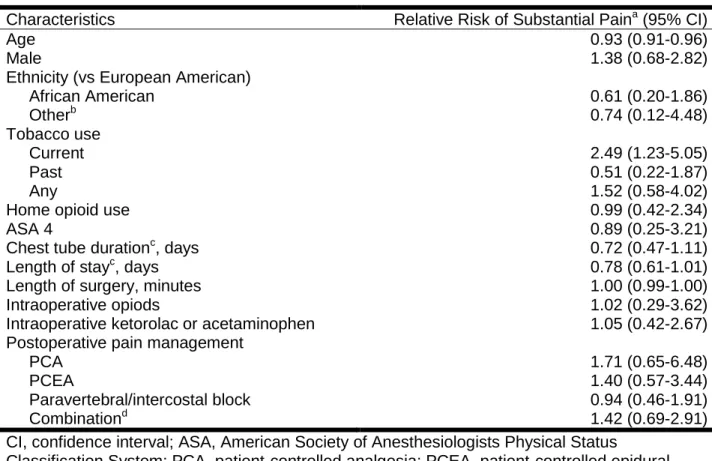
and postoperative pain intensity (Table 3). Current tobacco use was the only predictor of
interval of 1.23-5.05), but it still demonstrated poor predictive power (AUC=0.65). When all
twelve candidate predictors (age, gender, ethnicity, tobacco use, home opioid use, ASA
classification, chest tube duration, length of stay, length of surgery, intraoperative opioid
administration, intraoperative ketorolac or acetaminophen administration, and postoperative
pain management) were placed into a multivariate model together, their ability to predict
substantial postoperative pain during the overall hospitalization in this sample only improved
slightly (AUC=0.88), suggesting that these variables may not alone be useful predictors of
substantial postoperative pain.
DISCUSSION
One of the major benefits of a thoracoscopic approach to lobectomy is reduced acute
postoperative compared to thoracotomy. However, at this institution, substantial postoperative
pain was still common among patients undergoing VATS lobectomy. One in two patients
experienced substantial postoperative pain on the day of surgery, two in five had substantial
postoperative pain the following day, and one in four had substantial postoperative pain for the
overall hospitalization. Two in five patients had median pain scores of four or more throughout
hospitalization, suggesting moderate or severe pain at least 50% of the time. Thus, across
these several assessment methods, an increased burden of pain in a subset of patients was
consistently observed, even if VATS lobectomy decreases postoperative pain compared to
thoracotomy. Results of our secondary analyses suggest that common clinical and demographic
characteristics may not alone be sufficient to identify patients who will experience substantial
postoperative pain.
Few previous studies have reported the acute postoperative pain experience of patients
undergoing VATS lobectomy, and those studies focused on other objectives, only reporting
knowledge, this is the first study of postoperative pain intensity in patients undergoing VATS
lobectomy using individual level data. There is a growing appreciation that assessments of pain
outcomes using methods that retain individual level data are more clinically meaningful and
relevant.27-29 For instance, many papers reporting mean pain levels for VATS lobectomy patients
note that mean pain score is relatively low. Indeed, in our analysis, the median pain score for
patients throughout hospitalization was three, indicating only mild pain. However, when the pain
data is summarized by proportions of patients experiencing each pain score, it becomes clear
that many patients experience moderate or severe pain for much of their hospitalizations, and
may require improved postoperative pain management regimens.
Our study had several limitations that should be considered when interpreting the results. The
primary limitation of the study is that it was conducted at a single academic medical center.
Although our study was limited to a single site, the pain management described at our hospital
appears to be consistent with common regimens, although there is limited literature in this area
(refer to Systematic Review). If our findings are indeed generalizable, we suggest that as many
as 40% of patients experience moderate or severe pain during much of their hospitalization after
laparoscopic appendectomy. This represents a significant burden of suffering for these patients.
The results of this preliminary study provide sufficient evidence to justify further studies of pain
outcomes among patients undergoing VATS lobectomy.
Another limitation is that pain scores were assessed retrospectively and were based on chart
review. Thus, in some cases, it was impossible to determine whether a recorded pain score of
zero represented a true measure of no pain or if it represented a sleeping patient. To minimize
this effect, we used medians or proportions as our outcome measures. Defining substantial
postoperative pain as ≥60% of pain ratings ≥4 on a 0-10 NRS is only one potentially reasonable
Finally we were unable to measure some potentially important predictors of postoperative pain
due to the retrospective nature of our study. For instance, movement and ambulation may be
associated with increased pain.30 Although every patient in our institution receives physical
therapy aid for early ambulation, we were unable to measure the success or failure of attempted
ambulation or the amount of ambulation completed.
In conclusion, our study results indicate that a subset of patients who undergo thoracoscopic
lobectomy experience substantial postoperative pain. Prospective investigations describing pain
outcomes and pain management practices using methods that retain individual level data
among patients undergoing VATS lobectomy are needed to determine whether current
postoperative pain management strategies after VATS lobectomy are optimizing patient
REFERENCES
1. Cattaneo SM, Park BJ, Wilton AS, et al. Use of video-assisted thoracic surgery for lobectomy
in the elderly results in fewer complications. Ann Thorac Surg. 2008;85(1):231-5; discussion
235-6. doi: 10.1016/j.athoracsur.2007.07.080.
2. Koizumi K, Haraguchi S, Hirata T, et al. Lobectomy by video-assisted thoracic surgery for
lung cancer patients aged 80 years or more. Ann Thorac Cardiovasc Surg. 2003;9(1):14-21.
3. Casali G, Walker WS. Video-assisted thoracic surgery lobectomy: Can we afford it? Eur J
Cardiothorac Surg. 2009;35(3):423-428. doi: 10.1016/j.ejcts.2008.11.008;
10.1016/j.ejcts.2008.11.008.
4. Demmy TL, Curtis JJ. Minimally invasive lobectomy directed toward frail and high-risk
patients: A case-control study. Ann Thorac Surg. 1999;68(1):194-200.
5. Nakajima J, Takamoto S, Kohno T, Ohtsuka T. Costs of videothoracoscopic surgery versus
open resection for patients with of lung carcinoma. Cancer. 2000;89(11 Suppl):2497-2501.
6. Nomori H, Ohtsuka T, Horio H, Naruke T, Suemasu K. Difference in the impairment of vital
capacity and 6-minute walking after a lobectomy performed by thoracoscopic surgery, an
anterior limited thoracotomy, an anteroaxillary thoracotomy, and a posterolateral thoracotomy.
Surg Today. 2003;33(1):7-12. doi: 10.1007/s005950300001.
7. Nakata M, Saeki H, Yokoyama N, Kurita A, Takiyama W, Takashima S. Pulmonary function
after lobectomy: Video-assisted thoracic surgery versus thoracotomy. Ann Thorac Surg.
8. Petersen RP, Pham D, Burfeind WR, et al. Thoracoscopic lobectomy facilitates the delivery of
chemotherapy after resection for lung cancer. Ann Thorac Surg. 2007;83(4):1245-9; discussion
1250. doi: 10.1016/j.athoracsur.2006.12.029.
9. Nicastri DG, Wisnivesky JP, Litle VR, et al. Thoracoscopic lobectomy: Report on safety,
discharge independence, pain, and chemotherapy tolerance. J Thorac Cardiovasc Surg.
2008;135(3):642-647. doi: 10.1016/j.jtcvs.2007.09.014; 10.1016/j.jtcvs.2007.09.014.
10. Konge L, Petersen RH, Hansen HJ, Ringsted C. No extensive experience in open
procedures is needed to learn lobectomy by video-assisted thoracic surgery. Interact
Cardiovasc Thorac Surg. 2012;15(6):961-965. doi: 10.1093/icvts/ivs405; 10.1093/icvts/ivs405.
11. McLean SA, Diatchenko L, Lee YM, et al. Catechol O-methyltransferase haplotype predicts
immediate musculoskeletal neck pain and psychological symptoms after motor vehicle collision.
J Pain. 2011;12(1):101-107. doi: 10.1016/j.jpain.2010.05.008; 10.1016/j.jpain.2010.05.008.
12. Coghill RC, Eisenach J. Individual differences in pain sensitivity: Implications for treatment
decisions. Anesthesiology. 2003;98(6):1312-1314.
13. Nielsen CS, Stubhaug A, Price DD, Vassend O, Czajkowski N, Harris JR. Individual
differences in pain sensitivity: Genetic and environmental contributions. Pain.
2008;136(1-2):21-29. doi: 10.1016/j.pain.2007.06.008.
14. Mogil JS, Sternberg WF, Marek P, Sadowski B, Belknap JK, Liebeskind JC. The genetics of
pain and pain inhibition. Proc Natl Acad Sci U S A. 1996;93(7):3048-3055.
15. Mogil JS. The genetic mediation of individual differences in sensitivity to pain and its
16. Campbell CM, Edwards RR, Fillingim RB. Ethnic differences in responses to multiple
experimental pain stimuli. Pain. 2005;113(1-2):20-26. doi: 10.1016/j.pain.2004.08.013.
17. Campbell CM, France CR, Robinson ME, Logan HL, Geffken GR, Fillingim RB. Ethnic
differences in diffuse noxious inhibitory controls. J Pain. 2008;9(8):759-766. doi:
10.1016/j.jpain.2008.03.010; 10.1016/j.jpain.2008.03.010.
18. George SZ, Bialosky JE, Donald DA. The centralization phenomenon and fear-avoidance
beliefs as prognostic factors for acute low back pain: A preliminary investigation involving
patients classified for specific exercise. J Orthop Sports Phys Ther. 2005;35(9):580-588.
19. Picavet HS, Vlaeyen JW, Schouten JS. Pain catastrophizing and kinesiophobia: Predictors
of chronic low back pain. Am J Epidemiol. 2002;156(11):1028-1034.
20. Tomecka MJ, Bortsov AV, Miller NR, et al. Substantial postoperative pain is common among
children undergoing laparoscopic appendectomy. Paediatr Anaesth. 2012;22(2):130-135. doi:
10.1111/j.1460-9592.2011.03711.x; 10.1111/j.1460-9592.2011.03711.x.
21. McGraw KO, Wong SP. Forming inferences about some intraclass correlation coefficients.
Psychol Methods. 1996;1(1):30-46.
22. McGraw KO, Wong SP. 'Forming inferences about some intraclass correlations coefficients':
Correction. Psychol Methods. 1996;1(4):390-390.
23. Gerbershagen HJ, Rothaug J, Kalkman CJ, Meissner W. Determination of
moderate-to-severe postoperative pain on the numeric rating scale: A cut-off point analysis applying four
different methods. Br J Anaesth. 2011;107(4):619-626. doi: 10.1093/bja/aer195;
24. Hawthorn J, Redmond K. Pain : Causes and management. Malden, Mass:
BlackwellScience; 1998.
25. Zou G. A modified poisson regression approach to prospective studies with binary data. Am
J Epidemiol. 2004;159(7):702-706.
26. Lindquist K. Stata FAQ: How can I estimate relative risk using glm for common outcomes in
cohort studies? UCLA: Statistical Consulting Group Web site.
http://www.ats.ucla.edu/stat/stata/faq/relative_risk.htm. Published 2011. Updated 2011.
Accessed 6/17, 2013.
27. Abrahams E, Ginsburg GS, Silver M. The personalized medicine coalition: Goals and
strategies. Am J Pharmacogenomics. 2005;5(6):345-355.
28. Abrahams E, Silver M. The case for personalized medicine. J Diabetes Sci Technol.
2009;3(4):680-684.
29. Woodcock J. The prospects for "personalized medicine" in drug development and drug
therapy. Clin Pharmacol Ther. 2007;81(2):164-169. doi: 10.1038/sj.clpt.6100063.
30. Kim JA, Kim TH, Yang M, et al. Is intravenous patient controlled analgesia enough for pain
control in patients who underwent thoracoscopy? J Korean Med Sci. 2009;24(5):930-935. doi:
TABLES AND FIGURES
Table 1 Participant characteristics
Characteristics All (n=93)
Age, years (mean, SD) 62.1 (11.2)
Male (n, %) 41 (44.1)
Ethnicity (n, %)
European American African American Othera 70 (75.3) 18 (19.4) 5 (5.4) Past medical history (n, %)
Tobacco use Current Past
Home opioid use
27 (32.5) 35 (42.2) 20 (22) ASA classification (n, %)
2 3 4 7 (7.5) 77 (82.8) 9 (9.7) Average preoperative pain scoreb (n, %)
0-3 4-7 8-10 70 (94.6) 3 (4.1) 1 (1.4) Timesc (median, range)
Chest tube duration (days) Length of stay (days)
4 (2-7) 5 (3-10) Intraoperative characteristics
Length of surgery, minutes (median, range) Inhalational agentsd (n, %)
Desflurane Sevoflurane Isoflurane
Combination of two or more agents Analgesic administration (n, %)
Opioid
Ketorolac or acetaminophen
195 (55-381) 12 (13.2) 15 (16.5) 47 (51.6) 17 (18.7) 82 (91.1) 15 (16.7) Postoperative pain management (n, %)
PCA PCEA Paravertebral/intracostal block 80 (86.0) 12 (13.0) 45 (49.5)
ASA, American Society of Anesthesiologists Physical Status Classification System; PCA, patient-controlled analgesia; PCEA, patient-controlled epidural analgesia aOther refers to Asian, Hispanic, Native American, and unknown ethnicities. bAverage preoperative pain score on a 0-10 numeric rating scale (n = 74). cTimes include day of surgery and day of discharge/chest tube removal.
dTable displays data for agents used alone. Combination refers to two or more of
Table 2 Patient pain experience in each postoperative time period
Postoperative time period
Patients with pain scores availableb (n)
Pain score (median, range)
Patients with
substantial paina (n, %)
Number of pain scores recorded (median, range)
Entire postoperative hospitalization
93 3 (0-10) 23 (24.7) 34 (2-92)
Postoperative day 0 92 4 (0-10) 45 (48.9) 8 (1-26)
Postoperative day 1 81 3.5 (0-8) 31 (38.3) 9 (2-16)
Postoperative day 2 82 2 (0-8) 16 (19.5) 8 (2-21)
Postoperative day 3 76 1.5 (0-8) 13 (17.1) 6 (1-20)
Postoperative day 4 45 2 (0-6) 6 (13.3) 6 (2-12)
Postoperative day 5 24 0 (0-7.5) 4 (16.7) 6 (1-12)
Day of discharge 81 0 (0-8) 11 (13.6) 5 (1-11)
a Substantial pain was defined as patients rating their pain as moderate or severe (≥4 on a 0-10 numeric rating scale) in ≥60% of their
postoperative pain score ratings at each time period.
b Subjects with pain scores not available include patients discharged by the given time period, patients with missing records, and
Figure 1 Cumulative percent of patients with each median postoperative pain score during the postoperative hospitalization
0 10 20 30 40 50 60 70 80 90 100
C
u
m
u
la
ti
v
e
%
0 1 2 3 4 5 6 7 8 9 10
Table 3 Relative risk of substantial paina during postoperative hospitalization according to selected clinical and demographic characteristics (n=93)
Characteristics Relative Risk of Substantial Paina (95% CI)
Age 0.93 (0.91-0.96)
Male 1.38 (0.68-2.82)
Ethnicity (vs European American) African American Otherb 0.61 (0.20-1.86) 0.74 (0.12-4.48) Tobacco use Current Past Any 2.49 (1.23-5.05) 0.51 (0.22-1.87) 1.52 (0.58-4.02)
Home opioid use 0.99 (0.42-2.34)
ASA 4 0.89 (0.25-3.21)
Chest tube durationc, days 0.72 (0.47-1.11)
Length of stayc, days 0.78 (0.61-1.01)
Length of surgery, minutes 1.00 (0.99-1.00)
Intraoperative opiods 1.02 (0.29-3.62)
Intraoperative ketorolac or acetaminophen 1.05 (0.42-2.67)
Postoperative pain management PCA PCEA Paravertebral/intercostal block Combinationd 1.71 (0.65-6.48) 1.40 (0.57-3.44) 0.94 (0.46-1.91) 1.42 (0.69-2.91) CI, confidence interval; ASA, American Society of Anesthesiologists Physical Status
Classification System; PCA, patient-controlled analgesia; PCEA, patient-controlled epidural analgesia
aSubstantial pain was defined as patients rating their pain as moderate or severe (≥4 on a 0-10 numeric rating scale) in ≥60% of their postoperative pain score ratings at each time period. bOther refers to Asian, Hispanic, Native American, and unknown ethnicities.
cIncludes day of surgery and day of discharge/chest tube removal.
Acknowledgements
I would like to express my sincere gratitude to Dr. Samuel McLean and Dr. Russell Roberson for
their continuous support of my master’s research, patience, motivation, teaching, and his critical
reading of my paper. I thank my advisor, Dr. Anthony Viera, for his support, teaching, and
critical reading of my paper. I also thank Dr. Russell Harris for his support and aid in writing the
systematic review portion of my paper
My gratitude also goes to Dr. Andrey Bortsov, whose advice, aid, and teaching on statistical
methods made this paper possible. A special thanks also goes to Arshad Khalid, without whom
the timely collection of data would not have been possible.
Finally, I would like to thank Dr. Nirmal Veeramachaneni and Dr. Benjamin Haithcock for their