Stephen G. Krueger. Diversity and Inclusion Education at the School of Information and Library Science at the University of North Carolina at Chapel Hill. A Master’s Paper for the M.S. in L.S. degree. April, 2017. 44 pages. Advisor: Dr. Claudia Gollop
This study was conducted for a master’s paper at the School of Information and Library Science at the University of North Carolina at Chapel Hill. The project assessed the diversity and inclusion education available to SILS master’s students. The sample consists of course titles, descriptions, and syllabi from a two-year period (August 2015 through May 2017). The method used was content analysis, using a coding scheme based on existing literature as well as language and concepts found in the sample. It is hoped that the results provide a current depiction of the role of diversity and inclusion in the master’s degree at SILS.
Headings:
Library education Library schools
Information science – study & teaching Diversity in organizations – study & teaching Social justice
DIVERSITY AND INCLUSION EDUCATION AT THE SCHOOL OF INFORMATION AND LIBRARY SCIENCE AT THE UNIVERSITY OF NORTH
CAROLINA AT CHAPEL HILL
by
Stephen G. Krueger
A Master’s paper submitted to the faculty of the School of Information and Library Science of the University of North Carolina at Chapel Hill in partial fulfillment of the
requirements for the degree of Master of Science in Library Science.
Chapel Hill, North Carolina April 2017
Approved by
Table of Contents
Introduction ... 2
Research Questions ... 4
Significance... 5
Biases ... 6
Literature Review... 7
Organizational Positions ... 7
The Need for Diversity Education ... 9
The Role of Faculty ... 11
Related Studies... 13
Methodology ... 18
Sample... 18
Design ... 18
Results ... 21
Sample... 21
Syllabi ... 21
Specific Content ... 22
Classes... 23
Core Courses ... 25
Discussion ... 31
Research Question 1 ... 31
Research Question 2 ... 31
Research Question 3 ... 32
Research Question 4 ... 33
Limitations and Further Research ... 35
Conclusion ... 36
Introduction
Diversity and inclusion in libraries has been a much-discussed issue for decades. One important aspect of the subject concerns library and information (LIS) programs: are their graduates properly trained to work with and support diverse populations? Are the graduates themselves representative of the populations that they serve? If not, how can that be changed? This is obviously a huge, multifaceted topic, so it must be broken down into manageable parts. This paper focuses on how courses at the School of Information and Library Science (SILS) at the University of North Carolina at Chapel Hill incorporate diverse themes.
A fair amount of research has been done on diversity and inclusion in LIS education. The focus ranges from faculty demographics and their influence on LIS students (Gollop, 1999; Jaeger & Franklin, 2007; Subramaniam & Jaeger, 2010) to the role of student groups (Oxley, 2013; Jardine & Zerhusen, 2015) to examples of relevant courses (Cooke, 2014; Jaeger, Bertot, & Subramaniam, 2013) to overviews of the issue (Lee, Chancellor, Chu, Rodriguez-Mori, & Roy, 2015).
One study, which assessed the number and type of diversity courses offered by iSchools, pointed out that one limitation of their approach was the reliance on course titles and descriptions to identify such classes and acknowledged that a diversity component could be strong even if the description did not mention it explicitly
Research Questions
1. How many courses does SILS offer that explicitly teach about diversity, equity, and inclusion?
2. Of the courses that do include diverse themes, what form do they take (e.g. incorporated throughout or one devoted class period)?
3. Within the general areas of diversity, equity, and inclusion, how much are specific topics (e.g. race, LGBTQ+, disability) covered?
Significance
This study provides more comprehensive knowledge than was previously
Biases
Literature Review
Organizational Positions
Many organizations in the LIS and education world have statements on the importance of diversity in the profession. The American Library Association (ALA) does not have a formal diversity statement on its website, but it does have an Office for
Diversity, Literacy, and Outreach Services. Its mission statement, introducing a variety of initiatives and resources, follows:
The ALA Office for Diversity, Literacy, and Outreach Services supports library and information science workers in creating safe, responsible, and all-inclusive spaces that serve and represent the entire community. To accomplish this, we decenter power and privilege by facilitating conversations around access and identity as they impact the profession and those we serve. We use a social justice framework to inform library and information science workers' development of resources. We strive to create an association culture where these concerns are incorporated into everybody's everyday work. (American Library Association, 2016)
The Association for Library and Information Science Education (ALISE) has an extensive and powerful diversity statement. This includes principles, benefits to society and the profession, and directions for inclusive behavior. It opens with the following preamble:
The Association for Library and Information Science Education (ALISE) believes that diversity is central to its mission and values. ALISE is committed to the active recruitment and equitable and full participation of members of all
backgrounds, the promotion of diversity and its benefits in library and information science education, research and service by its personal and institutional members, and their full participation in the profession. ALISE’s commitment to diversity is grounded on principles and motivated by benefits that result in the wellness of the organization, and the work of its membership. The strength of the Association is promoted with this statement, which outlines diversity principles (what), benefits (why) and competencies (how). (Association for Library and Information Science Education, 2016)
SILS itself has a diversity statement that emphasizes inclusion, education, and service: In support of the University’s diversity goals and the mission of the School of Information and Library Science, SILS embraces diversity as an ethical and societal value. We broadly define diversity to include race, gender, national origin, ethnicity, religion, social class, age, sexual orientation and physical and learning ability. As an academic community committed to preparing our graduates to be leaders in an increasingly multicultural and global society we strive to:
Ensure inclusive leadership, policies and practices;
Integrate diversity into the curriculum and research;
Foster a mutually respectful intellectual environment in which diverse opinions are valued;
Recruit traditionally underrepresented groups of students, faculty and staff; and
Participate in outreach to underserved groups in the State.
The statement represents a commitment of resources to the development and maintenance of an academic environment that is open, representative, reflective and committed to the concepts of equity and fairness. (University of North Carolina at Chapel Hill, 2014c)
members of the field are also important. This project assesses the extent to which classes at SILS suit that purpose.
The Need for Diversity Education
Librarians, faculty, and other LIS professionals have been writing about the need for diversity in the profession for decades. This has taken many different forms,
depending on what social issues were topical. In more recent years, race and ethnicity have probably been the most prominent subjects (others included gender, sexual orientation and gender identity, age, and disability, to name a few).
Peterson (1996) points to the need for further research on race and racism in the context of librarianship. Elements include the history of discrimination or outright segregation in library schools, the ALA’s not always effective policies on protecting its members, and the need for focused scholarship on race in the library profession. She observes that multiculturalism, an increasingly popular term, “obscures equity issues” (Peterson, 1996, p. 172). In an article a decade later, Pawley (2006) expands upon this last issue. She analyzes some of the inherent biases in different aspects of LIS and points out that the broad area of multiculturalism minimizes the study of race by lumping it in with a variety of other groups, all with very different histories and needs.
(physical, social, and informational environments). She concludes with the need for a cultural competence model in LIS.
Jaeger, Bertot, and Franklin (2010) take a different approach. After observing the lack of diversity in the profession as well as the lack of information on the representation of many groups, they suggest a variety of options for relevant research and scholarship. They then explain the essential role of LIS education, as students can neither effectively serve nor study populations of which they have no knowledge. “Simply put, research in this area needs to be an integral part of every MLS curriculum” (Jaeger, Bertot, & Franklin, 2010, p. 179). It is pointed out that despite the ALA standards, few programs have explicitly focused on this area of study.
Another study by Jaeger, Subramaniam, Jones, and Bertot (2011) presents LIS education on inclusion and underrepresentation as necessary for both increasing the diversity of the profession and improving the cultural competence of librarians. Without this training, an increasing number of patrons will find libraries irrelevant to their needs. With it, LIS can make material contributions to society through research on information behavior. The researchers supply a framework of ideas for improving the situation and describe existing libraries who set good examples. The conclusion calls for an increase in inclusion in all aspects of LIS research, education, and practice to keep the profession relevant as well as to meet user needs.
into specific aspects of this subject (e.g. race, disability, LGBTQ+ issues) will find much more information to support such training for LIS students.
The Role of Faculty
This project concerns the academic curriculum, but that is far from the only important aspect of LIS education. Without a diverse, representative faculty and student body, the course content alone is not sufficient to create culturally competent LIS professionals.
“It is my hope that library and information science schools will recruit minority faculty and minority students whose faces will look more like America than the
preponderance of lily-white faces that fill many of our library schools” (Josey, 1993). This call, over twenty years old now, comes in the introduction of an article on the importance and lack of minority faculty and students in LIS programs. Josey (1993) points out the discrepancies between minority populations and their representation in LIS. After providing examples of continuing racism in society and in education, the article notes that, as of January 1992, 88.6% of faculty at ALA-accredited institutions were white (compared to just over 75% of the total population). Faculty and students are quoted to demonstrate the importance of non-white faculty for all students. The article closes with ideas for effective recruitment and retention.
Gollop (1999) updates Josey’s percentage of non-white faculty to 15.5% (according to 1996 ALISE statistics), which still does not approach accurate
provides context for the current situation in which very few doctoral students (and, by extension, faculty) come from minority populations. Gollop then discusses the role of LIS curricula in preparing future librarians to work with diverse patrons, quoting Peterson (1996) and suggesting ways to incorporate the subject into devoted courses as well as the general curriculum. The conclusion takes an optimistic tone, acknowledging the
hesitations LIS programs have (such as limited time and funding for additional classes) but reiterating the need to adapt to a changing society.
In an article several years later, Jaeger and Franklin (2007) report that the most recent set of ALISE statistics shows little improvement in minority representation in LIS faculty. They focus on Latino and African-American populations, where the discrepancy is the largest (for both, representation among faculty and professional librarians alike is less than half that needed to reflect the total population). In addition to simply
diversifying the profession, the need to change that situation comes from the fact that “culturally competent librarians can only be educated by a diverse faculty offering diverse perspectives on information and work in library systems with diverse leadership” (Jaeger & Franklin, 2007, p. 22). The authors introduce the concept of the “virtuous circle,” a system that ties together representation and education to produce culturally aware librarians, faculty, and administrators.
Related Studies section below; they did find that very few of the courses offered were on the doctoral level. More diverse faculty would help all students by providing a variety of perspectives from which to learn; it would also set an example encouraging students from different backgrounds to join the profession.
What these articles demonstrate is that talking about diversity and teaching it in class is insufficient on its own. Representation on all levels is extremely important; so far, LIS has not realized the goal of reflecting society in its professional or student
populations on any level. This study focuses on education, but that is not enough; having access to diverse faculty is an essential part of becoming a culturally competent graduate.
Related Studies
There have been a number of studies that assess how LIS programs prepare their students to serve diverse populations. It is not a new subject, which allows one to observe trends and similarities in results over time; many of the studies also recommend ideas for future research, some of which inspired this project.
electives. In all but one category, over 65% of the programs offered no courses at all (the one being elective lectures on cultural minorities, which were offered by 37% of the schools). Another section of the study asked about minority presence in the faculty. Over a quarter of the respondents provided no answer; of the others, the number of non-white faculty ranged from zero (six programs, or 13%) to six (one program). Sixteen schools, or 34.8%, had only one faculty member of color. The article concludes with the observation that “Multicultural librarianship has to be seen as an urgent, immediate objective in the here and now” (Josey, 1991, p. 22); it calls for further action on all fronts by library schools as well as for more research.
provide general information on how LIS programs view themselves, the questions are too ambiguous and nonspecific to tell much about the actual curricula.
Some studies have focused on a particular group. Carlos (2005) assessed the course offerings from nine ALA-accredited library schools to see if they taught students about serving patrons with disabilities. The anticipated results were largely based on a study from the previous year. This took the form of a questionnaire sent to the deans and directors of all ALA-accredited LIS programs; most respondents claimed to offer courses at least once each year that addressed the Americans with Disabilities Act as well as services and adaptive technology for people with disabilities (Walling, 2004). Carlos (2005) used a different method, consulting syllabi, reading requirements, and catalog descriptions of the nine schools for the 2004-2005 school year. Based on Walling’s results, Carlos was surprised to find only three schools and four total courses that offered any information on the subject. Carlos points out that limitations included the number of schools surveyed and the timeframe (only one year’s worth of classes) and the fact that she worked only with information publicly available online; she also notes, regarding the other study, that “as Walling herself acknowledges, a school director might not actually know much about what is being taught in individual classes” (Carlos, 2005, p. 31).
twenty-five respondents (51%). Of the librarians, 64% did not plan to seek out a position in multicultural/diversity services. Asked if their LIS education had prepared them to work with multiple cultures, 21.3% said yes, 44.7% somewhat, and 27.7% no. 75.6% said that their schools had not offered a specific course on the subject. Interestingly, the
survey of administrators showed a different perception; 75% said they did offer such a course. In a later chapter on curriculum reform, the librarians were asked what form education on multicultural librarianship should take. The two most popular answers were that it should be part of every course (40.4%) and that it should be a required course of its own (25.5%).
As part of a study on the diversity and language requirements of LIS jobs, Al-Qallaf and Mika (2013) scanned websites of the 58 ALA-accredited programs for courses on international, multicultural, or diverse themes. 146 were found (eleven schools had none), with nine schools providing 44.5% of them. The study did not address the frequency with which the courses were offered, though it did find that none were
required. Most concerned culturally, racially, or ethnically diverse populations. This was not the main focus of the study, which concentrated more on breakdowns of job
requirements. 36% of the sample (870 out of 2,414 advertisements) mentioned
multiculturalism, diversity, or language as a priority or qualification. Another section of the study found that 94.8% of ALA-accredited schools mentioned diversity or
multiculturalism in their mission statements.
Methodology
Sample
As the goal was to assess the courses available to a SILS master’s student following a standard schedule, this study used for its sample the master’s level classes taught at SILS over a two-year period. This included all courses numbered at 500 or over, excluding those in the 800 range that were limited to Ph.D students. For optimum
currency, the range started with the fall semester of 2015 and ended with the spring of 2017, including the summer of 2016. New courses, with numbers starting in 690, were excluded as the sample was the consistently offered curriculum. If a course was repeated by the same professor over the period of study, it was only assessed once. If a course was repeated under a different professor, it was treated as a separate course (as syllabi and content often differed). Titles and course descriptions were pulled from the SILS website (University of North Carolina at Chapel Hill, 2014a). Syllabi were obtained from the public syllabus archives (University of North Carolina, n.d.). The list of core courses was drawn from the degree requirements page of the SILS website (University of North Carolina at Chapel Hill, 2014b). As the project covered all courses offered in this time period, no more complex sampling method was necessary.
Design
and inclusion. Coding, defined as “the process of reducing the entire content of the messages in your sample into quantitatively analyzable data describing only the variables in which you are interested” (Wildemuth, 2009, p. 300), was the method of assessment. In order to most effectively capture the information, the coding took the form of concepts rather than specific terms (a syllabus may include readings on collection development for different cultural groups without using buzzwords like ‘diversity’ or ‘inclusivity.’
Conversely, use of those terms might apply to unrelated topics). Several levels of assessment were applied in order to ensure that the results were as objective and
comprehensive as possible. Each syllabus was assessed to determine whether it contained content on diversity and inclusion or not. Of those that did, the content was further broken down into type (socioeconomic status, race, LBGTQ+ issues, religion,
disability/accessibility, gender, bias, and general diversity). In addition, the number of classes and readings devoted to diverse topics were counted. Also noted was whether the syllabus included the SILS Diversity Statement (University of North Carolina, 2014c) or statements on disability, religion, learning style, or LGBTQ+ issues. All of this
information was collected in a spreadsheet.
Results
Sample
From the fall semester of 2015 through the spring semester of 2017, 250 master’s level courses were taught at SILS (University of North Carolina at Chapel Hill, 2014a). Of these, 115 met the needs of the study (48 were special topics or new courses, and the others were repeats by the same professor. Twelve did not have syllabi publicly
available). These 115 courses had their syllabi and schedules (when available) assessed for diverse content.
Syllabi
Syllabus Content Courses
Total assessed 115 (100%)
Diverse content in syllabus 8 (7%) SILS Diversity Statement 38 (33%) Disability statement 33 (28.7%) LGBTQ+ statement 4 (3.5%) Religious freedom statement 2 (1.7%) Learning styles statement 1 (.8%)
Table 1. Syllabus content.
Specific Content
Specific content of the courses was assessed based on schedules and reading lists. Of the original 115, 24 courses (20.9%) had a syllabus but no class schedule, so the details of their content were not available. The remaining 91 were assessed for class content. 20 included material on general diversity. 13 included content on
disability/accessibility, 12 on race, 8 on LGBTQ+ issues, 6 on gender, 5 on socioeconomic status, 3 on religion, and 2 on bias.
Schedule/reading list content Courses
Total courses 91 (100%)
Diverse content 37 (40.7%)
General diversity 20 (22%)
Disability/Accessibility 13 (14.3%)
Race 12 (13.2%)
LGBTQ+ issues 8 (8.8%)
Gender 6 (6.6%)
Socioeconomic status 5 (5.5%)
Religion 3 (3.3%)
Bias 2 (2.2%)
Classes
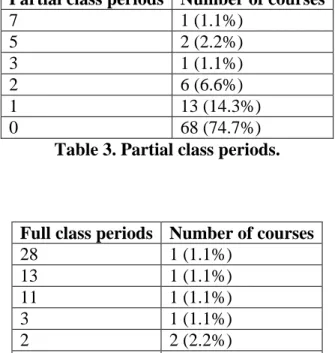
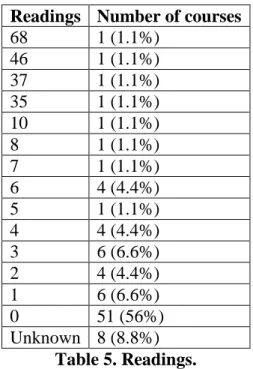
For each of the courses, the number of class periods and the number of readings spent on diverse content were calculated. Partial and full class periods were calculated separately, so there may be some overlap (e.g. a course with three full periods may also have two partial ones).
Table 3. Partial class periods.
Full class periods Number of courses
28 1 (1.1%)
13 1 (1.1%)
11 1 (1.1%)
3 1 (1.1%)
2 2 (2.2%)
1 16 (17.6%)
0 67 (73.6%)
Unknown 1 (1.1%)
Table 4. Full class periods.
Partial class periods Number of courses
7 1 (1.1%)
5 2 (2.2%)
3 1 (1.1%)
2 6 (6.6%)
1 13 (14.3%)
Table 5. Readings. Readings Number of courses
68 1 (1.1%)
46 1 (1.1%)
37 1 (1.1%)
35 1 (1.1%)
10 1 (1.1%)
8 1 (1.1%)
7 1 (1.1%)
6 4 (4.4%)
5 1 (1.1%)
4 4 (4.4%)
3 6 (6.6%)
2 4 (4.4%)
1 6 (6.6%)
0 51 (56%)
Core Courses
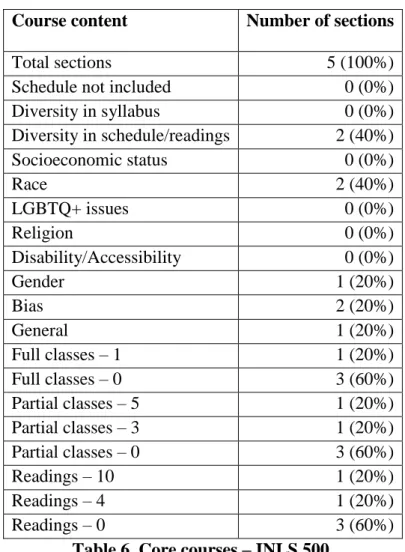
SILS’ eight required courses were assessed specifically to see what type of diverse content they include and how much that varies by section. Each time the course was taught by a different teacher, it was analyzed as a separate section.
Course content Number of sections
Total sections 5 (100%)
Schedule not included 0 (0%)
Diversity in syllabus 0 (0%)
Diversity in schedule/readings 2 (40%)
Socioeconomic status 0 (0%)
Race 2 (40%)
LGBTQ+ issues 0 (0%)
Religion 0 (0%)
Disability/Accessibility 0 (0%)
Gender 1 (20%)
Bias 2 (20%)
General 1 (20%)
Full classes – 1 1 (20%)
Full classes – 0 3 (60%)
Partial classes – 5 1 (20%)
Partial classes – 3 1 (20%)
Partial classes – 0 3 (60%)
Readings – 10 1 (20%)
Readings – 4 1 (20%)
Readings – 0 3 (60%)
Course content Number of sections
Total sections 3 (100%)
Schedule not included 0 (0%) Diversity in syllabus 0 (0%) Diversity in schedule/readings 3 (100%) Socioeconomic status 0 (0%)
Race 0 (0%)
LGBTQ+ issues 0 (0%)
Religion 0 (0%)
Disability/Accessibility 0 (0%)
Gender 0 (0%)
Bias 0 (0%)
General 3 (100%)
Full classes – 2 1 (33.3%)
Full classes – 1 2 (66.7%)
Partial classes – 0 3 (100%)
Readings – 5 1 (33.3%)
Readings – 3 1 (33.3%)
Course Content Number of Sections
Total sections 3 (100%)
Schedule not included 2 (66.7%)
Diversity in syllabus 0 (0%)
Diversity in schedule/readings 1 (33.3%)
Socioeconomic status 0 (0%)
Race 0 (0%)
LGBTQ+ 0 (0%)
Religion 0 (0%)
Disability/Accessibility 0 (0%)
Gender 0 (0%)
Bias 0 (0%)
General 1 (33.3%)
Full classes – 1 1 (33.3%)
Full classes – Unknown 2 (66.7%)
Partial classes – 1 1 (33.3%)
Partial classes – Unknown 2 (66.7%)
Readings – 1 1 (33.3%)
Readings – Unknown 2 (66.7%)
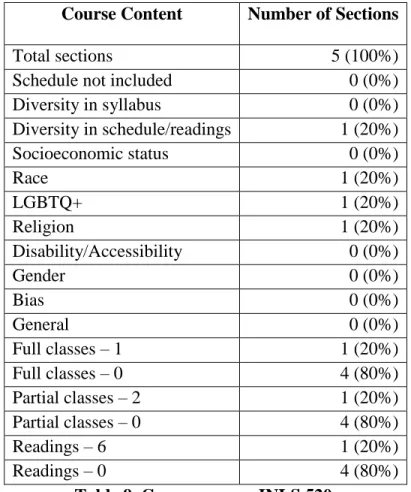
Course Content Number of Sections
Total sections 5 (100%)
Schedule not included 0 (0%)
Diversity in syllabus 0 (0%)
Diversity in schedule/readings 1 (20%)
Socioeconomic status 0 (0%)
Race 1 (20%)
LGBTQ+ 1 (20%)
Religion 1 (20%)
Disability/Accessibility 0 (0%)
Gender 0 (0%)
Bias 0 (0%)
General 0 (0%)
Full classes – 1 1 (20%)
Full classes – 0 4 (80%)
Partial classes – 2 1 (20%)
Partial classes – 0 4 (80%)
Readings – 6 1 (20%)
Readings – 0 4 (80%)
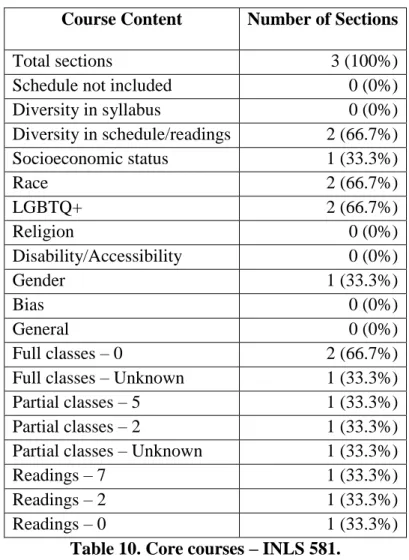
Course Content Number of Sections
Total sections 3 (100%)
Schedule not included 0 (0%)
Diversity in syllabus 0 (0%)
Diversity in schedule/readings 2 (66.7%)
Socioeconomic status 1 (33.3%)
Race 2 (66.7%)
LGBTQ+ 2 (66.7%)
Religion 0 (0%)
Disability/Accessibility 0 (0%)
Gender 1 (33.3%)
Bias 0 (0%)
General 0 (0%)
Full classes – 0 2 (66.7%)
Full classes – Unknown 1 (33.3%)
Partial classes – 5 1 (33.3%)
Partial classes – 2 1 (33.3%)
Partial classes – Unknown 1 (33.3%)
Readings – 7 1 (33.3%)
Readings – 2 1 (33.3%)
Readings – 0 1 (33.3%)
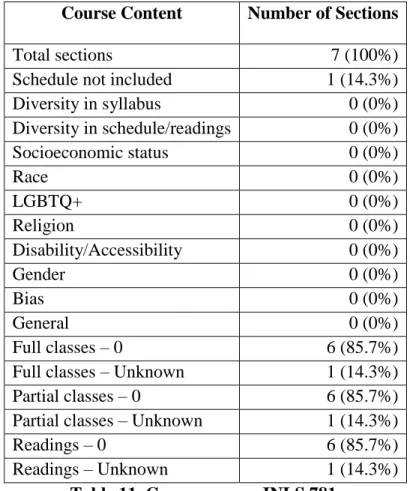
Course Content Number of Sections
Total sections 7 (100%)
Schedule not included 1 (14.3%)
Diversity in syllabus 0 (0%)
Diversity in schedule/readings 0 (0%)
Socioeconomic status 0 (0%)
Race 0 (0%)
LGBTQ+ 0 (0%)
Religion 0 (0%)
Disability/Accessibility 0 (0%)
Gender 0 (0%)
Bias 0 (0%)
General 0 (0%)
Full classes – 0 6 (85.7%)
Full classes – Unknown 1 (14.3%)
Partial classes – 0 6 (85.7%)
Partial classes – Unknown 1 (14.3%)
Readings – 0 6 (85.7%)
Readings – Unknown 1 (14.3%)
Discussion
Research Question 1: How many courses does SILS offer that explicitly teach about
diversity, equity, and inclusion?
The results of the project show that 40.7% of courses included any diverse content. This number may vary slightly from year to year, but given that most of the courses consistently offered over a two-year period were assessed, it provides an approximate representation of the content currently available. This is not to say that no course without diversity in its schedule touched on the topic at all, but this demonstrates how many considered it an important enough subject to assign readings about and formally devote class time to. Given SILS’ own goal to “integrate diversity into the curriculum and research” (University of North Carolina at Chapel Hill, 2014c), the fact that less than half of the classes do so at all is notable. The general number also does not show how much the courses include diverse topics.
Research Question 2: Of the courses that do include diverse themes, what form do they
take (e.g. incorporated throughout or one devoted class period)?
diversity, most of them do so in the context of a single session. Very few courses (excepting the few that are explicitly devoted to topics of equity and inclusion) discuss diversity throughout the term. It should be noted that some courses meet once each week and others twice, so a course with eleven full sessions may (and, in this case, does) devote nearly as much time to diversity issues as one with twenty-eight. Future research in this area might benefit from calculating the percentage of classes or readings instead of the number. However, so few courses have more than one class period on the subject that it does not make much difference in this case.
Research Question 3: Within the general areas of diversity, equity, and inclusion, how
much are specific areas (e.g. race, LGBTQ+, disability) covered?
The specific content of the courses demonstrates how much the particular elements of diversity and inclusion are addressed (see Table 2). 22% of classes assessed (just over half of the total number with diverse content) had some information on general diversity. This category was used for content that did not focus on any particular area (often using language such as cultural competency or multiculturalism).
syllabi (see Table 1): diversity (33%), disability (28.7%), LGBTQ+ (3.5%), religious freedom (1.7%), and learning differences (.8%).
Research Question 4: Of the core classes required to graduate, how many include some
element of diversity or inclusion education?
This question turned out to be more complex than expected because the core courses do not have consistent content from section to section. This necessitated a breakdown of the question by course.
For INLS 500, Human Information Interactions (see Table 6), two of the five available sections spent considerable time and assigned multiple readings on diverse topics of several different types, while three had no such content at all. INLS 501,
Limitations and Further Research
It is certainly possible that not every subject discussed in a class appears on the syllabus, so this project might miss content of some classes that is not described there or in the descriptions. However, explicitly devoting class time and readings to issues of diversity, equity, and inclusion demonstrates the importance of these topics, so it is worth noting how many courses do so.
Conclusion
The call for diversity research “to be an integral part of every MLS curriculum” (Jaeger, Bertot, & Franklin, 2010, p. 179) is clearly not met by the courses offered by SILS. Neither does the curriculum follow the recommendations from the Mestre (2010) study’s respondents that LIS programs either require a course on the subject or
What this research does demonstrate is that there are many examples of SILS courses that cover diversity, equity, and inclusion in effective ways. A few electives are wholly devoted to these issues and provide students who are interested with the
References
Al-Qallaf, C.L., & Mika, J.J. (2013). The role of multiculturalism and diversity in library and information science: LIS education and the job market. Libri, 63(1), 1-20. doi: 10.1515/libri-2013-0001
Allen, T.E. (2000). Management education in schools of information and library science: An assessment of the top five MLS programs (master’s paper). University of North Carolina at Chapel Hill, Chapel Hill, NC.
American Library Association. (2016). Office for Diversity, Literacy, and Outreach Services. Retrieved from http://www.ala.org/offices/diversity
Association for Library and Information Science Education. (2016). ALISE diversity statement. Retrieved from http://www.alise.org/alise---alise-diversity-statement Carlos, D.J. (2005). Instruction in disability services and adaptive technology in schools
of library and information science: A survey of the curriculum (master’s paper). University of North Carolina at Chapel Hill, Chapel Hill, NC.
Committee on Accreditation of the American Library Association. (2015). Standards for accreditation of master’s programs in library and information studies. Retrieved from http://www.ala.org/accreditedprograms/sites/ala.org.accreditedprograms /files/content/standards/Standards_2015_adopted_02-02-15.pdf
LIS curriculum. SRRT Newsletter, 187.
East, D., & Lam, E. (1995). In search of multiculturalism in the library science curriculum. Journal of Education for Library and Information Science, 36(3), 199-216. doi: 10.2307/40323740
Gollop, C.J. (1999). Library and information science education: Preparing librarians for a multicultural society. College & Research Libraries, 60(4), 385-395. doi:
10.5860/crl.60.4.385
Jaeger, P.T., Bertot, J.C., & Franklin, R.E. (2010). Diversity, inclusion, and
underrepresented populations in LIS research. The Library Quarterly, 80(2), 175- 181. doi: 10.1086/651053
Jaeger, P.T., Bertot, J.C., & Subramaniam, M.M. (2013). Preparing future librarians to effectively serve their communities. The Library Quarterly, 83(3), 243-248. doi: 10.1086/670699
Jaeger, P.T., & Franklin, R.E. (2007). The virtuous circle: Increasing diversity in LIS faculties to create more inclusive library services and outreach. Education Libraries, 30(1), 20-26.
Jaeger, P.T., Subramaniam, M.M., Jones, C.B., & Bertot, J.C. (2011). Diversity and LIS education: Inclusion and the age of information. Journal of Education for Library and Information Science, 52(3), 166-183.
Jardine, F.M., & Zerhusen, E.K. (2015). Charting the course of equity and inclusion in LIS through iDiversity. The Library Quarterly, 85(2), 185-192. doi:
10.1086/680156
are being taught? (master’s paper). University of North Carolina at Chapel Hill, Chapel Hill, NC.
Josey, E.J. (1991). Education for library services to cultural minorities. Education Libraries, 15(3), 16-22.
Josey, E.J. (1993). The challenges of cultural diversity in the recruitment of faculty and students from diverse backgrounds. Journal of Education for Library and Information Science, 34(4), 302-311.
Lee, S.A., Chancellor, R., Chu, C.M., Rodrigueq-Mori, H., & Roy, L. (2015). Igniting diversity: Actionable methods and ideas for advancing diversity in LIS education in the US. Journal of Education for Library and Information Science, 56, S47-S60.
Mestre, L. (2010). Librarians serving diverse populations: Challenges and opportunities. Chicago, IL: Association of College and Research Libraries.
Overall, P.M. (2009). Cultural competence: A conceptual framework for library and information science professionals. The Library Quarterly, 79(2), 175-204. doi: 10.1086/597080
Oxley, R. (2013). iDiversity and LIS education: Student-based groups promoting cultural competence as a vision for the profession. The Library Quarterly, 83(3), 236-242. doi: 10.1086/670698
Pappert, R.A. (2005). A course and syllabus review of ALA-accredited master’s
programs: focus on education for library instruction (master’s paper). University of North Carolina at Chapel Hill, Chapel Hill, NC.
The Library Quarterly, 76(2), 149-168. doi: 10.1086/506955
Peterson, L. (1996). Alternative perspectives in library and Information science: Issues of race. Journal of Education for Library and Information Science, 37(2), 163-174. doi: 10.2307/40324271
Subramaniam, M.M. & Jaeger, P.T. (2010). Modeling inclusive practice?: Attracting diverse faculty and future faculty to the information workforce. Library Trends, 59(1), 109-127.
Subramaniam, M.M., & Jaeger, P.T. (2011). Weaving diversity into LIS: An examination of diversity course offerings in iSchool programs. Education for Information, 28,
1-19. doi: 10.3233/EFI-2010-0891
University of North Carolina at Chapel Hill. (n.d.). Index of courses. Retrieved from https://ils.unc.edu/courses/
University of North Carolina at Chapel Hill. (2014a). UNC School of Information and Library Science: Courses. Retrieved from https://sils.unc.edu/courses
University of North Carolina at Chapel Hill. (2014b). UNC School of Information and Library Science: MSLS curriculum (starting fall 2013). Retrieved from
https://sils.unc.edu/programs/graduate/msls/curriculum-new
University of North Carolina at Chapel Hill. (2014c). UNC School of Information and Library Science: Statement of diversity. Retrieved from
https://sils.unc.edu/about/diversity
Walling, L.L. (2004). Educating students to serve information seekers with disabilities.