Sharif University of Technology
Scientia IranicaTransactions B: Mechanical Engineering http://scientiairanica.sharif.edu
RPT nite-element formulation for linear dynamic
analysis of orthotropic plates
J. Rouzegar
and M. Sayedain
Department of Mechanical and Aerospace Engineering, Shiraz University of Technology, Shiraz, P.O. Box 71555-313, Iran. Received 21 November 2016; received in revised form 10 January 2017; accepted 6 March 2017
KEYWORDS Orthotropic; Finite-element method;
Dynamic analysis; Two-variable rened plate theory; Rectangular plate element.
Abstract. This paper presents a nite-element formulation for dynamic analysis of orthotropic plates using two-variable Rened Plate Theory (RPT). Hamilton's principle is employed to obtain the governing equations, and the semi-discrete approach is utilized for solving the equations. After constructing spatial weak form equations, a 4-node rectangular plate element with six Degrees Of Freedom (DOFs) per node is introduced for discretization of the domain. An unconditionally stable implicit Newmark scheme is used for temporal discretization. A MATLAB code with the capability of modelling both static and dynamic plate problems with various boundary conditions is generated. Several numerical problems are solved, and the obtained displacements and stresses are compared with the existing results in the literature. The results demonstrate the accuracy, simplicity, and eciency of the present method in dynamic analysis of plate problems.
© 2018 Sharif University of Technology. All rights reserved.
1. Introduction
Plates are structural elements commonly used in many industrial applications, e.g. aerospace, marine, nuclear industries, etc. They are classied in the literature as thin, moderately thick, or thick plate. The clas-sication of a rectangular plate into one of the three aforementioned categories is based on relation h=a : h being the plate thickness and a being the shortest side length.
In the framework of Classical Plate Theory (CPT) [1], which is the simplest plate theory, the results are unrealistic in the case of thick plates because it does not take into account shear deformation eects. First-order Shear Deformation plate Theory (FSDT) presented by Mindlin [2] and Reissner [3] considers the shear eects in its formulation, but it needs a
*. Corresponding author. Tel./Fax: +98 71 37264102 E-mail address: [email protected] (J. Rouzegar) doi: 10.24200/sci.2017.4330
shear correction factor to rene the overestimated shear strain energy of the plate. Another drawback to this theory is the constant transverse shear stress across the plate thickness which is inconsistent with stress-free conditions on the plate surfaces. Higher-order Shear Deformation Theories (HSDTs) were developed using more unknown variables in their formulations to overcome shortcomings of CPT and FSDT [4-10].
Recently, several simple and ecient HSDTs have been proposed and employed in study of various structures such as functionally graded, laminated, and sandwich plates and shells [11-13]. In 2002, Shimpi [13] presented a simple HSDT called two-variable Rened Plate Theory (RPT), which involves only two unknown functions. He separated the transverse deection into the shear and bending parts which resulted in two uncoupled governing equations for bending analysis of isotropic plates. The two-variable rened plate theory, which can be used for thin and thick plates, predicts parabolic variation of transverse shear stresses across the plate thickness and does not need shear correction factor. In this theory, zero traction conditions are
satised on the plate surfaces. This theory was rapidly developed and extended to various applications. In 2006, Shimpi and Patel [14] employed this this method for analysis of orthotropic plates. In 2009, Kim et al. [15] extended the application of this the-ory to analysis of laminated composite plate. They investigated the bending of antisymmetric cross-ply and angle-ply laminates using Navier solution. In 2012, Thai and Kim [16] used the two-variable rened plate theory, Levy-type solution procedure, and state space concept to obtain a closed-form solution for orthotropic rectangular plates with two opposite edges simply supported and the other two edges having arbitrary boundary conditions. Rouzegar and Abdoli presented nite-element formulations for free vibra-tion [17] and buckling [18] analysis of isotropic and orthotropic plates using this theory. By adding two in-plane displacements to this theory, a four-variable rened plate theory was introduced. Rouzegar and Abad employed this theory for bending [19] and free vibration [20] analysis of cross-ply laminated plates integrated with piezoelectric layers. Rouzegar and Gholami [21] studied the non-linear bending analysis of rectangular plates by four-variable rened plate theory and Dynamic relaxation method.
The practical and typically complicated problems could be solved in an approximate manner employ-ing various numerical approaches, such as nite-layer method, collocation method, nite-element method, nite strip method, and meshless methods. Among dif-ferent numerical approaches, Finite-Element Method (FEM) is an ecient and attractive technique estab-lished in the 1940's. Recently, some investigations have been performed on isogeometric nite-element approach utilizing shear deformation plate theories. Nguyen-Xuan et al. [22] employed isogeometric nite-element method with a rened plate theory for static, free vibration and buckling analysis of FG plates. Thai et al. [23] presented a generalized shear deforma-tion theory for static, dynamic and buckling analysis of isotropic and sandwich FG plates. An inverse trigonometric shear deformation theory along with an isogeometric approach was employed in this study. Nguyen and Nguyen-Xuan [24] presented an isoge-ometric nite-element approach to three-dimensional static and dynamic analyses of FG plates. Nguyen et al. [25] introduced a novel unied framework on HSDTs for the modeling and analysis of laminated composite plates. They found that the proposed formulation with a polynomial form can theoretically cover all existing HSDTs models and is thus sucient to describe the nonlinear and parabolic variations of transverse shear stress. Nguyen et al. [26] presented an isogeometric nite-element formulation based on Bezier extraction of the non-uniform rational B-splines in combination with a generalized unconstrained
higher-order shear deformation theory for laminated compos-ite plates.
Previous researches on two-variable rened plate theory are mostly focused on analytical solutions to some plate problems with specic geometry, loading and boundary conditions. A new nite-element formu-lation of shear deformation plate was introduced by Pa-tel and Shimpi [27]. Katori and Okada [28] developed a nite-element formulation based on the rened plate theory using triangular and quadrilateral elements for discretization of the domain. Recently, Rouzegar and Abdoli [29] presented a nite-element formulation for static analysis of isotropic and orthotropic plates using a two-variable rened plate theory.
Although dynamic analysis of plate structures is the subject of a large number of research works, there are still some hypotheses either not introduced or not suciently tested. In this study, a new nite-element formulation based on the two-variable rened plate theory is developed for dynamic analysis of isotropic and orthotropic plates. The semi-discrete method is used to simulate the dynamic behavior of problems, and an implicit Newmark scheme is employed for temporal discretization. The performance of the code in simulation of isotropic and orthotropic plates under static and dynamic loadings is proved by solving several benchmark problems.
2. Theory of problem
2.1. Two-variable rened plate theory
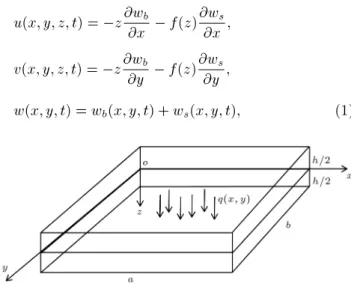
Consider a homogeneous, orthotropic, thick elastic plate of thickness, h, which is subjected to a transverse dynamic load, q(x; y; t), per unit area. According to Figure 1, axes x, y, and z are the Cartesian coordinate systems located at the corner of the plate.
Based on two-variable rened plate theory, the displacement eld is assumed as follows [13]:
u(x; y; z; t) = z@w@xb f(z)@w@xs;
v(x; y; z; t) = z@w@yb f(z)@w@ys;
w(x; y; t) = wb(x; y; t) + ws(x; y; t); (1)
Figure 1. Geometry and coordinate system of the problem.
where u and v are the displacements in x and y direc-tions, wb and wsare bending and shear components of
transverse displacement w, and: f(z) = z
4 + 5z 3 z h 2 : (2)
Regarding the assumption of small displacements, the innitesimal strain components are obtained as follows:
"x= zbx+ f(z)sx;
"y= zby+ f(z)sy;
xy= zbxy+ f(z)sxy;
yz= g(z)syz;
xz= g(z)xzs ;
"z= 0; (3a)
where: b
x= @ 2w
b
@x2 ; sx=
@2w s
@x2 ;
b y= @
2w b
@y2 ; sy =
@2w s
@y2 ;
b
xy= 2@ 2w
b
@x@y; sxy= 2 @2w
s
@x@y;
s
xz= @w@xs; yzs = @w@ys;
g(z) = 1 df(z)dz = 5 4 5 z h 2 : (3b)
Neglecting normal stress, z, the other stress
com-ponents for orthotropic plate are obtained by the following constitutive relations:
8 > > > > < > > > > : x y xy yz zx 9 > > > > = > > > > ; = 2 6 6 6 6 4
Q11 Q12 0 0 0
Q12 Q22 0 0 0
0 0 Q66 0 0
0 0 0 Q44 0
0 0 0 0 Q55
3 7 7 7 7 5 8 > > > > < > > > > : "x "y xy yz zx 9 > > > > = > > > > ; : (4) where:
Q11=1 E1 1221;
Q12=1 12E2 1221 =
21E2
1 1221;
Q22=1 E2
1221; Q44= G23;
Q55= G31; Q66= G12; (5)
where E1, E2, G12, G23, and G31 are elastic moduli,
and 12 and 21 are Poisson's ratios.
2.2. Governing equations for dynamic problems
The governing equations and boundary conditions are obtained using Hamilton's principle:
0 =
t2
Z
t1
(T )dt: (6)
Total potential energy of the plate, , is the sum of strain energy and work done by external loads:
= Z z=h=2 z= h=2 Z y=b y=0 Z x=a x=0 1 2
x"x+ y"y+ xyxy
+ yzyz+ zxzxdxdydz + a Z 0 b Z 0 qwdxdy; (7) where q is the normal external pressure applied onto the top surface of plate. Total kinetic energy of the plate (T ) can be written as follows:
T = Z z=h=2 z= h=2 Z y=b y=0 Z x=a x=0 1 2 @u @t 2 + @v @t 2 + @w @t 2 dxdydz: (8)
By substituting stress, strain, and displacement elds into Eqs. (6)-(8) and taking into account the indepen-dent variations of wb and ws, the governing dierential
equations are obtained as follows: D11@
4w b
@x4 + 2(D12+ 2D66)
@4w b
@x2@y2 + D22
@4w b
@y4
h3
12 @2
@t2(r2wb)+h(
@2wb
@t2 +
@2ws
@t2 )=q;
(9) 1
84
D11@ 4w
s
@x4 + 2(D12+ 2D66)
@4w s
@x2@y2 + D22
@4w s
@y4
A55@
2w s
@x2 + A44
@2w s @y2 h3 1008 @2
@t2(r2ws)
+h
@2w b
@t2 +
@2w s
@t2
where D11, D22, D12, D66, A44, and A55 are material
stinesses of the plate:
D11=Q11h 3
12 ; D22= Q22h3
12 ;
D12=Q12h 3
12 ; D66= Q66h3
12 ;
A44=5Q644h; A55=5Q655h: (11)
2.3. Finite-element formulation for dynamic problems
Appling the Hamilton's principle for a plate element with volume, ve, and mid-plane surface, e, the
following equation will be obtained: 1 2 Z ve @u @t 2 + @v @t 2 + @w @t 2 dv 1 2 Z ve
(xx"xx+yy"yy+ xyxy
+xzxz+ yzyz)dv
Z e qwdxdy I e
Mnn@w@n + Vnw
ds = 0; (12)
where Vn and Mnn are the eective shear force and
bending moment, respectively. Substituting the stress and strain and displacements elds into Eq. (12), we will have:
(T U) = h3 12
Z
e
@3w
b
@x@t2
@wb
@x + @3w
b @y@t2 @wb @y dxdy
+1008h3 Z
e
@3ws
@x@t2
@ws
@x + @3ws
@y@t2 @ws @y dxdy + Z e D11@
2w b
@x2 + D12
@2w b
@y2
@2w
b
@x2
+
D12@ 2w
b
@x2 + D22
@2w b
@y2
@2w
b
@y2
+ 4D66@ 2wb
@x@y @2wb
@x@y dxdy + Z e 1 84 D11@
2w s
@x2 + D12
@2w s
@y2
@2w
s
@x2
+
D12@ 2w
s
@x2 + D22
@2w s
@y2
@2w
s
@y2
+ 4D66@ 2w
s
@x@y @2w
s
@x@y
+
A44@w@xs@w@xs
+ A55@w@ys@w@ys
dxdy + h Z e @ @t wb
+ ws @w@tb +@w@ts
dxdy Z
e
q(wb+ ws)dxdy +
I
e
Mnn@ (w@nb+ ws)
+ Vn(wb+ ws)
ds: (13)
The weak form of governing equations is obtained by equating variation of sum of kinetic and total potential energies to zero:
Z
e
I0(wb)T ::wb+ I2(D1wb)T(D1w::b) + I0(ws)T ::ws
+84I2(D1ws)T(D1w::s)
dxdy + Z e
I0(w::b+w::s)(wb+ ws)dxdy
+ Z
e
(D2wb)TD(D2wb)
+
1
84(D2ws)TD(D2ws)
+ (D1ws)TA(D1ws)
dxdy Z
e
h
(wb+ ws)Tq
i dxdy
I
e
(@(wb+ ws)
@n
T
Mnn
+ [(wb+ ws)]TVn
ds = 0;
(14) in which I0, I2, A, D, D1, and D2are:
I0= h; I2= h 3
A =
A44 0
0 A55
; D = 2
4DD1112 DD1222 00 0 0 D66
3 5 ; D1=
h
@ @x @y@
iT
; D2=
h
@2
@x2 @ 2
@y2 2 @ 2
@x@y
iT : (15) In each element, the bending and shear components of transverse displacement are computed as follows:
wb(x; y) = n
X
j=1
b
j'j(x; y) = NTb;
ws(x; y) = n
X
j=1
s
j'j(x; y) = NTs; (16)
where b, s, 'j, and N are bending DOFs, shear
DOFs, interpolating functions, and shape functions, respectively. The two-variable RPT nite-element equations are obtained by substituting Eq. (16) into Eq. (14):
M11 M12
M12 M22
8>>< > > : :: b :: s 9 > > = > > ;+
K11 0
0 K22 b s = F F ; (17) where: K11=Z
e
(B2TDB2)dxdy;
K22=Z e
1
84B2TDB2+ B1TAB1
dxdy;
M11=Z e
I0NNT + I2B1TB1dxdy;
M22=Z e
I0NNT+84I2B1TB1
dxdy;
M12=Z e
I0NNTdxdy;
F = Z e Nqdxdy I e @N
@nMnn+ @N
@sMns+NQn
; (18) where B1and B2are:
B1= D1N; B2= D2N: (19)
2.4. Linear rectangular element
A non-conforming four-node rectangular element with the following six degrees of freedom per node is dened for discretizing the plate domain:
DOFs :n wb @w@xb @w@yb ws @w@xs @w@ys
o : (20)
If ab
eand asedenote elemental bending and shear DOFs
and ab
i and asi denote bending and shear nodal DOFs,
we can write that:
ab e= 8 > > < > > :
aib
ajb
akb
alb
9 > > = > >
; where : a
b i = 8 < : wb
@wb/@y
@wb/@x
9 = ; ; as e= 8 > > < > > :
ais
ajs
aks
als
9 > > = > >
; where: a
s i= 8 < : ws
@ws/@y
@ws/@x
9 = ; : (21)
The shape functions for discretizing bending and shear components of transvers deection are dened as fol-lows [30]:
NT = ['e
1 'e2 'e3::: 'e12];
'e
i = gi1 (i = 1; 4; 7; 10);
where:
gi1= 18(1 + 0)(1 + 0)(2 + 0+ 0 2 2);
'e
i = gi2 (i = 2; 5; 8; 11);
where:
gi2= 181(0 1)(1 + 0)(1 + 0)2;
'e
i = gi3 (i = 3; 6; 9; 12);
where:
gi3= 181(0 1)(1 + 0)(1 + 0)2;
= (x xa c); =(y yc)/b; 0= i; =i:
(22) As illustrated in Figure 2, a and b are half-width and half-length of element, and xc and yc are the
Figure 2. Rectangular plate element.
2.5. Newmark formulation for temporal discretization
By ignoring the damping eects, the following hyper-bolic dierential equation can be written for elastody-namic behavior of many engineering structures:
Md2u
dt2 + Ku = F; (23)
where M and K are the mass and stiness matrices, respectively, and F is the external force vector. The dynamic response of structure is solved using the well-known Newmark-beta method. The constant average acceleration method, which is unconditionally stable for linear problems, is adopted in this research [31].
3. Results and discussions
A FE code based on the presented formulation is generated using MATLAB software. Some benchmark problems are solved by the code, and the obtained results are compared with the existing results in the literature.
Example 1. Consider a simply supported square plate subjected to a uniformly distributed load of p0 = 10 lbf/ft2 which is suddenly applied to plate
and remains constant during time. The material and geometric parameters are considered as:
Young's modulus E = 10 106psi,
Poisson's ratio = 0:23, Weight density = 157:5 lb/ft3,
Thickness h = 0:25 in, side length, Width a = b = 8 ft.
The static response of plate can be obtained analytically using Navier solution. In this method, two trigonometric series are used for independent variables wb and ws as in Eqs. (24) and (25):
wb(x; y) = 1
X
m=1 1
X
n=1
wb
mnsinmxa
sinnyb ; (24) ws(x; y) =
1
X
m=1 1
X
n=1
ws
mnsinmxa
sinnyb : (25) These expressions satisfy boundary conditions, auto-matically. The distributed load is estimated as double Fourier expansion series according to Eq. (26):
q(x; y) =
1
X
m=1 1
X
n=1
qmnsin(mxa ) sin(nyb ): (26)
Coecient qmn is obtained by:
qmn= a
Z
0 b
Z
0
q(x; y) sin(mx a ) sin(
ny
b )dxdy: (27) By substituting displacement and load functions into governing Eqs. (9) and (10), the following relations are obtained:
wb
mn= D4(m2=aqmn2+ n2=b2)2; (28)
ws mn=
qmn D4
84 (m2=a2+n2=b2)2+5Gh
2
6 (m2=a2+n2=b2)
; (29) where D and G are dened as follows:
D =12(1 Eh3 2); G = 2(1 + )E : (30)
Static displacement of central point of plate can be obtained analytically by substituting Eqs. (28) and (29) into Eqs. (24) and (25) and taking into account suf-cient number of terms of series to fulll converged result:
w(4; 4) = wb(4; 4) + ws(4; 4) = 1:7869 + :00000622
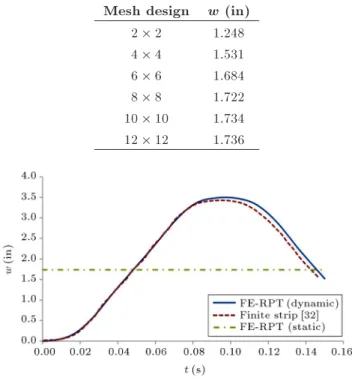
= 1:7869062 in: (31) The static analysis of problem is also performed by Static FF-RPT code. The eect of number of elements on central deection of the plate is investigated in Table 1. By increasing the number of elements, the obtained results converge to analytical value. Accord-ing to this table, considerAccord-ing 10 elements in each plate side is sucient to achieve converged result.
The dynamic response of the plate under pre-scribed loading is performed using Dynamic FE-RPT code. The computational time is considered 0.15 s which is divided into 1500 time steps of 0.1 ms; the obtained transverse deection of central point of the
Table 1. Convergence study for Example 1. Mesh design w (in)
2 2 1.248
4 4 1.531
6 6 1.684
8 8 1.722
10 10 1.734 12 12 1.736
Figure 3. Comparison of central deection of square plate subjected to uniform loading.
plate is shown in Figure 3. It is seen that the results of the presented formulation are in good agreement with those of nite strip method reported in [32], and the maximum dierence between these two methods is less than 10%. Furthermore, as expected, for the applied loading, the dynamic response of plate oscillates between 0 and twice the static value.
Example 2. Consider a simply supported rectangu-lar plate under uniformly distributed patch load of p0=
0:01 psi, as shown in Figure 4. The load is suddenly applied to the patch area and remains constant during applied time. The geometry and material parameters are considered as:
Figure 4. Rectangular plate subjected to suddenly applied patch load [32].
Figure 5. Time history of deection of central point of rectangular plate subjected to suddenly applied patch load.
Young's modulus E = 1 lb/in2,
Poisson's ratio = 0:3,
Mass density = 1 lb.sec2/in4,
Thickness h = 0:2in.
Figure 5 compares the time history of transverse deection of central point of the plate obtained by the proposed Dynamic FE-RPT formulation with the result of nite strip method, and good agreement is observed between the results of two methods. The analysis is performed by considering time step of 1 ms, and each plate side is discretized into 10 elements.
Example 3. A simply supported rectangular plate of (60 in 40 in 1 in) with material properties of E = 30 106 psi, = 0:3, and = 0:00073
lb.sec2/in4 is considered. The plate is subjected to
a uniform pressure having triangular time variations as shown in Figure 6(a). The dynamic response of the plate is obtained using the dynamic FE-RPT code considering a time step of 0.01 ms. Due to the symmetry of geometry and loading, half plate is discretized by a mesh of 12 8: Figure 6(b) compares the obtained dynamic response of plate with the results of boundary element method reported in [33], showing good agreement between the results.
Figure 6. Central deection of rectangular plate subjected to a uniform pressure having triangular time variation.
Table 2. Material properties of orthotropic plate.
E1 (GPa) E2=E1 G12=E1 G13=E1 G23=E1 12 21 (kg/m3)
200 0.525 0.26293 0.15991 0.26293 0.44026 0.23124 7860
Figure 7. Time variation of air blast pressure acting on a square plate [34].
Figure 8. Time history of central deection of square plate subjected to air blast.
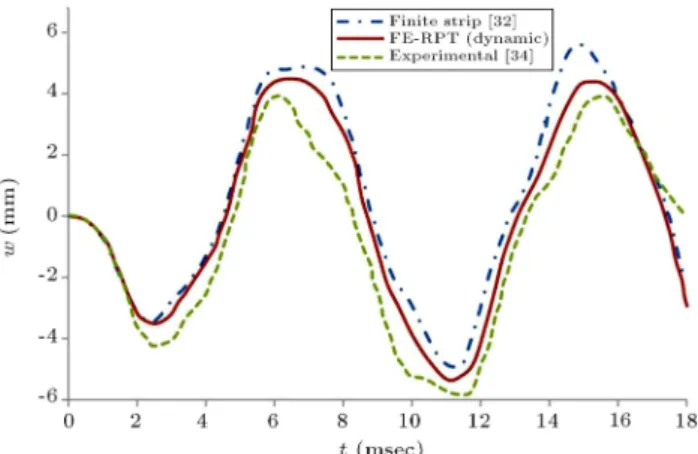
Example 4. A square plate with length of 508 mm, thickness of 3.4 mm, and material properties of E = 206:84 GPa, = 0:3, and = 7900 kg/m3 is
considered. All edges are clamped, and the plate is subjected to air blast pressure shown in Figure 7. The obtained time history of central deection of plate is compared with experimental [34] and nite strip method [32] results in Figure 8, where good agreement is observed between the results. A mesh of 12 12 is used for discretization of half plate, and time step is set to 0.01 ms.
3.1. Parametric study
In this section, an orthotropic plate under uniformly distributed loading with various boundary conditions, including fully simply support (SSSS), fully clamp (CCCC), and simply-clamp (SSCC), is considered, and eects of dierent parameters, such as aspect ratios, orthotropy ratio (E1=E2), and thickness ratio, are
studied on normalized transverse deections, in-plane normal stresses, and transverse shear stresses. The
Figure 9. Normalized central deection of orthotropic plate considering dierent thickness ratios, where a=b = 1.
Figure 10. Normalized central stress, x, of orthotropic
plate considering dierent thickness ratios, where a=b = 1.
analyses are performed using a mesh of 10 10 for the half plate and a time step of 0.01 ms. Material properties are chosen according to Table 2, and the following normalized parameters are introduced as follows:
w = wQ11/hq0; x= x/q0;
y = y/q0; xz = xz/q0: (32)
Figures 9 and 10 show the normalized transverse deection and normal stress of plate for dierent thick-ness ratios. As seen, the dynamic responses oscillate between zero and twice the static values, and the increment of the thickness ratio increases the stiness of plate, which results in the increase of frequency and decrease of amplitude of results.
The eect of boundary condition on normalized transverse deection and shear stress is investigated, as shown in Figures 11 and 12. As expected, by changing boundary conditions from fully simply sup-ported to fully clamped and, consequently, increasing the constraints on plate, the amplitude and frequency of results decrease and increase, respectively.
Figure 11. Normalized central deection of orthotropic plate considering dierent boundary conditions, where h=a = 0:1 and a=b = 1.
Figure 12. Normalized central out-of-plane shear stress, xz, of orthotropic plate considering dierent boundary
conditions, where h=a = 0:1 and a=b = 1.
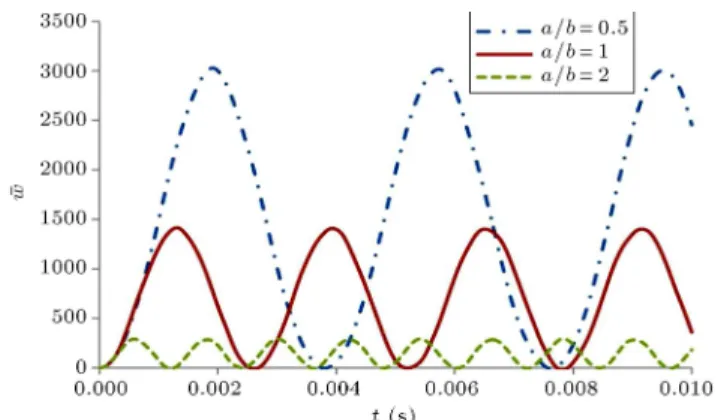
Figure 13. Normalized central deection of orthotropic plate considering dierent aspect ratios, where h=a = 0:1.
In Figures 13-15, eects of plate aspect ratio on normalized deections and stresses are studied. Param-eter a is constant in all analyses; by increasing a=b ratio and, consequently, decreasing the plate dimension (b), frequency and amplitude of results obviously increase and decrease, respectively.
The eect of orthotropy ratio (E1=E2) is
inves-tigated on dynamic response of plate in Figures 16 and 17. Parameter E1 is kept constant in all
anal-Figure 14. Normalized central normal stress, x, of
orthotropic plate considering dierent aspect ratios, where h=a = 0:1.
Figure 15. Normalized central out-of-plane shear stress, xz, of orthotropic plate considering dierent aspect
ratios, where h=a = 0:1.
Figure 16. Normalized central deection of orthotropic plate considering dierent orthotropy ratios, where h=a = 0:1 and a=b = 1.
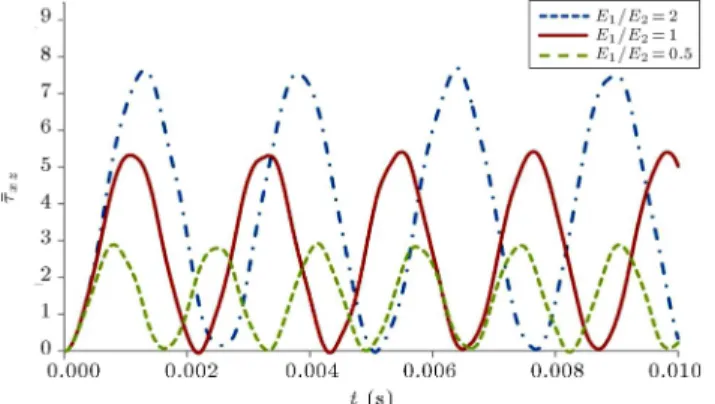
yses. Therefore, by increasing E1=E2 ratio, E2 and,
consequently, the overall stiness of structure decrease; moreover, frequency and amplitude of x and xz
decrease and increase, respectively.
4. Conclusion
In this study a nite-element formulation for dynamic analysis of isotropic and orthotropic plates is developed
Figure 17. Normalized central out-of-plane shear stress, xz, of orthotropic plate considering dierent orthotropy
ratios, where h=a = 0:1 and a=b = 1.
using the two-variable rened plate theory. This theory, which can be used for both thin and thick plates, predicts parabolic variation of transverse shear stresses across the plate thickness. In comparison with FSDT with three unknown parameters and the HSDTs with more than three parameters, this theory has only two parameters; therefore, the simplicity and accuracy are the main features of the present formulation. The main novelty of this work is constructing a dynamic nite-element model based on the two-variable rened plate theory for analysis of plate problems.
After constructing weak-form equations using the Hamilton's principle, a new 4-node rectangular plate element with six degrees of freedom at each node is introduced for discretization of the domains. The semi-discrete approach is adopted to deal with the dynamic analysis, and an unconditionally stable implicit New-mark scheme is used for temporal discretization. The eciency and accuracy of the presented formulation are proved by solving some benchmark isotropic and orthotropic plate problems. The obtained results are in good agreement with analytical solutions of common plate theories. Moreover, the eects of aspect ratio, thickness-to-side ratio, material properties and type of boundary conditions on deections and stresses are investigated.
The results show that the two-variable rened plate theory is simple and ecient in comparison with previous higher-order shear deformation plate theories; moreover, the present nite-element formulation can be a very useful tool for simulation of both thin and thick plate problems under static and dynamic loadings. The present study can be extended to other plate structures, such as functionally graded, laminated composite, and smart plates.
References
1. Kirchho, G. \Equilibrium and motion of an elastic disc [ AUber das gleichgewicht und die bewegung einer
elastischen scheibe", J. ReineAngew. Math., 1859(40), pp. 51-88 (1850).
2. Reissner, E. \The eect of transverse shear deforma-tion on the bending of elastic plates", J. Appl. Mech., 12(2), pp. 69-77 (1945).
3. Mindlin, R.D. \Inuence of rotary inertia and shear on exural motions of isotropic elastic plates", J. Appl. Mech., 18(1), pp. 31-38 (1951).
4. Whitney, J.M. and Sun, C.T. \A higher order the-ory for extensional motion of laminated composites", Sound Vib., 30(1), pp. 85-97 (1973).
5. Hanna, N.F. and Leissa, A.W. \A higher order shear deformation theory for the vibration of thick plates", Sound Vib., 170(4), pp. 545-555 (1994).
6. Reddy, J.N. \A simple higher-order theory for lam-inated composite plates", ASME. J. Appl. Mech., 51(4), pp. 745-752 (1984).
7. Reddy, J.N. and Phan, N.D. \Stability and vibration of isotropic, orthotropic and laminated plates according to a higher-order shear deformation theory", Sound Vib., 98(2), pp. 157-170 (1985).
8. Bhimaraddi, A. and Stevens, L.K. \A higher order theory for free vibration of orthotropic, homogeneous, and laminated rectangular plates", J. Appl. Mech., 51(1), pp. 195-198 (1984).
9. Kant, T. \Numerical analysis of thick plates", Comput. Methods Appl. Mech. Eng., 31(1), pp. 1-18 (1982). 10. Lo, K.H., Christensen, R.M., and Wu, E.M. \A
high-order theory of plate deformation, Part 1: Homo-geneous plates", J. Appl. Mech., 44(4), pp. 663-668 (1977).
11. Ghugal, Y.M. and Sayyad, A.S. \A static exure of thick isotropic plates using trigonometric shear deformation theory", J. Solid. Mech., 2(1), pp. 79-90 (2010).
12. El Meiche, N., Tounsi, A., Ziane, N., Mechab, I., and Adda Bedia, E.A. \A new hyperbolic shear deforma-tion theory for buckling and vibradeforma-tion of funcdeforma-tionally graded sandwich plate", Int. J. Mech. Sci., 53(4), pp. 237-247 (2011).
13. Shimpi, R.P. \Rened plate theory and its variants", AIAA J., 40(1), pp. 137-146 (2002).
14. Shimpi, R.P. and Patel H.G., \A two variable rened plate theory for orthotropic plate analysis", Int. J. Solids Struct., 43(22-23), pp. 6783-6799 (2006). 15. Kim, S.E., Thai, H.T., and Lee, J. \A two variable
rened plate theory for laminated composite plates", Compos. Struct., 89(2), pp. 197-205 (2009).
16. Thai, H.T. and Kim, S.E. \Analytical solution of a two variable rened plate theory for bending analysis of orthotropic Levy-type plates", Int. J. Mech. Sci., 54(1), pp. 269-276 (2012).
17. Rouzegar, J. and Abdoli Sharifroor, R. \Finite element formulations for free vibration analysis of isotropic and orthotropic plates using two-variable rened plate theory", Sci. Iran., 23(4), pp. 1787-1799 (2016).
18. Rouzegar, J. and Abdoli Sharifroor, R. \Finite ele-ment formulations for buckling analysis of isotropic and orthotropic plates using two-variable rened plate theory", Iran. J. Sci. Technol. -Trans. Mech. Eng., 41(3), pp. 177-187 (2017).
19. Rouzegar, J. and Abad, F. \Analysis of cross-ply laminates with piezoelectric ber-reinforced composite actuators using four-variable rened plate theory", J. Theor. Appl. Mech., 53(2), pp. 439-452 (2015). 20. Rouzegar, J. and Abad, F. \Free vibration analysis of
FG plate with piezoelectric layers using four-variable rened plate theory", Thin Wall. Struct., 89(1), pp. 76-83 (2015).
21. Rouzegar, J. and Gholami, M. \Non linear bending analysis of thick rectangular plates by four-variable Re-ned plate theory and Dynamic Relaxation method", Modares Mech. Eng., 15(2), pp. 221-230 (2015) (In Persian).
22. Nguyen-Xuan, H., Tran, L.V., Thai, C.H., Ku-lasegaram, S., and Bordas, S.P.A. \Isogeometric anal-ysis of functionally graded plates using a rened plate theory", Compos. Part B-Eng., 64, pp. 222-234 (2014). 23. Thai, C.H., Kulasegaram, S., Tran, L.V., and Nguyen-Xuan, H. \Generalized shear deformation theory for functionally graded isotropic and sandwich plates based on isogeometric approach", Comput. Struct., 141, pp. 94-112 (2014).
24. Nguyen, K.D. and Nguyen-Xuan, H. \An isogeometric nite element approach for three-dimensional static and dynamic analysis of FGM plates structures", Compos. Struct., 132, pp. 423-439 (2015).
25. Nguyen, T.N., Thai, C.H., and Nguyen-Xuan, H. \On the general framework of high order shear deformation theories for laminated composite plate structures: A novel unied approach", Int. J. Mech. Sci., 110, pp. 242-255 (2016).
26. Nguyen, L.B., Thai, C.H., and Nguyen-Xuan, H. \A generalized unconstrained theory and isogeometric nite element analysis based on Bezier extraction for laminated composite plates", Eng. Comput., 32(3), pp. 457-475 (2016).
27. Patel, H. and Shimpi, R.P. \A New Finite Element for a Shear Deformable Plate", 47th AIAA/ASME/ASCE/AHS/ASC Structures, Struc-tural Dynamics, and Materials Conference., Newport, Rhode Island, USA (2006).
28. Katori, H. and Okada, T. \Plate element based on a higher-order shear deformation theory", Transactions of the Japan Society of Mechanical Engineers Series A, 72(716), pp. 412-418 (2006).
29. Rouzegar, J. and Abdoli Sharifroor, R. \A nite element formulation for bending analysis of isotropic and orthotropic plates based on two-variable rened plate theory", Sci. Iran., 22(1), pp. 196-207 (2015). 30. Melosh, R.J. \Structural analysis of solids", J. Struct.
Div. ASCE, 89(4), pp. 205-223 (1963).
31. Rouzegar, S.J. and Mirzaei, M. \Modeling dynamic fracture in Kirchho plates and shells using the ex-tended nite element method", Sci. Iran., 20(1), pp. 120-130 (2013).
32. Sheikh, A.H. and Mukhopadhyay, M. \Linear and nonlinear transient vibration analysis of stiened plate structures", Finite Elem. Anal. Des., 38(14), pp. 477-502 (2002).
33. Providakis, C.P. and Beskos, D.E. \Free and forced vibration of plates by boundary elements", Comput. Methods Appl. Mech. Eng., 74(3), pp. 231-250 (1989). 34. Houlston, R. and Slater, J.E. \A summary of exper-imental results on square plate and stiened plates subjected to air blast loading", Shock Vibr. Bull., 2(57), pp. 14-16 (1986).
Biographies
Jafar Rouzegar is currently an Assistant Professor at the Department of Mechanical and Aerospace Engi-neering of Shiraz University of Technology, Iran. He received his BSc degree in Mechanical Engineering from Shiraz University, Iran in 2002. He also received his MSc and PhD degrees in Mechanical Engineering from Tarbiat Modares University, Iran in 2004 and 2010, respectively. His research interests include FEM and XFEM, theories of plates and shells, and fracture mechanics.
Mohammad Sayedain received his BSc in Mechan-ical Engineering from Vali-e-Asr University, Rafsan-jan, Iran in 2013. He also received his MSc degree in Mechanical Engineering from Shiraz University of Technology, Iran in 2015. His research interests include FEM, theories of plates and shells and composite materials.