Paul Jones
In 2010, entrepreneurial innovation emerged as the theme for a $125 million
fundraising initiative at the University of North Carolina at Chapel Hill. The
leaders of the initiative argue that if universities embrace entrepreneurial
thinking then these “engines of innovation” are poised to help solve some of
the world’s biggest problems. In this paper, I argue that the blueprint for such
an engine is far from complete, especially where the role of graduate students is
concerned. Over the course of my Master’s program, I tried to launch a venture
to build a community-owned “social archive site” for poverty alleviation. This
paper is a case study of that entrepreneurial effort and the barriers to innovation
I encountered.
Headings:
Social Network Sites
Innovation
Entrepreneurship -- Student
Student Groups
BARRIERS TO GRADUATE STUDENT INNOVATION IN SOCIAL MEDIA
by Michael Nutt
A Master's paper submitted to the faculty of the School of Information and Library Science of the University of North Carolina at Chapel Hill
in partial fulfillment of the requirements for the degree of Master of Science in
Information Science.
Chapel Hill, North Carolina
April, 2011
Approved by:
________________________
PREFACE ... 3
INTRODUCTION TO THE COMMUNITY COLLECTING PROJECT ... 9
INTENDED AUDIENCES ... 11
GRADUATE STUDENTS ... 11
FACULTY AND ADMINISTRATION ... 12
INFORMATION AND LIBRARY SCIENCE ... 14
THE ADVANTAGES OF AN ACADEMIC TOWNIE ... 16
METHOD ... 19
QUALITATIVE STORIES ... 20
THE STORY ECONOMY ... 20
WIKUMENTARIES VS. SOCIAL NETWORK SITES ... 23
NOT KNOWING ANYTHING ABOUT BUSINESS ... 27
THE PROTOTYPE: CAROLINA DIGITAL STORY LAB ... 29
LAUNCH THE VENTURE…OR NOT ... 31
THE DAY THE INNOVATION DIED ... 32
FINALLY, A COMPETITIVE ADVANTAGE ... 34
QUANTITATIVE STORIES ... 36
GOOGLE ANALYTICS DATA ... 36
MEETINGS ... 40
PERSONAL LESSONS LEARNED ... 45
CONCLUSION ... 52
REFERENCES ... 54
AUTHOR NOTE ... 57
APPENDIX A: BUSINESS PLAN ... 59
Preface
This is a case study of a big idea. My big idea. I have spent my graduate school
career trying to convince people that it is a good big idea. In fact, the personal goal of my
two-year graduate career was to be able to find a way to employ myself in the pursuit of
that big idea after receiving my master’s degree. For better or worse, I did not reach that
goal. When it came time to decide whether or not I would take a creative and well-paid
job at a well-respected library or try to risk bootstrapping a venture that was still trying to
find its footing after three years of grueling work, the choice was clear. By the time I got
a job offer in March 2011, my venture still had too many uninvestigated risks and no
capital, so I chose the library job. In the eyes of the state of North Carolina, I am now the
President of both a nonprofit and a limited liability corporation, but the future of those
entities is unknown. The case study that follows is an attempt to analyze some of the
factors that impeded the successful launch of my venture after graduate school.
I will not be self-employed next year, but that is not to say that I haven’t
accomplished anything. I set out to start a business, and in the process I created a student
group that I am extremely proud of. Whether or not the nonprofit I founded ever takes
off, I believe that the student group I started will be around for years to come. Indeed, I
hope to help ensure that happens as a supportive alumnus. So if this paper ever seems
A better manuscript would include more discussion of the highlights and milestones of
this journey, but those have been well documented elsewhere.1
Holden Thorp, chancellor of the University of North Carolina at Chapel Hill
(UNC), has identified entrepreneurial innovation as our top fundraising priority. Thorp
and Buck Goldstein, University Entrepreneur in Residence at UNC, say that universities
are the places where “big ideas are hatched and subsequently translated into reality”
(Thorp & Goldstein, 2010, p. 2). However, despite having all the resources available to a
graduate student, as well as some advantages unavailable to a typical UNC student, I was
not able to translate my big idea into the reality I wanted within the time I had here. Why
not? At UNC, I heard about lots of successful entrepreneurs, but detailed accounts of
students who try to start businesses and fail are hard to find. In this paper, I want to trace
the barriers to innovation that I faced so that university students, faculty, and
administrators might benefit from my experiences.
Before I explore what may have kept me from innovating, I would first like to
describe the origin of the vision that I have not been able to get out of my head for the
last three years. I can trace the big idea back to 2001 when I first heard the radio program
This American Life. I can say without hyperbole that it was a life-changing event. The
combination of interviews, narrative, documentary, field recordings, music, and found
audio unlocked something in me I did not know was there. This American Life taught me
that the stories of ordinary people could be just as engaging as the stories that are
manufactured in Hollywood. This simple revelation deflected me from an anticipated
career in the music business (thankfully) and towards a professional interest in what is
Digital storytelling is the use of the Internet and inexpensive digital media
technology (particularly video and audio) to “explain our identities to each other”
(Lambert, 2002). In the early 2000s, this was an innovative idea, and it was hard to find
practitioners and examples. Now, each of Facebook’s 500 million users creates 90 pieces
of content a month (Facebook, 2011), Twitter reports 600 tweets per second (Weil,
2010), and Myspace has had as many as 46 million status updates and action notifications
per day (Perez, 2009). Which is to say, social network sites have blown the lid off of
identity explaining. I believe what we have yet to find is a happy medium where new
media can be employed to collaboratively create and archive the important stories of our
lives, and that is the nucleus of my big idea: to create a “social archive site” that
combines the communal experience of a social network site with the stability of a digital
archive. I also believe that such social archive sites could be cooperatively owned and
operated to generate community economic development.
In 2008, I was employed as a Media Technician in the UNC Department of
Communication Studies’ undergraduate media production program. I managed a
half-million dollar audio/video equipment checkout room, helped faculty and students realize
their creative potential, and worked for a man who is likely to be the best boss I will ever
have. I decided I was ready for the next big thing after a remarkable email exchange
between a group of alumni that proudly call themselves the “Swain Hall Geezer-Coots.”
The media production program has its roots in UNC’s now defunct Department of
Radio, Television, and Motion Pictures, commonly referred to as RTVMP by its alumni.
Under the vision of UNC system president William Friday and founding department chair
launch public broadcasting in North Carolina in the 1950s. Students helped run the state’s
nascent public radio and television stations out of Swain Hall, and after graduation
frequently went on to work in North Carolina’s commercial broadcast stations. By the
60s and 70s, many of the state’s radio and television station managers and owners were
alumni of the RTVMP department. There is a long history of media-related innovation at
UNC.
In early 2008, a Communication Studies student and employee of the North
Carolina Collection at UNC’s Wilson Library gave me a DVD full of high quality scans
of archival pictures. The pictures featured students, faculty, and staff from the hey-day of
RTVMP in the 1960s. The photos were punctuated with racks of bewildering analog
electronics, broadcast personalities talking into microphones and cameras, and a fair
amount of indoor smoking. The photos were obviously of historical importance – but
there was almost no useful metadata associated with each photograph. The stories behind
the photographs were obscured.
I had previously met WCPE Program Manager and RTVMP alum Dick Storck,
who had enjoyed looking at a folder full of old photographs I had found in my office file
cabinet. I knew that Mr. Storck would be interested in this newly discovered trove of
archival photographs, so I contacted him to see if he would be willing to help identify the
While our plans for a larger exhibit of
the department’s history never coalesced, Mr.
Storck and several of the other Geezer-Coots
nevertheless found a way to electronically
share and annotate the pictures over email
(see Figure 1). While the Geezer-Coots’
color-coded annotations fleshed out the
stories of these remarkable photographs, I
was struck by the inadequacy of the tool for
the task. While email certainly got the job
done in this instance, it was inefficient and
cumbersome. Perhaps most importantly, the
Geezer-Coots had gone through all the
trouble of social annotation for 54
photographs, but the stories still only live in the inboxes of a handful of people. The
original photos will remain in their archival folders, separated from the rich context of
this collaborative storytelling. At the time, I thought that some kind of wiki would have
been a more appropriate tool for this project, because a wiki provides mechanisms for
quality control, versioning, and collaborative authorship. Indeed the collaboration,
sharing of knowledge, and “sense of belonging to something greater” reflected in these
email exchanges is typical of a wiki user (T. D. Moore & Serva, 2007, p. 155). After this
experience, I knew that I wanted to build a wiki-based “social archive site” for creating
the kinds of digital stories I wanted to build and preserve are made of information. After
some research, I decided that a master’s degree in information science would be the next
step in my career, and I enrolled full time at the UNC School of Information and Library
Science (SILS) in the fall of 2009.
From the beginning of my information science career, then, I was driven by the
desire to solve a problem and build a job for myself around the solution to that problem.
Having already worked professionally in several media-related jobs, I was relatively
certain that the right job for me either did not exist or else was so rare that it would make
more sense to start my own business. Although I only realized it later, I was approaching
my graduate school career with an entrepreneurial mindset, viewing big problems as big
opportunities (Thorp & Goldstein, 2010). What follows is the story of my attempt to
innovate at the University of North Carolina at Chapel Hill.
Introduction to
The Community Collecting Projec
t
This paper is one part of a four-part master’s project called Community Collecting
that also includes a business plan, a pitch, and a website:
1) The business plan is for a nonprofit “social archive site” for sharing and
preserving digital stories. The plan is attached as Appendix A.
2) The pitch is a slideshow designed to attract funding for the nonprofit. The notes
for each slide provide the text that would be delivered in person during a live
pitch. The pitch is attached as Appendix B.
3) This master’s paper takes the form of a case study. In it, I examine the road that
I have traveled since initially conceiving my entrepreneurial idea and
subsequently enrolling at SILS in order to pursue it. At the end of this case study,
I reflect on the lessons I have learned while trying to start innovative programs
within an academic setting.
4) The plan, pitch, and this paper, along with a collaborative bibliography of related
literature, are collected at the websitehttp://communitycollecting.web.unc.edu.
Over the course of this project, I incorporated Digital Storymakers Foundation in
the state of North Carolina (hereafter referred to as Storymakers). I serve as Storymakers’
President and am currently its sole officer. The plan and pitch were also entered into the
A potential disadvantage for this venture is being, to the best of my knowledge, a
first mover in a little understood social media niche. This niche depends on a “buy local”
economy but uses personal and community digital cultural assets as the basis for product
offerings. As the saying goes in the business world, the early bird gets the worm, but the
second mouse gets the cheese. To mitigate the “first mouse” nature of this venture, the
entire Community Collecting project is being released under the least restrictive Creative
Commons license.2 An important goal of this project is to provide an adaptable
framework to encourage other students, individuals, and communities to build their own
social archive sites. I hope that open-sourcing the business plan will attract those with the
capacity to help me improve the idea, whether through collaborating with me directly or
developing the idea through separate ventures.
Intended Audiences
I anticipate that this master’s paper will be valuable to three distinct audiences:
1) Graduate students
2) University faculty and administrators
3) Researchers and practitioners in the field of Information and Library Science
Graduate Students
While I am sincere in my effort to eventually launch this venture, the primary
goal of this master’s paper is distinct from my entrepreneurial goal. In this paper, I hope
to provide a model for other students interested in entrepreneurial innovation. This case
study is intended primarily for prospective or current graduate students who:
• Believe that entrepreneurial innovation can be used to improve quality of life
• Have an idea to solve a problem
• Would like to use graduate school as a springboard for starting a business to solve
the problem
The reader who fits this description will be a lot like me, three years ago. It is my hope
that the experiences that I document in this paper will provide useful parables to
entrepreneurial students, particularly those interested in the social media industry. I
believe that student readers of this paper will be able to increase the efficiency of their
There is no shortage of literature on the intersection of entrepreneurship and
academia or entrepreneurship education. However, there appears to be a nearly complete
dearth of research regarding barriers to entrepreneurial efforts by graduate and
professional students within the university itself, which is unfortunate since these students
have many unique circumstances that can make launching a venture daunting. After six
or more years of undergraduate and graduate school debt, Master’s and professional
school students are less likely to be able to choose the uncertain financial lifestyle of a
bootstrapping new entrepreneur. They often earn their degrees in only two years, and
rarely live on campus, making it much more difficult to establish social networks that can
be leveraged for support in entrepreneurial activities. When I was able to find
collaborators in my social network of colleagues and acquaintances, they frequently (and
understandably) exhibited a preference for taking care of their own needs and goals rather
prioritizing my own entrepreneurial aspirations. Often they will have found committed
partners or have a family. It is nearly impossible to give the proper amount of time to
loved ones while also going to graduate school full-time, working a twenty hour per week
research assistantship, and trying to start a business. Undoubtedly, the week will not
contain enough hours for the entrepreneurial graduate student. The primary purpose of
this paper is to help illuminate and straighten the path of graduate students that find
themselves in situations similar to mine.
Faculty and Administration
The second type of reader who might benefit from this case study is a faculty or staff
member at a large research university who is:
• Interested in reducing barriers to graduate student entrepreneurial innovation
• Seeking to understand or increase the role of entrepreneurship for graduate
students in non-translational disciplines
UNC’s own Chancellor Holden Thorp provides my mental model for this imagined
reader. Indeed, he was the catalyst for this paper. In 2010, the leader of this university
co-authored a book entitled Engines of Innovation: The Entrepreneurial University in the
Twenty-First Century and launched a $125 million fundraising effort dedicated to
supporting entrepreneurial innovation.
Thorp’s efforts to encourage entrepreneurship at UNC had a direct influence on my
own academic and entrepreneurial endeavors. His various writings and initiatives were
inspiring, educational, and affirming but were just as often frustrating and irrelevant to
my own situation. According to its jacket, Engines of Innovation is intended to be a
“practical guide” for generating high-impact innovation in the halls of academia.
Remarkably, however, the 170-page text omits the student perspective entirely. When
students are briefly mentioned, they are either as over-simplified cultural abstractions or
as the simple objects of teaching. Instead, the authors focus on political and
administrative structures that either had little relevance to my entrepreneurial efforts or
directly contradicted my experiences. In the book’s index, more pages are devoted to the
subject of donors than students.
In their introduction, Thorp and Goldstein describe the attributes of an
entrepreneurial thinker, and I humbly suggest that my narrative will show I possess all of
them. Was it unrealistic for me to think I could start my own business? If so, could the
how can the university prevent other students from making the same mistakes? I hope my
story will inspire faculty and administrators to ponder these questions and to implement
the solutions they imagine.
Information and Library Science
In a Delphi study of Library Journal “Movers & Shakers” award winners, Adam
Rogers found that risk-taking and flexibility, two entrepreneurial skills, were thought to
be the most important for librarians in the near future (A. Rogers, 2010). Out of a list of
28 skills that might change in importance for librarians in the next five years, these two
were the ones predicted to become “much more important” by some of the field’s most
interesting practitioners.
In the face of perpetually shrinking budgets, it may seem paradoxical at first that
librarians are thinking about risk-taking. If every dollar is precious, how can public
libraries afford to take chances? In fact, it may be that libraries need to turn to
entrepreneurial thinking precisely because of the uncertainty of public funding. Now
more than ever, libraries must prove their worth. The decreasing value of large print
collections makes libraries an easy target. They must provide a clear and attractive value
proposition to their communities in order for those communities to take an interest in
protecting them from rampant and drastic budget cuts.
The interdisciplinary nature of the information and library science field means
graduates could be highly sought after team members in entrepreneurial ventures if they
have experience solving problems and building systems with their knowledge, but often
innovators from elsewhere on campus are unaware that their needs require ILS expertise.
designing a database for a real client rather than the hypothetical one we built instead. A
year later in December 2010, I sat in on a meeting of the Chancellor’s Student Innovation
Team, where the students tasked with helping to implement the Chancellor’s innovation
roadmap discussed the need to find a computer science student to create a social database
of innovative and entrepreneurial campus activities. These students were completely
unaware of the existence of SILS until I spoke up and suggested that our students had the
skills they needed. Indeed recent SILS alumnus Brandon Young had already created the
exact resource they wanted when he was a member of the Carolina Entrepreneurial
Commune. It is my desire that this paper may illuminate some opportunities for the ILS
field to further explore and assert its role in the solutions of the world’s great new
The Advantages of an Academic Townie
Before a student might be able to usefully compare my entrepreneurial activities
with their own, one should consider that I had several advantages that likely helped me
accomplish as much as I did in my short time at UNC. I believe there were several factors
that differentiated me from most of the other graduate students I met in my program at
SILS. I would like to briefly catalog them here in order to underscore just how difficult it
is for a graduate student to launch an innovative venture at a large research university.
1) I was more familiar with UNC than a typical graduate student. I finished the last
two and a half years of my bachelor’s degree in the UNC Department of Communication
Studies in 2004. I went on to work for the same media production program from 2005
until I began graduate school fall 2009. This provided me with advanced knowledge
about the resources I would have access to as a graduate student. Perhaps more
importantly, as a staff member I came to understand UNC’s highly politicized nature and
some of the factors that governed access to available resources. Later in this paper, I
discuss the process of starting a student group to address media-related needs on campus.
I could not have been aware of these needs had I not already spent six and a half years in
2) I had more flexibility in my course load than a typical SILS student. When I was a
staff member, I completed a graduate certificate program in nonprofit leadership. I was
able to use 9 hours from this program as transfer credit, and waive a required
management course. Additionally, I took a total of six hours of credit in both the
summers of 2009 and 2010. Normally, the SILS curriculum requires a student to take
twelve credit hours per semester in order to graduate in two years. I was able to reduce
my load to nine hours per semester during both spring 2010 and fall 2010, and only
enrolled in four credit hours the final semester of my graduate career. The time I saved by
not taking as many classes was easily consumed by trying to launch an entrepreneurial
venture. It is difficult to imagine how I would have survived four semesters of a full
twelve-credit load.
3) I was more familiar with Chapel Hill and Carrboro than a typical graduate
student. I have lived in Chapel Hill or Carrboro for all but three months of the last eleven
years. My venture was always envisioned as one that was crafted specifically for the
Orange County, North Carolina market. The area has many characteristics that make it
ideal for Digital Storymakers, including high education levels, deep technology
penetration, and a culture friendly to entrepreneurship; if my venture cannot succeed in
the Triangle, then it likely would not succeed anywhere. My familiarity with the people
and values of the area mitigated a lack of detailed market research. Had I just moved to
the county, my lack of knowledge about the area would have made my various proposals,
4) I had already performed substantial academic work related to the problem I
wanted to solve. In Social Work’s nonprofit leadership certificate program, I began
research that culminated in a juried paper that I co-authored and presented with Gilson
Schwartz at the 5th Prato Community Informatics & Development Informatics
Conference 2008 in Italy. I still regard the argument at the center of that paper – that
personal digital stories can and should be used for community economic development –
as the truly innovative part of my vision for a social archive site. This previous familiarity
with the theory behind my venture helped me to recognize relevant new information
when it came along in my classes. I was able to synthesize new ideas much more quickly
Metho
d
This case study is informed by analysis of various personal and web-based
records. Over the course of my two-year (four-semester) program, and particularly in my
second and third semesters from January 2010 to December 2010, I collected data and
field notes pertaining to Carolina Digital Story Lab (a student group I started during this
time) and the Storymakers business plan. Data sources I used for the construction of this
case study include:
• One year’s worth of field notes and journal entries from meetings, seminars,
workshops, and classes relevant to the venture
• Annotated web traffic statistics from Google Analytics for
http://www.uncstorylab.org, the website of Carolina Digital Story Lab
• Sent and received emails related to the activities of Carolina Digital Story Lab
This set of varied quantitative and qualitative sources provided a timeline for the
Qualitative Stories
This chapter presents narrative details about some of the most significant aspects
of my entrepreneurial efforts, beginning with the genesis of the social archive site idea
one year before enrolling in graduate school.
The Story Economy
While innovation itself may be as simply defined as a new idea, practice, or object
(E. Rogers, 2003), Thorp and Goldstein (Thorp & Goldstein, 2010) argue that for a
university to generate high-impact innovation, it must offer a solution to one of the
world’s biggest problems (e.g. climate change, communicable diseases, environmental
degradation, extreme poverty, etc.). While the Geezer-Coots provided the inspiration for
the social archive site as an information system for collecting personal stories, such a
system alone would not qualify as “high-impact.” After all, the Geezer-Coots’ problem
was not insoluble; they were seemingly content with their email exchanges.
What I believe to be the truly innovative part of my idea was formed in the UNC
School of Social Work in 2008. While I worked full time for the Communication Studies
department, I also worked towards the completion of a Certificate in Nonprofit
Leadership through the School of Social Work. The certificate required the completion of
five graduate-level classes on various aspects of nonprofit leadership, including nonprofit
took SOWO 881: Community Practice and Planning with Dr. Marie Weil. In this course,
I was introduced to John Friedmann’s theory of alternative development (Friedmann,
1992). In Empowerment: The Politics of Alternative Development, Friedmann argues that
the poor are actively engaged in the production of their own lives and that this often
precludes participation in the formal aspects of the economy. The activities of the poor
usually suffer from “invisibility to official eyes” (Friedmann, 1992, p. 43) because their
activities are not reflected in traditional metrics like gross domestic product. This requires
us to rethink the poverty problem as a lack of access to bases of social power since
traditional economic development is aimed towards accelerating areas of the economy in
which the poor do not always participate.
The use of social empowerment as a development tool resonated deeply with me,
but Friedmann’s theory also felt slightly dated, and framed in the realities of
production-based economies. Empowerment was authored before the appearance of the world wide
web, and I wondered whether the advent of the information economy required a
reconfiguration of Friedmann’s model, and whether new creative industries might even
provide opportunities for the previously excluded to participate in more mainstream
economic spaces. Friedmann says an alternative development is necessary partly because
the activities of the poor are often incapable of being “traded for money” (Friedmann,
1992, p. 52). But in a knowledge economy, the production of livelihood has a valuable
byproduct that can be captured qualitatively through online digital media (and later I
would realize, quantitatively through networked social interactions): the story.
At the time, I was a member of an email discussion list for community
application of information and communications technology to enable and empower
community processes” (Gurstein, 2008, p. 11). After finishing my research paper for Dr.
Weil’s class, I posted it to this discussion list for feedback. To my great surprise, the
organizer of the annual Prato Community Informatics & Development Informatics
Conferences in Italy suggested that I should submit my paper if I could augment it with a
case study. I again turned to the listserv for help, and was surprised again to find a willing
collaborator…in Brazil!
Gilson Schwartz, Academic Director of the Universidade de São Paulo City of
Knowledge provided an incredible example that made my purely theoretical paper much
more convincing. Schwartz had been involved in a project with the Xavante people from
Mato Grosso to create cell phone icons and ringtones based on their indigenous
knowledge, stories, and songs. These representations of their livelihoods were available
for downloading, and revenue generated through digital sales was returned to the
Xavante.
After the addition of this case study, the paper was accepted, Schwartz and I met
and presented the paper in Italy, and it was published in the conference proceedings (Nutt
& Schwartz, 2008). While I was more or less terrified by the whole process (keep in
mind, I was simply a UNC staff member with a bachelor’s degree at this point), and far
from confident about the paper’s quality, I was energized and thrilled at the positive
reinforcement I received at the conference. As the world’s economy seemed to be
crumbling around us, I was buoyant at the prospect that I might be on the track of an
innovative solution to poverty. However, my contributions to The Story Economy were
also working on the first prototype for a story management system, which I called a
“wikumentary.”
Wikumentaries vs. Social Network Sites
Wiki inventor Ward Cunningham calls a wiki “The simplest online database that
could possibly work” (Cunningham & Leuf, 2002). While this short definition is rather
vague, it provides several of the reasons why I believed wikis were the right solution for
the kind of historical documentation problem that the Geezer-Coots faced. I wanted to
build a publicly accessible system, so providing online access was essential. It would
need a database to manage files and metadata. Perhaps most importantly, it would have to
be as simple as email or else the barriers to adoption were likely to be too high for
widespread adoption. In fact, I wondered whether the Geezer-Coots might simply be able
to add their stories to Wikipedia.org, the world’s largest wiki and online encyclopedia
(Stvilia, Twidale, Smith, & Gasser, 2008), but the terms of use prevent adding content
that is not “verifiable against a published reliable source.”4 The information system that
was needed would be an individual wiki instance where users could contribute media and
their own subjective recollections and stories about the events of their past, regardless of
whether or not those stories could be verified by some other source.
In 2008, shortly after the Geezer-Coots’ photo-swapping emails, I bought the
domain name wikumentary.net to prototype my vision for collaborative storytelling about
personal events. Although I was not the first to come up with a portmanteau of the words
‘wiki’ and ‘documentary,’5 I believe I was the first to model this particular vision for
collaborative online documentaries. In an effort to demonstrate that wikumentaries could
adding content about myself, including topics as varied as homebrewed beers I made to
bands that I liked to the book club I belonged to, along with photographs and videos (see
Figure 7 below). I also maintained a blog on the site to discuss various aspects of the
concept of wikumentary.
Figure 2. Screenshot of http://wikumentary.net
I began to think that Cunningham’s definition was overly optimistic. Operation of
the wiki I had created was anything but simple and it was debatable whether or not it
“worked.” The wiki software I chose, TikiWiki, was frustrating and confusing, and I soon
began to spend less time developing the wikumentary side of the site than simply
blogging about the ideas behind wikumentary. Additionally, I was rarely ever able to get
others to contribute to the site; there were more contributions from spambots than from
collaborative editing of web pages held much promise for story-based online
documentary – my last blog post on wikumentary.net was March 17, 2009, just over a
year after I had started the site. This was also around the time I confirmed to UNC that I
would attend graduate school at their School of Information and Library Science. I
thought to myself something along the lines of, “Well, this website is pretty awful, but
that’s why I wanted to go to graduate school in the first place. Maybe I’ll learn something
that will help me envision a better system.” That turned out to be exactly what happened.
My first semester at SILS in fall 2009, I took the special topics class INLS
490-151: Social Network Sites with then PhD candidate Fred Stutzman, in which we studied a
wide range of social network sites designed for everyone from knitters to business
professionals. It quickly dawned on me that social network sites (SNSs), not wikis, were
already being employed by millions of users to document the events of their lives. Social
network sites are:
...web-based services that allow an individual to (1) construct a public or semi-public profile within a bounded system, (2) articulate a list of other users with whom they share a connection, and (3) view and traverse their list of connections and those made by others within the system. (boyd & Ellison, 2007)
In April of 2009, four of the top six most popular websites for hosting digital photographs
were SNSs (Schonfeld, 2009). The attractive graphical user interfaces, lack of complex
syntaxes, and, most importantly, heavy social interaction, offered several benefits over
the wiki-based system I had envisioned. While wikis facilitate sophisticated versioning
history that allows for greater quality control (Stvilia et al., 2008), this function is less
network sites are more familiar than wikis. Nearly half of online adults in the United
States use a social network site (SNS), up from only eight percent in early 2005 (Lenhart,
2009). While I was unable to find estimates of the number of wiki users, active editing on
Wikipedia, undoubtedly the only wiki familiar to many Internet users, has hovered
between 80,000-100,000 worldwide for the last four years, and claims 1.3 million users.6
By comparison, Facebook claims 500 million active users worldwide.
In the two social archive site prototypes I have created (Wikumentary.net and
uncstorylab.org, discussed below), the ability to edit content authored by some other
person was utilized far less than the ability to simply comment on the content. In the
documentation of personal stories, it is less important to arrive at one version of the
“truth,” reflected in a single text document, than to allow comments, clarifications, and
addendums on user-authored texts and supporting documents. This reluctance to edit text
authored by others has also been found in previous studies (White, Gurzick, & Lutters,
2009) (Munson, 2008).
With this in mind, for my final assignment in INLS 490-151, I attempted to
capture my ideas in a business plan for the first time. Although I said that the company
would utilize a content management system called Wikumentary, the plan was
SNS-centric, not wiki-centric. This is also when the name Digital Storymakers was born, in
large part because I was able to purchase digitalstorymakers dot net, dot org, and dot
com. In moves that were outside of the scope of the assignment, I incorporated Digital
Storymakers, LLC in North Carolina and began the process to trademark the phrase
Digital Storymakers in the software industry (a process which is still ongoing nearly one
Digital Storymakers has not earned a dime and in fact has cost me several hundred
dollars in annual fees to North Carolina.
Although this early business plan is notable because it represents an important
transition in my vision from a wiki-based website to a social network site, there is little
that remains in the Digital Storymakers business plan from the document that I turned in
to Mr. Stutzman, as I will discuss in the following chapters. Looking back at this
assignment with the benefit of hindsight, it becomes clear that the product I turned in was
little more than a theoretical academic exercise, lacking a clearly articulated value
proposition and so broad as to include “recommendation systems, advertising,
podcasting, digital publishing, e-commerce, multimedia pattern recognition and object
detection, data mining, and game design.”
During the following spring semester, I met with Mr. Stutzman to discuss my
final assignment and the feasibility of launching the business as my master’s project. The
most important piece of advice that came from that meeting was that building a system
would not be as difficult as building the information-sharing community behind it. He
suggested that I start a low-fidelity version of the idea (e.g. an email listserv) to start
investigating the links between online and offline social networks. While this was an
important piece of advice, it was one that did not immediately sink in. I felt that my time
in graduate school would be too short to spend time on building a low-fidelity prototype.
This bit of hubris would not last long.
Not Knowing Anything About Business
At Stutzman’s suggestion, I met with ibiblio Director and UNC Professor Paul
start a business. He agreed, but only after a thorough grilling that concluded with the
observation, “It sounds like you don’t know much about business.” This was not an
unduly harsh summation of my business experience, but until that moment, I had not
considered that fact to be an obstacle. The truth is, I hadn’t considered it at all.
A recurring theme of the School of Social Work’s Nonprofit Leadership program
was that funders and the public at large increasingly expected nonprofits to act like
businesses and adhere to the principle of the “Triple Bottom Line.” That is, modern
nonprofits must not only provide social value and stewardship of environmental
resources, but must also generate their own revenues. Until that lunch with Professor
Jones, I had mistakenly assumed that my education about business-like nonprofits would
be enough to guide me through the establishment of my own innovative venture. After
that conversation, I was no longer under the impression that a nonprofit manager and an
entrepreneur were the same thing. This conversation and realization led directly to my
enrollment in the UNC Kenan-Flagler Business School’s entrepreneurship class Launch
the Venture I, discussed below.
As if this wake-up call was not enough for a single lunchtime meeting, Professor
Jones also asked another question of me that turned out to be pivotal. “Why you?”
“I’m sorry?” I asked.
“Why are you the person to lead this company you want to start? Why should I
believe you can do it?”
I opened my mouth to start talking about my academic resume and work history
but immediately realized that I did not have a convincing answer to this question. I had
(not any actual nonprofit management experience),and had written a paper that had been
published in the proceedings of a small conference for the obscure academic field of
community informatics, but these things would largely be theoretical abstractions to a
venture capitalist. I had never started or lead a real organization.In the split second it
took to realize this, Jones realized it as well. Before I could stumble my way through a
response, he spared me the embarrassment and explained that I wasn’t going to convince
anyone to give me resources to build this venture if I couldn’t at least explain why I was
worthy of them. He predicted correctly that I would face that question many more times
if I were really trying to start a business. I understood that a good answer to this question
was going to take more than a class at the business school, which was incredibly
disheartening at the time. As a graduate student, how could I possibly gain the kind of
experience I needed in order to be a convincing leader? A solution to this problem came
to me driving back from the North American Handmade Bike Show in Richmond,
Virginia.
The Prototype: Carolina Digital Story Lab
The day after I met with Professor Jones I drove to Richmond to ogle ridiculously
expensive, handcrafted bicycles with my friend Colin, who was flying in from San
Francisco. I had few expectations for the weekend other than an east-coast rendezvous
with my childhood friend, but the experience turned out to provide yet another pivotal
moment in the progression of the social archive site idea. Colin had also invited his friend
Kay, a software developer and two-times CEO from New York City. Over the two-day
weekend, he was gracious enough to spend the time it took for me to fully explain my
cautious and asked a lot of questions, some of which I had answers for, and some of
which I did not. His expertise in software development and data management was
especially helpful. Kay was the first person to impress upon me how technically difficult
it would be to build a social network site from scratch, and especially one that was going
to pay dividends to its members. I was familiar with administering content management
systems, and writing HTML and CSS code, but he suggested using Ruby on Rails as the
web application framework for the site. I had no idea what Ruby on Rails was.
I had assumed that building the site was going to require a level of technical
expertise above and beyond my own. I am no Mark Zuckerberg, and I was well aware
that my vision would require more programming knowledge than I had time to learn. I
had imagined that the site could be built with the help of a talented Chief Technology
Officer that had skills in data management and large-scale web applications. However,
after talking to Kay, I realized I was in a Catch 22: In order to attract resources to the
project, including investment capital and the technical talent I needed, I would likely
have to build a working prototype, but I would need technical talent to build a prototype.
On the three-hour drive back to Carrboro from Richmond, my conversations with
Jones and Kay weighed heavily on my mind. In less than three days, I had come face to
face with two major dilemmas: I lacked both the leadership experience and the technical
expertise I needed to get Digital Storymakers off the ground. These were significant
problems that could derail the momentum without an adequate solution. Turning these
problems over in my mind, something clicked, and I made one of the most important
decisions of my graduate career: I could solve both of these problems by starting an
“start-up” experience I needed and I could build a “low-fidelity” prototype website for
the group using a simple content management system. Driving down I-85, I was smiling,
laughing, and slapping the steering wheel in excitement. I had actually come up with a
single solution to what had seemed to be two nearly insurmountable problems. Of course,
another question was waiting for me. Could I execute?
Within two months, I had been granted official student group designation for a
group I named Carolina Digital Story Lab. From April to December 2010, I spent an
enormous amount of time trying to attract collaborators and resources to the Story Lab.
That process is discussed below in the section “Quantitative Stories.”
Launch the Venture…or not
With the Story Lab in motion, I set about my parallel effort to hone and launch
Digital Storymakers. I did this primarily by enrolling in the Kenan-Flagler Business
School’s MBA 848: Launch the Venture I. This was the first of a four-part, year-long
course that is designed to take UNC faculty, staff, and students through the process of
launching a venture. Admission into each of the subsequent classes was through a juried
application and business pitch. At the beginning of the semester, I made a deal with
myself that if I could make it all the way through all four parts of the class, I would try to
launch Digital Storymakers after school.
I will not recount all the things that I learned in that class here, but suffice to say
that this was when I realized just how right Jones had been when he evaluated my
business knowledge. The most important thing I learned was the concept of the value
proposition, which had been absent from the first iteration of my business plan for
proposition for Storymakers, searching for the right combination of factors that would
convince Professor Patrick Vernon that I was onto something. That never happened.
Vernon was charismatic and helpful, but my ideas were completely unprepared for the
ruthless Socratic inquiry of an entrepreneurial business professor.
Over the course of Launch the Venture I, I changed my idea several times in
search of a solid value proposition. In the end, I believe this worked against me and may
have been one of the reasons I was not selected to advance to the second module of the
course, Launch the Venture II. Every time I opened my mouth to discuss Storymakers, it
took a different form. The Launch the Venture series is intended for ventures that are
farther along in their development.
Although I had made a deal with myself that I would not pursue my business after
graduate school if I did not make it all the way through Launch the Venture, I couldn’t
make myself let go of the idea yet. After the class ended, I turned my attention to the
Story Lab student group, and tried to digest what I had learned in order to prepare for
UNC’s premiere business plan competition in the forthcoming spring semester, my last.
The Day the Innovation Died
While taking Launch the Venture in September, I took part in a remarkable legal
clinic7 hosted by the UNC Center for Sustainable Enterprise’s BASE program (Business
Accelerator for Sustainable Enterprise). The clinic was comprised of two parts. The first
part was a lecture by Vaddrick Parker, Attorney of Vaddrick Q. Parker Law Firm, on
basic legal principles for start-ups. The second part was a free consultation with lawyers
from NC LEAP (North Carolina Lawyers for Entrepreneurs Assistance Program), a
I say that the clinic was remarkable not because of the free half-hour I got with
NC LEAP Director Mary Horowitz, although that was surely fortuitous. It was
remarkable because only two other people (including just one student, a classmate of
mine in Launch the Venture I) came to the event to claim the free legal advice. After
awkwardly waiting for a few minutes for more people to show up, Parker ran through an
abbreviated version of his lecture, and then talked with each of us about our ventures.
During the second part of the clinic, I spoke in private with Horowitz and an
intern from the UNC Law School. The most important outcome of this consultation was
that the Digital Storymakers business plan did not, in her professional opinion, constitute
an organization that would fall under North Carolina’s definition of a cooperative.
Cooperatives were limited to agriculture-related companies.
It was too late to change my pitch to advance to the next stage of Launch the
Venture, but in light of this legal advice, afterthe class, I stopped referring to Digital
Storymakers as a cooperative social network site that would re-distribute dividends or
returns to its members. I felt that what I was trying to build was already complicated
enough, and that without the efficient phrase “cooperative” in my elevator pitch, it would
be even more difficult to describe the profit-distribution system I envisioned.
Whether or not Digital Storymakers will ever actually call itself a cooperative
remains to be seen. I feel strongly that the cooperative profit distribution mechanic is the
truly innovative aspect of my idea. After all, I saw the primary outcome of my venture as
poverty alleviation, not digital story preservation. Without a mechanism for profit
distribution to members, the idea is much less interesting to me and potentially much less
member dividends have been removed because of the difficulty in communicating the
innovation and because of the unknown legal structures necessary for implementation. I
hope that member dividends are still possible in the future, but I do not think it is
something I will be able plan without legal counsel that is beyond my reach right now.
Finally, A Competitive Advantage
During my final semester I took only four credit hours, three of which were for
the completion of this master’s project. The other one-hour course turned out to provide a
crucial element to the current iteration of the Storymakers business plan in the form of a
badly needed competitive advantage. In INLS 490-161: Building a Personal Digital
Library with Professors Reagan Moore and Arcot Rajasekar of the UNC DICE Center, I
shifted the Storymakers business plan once again to incorporate the iRODS technology
developed by the DICE group. iRODS (Integrated Rule-Oriented Data System) is an
open source middleware that I realized could provide the infrastructure for the
preservation environment that I wanted Storymakers to be able to provide. Marrying my
ideas for a social archive site with iRODS seems like a natural fit, and finally gives me an
good response to the question, “Why would I want to use your website when I already
have Facebook?” While Facebook makes redundant copies of user information on
multiple servers to guard against data loss, they do not provide any data management
polices that check for file integrity (R. Moore, 2011), a necessary step for long-term
digital preservation.
It is important to make stress a distinction here: iRODS is a good competitive
advantage, not a good value proposition. Users seem more than willing to contribute their
any thoughts for the long-term preservation of those media files. Nevertheless, in the
future, using iRODS as a middleware technology will enable Storymakers to build a more
robust product.
3 http://vancouvercommunity.net/lists/info/ciresearchers
4 http://en.wikipedia.org/wiki/Wikipedia:About
5 When purchasing the domain name, I initially wanted wikimentary.org. At the time, that
domain was owned by the Wikimedia foundation, who I discovered is fond of buying up ‘wiki’-prefixed domains to leave their options open for spin-off projects.
6 http://stats.wikimedia.org/EN/TablesWikipediaZZ.htm
Quantitative Stories
In this chapter I present the results of my quantitative analysis of field notes
recorded for this project, which include annotated web traffic logs for uncstorylab.org
and a journal of notes taken during meetings with project collaborators and prospective
collaborators.
Google Analytics Data
On May 15, 2010 I installed a WordPress content management system server space
given to us by ibiblio and uncstorylab.org was born. I signed up for Google Analytics to
track traffic to the site. Analytics is an “enterprise-class web analytics solution that gives
you rich insights into your website traffic and marketing effectiveness.”8
From May 20 through December 31, I made 58 annotations on our Analytics log
about events that I thought might drive (or slow) traffic to the site. “Blog post” was by far
the most common two-word phrase from my annotations (13), reflecting a desire to
understand how blog posts and meetings affected traffic to the website.
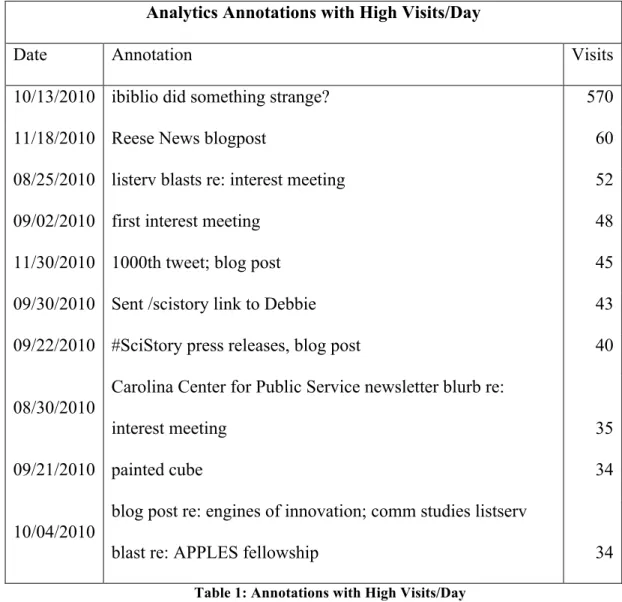
The tables below list the annotations for days with both the highest and lowest
numbers of visitors to the site. I did not make annotations every day. I only made them
when I felt an event was noteworthy. Therefore, these are not necessarily the heaviest and
least trafficked days overall, but only the heaviest and least trafficked days that were
Analytics Annotations with High Visits/Day
Date Annotation Visits
10/13/2010 ibiblio did something strange? 570
11/18/2010 Reese News blogpost 60
08/25/2010 listerv blasts re: interest meeting 52
09/02/2010 first interest meeting 48
11/30/2010 1000th tweet; blog post 45
09/30/2010 Sent /scistory link to Debbie 43
09/22/2010 #SciStory press releases, blog post 40
08/30/2010
Carolina Center for Public Service newsletter blurb re:
interest meeting 35
09/21/2010 painted cube 34
10/04/2010
blog post re: engines of innovation; comm studies listserv
blast re: APPLES fellowship 34
Table 1: Annotations with High Visits/Day
In Table 1, an anomaly is obvious, though difficult to explain. On October 13,
2010, there was a strange spike in visits to uncstorylab.org, 539 of which were referred to
by ibiblio.org. The Story Lab website was featured on the ibiblio homepage at that time,
but the visits had other characteristics which suggested that the visits may have been
automatically generated by a link-crawling bot. The reason for the next highest
annotation/visit was much more clear: it was related to a front-page scandal in which the
head of UNC School of Journalism’s experimental online news project reesenews.org
analyzing reesenews’ own
response to the scandal. The
scandal was national news, and
uncstorylab.org indexes well with
search engines, so it was not
surprising that the site earned many
visits that day. Also, as might be
expected, widespread email listserv
announcements and our large
general interest meeting were
effective drivers of website traffic.
New blog posts, advertised via
Twitter and Facebook, and
syndicated to subscribers via RSS, were
also high drivers of website traffic.
There were also some surprising visit-driving events. The “Debbie” mentioned
September 30 is my stepmother, and the link I sent her contains a video of an event for
which I served as moderator. It is likely that she was responsible for many of those visits,
although she may have also forwarded the link to other friends and relatives. Several days
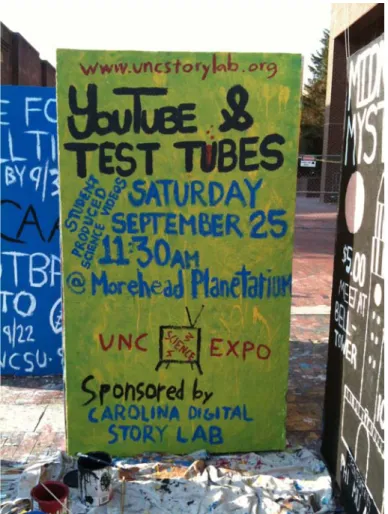
prior to that is the enigmatic annotation “painted cube.” This is a reference to a practice
that is a venerable advertising tradition for student groups at UNC. Near the student
union is a set of plywood cubes, the sides of which are painted by student groups to
for YouTube and Test Tubes. I was skeptical about the value of this practice, but it
appears that “painting a cube” may indeed be good website traffic driver (although I can
say with certainty that the advertisement did not convince many students to actually
attend the advertised event.)
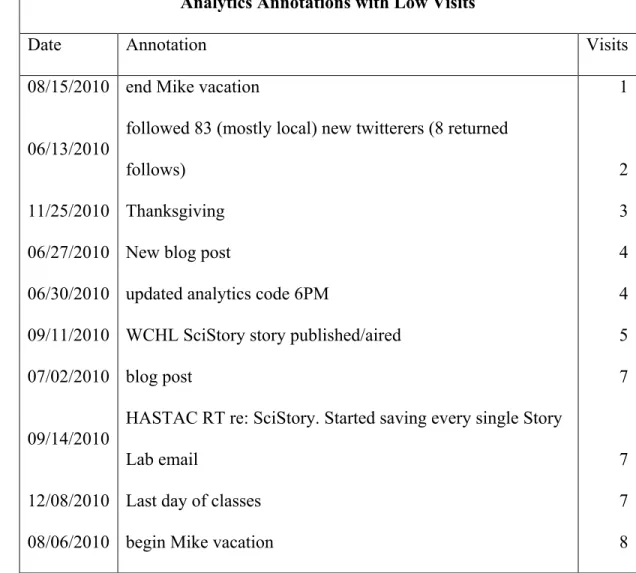
Table 2 illustrates some of the actions which had little effect on visits to the
website or that explained why there were few visitors. Following people on Twitter.com
was especially ineffective at generating visits to the website, even when those people
were also UNC community members. Also surprising was the small effect a local radio
station’s story had on website traffic. WCHL was the only local media news outlet to run
a story on YouTube and Test Tubes. It is difficult to say whether this generated
attendance at the event, but it did not seem to generate web traffic. Not surprising was the
effect that a vacation of mine had on the website. This was early in the website’s life and
daily traffic to the website primarily depended on some action by me, whether through
email, tweeting, or having a meeting with someone. When I was not doing any of those
things, traffic to the website dropped precipitously, indicating that it did not have a life of
Analytics Annotations with Low Visits
Date Annotation Visits
08/15/2010 end Mike vacation 1
06/13/2010
followed 83 (mostly local) new twitterers (8 returned
follows) 2
11/25/2010 Thanksgiving 3
06/27/2010 New blog post 4
06/30/2010 updated analytics code 6PM 4
09/11/2010 WCHL SciStory story published/aired 5
07/02/2010 blog post 7
09/14/2010
HASTAC RT re: SciStory. Started saving every single Story
Lab email 7
12/08/2010 Last day of classes 7
08/06/2010 begin Mike vacation 8
Table 2: Annotations with Low Visits
Interestingly, blog posts appear in both tables 1 and 2, perhaps indicating that there
are more variables at play that determine whether posts drive visits.
Meetings
Beginning in January, I kept a journal of every meeting that I had related to
Carolina Digital Story Lab or the Storymakers business plan. I recorded the date, the
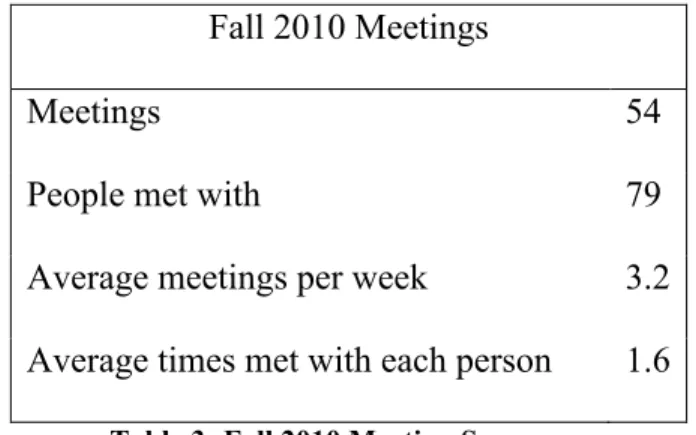
attendees of the meetings, and took notes about the topics of discussion. Fall 2010 was
the first full semester of the Carolina Digital Story Lab, and my meeting activity was
Fall 2010 Meetings
Meetings 54
People met with 79
Average meetings per week 3.2
Average times met with each person 1.6
Table 3: Fall 2010 Meeting Summary
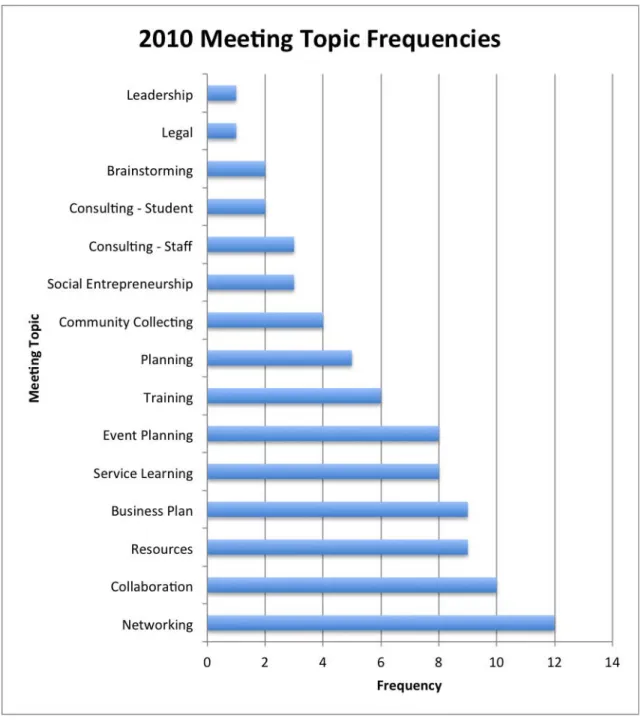
I coded each meeting with the predominant topic or activity of that meeting
(Figure 5). For meetings where more than one topic was discussed, the most prominent
topic was chosen as the representative topic for the meeting. In the graph below, I defined
Networking as a meeting initiated by either myself or another party in order to find out
more about each other’s interests and activities. Although it was the most popular
meeting topic, Networking meetings were the least productive. Only two of my twelve
Networking meetings eventually resulted in a working collaboration or product. The two
most frequent outcomes of Networking meetings were 1) an agreement to continue to talk
about ideas that were discussed or 2) the exchange of names of potential third party
collaborators. In the second outcome, a possible feedback loop is revealed. It was not
uncommon for the parties of unproductive Networking meetings to recommend talking to
Figure 4: Fall 2010 Meeting Topic Frequency, N=83
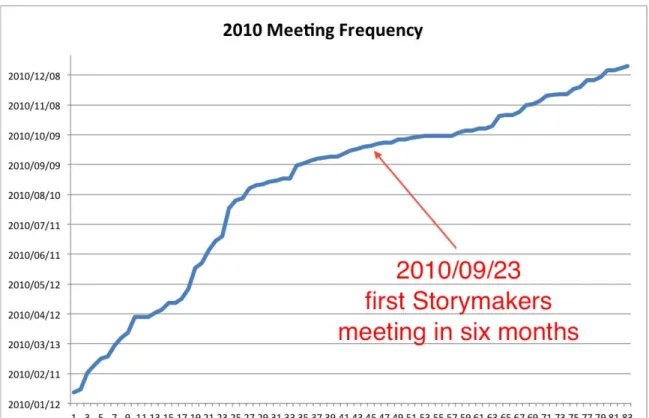
In my first and second semesters, I was fairly guarded in my disclosures of
dealings with both the Carolina Digital Story Lab and Digital Storymakers as I tried to
polish the ideas before wider disclosure. This changed during my third semester when I
found out how difficult it was to find collaborators. My meeting frequency increased as I
to August 22, but 54 meetings from August 23 (first day of the fall semester) to
December 31.
Figure 5: 2010 Meeting Frequency
During 2010, I had meetings regarding both Digital Storymakers and Carolina
Digital Story Lab. Storymakers meetings accounted for only 14 of the 83 meetings, and
seven of those meetings occurred before March 11. On March 19 I had my first Story Lab
related meeting and did not have another Storymakers meeting until September 23, six
months later. Clearly, I took my “prototyping” seriously, although it should also be noted
that during the first half of fall 2010, I was enrolled in a business school class called
Launch the Venture I (the first part of a year-long series of classes). Though I continued
few people outside the class. The lion’s share of my extracurricular time in 2010 was
devoted to starting and running a student group, not starting and running a business.
Personal Lessons Learned
Repeatedly throughout my entrepreneurial experiment, I heard people say that
college is a good place to try to start a business because of the supportive environment
and available resources. While this is true, I have found that advice from students who
have tried and fallen short of their goals is much more difficult to find than the rare
success stories that universities like to talk about. What follows is a list of some of the
lessons that I have learned through my experiences. I hope that students considering
launching a venture while attending a large research university will take these lessons
under advisement when planning their own ventures. While I have tried to generalize the
recommendations to be applicable to as many students as possible, the reader should use
the preceding narrative as a guide for the suitability of applying these reflections to one’s
own ambitions. Understanding the events that motivated these lessons will help the
reader adapt these realizations to individual circumstances.
Complexity makes communication difficult.
From the beginning, my ideas were complex. I often joke that I don’t have an
elevator pitch; I have a staircase pitch. When I think of a problem like poverty, I see
many different causes for such a problem. So when I envision solutions to problems with
complex causes, those solutions tend to have a lot of moving parts as well. I still believe
that an organization could exist that successfully marries “recommendation systems,
and object detection, data mining, and game design” to encourage community economic
development. However, I am quite sure that organization would not be pitchable venture.
While Google’s dazzling array of product offerings suggests that innovative companies
can be successful and complex at the same time, I do not imagine Google’s first investors
were enticed with the vision of a company that would offer dozens of information
products. It would have been nearly impossible to communicate that kind of complexity.
The complexity can come later, but the venture has to start as a small seed that can be
planted in the minds of others.
When challenged on the complexity of my ideas, I would often respond that
complex problems require complex solutions. Now I see that the truth of this statement is
almost irrelevant. I realize now that I will never be able to build a company big enough to
do all the things I want it to do if I cannot first build a company that does one thing that
other people think is valuable.
Over the last three years I have pursued many different aspects of this venture that
were interesting to me. It was incredibly educational. And I haven’t felt this creative
since back-to-back trips to the Odyssey of the Mind world finals in the 5th and 6th grade.
But the end result was that I spread myself too thin and failed to make coherent
arguments about the value of what I was proposing. Complexity was my enemy not
because the ideas I proposed were necessarily unworkable, but because their complexity
constantly impeded my communication with others on a day-to-day level. An example:
My student group’s name is so long that even people who are members of the group
The scope of my idea is baroque, and that has made it difficult to talk to others
about. In the last two years, I have started Digital Storymakers, LLC, the nonprofit
Digital Storymakers Foundation, and a student group called Carolina Digital Story Lab.
Those who are intimately familiar with my ideas have difficulty understanding what the
relationships and differences are among the three entities. Moving forward, my analysis
of the last three years strongly suggests that I distill the Digital Storymakers plan into the
most atomic structure I can.
Competitive advantage is second only to the value proposition.
I found the competitive advantage for my venture only after several iterations of
the idea. If I had investigated iRODS sooner, I might have been able to slow my constant
cycle of business plan synthesis and revision that made my communication efforts less
efficient. I also underestimated the persuasion power of a good competitive advantage.
Those Carolina Challenge judges who were familiar with iRODS immediately recognized
that as one of the stronger aspects of my plan.
A student group is an excellent way to not start a business.
My three original goals for the Story Lab were 1) to prove that I was capable of
leading a new organization 2) to build a prototype social archive site and community, and
3) address digital media needs in the UNC community. It is no surprise that I
accomplished all three of these student group goals and not the goal I set to be
self-employed after graduation: the starting and running a student group left no time for
anything else.
There is nothing I regret about starting Carolina Digital Story Lab. It has certainly